Systematic Review of the Surgical Treatment
of Trachoma Trichiasis
By
Mark Robinson
A Master's Paper submitted to the faculty of The University of North Carolina at Chapel Hill
In partial fulfillment of the requirements for The degree of Master of Public Health in
The Public Health Leadership Program.
Chapel Hill
Abstract
Aim
We conducted a systematic review to investigate which surgical
technique for treating trachomatous trichiasis resulted in the best surgical
outcomes, including success and adverse event rates.
Methods
To investigate success rates of different techniques, we limited our
search to clinical trials in trachoma endemic populations that included a
comparison group. We used internal validity criteria to assess the quality
of the randomized trials and discussed external validity based on the
aspects most relevant to the goal of treating large numbers of people in
trachoma endemic areas with non-ophthalmologist surgeons in community
settings. We also hand searched the literature to investigate whether
either of the most successful procedures were associated with more
adverse events than the other.
Results
Three randomized trials comparing two or more techniques provide
good evidence that the bilamellar tarsal rotation and tarsotomy (transverse
tarsotomy and rotation) are among the most effective surgical techniques
for trachomatous trichiasis and entropion. Two other randomized trials
provide evidence that the bilamellar tarsal rotation is equally successful
when performed by non-ophthalmologists as by ophthalmologists, and that
transverse tarsotomy and rotation is equally successful when performed
by ophthalmologists in a community setting as when
non-ophthalmologists perform it in a hospital setting. The one randomized trial
comparing bilamellar tarsal rotation and transverse tarsotomy and rotation
found that the former was associated with more adverse events than the
latter, but the other randomized trials and case series reported a wide
range of adverse event rates for both bilamellar tarsal rotation and
transverse tarsotomy and rotation.
Conclusions
The five randomized trials reviewed provide evidence that the
bilamellar tarsal rotation and the transverse tarsotomy and rotation are
among the most effective techniques for non-ophthalmologists correcting
trachomatous trichiasis and entropion. Randomized trials large enough to
analyze differences in adverse event rates between these two techniques
would help elucidate if one technique is superior to the other. Also, further
use and evaluation of clinical grading systems of trichiasis and entropion
may clarify whether recurrences of trichiasis and entropion result from
continued infection and progressive scarring or from errors in surgical
technique. Detailed clinical grading systems might also shed light on
whether certain surgical techniques are best suited for specific severities
of trichiasis or entropion.
I.
Background
Chlamydia trachomatis causes trachoma, the leading cause of
preventable blindness worldwide. Studies 1·2 within the last ten years
project that anywhere from three to six million people are blind from
trachoma. Also, for every case of blindness, 1.3 to 2.9 cases of
trachomatous low vision exist. Trachoma is endemic primarily in
impoverished, rural areas of developing nations, especially in
Sub-Saharan Africa, but also in parts of Central and South America, the Middle
East, Asia, and Australia. In some nations, such as the Gambia and
Morocco, trachomatous blindness has declined, probably because of
improved sanitation, education, and health care.3•4
Repeated trachomatous infections may cause scarring of the upper
tarsal conjunctivae. If this scar tissue contracts, the upper lid turns in
(entropion), pressing the eye lashes against the eyeball (trichiasis)5. The
lashes repeatedly brush against the cornea, eventually causing corneal
scarring and opacification. In addition to discomfort from the above
process, blindness results if the corneal opacification occurs over the
visual axis. A longitudinal study in the Gambia found that individuals with
trichiasis were eight times more likely than those with conjuctival scarring
alone to develop corneal opacity over a twelve-year period.6
In 1997, the World Health Organization began the Global
on four main strategies: surgery, antibiotics, facial cleanliness and
environmental hygiene, thus the acronym SAFE. Although the World
Health Organization intends the SAFE strategy ultimately to eradicate
trachoma, surgery remains the only intervention likely to prevent blindness
in those who already have trichiasis or entropion.
Controversy exists regarding which surgical techniques for
trachomatous trichiasis and entropion achieve the best outcomes. Many
procedures are available, and there is a pressing need to treat large
numbers of people with only minimal resources.7·8 Many countries have
developed cost-saving strategies such as training non-physician
ophthalmic workers to perform corrective surgeries Such workers usually
receive thorough training in one particular technique, so the success of
that technique is critical.
Although there are many reviews of the SAFE strategy and its
components,9-20 no previous reviews have systematically examined
outcomes of different surgical interventions for trichiasis and entropion.
We conducted a systematic review to assess which surgical technique
most effectively remedies trichiasis and entropion with the fewest
associated adverse events. In addition, we investigated whether the
literature presents one technique as the most accessible to
non-ophthalmologist surgeons.
II. Methods
Randomized Trials of Surgical Techniques
We searched Medline and Cochrane Database of systematic
reviews using the key words: "trachoma and trichiasis and surgery." We
limited our search to clinical trials published in the English language
between January 1950 and March 2004. We hand searched the
reference sections of the included articles to locate additional trials
meeting our criteria, but found none.
A primary and secondary reader evaluated every article retrieved
by the above search for inclusion in the analysis. To be included, studies
must have 1) performed a surgical intervention on the upper eyelid, 2)
addressed a patient population in which entropion/trichiasis results from
trachoma 3) included a comparison group (either control or other surgical
technique), and 4) assessed the outcome of such interventions at least 3
months after the intervention. We excluded studies if they were1) written
in a language other than English 2) case reports or case series 3)
non-human studies, and 4) review articles.
The Medline search yielded nine articles, five of which met the
selection criteria. Three21-23 did not examine surgical interventions and
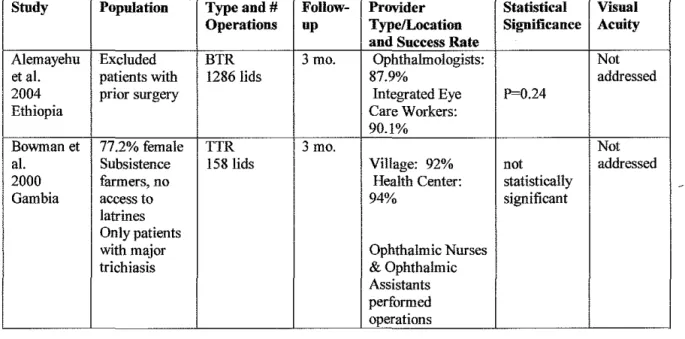
one24 did not include a comparison group. Table 1 summarizes the
selected randomized trials8·2s-28, including location, date, surgical
techniques, number of operations, provider type, length of follow-up,
success rate, and effect on visual acuity.
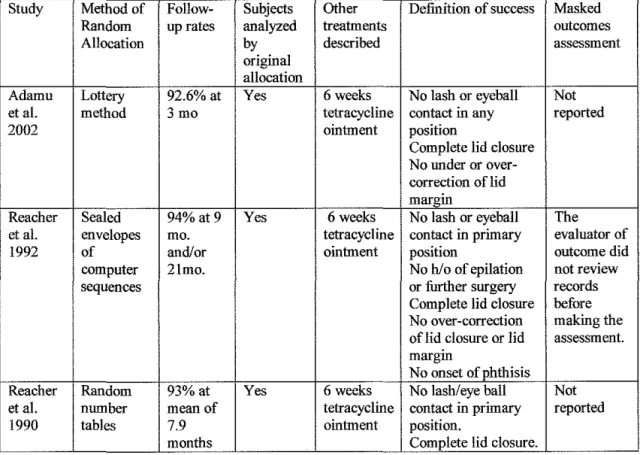
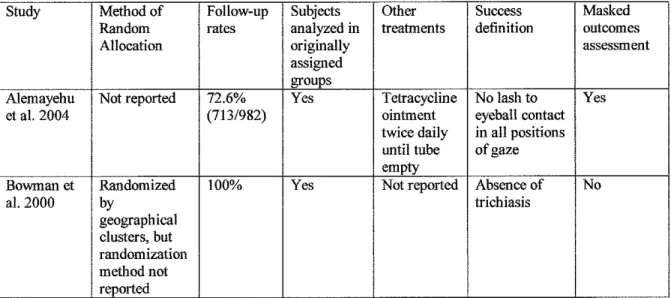
We assessed the internal validity of the randomized trials using the
following criteria: 1) adequacy of randomization, 2) intention to treat
analysis 3) concomitant treatments described (i.e. antibiotics) 4) drop-out
rates, 5) length of follow-up, 6) clear description of outcomes and 7)
masking of outcome assessment. We assessed external validity based on
subject demographics, provider type (surgeon, resident, ophthalmic
nurse/assistant), and practicality of performing surgical techniques in a
location with few resources. A study with strong external validity would
treat patients in a trachoma endemic area, employ ophthalmic assistants
rather than ophthalmologists, and perform the operations in community
settings.
Studies of adverse events
The initial search and analysis resulted in two surgical techniques,
bilamellar tarsal rotation and tarsotomy (transverse tarsotomy and
rotation), with apparently equal success rates, but perhaps with different
rates of adverse events. To collect more information on the adverse event
rates of these two techniques, we searched for case series that 1)
examined one of the two techniques: bilamellar tarsal rotation or
tarsotomy (or similar techniques), 2) treated the upper eyelid, 3)
addressed a patient population in which entropion/trichiasis results from
trachoma, and 4) gave a quantitative description of adverse events. We
excluded 1) non-English language studies, 2) single case reports, 3)
animal studies, and 4) review articles.
A Medline search for case series of "bilamellar tarsal rotation"
yielded no case series meeting the above criteria. A Medline search for
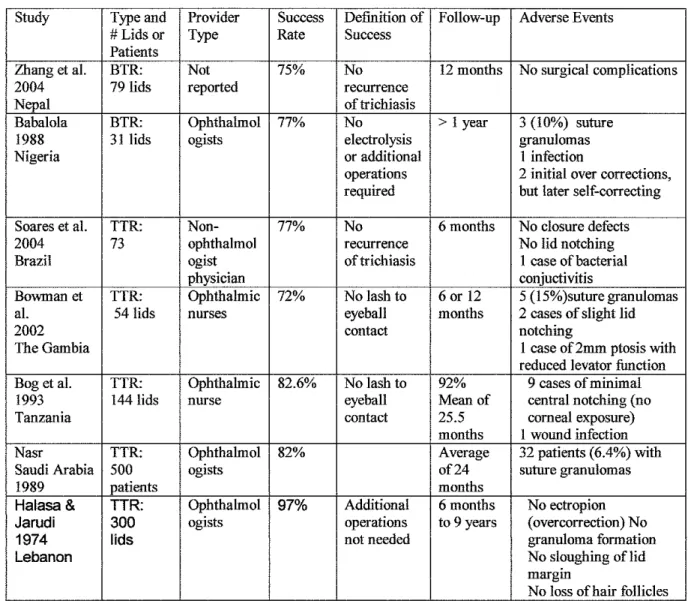
"tarsotomy" yielded one case series29 that met the above criteria. Hand
searches of the trials located by the first systematic search revealed two
case series for bilamellar tarsal rotation30·31 and five for tarsotomy7• 29•32-34
that reported adverse events(table 3). We did not assess internal and
external validity for these studies, because no case series could meet the
validity criteria. We did look at whether studies clearly defined adverse
events, so at least we would understand exactly what the studies meant
by the particular adverse events reported in that setting. Our goal was to
detect any overall pattern suggesting a difference in adverse events
Ill. Results
Randomized trials of surgical techniques
Three randomized trials25·27·28 directly compared the success rates
of two or more surgical techniques. The bilamellar tarsal rotation's (BTR)
success rate proved superior to all but one technique in the 1990 trial, all
techniques in the 1992 trial, and not significantly different than the success
rate of transverse tarsotomy and rotation (TTR) in the 2002 trial (table 1 a).
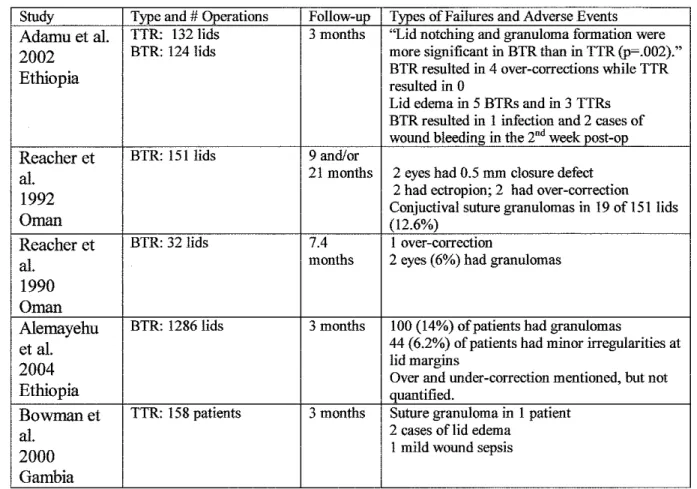
In addition, the 2002 randomized trial found that BTR had a significantly
(p=.002) higher rate of lid notching and pyogenic granulomas than did
TTR (table 3a).
In the first randomized trial in 1990, BTR proved superior to
eversion splinting, tarsal advance, and tarsal grooving, but not statistically
different than tarsal advance and rotation despite a 25% difference in
success rate because of the small numbers of patients involved. Although
this trial had small and uneven numbers in its treatment arms because the
randomization was not done in blocks, it is methodologically sound. The
authors did not report masking of outcome assessment in this study, yet
the substantial difference in success rates between techniques is unlikely
to result from evaluator bias alone. Also, with some techniques in that
study, the type of surgery would have been obvious, making masking
impossible.
In the second randomized trial in 1992, the authors assigned the
minor or major. Patients with minor trichiasis (<5 lashes touching the
eyeball) received BTR, electrolysis, or cryoablation. In minor trichiasis,
BTR's success rate of 80% was significantly higher than the rate of 29%
for electrolysis and 18% for cryoablation, with electrolysis and cryoablation
having failure rates 6.1 (95% confidence interval: 2.9-12.8) and 7.5
(3.6-15.4) times greater than that of BTR. In patients with major trichiasis (5 or
more lashes touching the eyeball) the authors compared BTR to the
technique (tarsal advance and rotation) from the previous trial that was not
statistically different than BTR. In this trial, tarsal advance and rotation
was about three times as likely to fail during the 9-21 month follow-up
period as BTR (Hazard of failure of 3.1, 95% confidence interval: 1.9-5.2).
The 1992 trial met all of this review's quality criteria for internal validity,
and presents strong evidence that BTR is superior to the other techniques
employed in the trial.
The 2002 trial also classified patients as either having minor or
major trichiasis and then compared the success rates of BTR to TTR
according to this clinical classification. In both minor and major trichiasis,
there was no statistically significant difference in success rates between
BTR and TTR. Unlike the previous two trials, this trial excluded patients
who had previous lid surgery, which may make the results more applicable
to populations without exposure to surgical treatment. The shorter
follow-up period (3 months) of this study and the lack of masked outcomes
assessment are weaknesses, yet overall the results of the study provide
reasonable evidence that the success rates of BTR and TTR are not
significantly different at 3 months. Also, masked outcomes assessment of
a study comparing BTR and TTR may not be possible as BTR involves an
incision through the skin of the upper eyelid and TTR does not. This study
also found that BTR resulted in pyogenic granulomas and lid notching
more often than TTR did (p=. 002), yet did not report the actual number of
occurrences of these adverse events, nor criteria for evaluating their
presence or severity.
Randomized trials of surgical providers and location
Of the other two randomized trials (table 1 b), one assessed
whether provider type, ophthalmologist versus ophthalmic assistant,
affected the success rate of the bilamellar tarsal rotation. This study8
found no significant difference in BTR success rates between
ophthalmologists and Integrated Eye Care Workers (P= .24) This trial was
large, masked the evaluators of outcome, and yet did not report its method
of randomization. Adequate randomization is one of the more significant
criteria for assessing the internal validity of a study because inadequate
randomization may allow selection bias to influence the results.
The other trial, which employed TTR, assessed whether location,
village or health center, resulted in a higher rate of surgical acceptance.26
Ophthalmic assistants or ophthalmic nurses performed the operation in
either setting, so this study does not help us detect a difference in success
rates between ophthalmologists performing TTR and ophthalmic
assistants performing them. Even so, this study contributes pertinent
information regarding the implication of surgical programs. It demonstrated
a trend towards increased surgical uptake in the community centers (20%
improvement, p=.15) and no significant difference in TTR surgical success
rates between the village and health center locations (92% and 94%,
respectively).
Adverse events associated with bilamellar tarsal rotation and
tarsotomy
As the current evidence does not demonstrate whether bilamellar
tarsal rotation or transverse tarsotomy and rotation is the most successful,
we examined the adverse event rates associated with BTR and TTR in the
above randomized trials (table 3a) and in case series (table 3b), to see if
one was consistently associated with more adverse events than the other.
As stated previously, the 2002 trial comparing BTR and TTR found that
BTR resulted in significantly more lid notching and pyogenic granulomas
in that study than did TTR (p=.002), but did not report the actual numbers
of adverse events. The specific occurrences of lid notching and pyogenic
granuloma would be helpful in determining the clinical significance of the
differences between BTR and TTR. The 2002 trial also reported that BTR
resulted in over corrections in 4 (3.2%) of 124 lids and that TTR resulted in
zero.
In the other four randomized trials, the studies did not compare
BTR and TTR directly. Therefore, because of differing re-infection rates,
cultural practices, environmental conditions, and surgical expertise among
different populations in different areas, the adverse event rates reported in
these trials can only provide a general overview of this issue. For these
reasons, we will consider the adverse event rates of BTR and TTR in
these four randomized trials along with the adverse event rates of two
case series of BTR and five of TTR.
In these randomized trials and case series the rates of pyogenic
granulomas for BTR ranged from 0% of 79 lids in a 2004 case series31 to
14% of 1286 lids in a randomized trial also conducted in 2004.81n the
randomized trials and case series reporting on TTR, the rates of pyogenic
granuloma spanned a similar range: from 0% of 300 lids in a 197 4 case
series29 and 0% of 1541ids in a 1993 case series7 to 15% of 34 lids in a
2002 case series. 33
Although lid notching was an adverse event associated with BTR in
the trial comparing BTR with TTR, it was not directly mentioned in the
other studies of BTR. Even so, similar adverse events associated with
BTR occurred in a 1992 randomized trial29 (lid closure defects in 1.5% of
151 lids) and in a 2004 trial8 (6.2% of 1286 lids had minor irregularities at
the lid margin). Other studies reported that TTR also is associated with lid
notching. A case series in 1993 found that TTR resulted in mild lid
notching (no corneal exposure) in 6.3% of 144 lids and another in 2002
found slight lid notching in 3.7% of 54 lids.7·33
Over corrections associated with BTR occurred in 2 (1.3%) of 151
lids in a 1992 randomized trial, 1 (3.1 %) of 32 lids in the 1990 randomized
trial, and 2 (6.5%) of 31 lids that later self-corrected in a 1988 case
IV.
Discussion
Findings
This systematic review of five randomized trials found higher
success rates for bilamellar tarsal rotation (upper-lid Wies35 or Ballen36)
and transverse tarsotomy and rotation (marginal rotation procedure by a
posterior approach32 or posterior tarsotomy34 or Ewing37) compared to
other corrective surgical techniques for trichiasis. However, evidence is
inconclusive regarding superiority of BTR versus TTR. In addition, data
on adverse events from the included five randomized trials and the five
case series presents a mixed picture of whether one of the techniques is
associated with more adverse events than the other. Moreover, the
clinical relevance of the two adverse events (pyogenic granuloma and lid
notching) associated more frequently with BTR than TTR in the 2002 trial
warrants further discussion.
As the performance of this operation in the communities where it is
needed is important to its acceptance, the practicality of performing the
operation in outpatient, temporary conditions is important. Two of the
above randomized trials address this issue and both BTR and TTR appear
effective in community settings with non-ophthalmologist surgeons.8•26 In
addition, both the BTR and TTR are relatively simple to perform with little
Internal Validity
Even with the relatively few patients in each of the treatment arms
of the 1990 randomized trial, the study demonstrated BTR's superior
success rates when compared to eversion splinting, tarsal advance (lid
split), and tarsal grooving. That is, the differences in success rates
between BTR and the other techniques in the study were large enough
that they were apparent even with treatment groups of about thirty lids
each. The 1992 trial comparing BTR with electrolysis, cryoablation, and
tarsal advance and rotation provides good evidence that BTR results in
superior success rates than these other methods do. With respect to the
results from the 1990 and 1992 randomized trials, no further need exists
for research of the other techniques present in those trials, as we may
reasonably conclude that BTR is superior. Unless of course, other experts
in the field would modify the application of the surgical methods included
in those trials, as is the case with a recent case series38 published in May,
2004. This study reported good results with a combined method of the
modified tarsal wedge resection and the eversion splinting-grey line
incision. Without a trial of this method including a comparison group,
however, it is difficult to make conclusions about its success rate
compared with other techniques.
The 2002 randomized trial suggesting equality between BTR and
TTR has two weaknesses, a relatively short follow up period of three
months, and a lack of masked outcomes assessment. Studies27•31 have
reported significant recurrence rates after a period of three months,
although such recurrences may result from continued scarring rather than
any deficit in surgical technique. Even so, a longer follow-up period would
be ideal.
As mentioned previously, performing a masked outcomes
assessment of BTR and TTR is difficult because BTR involves an incision
through the skin of the upper eyelid and TTR does not. Therefore,
masking the evaluators of surgical success would be difficult, as BTR may
leave a scar that is visible when the eye is closed. The complete closure
of the lid as in sleep is a desired outcome after a lid operation and it would
therefore be difficult to avoid seeing a visible scar on the closed lid during
the evaluation process.
Each of the randomized trials clearly defined success as no lashes
touching the lid either in any position or in the primary position of gaze.
These definitions are clearer and more reproducible than certain case
series that simply reported failures as those lids that needed repeat
surgery. Although the above definitions are clear, they are strict and may
count as failures lashes that touch the eye only peripherally. Peripheral
lashes brushing against the eyeball would still cause discomfort and
peripheral scarring but might not increase the likelihood of blindness
resulting from scarring over the pupil.
External Validity
The three randomized trials that directly compared surgical
techniques employed either ophthalmologists or second year
ophthalmology residents. As non-ophthalmologists may perform many of
the operations in the future, studies that employ them to determine the
success rates of surgical techniques may have greater applicability than
studies that employ ophthalmologists do.
The randomized trial that addressed this issue compared
ophthalmologists to integrated eye care workers and found no significant
difference in the success rates of BTR between these two. Therefore, the
importance of having non-ophthalmologist surgeons participate in trials
comparing different techniques may be less critical for future trials. On the
other hand, although a trial exists demonstrating BTR to be equivalent
when performed by ophthalmic assistants and ophthalmologists, perhaps
other techniques do not have equivalent success rates between provider
types. Also, training non-ophthalmologist surgeons in different techniques
in a single study may help elucidate which technique is the simplest to
teach. Although the success rates of TTR between ophthalmologists and
ophthalmic assistants has not been directly compared, the randomized
trial that conducted TTR in community or health center locations found
good and similar success rates between non-ophthalmologist surgeons in
both areas. 26
The randomized triaf5 comparing BTR and TTR excluded those
who previously had surgery, making its results more applicable to
populations that have not yet been exposed to surgery. This is a
weakness of this study if most endemic populations have already received
surgery, but if the opposite were true, it would be a strength.
All five of the randomized trials occurred in places where trachoma
is endemic, an important component to ensure applicability to performing
surgery in other trachoma endemic areas. With respect to eliminating
trachoma, Melese and coworkers39 argue that trials of interventions for
trachoma should occur in the hyper-endemic areas, for these areas are
where trachoma interventions critically need to work. In the same vein,
surgical techniques that prove successful in hyper-endemic areas are
more likely to prove successful in other areas as well.
Surgical Failures
A key question with respect to surgical success rates is whether
failures occur because of progressive scarring resulting from trachoma or
because of poor or inadequate surgery.40 A recent prospective
case-control cohort study31 found that active chlamydia! infection (as defined by
clinical observation) at 6 months after an operation predicted recurrence of
trichiasis at 12 months, lending support to the theory that progressive
scarring is at least in part a cause of recurrent trichiasis. The diagnosis of
active trachoma, however, does not always correlate with chlamydia!
infection.41 Also, chlamydia! infections are frequently present with few
clinical signs of disease.42·43 Further research might examine whether
clinical evidence of disease or laboratory evidence of chlamydia best
predicts surgical failures and what we can do to help people in such cases
(perhaps alternative antibiotic regimens or particular surgical techniques).
On the other hand, Soares and Cruz28 suggest that improper
surgical technique may lead to recurrence of trichiasis. In their case
series, recurrences of trichiasis after the posterior tarsotomy procedure
were always lateral or medial to the cornea. They propose that two
surgical errors may have caused this segmental trichiasis: 1) the tarsal
incision did not involve the entire tarsal plate, or 2) the tarsal incision was
not parallel to the lid margin, resulting in uneven lid eversion. Me lese and
co-workers44 also suggest that surgeons may not extend the incision and
stitches far enough medially and laterally to prevent recurrences in these
areas of the lid margin. Perhaps grading of the surgical technique (length
of incision, consistent distance from the lid margin, appropriate placement
of stitches) at the time of surgery and recording location of trichiasis
recurrence would provide a connection between recurrences of trichiasis
and surgical technique. Also, Taylor suggests that the elapsed time
between the operation and surgical failure would help elucidate the cause
of recurrence.40
Clinical Classification of Trichiasis and Entropion
Another aspect of the trials relating to success rates is the clinical
grading of the severity of trichiasis or entropion before surgery. In the
1992 randomized trial, patients with major trichiasis undergoing surgery
had a statistically significant improvement in visual acuity after nine
months, whereas those with minor trichiasis before surgery did nol.27 The
2004 trial comparing ophthalmologists to integrated eye care workers
employed the clinical classifications of Melese and coworkers44 and found
increased recurrence rates associated with patients who had more severe
degrees of trichiasis or entropion at baseline (p<.001 ). Melese and
coworkers classification scheme is detailed and their specific clinical
criteria may help determine which surgical techniques are best for which
conditions and levels of severity.
Certain ophthalmologisls30•34 proposed that surgeons should
choose the surgical technique to match the severity of entropion or
trichiasis to achieve good results. Others have suggested that TTR was
successful and simple enough to almost always be the procedure of
choice for the initial operalion45 This theory of certain techniques being
appropriate for differing severities has never been tested in a randomized
trial. Even so, the current techniques have significant failure rates as lime
progresses and any clinical information, such as Melese and coworker's
classification scheme,44 that would help predict which eyes may need
more complicated and successful surgical techniques, would be helpful.
Adverse Events
The only direct evidence that TTR results in fewer adverse events
than BTR comes from the 2002 randomized trial comparing the two
techniques.25 Although the difference was statistically significant (p=.002),
the study did not report the actual numbers of pyogenic granulomas and
cases of lid notching. Also, the applicability of these results may depend
upon clinical features of the population and the surgical technique. That
is, perhaps TTR is better suited for this population or the surgeons are
more familiar with it than with BTR. That being said, in that particular
setting, TTR resulted in fewer pyogenic granulomas and cases of lid
notching than did BTR.
The other randomized trials and case series present a mixed
picture of the adverse events associated with the two procedures, ranging
from no complications in both procedures, to pyogenic granulomas
occurring in over 10% and lid abnormalities in about 6% of the study
populations for both BTR and TTR. We cannot assess whether
differences in severity of adverse events existed between BTR and TTR
cases because these studies did not include a clinical scale for grading
the severity of adverse events.
Nasr34 reported that pyogenic granulomas occurred with posterior
tarsotomies but not anterior tarsotomies, suggesting that suture to
conjunctivae contact predisposes eyelids to this problem. If suture to
conjunctivae contact were indeed the cause, then we would expect rates
of pyogenic granulomas to be about the same in BTR and TTR as both
involve suture to conjunctivae contact. Reacher and coworkers27
suggested that granuloma formation might be reduced with more
absorbable sutures and their routine removal after the seventh
postoperative day.
The clinical significance of pyogenic granulomas and lid notching
that does not expose the cornea warrants further discussion. Although
pyogenic granulomas are easily excised and mild lid notching may not
result in corneal damage, these adverse events may decrease surgical
acceptance. Surgical acceptance is already low in many communities
where trachoma is endemic46-51 and pyogenic granulomas requiring
corrective procedures and even slight lid deformities may increase the
barriers to gaining a community's trust.
One pattern that did emerge from an examination of the
randomized trials and case series was that BTR was associated with over
corrections, whereas no one reported this adverse event for TTR.
Alemayehu and coworkers8 reported that over corrections were repaired
within the first week after the initial operation, yet they did not report the
numbers of BTR requiring additional surgery. Perhaps they view over
corrections as a failure on behalf of the surgeon rather than a failure of the
technique itself. Even so, if BTR has a propensity to over correction, in
addition to the time and cost of repeat surgeries, this adverse event might
discourage others from accepting surgery. On the other hand, one case
series30 found that the two over corrections occurring following BTR were
later self-correcting and Soares and Cruz32 suggest that slight initial over
corrections (with the TTR, at least) may reduce the incidence of
recurrence of trichiasis.
Conclusion
The five randomized trials reviewed provide evidence that the
bilamellar tarsal rotation and the transverse tarsotomy and rotation are
among the most effective procedures for correcting trachomatous
trichiasis and entropion. Given the positive results of both BTR and TTR,
future research should include randomized trials with the power to analyze
adverse event rates. Trials should define the adverse events ahead of
time and attempt to develop clinically meaningful scales of their severity.
Also, integrated eye care workers should perform the operations
after learning one of the above techniques, to simulate the real world
implementation of reaching many people with non-ophthalmologist
surgeons. The ease with which each technique is learned to achieve a
satisfactory success rate would also be an important outcome of future
trials. The education of equally experienced non-ophthalmologist
surgeons during the trial period would help ensure that some of them are
not already more familiar with one technique than the other.
Further use and evaluation of Melese and co-worker's modified
grading system for trichiasis and entropion44, or the development of other
clinically meaningful grading systems, might help elucidate whether
certain procedures work best for certain conditions or levels of severity.
Also, classifying where the recurrences occurred on the lid margin
(medial, central, lateral) may help elucidate whether imperfect surgical
technique contributed to the failure, as discussed above.
References
1. Thylefors B, Negrel AD, Pararajasegaram R, Dadzie KY, Global data on blindness. Bulletin of the World Health Organization 1995; 73:115-121.
2. Ranson MK, Evans TG. The global burden of trachomatous visual impairment: I. Assessing prevalence. International Ophthalmology. 1996; 19:261-70.
3. Dolin PJ, Faal H, Johnson GJ, Ajewole J, Mohamed AA, Lee PS. Trachoma in the Gambia. British Journal of Ophthalmology.
1998;82:930-33.
4. Ferriman, A. Blinding trachoma almost eliminated from Morocco.
British Medical Journal. 2001; 323:1387.
5. ai-Rajhi AA, Hidayat A, Nasr A, ai-Faran M. The histopathology and the mechanism of entropion in patients with trachoma.
Ophthalmology. 1993 Sep;100(9):1293-6.
6. Bowman RJC, Jatta B, Cham B, Bailey RL, Fall H, Myatt M, Foster A, and Johnson GJ. Natural History of Trachomatous Scarring in The Gambia: results of a 12-year longitudinal follow-up. Ophthalmology 2001; 108:2219-24.
7. Bog H, Yorston D, Foster A. Results of community-based eyelid surgery for trichiasis due to trachoma. British Journal of Ophthalmology 1993; 77:81-83.
8. Alemayehu W, Melese M, Bejiga A, Alemayehu W, Kebede W, Demeke F. Surgery for trichiasis by ophthalmologists versus integrated eye care workers. Ophthalmology. 2004; 111 :578-584.
9. West, S. Blinding Trachoma: Prevention with the Safe Strategy. American Journal ofTropical Medicine and Hygiene. 2003; 69:18-23. 10. Mabey D, Solomon A, Foster A. Trachoma. The Lancet. 2003; 362:223-229.
11. Kuper H, Solomon A, Buchan J, Zondervan M, Foster A, Mabey D. A critical review of the SAFE stratedgy for the prevention of blinding trachoma. The Lancet Infectious Diseases 2003; 3:372-381.
12. Kuper H, Buchan JC, Foster A. Time to learn from what is known.
British Journal of Ophthalmology. 2004;88: 156
13. Bailey R, Lietman T. The SAFE strategy ofr the elimination of trachoma by 2020: will it work? Bulletin of the World Health Organization. 2001; 79:233-236.
14. Emerson PM, Cairncross S, Bailey RL, Mabey DCW. Review of the evidence base for the 'F' and 'E' components of the SAFE stratedgy for trachoma control. Tropical Medicine and International Health. 2000; 5:515-527.
15. Kumaresan JA, Mecaskey JW. The global elimination of blinding trachoma: progress and promise. American Journal of Tropical Medicine
16. Mecaskey JW, Knirsch CA, Kumaresan JA, Cook JA The
possibility of eliminating blinding trachoma. Lancet Infectious Disease. 2003 Nov;3(11 ):728-34. Review.
17. Schachter J, Dawson CR. Elimination of blinding trachoma.
Current Opinion in Infectious Disease. 2002 Oct; 15(5):491-5. Review. 18. Emerson PM, Lindsay SW, Walraven GEL, Faal H, Bogh C, Lowe K, Bailey RL Effect of fly control on trachoma and diarrhoea. The Lancet. 1999:353:1401-1403
19. Emerson PM, Lindsay SW, Alexander N, Bah M, Dibba S, Faal HB, Lowe KO, McAdam KPWJ, Ratcliffe AA, Walraven GEL, Bailey RL Role of flies and provision of latrines in trachoma control: cluster-randomised controlled trial. The Lancet. 2004;363:1093-1098
20. Bailey R, Downes B, Downes R, Mabey D. Trachoma and water use. A case control study in a Gambian village. Transactions of the Royal
Society of Tropical Medicine and Hygiene. 85:824-828.
21. Graz B, Xu JM, Yao ZS, Han SR, Kok A Trachoma: can trichiasis be treated with a sticking-plaster? A randomized clinical trial in China.
Tropical Medicine and International Health. 1999 Mar;4(3):222-8. 22. Limburg H, Bah M, Johnson GJ. Trial of the Trachoma Rapid Assessment methodology in The Gambia. Ophthalmic Epidemiology. 2001 Jul;8(2-3):73-85.
23. Frick KD, Keuffel ER, Bowman RJ. Epidemiological, demographic, and economic analyses: measurement of the value of trichiasis surgery in The Gambia. Ophthalmic Epidemiology. 2001 Jul;8(2-3):191-201.
24. Unlu K, Aksunger A, Saker S, Karana C, Bilek K. Prospective evaluation of the argon laser treatment of trachomatous trichiasis.
Japanese Journal of Ophthalmology. 2000 Nov-Dec;44(6):677-9.
25. Adamu Y, Alemayehu W. A randomized clinical trial of the success rates of bilamellar tarsal rotation and tarsotomy for upper eyelid
trachomatous trichiasis. Ethiopian Medical Journal2002; 40:107-114. 26. Bowman RJ, Soma OS, Alexander N, et al. Should trichiasis surgery be offered in the village? A community randomized trial of village vs. health centre-based surgery. Tropical Medicine and International
Health 2000; 5:528-33.
27. Reacher MH, Munoz B, Alghassany A, Daar AS, Elbualy M, Taylor HR. A controlled trial of surgery for trachomatous trichiasis of the upper lid. Archives of Ophthalmology. 1992; 110:667-74.
28. Reacher MH, Huber MJE, Canagaratnam R, Alghassany A A trial of surgery for trichiasis of the upper lid from trachoma. British Journal of
Ophthalmology. 1990; 7 4:109-113.
29. Halasa AH, Jarudi N. Tarsotomy for the correction of cicatricial entropion. Annals of Ophthalmology. 197 4 Aug;6(8):837 -40.
30. Babalola OE. Correction of Trachomatous Entropion/Trichiasis in Dad una: an Assessment of Two Simplified Methods. East African Medical
Journal. 1988;65:525-31.
31. Zhang H, Kandel RP, Sharma B, Dean D. Risk Factors for Recurrence of Postoperative Trichiasis. Archives of Ophthalmology. 2004;122:511-516.
32. Soares OE, Cruz AAV. Community-based transconjunctival marginal rotation for cicatricial trachoma in Indians from the Upper Rio Negro basin. Brazilian Journal of Medical and Biological Research. 2004. 37:669-674.
33. Bowman RJC, Faal H, Myatt M, Adegbola R, Foster A, Johnson GJ, Bailey RJ. Longitudinal study of trachomatous trichiasis in the Gambia. British Journal of Ophthalmology. 2002;86:339-343. 34. Nasr AM. Eyelid Complications in Trachoma I. Cicatricial Entropion. Ophthalmic Surgery. 1989; 20:800-807.
35. Wies FA. Spastic entropion. Transactions of the American Academy of Ophthalmology and Otolaryngology. 1955;59:503-506. 36. Ballen PH. A simple procedure for the relief of trichiasis and
entropion of the upper lid. Archives of Ophthalmology. 1964;72:239-240. 37. Ewing LE. An operation for atrophic (cicatricial) entropion of the lower eyelid. American Journal of Ophthalmology. 1903;20:39-40. 38. Bujger Z, Cerovski B, Kovacevic S, Nasic M, Pokupec R, Tojagic M. A contribution to the surgery of the trachomatous entropion and trichiasis. Ophthalmologica. 2004 May-Jun;218(3):214-8.
39. Melese M, Alemayehu W, Gaynor B, Yi E, Whitcher JP, Lietman TM. What more is there to learn about trachoma? British Journal of
Ophthalmology. 2003;87:521-2.
40. Taylor HR. Trachoma and recurrent trichiasis. British Journal of
Ophthalmology 2002; 86:831-832.
41. Bird M, Dawson C, Schachter J, Yinghui M, Shama A, Osman A, Bassem A, Lietman T. Does the Diagnosis of Trachoma Adequately Identify Ocular Chamydial Infection in Trachoma-Endemic Areas? The
Journal of Infectious Diseases. 2003; 187:1669-73
42. Taylor HR, Rapoza PA, WestS, Johnson S, Muno B, Katala S. The epidemiology of infection in trachoma. Investigative Ophthalmology
and Visual Science. 1989; 30:1823-33.
43. Bobo LD, Novak N, Munoz B, Hsieh YH, Quinn TC, West S. Severe disease in children with trachoma is associated with persistent chlamydia trachomatis infection. Journal of Infectious Disease. 1997; 176:1524-30.
44. Melese M, Alemayehu W, Bejiga A, Adamu Y, Worku A. Modified grading system of upper eyelid trachomatous trichiasis. Ophthalmic
Epidemiology. 2003;10:75-80.
45. Kersten, RC. Tarsotomy for the treatment of cicatricial entropion with trichiasis. Archives of Ophthalmology. 1992 May; 11 0(5):714-7. 46. Bowman RJC, Jatta B, Faal H, Bailey R, Foster A, Johnson GJ. Long-term follow-up of lid surgery for trichiasis in the Gambia: surgical success and patient perceptions. Eye. 2000;14:864-868.
47. Courtright P. Acceptance of surgery for trichiasis among rural Malawian women. East African Medical Journal. 1994; 71:803-4. 48. WestS, Lynch M, Munoz B, Katala S, Tobin S, Mmbaga BBO. Predicting surgical compliance in a cohort of women with trichiasis.
International Ophthalmology. 1994; 18:105-9.
49. Oliva MS, Munoz B, Lynch M, Mkocha H, West SK. Evaluation of barriers to surgical compliance in the treatment of trachoma. International
Ophthalmology. 1998; 21:235-41
50. Rabiu MM, Ablose A Magnitude of trachoma and barriers to
uptake of lid surgery in a rural community of northern Nigeria. Ophthalmic·
Epidemiology. 2001 ;8:181-90.
51. Bowman RJ, Faal H, Jatta B, Myatt M, Foster A, Johnson GJ, Bailey RL. Longitudinal study of trachomatous trichiasis in the Gambia: barriers to acceptance of surgery. Investigative Ophthalmology and Visual
Science. 2002; 43:936-40.
1a.
Randomized Trials of Surgical TechniquesStudy Population Type and# Provider Follow- Success Statistical Visual Operations Type up Rate Significance Acuity Adamu et 77.3% female BTR (115) 3 mo. Minor: Trend towards a!. mean age: Vs. 2nd year BTR: 86.1% improvement
2002 40.7 years TTR(l22) ophthalmology TTR: 95.1% P~0.686 ~~in all
Ethiopia Excluded resideots Major: categories"
patients with BTR:86.0% r~.0515
former upper TTR: 84.0% P~0.286
lid surgery
Reacher 75.5% female 9-21 Hazard of
eta!. mean age: Minor: Ophthalrn- mo. Minor: Failure** Minor: 1992 54.7 years BTR (52) ologists BTR: 80%
--
No significant Oman Electro (57) Electr: 29% 6.1, 2.9-12.8 improvementCryo (57) Cryo: 18% 7.5, 3.6-15.4
Major: Major: Major: Improvement BTR (98) BTR: 77% -- of half a line of TAR (101) TAR: 41% 3.1, 1.9-5.2 Snellen in both
methods P<.001 Reacher Age and sex BTR (41)
*
7.4 mo. 71%eta!. not reported TAR(24) Ophthalrn- 8.8mo. 46% P>.05 Not addressed 1990 Pregnant ES (24) o1ogists 8.7mo. 29% P<.01
Oman women TA (41) 7.5mo. 27% P<.001 excluded TG (35) 7.7mo. II% P<.001
*Blockmg procedure not used dunng random1zat1on, thus the unequal s1zes of groups m th1s study ** Relative Hazard of Failure as compared to the bilamellar tarsal rotation with 95% confidence intervals.
BTR: Bilamelar Tarsal Rotation on globe)
TTR: Transverse Tarsotomy and Rotation on globe)
TAR: Tarsal Advance and Rotation ES: Eversion Splinting
TA: Tarsal Advance (lid split) TG: Tarsal Grooving
Minor: Minor Trichiasis ( <5 lashes
Major: Major Trichiasis (>5 lashes
mo: months
Table 1 b. Randomized Trials of Provider Type or Location
Study Population Type and# Follow- Provider Statistical Visual Operations up Type/Location Significance Acuity
and Success Rate
Alemayehu Excluded BTR 3mo. Ophthalmologists: Not
et al. patients with 1286 lids 87.9% addressed 2004 pnor surgery Integrated Eye !>=0.24
Ethiopia Care Workers: 90.1%
Bowman et 77.2% female TTR 3mo. Not al. Subsistence 158 lids Village: 92% not addressed 2000 farmers, no Health Center: statistically
Gambia access to 94% significant latrines
Only patients
with major Ophthalmic Nurses trichiasis & Ophthalmic
Assistants performed operations
Table 2a. Internal Validity of Randomized Trials of Surgical Techniques
Study Method of Follow· Subjects Other Definition of success Random up rates analyzed treatments
Allocation by described original
allocation
Adamu Lottery 92.6% at Yes 6 weeks No lash or eyeball et al. method 3 mo tetracycline contact in any
2002 ointtnent position
Complete lid closure No under or over-correction oflid margin
Reacher Sealed 94% at 9 Yes 6 weeks No lash or eyeball et al. envelopes mo. tetracycline contact in primary 1992 of and/or ointtnent position
computer 21mo. No h/o of epilation
sequences or further surgery Complete lid closure
No over-correction
of lid closure or lid margm
No onset of phthisis Reacher Random 93%at Yes 6 weeks No lash/eye ball et al. number mean of tetracycline contact in primary 1990 tables 7.9 ointtnent position.
months Complete lid closure.
Table 2b. Internal Validity of Randomized Trials of Provider Type or Location With Respect to Surgical Outcomes
Study Method of Follow-up Subjects Other Success Masked Random rates analyzed in treatments definition outcomes
Allocation originally assessment
assigned groups
Alemayehu Not reported 72.6% Yes Tetracycline No lash to Yes et al. 2004 (713/982) ointment eyeball contact
twice daily in all positions until tube of gaze empty
Bowman et Randomized 100% Yes Not reported Absence of No
al. 2000 by trichiasis
geographical clusters, but
randomization
method not reported
Table 3a: Adverse Events of BTR and TTR in Randomized Trials
Study Type and # Operations Follow-up Types of Failures and Adverse Events
Adamuet a!. TTR: 132 lids 3 months "Lid notching and granuloma formation were
2002
BTR: 124 lids more significant in BTR than in TTR (p~.002)."Ethiopia resulted in 0 BTR resulted in 4 over-corrections while TTR
Lid edema in 5 BTRs and in 3 TTRs BTR resulted in 1 infection and 2 cases of wound bleeding in the 2"d week post-op
Reacher et BTR: 15llids 9 and/or
a!. 21 months 2 eyes had 0.5 mm closure defect
1992
Conjuctival suture granulomas in 19 of 151 lids 2 had ectropion; 2 had over-correctionOman (12.6%)
Reacher et BTR: 32lids 7.4 1 over-correction
a!. months 2 eyes ( 6%) had granulomas
1990
Oman
Alemayehu BTR: 1286lids 3 months 100 (14%) of patients had granulomas
eta!. 44 (6.2%) of patients had minor irregularities at
2004
Over and under-correction mentioned, but not lid marginsEthiopia quantified.
Bowmanet TTR: 158 patients 3 months Suture granuloma in I patient
a!. 2 cases oflid edema
2000
I mild wound sepsisGambia
BTR: Bilamellar Tarsal Rotation
Table 3b: Case series and adverse events
Study Type and Provider Success Definition of Follow-up Adverse Events #Lids or Type Rate Success
Patients
Zhang et al. BTR: Not 75% No 12 months No surgical complications 2004 79 lids reported recurrence
Nepal of trichiasis
Babalola BTR: Ophthahnol 77% No > 1 year 3 (10%) suture 1988 31 lids ogists electrolysis granulomas Nigeria or additional 1 infection
operations 2 initial over corrections,
required but later self-correcting Soares et al. TTR: Non- 77% No 6 months No closure defects 2004 73 ophthalmol recurrence No lid notching Brazil ogist of trichiasis I case of bacterial
physician conjuctivitis
Bowman et TTR: Ophthalmic 72% No lash to 6 or 12 5 (15%)suture granulomas al. 54 lids nurses eyeball months 2 cases of slight lid
2002 contact notching
The Gambia I case of2mm ptosis with reduced levator fimction Bog et al. TTR: Ophthahnic 82.6% No lash to 92% 9 cases of minimal 1993 144lids nurse eyeball Mean of central notching (no
Tanzania contact 25.5 corneal exposure)
months I wound infection Nasr TTR: Ophthahnol 82% Average 32 patients (6.4%) with Saudi Arabia 500 ogists of24 suture granulomas 1989 patients months
Halasa& TTR: Ophthahnol 97% Additional 6 months No ectropion
Jarudi 300 ogists operations to 9 years (overcorrection) No
1974 lids not needed granuloma formation
Lebanon No sloughing oflid
margin
No loss of hair follicles
BTR: Bilamellar Tarsal Rotation
TTR: Transverse Tarsotomy and Rotation