Islamic Republic ofIran
NOVEL REAGENTS FOR CREATINE KINASE
MAHMOUD AMINLARI, HABIB FIROOZABADI*
AND ORLI SIMOZAR*
From the Department a/Biochemistry, School a/Veterinary Medicine, and the *Department a/Chemistry, Shiraz University, Shiraz, Islamic Republic of Iran.
ABSTRACT
The purpose of this investigation was to develop a simple colorimetric method for creatine kinase (CK). The new method is based on the reaction of creatine, formed enzymatically from creatine phosphate and ADP, with different glyoxal compounds. Hydrated glyoxals, such as para-nitrophenyl, 2-thiophene, 4-biphenyl, 4, 4' -biphenyl, a-naphthyl,
f3
-naphthyl, para-chlorophenyl, and styryl were synthesized and allowed to react with creatine. Among the glyoxals, the 2-thiophene derivative was the best in terms of the stability and intensity of the colored complex which was produced under mild alkaline conditions. The complex absorbed maximally at 460 nm with an extinction coefficient of 1.56x 1 04 M-I Cm-I. This reagent was used to determine CK in the sera of normal human beings and patients with myocardial infarction. The results obtained were in agreement with those obtained by another available method for CK. However, this new method is simple, less time consuming and employs a single reagent for color development. Such a simple method might be of value in clinical laboratories with little access to sophisticated instruments such as auto analyzers and spectropho tometers.Keywords: Creatine kinase, reagents, colorimetry MJIRI, Vol. 10, No.4, 299-304,1997.
Winter 1375 February 1997
INTRODUCTION
Creatine kinase (CK) (A TP: creatine phospho transferase,
EC 2.7.3.2) catalyzes the reversible reactioJ1:
groups on the glyoxals, it might be possible to obtain a colored product when glyoxals are allowed to react with
creatine. This reaction can be employed for determination
ofCK.
Creatine phosphate + ADP � creatine + ATP
Several reports indicate that dicarbonyl reagents, such as glyoxals, react with guanidino group-containing com pounds.'-5 By varying the properties of the substituted
Correspondence should be addressed to:
M. Aminlari, Depatment of Biochemistry, School of Veterinary Medicine, Shiraz University, Shiraz. 71365 Iran. Fax Nwnber: 0098-71-27962.
The purpose of this investigation was to develop a new
method for determination of CK. The new method is based
on the reaction of creatine with different glyoxal com
pounds. Among different glyoxals studied, 2-thiophene
glyoxal (2TG) was the most suitable in terms of the sensitiv ity and specificity of the reaction condition. The procedure requires no critical handling of chemicals and is performed under mild conditions. There is no need to remove excess reagent because the absorption maximum of the product is
sufficiently different from the reagent. The color
Reagents for Creatine Kinase
ment in this procedure is accomplished by addition of a single reagent, thus decreasing the number of chemicals ordinarily used in CK assays.
EXPE�ENTALPROCEDURES
Materials
All chern icals were of reagent grade and were purchased from commerical sources. All glyoxals were prepared in their hydrated form from the corresponding ketones using selenium dioxide in acetic acid or dioxane according to the established procedures described in the literature (Table I and references therein). All glyoxals were soluble in abso lute methanol except p-nitrophenyl glyoxal which was soluble in water up to 5 mglmL. All buffers and glyoxal solutions were prepared fresh daily. Absorbance measure ments were done by a Unicam Model SP recording spectro photometer, melting points were determined by Bushi Model 510 melting point apparatus and pH measurements were done by aNEL pH meter Model 821. Sigma diagnostic kits were purchased from Sigma Chemical Co (USA). Human serum specimens were collected froni local hospitals and were stored under refrigeration.
Methods
Reaction of creatine with glyoxals. For each glyoxal, the effects of buffer concentration, pH, temperature and time of reaction, concentration of glyoxal and sodium ascorbate as color stabilizing agent was studied in order to find the optimum condition for the reaction of creatine with glyoxals. The following general condition was used to study the reaction of creatine with 2-thiophene glyoxal (2TG): 2.0 mL 0.5 mol/L NaOH, 0.025 mol/L sodium ascorbate and 0.4 mL 0.22 mol/L 2-TG in absolute methanol was added to 1 mL of 0.2 mmol/L creatine and the reaction was allowed to proceed at 25°C. After 30 min the absorbance at 460 nm was read against a blank containing all reagents except creatine. The effects of pH, different concentration of NaOH, tem perature, concentration of sodium ascorbate, and time of reaction were studied by varying a single factor while keeping the others constant. The specificity of the color reaction for creatine was tested by substituting other com pounds at the same concentration used for creatine and reading the absorbance at 460 hm as described above.
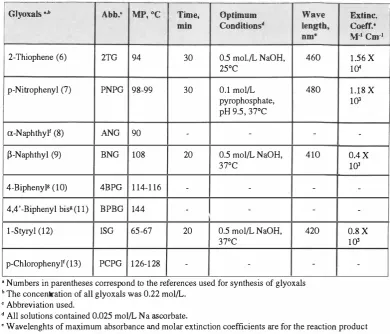
The experiments designed for the reaction of other glyoxals with creatine was essentially the same as described for 2-TG with exceptions indicated in Table I.
Determination ofCK activity by 2· TG. The activity of CK in human serum was
1
etermined by two different methods. The colorimetric method of Hughes (diacetyl-a naphthol method, Sigma kit No. 520) was used and com pared with the 2-TG method.14 The incubation mixture for CK contained 5.6 mmol/L creatine phosphate, 0.015 mol/LE c:: 0 CD ." I-<t w 0 z <t m a: 0 U) m <t
1.4
1.2
1
0.5 N NaOH 0.8
.0 N NaOH
0.6
0.4 0.1 N NaOH
H 10.5 0.2
O��
�
�-L
��-L
J-
��
-L�
�
_LJ-
D
o 10 20 30 40 50 60 70 80 90 100 TIME (MINUTES)
Fig. 1. Absorption spectrum of the reaction mixture of creatine with 2-thiophene glyoxal (2-TG). 2.0 mL 0.5 mollL NaOH, 0.025 moVL Na ascorba te and 004 mL 0.22 mol/L 2-TG in ab solute methanol was added to 1 ml solution of 0.2 mmollL creatine. The absorbances were scanned after 30 min at 25°C against a blank containing all reagents except creatine in a 1 cm cuvette.
1.2 ,---,
�
0.8ca
a:: 0.6 o�
� 0.40.2
O ���-L������������
400 420 440 460 480 500 520 540 WAVELENGHT, nm
Fig. 2. Effects of pH and concentration of NaOH on the reaction of creatine with 2-thiophene glyoxal (2-TG). 2.0 mL mol/L NaOH, 0.025 moVLNa ascorbate and 004 mLO.22 mollL2-TGin absolute methanol was added to 1 mL solution of 0.2 mmoVL creatine. The reaction was allowed to proceed at 25°C and the absorbances at 460 nm were read against a blank containing all reagents except creatine in a 1 cm cuvette. All alkaline solutions and buffer contained 0.025 M Na ascorbate. The buffer was 0.1 M sodium carbonate, pH 10.5.
MgS04,4.0 mmol/LADP,0.2Smmol/Lreducedglutathione and 10 � serum in 0.8 mL 0.1 mol/L Tris, pH 7.5. The mixture was incubated at 37°C for exactly 30 min. Follow ing incubation, the reaction was stopped by adding 0.2 mL 0.05 mol/L p-hydroxymercury benzoate. The concentratiC'n of creatine in the incubation mixture was determined by
Table I. Properties and conditions for reaction of creatine witb glyoxals.
Glyoxals",b Abb: MP,"C Time, (}ptimum Wave Exline.
I
min Condltionsd length, Cooff."
nm- M-I Cm·J
2-Thiophene (6) 2TG 94 30 0.5 mol./L NaOH, 460 L56X
25"C 1 ()4
p-Nitrophenyl (7) PNPG 98-99 30 0.1 mol/L 480 L18X
pyrophosphate, 1()3
pH 9.5, 37"C
a-Naphthylf (8) ANG 90 - - -
-�-Naphthyl (9) BNG 1 08 20 0.5 mol/L NaOH, 410 OAX
37°C 1(}l
4-Biphenyl8 ( 1 0) 4BPG 1 1 4-1 16 - - -
-4,4'-Biphenyl bis8(1 l) BPBG 144 - - -
-1 -Styryl (-12) ISG 65-67 20 0.5 mol/L NaOH, 420 0.8X
37°C 1 ()3
p-Chlorophenylf ( 1 3) PCPG 1 26-1 28 - - -
-• Numbers In parentheses correspond to the references used for synthesIs of glyoxals
b The concentration of all glyoxals was 0.22 mol/L.
e Abbreviation used.
d All solutions contained 0.025 mol/L Na ascorbate.
e Wavelenghts of maximum absorbance and molar extinction coefficients are for the reaction product when each glyoxal was allowed to react with creatine under the condition given.
E
1.5
I:
§
�
w o zia
II: o
CIJ
0.5
III <t:
f No reaction occurred.
8 Turbidity of the reaction mixture occurred.
3<PC
o
10 20 30 40 50 60 70 80 90 100
TIME (MINUTES)Fig. 3. Effect of temperature on the reaction of creatine with 2-thiophene glyoxal (2-TG). 2.0 mL 0.5 mol/L NaOH, 0.025 mol/L Na ascorbate and 0.4 mL 0.22 mol/L 2-TG in absolute methanol was added to 1 mL solution of 0.2 mmol/L creatine. The reaction was allowed to proceed at indicated temperatures and the absor bances at 460 nm were read against a blank containing all reagents except creatine in a 1 cm cuvette.
2TG method as described in the preceding section, using a molar extinction coefficient of 1.56xl ()4 M-ICm-1 (Table I). A blank was prepared which contained all reagents except serum.
In this paper, one unit CK is defmed as the amount of enzyme that can produce one )lmol creatine per min at 37°C and pH 7.5.
RESULTS
Reaction of creatine with 2-thiophene glyoxal
Creatine reacted with 2-TG in 0.5 mol/L NaOH contain ing 0.025 mol/L sodium ascorbate to produce a colored complex which absorbed maximally at 460 nm (Fig. 1). The rate of reaction and the intensity of the color was greater at higher alkali concentration (i.e., 1.0 mol/L NaOH), but the absorbance at 460 nm due to the blank was high, the colored product was unstable and the absorbance started to decline soon after reaching its highest value (Fig. 2). The rate of color development was slow at 0.1 mol/L NaOH or 0.1 moV L sodium carbonate, pH 10.5, even in the presence of 0.025
Reagents for Creatine Kinase
Table II. Absorbance of samples treated with 2-thiopheoe glyoxal".
Compounds Absorbance
, at 460 om
Creatine 0.92
Arginine 1.66
Lysine 0.006
Histidine 0.01
Creatinine 0.01
Urea 0.002
Creatine phosphate 0.01
Cys.teine 0.008
Glycine and other amino I <0.002 acids
I
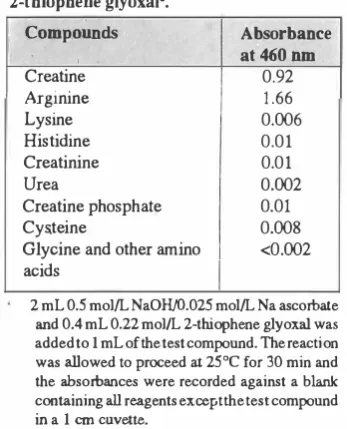
2 mL 0.5 mol/L NaOHJO.025 mol/L Na ascOIbate and 0.4 mL 0.22 mol/L 2-thiophene glyoxal was added to 1 mL of the test compound. The reaction was allowed to proceed at 25°C for 30 min and the absorbances were recorded against a blank
containing all reagents except the test compound in a 1 em cuvette.
mol/L sodium ascorbate as color stabilizing agent. The reaction of creatine with 2-TG was also dependent on temperature. At 25°C, the reaction was complete in 30 min, absorbance at 460 nm remained stable for an additional! 00 min and started to gradually decrease thereafter (Fig. 3). At higher temperatures, the rate of color development was higher, but the absorbance of the colored product decreased rapidly. The presence of 0.025 mol/L sodium ascorbate in the reaction mixture was necessary in order to increase the rate of color formation, and the intensity of colored product. Higher concentration of sodium ascorbate did not increase the rate of color development nor did it have any effect on the stability of color (Fig. 4). In the absence of sodium ascorbate the color formation was too slow to be of value. It was concluded that 0.5 mol/L NaOH solution containing 0.025 mol/L sodium ascorbate at 25°C was the best condi tion for reaction of creatine with 2-TG when the color development in the blank was taken into consideration. Under these conditions the reaction product obeyed Beer's law in the range of 0.005-0.06 mol/L creatine with a molar extinction coefficient of 1.56xlO" M·ICm·1 (Fig. 5). A
0.4-mL aliquot of 0.22 mol/L 2-TG was considered the best concentration. Higher concentrations caused turbidity of the reaction mixture, probably due to insolubilization of 2-TG. These results as well as the data for other glyoxals are summarized in Table I.
Other compounds that might be present in the samples and that might react with 2-TG, interfering in the determi nation of creatine, were tested. These included the 20 common amino acids found in the proteins, cholesterol, creatinine, ornithine, urea, and creatine phosphate, which were individually tested at the same concentration. Table II shows the results of the reaction of some of these com pounds. Among the compounds tested, arginine reacted
1.2
E
c 0.025 M Na ascorbate
0 CD
�
0.8 ��
0.6z 0.05 M Na ascorbate
�
IE: 0.4 0en No Na ascorbate
�
0.2 00 10 20 30 40 50 60 70 80 90 100 TIME (MINUTES)
Fig. 4. Effect of Na ascorbate concentration on the reaction of creatine with 2-thiophene glyoxal (2-TG). 2.0 mL 0.5 mol/L
NaOH containing different concentrations ofNa ascorbate and 0.4
mL 0.22 mol/L 2-TG in absolute methanol was added to 1 mL solution of 0.2 mmoVL creatine. The reaction was allowed to
proceed at 25 °C and the absorbances at 460 run were read against a blank containing all reagents except creatine in a 1 cm cuvette.
E 0.8
c
0 co
."
�
0.6 w 0 z� 0.4 m IE: 0 en m 0.2
�
0
0 .01 .02 .03 .04 .05 .06
CREATINE CONCENTRATION, mM
Fig. 5. Standard curve for determination of creatine with 2-thiophene glyoxal (2-TG). 2.0 mL 0.5 mol/L NaOH, 0.025 mol/L Na ascorbate· and 0.4 mL 0.22 mol/L 2-TG in absolute methanol was added to 1
mL solution of 0.005 to 0.075 mmol/L creatine. The reaction was allowed to proceed at 25°C and the absorbances at 460 nm were recorded against a blank containing all reagents except creatine in a
1 cm cuvette.
with 2-TG to produce colored product which absorbed at .460 nm. All other compounds tested but not listed in this table showed absorbance ofless than 0.001 at 460 nm. Other amino acids, citrulline, as well as many other commonly used biochemical reagents including Tris, borate, Hepes, dithiodierythritol, EDTA, pyridine, and ethanolamine did not react.
Reaction of creatine with other glyoxals
The reaction of creatine with other glyoxals was studied
..J 3,000 0
::I: R = 0.92
I- 2,500 Y = 0.85 X + 20
::I: CL <t 2,000 Z <t ::I: CL 1,500 ..J
�
1,000> ::I: I-W 500 0
<t
..
'0 0
,. .
1,500 2,000 2,500 3,000 0 500 1,000
2-THIOPHENE GLYOXAL
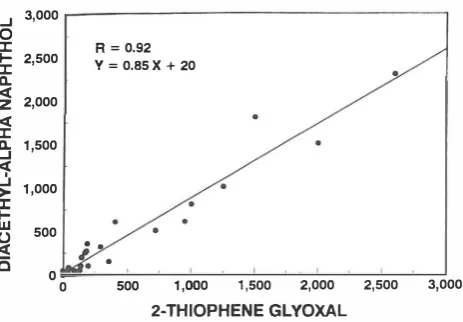
Fig. 6. Correlation between results of2-TG and diacetyl-a-naphthol method for determination of serum CK.
and the optimum conditions for each was established. The results are summarized in Table I. Among the glyoxals tested, a-naphthol glyoxal (ANG), 4-biphenyl glyoxal (4BPG), 4, 4'-biphenyl bisglyoxal (BPBG), and p chlorophenyl glyoxal (PCPG) did not react, even in the presence of 1.0 mol/L or higher conentration of NaOH. Also changing other variables such as increasing the temperature to 45°C or above, or changing sodium ascorbate concentra tion did not improve the reactivity of these glyoxals with creatine. In the case of 4BPG and BPBG the reaction mixture became turbid and lowering the concentration of creatine and/or glyoxal did not decrease turbidity.
Determination of CK by 2-TG method
CK activity was determined in normal sera and sera of patients with acute myocardial infarction. Units per liter (UI L) of CK in each serum sample was determined by 2-TG method as well as diacetyl a-naphthol method (Fig. 6). In both methods CK activity was stopped by p-hydroxymercury benzoate. Activities lower than 100 U/L were considered normal and those above 100 U/L were from patients with myocardial infarction. The slope of the curve in Figure 6 (0.85) indicates the degree of correlation between these two methods. A correlation coefficient of 0.92 shows a linear relationship between the results of two methods.
DISCUSSION
In this paper the results of studies on the reaction of creatine with different glyoxals is reported. Creatine reacted with some glyoxals and produced colored products which could be used to measure CK activity. Among the glyoxals tested, 2-thiophene glyoxal (2-TG), p-nitrophenyl glyoxal, (PNPG), �-naphthyl glyoxal (BNG), and I-styryl glyoxal (lSG) reacted with creatine under mild alkaline conditions. 4-biphenyl glyoxal (4BPG), 4, 4'-biphenyl bisglyoxal
(BPBG) did not react due to the insolubilization of these
glyoxals in the aqueous reaction mixture. Solubility of these glyoxals was a problem and application of solvents such as dimethylsulfoxide (DMSO) did not improve the solubility. Therefore, no further work was performed on these glyoxals. While f3- naphthyl glyoxal reacted with creatine in 0.5 mol! L NaOH at 37°C and the colored product absorbed maxi mally at 410 nm, no reaction occurred with the a-naphthyl
derivative. This lack of reactivity might be attributed to the
steric hinderance between the hydrogen atom on carbon 8 of the naphthalene moiety and the carbonyl group on carbon 1 of glyoxal.
The nature of the complex produced by the reaction of creatine with glyoxals is not known at present It has been reported that phenyl glyoxal reacts with arginine to produce a derivative containing two phenyl glyoxal moieties per arginine.3 A similar mechanism might be involved in the reaction of the methyl guanidino group of creatine with
glyoxals used in this study. In order to absorb in the visible
region, some degree of conjugation in the glyoxal derivative is apparently required. While the product of reaction of guanidino group in arginine with phenyl glyoxal3 and p hydroxyphenyl glyoxals absorbs at the ultraviolet region, p nitrophenyl glyoxal reacts with arginine and creatine to produce colored compounds which absorb at 475-480 nm.l.
4 These considerations might explain why p-chlorophenyl
glyoxal did not produce colored compound with creatine
(Table
I).
No attempt was made to follow the reaction ofcreatine with p-chlorophenyl glyoxal in UV region because
of the high extinction of p-chlorophenyl glyoxal itself at wavelengths below 300 nm.
The highest extinction coefficient was obtained for the reaction of creatine with 2-TG. Another suitable candidate was PNPG. However, at pH 9.0 and 37°C, the optimum conditions for reaction of creatine with PNPG (Table I), the extinction coefficient of the product was at least one order of magnitude lower than that produced by 2-TG. At higher pH's the rate of color development and the intensity of the color with PNPG was greater but the color product was too unstable and the reaction lost its specificity .15 Therefore, it
was concluded that 2-TG was the best glyoxal in terms of the simplicity of the reaction conditions and the sensitivity and specificity of the reaction for creatine determination. This reaction is fairly specific for guanidino group-containing compounds. Among the compounds that
are
present in serum and that might be expected to interfere with CK determination is free arginine. A simple calculation shows that arginine, at the levels present in the human serum (0.6-1.2 mg/l00mL)16
does not normally interfere with determi nation of enzymatically formed creatine. If 10 J.1I... serum is used, the concentration of free arginine in 3.4 mL reaction mixture of 2-TG method would be 1.1-2.2 X 1()4 mmol/L. Table II shows that 0.2 mmol/L of arginine will give an absorbance of 1.6 at 460 nm.Reagents for Creatine Kinase
2-TG method can be used reliably to determine CK activity in normal sera as well as sera from patients with myocardial infarction. Good correlation was obtained when 2-TG method was compared with diacethyl-a-naphthol method of Hughes.14 Both methods are based on direct colorimetric determination of creatine. However, 2-TG method offers several advantages over currently used colo rimetric methods. In this method, color development is achieved by addition of a single reagent, i.e. 2-TG, to the incubation mixture, thereby obviating the inconvenience of working with such odorous and dangerous compounds as diacethyl and a-naphthol. 2-TG method is more rapid because the color develops in 30 min at 25°C and no turbidity of the reaction mixture occurs, therefore all cen trifugation steps that are usually required in other methods
are omitted. Furthermore, we have found (unpublished data) that 2-TG inhibits CK. The reason for this action of2-TG on CK is not known. It is possible that 2-TG reacts with a critical arginine residue of CK. The beneficial effect of2-TG is that the addition of p-hydroxy mercury benzoate, which normally is used in other assays for stopping CK after incubation, is eliminated.
At present, the coupled enzymatic assay of Rosalki17 is
the method of choice in most laboratories18 and has been adapted to automation. However, besides the requirement for recording spectrophotometers, this method utilizes two
enzymes and many reagents and is more expensive than
colorimetric methods. Decreasing the cost of CK tests, which is probably achievable by the 2-TG method, might render this method valuable in clinical laboratories with little access to such facilities as recording spectrophotom eters, autoanalyzers, or expensive chemicals.
REFERENCES
1. Aminlari M, Vaseghi T: A new colorimetric method for creatine phosphokinase. Anal Biochem 164: 397-404; 1987. 2. Means GE, Feeney RE: Chemical Modification of Proteins.
Holden Days, San Francisco, pp. 194-98, 1971.
3. Takahashi K: The reaction of phenylglyoxal with arginine
residues in proteins. J BioI Chern 243: 6171-6179; 1 968. 4. Yamasaki R:B, Vega A, Feeney RE: Modification of available
arginine residues in proteins by p-hydroxyphenyl glyoxal. Anal Biochem 109: 32-40; 1980.
5. Yamasaki R:B, Shimer DA, Feeney RE: Colorimetric determi nation of arginine residues in proteins byp-nitropheny I glyoxal. Anal Biochem 1 1 1: 220-226; 1981.
6. Kipnis F, Ornfelt J: A synthesis of thiophene-2-glyoxal. J Am Chern Soc 68: 2734; 1946.
7. Steinbech L, Becker EI: A synthesis of p-acrylacrylic acid substituted with electron withdrawing groups. J Am Chern Soc 5: 5808-5810; 1954.
8. Fuson RC, Emerson WS, Gray HW: Acryl glyoxal and steric hinderance. J Am Chern Soc 61: 480-482; 1939.
9. Goldyrer LN, Postovski I: A synthesis of b-naphthyl glyoxal.
J Gen Chern 10: 39-4; 1940.
10. Musante C, Parini V: A synthesis of 4-biphenyl glyoxal. Gazz Chim Ital 80: 868-883; 1950. .
II. Banihasherni A, Amiri M, Haghighi B: 2,2' -diiodobiphenyl, 4, 4'-diglyoxal with different di-and tetraamino compounds Iranian J Poly Sci 2: 19-25; 1993.
12. Schank K: Einflub von konjugations -und substituen effecten.
Chern Ber 103: 3087-3091; 1 970.
13. Gassidi PE: Thermally stable polymers. New York, Marcel Decker, pp. 201 , 1 980.
. 14. Hughes BP: A method for estimation of serum creatine kinase and its use in comparing creatine kinase and aldolase activity in normal and pathologic sera. Clin Chim Acta 7: 579-603; 1962.
15. Aminlari M, Rezaian GR: Determination of creatine kinase in the sera of patients with myocardial infarction byap-nitrophenyl glyoxal method. Ann Clin Biochem 27: 569-574; 1990. 16. Woo J, Cannon DC: Metabolic intermediates and inorganic
ions. In: Henry JB, (ed)., Clinical Diagnosis and Management by Laboratory Methods. 1 7th ed., Vol. 1, Philadelphia, W.B. Saunders, p. 133, 1984.
17. Rosalki SB: An improved procedure for serum creatine phos phokinase determination. J Lab Clin Med 69: 695-705; 1 967.
18. Crowly LV, Alton M: A comparison of four methods for measuring creatine phosphokinase. Am J Clin Pathol 53: 948-955; 1 970.