a new species of ginger lily from Northeast India
Ajith Ashokan1, Vinita Gowda1
1 Tropical Ecology and Evolution (TrEE) Lab, Department of Biological Sciences, Indian Institute of Science Education and Research (IISER) Bhopal, Bhopal, 462066, India
Corresponding author:Vinita Gowda ([email protected])
Academic editor:Y. Mutafchiev | Received 12 March 2018 | Accepted 10 May 2018 | Published 6 February 2019
Citation: Ashokan A, Gowda V (2019) Hedychium ziroense (Zingiberaceae), a new species of ginger lily from Northeast India. PhytoKeys 117: 73–84. https://doi.org/10.3897/phytokeys.117.24951
Abstract
We describe Hedychium ziroensesp. nov. from Northeast India (NE India) which was discovered dur-ing one of our recent botanical explorations in Arunachal Pradesh. We provide detailed morphological comparison of this species with four other Hedychium species (H. griersonianum R.M.Sm., H. ellipticum
Buch.-Ham. ex Sm., H. gomezianum Wall. and H. yunnanense Gagnep.), with which it shares some mor-phological similarities. The new species is characterised by a dense cylindrical spike, pubescent rachis, folded bracts, 2–3 flowers per cincinnus, deeply cleft labellum and a distinctive late monsoonal flowering phenology from August to September.
Keywords
Apatani, Arunachal Pradesh, Hedychium, taxonomy, Ziro
Introduction
The genus Hedychium, comprising more than 80 species (Sanoj 2011), is distributed in the tropical, subtropical and warm-temperate Asia (Indian subcontinent, China and Southeast Asia) and Madagascar (Sirirugsa 1991, Newman et al. 2004, Newman and Pullan 2007, Tanaka et al. 2016, Ding et al. 2018, WCSP 2018). Based on in-florescence type and bract structure, Wallich (1853) recognised four subgeneric divi-sions within Hedychium: Coronariae (spikes with more or less tightly imbricate bracts),
Spicatae (spikes with distant, spreading bracts), Siphonium (characterised by stemless habit and crested anther) and Brachychilum (characterised by an exceedingly small
bellum). Based on the relative lengths of stamen and labellum, Horaninow (1862) divided the genus into three groups: Gandasulium (species with shorter stamen com-pared to labellum), Macrostemium (species with stamen length equal to or exceeding the labellum length) and Brachychilum. Later, Baker (1892) treated Gandasulium (to be corrected as Hedychium, as it includes the type of the genus, M. Newman pers. com.) and Macrostemium as two different sections within the genus Hedychium. Fi-nally, based on the shape of the inflorescence and concealment of the inflorescence rachis, Schumann (1904) divided Hedychium into two subgenera: Gandasulium (to be corrected as Hedychium, mentioned above; characterised by wide, ellipsoid or ovoid in-florescence, dense imbricate bracts and hidden rachis) and Eosmianthus (characterised by longer than wide inflorescence, spreading bracts and exposed rachis). However, the molecular phylogeny of Hedychium by Wood et al. (2000) revealed that the morpholo-gies referred to by Wallich (1853), Horaninow (1862), Baker (1892) and Schumann (1904) were not synapomorphic with any of the subgeneric groups and therefore the subgeneric groups were not supported. Instead, four distinct clades were now identi-fied in the phylogenetic tree based on their biogeographic pattern; clade 1 - mostly Peninsular Malaysian taxa, clade 2 - Chinese and high elevation Himalayan taxa, clade 3 – Hedychium acuminatum and clade 4 - mostly Indian and Burmese (Myanmar) taxa. Interestingly, the number of flowers per cincinnus was the only morphological charac-ter that correlated with the clades wherein clade 2 was represented only by the species with 1-flowered cincinnus.
In India, Hedychium is the most diverse genus in the family Zingiberaceae and it is represented by at least 44 taxa (31 species and 13 varieties) from NE India and the Western Ghats (Sanoj 2011). Taxonomic revisions and explorations in the last few decades have resulted in the discovery of several new Hedychium (species as well as varieties) from the NE India and the Western Ghats (Sanoj et al. 2010, Sanoj and Sabu 2011, Thomas et al. 2015, Odyuo and Roy 2017). However, the total species count of
Hedychium in India remains ambiguous due to the lack of detailed taxonomic studies, incomplete geographical sampling caused by difficult terrain and political disturbances (Srivastava 1984, Sarangthem et al. 2013, Sarangthem 2015, Ashokan and Gowda 2017). Northeast India consists of eight states, out of which Arunachal Pradesh (previ-ously known as NEFA or North-East Frontier Agency) holds a major share of the East-ern Himalayan biodiversity hotspot (Mani 1974, Paul et al. 2005). It is second highest (20 species) in Hedychium diversity in India, next to Meghalaya (28 species, pers. obs.). Three Hedychium species (H. radiatum, H. raoii and H. robustum) are known to be narrow endemics to Arunachal Pradesh and they are known only from their respective type localities (Rao and Hajra 1974, Pal and Giri 1998, Sanoj 2011).
Figure 1. Distribution of Hedychium ellipticum, H. gomezianum, H. griersonianum, H. yunnanense and
H. ziroense sp. nov. in the Indian subcontinent, China and Southeast Asia.
distributed in Myanmar, NE India and Thailand. H. yunnanense is native to Southwest China and Vietnam. All the aforementioned species are characterised by 1-flowered cincinnus in each bract (scarcely two flowers appearing per bract even though the whole inflorescence never completely deviates from the 1-flowered cincinnus structure).
Materials and methods
Field collection trips were planned and conducted in August and September 2017 in selected regions within the state of Arunachal Pradesh. Metadata collection included scoring of morphological, phenological as well as ecological characters. Morphological measurements were taken using both ruler and digital calipers. Collections included herbarium and spirit samples and leaf tissues in silica for further molecular studies.
plants.jstor.org/; Kew Herbarium Catalogue: http://apps.kew.org/herbcat/; Muséum national d’Histoire naturelle: https://science.mnhn.fr/; Smithsonian Institution: htt-ps://www.si.edu/; The Linnean Collections: http://linnean-online.org/; Zingiberaceae Resource Centre: http://padme.rbge.org.uk/ZRC/; see Appendix 1).
The conservation status for the new species was evaluated according to the Interna-tional Union for Conservation of Nature (IUCN) guidelines (2017).
Taxonomic treatment
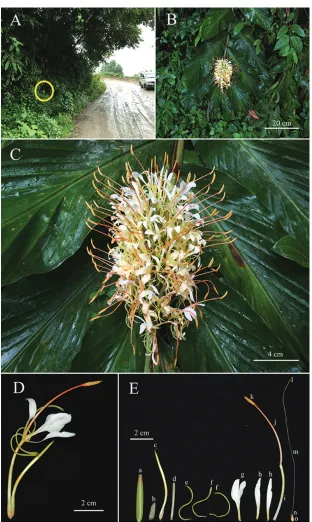
Hedychium ziroense V.Gowda & Ashokan, sp. nov.
urn:lsid:ipni.org:names:60478024-2 Fig. 2
Diagnosis. Based on inflorescence shape and floral characters such as flower colour, relative length of filament to the labellum, relative length of corolla lobes to lat-eral staminodes and labellum, Hedychium ziroense V.Gowda & Ashokan, sp. nov. is morphologically similar to H. griersonianum R.M.Sm., H. ellipticum Buch.-Ham. ex Sm., H. gomezianum Wall. and H. yunnanense Gagnep., but it can be easily dis-tinguished from the aforementioned species by lamina length (up to 60 cm long in H. ziroense vs. 40 cm or less in H. griersonianum, H. ellipticum, H. gomezianum
and H. yunnanense), bract length (4 cm or more in H. ziroense and less than 4 cm in H. griersonianum, H. ellipticum, H. gomezianum and H. yunnanense), number of flowers per cincinnus (2-3 flowered in H. ziroense vs. 1-flowered in H. griersoni-anum, H. ellipticum, H. gomezianum and H. yunnanense), relative lengths of bract and calyx (bract always longer than calyx in H. ziroense vs. bract length equal or less compared to calyx in H. griersonianum, H. ellipticum, H. gomezianum and H. yun-nanense) and anther colour (orange in H. ziroense vs. crimson in H. griersonianum, orange-red in H. ellipticum, red in both H. gomezianum and H. yunnanense), (Figs 2, 3 and 4; Table 1).
Type. INDIA. Arunachal Pradesh, Lower Subansiri District, about 5 km before Ziro town along the Itanagar-Ziro road. Terrestrial herbs on the edge of sub-trop-ical broad-leaved evergreen forest, 27°32'13.19"N, 93°47'35.70"E, 1717 m a.s.l., A. Ashokan, VG2017-AR1989, 08 September 2017 (flowering). Holotype: BHPL!; isotypes: ARUN!, BHPL!, CAL!. Fig. 2.
Table 1. Morphological similarities and dissimilarities of Hedychium ziroense sp. nov. with H. griersoni-anum, H. ellipticum, H. gomezianum and H. yunnanense. Amongst the five species, characters that are diagnostic for H. ziroense sp. nov. are shown in bold.
Attributes Hedychium
ziroensesp. nov. H. griersonianum R.M.Sm. Buch.-Ham. ex Sm. H. ellipticum H. gomezianumWall. H. yunnanenseGagnep.
Literature source for morphological
characters This paper
Smith (1991,
1994) Smith (1811), Sanoj (2011)
Wallich (1853), Sirirugsa (1991), Sanoj (2011), Wongsuwan and Picheansoonthon (2011) Gagnepain (1907), Wu and
Larsen (2000), MNHN (2018)
Plant height (m) 1.6 1 0.6–1.1 0.5–1.2 0.5–1.0
Lamina size (cm) 35–60 × 13–17 30–35 × 8–10 24–39 × 7–15 34–37 × 5.5–7.5 20–40 × 10 Inflorescence type cylindrical elongate spike; elliptical elliptical cylindrical cylindrical
Inflorescence density dense dense dense lax lax
Inflorescence length
(cm) 16 12 4–10 5–20 15–20
Bract type folded; involute imbricating imbricating folded; involute folded; involute
Bract shape elliptic oblong elliptic elliptic lanceolate
Bract indumentum
(adaxial) absent absent absent present absent
Bract size (cm) 4.0–4.5 × 1.0–1.2 1.0–2.0 × 0.5–0.8 1.5–3.2 × 1.0–3.0 2.8–3.1 × 0.9–1.1 1.5–2.5
Bracteole size (cm) 1.0–1.5 1.0 0.9–1.2 1.0–1.3 1.2–1.8
Number of flowers
per cincinnus 2–3 1 1 1 1
Calyx length (cm) 2.8–3.2 2.0–2.5 1.7–3.2 2.7–3.0 1.7–2.8
Floral tube length
(cm) 4.7–5.0 3.5–4.0 4.0–7.0 3.0–4.8 3.5–5.0
Corolla lobe length
(cm) 4.0–4.5 2.5–3.5 2.8–5.6 4.0–4.5 2.5–3.0
Lateral staminode
shape oblanceolatenarrowly narrowly elliptic spatulate oblanceolatenarrowly oblong-linear Lateral staminode
length (cm) 3.5–4.0 1.5–1.8 2.5–5.0 3.1–3.2 2.2–2.9
Labellum shape elliptic elliptic spatulate oblanceolate obovate
Labellum length (cm) 3.5–4.0 1.0–1.3 2.1–4.0 2.6–2.7 2.0–2.5
Labellum sinus depth the length of ½ or more labellum
⅓ the length of
labellum length of labellumless than ⅓ the
less than ½ the length of
labellum
½ the length of labellum
Filament length (cm) 5.5–6.0 2.5–3.0 4.0–7.0 3.5–4.0 3.5–4.2
Anther colour orange crimson orange-red red red
Anther length (cm) 0.9–1.2 0.6–1.0 1.6–1.8 1.0–1.5 1.0–1.2
Flowering SeptemberAugust- June-July June-August July-August July-September
Elevation (m) >1700 1100 305–2440 500–1700 2000–3000
Distribution Arunachal Pradesh Bhutan NE India, China, Nepal, Bhutan, Myanmar
NE India, Myanmar,
tubular, translucent, 3-toothed, slightly hairy at tip; floral tube 4.7–5.0 cm long, gla-brous, curved, greenish-yellow; corolla lobes linear, curled, orientated downwards, glabrous, light green; dorsal lobe 4.2–4.5 cm long, linear, curled, glabrous, beaked at tip, embracing the filament and anther in the bud stage, light green; lateral lobes 4.0–4.3 cm long, linear, curled (single curl), non-beaked at tip, glabrous, light green; lateral staminodes 3.5–4.0 cm long, widest part 0.5 cm, narrowly oblanceolate, one edge linear, obtuse, unguiculate, upper halves reflexed backwards, positioned acute (< 70°) with respect to labellum, white, light yellow towards base; labellum 3.5–4.0 × 1.0–1.5 cm, elliptic, glabrous, white with light yellow blotch, deeply bilobed, cana-liculate, gradually clawed; lobes acute, upper halves reflexed backwards; sinus 1.5–2 cm deep; claw 1.0–1.3 × 0.2–0.3 cm; filament 5.5–6.0 cm long, slightly arching, deeply grooved on one side, pale orange, bright orange towards tip; anther 0.9–1.2 cm long, linear, basifixed, orange; thecae 2, split longitudinally; connective 0.1–0.2 cm long, bright orange; stigma 0.1 cm wide, cup-shaped, hairy at tip, exserted from the anther by at least 0.1 cm, green; style 11.5–12 cm long, filiform, white, greenish towards tip; epigynous nectaries 0.2–0.25 cm long, glabrous, yellow; ovary 0.3–0.4 × 0.2–0.4 cm, barrel-shaped, pubescent, creamy orange externally; placentation axile; ovules spherical, creamy white. Fruit not seen.
Distribution and habitat. This species is known only from collection along road banks on the Itanagar-Ziro road, Lower Subansiri District, Arunachal Pradesh at an elevation of more than 1700 m.
Phenology and ecology. Flowering from August to September. Flowers mildly fragrant during the day and prominently fragrant at night indicating that this species may be pollinated by nocturnal pollinators.
Sub-tropical broad-leaved evergreen forest; canopy partially shaded; soil black, clay loam; Average temperature: 25 ± 2 °C; Humidity: > 98%; Average rainfall: ~3000 mm.
Other Hedychium in the vicinity: H. coccineum Buch.-Ham. ex Sm., H. specio-sum var. gardnerianum (Ker Gawl.) Sanoj and M.Sabu, H. stenopetalum Lodd. and
H. wardii C.E.C.Fisch. Except for some H. speciosum var. gardnerianum, all other
Hedychium were fruiting at the time of collection.
Figure 4.AHedychium griersonianumB Inflorescence of H. yunnanense (flower in the inset) C Inflores-cence of H. ellipticumD Inflorescence of H. gomezianumE Flower of H. ziroenseF Flower of H. ellipticum
G Flower of H. gomezianum. Photo Credits: A Andrew Grierson. © Royal Botanic Garden Edinburgh 2018; B Leslie Brothers. © United States National Herbarium (US); C, E. Ajith Ashokan; D, F, G Preeti Saryan.
Acknowledgements
The authors thank the Ministry of Human Resource Development (MHRD) and the National Geographic Society for research funds to V. Gowda; IISER Bhopal for the infrastructure; the Council for Scientific and Industrial Research (CSIR) for the sen-ior research fellowship to A. Ashokan and the Heliconia Society International (HSI) for field research grant to A. Ashokan. We also thank the State Forest Department of Arunachal Pradesh for the research permit; ARUN, ASSAM, BO, BSA, BSHC, BSI, CAL, MH, QBG, SING and TBGT for herbarium consultation; and RBGE (E) and Dr. W. John Kress, NMNH (US) for permitting us to use the images. We also thank Dr. Kanchi N. Gandhi for nomenclatural help; Dr. Mark F. Newman and Dr. Piyaka-set Suksathan for their critical comments that have helped us improve this manuscript.
References
Ashokan A, Gowda V (2017) Diversity of the genus Hedychium J.Koenig (Zingiberaceae) in the Northeast of India-I. Heliconia Society International Bulletin 23(2): 1–11.
Baker JG (1892) Hedychium Koenig. In: Hooker JD (Ed.) Flora of British India 6. Reeve & Co., London, 225–233.
Bouchery P (2016) Dictionary of the Apatani Language: Apatani-English Dictionary (with English-Apatani Index). [hal-01423834]
Ding HB, Yang B, Zhou SS, Li R, Maw MB, Kyaw WM, Tan YH (2018) Hedychium putaoense
(Zingiberaceae), a new species from Putao, Kachin State, Northern Myanmar. PhytoKeys 94: 51–57. https://doi.org/10.3897/phytokeys.94.22065 PubMed
Gagnepain MF (1907) Zingibéracées Nouvelles De L'Herbier Du Muséum (18° Note). Bulletin de la Société Botanique de France 54(3): 164–165.
Horaninow PF (1862) Prodromus Monographiae Scitaminarum. St. Petersburg.
IUCN Standards and Petitions Subcommittee (2017) Guidelines for Using the IUCN Red List Categories and Criteria. Version 13. Prepared by the Standards and Petitions Subcommit-tee. Available from: http://www.iucn-redlist.org/documents/RedListGuidelines.pdf [ac-cessed 05 March 2018]
Koenig JG (1783) Descriptions Monandrarum pro annis. In: Retzius AJ (Ed.) Observationes Botanicae 3. Lipsiae, 45–76.
Mani MS (1974) Vegetation and Phytogeography of the Himalaya. In: Mani MS (Ed.) Ecology and Biogeography in India. W. Junk, The Hague, 204–246.
MNHN [Muséum national d’Histoire naturelle] (2018) The vascular plants collection (P) at the Herbarium of the Muséum national d’Histoire naturelle (MNHN – Paris). Version 69.60. Occurrence Dataset https://doi.org/10.15468/nc6rxy [accessed via GBIF.org on 2018-04-22]
Naik VN, Panigrahi G (1961) Genus Hedychium in Eastern India. Bulletin of the Botanical Survey of India 3(1): 67–73.
Arunachal Pradesh, India. Journal of the Bombay Natural History Society 95(1): 102–104. Paul A, Khan ML, Arunachalam A, Arunachalam K (2005) Biodiversity and conservation of
rhododendrons in Arunachal Pradesh in the Indo-Burma biodiversity hotspot. Current Science 89(4): 623–634.
Rao AS, Hajra PK (1974) Hedychium radiatum & H. robustum (Zingiberaceae) – two new spe-cies from Kameng District, Arunachal Pradesh. Bulletin of the Botanical Survey of India 16(1-4): 163–166.
Rao AS, Verma DM (1969) Notes on Hedychium Koenig, Including Four New Species from Khasi & Jaintia Hills, Assam. Bulletin of the Botanical Survey of India 11(1-2): 120–128. Roscoe W (1828) Monandrian Plants of the Order Scitamineae. Liverpool.
Sanoj E (2011) Taxonomic Revision of the Genus Hedychium J. Koenig (Zingiberaceae) in India. PhD Thesis, University of Calicut, Kerala.
Sanoj E, Sabu M (2011) The identity of Hedychium marginatum C.B.Clarke (Zingiberaceae), and a new species, H. nagamiense from North-eastern India. Bangladesh Journal of Plant Taxonomy 18(2): 169–176. https://doi.org/10.3329/bjpt.v18i2.9304
Sanoj E, Sabu M, Kumar TR (2010) Hedychium forrestii (Zingiberaceae) with a new syn-onymy and a variety from India. Journal of the Botanical Research Institute of Texas 23: 633–639.
Sarangthem N (2015) Molecular phylogenetic and diversity analysis of Hedychium Koenig (Zingiberaceae) of North East India. PhD Thesis, Gauhati University, Assam.
Sarangthem N, Talukdar NC, Thongam B (2013) Collection and evaluation of Hedychium spe-cies of Manipur, Northeast India. Genetic Resources and Crop Evolution 60(1): 13–21. https://doi.org/10.1007/s10722-012-9810-1
Schumann K (1904) Zingiberaceae. In: Engler A (Ed.) Das Pflanzenreich. IV. 46 (Heft 20). Engelmann, Leipzig, 1-458. https://www.biodiversitylibrary.org/item/56528
Sirirugsa P (1991) The genus Hedychium (Zingiberaceae) in Thailand. Prince of Songkla Uni-versity, Songkhla.
Sirirugsa P, Larsen K (1995) The genus Hedychium (Zingiberaceae) in Thailand. Nordic Journal of Botany 15(3): 301–304. https://doi.org/10.1111/j.1756-1051.1995.tb00156.x Smith JE (1811) Hedychium. In: Rees A (Ed.) Cyclopaedia. London, 17.
Smith RM (1991) Notes relating to the Flora of Bhutan: XVII. Zingiberaceae: Zingiberaceae. Edinburgh Journal of Botany 48(1): 23–25. https://doi.org/10.1017/S0960428600003565 Smith RM (1994) Zingiberaceae. In: Noltie HJ (Ed.) Flora of Bhutan: Including a Record of
Plants from Sikkim and Darjeeling 3(1). Royal Botanic Garden Edinburgh, 182–209. Srivastava SC (1984) A Taxonomic Study of Genus Hedychium Koen. (Zingiberaceae) in India
and its Vicinity. PhD Thesis, University of Calcutta, West Bengal.
Tanaka N, Ohi-Toma T, Aung MM, Murata J (2016) Systematic notes on the genus Hedychium
Thomas S (2015) Classical and Molecular Systematics of Hedychium J. Koenig (Zingiberaceae) from the Western Ghats, India. PhD Thesis, Bharathidasan University, Tamil Nadu. Thomas S, Mani B, Britto SJ (2015) A new species of Hedychium (Zingiberaceae) from the
southern Western Ghats, India. Webbia 70(2): 221–225. https://doi.org/10.1080/00837 792.2015.1082270
Wallich N (1853) Initiatory attempt to define the species of Hedychium, and settle their syn-onymy. Hooker’s Journal of Botany and Kew Garden Miscellany 5: 321–329, 367–377. WCSP (2018) World Checklist of Selected Plant Families. Facilitated by the Royal Botanic
Gar-dens, Kew. Published on the Internet; http://wcsp.science.kew.org/ [Retrieved 05 March 2018] Wongsuwan P, Picheansoonthon C (2011) Taxonomic Revision of the Genus Hedychium J.
König (Zingiberaceae) in Thailand (Part I). The Journal of the Royal Institute of Thailand 3: 126–149.
Wood TH, Whitten WM, Williams NH (2000) Phylogeny of Hedychium and related genera (Zingiberaceae) based on ITS sequence data. Edinburgh Journal of Botany 57(2): 261– 270. https://doi.org/10.1017/S0960428600000196
Wu TL, Larsen K (2000) Zingiberaceae. In: Wu ZY, Raven PH (Eds) Flora of China 24. Science Press, Beijing and Missouri Botanical Garden Press, St. Louis, 322–377.
Appendix 1
List of specimens examined for Hedychium ziroense sp. nov., H. griersonianum, H. ellip-ticum, H. gomezianum and H. yunnanense. Specimens from the Royal Botanic Garden Edinburgh (E), Royal Botanic Gardens, Kew (K), Linnean Society of London (LINN) and Muséum national d’Histoire naturelle (P) refer to high-resolution digital images of specimens that were examined in this study.
Species Specimen(s) examined with collector and collection information.
Hedychium ziroense V.Gowda & Ashokan, sp. nov.
INDIA. Arunachal Pradesh, Lower Subansiri District, about 5 km before Ziro town along the Itanagar-Ziro road, 27°32'13.19"N, 93°47'35.70"E, 1717 m a.s.l., A.Ashokan VG2017-AR1989, 08 September 2017; 27°31'57.97"N, 93°47'43.35"E, 1782 m a.s.l., A.Ashokan VG2018007, 25 August 2018 (BHPL!).
H. griersonianum R.M.Sm. BHUTAN. Sarbhang, 01 June 1979, A. J. C. Grierson & D. G. Long 1547 (E, K); Chukka, 03 July 1914, R. E. Cooper 1152 (E).
H. ellipticum Buch.-Ham. ex Sm.
NEPAL. Narainhetty, 28 July 1902, F. Buchanan-Hamilton 8.31 (LINN); INDIA. Arunachal Pradesh, Lower Subansiri District, Jara, 17 September 1983, G. D. Pal 591 (ARUN!); Meghalaya, Khasi & Jaintia Hills, Barapani, 3500 ft., 28 June 1922, U. Kanjilal 7731 (ASSAM!); Manipur, Senapati District, Taphou Hills, 23 July 2016, N. Sarangthem VC2016c (BHPL!).
H. gomezianum Wall.
MYANMAR. Mergui, N. Wallich 6543 (K); THAILAND. Peninsular: Khao Khlong Yang at Khao Phra Mi, 06 July 1979, K. Larsen 30649 (E); Ranong, Pra Part Beach, 18 July 1979, C. Niyomdham 349 (E);
INDIA. Arunachal Pradesh, Anjaw District, Pomagam, 1500 m., 20 October 2010, R. Gogoi 21543 (ARUN!); West Kameng District, Tenga Valley, 05 September 2017, A. Ashokan VG-AR1971 (BHPL!); Manipur, Senapati District, Taphou Hills, 01 August 2017, P. Saryan VG-MN1751 (BHPL!); Ukhrul District, 25 August 2017, A. Ashokan VG-MN1926 (BHPL!); Nagaland, Kohima, 31 August 2017, A. Ashokan VG-AR1949 (BHPL!).