The Thirty-Third AAAI Conference on Artificial Intelligence (AAAI-19)
Validation of Growing Knowledge Graphs by Abductive Text Evidences
Jianfeng Du,
†Jeff Z. Pan,
‡Sylvia Wang,
‡Kunxun Qi,
†Yuming Shen,
‡Yu Deng
§ †Guangdong University of Foreign Studies, Guangzhou 510420, P.R.China‡Department of Computing Science, The University of Aberdeen, Aberdeen AB24 3UE, UK
§IBM T.J. Watson Research Center, Yorktown Heights, NY 10598, USA
[email protected], [email protected], [email protected], [email protected], [email protected], [email protected]
Abstract
This paper proposes a validation mechanism for newly added triples in a growing knowledge graph. Given a logical the-ory, a knowledge graph, a text corpus, and a new triple to be validated, this mechanism computes a sorted list of ex-planations for the new triple to facilitate the validation of it, where an explanation, called anabductive text evidence, is a set of pairs of the form (triple, window) where appending the set of triples on the left to the knowledge graph enforces entailment of the new triple under the logical theory, while every sentence window on the right which is contained in the text corpus explains to some degree why the triple on the left is true. From the angle of practice, a special class of abduc-tive text evidences calledTEP-based abductive text evidence
is proposed, which is constructed from explanation patterns seen before in the knowledge graph. Accordingly, a method for computing the complete set of TEP-based abductive text evidences is proposed. Moreover, a method for sorting ab-ductive text evidences based on distantly supervised learning is proposed. To evaluate the proposed validation mechanism, four knowledge graphs with logical theories are constructed from the four great classical masterpieces of Chinese litera-ture. Experimental results on these datasets demonstrate the efficiency and effectiveness of the proposed mechanism.
Introduction
Knowledge graphs have been widely used in many applica-tions recently. A knowledge graph is a directed graph with vertices labeled by entities and edges labeled by relations. It can be treated as a set of triples of the formhh, r, ti, where his thehead entity(simplyhead),rtherelationandtthe
tail entity (simplytail). In order to widen the applicabil-ity, knowledge graphs need to grow with the increasing data nowadays. There exist some common approaches to enlarg-ing knowledge graphs such as knowledge graph completion. Knowledge graph completion aims to enlarge a knowledge graph with those new triples that are predicted by a learnt model and pass the manual validation. However, manual val-idation of triples is laborious and error prone. Thus it calls for automatic methods for explaining the existence of new triples to assist the validation of new triples.
There are two categories of traditional explanations that can be used to prove the existence of new triples.
Copyright c2019, Association for the Advancement of Artificial Intelligence (www.aaai.org). All rights reserved.
One is the logic-based category. Given a logical theory formalizing the schema of the knowledge graph, a new triple can be naturally explained by a set of triples that are al-ready in the knowledge graph under the logical theory. But the coverage of this mechanism is limited. To explain more triples, we can employ logic-based abduction (Eiter and Got-tlob 1995), i.e. explain a new triple by a set of triples that are possibly not in the knowledge graph. However, in this mech-anism we need to prove the existence of the absent triples. For example, given a logical theory made up of a single rule
∀x, y, z:Father(x, y)∧Father(y, z)→Grandfather(x, z), the new triplehTom,Grandfather,Timican be explained by
{hTom,Father, ei,he,Father,Timi} for some entitye un-der the logical theory. But to get a complete proof, we need to explain whyhTom,Father, eiandhe,Father,Timiexist. It shows that logic-based abduction improves the coverage for new triples but may require extra validations.
The other category of explanations, calledtext evidences, are text-based. A text evidence for a triplehh, r, tiis a sen-tence window composed by several consecutive sentences that explain whyhandthave the directed relationr. How-ever, this explanation mechanism is only applied to new triples explainable by consecutive sentences. Consider the aforementioned example. If there is no sentence window mentioning both Tom andTim, hTom,Grandfather,Timi
cannot be explained. It shows that purely text-based expla-nations have a rather low coverage for new triples.
We consider combining the above two categories to re-solve limitations therein. There are two research problems about this combination — one on the way to combine log-ical information and text information, and the other on the way to present the explanations.
For the first problem, we propose a new category of explanations, called abductive text evidences, to combine logical information and text information. Given a logical theory, a knowledge graph and a text corpus, an abduc-tive text evidence for a new triple τ is a set of pairs
{(τi, wi)}1≤i≤n for τi a triple and wi a sentence window
in the text corpus, such that appending {τi}1≤i≤n to the
knowledge graph makes τ entailed under the logical the-ory, whilewi explains to some degree the existence ofτi
ab-ductive text evidences gives more chances to explain a new triple. Consider the aforementioned example again. Even when none of the sentence windows mentions both Tom
and Tim, hTom,Grandfather,Timi can still be explained by an abductive text evidence {(hTom,Father, ei, w1),
(he,Father,Timi, w2)}forean entity, andw1andw2
sen-tence windows respectively explaining to some degree why
hTom,Father, eiandhe,Father,Timiexist.
To make explanations as concise as possible, we consider only subset-minimal abductive explanations, simply called
mina-explanations. Computing the complete set of explanations is still impractical because the number of mina-explanations can be easily exponential in the number of en-tities. Take for example a knowledge graph withN entities
{vi}1≤i≤N but without triples of the form edge(vi, vj), a
new triplepath(v1, vN), and a logical theory composed by
two rules∀x, y, z : path(x, y)∧path(y, z) → path(x, z) and ∀x, y : edge(x, y) → path(x, y), then there will be (N−2)!mina-explanations of the form{edge(v1, vk1), . . . , edge(vki, vki+1), . . . ,edge(vkN−2, vN)} for path(v1, vN), where(k1, . . . , kN−2)is a permutation of(2, . . . , N−1).
To reduce the number of mina-explanations to be com-puted, we assume that a pragmatic explanation should be instantiated from anexplanation patternseen before and be supported by the text corpus. An explanation patternP is a set oflifted tripleswhich are almost the same as triples ex-cept that all entities therein are replaced with variables.P is said to beseen beforein a knowledge graph for a lifted triple
hx, r, yiif there is adifferentiated substitutionθforP mak-ingP θa minimal subset of the knowledge graph that entails
hxθ, r, yθiunder the logical theory, where a differentiated substitution forPreplaces different variables inP with dif-ferent entities. Moreover, given a text corpus composed of sentence windows, an explanation is required to consist of only tripleshh, r, tisuch that a mention ofhand a mention oftco-occur in at least one sentence window, since this kind of explanations can directly be extended to abductive text evidences. Roughly speaking, a mina-explanation for a new triple is called atext and explanation pattern based expla-nation(simplyTEP-based explanation) if it is derived from an explanation pattern seen before in the given knowledge graph and consists of only tripleshh, r, tisuch that a men-tion ofhand a mention oftco-occur in a sentence window in the given text corpus. Accordingly, we call an abductive text evidence extended from a TEP-based explanation under the same text corpus aTEP-based abductive text evidence. We then propose a method for computing the complete set of TEP-based abductive text evidences.
For the second problem, we aim to present TEP-based ab-ductive text evidences in an order that prefers more explica-ble sentence windows so that anyone who wants to validate a new triple can merely focus on high-rank explanations. To avoid laborious annotation, we adapt a distantly supervised method for relation extraction (Lin et al. 2016) to estimate, for every pair(τ, w)in an abductive text evidence, to what degree the sentence windowwexplains the existence of the tripleτ. We then propose a total order for sorting all TEP-based abductive text evidences that are extended from the same TEP-based explanation.
To evaluate the proposed mechanism for validating new triples, we construct four knowledge graphs and their corre-sponding logical theories from the text corpora that we are familiar with, which are the four great classical masterpieces of Chinese literature. We divide each knowledge graph into a training set and a test set, where triples in the test set are all treated as new triples. To validate every triple in the test set, we compute all TEP-based abductive text evidences for it and sort them in a variant of the proposed total order. Ex-perimental results show that the computation of TEP-based abductive text evidences is efficient while the proposed to-tal order is more effective than other variants (including the random order) in ranking true explanations at top places.
Preliminaries
This work considers only logical theories that are expressed in first-order logic. Such a logical theory is a set of rules R of the form∀~x : φ(~x) → ∃~y ϕ(~x, ~y), where φ(~x)is a conjunction of atoms on the universally quantified variables ~
x, andϕ(~x, ~y)is a disjunction of atoms on both~xand the existentially quantified variables~y. The part ofRat the left (resp. right) of→is called thebody(resp.head) ofR. By body(R)(resp.head(R)) we denote the set of atoms in the body (resp. head) ofR. If the head ofR has no atoms,R is also called aconstraint while the empty head is written as ⊥. If the head ofR has a single atom without existen-tially quantified variables, R is also called adatalogrule. For brevity, in this paper we present our work with the Horn fragment of first-order logic, although the proposed methods can be applied to other fragments such as description logics (DLs) (Baader et al. 2003). We simply call a set of datalog rules and constraints aHorn theory, which may contain con-stants. A knowledge graph can be treated as a set of ground rules with empty bodies, or simply a set of ground atoms, by rewriting tripleshh, r, tito ground atomsr(h, t), where entity-type triples of the formhe,type, ti(meaningehas a typet) are also rewritten totype(e, t)as other triples.
Amodelof a Horn theoryT is a setS of ground atoms such that (1)body(R)θ⊆Simplieshead(R)θ∩S6=∅for any datalog ruleR ∈ T and any ground substitutionθ for var(R), and (2)body(R)θ 6⊆S for any constraintR ∈ T
and any ground substitutionθ forvar(R), where aground substitutionfor a symbol maps all variables in the symbol to constants, andvar(R)denotes the set of variables inR. A model of the unionK of a knowledge graphG and a Horn theoryT is a model of T that includesG. The unionK is said to beconsistentif it has a model, which means thatK
has a unique least model sinceT is Horn. We say a triple is entailed by a knowledge graphG under a Horn theory
T, orentailedbyG ∪ T, if the triple is in the unique least model ofG ∪ T. Given anobservationwhich is a tripleτ, a knowledge graphGand a Horn theoryT such thatG ∪ T is consistent, anabductive explanationEforτinGunderT is a set of triples constructed from entities inGsuch that (1)τ is entailed byG ∪ EunderT, and (2)G ∪ E ∪ T is consistent.
E is further called asubset-minimal abductive explanation
A Validation Mechanism for New Triples
To maintain high quality for a growing knowledge graph, it is crucial to find explanations to prove the existence of any new triple to be added. As discussed in Introduction, al-though abductive explanations can be used to prove a large number of new triples through a background logical theory, the absent triples in an abductive explanation need to be fur-ther validated. Fortunately, text-based explanations can be used to prove these absent triples. Thus we propose below a new kind of explanations which integrates text-based expla-nations into abductive explaexpla-nations, where asentence win-dowis a text composed by several consecutive sentences.Definition 1 (abductive text evidence) Given a tripleτ, a knowledge graphG, a Horn theoryT and a text corpus C
composed of sentence windows, such thatG ∪ {τ} ∪ T is consistent, anabductive text evidenceforτis a set of pairs
{(τi, wi)}1≤i≤nsuch that{τi}1≤i≤nis an abductive
expla-nation forτinGunderT, while for all1≤i≤n,τi6∈ G,
wi∈ Candwiexplains to some degree the existence ofτi.
The above definition is not given rigorously as “to some degree” is not well-defined. More importantly, computing all abductive text evidences for a triple is often impracti-cal since it requires to compute all abductive explanations. It has been shown in Introduction that the number of mina-explanations can be up to exponential in the number of enti-ties that appear in the knowledge graph. Hence, we need to introduce a special class of abductive text evidences which is defined rigorously and is easy to compute.
By observing that practical logical reasoning often fol-lows fixed patterns, we assume that practical abduction can be a mimic of deductive reasoning in the same knowledge graph; i.e., every explanation-observation pair used in prac-tice, say(E, τ), is copied from some(E0, τ0)by substituting entities and removing entailed triples, whereτ0is a triple and
E0is a minimal subset of the knowledge graph that entailsτ0. To define such mina-explanations, we introduce a notion of pattern defined below, where adifferentiated substitutionis a ground substitution that maps different variables to differ-ent differ-entities, and alifted tripleis a triple whose head and tail are both variables.
Definition 2 (SBE-pattern) Given a knowledge graphG, a Horn theoryT and a lifted triple%, a setP of lifted triples is called anexplanation pattern seen before (simply SBE-pattern) inG for %underT if there exists a differentiated substitutionθ forP such thatP θis a minimal subset ofG
that entails%θunderT.
Example 1 Letltbe short forless then. Consider a knowl-edge graphG={ha,lt, bi,ha,lt, ci,hb,lt, di,hc,lt, ei,hd,lt, fi}and a Horn theoryT consisting of two rules∀x, y, z : lt(x, y)∧lt(y, z)→lt(x, z)and∀x, y:lt(x, y)∧lt(y, x)→ ⊥. There are exactly three SBE-patterns inG forhx,lt, yi
under T. They are P1 = {hx,lt, yi}, P2 = {hx,lt, v1i,
hv1,lt, yi}andP3={hx,lt, v1i,hv1,lt, v2i,hv2,lt, yi}.
Under our assumption, every desirable mina-explanation should be obtained by applying a differentiated substitution to an SBE-pattern and removing entailed triples from the substituted result. Moreover, every triple τ in a desirable
mina-explanation should be explained to some degree by a sentence window. A condition probably fulfilling this re-quirement is that a mention of the head ofτ and a mention of the tail ofτco-occur in a sentence window. This condi-tion may not work well for entity-type triples of the form
he,type, tisince a sentence window explaininghe,type, ti
may often not mention any surface names aboutt. We will leave this problem in our future work. In the current work we introduce a class of desirable mina-explanations defined be-low according to the above condition, wherelift(τ)denotes a lifted triple obtained from a tripleτby replacing different entities with different variables, and h(τ)andt(τ) respec-tively denote the head and tail ofτ.
Definition 3 (TEP-based explanation) Given a tripleτ, a knowledge graph G, a Horn theoryT, a setC of sentence windows, and a functionf mapping entities inGto mention sets, such thatG ∪ {τ} ∪ T is consistent, a mina-explanation
EforτinGunderT is called atext and explanation pattern based explanation (simply TEP-based explanation) for τ wrt(G,T,C, f)if there is an SBE-patternPinGforlift(τ) underT and a differentiated substitutionθforP such that
E ⊆P θand every triple inP θ\Eis entailed byG ∪T, while for every tripleτ0 ∈ E, there is a mentionmh∈f(h(τ0)), a
mentionmt∈f(t(τ0))and a sentence windoww∈ C such
thatmhandmtco-occur inw.
Example 2 Continue with Example 1. Let C = {“c and d are comparable”,“e is smaller than f”} be a text cor-pus, and f(x) = {x} be a mapping function from enti-ties to mention sets. For the observation hc,lt, fithere are exactly two TEP-based explanations wrt(G,T,C, f). They are E1 = {hc,lt, di} andE2 = {he,lt, fi}. Both of them
can be derived from P2. In fact, there are also other three
mina-explanations derivable from the SBE-patterns, namely
E3={hc,lt, fi},E4={hc,lt, bi}andE5={he,lt, di}. But
they are not supported by sentence windows inC.
Based on Definition 3, we accordingly define a special class of abductive text evidences below.
Definition 4 (TEP-based abductive text evidence) Given a tripleτ, a knowledge graphG, a Horn theoryT, a setC
of sentence windows, and a functionf mapping entities in
G to mention sets, such that G ∪ {τ} ∪ T is consistent, a
TEP-based abductive text evidence for τ wrt (G,T,C, f) is a set of pairs {(τi, wi)}1≤i≤n such that {τi}1≤i≤n is a
TEP-based explanation for τ wrt (G,T,C, f), while for all 1 ≤ i ≤ n,wi ∈ C and there ismh ∈ f(h(τi))and
mt∈f(t(τi))such thatmhandmtco-occur inwi.
TEP-based abductive text evidence can be treated as a special class of abductive text evidences, because a sentence window mentioning both the head and the tail of a triple ex-plains to some degree the existence of the triple. This special class is defined rigorously and can be computed in a practi-cal way described by the algorithm in Figure 1.
Algorithm.ComputeExplanations(hh, r, ti,G,T,C,f) Input: An observationhh, r, ti, a knowledge graphG, a Horn
the-oryT, a setCof sentence windows, and a functionf mapping entities inGto mention sets.
Output: The complete set of TEP-based abductive text evidences forhh, r, tiwrt(G,T,C, f).
1: G+←ComputeEntailments (G,T); 2: ifhh, r, ti ∈ G+
then return{∅}; 3: Ξ← ∅;∆← ∅;
4: foreachhh0, r, t0i ∈ G+
and each minimal subsetSofGthat entailshh0, r, t0iunderT doΞ←Ξ∪{lift(S, h07→x, t07→y)}; 5: foreachP ∈ Ξ, each bipartition(P1, P2)ofP s.t.P2 6=∅, each{x 7→ h, y 7→ t}-compatible differentiated substitutionθ
forP1s.t.P1θ ⊆ G+, and eachθ-compatible differentiated sub-stitutionσforP2s.t.P2σ∩ G+=∅do
6: ifG ∪P2σ∪ T is consistent
andhh, r, ti ∈ComputeEntailments(G ∪P2σ,T) andhh, r, ti 6∈ComputeEntailments(G ∪S,T) for all
S∈sub1(P2σ)then
7: ∆←∆∪ {{(τ1, w1), . . . ,(τn, wn)} | {τ1, . . . , τn}=
P2σ, w1 ∈ C, . . . , wn ∈ C,∀1 ≤ i ≤ n∃mh ∈ f(h(τi)),
mt∈f(t(τi)) :mhandmtco-occur inwi}; 8: return∆;
Figure 1: Computing all TEP-based abductive text evidences
M(t)defined byM(0)=Gand fort >0,
M(t)=M(t−1)∪ [
R∈T,body(R)θ⊆M(t−1)
head(R)θ.
For a setSof triples,lift(S, h0 7→x, t0 7→ y)returns a set of lifted triples obtained fromS by replacing h0 withx,t0 withy, and other different entities with different variables, whereassub1(S)returns the set of all subsets ofS that are
obtained fromS by removing one triple. Given a differen-tiated substitutionθ, aθ-compatibledifferentiated substitu-tion is a differentiated substitusubstitu-tion extended fromθ; i.e., it is a superset ofθwhenθis treated as a set of replacements. A pair(P1, P2)of sets of lifted triples is called abipartitionof
a setPof lifted triples ifP1∪P2=PandP1∩P2=∅.
The algorithm in Figure 1 works as follows. Ifhh, r, tiis entailed byG underT, there is only an empty TEP-based abductive text evidence forhh, r, ti(line 2). Otherwise, the setΞof SBE-patterns inGforhx, r, yiunderT is computed (line 4). The SBE-patterns are derived from all minimal sub-sets ofG entailinghh0, r, t0iunderT (simply called justifi-cationsforhh0, r, t0i) for every triplehh0, r, t0ientailed byG
underT, according to Definition 2. The set of justifications for an entailment can be efficiently computed by the method proposed in (Kalyanpur et al. 2007) and can be further op-timized by justification-preserving module extraction (Du, Qi, and Ji 2009) or by the MapReduce technology (Wu, Qi, and Du 2011). Afterwards, the set of TEP-based abductive text evidences forhh, r, tiwrt(G,T,C, f)is computed from the set of SBE-patterns according to Definition 3 and Defi-nition 4 (lines 5–7), where the consistency checking in line 6 can also be done by least fix-point computation. The fol-lowing theorem shows the correctness of the algorithm. Due to the space limitation, the proof of this theorem is moved to
Figure 2: The neural model for relation extraction
our technical report (Du et al. 2018).
Theorem 1 ComputeExplanations(hh, r, ti,G,T,C,
f) computes the complete set of TEP-based abductive text evidences forhh, r, tiwrt(G,T,C, f).
All TEP-based abductive text evidences can be grouped by the TEP-based explanations that they are extended from. We can present all the TEP-based abductive text evidences group by group, where TEP-based abductive text evidences in the same group are sorted in an order preferring more ex-plicable sentence windows. To do this, we rank all sentence windows that explain the same triple and extend this rank-ing to sort TEP-based abductive text evidences in the same group. The problem to be solved is: given a triple hh, r, ti
and a setC of sentence windows in each of which both a mention ofhand a mention oft are marked, how to rank sentence windows inCby support degrees forhh, r, ti?
We consider the probabilityP(r|hh, r, ti, w) as an esti-mation of the support degree of a sentence window w for
hh, r, ti, and adapt a distantly supervised method for relation extraction (Lin et al. 2016) to compute it. Without annota-tion on whether a sentence window truly prove the existence of hh, r, ti, this method creates training data under the as-sumption that all sentence windows mentioning bothhand t contribute to the proof ofhh, r, timore or less. Then the method builds a neural model shown in Figure 2 to compute P(r|hh, r, ti, w). It treats all sentence windows mentioning bothhandtas abagfor every training triplehh, r, ti.
The model consists of three layers. The first layer, called
sentence encoder, builds anembedding(i.e. a real-value vec-tor) for every sentence window. It concatenates the word embedding and position embedding for every word in the given sentence window, where the position embedding has two parts — one corresponds to the distance to the marked mention ofhand the other corresponds to the distance to the marked mention oft, and then aggregates all concatenated embeddings to form a sentence embedding with a fixed di-mensiondthrough a convolutional neural network (CNN) or a piecewise convolutional neural network (PCNN). From now on, let−−−→sh,t,w∈Rddenote the sentence embedding
con-structed from a sentence window wwrthandt. We refer the interested reader to (Lin et al. 2016) for more details on computing−−−→sh,t,w. The second layer, called attention layer,
aggregates all sentence embeddings in the same bag to form a bag embedding by applying an attention mechanism. Let
− →
ar ∈ Rd denote the attention vector for relationr, which
sentence windowsw1, . . . , wncan be defined as
~b =
n
X
i=1
αi−−−→sh,t,wi, (1)
αi = exp(ci)/ n
X
j=1
exp(cj), (2)
ci = −−−→sh,t,wi· −
→
ar, (3)
where~x·~y is the dot product of two vectors~xand~y. The last layer, calledclassification layer, converts a bag embed-ding into a probability distribution on all relations through a dense sublayer and a softmax sublayer. Formally, by intro-ducing a matrixW ∈ Rm×d and a vector~v ∈
Rmfor m
the number of different relations, the probability for theith relationri, writtenP(ri|h, t, w1, . . . , wn), can be defined as
P(ri|h, t, w1, . . . , wn) = exp([~u]i)/ m
X
j=1
exp([~u]j),(4)
~
u = W~b+~v. (5)
In the training phase, all training tripleshhi, ri, tii(1 ≤
i ≤ N) are organized as N bags {(hhi, ri, tii, w1, . . . ,
wni)}1≤i≤N, wherew1, . . . ,wni are all sentence windows mentioning both hi and ti, and then the target function
PN
i=1P(ri|hi, ti, w1, . . . , wni)is maximized. In the predic-tion phase, given a test triplehh, r, tiand a sentence win-dowwin which both a mention ofhand a mention oftare marked, the probabilityP(r|hh, r, ti, w)is computed from the learnt model by ignoring the attention layer; i.e.,
P(r|hh, r, ti, w) = exp([−→u0]ir)/
m
X
j=1
exp([−→u0]j), (6)
− →
u0 = W−−−→sh,t,w+~v, (7)
whereirdenotes the index oframong all relations.
It is inappropriate to rank sentence windows forhh, r, ti
directly by P(r|hh, r, ti, w), because P(r|hh, r, ti, w) has been normalized without considering other sentence win-dows. Instead, the support degree of a sentence windoww forhh, r, tican be better estimated by its contribution to the proof ofhh, r, ti(i.e.−−−→sh,t,w· −→ar) as defined by Formula (3).
Letγ(hh, r, ti, w,C)denote the position ofwin the sorted list of all sentence windows inC mentioning bothhandt, which is sorted in the descending order of−−−→sh,t,w· −→ar. We
de-fine a precedence orderTEP on two TEP-based abductive text evidences{(τi, wi)}1≤i≤nand{(τi, w0i)}1≤i≤nas
{(τi, wi)}1≤i≤nTEP{(τi, wi0)}1≤i≤n
⇐⇒
n
X
i=1
γ(τi, wi,C)< n
X
i=1
γ(τi, w0i,C)or
(
n
X
i=1
γ(τi, wi,C) = n
X
i=1
γ(τi, wi0,C)and
n
X
i=1
P(ri|τi, wi)≥ n
X
i=1
P(ri|τi, wi0)),
(8)
whereri is the relation ofτi. SinceTEPis antisymmetric, transitive and has the connex property, it is a total order.
Experimental Evaluation
We implemented the proposed methods for computing and ranking TEP-based abductive text evidences in Java, where the implementation of the method proposed in Figure 1 was optimized by module extraction (Du, Qi, and Ji 2009) and by caching sentence windows for every head-tail pair handled in line 7. There are two proposed ranking methods based on the neural model shown in Figure 2, where one (denoted CN-NRP) uses CNN to encode sentence windows and the other uses PCNN (denoted PCNNRP) to encode sentence win-dows. Both ranking methods employ Adam (Kingma and Ba 2014) as the stochastic optimization algorithm in the train-ing course. To compare different ranktrain-ing strategies, we also implemented three other ranking methods. The first two use only probability information to rank TEP-based abductive text evidences; i.e., in contrast to Formula (8) they define
{(τi, wi)}1≤i≤nTEP{(τi, wi0)}1≤i≤n
⇐⇒
n
X
i=1
P(ri|τi, wi)≥ n
X
i=1
P(ri|τi, wi0)).
(9)
Among these two methods, one (denotedCNNP) uses CNN to encode sentence windows and the other uses PCNN (de-noted PCNNP). The last method (denoted Rand) simply ranks TEP-based abductive text evidences in a random order.
Data Construction
Existing benchmark knowledge graphs do not have corre-sponding logical theories or text corpora from which they are extracted. It is hard to add adequate rules to these datasets and seek related text corpora for them. Thus we constructed new knowledge graphs and the corresponding logical theories from existing text corpora in a domain that we are familiar with. The domain is about character rela-tionships in the four great classical masterpieces of Chinese literature, namelyDream of the Red Chamber(DRC), Jour-ney to the West(JW),Outlaws of the Marsh(OM), and Ro-mance of the Three Kingdoms (RTK). We collected triples on character relationships from e-books for these master-pieces, yielding four knowledge graphs each of which corre-sponds to one masterpiece. For every knowledge graph, we collected all human entities in it and sought surface names for every entity by checking the Web page of that entity in Baidu Wikipedia1. Thus we got a set of mentions (i.e. sur-face names) for every entity in the knowledge graphs. For each e-book, we separated it into sentences and composed a sentence window for every three consecutive sentences since we statistically found that most collected triples can be ex-plained by consecutive three sentences. Finally, we manu-ally built a logical theory for modeling character relation-ships in one masterpiece by Protege2, a well-known ontol-ogy editor. Every logical theory is originally expressed in OWL 2 RL (Grau et al. 2008), a tractable profile of OWL 2 for modeling ontologies, and then translated to a Horn the-ory by standard transformation. Every constructed OWL 2
1
https://baike.baidu.com/
2
RL ontology is rather complex. It contains transitivity ax-ioms, such as one axiom declaring that relatives are transi-tive, as well as property chain axioms, such as another axiom declaring that daughters in law are wives of sons.
We divided each knowledge graph into a training set and a test set, where every triple in the test set is treated as an ob-servation whose TEP-based abductive text evidences are to be computed. Initially the training set is the complete knowl-edge graph and the test set is empty. Afterwards the test set is enlarged by randomly picking out triples from the training set in turn, until the cardinality of the test set reaches one-tenth of the cardinality of the knowledge graph or there is no triple that can be picked out, where a triple picked out should be constructed from entities and relations in the remainder of the training set and cannot be entailed by the remainder of the training set under the corresponding logical theory.
To evaluate ranking methods, the training set of a knowl-edge graph was extended by joining sentence windows that contain a mention of the head and a mention of the tail for every triple in it. Afterwards the training set was modified by deleting records in which the relations are not used in the test set, and then by adding records with unknown relations for every head-tail pair that has no relation in the training set and every sentence window containing a mention of the head and a mention of the tail. We call the resulting set the
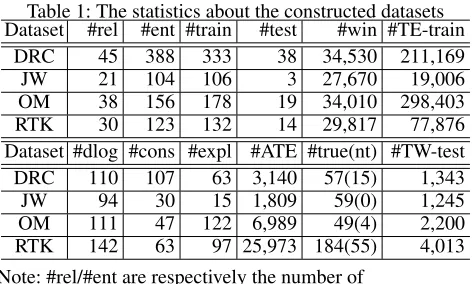
TE-training set, where TE is short for “text enhanced”. We treated the training set as the input knowledge graph and computed the complete set of TEP-based abductive text ev-idences for every triple in the test set. We call the set of triple-window pairs each of which is contained in at least one computed TEP-based abductive text evidence the TW-test set. We carefully checked every triple-window pair in the TW-test set and marked it with a Boolean flag to indicate if the sentence window on the right truly explains the exis-tence of the triple on the left. Then a computed TEP-based abductive text evidence is defined astrueif all triple-window pairs in it are marked true in the TW-test set. Table 1 reports the statistics about all of our constructed datasets.3
Experimental Results
The computation of TEP-based abductive text evidences was conducted in a laptop with 8GB memory and 2-core 2.5GHz CPU. The execution time for computing all TEP-based ab-ductive text evidences for all observations ranges from 4 sec-onds (for JW) to 28 secsec-onds (for OM). It can be seen from Table 1 that, for all datasets, the set of TEP-based explana-tions containsnontrivialones that are not the given obser-vation itself, while for all datasets but JW, there exist true TEP-based abductive text evidences that are extended from nontrivial TEP-based explanations. This means that the pro-posed mechanism is able to find true explanations combing both logical information and text information as expected.
The ranking of TEP-based abductive text evidences by our proposed method (CNNRP/PCNNRP) or a variant (CNNP/PCNNP) needs to learn a neural model in Figure 2
3
All datasets mentioned in Table 1 and our constructed OWL 2 RL ontologies are available at http://dataminingcenter.net/papers/ AAAI-19-data.zip.
Table 1: The statistics about the constructed datasets Dataset #rel #ent #train #test #win #TE-train
DRC 45 388 333 38 34,530 211,169
JW 21 104 106 3 27,670 19,006
OM 38 156 178 19 34,010 298,403
RTK 30 123 132 14 29,817 77,876
Dataset #dlog #cons #expl #ATE #true(nt) #TW-test DRC 110 107 63 3,140 57(15) 1,343
JW 94 30 15 1,809 59(0) 1,245
OM 111 47 122 6,989 49(4) 2,200
RTK 142 63 97 25,973 184(55) 4,013
Note: #rel/#ent are respectively the number of
relations/entities in the knowledge graph, #train/#test are respectively the number of triples in the training/test set, #win is the number of sentence windows, #TE-train/ #TW-test are respectively the number of records in the TE-training/TW-test set, #dlog/#const are respectively the number of datalog rules/constraints in the Horn theory, #expl/#ATE/#true(nt) are respectively the number of TEP-based explanations/TEP-based abductive text evidences/true TEP-based abductive text evidences (true ones extended from nontrivial TEP-based explanations).
from the TE-training set and then apply the learnt model to compute certain values used in Formula (8) or Formula (9). These experiments were conducted in a workstation with 64GB memory and 28-core 2.2GHz CPU. In order to learn and apply a neural model, we split a sentence window into a set of mentions of human entities and singleton charac-ters in the remaining part. We did not split a sentence win-dow into words because existing word segmentation tools do not work well for ancient Chinese sentences in the mas-terpieces. We treated every split unit as a word, where the word embedding is randomly instantiated and learnt during training of the neural model. For training the model we uni-formly set the dimension for word embeddings as 100, the dimension for position embeddings as 10, the dimension for sentence embeddings as 100 for CNN and 150 for PCNN, the window size in CNN/PCNN as 2, the initial learning rate as 0.001 for Adam (Kingma and Ba 2014), the probability for applying dropout (Srivastava et al. 2014) as 0.1, and the learning epochs as 20. The execution time for learning a neu-ral model ranges from 7 minutes (for JW) to 18 hours (for OM). On the contrary, applying the learnt model to compute ranks for all TEP-based abductive text evidences is done in 2 seconds for every dataset.
To compare the five methods for ranking each group of based abductive text evidences that have the same TEP-based explanation, we introduce two metrics from the field of Information Retrieval. The first metric, written Rankmin,
is defined as the minimum rank of true TEP-based abductive text evidences in the sorted list of a group of TEP-based ab-ductive text evidences. The smaller Rankmin is, the earlier
Table 2: The performance measured by average Rankmin
Dataset CNNRP PCNNRP CNNP PCNNP Rand DRC 12.714 6.524 25.095 20.095 34.331 JW 4.000 4.500 19.500 22.500 10.333 OM 3.825 4.875 6.173 6.753 6.361 RTK 4.786 6.071 8.286 6.571 9.333
Table 3: The performance measured by average NDCG Dataset CNNRP PCNNRP CNNP PCNNP Rand
DRC 0.553 0.595 0.535 0.512 0.327 JW 0.543 0.541 0.472 0.480 0.504 OM 0.596 0.571 0.529 0.491 0.543 RTK 0.664 0.614 0.607 0.602 0.417
the discounted cumulative gain (DCG) of the current sorted list to the DCG of the ideal sorted list where all true TEP-based abductive text evidences are ranked at top places. The value of NDCG is ranged from 0 to 1. The larger NDCG is, the closer the sorted list is to the ideal one, thus the better the sorted list is. Formally, NDCG is defined as
NDCG= DCG
IDCG =
Pn
i=1
reli
log2i+1
Pm
i=1 1 log2i+1
, (10)
where n is the number of TEP-based abductive text evi-dences,m is the number of true TEP-based abductive text evidences, andreli = 1if theithTEP-based abductive text
evidence in the sorted list is true orreli= 0otherwise.
Table 2 and Table 3 report the average Rankminand the
average NDCG, respectively, for all groups of TEP-based abductive text evidences, where the best value achieved by all compared methods is displayed in bold and the value for the random method (Rand) has been averaged by 10 ran-dom runs. It can be seen that, ranking sentence windows by their contributions to the proof of the corresponding relation which are computed by an attention mechanism is much ef-fective than random ranking or ranking by their probabili-ties on inferencing the corresponding relation, in giving true TEP-based abductive text evidences high-ranks. Ranking by probabilities is sometimes worse than random ranking, be-cause the computed probabilities have been normalized lo-cally and the comparison result between two normalized probabilities for a pair of sentence windows may not truly reflect the comparison result between two support degrees for the same pair of sentence windows.
Related Work
This work is most related to those studies addressing the au-tomatic seeking of external evidences to validate triples in a knowledge graph. The DeFacto (Deep Fact Validation) ap-proach (Gerber et al. 2015) validates triples by finding trust-worthy sources for them on the Web. It transforms triples into natural language sentences and retrieves web pages mention-ing these sentences by a web search engine. The TTA (Triples Accuracy Assessment) approach (Liu, d’Aquin, and Motta 2017) validates triples by finding consensus of matched
triples from other knowledge graphs. Either of the above ap-proaches exploits evidences of a single type and does not consider logical information. As far as we know, our pro-posed approach is the first one that combines logical infor-mation and textual inforinfor-mation to validate triples.
By treating a knowledge graph as an ABox and a logical theory as a TBox, the problem of computing abductive ex-planations for a triple can be viewed as a problem of ABox abduction (Elsenbroich, Kutz, and Sattler 2006) in descrip-tion logics (DLs) (Baader et al. 2003) which are fragments of first-order logic. ABox abduction aims to compute expla-nationsfor anobservation, where the observation is usually an ABox assertion which can be treated as a triple, and an explanation is a set of ABox assertions whose addition to a consistent DL knowledge base (KB) made up of a TBox and an ABox enforces entailment of the observation while keep-ing the KB consistent. Existkeep-ing methods for ABox abduction are restricted to specific DLs. An early study for ABox ab-duction (Peraldi et al. 2007) proposes a backward inference method. It restricts the TBox axioms to specific forms and does not guarantee minimality for the output explanations. To compute all minimal explanations in an ALC KB, the study (Klarman, Endriss, and Schlobach 2011) proposes a method based on resolution and tableau. A subsequent study (Halland and Britz 2012) proposes a purely tableaux-based method for ABox abduction inALC. Another study (Ma et al. 2012) extends the method proposed in (Klarman, Endriss, and Schlobach 2011) to work forALCIKBs. All the above methods do not guarantee termination in computing all min-imal explanations. In (Du et al. 2011) the termination prob-lem is tackled by restricting explanations to be constructed from a finite vocabulary. A sound and complete method is accordingly proposed to compute all minimal explana-tions in Horn-SHIQ KBs. It is later extended by (Wang et al. 2015) to handle OWL 2 EL KBs. In (Du, Wang, and Shen 2014) a tractable method for ABox abduction is pro-posed. It only works for KBs that are first-order rewritable. In (Del-Pinto and Schmidt 2017) a forgetting based method for ABox abduction inALCis proposed. In contrast to the above methods, we propose a novel method for computing certain minimal explanations, where SBE-patterns are intro-duced to confine the structure of minimal explanations. It is applicable to many fragments of first-order logic including DLs as long as a reasoner for the fragment exists to perform consistency checking or entailment checking.
This work addresses not only how to compute abduc-tive explanations but also how to rank abducabduc-tive text evi-dences that are extended from abductive explanations. The proposed ranking methods rely on an attention mechanism for weighting different sentence windows that contribute to explaining a given triple. Hence any attention-based method for distantly supervised learning of relation extraction mod-els, besides (Lin et al. 2016), can be employed in this work. We refer the interested reader to (Kumar 2017) for more neu-ral models for relation extraction.
Conclusions and Future Work
text evidence for new triples. Both logical information and text information are combined in an abductive text evidence to prove the existence of a new triple. From the angle of practice, we proposed a special class of abductive text evi-dences namely TEP-based abductive text evidence which is easy to compute. Accordingly, we proposed a method for computing the complete set of TEP-based abductive text ev-idences. Moreover, we proposed a method for sorting TEP-based abductive text evidences TEP-based on distantly supervised learning. The efficiency and effectiveness of our proposed methods have been demonstrated in our experiments.
As mentioned before, a TEP-based abductive text evi-dence is hard to contain any entity-type triple of the form
he,type, tialthough entity-type triples can be used as other triples in our proposed computational framework. In our fu-ture work we plan to define other classes of abductive text evidences that can contain entity-type triples as required. In addition, we plan to develop more elaborate ranking meth-ods to give true abductive text evidences higher ranks.
Acknowledgements
This work was partly supported by National Natural Science Foundation of China (61375056 and 61876204), Guangdong Natural Science Foundation (2018A030313777), Science and Technology Program of Guangzhou (201804010496), Scientific Research Innovation Team in Department of Ed-ucation of Guangdong (2017KCXTD013), IBM Faculty Award and the EU Marie Currie K-Drive project (286348).
References
Baader, F.; Calvanese, D.; McGuinness, D. L.; Nardi, D.; and Patel-Schneider, P. F., eds. 2003. The Description Logic Handbook: Theory, Implementation, and Applica-tions. Cambridge University Press.
Del-Pinto, W., and Schmidt, R. A. 2017. Forgetting-based abduction in ALC. In Proceedings of the Workshop on Second-Order Quantifier Elimination and Related Topics (SOQE), 27–35.
Du, J.; Qi, G.; Shen, Y.; and Pan, J. Z. 2011. Towards prac-tical ABox abduction in large OWL DL ontologies. In Pro-ceedings of the 25th National Conference on Artificial Intel-ligence (AAAI), 1160–1165.
Du, J.; Pan, J. Z.; Wang, S.; Qi, K.; Shen, Y.; and Deng, Y. 2018. Validation of growing knowledge graphs by abduc-tive text evidences. Technical report, Guangdong Univer-sity of Foreign Studies. http://dataminingcenter.net/papers/ AAAI-19-TR.pdf.
Du, J.; Qi, G.; and Ji, Q. 2009. Goal-directed module extrac-tion for explaining OWL DL entailments. In Proceedings of the 8th International Semantic Web Conference (ISWC), 163–179.
Du, J.; Wang, K.; and Shen, Y. 2014. A tractable approach to ABox abduction over description logic ontologies. In Pro-ceedings of the 28th AAAI Conference on Artificial Intelli-gence (AAAI), 1034–1040.
Eiter, T., and Gottlob, G. 1995. The complexity of logic-based abduction. Journal of the ACM42(1):3–42.
Elsenbroich, C.; Kutz, O.; and Sattler, U. 2006. A case for abductive reasoning over ontologies. InProceedings of the 3rd OWLED Workshop on OWL: Experiences and Direc-tions.
Gerber, D.; Esteves, D.; Lehmann, J.; B¨uhmann, L.; Usbeck, R.; Ngomo, A. N.; and Speck, R. 2015. Defacto - tempo-ral and multilingual deep fact validation. Journal of Web Semantics35:85–101.
Grau, B. C.; Horrocks, I.; Motik, B.; Parsia, B.; Patel-Schneider, P. F.; and Sattler, U. 2008. OWL 2: The next step for OWL. Journal of Web Semantics6(4):309–322. Halland, K., and Britz, K. 2012. ABox abduction in ALC using a DL tableau. InProceedings of the South African In-stitute of Computer Scientists and Information Technologists Conference (SAICSIT), 51–58.
Kalyanpur, A.; Parsia, B.; Horridge, M.; and Sirin, E. 2007. Finding all justifications of OWL DL entailments. In Pro-ceedings of the 6th International Semantic Web Conference (ISWC), 267–280.
Kingma, D. P., and Ba, J. 2014. Adam: A method for stochastic optimization. CoRRabs/1412.6980.
Klarman, S.; Endriss, U.; and Schlobach, S. 2011. ABox ab-duction in the description logicALC.Journal of Automated Reasoning46(1):43–80.
Kumar, S. 2017. A survey of deep learning methods for relation extraction.CoRRabs/1705.03645.
Lin, Y.; Shen, S.; Liu, Z.; Luan, H.; and Sun, M. 2016. Neu-ral relation extraction with selective attention over instances. InProceedings of the 54th Annual Meeting of the Associa-tion for ComputaAssocia-tional Linguistics (ACL), 2124–2133. Liu, S.; d’Aquin, M.; and Motta, E. 2017. Measuring ac-curacy of triples in knowledge graphs. In Proceedings of the 1st International Conference on Language, Data, and Knowledge (LDK), 343–357.
Ma, Y.; Gu, T.; Xu, B.; and Chang, L. 2012. An ABox abduction algorithm for the description logic ALCI. In Pro-ceedings of the Intelligent Information Processing VI - 7th IFIP TC International Conference (IIP), 125–130.
Peraldi, I.; Kaya, A.; Melzer, S.; M¨oller, R.; and Wessel, M. 2007. Towards a media interpretation framework for the se-mantic web. InProceedings of 2007 IEEE/WIC/ACM Inter-national Conference on Web Intelligence (WI), 374–380. Srivastava, N.; Hinton, G. E.; Krizhevsky, A.; Sutskever, I.; and Salakhutdinov, R. 2014. Dropout: a simple way to pre-vent neural networks from overfitting. Journal of Machine Learning Research15(1):1929–1958.
Wang, Z.; Chitsaz, M.; Wang, K.; and Du, J. 2015. To-wards scalable and complete query explanation with OWL 2 EL ontologies. InProceedings of the 24th ACM Interna-tional Conference on Information and Knowledge Manage-ment (CIKM), 743–752.