Early V
iew
complexity scale in medication errors, Iran
Marzieh Pazokian1, Mansoureh Zagheri Tafreshi2, MaryamRassouli3, Farid Zayeri4
Abstract
Twenty-first century challenges of nursing work is increasing complexity of care in the workplace. The most common medical errors that identified are medication errors. With changing patterns of health services, the complexity increases in all workplaces. The aim of study was assessing factor analysis, validity, reliability and psychometric characteristics of nursing care complexity scale in medication errors. In this study the scale translates by Wilde and colleagues model, 115 Iranian nurses were selected by convenience sampling method. Data was analyzed using SPSS-18. The age of nurses was 34.8± 7.87 years and almost them were female (n=78) and mean work experience in ward was 6.07±4.13 years. The factor analysis, rotated matrix determined 5 factors: 1) organizational technology, 2) client condition, 3) critical care condition,4) decision making methods and 5) creativity in care. Also reliability using Cronach's alpha coefficient showed moderate reliability of scale (α=0.61) and correlation coefficient in test- retest emerged (r=0.88). Although translations of care complexity scale in medical errors has satisfactory reliability and validity and can be used in the Iranian health system.
Keywords: Medication Error, Nursing Care, Reliability, Validity Journal of Research & Health
Social Development & Health Promotion Research Center
Vol. 5, No.1, Spring 2015 Pages: 74-81 Original Article
1. PhD Student of Nursing Department, School of Nursing and Midwifery, Shahid Beheshti University of Medical Sciences, Tehran, Iran
2. Correspondence to: Assistant Professor of Nursing Department, School of Nursing
and Midwifery, Shahid Beheshti University of Medical Sciences
Tel/Fax: +98 51 55250546 Email: [email protected]
3. Associate Professor of Nursing Department, School of Nursing and Midwifery, Shahid Beheshti University of Medical Sciences, Tehran, Iran
4. Associate Professor of Biostatistics Department, School of Nursing & Midwifery, Shahid Beheshti University of Medical Sciences, Tehran, Iran
Received: 17 Jun 2013 Accepted: 18 Sep 2013
How to cite this article: Pazokian M, Zagheri Tafreshi M, Rassouli M, Zayeri F. Psychometric characteristics of nursing care complexity scale in medication errors, Iran, J Research Health2015; 5(1): 74-81.
Introduction
In the 21st century, challenge in nursing work is the increasing complexity of care in health systems. The changing pattern of health services has increased complexity in every workplace. Thus, nurses are unable to anticipate many factors that lead to desirable outcomes and various levels of patient satisfaction [1]. Understanding the complexity of healthcare systems is essential for improving workplace in these systems [2]. In understanding nursing work, knowledge of complexity has been increasingly used as an appropriate approach
for explaining organizational dynamics and nursing work [3].
cause of death next to car accidents, diabetes, renal diseases, breast cancer, and influenza in America [6], and the American Medical Institute has considered it as one of 5 groups of medical errors [7]. Bates et al. reported that 2% to 14% of patients experience at least one medication error in the course of their hospitalization, and a minimum of one medication error occurs daily for patients in any hospital [8]. In relation to administration of drugs by nurses, Baker et al. reported that one out of every 5 drugs administered for patients leads to a medication error [9]. Researchers have shown that complexity of environment such as distraction, workload, number of staff, and working conditions are contributing factors to medication errors [10, 11]. Inappropriate workplace such as large workload, irregular work and personnel shortages, distraction, delay in administration of drugs to patients, in addition to inappropriate patient-nurse ratio increase medication errors [12-14]. Meanwhile, complexity of care increases in patients hospitalized with acute and critical conditions, and nurses are forced to simultaneously organize, prioritize, and manage changes in clinical information of different patients [15-16]. Considering importance of complexity of care in medication errors by nurses, and its role in providing strategies to prevent errors, the need is felt for a valid and reliable tool for measurement of complexity of care in nurses’ medication error model, to enable recommendations of strategies for reduction, control and prevention of medication errors and interventions to authorities. Although there are tools for measurement of complexity of care, such as the 14-item Orton et al. scale that was modified by Mark in 1992 and again by Mark et al. in 2004, and 15-item Walskois scale (2005), the latter considers all aspects of patient care comprehensively. The 15-item Walskois scale “measuring complexity in nursing care centers” was designed in 2005, and because of its comprehensiveness in considering all aspects of patient care, it is used in this study to assess complexity of nursing care in medication errors, and since so far no appropriate tool for measuring complexity in medication errors has
been designed and undergone psychometrics in Iran, thus present study aims to conduct psychometric assessment of “complexity of care in medication errors” tool according to Reason Human error model, to help meeting community needs.
Method
The complexity of care tool was designed by Donna Maria Walskois in 2005 as her Nursing PhD thesis from University of Arizona. This tool contains 45 items, and assesses aspects of patient care, and organizational science and technology, with 4-option Likert scale (from totally disagree to totally agree). Following factor analysis, 30 of its items were merged with other items. Generally, 9 items concern the patient, 7 are about performance, and 9 are about patient care knowledge. Finally, a 15-item short-form was obtained. Content validity was confirmed using specialized nurses and extensive theoretical knowledge, factor analysis, and construct validity, and Cronbach’s alpha (α=0.82) and test-retest correlation coefficient (r=0.72) were also found [20].
For psychometrics of complexity of care tool, permission was obtained from the tool designer through correspondence, and then translation and psychometric processes began using Wild et al. method [21], in which 8
stages are mentioned for translation and
cultural adjustment of the tool including: 1)
translation of questionnaire from original to
target language, 2) combination and merger
of initial translations into a single translation,
3) translation of final translated version back into original language, 4) review of translated
version from target to original language,
the translated tool was made available to a university faculty member fluent in English language, to translate it back into English. Then, this English version was compared with the original, and accordingly revised. In the fifth step, complexity of care tool was studied by 12 nurses from various departments of teaching centers affiliated to Shahid Beheshti University of Medical Sciences, and following review of returned questionnaires, items were simplified again in terms of writing and meaning (6th step). In the seventh step, face validity and reliability (internal consistency and stability) of complexity of care tool were assessed. In face validity, the tool was assessed and revised according to opinions expressed by 12 nursing experts. Reliability of the tool was confirmed using internal consistency and stability through Cronbach’s alpha and correlation coefficient between test-retest stages, and construct validity was also assessed using confirmatory factor analysis to assess factorial structure.
Study population comprised nurses working in different departments of teaching centers affiliated to Shahid Beheshti University of Medical Sciences, Tehran, Iran. Study inclusion criteria were minimum of a degree qualification, at least two years work experience in a single department, and work in different shifts. Recommended number of participants for factor analysis is 5-10 participants per item.
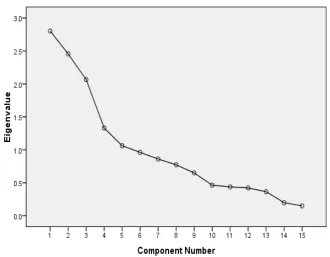
Furthermore, since factor analysis is conducted according to correlation 100-200 participants suffice; even though there is not a clear rule for participant size [22]. In this study, 115 nurses were selected using convenient sampling method. Data were analyzed using SPSS-18 software. Adequacy of sampling was assessed with Keiser-Meier-Elkin test, and Bartlett test to decide if the correlation matrix had any significant difference with zero, and based on that, if factor analysis was justified or not, for which 278.003 was found (P<0.001). Screed plot and eigenvalue were used to determine constituent factors of the complexity of care tool (Figure 1), and rotational varimax for simplifying and interpretability of factorial structure. Study objectives and process were explained to all participants, and their written consents were obtained. They were also assured of confidentiality of data, and that they could withdraw from study at any stage. Also, if so desired, they could be informed of the results.
Results
According to present study results, mean age of participating nurses was 34.89±7.87 years, and the majority were female (n=78), with mean work experience of 6.07±4.13 years in their current department (Table 1).
Table1 Demographic charactristics 0f the prticipants
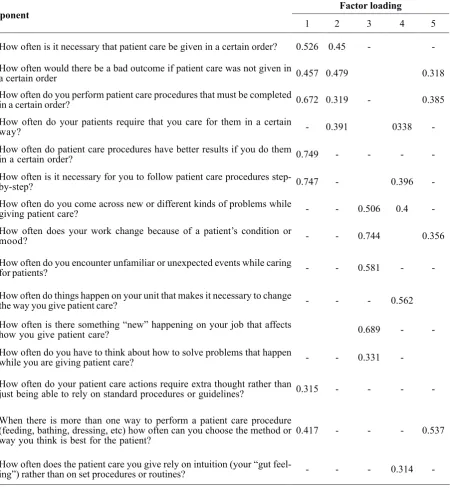
Results of factor analysis for assessment of construct validity are presented in Table 2. Rotational matrix identified 5 factors: most items (11 items) are associated with factor loading of 1 and least (8 items) with factor loading of 5. Next, factor loadings found were interpreted and named. Factor loading 1: organizational technology, factor loading 2: patient conditions,
3: critical care conditions, 4: decision-making methods, and 5: creativity in care. Factor loadings in excess of 0.3 were considered significant. Furthermore, Cronbach’s alpha was found for complexity of care tool (α=0.61), which indicated moderate reliability of the tool. Correlation coefficient between two stages was calculated (r=0.88) (Table 3).
Table 2 Rotated component matrix of care complexity scale in medication errors among nursing
Component Factor loading
1 2 3 4 5
1 How often is it necessary that patient care be given in a certain order? 0.526 0.45 -
-2 How often would there be a bad outcome if patient care was not given in a certain order 0.457 0.479 0.318
3 How often do you perform patient care procedures that must be completed in a certain order? 0.672 0.319 - 0.385
4 How often do your patients require that you care for them in a certain way? - 0.391 0338
-5 How often do patient care procedures have better results if you do them in a certain order? 0.749 - - -
-6 How often is it necessary for you to follow patient care procedures step-by-step? 0.747 - 0.396
-7 How often do you come across new or different kinds of problems while giving patient care? - - 0.506 0.4
-8 How often does your work change because of a patient’s condition or mood? - - 0.744 0.356
9 How often do you encounter unfamiliar or unexpected events while caring for patients? - - 0.581 -
-10 How often do things happen on your unit that makes it necessary to change the way you give patient care? - - - 0.562
11 How often is there something “new” happening on your job that affects how you give patient care? 0.689 -
-12 How often do you have while you are giving patient care?to think about how to solve problems that happen - - 0.331
-13 How often do your patient care actions require extra thought rather than just being able to rely on standard procedures or guidelines? 0.315 - - -
-14 When there is more than one way to perform a patient care procedure (feeding, bathing, dressing, etc) how often can you choose the method or
way you think is best for the patient? 0.417 - - - 0.537
15 How often does the patient care you give rely on intuition (your “gut feeling”) rather than on set procedures or routines? - - - - 0.314
-Table 3 Correlation coefficient and cronach's alpha coefficient of care complexity scale
Scale Name Correlation coefficient Cronach’s alpha coefficient
Figure 1 Scree plot
Discussion
This study aimed to perform translation and psychometric assessment of complexity of care tool in medication errors. Content and face validities of the tool were confirmed for all 15 items using opinions of experts in this field. Results of factors analysis of items and Screed plot indicated unidimensionality and suitability of the tool as model of nurses’ medication errors. In factor analysis, rotation matrix identified 5 factors: Factor loading 1: organizational technology, factor loading 2: patient conditions, 3: critical care conditions, 4: decision-making methods, and 5: creativity in care.
Studies conducted at Michigan University showed that complex needs include all physical, psychological, and social aspects, which nurses should carefully assess, and measures they should take for revival, preservation and promotion of health and even for dignified death. Clinical experience are necessary for improving critical thinking, communication, collaboration and clinical skills needed for uniform care in health systems according to complex patient care requirements [23]. Factor loading 1 (organizational technology) is in fact organization’s effort for dealing with goals and
how to achieve them [15]. Patient condition as the second factor loading means that patient
is the instrument of health systems, and his
conditions are changes created in him, and nursing personnel try to improve, meet needs, and ultimately discharge patient in desirable state of health [24]. As the third factor loading, in acute care conditions, critically ill patients require urgent admission to intensive care
units, and any delay in their transfer leads to
designing an effective management structure is the best guide, given organizational and work complexities [28]. Another study conducted by Mark (1996 and 2004) in emergency departments showed that organizational structure is the same as professional nursing actions that include independence of the nurse, control over operations and doctor-nurse interaction in critical situations in patient care [18-19]. In the opinion of Payro, complexity is the same as technology, which shows work done by organization. However, in previous studies, researchers used complexity in acute care [17, 19], mobile care and in public health [29]. Linaker argues that use of complexity theory in nursing interventions improves primary care [30]. Studies have shown that successful interventions based on complexity theory eliminate at least one problem or obstacle, and thus, design of interventions should be in accordance with conditions, actions and dynamics of workplace. In fact, there are challenges in behavior change in clinical professionals [31-33]. Meanwhile, Mir asserts that, in addition to complexity of care, patient’s complex needs can require a totally dynamic, harmonized team care [34]. Cologan et al. argued that, considering that complexity of care includes 3 meanings: 1) nursing inclination, including concept of dependence, intensity and complexity of care of patient, 2) workload, which includes concept of nursing inclination and all activities associated with patient, and 3) patient assessment, including: intensity of disease and tendency for care, importance of all aspects of care is essential [35].
In this study, reliability of the tool was confirmed using Cronbach’s alpha for internal consistency and correlation coefficient between test-retest, and showed stability of the tool.
Among study limitations, not reporting medication errors by nurses, because of fear of punishment, reprimand, etc can be cited, which may have occurred beyond researcher’s control. Attempts were made in the course of study to control this limitation by assuring participants of confidentiality of data and anonymity of questionnaires.
Conclusion
In this study, psychometric assessment of complexity of care tool was carried out and was confirmed. Given the process of translation and cultural adjustment, it can be asserted that this tool can also be used in Iran. In fact, psychometrics of such tools provides essential information for development of an appropriate structure to achieve care objectives and policies, and in any health system, before medication interventions, complexity of nursing care should first be conceptualized and then measured, in order to provide desirable level of care in the organization. It is recommended that in future studies criterion validity should also be assessed, where other similar tools exist.
Acknowledgments
This paper is part of the PhD dissertation of the first author. This study has been supported by Shahid Beheshti University of Medical Sciences, Iran. We would like to thank of nursing staff in Emam Hossain, Taleghani and Shohada Tajrish hospitals that participate in the research.
Contributions
Study design, Data collection and Analaysis manuscript Preparation: MP
Manuscript preparation: RM. Manuscript preparation: Z,TM Data collection and analysis: ZF
Conflict of Interest
"The authors declare that they have no competing interests."
References
1- Rosemary D. Challenges for Nursing in the 21st Century: Increasing Complexity. Nursing Economic2005; 23(6):312-318.
2- American Association of Critical Care Nurses. Available at URL: http://www.aacn.org/.accessed February 5, 2012.
4- Mayo AM, Duncan D. Nurse perceptions of medication errors: What we need to know for patient safety.
JNCQ2004; 19(3) : 209-217
5- Sanghera IS, Franklin BD, Dhillon S. The attitude &beliefs of health care professionals on the cause and reporting of medication error in a UK intensive care unit.
Anesthesia2007; 62 (1): 53-61.
6- National Coordinating Council for Medication Error & Prevention. Available from : http://www.nccmerp.org/ aboutMedErrors.html. accessed February 5, 2012. 7- Mrayyan MT, Shishani K, Al-FouriI. Rate, cause & reporting of medication error in Jordan: nurse perspective,
JNM2007; 15 (6):659-670.
8- Institute of Medicine (2013). Medical errors. Availablefrom:https://www.premierinc.com/safety/ topics/patient_safety/index_1.jsp. accessed February 5, 2012.
9. Baker GR, Norton PG, Flintoft V, et al. the Canadian adverse events study: the incidence of adverse events among hospital patients in Canada.
CMAJ2004;170(11):1678-1686.
10- Hicks RW, Becker SC, Krenzischeck D, Beyea S C. Medication errors in the PACU: a secondary analysis of MEDMARX findings. JPN2004; 19(1):18-28.
11- Taxis K, Barber N . Causes of intravenous medication errors: an ethnographic study. Qual Saf Health Care2003; 12(5): 343-347.
12- Kralewski JE, Dowd BE, Heaton A & Kaissi A. The influence of the structure and culture of medical group practices on prescription drug errors. Med Care2005; 43(8):817-825.
13- Seki Y, Yamazaki Y. Effects of working conditions on intravenous medication errors in a Japanese hospital.
JNM2006; 14(2) : 128-139.
14- Cohen H, Robinson E. S, Mandrack M. Getting to the root of medication errors: Survey results. Nursing2003; 33(9):36-45.
15- Perrow C. A framework for the comparative analysis of organizations. ASR1967; 32(2) :194-208.
16- Wolf, ZR, Hughes, RG. Error Reporting& Discloser. In: Patient Safety &Quality: An Evidence Based Handbook for Nurses, Rockvill .MD: AHRQ Publication2008, 1-47. 17- Overton P, Schneck R, Hazlett C B. An empirical study of the technology of nursing subunits. ASQ1977, 22(2): 203-219.
18- Mark B. A. Characteristics of nursing practice models.
JNA1992, 22(11): 57-63.
19- Mark B A, Harless DW, McCue M, Xu Y. A longitudinal examination of hospital registered nurse
staffing and quality of care. HSR2004, 39(2):279-300. 20- Velasquez DM . Measuring Nursing Care Complexity in Nursing Homes. A Dissertation Submitted to the Faculty of the College Of Nursing In Partial Fulfillment of the Requirements For the Degree of Doctor Of Philosophy In the Graduate College. 2005
21- Afrasiabi Far A, Yaghmaei F. Abduli S, Abdsydi J. The research questionnaire was translated and adapted from a cultural perspective. Journal of Nursing and
Midwifery, SBUMS1385;54:58-67. [In Persian]. 22- Munro B. Statistical method for health care research, 5th :Lippincott Williams & Wilkins; 2005.
23- University of Michigan School of Nursing's Nurse Midwife Program. Available from :http://nursing.umich. edu/academic-programs/nursing-courses/nursing-care-patients-complex-needs. It is a snapshot of the page as it appeared on 9 Nov 2012 13:28:46 GMT. accessed February 5, 2012.
24- Alexander JW, Mark B. Technology and structure of nursing organizations. Nurs & Health care. 1990;11(4): 195-199.
25- Hov R, Hedelin B, Athlin E. Good nursing care to ICU patients on the edge of life. Intensi and Critic Care Nurs2007;23(6):331-41.
26- Institute of Medicine (IOM). Wunderlich G.S. & Kohler, P.O. Eds.)Improving the quality of long-term care. Washington, DC: National Academy Press.2001. 27- Aliyari sh, Ebrahimi Q . Creativity in nursing.
AUMS2007;7(2):5
28- Schnelle JF, Simmons SF, Harrington C, Cadogan, M, Garcia E, Bates- Jensen BM. Relationship of nursing home staffing to quality of care. HSR: HSR2004; 39(2): 225-250.
29- Alexander J, Kroposki M. Using a management perspective to define and measure changes in nursing technology. JAN2001; 35(5):776-783.
30- Litaker D, Tomolo A, Liberatore V, Stange K, and Aron D. Using Complexity Theory to Build Interventions that Improve Health Care Delivery in Primary Care. J Gen Intern Med2006; 21(2): 30–S34. 31- Berwick DM. Disseminating innovations in health care. JAMA2003;289:1969–75.
32- Greco PJ, Eisenberg JM. Changing physicians' practices. N Engl J Med1993;329:1271–4.
33- Eisenberg JM. Physician utilization: the state of research about physicians' practice patterns. Med Care1985;23:461–83.
nursing home stays for the elderly and the physically and mentally disabled. Health Aff2001;30(3):4125.