Modern Journal of Language Teaching Methods ISSN: 2251-6204
Vol. 7, Issue 8 , August 2017
Page 1
Modern Journal of Language Teaching Methods ISSN: 2251-6204
Vol. 7, Issue 8 , August 2017
Page 2
Modern Journal of Language Teaching Methods (MJLTM)
ISSN: 2251 - 6204
www.mjltm.com
Editor – in – Chief
Cristina UNGUREANU,Associate Professor in University of Pitesti
Editorial Board:
1.
Hamed Ghaemi,Assistant Professor in TEFL,Islamic Azad University (IAU),Iran
2.
Domingo Docampo Amoedo,Full Professor,Department: Signal Theory and
Communications, Vigo University,spain
3.
Barbara Sicherl Kafol,Full Professor of Music Education University of
Ljubljana,slovenia
4.
Agüero-Calvo Evelyn,Professor of Mathematics,Technological Institute of Costa
Rica
5.
Tito Anamuro John Albert,Assistant professor Universidad del Norte,Colombia
6.
Dlayedwa Ntombizodwa,Lecturer,University of the Western Cape,South Africa
7.
Doro Katalin,PhD in Applied Linguistics,Department of English Language
Teacher Education and Applied Linguistics,University of Szeged,Hungary
8.
Dutta Hemanga,Assistant Professor of Linguistics,The English and Foreign
Languages University (EFLU),India
9.
Fernández Miguel,PhD,Chicago State University,USA
10.
Grim Frédérique M. A.,Associate Professor of French,Colorado State
University,USA
11.
Izadi Dariush,PhD in Applied Linguistics,Macquarie
University,Sydney,Australia
Modern Journal of Language Teaching Methods ISSN: 2251-6204
Vol. 7, Issue 8 , August 2017
Page 3
12.
Kaviani Amir,Assistant Professor at Zayed University,UAE
13.
Kirkpatrick Robert,Assistant Professor of Applied Linguistics,Shinawatra
International University,Thailand
14.
Mouton Nelda,PhD in Education Management,North-West University
(NWU),South Africa
15.
Naicker Suren,Department of Linguistics and Translation,University of South
Africa
16.
Ndhlovu Finex,PhD,Linguistics Programme,University of New
England,Australia
17.
Raddaoui Ali Hechemi,PhD,Associate Professor of Applied
Linguistics,University of Wyoming in Laramie,USA
18.
Rolstad Kellie,PhD,Associate Professor of Education,University of
Maryland,USA
19.
Shahbazirad Mohammad,PhD candidate in English language and
Literature,Yerevan State University,Armenia
20.
Stobart Simon,PhD,Dean of Computing,Teesside University,UK
21.
Suszczynska Malgorzata,Senior Assistant Professor,University of
Szeged,Hungary
22.
Weir George R. S.,PhD in Philosophy of Psychology,University of
Strathclyde,Glasgow,UK
23.
Zegarac Vladimir,PhD,University of Bedfordshire,UK
Modern Journal of Language Teaching Methods ISSN: 2251-6204
Vol. 7, Issue 8 , August 2017
Page 4
Abstracting/Indexing
Index
Copernicus 2011
Modern Journal of Language Teaching Methods ISSN: 2251-6204
Vol. 7, Issue 8 , August 2017
Page 5
Linguistics Abstract
EBSCO Publication
Lulu Publication
Modern Journal of Language Teaching Methods ISSN: 2251-6204
Vol. 7, Issue 8 , August 2017
Page 6
Directory of Open Access Journals
ProQuest
Modern Language Association
Cabell's Directories
Modern Journal of Language Teaching Methods ISSN: 2251-6204
Vol. 7, Issue 8 , August 2017
Page 7
COPE
Directory of Research Journal Indexing (DRJI)
Indian Citation Index
Modern Journal of Language Teaching Methods ISSN: 2251-6204
Vol. 7, Issue 8 , August 2017
Page 8
International Society of Universal Research in Sciences
Ulrich's
Modern Journal of Language Teaching Methods ISSN: 2251-6204
Vol. 7, Issue 8 , August 2017
Page 9
Table of Contents
Meeting of Surrealism and Magic Realism in Modern Novel “Scorpion on the Stairs of Andimeshk Railway Station”
Kazem Dezfulian (PhD), Narjes Arjmand
Perceived Teacher Self-efficacy and Burnout: A Study of Relations and Predictors among EFL Teachers
Ebrahim Khezerlou
The Differences between Novice and Experienced Language Teachers in Performing Complex Speaking Tasks
Farzad Rostami, Fouzie Ahmadi
A Cognitive Study of Polysemy in Adverbs of Azarbaijani Turkish
Mohammad Reza Oroji , Naser Abbasi
Verbal Protocol Analysis and Report in SLA and L2 Assessment
Payam Nour, Kobra Tavassoli
Complex Dynamic Systems Theory (CDST) Approach in SLA
Muhammad Makhdoumi, Hanye davatgari Asl, Masoud Zoghi
The Application of Complex Dynamic Systems Theory (CDST) in Language Learning Histories (LLHs)
Muhammad Makhdoumi, Hanye davatgari Asl, Masoud Zoghi
EFL learners' Production of lexical Collocations as a Function of Feedback Type
Maryam Mousavi , Abbas Ali Zarei
Language as a Social Phenomenon Relying on Bakhtin’s Dialogism Fatima Araji
A comparative criticism of Feminism in Virginia Woolf's "The Lady in the Looking-Glass: A Reflection" and Moniroo Ravanipoor's "The Gray Friday"
Sedigheh Badiei
The impact of raising awareness of textual patterns on Iranian EFL learners reading comprehension.
Laaya Jafari
Folktale discourse as an object lingvo-cognitive research
Eugenia M. Abysheva
Attitude toward usefulness of mathematics of Costa Rican high school students
Evelyn Agüero-Calvo, Luis Gerardo Meza-Cascante, Zuleyka Suárez-Valdés-Ayala
Representation of female central character in the Novel "El Aswad Yalikou Biki (Black Suits You so Well)", by Ahlam Mosteghanemi, the Algerian Writer .
Maryam Akbari Mousaabadi
An analysis of Lak Students Language Transfer in Learning and Using Persian
Ali Sattari,Mohammad Reza AhmadKhani,Bahman Zandi,Mehdi Sabzevari
Perception Peculiarities of Image Advertising Polycode Texts (Some Results of Experimental Research)
Olga S. Zubkova, Antonina V. Annenkova
Modern Journal of Language Teaching Methods ISSN: 2251-6204
Vol. 7, Issue 8 , August 2017
Page 10
Beliefs regarding plurilingual competence The perspective in Catalonia through a case study of a pre-service teacher
Juli Palou Sangrà, Míriam Cabré Rocafort
The effect of contextual and socioeconomic factors on reading comprehension levels.
Pablo Cáceres-Serranoa, Jesús M. Alvarado-Izquierdob
Introducing Cross Cultural Perspectives Into Teaching Academic Writing To Master’s Students In Russia
Elina Chuikova
MOOC as complementary tool for learning basic competences in higher education
Edwin Santamaria Freire , Sonia Lopez
An Empirical Research On The Effects Of Text Choice On The Tolerance Levels Of Students
Cem Erdem
Saadi and Attar the mystical interpretations of common in ghazals’s
Reza Ashraf Zadeh(Phd),Fatemeh Beygom Seyed Asaei
The Impact of M-learning on Second Language Learning Process among University Students
Hamzeh Moradi/ Ph. D in Linguistics
Effect of a six-year long extensive reading program for reluctant learners of English
Hitoshi Nishizawa, Takayoshi Yoshioka, and Yuri Ichikawa
Assessment of Fatima Al-Zahra University campus student's attitudes on Teaching Codes of Ethics
Homa Rahmani
effective factors stimulating the academic achievement of rural in high schoole stiudent in the border area and Mahroum Helylan Ilam province year of education 2016/2017
Hoshang Almasi
In Search of an Alternative Public Policy Framework for Globalization
Julian V. Advincula Jr
Abjection in Alice Walker’s The Color Purple
Faranak. Kakanaeini
Teaching Strategies for the Alleviation of Tourism Students’ Oral Presentation Anxiety
Maleerat Ka-kan-dee
Comparison of Rhetorical Moves in the Results Section of Two Disciplines
Delaram Khansari
Exploratory study of environmental education in engineering in Chile
Ronald Mac-Ginty, Astrid Oddershede, Luis Quezada
E-Learning curriculum of Payame Noor UniversityOf view teachers and students
Maryam Ansari
The comparison of the Islamic and Western human rights
Mohammd Kadkhodaei,Terife Aghamajidi
Teachers’ Perceptions on Learner Autonomy in the EFL Educational Context in Iran
Mahdi Harati
Modern Journal of Language Teaching Methods ISSN: 2251-6204
Vol. 7, Issue 8 , August 2017
Page 11
The Use of L1 in the Process of Teaching English
Mária Hanáková, Rastislav Metruk
The Grail Theme in Medieval Romances: The Evolution of the Story
Mohammed H. Albalawi
The relationship between internet addiction and teachers' classroom management
Nasim Saeid
Thermal comfort indoors: A factor that influences the environmental perception of the occupants (Case study: Student community of the Autonomous University of Baja California).
Julio Rincón, Gonzalo Bojórquez, Claudia Calderón and Víctor Fuentes
The Effect of Teacher Recast vs. Peer Recast on Grammatical Accuracy of Iranian Introvert vs. Extrovert EFL Learners
Mohammad Reza Khodadust (Ph.D.)/ Neda Rostami
Evaluation of Machine Translation (Google Translate vs. Bing Translator) from English into Persian across Academic Fields
Mitra Saffari, Samad Sajjadi, Mehrad Mohammadi
The Kinesics of PowerPoint Presentations in the Iranian EFL Academic Classrooms
Seyyed Mohammad Ali Soozandehfar (PhD)
Neurophysiology of a Sustainable Lifestyle and the Role of Students’ Research Activity in its Formation(as exemplified by studying the “Human Ecology”course)
E.Shtakk
World of Games in the World of Education
Tomasz Szandała
Improving sports technique of stretched Gienger salto on uneven bars based on biomechanical indicators
Vladimir Potopa, Olivia Carmen Timneab, Marius Stanescuc
Immortality and immortals in Pahlavi texts and Shahnameh
Farzaneh Rashidi
Modern Journal of Language Teaching Methods ISSN: 2251-6204
Vol. 7, Issue 8 , August 2017
Page 12
The effect of austerity on the youth's self-development, relying on the three first offices of Masnavi Rumi, from the perspective of literary students of Payame Noor University (Case study: Mazandaran province)
Marzie zare
The effect of earthly mysticism(Natural) in the poem Sohrab Sepehri
Student PhD of persian language & literature
Comperative Analysis of "Egocentricity" in Sufism and Mental Self from Psychological Perspective
Sedighe Mardani, Tahere Khoshhal
Aspects of literary mysticism in fifty year resistance poetry
Tahere Ghahremanifard, Fatemeh koupa, Mortaz Mazdarani, Hossein Yazdani
The relationship between academic self-efficacy and 3 × 2 achievement goal with internal-external motivation of high school students in Manujan
Akbar jadidi mohammadabadi
Investigating the relationship between the socio-economic status of the family, parents' attitude toward reading, family literacy environment and the student's attitude toward reading with the reading comprehension of Second Grade Elementary School Students in Manoujan
Akbar jadidi mohammadabadi
Comparison of Motor Skills and Auditory Perception in Blind and Normal Children
Frahnaz Mirzaee
The role of critical thinking in predicting self-efficacy
susan jabari, Haniye Mohamad Esmaeelbeygi
The Investigation of the degree of Education System Goals Achievement in privatization policy
Kamal Asadpour (Ph.D)
The Effect of New Teaching Methods on the Academic Achievement of High School First-Year Students in Lamerd County
Khalil Foroutan, Marzyea alinejhad, Soghra Norouzi
Teachers 'role in students' interest in history lessons
Razieh Hosseini
A comparative study of archetypal mask Maulana Abdul Wahab al-Bayati mystical poems and sonnets in
Manijeh Amir Nejad Lomer ،Dr Ahmad Reza Nazari charvadeh(Author)
The Relationship between Students’ Creativity and Parenting Styles with High School Students’ Procrastination
Fatemeh Mozayyeni,Ali Jahangiri
A Comparison study of rate the Obsession of mental disorder among High school theatrical teachers and technical school students in Malayer City
Mohammad Chahardoli, Ali Mohammad Azizi, Alireza Sadra,Hdis karim davijani
The role of collaborative multimedia games with native language in children's social development
Hossein Moradimokhles
Psychotherapy Review with Family Psychology Approach in the Context of Iran's Religious and Cultural Values
Fariba Ahmadi/ Saba Simyari /Mahnaz Aliakbari
Modern Journal of Language Teaching Methods ISSN: 2251-6204
Vol. 7, Issue 8 , August 2017
Page 13
Relationship Between Anxiety and Mental Health of Patients with Depression
Mona Isvand, Fariba Hafezi
The role of family in the formation of children's personality
Vahide Abbasi, Karim Ali mohammadi , Manochehr Samberani
Expediency and rehabilitated in Iran's Law
Dr.Mohammad Hasan Javadi/ Behzad Balazadeh Nahr/ Dr.mehdi ghoreyshi
Unconsciousness (Ecstasy) in Pragmatic Mysticism and Jurisprudence
Mehdi Eftekhar
The Position Of Innateness In Dr.Motahari's Epistemology
Tahereh Majdodin, Dr.Mohammadreza Sharafi, Dr.Mohammadreza Sarmadi, Dr.Seyed Mohammad Mirdamadi
Survey the Eve penance in holey Quran
Zahra Aflatuni
investigate the relationship between early maladaptive schemas of mothers and mental health of daughters of Gonbad-e-Qabus high school
Maria Marjani, Hamze akbari
Reflection of Astronomy in Shahriar's Poetry
Ayat shokati
E-Learning curriculum of Payame Noor University Of view teachers and students
Maryam Ansari
Analyzing A Persian Translation of the Novel, “Gone with the Wind” Based on the Hyland Modality Reccognition Theory
Simin Anbarshahi, Shahnaz Goharinezhad Eidgahi
Skill Acquisition Theory and Instructed Second Language Acquisition
Roshanak Rezaei, Dr. Peyman Rajabi
A Critical Review via an Experiential Perspective
Peyman Rajabi, Negar Nowroozzadeh
Study the style of questions in sure Naml
Houman Nazemian, Abdurrahim Khourtan
Abbreviations in Poly Discourse Environment
Zerkina, N., Kostina, N.,Lomakina Ye.
Verbal Aggression in Virtual Environment
Zerkina, N., Chusavitina G., Lomakina Ye.
Perception of Human Values in Higher Education
Astrid Oddershedea , Francisco Watkinsb
Modern Journal of Language Teaching Methods ISSN: 2251-6204
Vol. 7, Issue 8 , August 2017
Page 14
Meeting of Surrealism and Magic Realism in Modern Novel “Scorpion on the Stairs of Andimeshk Railway Station”
Kazem Dezfulian (PhD), Narjes Arjmand
Professor and Faculty Member, Beheshti University, Tehran, Iran
MA Student, Department of Language and Resistance Literature, Sureh University.Tehran, Iran.
Abstract
The resistance literature plays an important role in identifying the period of the Iraqi imposed war on Iran and transferring of the features of this period to the future generations. In this regard, many writers have written their stories through a sanctification approach to the theme of war. But, some writers have focused on a different angle of the antihero personalities in their stories. The main focus of this paper is to study the novel entitled “Scorpion on the Stairs of Andimeshk Railway” written by Hossein Mortezaian Abkenar in the field of the Iran-Iraq war. Attempts have been made in the present paper to find out the literary school that the story follows by elaborating on the realistic and magical realistic elements of the story as well as by relying on the story itself. Another question of the present research is: Are all the scenes mentioned in the story real as the author claims? If the answer is in the affirmative, then where is the place of magical realism in the novel? The hypothesis of this paper is: Although there are some traces of magical realism in this novel, the story belongs to the magical realism genre. However, since the elements of magical realism are not frequently used in the novels belonging to resistance literature, Abkenari’s book deserves to be scientifically studied.
Keywords: Magical realism, realism, modern story, scorpion, Anidmeshk, railway
Introduction
The eight years of Iraqi Imposed War against Iran at the early years of the Islamic Revolution are among the tumultuous years in the history of Iran. Such an enmity has its roots deep in the past history of this land. Upon the rise to power of Saddam Hussein in Iraq, the preparations were made for a devastating war against Iran, although the political tensions between the two countries had already turned to be a turning point in the outbreak of an eight-year war. On Sept. 2, 1980, Iraqi Army invaded western territories of Iran, advanced toward Qasr-e Shirin, Khorramshahr suburbs, and Vaseliyeh, and launched heavy airstrike on Naftshahr (Yekta, 1997:32). The regime of Iraq launched extensive air and land strikes from the very beginning so that Mehrabad Airport in Tehran was hit by Iraqi airstrikes a few days after the war. The same night, Imam Khomeini issued a statement that was released by the media. He said: “You must fight this person [Saddam Hussein] with all your might. If the war – God forbidden – continued under the command of Saddam Hussein and his supporters, I will make up my mind on the nation’s national duty. I hope it will not get into that point, otherwise there will be no sign of Baghdad.” (Imam Khomeini, 2006, Vol. 13: 226) It was upon the release of this statement that revolutionary and voluntary forces rushed to the warfronts in southern Iran from across the country and forced the enemy to stop its advancement. This spoiled the dream of Saddam Hussein who had planned to finish Iran “in a matter of three days” and the resistance movement dragged the war until the next eight years. The eight-year Imposed War needs to be re-studied and re-analyzed constantly to bring its hidden and unknown dimensions to light. One such necessity is authoring books on the literature of war and resistance. The literature of resistance has thus become an influential media to convey the message of war and resistance. The literature of resistance is a type of committed writing. The theory of “committed writing” was introduced by French philosopher and novelist Jean-Paul Sartre, after the World War II in 1967. According to his theory, the literature had to abide by its social responsibility because the author is like someone who shares his country’s social and political developments via his works. “We want literature to undertake again its social responsibility, something that must have never been forgotten.” (Najafi, 1977:54) After the end of World War II, some writers followed suit and penned works based on freedom. “By literature, …, we mean an effort and struggle for awareness, for the realization of truth and for
Modern Journal of Language Teaching Methods ISSN: 2251-6204
Vol. 7, Issue 8 , August 2017
Page 15
freedom of man. This is why a writer is responsible for what he does … because what he says is synonymous with what he does.” (Sartre, 1969: 101) The theory did not receive good welcome in Iran. This is because Eastern nations’ thoughts have always superseded those of Western nations and of course, in some discourses they have gone astray. Telling the truth, however, is something that makes literature committed. “Literature of resistance is a genre of committed writing that has come to being by the people and intellectual avant-gardes of the society against any threat to their material and spiritual lives. The prime responsibility of this literature is to prevent any deviation from the genuine literature, and help its development and perfection.” (Basiri, 2009: 26)
With respect to the theory of committed writing, sometimes it is necessary to review works in the literature of war that open a different point of view to the realities of war, an example of which could be the “Scorpion on the Stairs of Andimeshk Railway Station”, a novel by Hossein Mortazaian Abkenar, on which we have developed this paper.
The novel “Scorpion on the Stairs of Andimeshk Railway Station” has focused on the eight years of Imposed War between Iran and Iraq. The author has tried to look at the war from a different point of view and constitute the theme of the story on the views of those who were afraid of war. The protagonist of the story is a soldier who has happened to be in the warfronts not upon his will, but to serve his mandatory military service. In this paper, we will first present a general morphology of the novel, then continue with recovering the components of realism and magic realism, and end up with the identification and explanation of the conflicts between these two components. The author of these lines intends to find out which component comes out victorious in the end. It should be noted that according to the first page of the book and the preliminary phrase of “Based on a true story”, the review of this novel has to be based on the components of realism and magic realism. The paper tries to clarify the fact that the author of the book has managed to develop the story into a modern short story with such components as realism (in view of the author) and surrealism and magic realism (in view of the reader).
The Plot of the Story
The protagonist of the book is an 18-year-old boy with all qualities of an ordinary young man who has been recently graduated from high school. Serving his two years of mandatory military service and on his way back home in Tehran, he receives a four-month extra duty as a penalty set by his commander. He waits in the train station to be taken back to the warfront. The author in some way tells his memories of military service in this book. The name of the protagonist of the story is not irrelevant to this claim. The author of the story was a student at guidance school when the war took place. After receiving his diploma, he is sent to the warfronts to pass his mandatory military service. His sensitive years of adolescence and youth pass in the midst of war, and a large part of his life is associated with war. The ceasefire is announced just two days after the termination of his military service. The novel is an objective narration of war and warfronts. To clarify the story better, we will hereunder focus on its morphology:
Modern Journal of Language Teaching Methods ISSN: 2251-6204
Vol. 7, Issue 8 , August 2017
Page 16
2.1 Morphology of the Book based on Modern-Story Components
The story does not follow a certain chronology of events. It is a combination of past and present events related to the protagonist of the story. In view of the conceptual structure, the author has tried to deconstruct the sanctity of the long-believed and cliché beliefs of the stories of war to give a different picture of war. He has indeed embarked on a sort of conceptual de-familiarization in characterization of the soldiers, commanders and agents of war and has thus given a different narration of the eight years of war between Iran and Iraq. His narrator is a person of commonalty, simple-minded and coward, whose mental and psychological distress augments as a result of receiving extra duty. Unlike its long-worded title, the story is rather short and developed into 19 chapters. Each chapter is only 3 to 5 pages. Brevity plays a key role in the narration. Brevity in narration, with brief, precise and non-repetitious explanations, is instrumental in this story so that sometimes a single line signifies an entirety of a paragraph in meaning. The sentences, paragraphs and chapters are indeed short in wording but elegantly meaningful because of the brevity. The chapters are connected clip-wise so that each chapter is meaningfully but implicitly connected to the next one. The chapters do not follow a chronology of events, though, and the narrator changes his point of view now and then. The narrator is sometimes third person, while at times dialogs narrate the story and some other times, like Chapter Eighteen, the narrator is first person.
“The change in point of view, or using more than one narrator, is another important specification of narration in the majority of modern stories. The realistic stories used to be narrated by a single narrator from the beginning to the end … Modernists changed the point of view and multiplied persons of narration to guide the reader toward a capacity to rearrange multiple components of narration upon his own initiative and extract a meaningful story from this plurality.” (Payandeh, 2006, Vol. 2:27)
The protagonist of the story, Morteza, is not introduced from the very beginning. In the second chapter, the writer explains the situation of Morteza after finishing two years of military service by saying “I have finished my military service.” He reads books while guarding the camp. The similarity of the title of the book he reads (Blood-shedding Train) with the contents of the author’s book is relevant to the situation of Morteza in the warfront. “Darkness had spread over the plain. The soldier was asleep in the mosquito net … A black shadow was approaching … He heard some noises … He could hear the rustle of footsteps from another side … He grabbed his gun tight with two hands … His fingers were ice-cold.” (Mortazaian Abkenar, 2007: 24-25) The conceptual interference of the two books signifies a type of de-familiarization in narration of the story. To explain what he means, the author resorts to the book he has included in his story and thus generalizes the fears of Morteza to the fears expressed on the character of the book Morteza reads: “At an inclined push of the bayonet, the soldier’s throat was torn. Blood rushed over his white shirt. Another hand of the black shadow was tight on the soldier’s mouth to prevent his screaming. The soldier shook his feet a few times in his struggle for life. His blood coated the mattress …” (Ibid: 25) The names of personalities, though few in number, are common but outstanding. Names are not important for the author. Sometimes the name of a person is allocated to his job (the driver of Alpha truck). Even characterization is made skilfully in the midst of the events.
In the very beginning, the reader distinguishes the difference between the personality of the protagonist and other combatants, and then finds out that there is no commonality between them. This is a key component of the modern novels that unlike the realist stories, the protagonist is also an antagonist at the same time. “The modernist writer usually pictures his protagonist as a solitary and dissociable person. He has no commonality with other walks of life in the society and sees himself a different personality and a stranger in the society he lives in.” (Payandeh, 2006, Vol. 2: 33) Therefore, one major component of modern novel is this that its protagonist is at the same time the antagonist. “Modern period is the era of the downfall of epics and epical heroism … The protagonist in such a story does not think of saving anyone, even himself. He is passive and receptive and instead of revolt and uprising, prefers to give up.” (Ibid: 33)
War is among the calamities created as a result of the tensions between nations. On this basis, in modern stories, “the pre-modern certainties lose weight in the face of modern unpredictable situation. In the short
Modern Journal of Language Teaching Methods ISSN: 2251-6204
Vol. 7, Issue 8 , August 2017
Page 17
stories of our time, the pre-modern certainty is replaced with skepticism and existential distress. For these reasons, the plot of the modern short story cannot be based on a cause and effect relation as realistic stories are.” (Ibid)
Another privilege with this book deals with the linguistic explanations and games. The phrase “eyes frozen toward the front” (zol mandeh bood be-jolo in Persian) is rare in type. Another example is an explanation of the southern Iran climate: “The weather was so hot to bake the dates. It was hot with gunpowder and fish odor in the air.” (Ibid: 25) The combination of gunpowder and fish odor in the air is a beautiful explanation of the realm of life and death. It describes a region where cooking food and death are both underway. The explanation of a war-stricken city is also interesting: “It was dark in Andimeshk … collapsed walls could be seen here and there … Collapsed ceilings were also evident …” (Ibid: 53) Perhaps the best explanation for a bombarded and totally destroyed city has been made by using the word darkness, followed by the bursting shops with torn-apart shutters, holed walls, the wail of the sirens, the sound of the sporadic shooting heard from afar, the moaning and mourning of women and children, … The book has also applied personification. “He went toward the lighter side, but when the anti-aircraft guns started shooting again, he took shelter under a palm tree that was pregnant. All of a sudden, he heard the sound of an explosion nearby. The palm tree was shaken … and the sound of dropping dates before his feet could be heard … Dates spread all around him and the palm tree was still shivering.” (Ibid: 55) The phrase “under the palm tree that was pregnant” and using allusion to attribute pregnancy to a tree, and in the end, using the phrase “the tree was still shivering” are the best examples of personification for expressing fear in this region. The poetic name of the story, “Blood sheds from this train sir!” expresses the wonder of a young private, or better say, a simple-minded young adult that the drops of the blood of martyrs from a car of the train tells him he is going to face horrible scenes in the warfront. The sort of warfront he has experienced through films, stories, books or in his imagination will be soon experienced by him in reality and all horrible scenes in his mind will be realized in the coming days. The first sign of the meeting between imagination and reality appears in the beginning of the story, i.e. the beginning of suspense. This, of course, proves to be otherwise in some cases when the protagonist uses his imagination to express the intensity of his fears of war and war commanders in explaining about the real events of the story. In this case, the real world is manifested like a surreal world. The story that is observable for the author, is surreal for the reader who is away from that environment. In view of the author or protagonist Morteza, any surreal environment can be real and any real environment can be surreal. But these fantasies and imaginations are not that much to shift the story toward surrealism. Rather, they have embedded so elegantly in the heart of the real events of the story that push the story toward magic realism in some way. Now, it is necessary to review realism, magic realism and surrealism separately and in the meantime take a glance at some extracts from the book.
2.2 Realism
Literary realism attempts to represent familiar things as they are. Realist authors chose to depict everyday and banal activities and experiences, instead of using a romanticized or similarly stylized presentation. It is a commitment to art and literature, to represent life and society without any interference (Amid Dictionary: Realism entry) Realism means whatever relying on the real thing and phenomena independent of mind (Grant, 1996: 56) “It is precise observation of the realities of life, right diagnosis of the causes and effects in life, and clarification, explanation and personification of them.” (Seyyed Hosseini, 2012: 287) In realist literature, a sort of society is clarified and analyzed that exists. The realist author is like a bystander who takes note on what he sees without including his subjectivity. He creates a work of art without including his judgment or his mindset that is not better or more outstanding than what has happened. It is the characters of the story that advance the story by the events they create. “A realist author, explains the events and the readers understand about the heroes and their psychological situation through those events.” (Ibid: 289) The characters in a real story are not odd, extraordinary or heroic. The realist author does not need to select an unusual and odd character – who is quite different from ordinary people – as his protagonist. He picks his protagonist from among ordinary people and from any real environment he prefers … This person might be an example of a group of outstanding and
Modern Journal of Language Teaching Methods ISSN: 2251-6204
Vol. 7, Issue 8 , August 2017
Page 18
influential people but not a distinguished and uncommon man. (Ibid: 288) “Realism tries to picture the things as they are. This is because some authors – not all of them – avoid annoying aspects of life, such as dirty neighborhoods, horrible aspects of war, injustice, tragic racial issues, … The novels and plays dealing with these problems are usually and generally categorized under realistic works.” (Abu Mahboub, 2016: 181) All these definitions are true in the case of the first person of the book under study and the author has never introduced him as a hero.
Realism covers superficial issues, whatever taking place in the life of the ordinary people. The distinguished and influential people have no place in this school and whatever available are the details of the life of an ordinary member of the society. “When a realist author intends to write about war, there is no doubt that he will prefer to write about a private soldier or a low-rank officer not a commander, because that soldier or the low-rank officer is closer to the warfront and the influence of the warring environment on him is much greater. This is why the realist author intends to write about “small and unimportant” people.” (Seyyed Hosseini, 2012: 288)
In discussing the realm of reality and imagination, we should say that in this literary school, a realist author must make use of his imagination but whatever happening is based on external reality not imagination. (Pakbaz, 2013: 277) The narrator must indeed reflect in his work the external reality like a mirror. In realism, the authenticity of reality is an important component. Realities must be reflected as they are. For instance, in Chapter Thirteen, making a field air conditioning system, heat stroke of the combatants, and washing dirty clothes in food pot are all reflections of reality in a warring environment. This reflection of reality is seen not only in the environment but also in the mind of the protagonist of the story. Morteza expresses his psychological and physical attachments to Siavash, the driver of Alpha truck or to even his sleeping bag. He is not a hero like the combatants of war, and he is afraid of death and darkness. He does not like martyrdom, which is something like a dreadful death to him. Morteza is an educated person full of sense and sensibility. He is extremely interested in Siavash, his close friend, when in warfront.
2.3 Magic Realism
Magic realism is a branch of the literary school of realism. It has never been an independent school. Although it was originated in Europe, magic realism rose to fame in South America. The term magic realism (also magical realism and marvelous realism) was first used by German art critic Franz Roh in 1925 concurrent with the emergence of the school of surrealism in France as an alternative to expressionism in an article he wrote about a number of post-expressionist painters who were realist painters but had used a strange, exaggerated, and dreamy or imaginary element in their techniques for picturing reality.” (According to Mirsadeqi, 1998: 311) This literary school is a combination of reality and imagination in such a way that it is difficult to distinguish the borderline between the two.
“Truth and falsehood, reality and fiction have been so intermingled in these texts that it is impossible to distinguish them. The narrow borderline between the two is often fading so that both of these worlds can serve as the warp and woof of a whole. The more ambiguous this whole, the more fascinating it seems to be, in which the possible and impossible are both of the same nature.” (Seyyed Hosseini, 2012: 360) The author of magic realism intends to picture unnatural and extraordinary incidents in a realistic way. The narrator pictures the magical world in a realistic form indeed. The most outstanding component of this school is imagination that has made it magical. The “Dictionary of Literary Terms” has attributed the origin of this school to a few factors: a) The rule of tyrant regimes, dictators and colonial powers in colonies that was an obstacle to free experience in the area of realism by those tribes and nations; b) Studies by Western anthropologists on native culture and traditions of the Latin American Indians led to the self-awareness and more understanding of these people of their culture and tribal stories; c) Strong eagerness of the people in these lands to narration of historical events the colonial powers had imposed on them. These facts in combination with rich and virgin stories as well as the impossibility of free expression of reality led to the emergence of this special genre of realism (Daad, 2004: 258). During their trips under the colonial rule, these people experienced astonishing events that added to their understanding of the realities. “Upon interpretation of the New-World realities by the colonial European
Modern Journal of Language Teaching Methods ISSN: 2251-6204
Vol. 7, Issue 8 , August 2017
Page 19
explorers, an extraordinary insight on the reality of Latin America was created, from imaginary animals to the hidden cities, the springs of freshness and immortality and finally the trees whose fruits fulfil the wishes.” (Bravo, 1992: 51) In the meantime, the French-Russian Cuban writer Alejo Carpentier, who rejected Roh's magic realism as tiresome pretension, developed his related concept “lo real maravilloso”, or “marvelous realism”, in 1949. He came to know that “the marvelous real” can be found in (Latin) America. He was of the opinion that one must not seek marvelous real or create marvelous things, because they are just before our eyes.” (Chiampi, 1983: 98) In this literary school, the astonishing magical events, unreal happenings, magic and sorcery, … take the text out of its normal and cool atmosphere. The break in time and jump in time, reversion of the signifier and the signified, creating suspension in the reader, de-familiarization, making surreal things palpable, juxtaposition and intermingling of reality and fantasy, using exaggeration, difficult plots, surreal explanations, mysteriousness, motif or symbol are among the most outstanding characteristics of the magic realism. This paper has focused on the components of “dream and fantasy”, “break in time”, “surreal explanation”, and “symbol”.
2.3.1 Dream and Fantasy
Dream and fantasy are among the main features of magic realism. The meeting point of modern narration and the symbolic language of dream marks one major characteristic of modernist literature. The closing pages of Chapter Nine and the entire pages of Chapter Fourteen explain about the dreams of the protagonist. The dream of the story is a paradox of water and fire. A large and illuminated swimming pool, with white and fat women swimming, and the cheering sound of water. All of a sudden, the swimming pool turned into a ball of fire after an explosion. Screams could be heard here and there. Red and black are what he sees everywhere. Dismembered arms and legs are scattered around the burning swimming pool. The burning of a swimming pool full of water and the conquest of fire on water are not the things to be experienced in a real world. This signifies the concept of “inversion” in view of Freud. “Inversion” is the preference of real over reality. In view of Freud, “Inversion occurs in the sequence of events, so that in the dream the cause is placed after the effect. … Or there are dreams in which the whole sequence of the elements is inverted, so that in the interpretation one must take the last first, and the first last.” (Freud, 2013: 220) In view of Freud, dream is a symbolic realization of repressed desires. The two main processes for hiding the repression, according to him, are “displacement” and “condensation”. Condensation is like a metaphor that refers, for rhetorical effect, to one thing by mentioning another thing by a collection of images in a sentence or even a word. According to Freud, condensation never becomes transformed into the manifest content. In other words, we never find a manifest dream to be greater than hidden or latent dream in vastness or content. (Ibid: 212) His opinion on another component, or displacement, is the following:
“Displacement works in two ways: In the first, a latent element is replaced not by a component part of itself but by something more remote – that is, by an allusion; and in the second, the psychical accent is shifted from an important element on to another which is unimportant, so that the dream appears differently centered and strange.” (Ibid: 215)
In this novel, the dream of swimming pool is the metaphorical plot of the story that helps the intellectual object of the reader to understand about the latent content of the dream. “Using metaphor as a structural device in the plot, the author replaces events, characters, relations and sentences with a collection of signs that while being silent, they have to change into the intellectual object of the reader.” (Payandeh, 2010: 344) These hidden concepts, known as “eliminated plot”, are the untold facts that are absent in the text and the reader is responsible for exploring their real meaning. “These untold things are the theme and signifiers of the real incidents and even metaphorical incidents of a narrative. Exploring these hidden incidents and analyzing their content will help understanding well the superstructure of the story and finding out the causes for interactions.” (Fuad Moloodi and Hamed Yazd Khasti, 2012: 159) If we want to present a collective and social interpretation of this dream, perhaps we can claim the domination of fire and smoke on water, fog and darkness on light, calm and beauty, is indeed the domination of the dark and destructive atmosphere of war on the calm and stability of a community. In personal view, however,
Modern Journal of Language Teaching Methods ISSN: 2251-6204
Vol. 7, Issue 8 , August 2017
Page 20
it might be an indication of the maturity and puberty age of Morteza and his tendency to carnality that shifts his thought toward the opposite sex.
Magic realism, however, has a major distinction with other schools and styles, i.e. the borders between reality and fantasy are distinct in magic realism, while dream and fantasy are intermingled. Magic realism does not ever go beyond realism to turn into a fiction. The realistic aspect of the story overshadows its aspects of imagination and fantasy. (Roudgar, 1997: 77) In the prose of the fiction, Mortazaian Abkenar, too, has tried to gradually inject imagination and fantasy into the real story. It seems that in view of the narrative perspective, magic realism can be realized from the narrator’s point of view, because it is the narrator who experiences the marvelous real things that seem surreal – in a sense – to him, although it is the reader who considers the incident or the narration an instance of surrealism or magic realism. This, Mortazaian Abkenar has pictured in a realistic manner. As a result, any magic realism or surrealism can be realism in view of another person.
“One of the military police members was holding a hook in his hand. He rammed the hook into and out of any pile of dirt and dust on his way. … He rammed again and again, lifted bodies of soldiers struggling for life, with all his strength and threw the corpses back into the truck.” (Mortazaian Abkenar, 2007: 8)
Another example of the juxtaposition of fantasy and reality:
“In the dark, the eyes of the soldiers hiding behind the bushes were flashing. The military police forces were searching the bushes and branches high and low to arrest the AWOL soldiers … Any soldier they found, two members of the search team took his hands and feet and throw him into the truck and on the other soldiers already detained. (Ibid: 7)
Or, in Chapter Three, where the Alpha truck driver gives a ride to Morteza toward Andimeshk, there are similar examples. The explanations by a driver who has been shot for several times, and who has a hole on his cheek created by a G-3 bullet: black blood dripping from the seat, driving without boots toward Andimeshk to take back new soldiers, and being awake for four consecutive nights and still working. These fantasies and exaggerations are repeated in the next chapters as well. These explanations are only the author’s instruments through which he tries to exaggerate what he has seen in the warfronts. Another example in Chapter Six: “He looked at the sky and saw two moons getting onto each other and then parting.” (Ibid: 27) In Chapter Nine, the reality and fantasy go along with each other. The narrator returns to the warfront. The other characters of the story are introduced by their behavior and ethical descriptions. They were busy digging a large pit, when the sound of explosion is heard in the nearby and Morteza’s close friend, Siavash, is killed. The author sticks to hyperbole to express the degree of sorrow of Morteza because of the martyrdom of his close friend. He cries for his deceased friend for five days and nights inside the pit. Likening his tears to the raindrops, including additional paradox of a limpid sky in an otherwise five days of raining, exaggeration in telling about a heavy rain for five days and nights in an arid region that filled the pit to the waist of Morteza, all and all come together to express how sorrowful he was.
In Chapter Sixteen, another friend of Morteza, named Ashkan, asks about Siavash and wants to know whether he has finished his military service. Knowing about his martyrdom, Morteza responds, “Yes. We’ve come together.” (Ibid: 70) This chapter, with its dreamful images displays a kind of juxtaposition of subjectivity and objectivity. In this chapter, the martyrs are still at fight with the enemy and help the commanders by unseen works and aids, something that has no place in the school of realism.
In Chapter Seventeen, Morteza is waiting for the train in the station. The train approached smoothly and stood just before his feet. Train smoke had engulfed the station. He opened his eyes and saw there was no train on the railway tracks. His hallucination of train coming to the station is never-ending in this chapter. His waiting for the train to come is quite intolerable for him. The agony of war culminated where he says: “The drops of blood and yellow ichor was dropping on the tracks from beneath the cars of the train. … He was crying: Drops of blood dripping down here Sir! … Mixed blood and dirt spread on the ground and evaporated … The odor of blood and iron was standing in the air … The soldiers with white masks … dropped the corpses into the dark and returned to the train …” (Ibid)
Modern Journal of Language Teaching Methods ISSN: 2251-6204
Vol. 7, Issue 8 , August 2017
Page 21
A train filled with an odor of death and putridity stops at the station for Morteza and his martyred friend Siavash. The description of "blood dropping down from the train” is an exaggerated way of telling the high number of war casualties, martyrs and the injured. This exaggeration, however, is quite real for Morteza. Chapter Eighteen, tells the story of a young man with mandatory military service returning from the dreads and darkness of war. It is a very hard time for him. He does not know what to do: to be happy for his freedom and his separation, or to cry for the dark and tension-filled worst moments of the best years of his life. He struggles to keep awake all the time. He is thirsty and in his view, there is long way ahead. “Your hair will grow longer until you reach in Tehran … You are tired but awake … It seems you have been stiffened, standing.” (Ibid: 78)
2.3.2. Jumps in Time
Break in time, jumps in time and change in time are among the other features of the magic realism. In Chapter Fifteen, the reality is mixed with the childhood memories. The military police forces approached Morteza. He closes his eyes in fear of captivation, keeps his wrists together and stretches his arms for handcuffs to avoid possible beating. At this moment, the author applies a jump in time to take the reader to Morteza’s childhood. In his memories, Morteza returns to his childhood neighborhood in Tehran. The children are playing football and they say “Morteza! Pass the ball … kick the ball …” His mother, returning from the public bathhouse, cries out: “Morteza! You wretched boy! I told you not to get out of the house! … I will beat you hard … Morteza runs toward the house in a matter of seconds. He sits on the rug and keeps his hands together and waits for his mother to come and tie his hands tight.” (Ibid)
Chapter Nineteen is on jump in time. The author gets back to the early time of the story. Morteza, in Chapter Two, urges the military police force to accept his letter of military discharge and not to return him to the warfront, but he does. He insists that Morteza must return to the heart of the danger. “He opened his eyes and saw a military police officer standing by him with a baton in his hand.
Which company do you belong to?
The officer was softly beating with his baton the pillar he was leaning on. I, I, … was mar…, martyred.” (Ibid: 83)
Opening the eyes, here, signifies some way of termination of the memories of war. The book comes to an end with a quotation. These features (time and place) are among the major components of modern story. “The initial scenes of these stories are indeed the closing incidents of the story’s plot.” (Ibid, Vol. 2: 29) In the last sentence, the faltering of the tongue, has been artistically mixed with the faltering of Siavash, Morteza’s close friend, to associate his mind on martyrdom of his close friend and his first companion in warfront. He lives with Siavash in his mind all the time. Recalling past memories does not necessarily need linear time structure.
2.3.3 Symbol of Scorpion and Matches
In literature, whatever expressed explicitly is not usually of big importance. On the contrary, literature deals with what is expressed implicitly. This is one of the major characteristics of the modern stories. That is to say, “The author does not include the imaginary incident itself in the story. He applies metaphor, as a structural device in the plot, to substitute incidents, characters, relationships, and texts with a collection of signs that while being silent, they have to change into the intellectual object of the reader.” (Payandeh, 2010, Vol. 2: 349) In this book, the motifs of “scorpion” and “matches” are repeated from the first page to the last one. These words serve as keys for unfolding the hidden meaning in the story and exploring its content. The congruity of ethics and conduct of the first person of the story with the behavior of the scorpion has been worked prudently. Identification of soldier with scorpion is an instance of aesthetics in the story. He is like a scorpion, horrified of noises, hates fire and firing (war). Like a scorpion trapped in fire, he escapes from danger and commits suicide when there is no way out. The scorpion bites to defend itself, like a soldier who shoots to defend himself. Another similarity between the two (scorpion and soldier) is this that they both get out of their trenches and hideouts at night for operation or guarding and
Modern Journal of Language Teaching Methods ISSN: 2251-6204
Vol. 7, Issue 8 , August 2017
Page 22
both consider fire their prime enemy. The word scorpion in the story and in the plot bears a significant meaning, where it is everywhere accompanied with matches.
In the beginning of Chapter Four, the word scorpion is repeated for the first time. Chapter Six is about Morteza’s standing guard at night. “The previous sentry said: The countersign is matches! … It was the full moon in the sky! He went toward a bush and removed soil from a pile of dust by his bayonet and took out a nylon bag. He took out the book “Blood-shedding Train” from his sleeping bag and returned to his post … He started reading from where he had stuck a matchstick as a bookmark.” Mortazaian Abkenar: 24) The two words of “scorpion” and “matches” are considered two symbolic proportions in the story. Bringing the word “matches” is not irrelevant in the story and it has congruity with the word scorpion. At a night he is standing at his guard post, in the dark and harsh cold and in the silence of the dark plain, Morteza is afraid of pending mishap. His fear of death is with him for two years and four months. In Chapter Eight, the narrator is first person speaking on behalf of Morteza’s friend. A friend, named Ali, speaks and his words prove to have deep relations with the type of scorpion’s suicide. Another friend does not tolerate living among “a pile of scorpions and tarantulas and snakes and mice and wild dogs and bombs and mortars and chemicals and myriads of other damn things, and the people – I should say – all shit, boorish and stubborn.” (Ibid: 35) He wants his accustomed cozy and cool house not a place known as trench. Every night he dreams of being bitten by a tarantula and every moment he is waiting “to beat someone … Morteza, I swear by God your words are always in my mind, but what should I do? It was because of your advice I could stand for a couple of more months. If you did not talk to me that night at the guard post, I had finished my life, but I told to myself ‘wait Ali, wait for some time my boy! …” (Ibid: 36)
He points to the suicide of the scorpion in the end of the chapter: “You know what the scorpion does when it is trapped in the middle of a fire and when there is no way out for it? … You don’t know! … Then watch it! …” Here, identification of Ali with scorpion is quite clear given that Ali is in the warfront and under the enemy fire, but Morteza has helped him avoid committing suicide. Chapter Fifteen deals with the same railway track that has motivated the author to give such a title to his book. Each member of the military police vanished in the dark in a different direction. It is dark. Morteza sits on the stairs and puts besides him his bag of personal belongings. A scorpion runs close to his foot and freezes. He looks at the scorpion.
2.3.4. Surreal Descriptions
Surrealism marks the exit from the real world to the world of imagination and hallucination for a better understanding of the inner character of human beings and their detachment from the outside world. The world of the dreams gives man a kind of recognition that is unattainable in the world of reasoning and contemplation. The surrealist author is after discovering and unfolding the undiscovered realms in the psyche of the individual. Such an author is chiefly interested in mental experiences and reflections and inversions of reality in the mind. (Payandeh 2006, Vol. 2: 193)
“In this delusive world, the strangest incidents are displayed as normal and natural happenings; the critic does not know what to say; there is no pressure or restriction; and this magical world becomes the domain of the “superb reality”. (Seyyed Hosseini, 1974: 326) The principles governing surrealism can be listed as humor, dream, astonishment, detachment and confusion, imagination, madness, selflessness, … “Instead of reasoning, surrealism favors unconscious mind and unbridled freedom of imagination. It intends to change human understanding of the world by “automatic writing” and expression in ecstasy that is a product of random impressionability.” (Roudgar, 2007: 66) But the essential difference between magic realism and surrealism, despite all their close similarities, is the following:
“If the pillar of surrealism rests on the unreal affairs, the bulk of the magic realism is all about real affairs. The availability of the elements of imagination, hallucination and magic in magic realism is far less than realist elements. The presence of real life and external reality is the dominant and outstanding aspect of magic realism, otherwise this genre will fail to display unreal things that much real.” (Ibid)
Modern Journal of Language Teaching Methods ISSN: 2251-6204
Vol. 7, Issue 8 , August 2017
Page 23
Mandatory military service for an 18-year-old boy is so horrible and dreadful that he prefers to sit on the stairs of Andimeshk railway station and wait for the military police to take him back by force. The exaggeration in telling that blood flooded to the fourth stair is a type of surrealist imagery in this story: “Let me alone! … A few steps away, just beside a lotos tree, a military police force was beating a squatting soldier on the head. He was beating on the head of a squatting soldier. Beating, beating, and beating on the head of the soldier who had fallen on the ground … Blood was running from under the soldier’s cap. It was running and running and running to the fourth stair and ponded there just before his foot …” (Mortazaian Abkenar, 2007: 66)
Another surreal scene:
“There were many muddy and torn boots in front of the small room, sparse and scattered … - Such a small room and so many boots? How come? There are 200-300 boots around here! … - Everyone is here. Commander of Division 21, commander of armored brigade, commander of Division 72, Brigadier General Babaei, Brigadier General Fallahi … Haj Kazem Rastegar, Jahan Ara, Ebrahim Hemmat, … - He was martyred, wasn’t he? – Why, yes. Many of those attending the session here are martyrs.” (Ibid: 71) Morteza is burning with curiosity to peer into the room, but “looking into the room from the window outside, he could not see anyone because a flash of light hit his eyes.” (Ibid). This chapter represents a sort of juxtaposition of subjectivity and objectivity with its surrealist imagery. In this chapter, the combatants of war are shown still alive and working and still helping the commander with their invisible hands. There is no such a thing in the world of realism.
2 Conclusion
A glance at the morphology of the novel, brief explanation of the components of modern stories, and the application of these components in this story, we can claim this book must be included in the modern short story genre. This is because, the book includes characteristics of modern short stories like antihero characters, lack of time and space chronology, unspecified text, … Realism needs the author to be present in the environment he is writing about as well as deep understanding of the sentiments of the characters who live in that environment. Realism is associated with and proportionate to the reality. It is a need for the realist author to present the characters as they appear in the real world and behave based on real. Going through realism, magic realism or metaphorical plots of the story and given the brevity in speaking, as well as juxtaposition of realism and magic realism, the author has tried to create a type of realistic literature. But these realistic approaches meet the break in time and imagination and dream, which are the distinctive components of magic realism. Therefore, realism is the dominant literary genre again in view of the author, although – in view of the reader – hints of magic realism can be found everywhere in the book. The book under study in this paper, according to the author, is based on true story “with real scenes” but sometimes, real scenes are intermingled with the dream of swimming pool on fire, symbol of scorpion, matches, or even the session of the martyred commanders. All of these features join hands to create a modern short story, but not a magic realism story, rather, a realist story with hints of magic realism. The “Scorpion on the Stairs of Andimeshk Railway Station” is not a story on heroes. It is a story on the weakest people who had happened to be in the warfronts and the agony of war has not still left them alone after so many years.
In the end, the author of these lines suggests studying the eight years of Imposed War under resistance literature with respect to the theory of committed writing and with a perspective broader than what it is. War is a universal phenomenon, embracing people of all walks of life, from any family and tribe, with any language or race, of any faith, tradition and accompanying rites and rituals. Therefore, any label on the books of resistance literature must be avoided, because resistance literature is responsible for studying the literary genre of resistance in all fields and with all tastes.
References Books:
1- Abu Mahboub, Ahmad (2016), An Analysis of the Skeleton of Prose, Tehran, Mitra Publishing House
Modern Journal of Language Teaching Methods ISSN: 2251-6204
Vol. 7, Issue 8 , August 2017
Page 24
2- Scholes, Robert (1976), Structuralism in Literature: An Introduction
3- Imam Khomeini, Seyyed Ruhollah (2006), Sahifeh Imam, Vol. XIII, Tehran, Oruj Publishing House
4- Basiri, Mohammad Sadeq (2009), An Analytical Survey of Resistance Poetry in Persian Literature, Vol. 1, Kerman, Bahonar University of Kerman Press
5- Pakbaz, Ruyin (2013), An Encyclopedia of Art, 13th Edition, Tehran, Farhang-e Moaser Publishing
House
6- Payandeh, Hossein (2016), Short Story in Iran, Vol. 2, Tehran, Nilufar Publishing House 7- Daad, Sima (2004), A Dictionary of Literary Terms, Tehran, Morvarid Publishing House
8- Legal Bureau of the I. R. of Iran Ministry of Foreign Affairs (1982), An Analytical Review of the Iraqi Imposed War against the Islamic Republic of Iran, Tehran, Legal Bureau Press
9- Roudgar, Mohammad (2017), Mystical Realism, Tehran, Soureh Mehr Publishing House 10- Sartre, Jean-Paul (1948), What is literature?
11- Seyyed Hosseini, Reza (2012), Literary Schools, 16th Edition, Tehran, Negah Publishing House
12- Shamisa, Sirous (2004), Literary Genres, Tehran, Mitra Publishing House 13- Grant, Damian (1970), Realism
14- Mortazaian Abkenar, Hossein (2007), Scorpion on the Stairs of Andimeshk Railway (Blood sheds from this train sir!), Tehran, Ney Publishing House, 3rd Edition
15- Moin, Mohammad (1997), Persian Dictionary, Tehran, Amir Kabir Publishing House, 12th Edition
16- Mirsadeqi, Jamal & Meymanat Mirsadeqi (Zulqadr) (1998), A Glossary of the Art of Story-writing (A Detailed Glossary of Fiction Terms), Tehran, Mahnaz Publishing House
17- Najafi, Abulhassan (1977), The Duty of Literature, 1st Edition, Tehran, Ketab-e Zaman Publishing
House
18- Yekta, Hossein (1997), Pre-war Political and Military Movements of Iraq against Iran: Islamic Revolution, Imposed War and International System (Collection of Papers on Sacred Defense), Tehran, Publishing House of the Islamic Ideology Dissemination Organization
19- Bravo, V. (1992), Magias y maravillas en el continente literario, Caracas, La Casa de Bello
Articles:
20- Freud, Sigmund (2003), On Dreams
21- Moloodi, Fuad & Yazd Khasti, Hamed (2012), A Freudian Interpretation of the Novel Gavkhooni, Literary Criticism Quarterly, Year V, Issue No. 18, pp. 153-181
Modern Journal of Language Teaching Methods ISSN: 2251-6204
Vol. 7, Issue 8 , August 2017
Page 25
Perceived Teacher Self-efficacy and Burnout: A Study of Relations and Predictors among EFL Teachers
Ebrahim Khezerlou
Assist. Prof, English Department, Azarbaijan Shahid Madani University, Tabriz-Iran.
Abstract
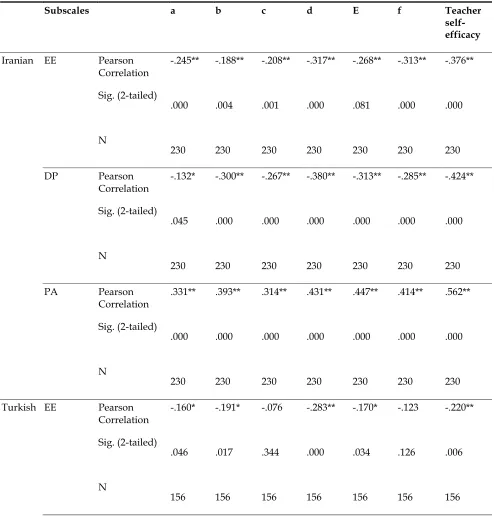
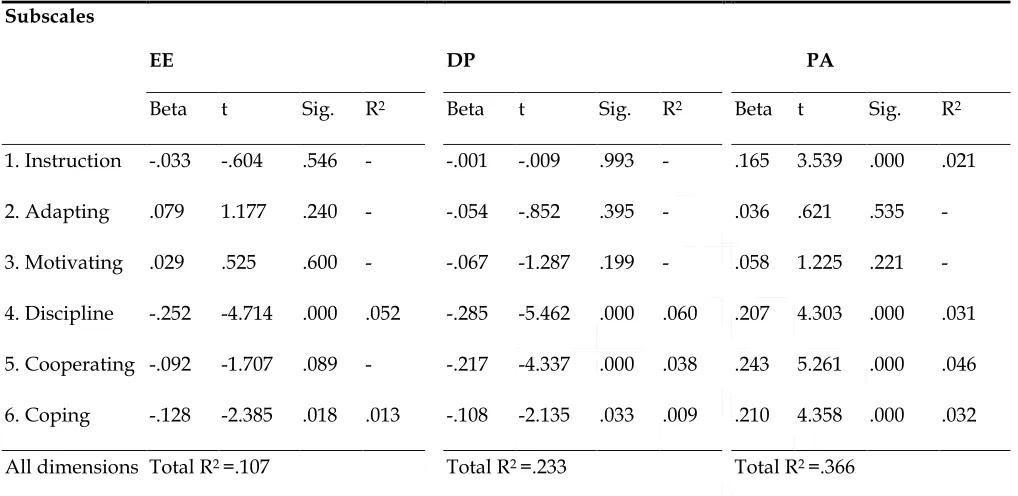
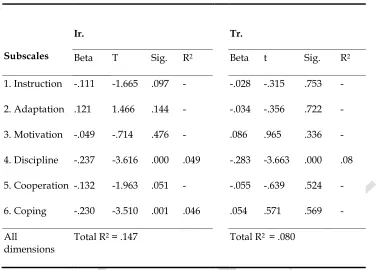
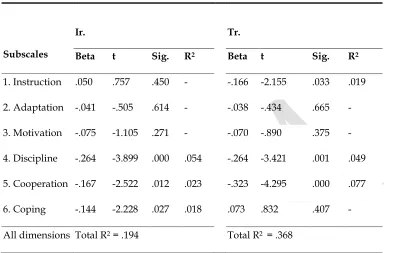
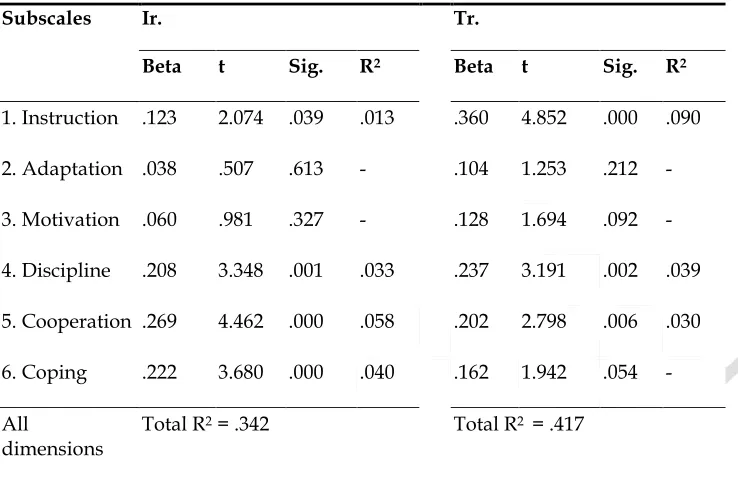
The study aimed at measuring the perceived Teacher Self-efficacy, Emotional Exhaustion (EE), Depersonalization (DP), and Personal Accomplishment (PA) of Iranian (n = 230) and Turkish (n =156) EFL teachers and determining its prediction role in EE, DP, and PA processes. The Maslach Burnout Inventory-Educators Survey (MBI-ES) was used to measure the perceived burnout levels of the participants, and the Norwegian Teacher Self-Efficacy Scale (NTSES) developed by Skaalvik and Skaalvik (2007) was used to measure their self-efficacy perceptions. The reliability of the NTSES scale was r = 0.837 in the study. The results revealed that EE and DP negatively and PA positively correlated with self-efficacy. Moreover, EE processes of the groups were better predicted by Maintaining Discipline, DP by Maintaining Discipline and Cooperating with Colleagues and Parents, and PA by Cooperating with Colleagues and Parents and Instruction dimensions of NTSES. Additionally, the EE prediction variance of Iranian group was greater than that of Turkish group, whereas the DP and PA prediction variances of Turkish group were greater than that of Iranian group.
Keywords: Burnout; Teacher self-efficacy; MBI-ES; NTSES; EFL teachers
1 Introduction
Burnout is a reaction to chronic occupational stressful conditions (Maslach, Leiter, & Jackson, 2012). It is generally associated with individual characteristics and situational factors. The individual perspective views burnout as a problem residing entirely within an individual and attributes its causes to the inability of the individual to cope with job stressors, whereas the situational perspective conceptualizes burnout as a form of role-specific alienation and looks for its causes in the situational conditions under which the individual works (Dworkin, 2001; Dworkin, Saha, & Hill, 2003; Maslach & Leiter, 1997). Based on his observations, Freudenberger (1974) characterized burnout from the perspective of an individual as one’s lack of enough resources to cope with work demands: “A situation in which one loses an idea- the incentive that motivates the person” (p. 160). Inclining with Freudenberger’s (1974) view, Farber (1991) characterized it as “a work-related syndrome that stems from an individual’s perception of a significant discrepancy between effort (input) and reward (output)” (p. 24). While based on the situational perspective Maslach and Jackson (1981) defined burnout as “a syndrome of emotional exhaustion and cynicism that occurs frequently among individuals who do ‘people-work’ of some kind” (p. 99). They put forward the most widely accepted conceptualization of burnout that has three dimensions: Emotional exhaustion (EE) describing feelings of being emotionally overextended and exhausted by one’s work, depersonalization (DP) defining an unfeeling and impersonal response towards recipients of one’s care or service, and personal accomplishment (PA) referring to feelings of competence and successful achievement in one’s work with people (Maslach, Schaufeli, & Leiter, 2001).
Burnout among teachers has been associated with many factors. One of them is teacher self-efficacy which refers to the belief held by a teacher that he/she can make a significant impact on a student’s learning, behavior, and achievement in spite of outside circumstances (Hoy, 2000). The study of self-efficacy has received increasing attention in burnout processes because scholars propose that teachers with high levels of teacher efficacy set higher goals for both themselves and their students, and they work harder to achieve them regardless of external forces (Ross, 1994). Besides, teachers with no sense of mastery (i.e., self-efficacy) usually lack the capabilities of adaptation and easily burn out (Brouwers & Tomic, 2000). There are also a lot of burnout studies in education showing that teachers are dissatisfied with their profession because of job stressors, which are manifested as physical problems (such as heart diseases, diabetes, high blood pressure, headaches, and respiratory problems), psychological disorders
Modern Journal of Language Teaching Methods ISSN: 2251-6204
Vol. 7, Issue 8 , August 2017
Page 26
(such as anxiety, depression and frustration), and behavioural changes (such as violence, smoking, alcohol and drug abuse) (Feinberg, 2002; Sadeghi & Khezrlou, 2016; Soodmand Afshar & Doosti, 2016). For example, Labone (2004) and Wheatley (2005) found that teachers who reported a higher sense of efficacy tended to be more likely to stay in the profession, report higher job satisfaction, exhibit more effort and motivation, take on additional roles in their schools, and display a greater degree of resiliency throughout their teaching career. Moreover, Khezerlou (2012) found that 60 per cent of Iranian and 74.4 per cent of Turkish secondary EFL teachers had experienced moderate level of burnout.
Taking the studies in the field into account, the researcher thinks burnout research has the potential to further contribute to our understanding of the consequences of chronic stress in the workplace. Additionally, there is not any study comparatively to focus on teacher burnout and self-efficacy among Iranian and Turkish EFL teachers. Finally, our research method provides a new framework for studying teacher burnout which justify the need to continue the research. For the purpose of shedding more light on the role of self-efficacy in burnout processes, the study employed the multidimensional self-efficacy model of Skaalvik and Skaalvik (2007). The model measures teacher self-efficacy in six dimensions of (a) instruction: a sense of ability to provide instruction so that maximum goals of the program to be achieved, (b) adapting education to individual students' needs: a sense of ability to provide individualized instruction, (c) motivating students: a sense of ability to engage students in teaching/learning activities, (d) keeping discipline: a sense of ability to deal with students’ discipline problems, (e) cooperating with colleagues and parents: a sense of desire to cooperate with others to solve problems, and (f) coping with changes: a sense of desire to adapt oneself to methodological and situational changes (Skaalvik & Skaalvik, 2010). However, the study tries to measure the pervasiveness o