R E S E A R C H A R T I C L E
Open Access
The developmental relation between aggressive
behaviour and prosocial behaviour: A 5-year
longitudinal study
Ingrid Obsuth
1*, Manuel P Eisner
1, Tina Malti
2and Denis Ribeaud
3Abstract
Background:Past research has shown links between both children’s aggressive behaviour and a lack of prosocial behaviour to later maladaptation. Both types of behaviours have also been identified as crucial in children’s social and emotional development and later (mal)adaptation. However, little is known about the way they predict each other over time.
Methods:We utilised a large, ethnically diverse, longitudinal population sample of girls and boys (N = 1,334) to examine the bidirectional cross-lagged links between aggressive and prosocial domains of behaviour from age seven to eleven. Teacher, parent and child self-reports were utilised to assess aggressive behaviour and prosocial behaviour.
Results:The results revealed that aggressive behaviour measured one year predicted decreases in prosocial behaviour in the following year. Conversely, prosocial behaviour did not predict changes in aggressive behaviour in the
subsequent year. Furthermore, peer difficulties were examined and found to be an important mediator of the link between aggressive and prosocial behaviour. Specifically, peer difficulties mediated the links between aggressive behaviour and prosocial behaviour one year later, particularly during the first three years of school attendance.
Conclusions:Implications of the findings for the design of intervention strategies to reduce children’s aggressive behaviour are discussed.
Keywords:Aggressive behaviour, Prosocial behaviour, Peer difficulties, Longitudinal study, Childhood
Background
Numerous studies have shown that aggressive behaviour and prosocial behaviour are negatively correlated con-currently at different stages of development (e.g., Eivers et al. 2012; Krahé and Möller 2011). Yet, few studies ex-amined the possible impact of these behaviours on each other over time and very little is known about the devel-opmental processes which may facilitate the link be-tween them. The present study sets out to fill these important research gaps.
Aggressive behaviour has been defined as any behaviour directed towards another person that is carried out with the proximate intent to cause physical or psychological
harm (Krahé 2013). Prosocial behaviour is social behav-iour that benefits another person (Eisenberg et al. 2015). Early developmental research conceptualised the relation between aggressive and prosocial behaviour as two poles of the same behavioural construct, which would suggest that the two constructs co-vary at any moment in time.
When Wispe (1972) first introduced the term ‘prosocial
behaviour’ over four decades ago, she defined it as the opposite of ‘antisocial behaviour’, including aggressive be-haviour. Consistently, some researchers (e.g., Eron and Huesmann 1984; Wiegman and van Schie 1998) argue that the respective underlying variables represent opposite ends of one broader construct based on evidence that pro-social behaviour is positively and aggressive behaviour is negatively related to common third variables, such as em-pathy (e.g., Eisenberg and Miller 1987). However, others have established that aggressive versus prosocial behaviour * Correspondence:[email protected]
1
Institute of Criminology, University of Cambridge, Sidgwick Site, Cambridge CB3 9DA, UK
Full list of author information is available at the end of the article
are two related but distinct behavioural constructs (e.g., Caprara et al. 2006) and find that each contributes unique variance in relation to explaining later negative and posi-tive developmental outcomes.
Arguably, the two behaviours are conceptually related constructs, and numerous developmental theories, such as Bowlby’s (1980) attachment theory and socialisation theories (e.g., Hastings et al. 2007) have elaborated that both behaviours result from similar causal mechanisms. For example, by experiencing their parents as empathic and trustful individuals towards them and to each other, children learn how to be other-oriented and prosocial (Eisenberg et al. 2015). On the other hand, in situations where parents do not show empathy and trust in them, children may respond with aggressive behaviour.
Despite this conceptual notion, researchers have only relatively recently started to study both behaviours sim-ultaneously using longitudinal designs (e.g., Caprara et al. 2001; Eivers et al. 2010) in order to understand their developmental links. The majority of these studies have examined the individual correlates as well as stabil-ity and change of these two behaviours, but not their im-pact on each other over time. For example, in a longitudinal study of 800 participants at ages 8, 19 and 30, Eron and Huesmann (1984) found that prosocial be-haviour was negatively related to aggressive bebe-haviour consistently at each point in time. Caprara et al. (2006), on the other hand, found that while they were related, the degree of the concurrent relation between prosocial and aggressive behaviour varied depending on the age of the child over a six year period (from age 7 to 13) and the informant; these researchers thus argued against considering them as mere opposite ends of a single con-struct. Similarly, Kokko et al. (2006) investigated the link between the developmental trajectories of physically ag-gressive and prosocial behaviour in a large male sample assessed at ages 6, 10, 11 and 12. They identified three
trajectories of aggression – low, moderate and high
de-clining trajectories; and contrary to expectations, only
two trajectories of prosociality – low and moderate
de-clining. Boys in the low aggression trajectory group were evenly distributed in the low and moderate prosocial tra-jectory groups. However, the majority of boys in the moderate aggression trajectory group (63%) and high ag-gression trajectory group (79%) followed the low proso-ciality trajectory. While these findings suggest an inverse relation between aggressive and prosocial trajectories, this study did not elucidate how the behaviours may be relating to each other over time. It also remains unclear whether these findings generalise to a normative sample of boys and girls. Furthermore, when examining the links between the aggressive and prosocial behaviour tra-jectories, in the same study Kokko et al. (2006) found that while physical aggression predicted both school
dropout and physical violence at age 17, prosocial behav-iour did not serve as a protective factor for the same be-haviours. This pattern of findings is contrary to those presented in an earlier study by Crick (1996), who found that prosocial behaviour was uniquely related to future peer acceptance and peer rejection when accounting for aggressive behaviour. These inconsistent findings, along with the overall paucity of research in this area, highlight the importance of further examining the longitudinal directional links between aggressive and prosocial behav-iour. Although there is some limited empirical evidence supporting a (negative) association between the two be-haviours over time, the cross-lagged bidirectional rela-tion between them has not been examined.
Insight into the dynamic relations between aggressive behaviour and prosocial behaviour is of importance for both conceptual and practical reasons. Conceptually, both behaviours are morally relevant, since they both concern the compliance with or infringement of moral norms, such as concern for the welfare of others, justice and fair-ness, or the omission of physical and psychological harm (Malti and Krettenauer 2013; Eisner and Malti 2015). Practically, understanding whether one can expect that desirable change in one type of behaviour is linked to sub-sequent change in the other type, may have implications for existing intervention strategies as well as for the design of new programmes. For example, if increases in prosocial behaviour result in decreases in aggressive behaviour, in-terventions may focus on increasing the former to achieve results on the latter. However, if this direct link is not present, interventions would need to incorporate strat-egies to achieve decreases in aggression through other mechanisms, such as peer rejection.
Three possible developmental links are plausible be-tween these two behaviours: First, only prosocial behav-iour predicts future aggressive behavbehav-iour. Second, only aggressive behaviour predicts future prosocial behaviour. Third, aggressive and prosocial behaviours reciprocally predict each other over time. Each of these possible links will be further discussed below.
Prosocial behaviour predicts subsequent aggressive behaviour
aggressive behaviours (e.g., Dodge et al. 2013; Lansford et al. 2010; Ostrov 2010).
Prevention and intervention programmes for children at risk for aggressive behaviour problems frequently target the enhancement of prosocial skills with the goal to increase prosocial behaviours (Sheridan et al. 2011) and
decrease aggression (Conduct Problems Prevention
Research Group, 2010). Meta-analytic evidence suggests positive effects of life skills and social-emotional learning programmes on aggressive problem behaviour (e.g., Durlak et al. 2011; Malti T, Chaparro MP, Zuffianò A, & Colasante T. School-based interventions to promote em-pathy in children and adolescents: A developmental ana-lysis, Submitted). Recently, researchers have begun to examine the mechanisms of change (i.e., mediating vari-ables) related to reductions in aggression. One meta-analysis (Dymnicki et al. 2011) identified social skills, social-cognitive processes, and classroom characteristics as mechanisms linked to small but significant reductions in overt aggression following universal school-based vio-lence prevention programmes. However, it remains un-known whether the reductions in aggression may indeed be mediated by increases in prosocial behaviour.
Aggressive behaviour predicts subsequent prosocial behaviour
Other developmental scientists have argued that aggres-sive behaviour may be linked to subsequent reductions in prosocial behaviour, particularly if children form friendships with aggressive peers (e.g., Bowker et al. 2007). Empirical findings suggest that aggressive chil-dren tend to form friendships with each other (Dishion and Tipsord 2011; Logis et al. 2013), they lose their so-cial reputation, and experience peer rejection. When they attack and inflict harm on others, aggressive chil-dren may be seen as a threat to both victims and by-standers, who may therefore avoid interactions with them. In this way, children who engage in aggressive behaviour may isolate themselves from and/or become isolated by their socially competent peers from whom they could learn to engage in prosocial behaviours. In addition, aggressive behaviour, especially when it is part of a sustained pattern of conduct problems, is likely to reinforce social information-processing biases (Arsenio and Lemerise 2004). Hence, children who engage in ag-gressive behaviour may subsequently not perceive pro-social behaviours as response options and/or they may not evaluate them as strategies that are associated with internal or external gratifications.
Aggressive behaviour and prosocial behaviour reciprocally relate to each other over time
The third possibility is that aggressive behaviour and prosocial behaviour reciprocally relate to or predict each
other over time. Zimmer-Gembeck et al. (2005) exam-ined but did not find reciprocal links between prosocial behaviour and relational or physical aggression and vice versa between Grades 3 and 6. They did, however, find that social preference, a measure of likability and accept-ance by peers, predicted both aggressive behaviours as well as prosocial behaviour three years later. To our know-ledge only one study thus far has examined the possibility of reciprocal links between these two behaviours at more than only two time points and across a longer period of time. Specifically, Chen et al. (2010), tested the cross-lagged reciprocal relations between aggressive behaviour, academic achievement and social competence, a construct related to prosocial behaviour, over time in a sample of 1140 Chinese children from Grades 2 to 5 based on peer nominations and teacher reports. Combining information from the two informants, aggression in Grades 2, 3, and 4 was significantly negatively related to subsequent so-cial competence (peer-assessed sociability, soso-cial prefer-ence, teacher-rated social competprefer-ence, and leadership), while this was not the case in Grade 5. In contrast, levels of social competence were not related to aggres-sive behaviour one year later. These findings hence support the hypothesis of a unidirectional effect from aggression to later social competence, which includes aspects of prosocial behaviour, but not from social competence to aggression. The authors argue that earl-ier aggressive behaviour may elicit negative social eval-uations of others, which may in turn lead to lower levels of social competence and fewer opportunities to develop a healthy self-confidence.
The current study
aggressive and prosocial behaviours, sex was tested as a potential moderator of the relations between these two behaviours.
Next, given the evidence suggesting that experiences of peer difficulties relate to both, the engagement in aggressive behaviour and prosocial behaviour, we anti-cipated that such experiences (not perceived as being popular, being victimised, and isolated by peers) will be positively related to aggressive behaviour and negatively to prosocial behaviour. In addition, we expected experi-ences of peer difficulties to mediate the link between the two behaviours over time.
Consideration has been given to the choice of measure of aggressive behaviour. Several types of aggressive be-haviour have been identified (e.g., Murray-Close and Ostrov 2009) both with respect to the “form” of aggres-sive behaviour (i.e., whether it is expressed physically or in the form of a threat or harm to relationships) and the “function” that it serves (i.e., reactive, or impulse and anger oriented; or proactive, that is goal oriented). In the current study we opted to utilise the broader overt ag-gressive behaviour scale, which included pro-active, re-active and physical aggression. This broader scale was used for two reasons: First, we wanted to utilise the most robust measure of aggression since this is, to our knowledge, the first study exploring the longitudinal link between these behaviours; second, indirect or relational aggression is more difficult to assess by raters such as teachers or parents as it is often concealed and more dif-ficult to observe (e.g., Kuppens et al. 2013).
We focused on examining these developmental links be-tween ages 7 and 11 as these developmental periods have been identified as key transitional periods from childhood through adolescence to adulthood. During these periods, children experience marked changes in their social lives, which expand beyond their family to include peers and teachers. They develop significant cognitive, emotional and social competencies necessary for later functioning (e.g., Huston and Ripke 2010).
Method
Participants
The data were drawn from an ongoing combined longi-tudinal and intervention study, the Zürich Project on the Social Development of Children and Youth (z-proso). The gross sample at the initial assessment consisted of all 1,675 first graders from 56 public elementary schools.
Of all approached parents, 81.3% (n= 1,361) consented
to their child’s participation at wave 1 (W1) and 74%
(n= 1240) participated in the parent interview at W1. In line with the requirements for ethical conduct in survey-based research with human subjects in Switzerland out-lined by the Association of the Swiss Ethics Committee (2009), written informed consent was collected from the
parents at the beginning of the study (at W1 valid until W3) and again at the beginning of W4 and from the children from age 13 onwards. Four data collection waves took place between 2004/5 and 2009/10 when the children were 7, 8, 9 and 11 years old (each year through Grades 1 to 3 and Grade 5 corresponding to Ws 1 to 4 across 5 years) and information was collected from par-ents, teachers and children. Two universal prevention programmes were introduced into the study with the aim to reduce children’s externalising problems. In a factorial design, schools were randomly assigned to a control condition, the Triple-P (Positive Parenting Programme) programme, the social and emotional skills intervention PATHS (Promoting Alternative Thinking Strategies), and a combined (PATHS and Triple P) condition. Findings on the interventions are reported in Malti et al. (2011). In brief, they yielded very limited, if any, evidence of inter-vention effects. In the present study, we included the two interventions as covariates in all analyses. However, in line with previously reported findings no systematic interven-tion effects were found.
We analysed data from all three informants from W1 to W4 of data collection. Data were included for all chil-dren, teachers and parents, who participated in the first and in at least one subsequent data collection wave resulting in a sample of 1,334 children; 1,191 parents
and 1,325 teachers. At W1, the children’s age was M =
7.45 years (SD= .39). The retention rate from W1 to
W2, when the children’s age wasM =8.11 (SD= .38) was 97% for the child, 95% for the parent, and 96% for the
teacher assessments; from W1 to W3 (age M =9.21,SD
= .37), the retention rate was 96% for the child, 95% for the parent, and 94% for the teacher assessment; and for
W1 to W4 (age M =10.70, SD= .38), the retention rate
was 83% for children, 86% for parent, and 92% for the teacher assessment.
Sample attrition effects were examined by comparing the children at W4 with those who did not participate at
W4 (n= 275) on demographic variables (i.e., SES and
sex) and revealed no significant differences. Of the 1,334 children in the study 51% were boys; at W1 78% lived with both of their biological or adoptive parents, 20% with their biological mother only, and 2% with their bio-logical father only, with foster parents or in residential care (Eisner et al. 2007; Eisner et al. 2011).
Procedure
At each wave information was collected from the child, the primary caregivera, and the teacher. Computer-assisted 45-minute-long interviews were conducted with the chil-dren at school at W1 to W3 and with a parent at W1 to W4 at each child participants’home. In W4, children com-pleted a written questionnaire. Each child’s teacher com-pleted a questionnaire at all four waves.
Measures
Parent and teacher ratings of aggressive and prosocial behaviour
For the parent and teacher ratings, the Social Behaviour Questionnaire (SBQ; Tremblay et al. 1991) was utilised. The SBQ is a 55-item paper and pencil questionnaire rated on a 5-point Likert scale from never =‘0’ to very often =‘5’. It is used to rate children’s psychosocial func-tioning across ten subscales contributing to five higher order scales. This study utilised two scales of the SBQ: mean scores of the overt Aggressive Behaviour and Pro-social Behaviour scales.
The overt Aggressive Behaviour scale included eleven
items in total, tapping into pro-active aggression (four
items; e.g. ”The child encourages others to pick on a
particular child”), reactive aggression (three items; e.g. “The child is aggressive when he/she is contradicted.”), and physical aggression (four items; e.g.“The child kicks, bites and hits”). Cronbach’s alphas ranged from .77 to .81 with mean alpha .79 for parents and from .93 to .94 with mean alpha .93 for teachers.
The Prosocial Behaviour scale consisted of ten items and tapped into behaviours related to helping and
em-pathic behaviour, for example“The child helps someone
who is hurt” or “The child listens to others’ point of view”; respectively. Cronbach's alphas ranged from .76 to .80 with mean alpha .78 for parents and from .91 to .92 with mean alpha .91 for teachers.
Child rating of aggressive and prosocial behaviour
Children completed the“Tom & Tina” –Adapted Social Behaviour Questionnaire (T & T). The T&T adaptation was developed by the research team with the purpose of measuring self-reported aggressive and prosocial behav-iour amongst primary-school children parallel to the re-ports of teachers and parents. It is an adapted computer-based multimedia version of the SBQ that consists of a series of 54 drawings displaying specific behaviours of a child called “Tom” or “Tina” based on the child’s sex. For each drawing the child is asked by a voice recorded on the computer whether he/she happens to do what is shown on the drawing and responds by pressing the “Yes” or“No” button at the bottom of each screen. The
administration was adapted from the “Dominic
Interac-tif” (Scott et al. 2006) measure with a demonstrated
moderate to excellent reliability and validity for young children (Campbell et al. 2006). The computer-based version of the T & T was administered to children at W1 to W3 and its parallel paper and pencil version was administered at W4. We utilised the prosocial and overt aggressive behaviour subscales comprised of parallel items to the SBQ scales described above. Cronbach's al-phas ranged from .55 to .62 with mean alpha .60 for pro-social behaviour and from .72 to .79 with mean alpha .76 for aggressive behaviour. The means in Table 1 represent the means for the number of items they responded with “Yes”.
Teacher rating of peer difficulties
At each wave of data collection, teachers answered three questions to rate the degree to which each child is “popular”, “victimised” and/or “isolated” by peers on a 5-point Likert scale from ‘does not apply at all’ to ‘
ap-plies very much’. The three items were combined into
composite scores, with being popular reverse-scored. The scores for W2 to 4, which yielded Cronbach’s alphas .75, .78, .80, respectively, were utilised in the analyses. This scale was specifically developed for the purposes of this study based on a review of literature related to peer rejection and negative peer experiences. At the time this longitudinal project was launched (in 2004/2005) peer rejection was most commonly measured via peer nomin-ation sociometric tools (Lev-Wiesel et al. 2013). These were deemed not sufficient or feasible for the then six-year old participants of the current study. For consistency of measurement over time, the same measure was utilised during subsequent data collection points.
Data analytic approach
Data analyses were conducted via multiple-group cross-lagged regression models in a structural equation model-ling (SEM) framework using the statistical software AMOS (Version 19; Arbuckle 2010; see Figure 1). SEM provides a confirmatory approach to data analysis in which the expected set of structural relations among vari-ables is specified a priori and modelled simultaneously. It also allows for a direct comparison of model parameters across groups (e.g., across boys and girls) through multiple group modelling (Muthén et al. 1997).
First-order autoregressive and cross-lagged pathways of association were simultaneously evaluated. In a first-order autoregressive model, variables are represented as causes of themselves over time. Therefore, autoregres-sive pathways estimate the association between prosocial
behaviour at time tn with prosocial behaviour at time
that behaviours at time tn have on the same behaviours at time tn+1as children grow older. Aggressive and pro-social behaviours will be modelled in this way as exten-sive previous literature suggests that past behaviour is often the best predictor of current behaviour (e.g., Crick 1996; Eivers et al. 2012).
Cross-lagged models (e.g., Kenny and Harackiewicz 1979) have been widely used in developmental research to assess bi-directional time-lagged relations (e.g., Defoe et al. 2013). The cross-lagged associations represent rela-tions between prosocial behaviour at time tnand
aggres-sive behaviour at time tn+1 as well as the reciprocal
association between aggressive behaviour at time tnand
prosocial behaviour at time tn+1. These effects were
allowed to vary across time to examine change in the
reciprocal association between aggressive and prosocial behaviour from age 7 to age 11. Concurrent residual cor-relations between aggressive and prosocial behaviour at the same time of assessment were estimated and allowed to vary over time as were the residuals within construct variances. The intervention conditions (attendance/en-gagement in the intervention) were included in the models as covariates to account for possible effects on be-haviour; Triple P at Ws 2, 3, and 4 as it was implemented when the children were in Grade 2 and Paths at Ws 3 and 4 as it was implemented when the children were in Grade 3. The autoregressive models were set up as multiple-group analyses to examine the association between aggres-sive and prosocial behaviour by sex. Within this frame-work, structural models with the associations between
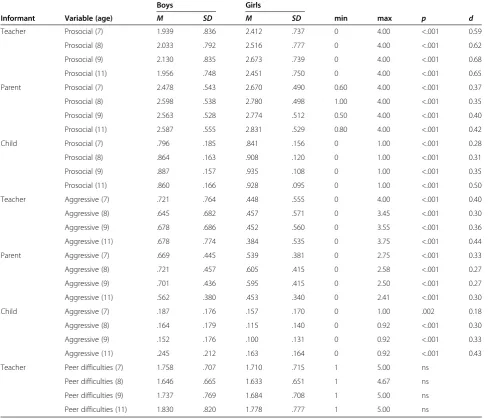
Table 1 Descriptive statistics (means, standard deviations) for aggressive and prosocial behaviour of boys and girls at each wave of measurement by each informant
Boys Girls
Informant Variable (age) M SD M SD min max p d
Teacher Prosocial (7) 1.939 .836 2.412 .737 0 4.00 <.001 0.59
Prosocial (8) 2.033 .792 2.516 .777 0 4.00 <.001 0.62
Prosocial (9) 2.130 .835 2.673 .739 0 4.00 <.001 0.68
Prosocial (11) 1.956 .748 2.451 .750 0 4.00 <.001 0.65
Parent Prosocial (7) 2.478 .543 2.670 .490 0.60 4.00 <.001 0.37
Prosocial (8) 2.598 .538 2.780 .498 1.00 4.00 <.001 0.35
Prosocial (9) 2.563 .528 2.774 .512 0.50 4.00 <.001 0.40
Prosocial (11) 2.587 .555 2.831 .529 0.80 4.00 <.001 0.42
Child Prosocial (7) .796 .185 .841 .156 0 1.00 <.001 0.28
Prosocial (8) .864 .163 .908 .120 0 1.00 <.001 0.31
Prosocial (9) .887 .157 .935 .108 0 1.00 <.001 0.35
Prosocial (11) .860 .166 .928 .095 0 1.00 <.001 0.50
Teacher Aggressive (7) .721 .764 .448 .555 0 4.00 <.001 0.40
Aggressive (8) .645 .682 .457 .571 0 3.45 <.001 0.30
Aggressive (9) .678 .686 .452 .560 0 3.55 <.001 0.36
Aggressive (11) .678 .774 .384 .535 0 3.75 <.001 0.44
Parent Aggressive (7) .669 .445 .539 .381 0 2.75 <.001 0.33
Aggressive (8) .721 .457 .605 .415 0 2.58 <.001 0.27
Aggressive (9) .701 .436 .595 .415 0 2.50 <.001 0.27
Aggressive (11) .562 .380 .453 .340 0 2.41 <.001 0.30
Child Aggressive (7) .187 .176 .157 .170 0 1.00 .002 0.18
Aggressive (8) .164 .179 .115 .140 0 0.92 <.001 0.30
Aggressive (9) .152 .176 .100 .131 0 0.92 <.001 0.33
Aggressive (11) .245 .212 .163 .164 0 0.92 <.001 0.43
Teacher Peer difficulties (7) 1.758 .707 1.710 .715 1 5.00 ns
Peer difficulties (8) 1.646 .665 1.633 .651 1 4.67 ns
Peer difficulties (9) 1.737 .769 1.684 .708 1 5.00 ns
Peer difficulties (11) 1.830 .820 1.778 .777 1 5.00 ns
aggressive and prosocial behaviour over time were assessed independently in three separate models; one based on each type of informant (child, parent, teacher). The research question of whether sex moderates the asso-ciations between aggressive and prosocial behaviour was assessed in each of the models. A series of nested models were fit to the data in which each of the cross-lagged pa-rameters were constrained to be equal across sexes.
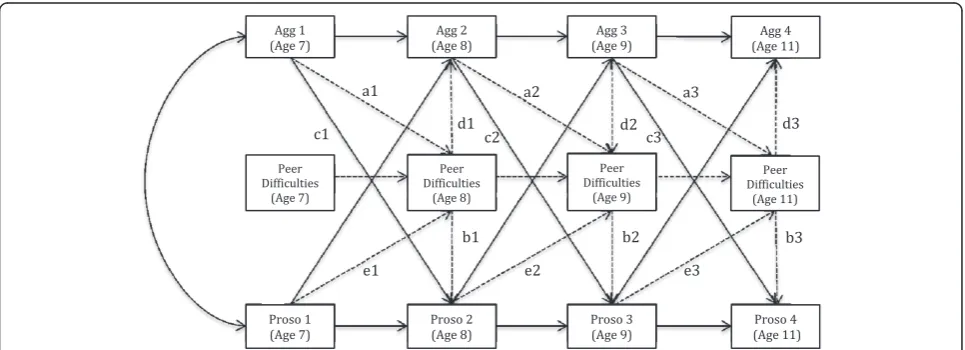
Finally, nested mediation models were tested to assess the influence of peer difficulties on the association be-tween prosocial and aggressive behaviour at each cross-lag (see Figure 2). Specifically, a model in which the
paths from and to peer difficulties were restrained (no mediation) was compared to a model, in which these paths were free to vary (or account for variance). These final models were only tested utilising the teacher re-ported data for several reasons. First, the reports about peer difficulties were provided by the teachers based on their observation of the children in the classroom, based on which they also rated their engagement in ag-gressive and prosocial behaviours. Furthermore, some research suggests that teacher reports of behaviour at school are more reliable than those of children (e.g., Ladd and Profilet 1996).
Figure 2Autoregressive cross-lagged model of the association between prosocial behaviour and aggressive behaviour, including mediation by peer difficulties.
Note: Not displayed are pathways controlling for the effects of treatment as pictured in Figure 1 and residual correlations. All of these were estimated as described in the data analytic plan. The dotted lines represent the influences by peer difficulties; paths a1, a2, and a3
represent the influence of aggression at time t on peer difficulties at time t+1; paths b1, b2, and b3 represent the influence of peer difficulties at time t on prosocial behaviour at time t. Paths c1, c2, and c3 represent the direct influence of aggressive behaviour at time t on prosocial behaviour at time t+1.
Figure 1Autoregressive cross-lagged model of the association between prosocial behaviour and aggressive behaviour.
Missing data
Prior to conducting the final data analysis, missing data patterns were examined. The number of missing values over the four time periods was 4% for teacher reported measures, 8.5% for parent reported measures, and 7% for child reported measures. As missing data for each type of informant were not related to any of the demo-graphic variables collected at W1 (age of parent and child, ethnicity, SES, education, single parenthood), they were handled through the use of Full Information Max-imum Likelihood Estimation, which produce valid esti-mates under the assumption that the missing data are missing at random (MAR; Rubin 1976).
Results
Descriptive statistics
Descriptive statistics and paired-samples t-tests revealed significant differences in the mean levels of boys’ versus girls’aggressive and prosocial behaviours at each wave of data collection for all informants (see Table 1). At each wave, boys rated themselves lower and were rated lower by both their parents and teachers on prosocial behav-iour and higher on aggressive behavbehav-iour. Effect sizes for sex differences in prosocial behaviours ranged from small to medium, with largest effect sizes observed based on teacher reports. The effect sizes for differences in ag-gressive behaviour remained in the small range (max-imum 0.44 according to teacher reported aggression at age 11; see also Nivette et al. 2014). There were, how-ever, no significant mean differences in the rate of peer difficulties experienced by boys and girls as reported by their teachers.
The inter-correlations between the study variables are displayed in Table 2. The within-informant correlations between the ratings of the child’s aggressive and pro-social behaviour were small to medium, but negative and significant at each wave. The correlations between teacher reported aggressive behavior and peer difficulties were positive and medium in size. On the other hand, the correlations between prosocial behaviours and peer difficulties were negative and small.
Structural equation models
All SEM models were evaluated using recommended fit in-dices, including root mean square error of approximation (RMSEA), where values < .08 indicate acceptable fit and values < .05 indicate good fit; confirmatory fit index (CFI) and normed fit index (NFI) where estimates > .90 indicate acceptable fit and values > .95 indicate good fit (McDonald and Ho 2002). Because theχ2becomes increasingly sensi-tive with growing sample size (Marsh et al. 1988), it was not considered for evaluation of model fit. Instead, we used practical fit indexes to test for sex invariance. According to Little (1997), model invariance can be assumed (a) if the overall model fit is acceptable, as indicated by relative fit indexes (e.g., if the CFI is approximately .90 or greater; Marsh et al., 1988; and if the RMSEA is less than .05; Browne and Cudeck 1993); (b) if the difference in model fit is negligible (e.g.,≤.05 for the fit indices) after introduction of the equality constraints; and (c) if the justification for the accepted model is substantively more meaningful and the interpretation is more parsimonious than the alterna-tive model. In addition, we followed recommendations by MacCallum et al. (1996) and used the 95% confidence interval (CI) around the RMSEA to evaluate model fit and for nested model comparisons. Specifically, if the upper bound of the CI is equal to or lower than .05, a close fit of the model to the data can be assumed. Moreover, if the CIs of subsequent nested models overlap with those of preced-ing, less constrained models, the more parsimonious model is deemed acceptable.
Sex Invariance
In the first step of the analyses, we examined whether variance across boys and girls can be assumed. Model in-variance across the sexes was assumed to be more parsimonious and was tested in the model for each type of informant by comparing the fit indices of nested models: A model where all the regression weights were free to vary across boys and girls, and a model in which these regres-sion weights were constrained to be equal (see Table 3). Comparison of fit indices supported sex invariance (no significant sex differences) in the predicted paths between aggressive and prosocial behaviour over four points of
Table 2 Zero-order correlations between variables in the study at each wave of data collection
Aggressive and prosocial behaviour Aggressive behaviour and peer difficulties
Prosocial behaviour and peer difficulties
Teacher Parent Child Teacher Teacher
Age (7) -.30** -.24** -.08* .45** -.37**
Age (8) -.30** -.25** -.23** .48** -.31**
Age (9) -.33** -.23** -.23** .38** -.34**
Age (11) -.36** -.35** -.22** .34** -.33**
data collection, from 7 to 10 years of age. This was the case for each of the models (see Table 3); teacher reported (NFI = .939, CFI = .940, RMSEA = .050), parent reported (NFI = .922, CFI = .921, RMSEA = .060) and child self-reported (NFI = .907, CFI = .904, RMSEA = .038). Chi-square difference tests were also carried out for each informant and provided further support for sex invari-ance (critical value 12.59 > observed difference of 5.89, 4.66 and 10.74 for the teacher, parent and child model, respectively; p< .05). Given support for sex invariance in the fit of each of the models, individual paths are interpreted for the constrained models (the sample overall) and not separately for boys and girls.b
Autoregressive relations of aggressive and prosocial behaviours
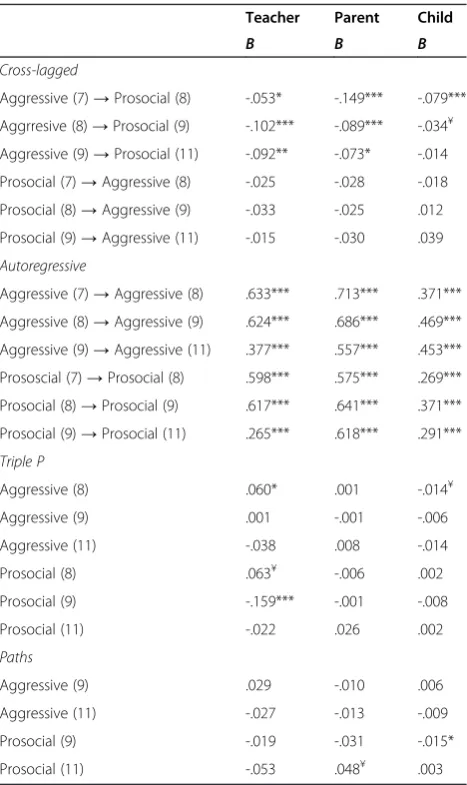
As expected, prosocial and aggressive behaviour at time t was significantly related to aggressive and prosocial be-haviour at tn+1, respectively. Previous behaviour signifi-cantly predicted the same future behaviour consistently across all waves and all types of informants. This was the case with respect to both aggressive and prosocial behaviour (all ps < .001; B = .37 to .71 and .27 to .64, respectively).
Cross-lagged relations between prosocial behaviour and aggressive behaviour
Next, we examined the cross-lagged effects between ag-gressive and prosocial behaviour. Based on both the teacher- and parent-reported models, increases in ag-gressive behaviour at time tn consistently and signifi-cantly predicted decreases in prosocial behaviour at time
tn+1 across each of the waves. However, based on both
the teacher- and parent-reported models increases in prosocial behaviour at time tndid not predict decreases in aggressive behaviours at time tn+1. A similar pattern of negative paths from aggressive behaviour to prosocial behaviour was observed in the model based on children’s self-reports. However, only the paths from aggressive behaviour at age 7 to prosocial behaviour at age 8 reached statistical significance (see Table 4 for all model coefficients).
Table 3 Summary of nested model tests regarding sex invariance
NFI CFI RMSEA CI 95% RMSEA Δdf χ2 df
Teacher Unconstrained .931 .931 .059 .052-.065 256.040 38
Constrained (Invariant) .939 .940 .050 .044-.055 6 261.930 44
Parent Unconstrained .919 .918 .074 .067-.081 386.755 38
Constrained (Invariant) .922 .921 .060 .055-.065 6 391.420 44
Child Unconstrained .923 .919 .044 .037-.051 161.762 38
Constrained (Invariant) .907 .904 .038 .033-.044 6 172.507 44
Note: IFI = incremental fit index; CFI = comparative fit index; RMSEA = root mean square of approximation;Δdf = change degrees of freedom.
Table 4 Cross-lagged and autoregressive unstandardised estimates of aggressive and prosocial behaviour, and treatment effects
Teacher Parent Child
B B B
Cross-lagged
Aggressive (7)→Prosocial (8) -.053* -.149*** -.079***
Aggrresive (8)→Prosocial (9) -.102*** -.089*** -.034¥
Aggressive (9)→Prosocial (11) -.092** -.073* -.014
Prosocial (7)→Aggressive (8) -.025 -.028 -.018
Prosocial (8)→Aggressive (9) -.033 -.025 .012
Prosocial (9)→Aggressive (11) -.015 -.030 .039
Autoregressive
Aggressive (7)→Aggressive (8) .633*** .713*** .371***
Aggressive (8)→Aggressive (9) .624*** .686*** .469***
Aggressive (9)→Aggressive (11) .377*** .557*** .453***
Prososcial (7)→Prosocial (8) .598*** .575*** .269***
Prosocial (8)→Prosocial (9) .617*** .641*** .371***
Prosocial (9)→Prosocial (11) .265*** .618*** .291***
Triple P
Aggressive (8) .060* .001 -.014¥
Aggressive (9) .001 -.001 -.006
Aggressive (11) -.038 .008 -.014
Prosocial (8) .063¥ -.006 .002
Prosocial (9) -.159*** -.001 -.008
Prosocial (11) -.022 .026 .002
Paths
Aggressive (9) .029 -.010 .006
Aggressive (11) -.027 -.013 -.009
Prosocial (9) -.019 -.031 -.015*
Prosocial (11) -.053 .048¥ .003
Note: The numbers in brackets indicate age at time of measurement. The presented coefficients are ustandardised estimates recommended by Kline (1998) to be used when reporting results in AMOS, as only those (and not the standardised estimates) are affected by identification constraints (Arbuckle,1995).
Mediation by peer difficulties
Next we tested a model (see Figure 2), in which peer dif-ficulties at tn+1 was included as a mediator of the links between aggressive and prosocial behaviours one year later (at tn+1). This model yielded a significant goodness of fit for the overall model, χ2(126) = 386.907; p< .001, however, it also showed adequate approximate fit indices (NFI = .927; CFI = .946; RMSEA = .038). To further as-sess the fit of the mediation model, we tested it against the original model. Specifically, a model, in which the paths from (b1-b3; d1-d3; see Figure 2 dotted lines) and to peer difficulties (a1-a3; e1-e3; see Figure 2 dotted lines) were free (free to mediate), was compared to a model, in which these paths were restrained. The com-parison of the two models yielded a significant chi-square difference score; χ2diff (14)= 1504.999, p= .001. Thus, we deemed the mediation model to be a better fit and appropriate for interpretation.
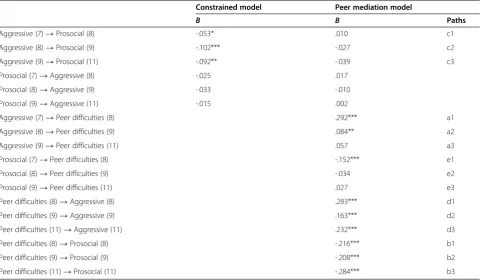
The interpretation of the individual paths suggested that the significant links from aggressive behaviour to prosocial behaviour one year later were mediated by the influence of peer difficulties. Specifically, in the model (Figure 2) where peer difficulties were free to be esti-mated as predicted by previous levels of aggressive be-haviour (paths a1, a2, and a3) and predicting concurrent
levels of prosocial behaviour (paths b1, b2, and b3) the direct links between aggressive and prosocial behaviour one year later (paths c1, c2, and c3) were no longer sig-nificant (see Table 5; the right most column in the table corresponds to the paths in Figure 2). Instead, aggressive behaviour significantly predicted lower levels of peer dif-ficulties one year later at ages 8 and 9 but not at age 11 (Bc=.292; .084 and .057; a paths respectively). Further-more, peer difficulties at age 8, 9 and 11 were a significant predictor of both aggressive behaviour and prosocial be-haviour concurrently (each at p< .001). Specifically, they predicted higher levels of aggression at each age (B =.283; .163 and .232; d paths respectively) and lower levels of pro-sociality (B =−.216;−.208 and -.284; b paths respectively). Thus, given that aggressive behaviour predicted peer diffi-culties, which in turn predicted prosocial behaviour, ag-gressive behaviour seems to be mediated or exert influence on prosocial behaviour through its influence on peer diffi-culties. Higher levels of peer difficulties as a result of previ-ous aggressive behaviour appear to be the mechanism through which aggressive behaviour is related to lower levels of prosocial behaviour later on. Interestingly, how-ever, prosocial behaviour predicted a lower level of peer difficulties only from age 7 to age 8 (B =−.152) but not at later ages.
Table 5 Cross-lagged and autoregressive unstandardised estimates of aggressive and prosocial behaviour, and peer difficulties
Constrained model Peer mediation model
B B Paths
Aggressive (7)→Prosocial (8) -.053* .010 c1
Aggressive (8)→Prosocial (9) -.102*** -.027 c2
Aggressive (9)→Prosocial (11) -.092** -.039 c3
Prosocial (7)→Aggressive (8) -.025 .017
Prosocial (8)→Aggressive (9) -.033 -.010
Prosocial (9)→Aggressive (11) -.015 .002
Aggressive (7)→Peer difficulties (8) .292*** a1
Aggressive (8)→Peer difficulties (9) .084** a2
Aggressive (9)→Peer difficulties (11) .057 a3
Prosocial (7)→Peer difficulties (8) -.152*** e1
Prosocial (8)→Peer difficulties (9) -.034 e2
Prosocial (9)→Peer difficulties (11) .027 e3
Peer difficulties (8)→Aggressive (8) .283*** d1
Peer difficulties (9)→Aggressive (9) .163*** d2
Peer difficulties (11)→Aggressive (11) .232*** d3
Peer difficulties (8)→Prosocial (8) -.216*** b1
Peer difficulties (9)→Prosocial (9) -.208*** b2
Peer difficulties (11)→Prosocial (11) -.284*** b3
Discussion
Both, aggressive behaviour and prosocial behaviour, have been identified as crucial in children’s social development (Eisenberg 2000; Eisenberg et al., 2015; Eisner and Malti 2015). While both behaviours have been studied exten-sively independently, less is known about the way they re-late to each other throughout development. The current study contributed to this understanding by examining the bidirectional cross-lagged links between aggressive and prosocial behaviours in a large-scale sample of boys and girls from age 7 to 11. The relations were examined on the basis of teacher, parent and child self-reports.
Aggressive behaviour and prosocial behaviour
Our first main finding was that both, aggressive behaviour and prosocial behaviour one year prior, were strong pre-dictors of the same behaviour one year later, thus suggest-ing considerable stability in both behaviours. There is evidence in support of stability of aggressive behaviour across normative and high-risk samples from early child-hood (Crick et al. 2006) through adolescence (Piquero et al. 2012). Much less is known about the stability or change in prosocial behaviour over time (Hay and Cook 2007). The handful of studies which have explored these trends suggest a modest continuity in prosocial behaviours according to teacher reports, but not peer nominations measured at two time points, from age 9 to 12 (Zimmer-Gembeck et al. 2005) and from age 5 to 6 (Eivers et al. 2010). The current study provides support for the con-tinuity of both aggressive and prosocial behaviours by demonstrating these relations across four time points, from age 7 to 11 in a large sample. Importantly, the level of stability was similarly high for prosocial behaviour as it was for aggressive behaviour.
We also found evidence for the one-directional predic-tion of aggressive behaviour on prosocial behaviour one year later but not vice versa. Children’s elevated levels of
aggressive behaviour at time tn predicted a decreased
level of their engagement in prosocial behaviour at tn+1 after controlling for their propensity to engage in pro-social behaviour at tn. In contrast, no evidence in sup-port of the effects in the opposite direction was found. Our results suggest that this pattern of findings holds equally for boys and girls and was evident in the parent and the teacher reports. Findings for the child reports were in the same direction, but were not significant, with the exception of the effects of aggressive behaviour at t1predicting decreased prosocial behaviour at t2. The lower consistency in the results for the child self-reports can be due to the fact that the child data have lower reli-ability, resulting in attenuated observed measures of existing relationships. Nevertheless, it is important to note that teacher, parent and child reports were all posi-tively correlated across all time points with respect to
both types of behaviours. Given that the pattern of find-ings is consistent across informants, we believe that our findings provide evidence of the one-directional pattern of effects of levels of aggressive behaviour on levels of prosocial behaviour but not vice versa.
Taken together, these findings are consistent with the findings of Chen et al. (2010) based on a similar design in a similar sample of children in China. The authors found that aggressive behaviour at tn was related to so-cial competence at tn+1, but that social competence did not predict later aggressive behaviour. Although social competence as measured by Chen and colleagues and pro-social behaviour as measured in this study are not the same construct, they are closely related. The consistency of findings in two different cultures suggests that they may reflect universal rather than culturally specific dynamics.
Conceptually, there are several possibilities of how one type of behaviour can influence subsequent behaviour patterns within the same individual. In this paper we ex-panded previous research by examining the role of peers and specifically peer difficulties on facilitating this link. Our findings suggest that aggressive behaviour is related to children’s subsequent experiences of peer difficulties, which in turn is related to decreases in prosocial behav-iours. These findings are consistent with a transactional model developed by Sameroff (2000), which proposes that an individual’s behaviour has effects on the social environment, which in turn triggers change in another behaviour domain. In other words, our findings suggest that children who engage in aggressive behaviour may elicit negative social evaluations by others, which are as-sociated with peer difficulties and in turn may lead to fewer opportunities to practice and further develop social com-petencies. However, as prosocial behaviour and peer diffi-culties are measured at the same time, it is also possible that increases in aggression lead to decreases in prosocial behaviour, and this in turn results in increases in peer diffi-culties. This possibility warrants further examination.
Some research suggests that based on their experiences of difficulties with prosocial peers and acceptance by ag-gressive peers, children develop negative views of them-selves (Rudolph and Clark 2001), which may lead to lowered motivation to act in a prosocial way. Others (e.g., Volk et al. 2012) suggest that aggressive behaviour in chil-dren and adolescents has strategic and evolutionary roots. Following this argument, children who successfully ag-gress against others may have fewer incentives to engage in cooperative behaviour.
Notably, peer difficulties were a significant mediator be-tween aggressive behaviour and prosocial behaviour up until age 9. However, it was no longer significant in linking aggressive behaviour at age 9 to prosocial behaviour at age 11. Possibly, aggressive behaviour in younger children ex-erts a greater influence on future peer difficulties than in older children, where the pattern of peer difficulties may already be set, aggression becomes more valued (or less disliked) and/or children transfer into different class-rooms/schools as it was the case in this study. Both of these hypotheses warrant further inquiry to further eluci-date the role of peer difficulties in the development of these behaviours from childhood to pre-adolescence. The current study utilised a new measure of peer difficulties and as such these findings are not directly comparable with other studies exploring the role of peer rejection and victimisation specifically.
Future research needs to extend our study and investi-gate the moderating and mediating role of various other dimensions of peer relationships (e.g., friendship quality, characteristics of friends and peers, etc.) and other pro-cesses, unexplored in the current study, that may also contribute to the link between aggressive and prosocial behaviour. For example, there is ample evidence suggest-ing that aggressive children tend to develop friendships with other aggressive children (e.g., Bowker et al. 2007). Children who are surrounded by aggressive peers may also be under peer pressure and at first opt to not en-gage in prosocial behaviours so as to appear tough, avoid ridicule, or feel accepted as part of the peer group (e.g., Pepler et al. 2008). Through these associations, children may be exposed to fewer opportunities to practice previously acquired, or to acquire new, social skills, which would allow them to engage in more prosocial behaviours.
Each of the above explanations adopts the more com-mon interpretation in linking higher levels of aggression to decreased levels of prosocial behaviour later. How-ever, the opposite is possible as well. Specifically, it is plausible that children’s low levels of aggressive behav-iour predicted an increased level of their engagement in prosocial behaviour later after controlling for their pro-pensity to engage in prosocial behaviour. In the current study we did not examine the specificity of these links,
but this question represents another important future direction for research in this area.
Interestingly, prosocial behaviour in the previous year did not negatively predict aggressive behaviour in the fol-lowing year according to any of the informants. In other words, engaging in more prosocial behaviour in one year did not predict decreases in aggressive behaviour the next year. This may imply that children’s engagement in more helpful and considerate behaviours is not directly linked to their engagement in less aggressive behaviours. Given the low level of aggressive behaviour overall among the children in this sample, it is possible that children with relatively high levels of prosocial behaviour do not engage or engage in only low levels of aggressive behaviour. How-ever, this would not explain why increases in aggressive behaviour one year would predict decreases in prosocial behaviour the next year. Variation in aggressive behaviour over and above the individual propensity might be driven by factors other than other-oriented, prosocial behaviour, for example emotion recognition, empathy, and emotion regulation. Here we did not examine various additional other-oriented social-emotional skills, such as identifying
and managing emotions, understanding others’ emotions,
and how they may be related to both types of behaviours, and cross-lagged relations on each other over time (see Fraser et al. 2005). Given the importance that is placed on the development of other-oriented, prosocial skills with the goal to decrease aggressive behaviours and increase pro-social behaviours, the examination of these links is a crucial next step in understanding the processes through which positive behavioural outcomes are expected to occur.
While the multi-informant measurement of prosocial and aggressive behaviour in a large sample of children over five years constitutes a strength of this study, several limitations should be noted. First, we focused only on dir-ect/overt aggressive behaviour and overt prosocial behav-iour, which included helping, sharing, and comforting behaviours. As we pointed out earlier, this approach has its advantages. However, recent evidence suggests that dif-ferent types of aggressive behaviour, such as relational and physical aggression, may have different developmental links with later prosocial behaviour (Carlo et al. 2003). In the present study, we focused on overt direct aggression, amongst others because indirect aggression is much more difficult to assess by raters such as teachers or parents. Fu-ture research is needed to examine the developmental causal pathways between sub-domains of aggressive and prosocial behaviour. For example, future studies should examine the pattern of these relations with respect to rela-tional aggression as it is possible that these will differ for girls versus boys. Furthermore, the aggression and pro-social variables in this study were skewed, as is to be ex-pected in a normative sample. This could have influenced the estimates, however, according to Satorra (2001) non-normality in structural equation models is not a problem with large samples (over 1000 as is the case in this study) and results are robust.
Second, our assessment of peer difficulties was based on teacher reports. While peer difficulties are most commonly observed in the school context and teachers provide solid ratings of peer difficulties, future studies that combine teacher reports and peer nominations may elucidate simi-larities and differences of these ratings in relation to ag-gression and prosocial behaviour. Third, while the parent and teacher scales of aggressive and prosocial behaviour were directly adapted from a well-established instrument (SBQ; Tremblay et al. 1991), the parallel child measure in-volved a greater adaptation due to its computer-administration and dichotomous response style. These ad-aptations were implemented in order to provide children a more accessible response alternative. The internal reliabil-ity of the child scales was relatively low, in particular with respect to prosocial behaviour, hence the results related to the child-reported behaviours should be interpreted with caution and warrant replication.
Conclusions
Despite some limitations, the current study offers in-sights into the effects aggressive and prosocial behav-iours have on each other with a one to two year lag, and has as such implications for the design of interventions that aim to reduce aggression. Specifically, our findings highlight that prosocial behaviour may not necessarily be seen as a main proximal target of intervention strat-egies. Our study provides further support for the role of
peer difficulties as an important mechanism linking ag-gressive behaviour and subsequent decreases in prosocial behaviour. Together these findings suggest that promot-ing positive peer relationship may be an important com-ponent of interventions with young people exhibiting behaviour problems.
Endnotes
a
From here on we will use the term‘parent’to refer to the primary caregiver. The vast majority of primary care-givers (97%) were biological mothers.
b
Model invariance by immigration status (yes/no) was tested and compared to the unconstrained model was not significantly different than the constrained (invari-ant) model, suggesting that immigration status did not make a difference in model fit.
c
The presented coefficients are unstandardised esti-mates recommended by Kline (1998) to be used when reporting results in AMOS, as only those (and not the standardised estimates) are influenced by identification constraints.
Competing interests
The authors declare that they have no competing interests.
Authors’contributions
IO has made a substantial contribution to the analysis and interpretation of data, drafting, revising and finalising the manuscript. ME has made a substantial contribution to the acquisition of data, contributed to the drafting of the manuscript, and interpretation of data. TM has made a substantial contribution to the drafting of the manuscript and contributed to the interpretation of data. DR has made a substantial contribution to the acquisition of data. All authors read and approved the final manuscript.
Acknowledgements
The authors would firstly like to thank the children, parents and teachers who participated in the study as well as the numerous research assistants who were instrumental in collecting this data. The authors would also like to acknowledge the generosity of the Jacobs Foundation (Grant 2010–888), the Swiss National Science Foundation (Grants 100013_116829 & 100014_132124), and the Swiss Federal Office of Public Health (Grant 8.000665) each of which provided continued financial support for this project.
Author details
1Institute of Criminology, University of Cambridge, Sidgwick Site, Cambridge
CB3 9DA, UK.2Department of Psychology, University of Toronto, 3359 Mississauga Rd. N., Mississauga, ON L5L 1C6, Canada.3Criminological Research Unit, Chair of Sociology, Swiss Federal Institute of Technology (ETH Zurich), WEP H18, Weinbergstrasse 109, 8092 Zürich, Switzerland.
Received: 30 October 2014 Accepted: 29 April 2015
References
Arbuckle, JL. (1995).AMOS for Windows Analysis of Moment Structures. Version 3.5. Chicago: Small Waters Corp.
Arbuckle, JL. (2010).IBM SPSS Amos 19 user’s guide(SPSS, Ed.). Chicago: ILL. Arsenio, WF, & Lemerise, EA. (2004). Aggression and moral development:
Integrating social information processing and moral domain models.Child Development, 75(4), 987–1002. doi:10.1111/j.1467-8624.2004.00720.x. Association of the Swiss Ethics Committee (2009). Forschung mit Menschen. Ein
Bowker, JC, Rubin, KH, Rose-Krasnor, L, & Booth-LaForce, C. (2007). Good friendships, bad friends: Friendship factors as moderators of the relation between aggression and social information processing.The European Journal of Developmental Psychology, 4(4), 415–434. doi:10.1080/17405620701632069. Bowlby, J. (1980).Attachment and Loss: Volume III: Loss, Sadness and Depression.
The International Psycho-Analytic Library (pp. 1–462). London: The Hogarth Press and the Institute of Psycho-Analysis.
Browne, MW, & Cudeck, R. (1993). Alternative ways of assessing fit. In KA Bollen, J Long, & S (Eds.),Testing Structural Equation Models(pp. 111–135). Beverly Hills, CA: Sage.
Campbell, SB, Spieker, S, Burchinal, M, & Poe, MD. (2006). Trajectories of aggression from toddlerhood to age 9 predict academic and social functioning through age 12.Journal of Child Psychology and Psychiatry, and Allied Disciplines, 47(8), 791–800. doi:10.1111/j.1469-7610.2006.01636.x. Caprara, GV, Barbaranelli, C, & Pastorelli, C. (2001). Prosocial behaviour and aggression in childhood and pre-adolescence. In AC Bohart & DJ Stipek (Eds.),Constructive and Destructive Behaviour: Implications for Family, School, and Society(pp. 187–203). Washington, DC, US: American Psychological Association.
Caprara, GV, Dodge, KA, Pastorelli, C, & Zelli, A. (2006). The effects of marginal deviations on behavioural development.European Psychologist, 11(2), 79–89. doi:10.1027/1016-9040.11.2.79.
Card, NA, Stucky, BD, Sawalani, GM, & Little, TD. (2008). Direct and indirect aggression during childhood and adolescence: A meta‐analytic review of gender differences, intercorrelations, and relations to maladjustment.Child Development, 79(5), 1185–1229. doi:10.1111/j.1467-8624.2008.01184.x. Carlo, G, Hausmann, A, Christiansen, S, & Randall, BA. (2003). Sociocognitive and
behavioural correlates of a measure of prosocial tendencies for adolescents. Journal of Early Adolescence, 23(1), 107–134. doi:10.1177/0272431602239132. Chen, X, Li, D, Li, Z, Li, B, & Liu, M. (2000). Sociable and prosocial dimensions of
social competence in Chinese children: Common and unique contributions to social, academic, and psychological adjustment.Developmental Psychology, 36(3), 302–14. doi: 1O.1O37//OO12-1649.36.3.3O2.
Chen, X, Huang, X, Chang, L, Wang, L, & Li, D. (2010). Aggression, social competence, and academic achievement in Chinese children: A 5-year longitudinal study. Development and Psychopathology, 22(3), 583–92. doi:10.1017/S0954579410000295. Conduct Problems Prevention Research Group. (2010). The effects of a multiyear
universal social-emotional learning program: The role of student and school characteristics.Journal of Consulting and Clinical Psychology, 78(2), 156–68. doi:10.1037/a0018607.
Crick, NR. (1996). The role of overt aggression, relational aggression, and prosocial behaviour in the prediction of children’s future social adjustment.Child Development, 67, 2317–2327. doi:10.1016/j.physbeh.2015.02.053. Crick, NR, & Dodge, KA. (1996). Social information-processing mechanisms in
reactive and proactive aggression child development.Child Development, 67, 993–1002. doi:10.1111/j.1467-8624.1996.tb01778.x.
Crick, NR, Ostrov, JM, & Werner, NE. (2006). A longitudinal study of relational aggression, physical aggression, and children’s social-psychological adjustment. Journal of Abnormal Child Psychology, 34(2), 131–42. doi:10.1007/s10802-005-9009-4.
Defoe, IN, Farrington, DP, & Loeber, R. (2013). Disentangling the relationship between delinquency and hyperactivity, low achievement, depression, and low socioeconomic status: Analysis of repeated longitudinal data.Journal of Criminal Justice, 41(2), 100–107. doi:10.1016/j.jcrimjus.2012.12.002. Dishion, TJ, & Tipsord, JM. (2011). Peer contagion in child and adolescent social
and emotional development.Annual Review of Psychology, 62, 189–214. doi:10.1146/annurev.psych. 093008.100412.
Dodge, KA, Lansford, JE, Burks, VS, Bates, JE, Pettit, GS, Fontaine, R, & Price, JM. (2013). Peer rejection and social information-processing factors in the development of aggressive behaviour problems in children.Child Development, 74(2), 374–393. doi:10.1111/1467-8624.7402004.
Durlak, JA, Weissberg, RP, Dymnicki, AB, Taylor, RD, & Schellinger, KB. (2011). The impact of enhancing students’social and emotional learning: A meta-analysis of school-based universal interventions.Child Development, 82(1), 405–432. doi:10.1111/j.1467-8624.2010.01564.x.
Dymnicki, AB, Weissberg, RP, & Henry, DB. (2011). Understanding how programs work to prevent overt aggressive behaviours: A meta-analysis of mediators of elementary school–based programs.Journal of School Violence, 10(4), 315–337. doi:10.1080/15388220.2011.602599.
Eisenberg, N. (2000). Emotion, regulation, and moral development.Annual Review of Psychology, 51, 665–697. doi:10.1146/annurev.psych.51.1.665.
Eisenberg, N, & Miller, PA. (1987). The relation of empathy to prosocial and related behaviours.Psychological Bulletin, 101(1), 91–119. doi:10.1037/0033-2909.101.1.91.
Eisenberg, N, Spinrad, T, & Knafo, A. (2015). Prosocial development. In ME Lamb & RM Lerner (Eds.),Handbook of Child Psychology and Developmental Science, Vol. 3: Social, Emotional and Personality Development (7th edition, pp. XXX) (Vol. 7). New York: Wiley.
Eisner, MP, & Malti, T. (2015). Aggressive and violent behavior. In ME Lamb & RM Lerner (Eds.),Handbook of Child Psychology and Developmental Science, Vol. 3: Social, Emotional and Personality Development(Vol. 7, pp. 795–884). New York: Wiley.
Eisner, M, Ribeaud, D, Juenger, R, & Meidert, U. (2007). Fruehpraevention von Gewalt und Aggression. InErgebnisse des Zuercher Praeventions- und Interventionsprojektes an Schulen [Early prevention of violence and aggression. Results from the Zürich prevention and intervention project at schools]. Zürich: Rueegger Verlag.
Eisner, M, Malti, T, & Ribeaud, D. (2011). Large-scale criminological field experiments. The Zurich Project on the Social Development of Children. In D Gadd, S Kar-stedt, & S Messner (Eds.),The SAGE Handbook of Criminological Research Methods (pp. 410–424). London: Sage.
Eivers, AR, Brendgen, M, & Borge, AIH. (2010). Stability and change in prosocial and antisocial behaviour across the transition to school: Teacher and peer perspectives.Early Educ Dev, 21(6), 843–864. doi:10.1080/ 10409280903390684.
Eivers, AR, Brendgen, M, Vitaro, F, & Borge, AIH. (2012). Concurrent and longitudinal links between children’s and their friends' antisocial and prosocial behaviour in preschool.Early Childhood Research Quarterly, 27(1), 137–146. doi:10.1016/j.ecresq.2011.05.001.
Eron, LD, & Huesmann, LR. (1984). The relation of prosocial behaviour to the development of aggression and psychopathology.Aggressive Behaviour, 10, 201–211. doi:10.1002/1098-2337.
Fraser, MW, Galinsky, MJ, Smokowski, PR, Day, SH, Terzian, MA, Rose, RA, & Guo, S. (2005). Social information-processing skills training to promote social competence and prevent aggressive behaviour in the third grades. Journal of Consulting and Clinical Psychology, 73(6), 1045–55. doi:10.1037/ 0022-006X.73.6.1045.
Gasser, L, & Malti, T. (2012). Children’s and their friends' moral reasoning: Relations with aggressive behaviour.International Journal of Behavioural Development, 36(5), 358–366. doi:10.1177/0165025412448353.
Hastings, PD, Utendale, WT, & Sullivan, C. (2007). The socialization of prosocial development. In JE Grusec & PD Hastings (Eds.),Handbook of Socialization: Theory and Research(pp. 638–664). New York, NY: Guilford Press. Hay, DF, & Cook, KV. (2007). The transformation of prosocial behavior from
infancy to childhood. In CA Brownell & CB Kopp (Eds.),Socioemotional Development in the Toddler Years: Transitions and Transformations (pp. 100–131). New York, NY: Guilford Press.
Huston, AC, & Ripke, MN (Eds.). (2010).Developmental Context in Middle Childhood: Bridges to Adolescence and Adulthood. New York: Cambridge University Press.
Kenny, DA, & Harackiewicz, JM. (1979). Cross-lagged panel correlation: Practice and promise.The Journal of Applied Psychology, 64(4), 372–379. doi:10.1037// 0021-9010.64.4.372.
Kline, RB. (1998).Principles and Practices of Structural Equation Modeling. New York: Guilford.
Kokko, K, Tremblay, RE, Lacourse, E, Nagin, DS, & Vitaro, F. (2006). Trajectories of prosocial behaviour and physical aggression in middle childhood: Links to adolescent school dropout and physical violence.Journal of Research on Adolescence, 16(3), 403–428. doi:10.1111/j.1532-7795.2006.00500.x. Krahé, B. (2013).The Social Psychology of Aggression. Hove, England: Psychology
Press.
Krahé, B, & Möller, I. (2011). Links between self-reported media violence exposure and teacher ratings of aggression and prosocial behaviour among German adolescents.Journal of Adolescence, 34, 279–87. doi:10.1016/
j.adolescence.2010.05.003.
Kuppens, S, Laurent, L, Heyvaert, M, & Onghena, P. (2013). Associations between parentalpsychological control and relational aggression in children and adolescents: A multilevel and sequential meta-analysis.Developmental Psychology, 49(9), 1697–1712. doi:10.1037/a0030740.
Ladd, GW, & Profilet, SM. (1996). The Child Behavior Scale : a teacher report measure of young children’s aggressive, withdrawn, and prosocial behaviours.Developmental Psychology, 32(6), 1008–1024. doi:10.1037/0012-1649.32.6.1008.
Lansford, JE, Malone, PS, Dodge, KA, Pettit, GS, & Bates, JE. (2010). Developmental cascades of peer rejection, social information processing biases, and aggression during middle childhood.Development and Psychopathology, 22(3), 593–602. doi:10.1017/S0954579410000301.
Lev-Wiesel, R, Sarid, M, & Sternberg, R. (2013). Measuring social peer rejection during childhood: Development and validation.J Aggression Maltreatment Trauma, 22(5), 482–492.
Little, TD. (1997). Mean and covariance structures ( MACS ) analyses of cross-cultural data: Practical and theoretical issues.Multivariate Behavioural Research, 32(1), 53–76. doi:10.1207/s15327906mbr3201_3.
Logis, HA, Rodkin, PC, Gest, SD, & Ahn, HJ. (2013). Popularity as an organizing factor of preadolescent friendship networks: Beyond prosocial and aggressive behavior.Journal of Research on Adolescence, 23(3), 413–423. doi:10.1111/ jora.12033.
MacCallum, RC, Browne, MW, & Sugawara, HM. (1996). Power analysis and determination of sample size for covariance structure modeling.Psychological Methods, 1(2), 130–149. doi:10.1037//1082-989X.1.2.130.
Malti, T, & Krettenauer, T. (2013). The relation of moral emotion attributions to prosocial and antisocial behaviour: A meta-analysis.Child Development, 84(2), 397–412. doi:10.1111/j.1467-8624.2012.01851.x.
Malti, T, Ribeaud, D, & Eisner, MP. (2011). The effectiveness of two universal preventive interventions in reducing children's externalizing behavior: a cluster randomized controlled trial.Journal of Clinical Child and Adolescent Psychology, 40(5), 677–692. doi:10.1080/15374416.2011.597084.
Marsh, HW, Balla, JR, & Mcdonald, RP. (1988). Goodness-of-fit indexes in confirmatory factor analysis: the effect of sample size.Psychological Bulletin, 103(3), 391–410. doi:10.1037/0033-2909.103.3.391.
McDonald, RP, & Ho, M-HR. (2002). Principles and practice in reporting structural equation analyses.Psychological Methods, 7(1), 64–82. doi:10.1037//1082-989X.7.1.64.
Murray-Close, D, & Ostrov, JM. (2009). A longitudinal study of forms and functions of aggressive behavior in early childhood.Child Development, 80, 828–842. Muthén, BO, Curran, PJ, Brown, H, Hussong, A, & Khoo, S. (1997). General
longitudinal modeling of individual differences in experimental designs: a latent variable framework for analysis and power estimation.Psychological Methods, 2(4), 371–402. doi:10.1037/1082-989x.2.4.371.
Nivette, AE, Eisner, M, Malti, T, & Ribeaud, D. (2014). Sex differences in aggression among children of low and high gender inequality backgrounds: A comparison of gender role and sexual selection theories.Aggressive Behavior, 40(5), 451–464. doi:10.1002/ab.21530.
Ostrov, JM. (2010). Prospective associations between peer victimization and aggression.Child Development, 81(6), 1670–7. doi:10.1111/j.1467-8624.2010.01501.x.
Ostrov, JM, & Keating, CF. (2004). Gender differences in preschool aggression during free play and structured interactions: An observational study.Social Development, 13(2), 255–277. doi:10.1111/j.1467-9507.2004.000266.x. Pepler, D, Craig, W, Jiang, D, & Connolly, J. (2008). The development of bullying.
International Journal of Adolescent Medicine and Health, 20(2), 113–119. doi:10.1515/ijamh.2008.20.2.113.
Piquero, AR, Carriaga, ML, Diamond, B, Kazemian, L, & Farrington, DP. (2012). Stability in aggression revisited.Aggression and Violent Behaviour, 17(4), 365–372. doi:10.1016/j.avb.2012.04.001.
Pursell, GR, Laursen, B, Rubin, KH, Booth-Laforce, C, & Rose-Krasnor, L. (2008). Gender differences in patterns of association between prosocial behaviour, personality, and externalizing problems.Journal of Research in Personality, 42(2), 472–481. doi:10.1016/j.jrp.2007.06.003.
Rubin, DB. (1976). Inference and missing data.Biometrika, 63(3), 581–592. Rubin, KH, Coplan, RJ, & Bowker, JC. (2009). Social withdrawal in childhood.
Annual Review of Psychology, 60(c), 141–71. doi:10.1146/annurev.psych. 60.110707.163642.
Rudolph, KD, & Clark, AG. (2001). Conceptions of relationships in children with depression and aggressive symptoms. Social-cognitive distortions or reality. Journal of Abnormal Child Psychology, 29(1), 41–56. doi: 10.1023/A: 1005299429060.
Sameroff, AJ. (2000). Developmental systems and psychopathology.Development and Psychopathology, 12(3), 297–312. doi:10.1017/s0954579400003035.
Satorra, A. (2001). Goodness of fit testing in structural equation models with multiple group data and non-normality. In RC Cudeck, S du Toit, & D Sorbom (Eds.),Structural Equation Modeling: Present and future(pp. 231–256). Lincolndood, IL: Scientific Software International.
Scott, TJL, Short, EJ, Singer, LT, Russ, SW, & Minnes, S. (2006). Psychometric properties of the dominic interactive assessment: A Computerized self-report for children.Assessment, 13(1), 16–26. doi:10.1177/1073191105284843. Sheridan, BA, MacDonald, DA, Donlon, M, Kuhn, B, McGovern, K, & Friedman, H.
(2011). Evaluation of a social skills program based on social learning theory, implemented in a school setting.Psychological Reports, 108(2), 420–436. doi:10.2466/10.11.17.pr0.108.2.420-436.
Tremblay, RE, Loeber, R, Gagnon, C, Charlebois, P, Larivée, S, & LeBlanc, M. (1991). Disruptive boys with stable and unstable high fighting behaviour patterns during junior elementary school.Journal of Abnormal Child Psychology, 19(3), 285–300. doi:10.1007/bf00911232.
Vitaro, F, Gagnon, C, & Tremblay, RE. (1990). Predicting stable peer rejection from kindergarten to grade one.Journal of Clinical Child Psychology, 19(3), 257–264. doi:10.1207/s15374424jccp1903_9.
Volk, AA, Camilleri, JA, Dane, AV, & Marini, ZA. (2012). Is adolescent bullying an evolutionary adaptation?Aggressive Behavior, 38(3), 222–238. doi:10.1002/ ab.21418.
Wispe, LG. (1972). Positive forms of social behaviour. An overview.Journal of Social Issues, 28(3), 1–19. doi:10.1111/j.1540-4560.1972.tb00029.x.
Youngstrom, E, Loeber, R, & Stouthamer-Loeber, M. (2000). Patterns and correlates of agreement between parent, teacher, and male adolescent ratings of externalizing and internalizing problems.Journal of Counseling and Clinical Psychology, 68(6), 1038–1050. doi:10.1037//0022-006x.68.6.1038. Zimmer-Gembeck, MJ, Geiger, TC, & Crick, NR. (2005). Relational and physical
aggression, prosocial behaviour, and peer relations: Gender moderation and bidirectional associations.The Journal of Early Adolescence, 25, 421–452. doi:10.1177/0272431605279841.
Submit your next manuscript to BioMed Central and take full advantage of:
• Convenient online submission
• Thorough peer review
• No space constraints or color figure charges
• Immediate publication on acceptance
• Inclusion in PubMed, CAS, Scopus and Google Scholar
• Research which is freely available for redistribution