Original Article
Interleukin-16
rs4778889 polymorphism contributes to
the development of renal cell cancer in a Chinese
population
Zongping Wang, Yipeng Xu, Shaoxing Zhu
Department of Urology, Zhejiang Cancer Hospital, Hangzhou 310022, Zhejiang, China
Received September 11, 2015; Accepted October 22, 2015; Epub November 1, 2015; Published November 15, 2015
Abstract: We conducted a case-control study to assess the role of IL-16 rs4778889, rs11556218 and rs8034928 polymorphisms in the development of RCC. This case-control study included 181 patients with RCC and 278 control patients. The genotyping of IL-16 rs4778889, rs11556218 and rs8034928 polymorphisms were performed using polymerase chain reaction (PCR) combined with restriction fragment length polymorphism analysis. By χ2 test, we
found that patients with RCC were more likely to suffer from hypertension (χ2 = 9.06, P = 0.003) and diabetes (χ2 =
7.91, P = 0.005). By unconditional logistic regression analysis, the CC genotype of rs4778889 was associated with an increased risk of RCC compared to TT genotype, and the adjusted OR (95% CI) was 3.58 (1.59-8.31). In dominant model and recessive model, we found the rs4778889 polymorphisms were associated with an elevated increased risk of RCC, and the adjusted ORs (95% CI) were 1.64 (1.10-2.43) and 3.07 (1.40-6.98), respectively. We found that rs4778889 polymorphism had interaction with hypertension (OR = 2.44, 95% CI = 1.01-6.00) and diabetes (OR = 6.91, 95% CI = 1.44-37.05) in the risk of RCC. In conclusion, the results of our study suggested an association between the IL-16 rs4778889 polymorphism and an elevated risk of RCC.
Keywords: Interleukin-16, polymorphism, renal cell cancer
Introduction
Renal cell cancer (RCC) is a complex-trait dis-ease, and is the ninth most common tumor in men and the fourteenth most common tumor in women [1]. The incidence of RCC is increasing steadily, and it increased by 2% and 3% per year in developed countries [1]. In the Chinese population, there were 44,375 new cases with RCC per 10,000 people [2]. The process of RCC is involved in many complex factors, such as hypertension, cigarette smoking, alcohol drink-ing, occupational exposures to chemicals and family history of RCC [3-6]. However, not all patients who exposed to the risk factors of RCC would develop RCC, which suggests that genet-ic factors may contribute to the development of this cancer.
An increasing amount of evidence has reported that the inflammation contributes to the patho-genesis of RCC [7-10], and that several cyto-kines are associated with the arterial wall
the role of IL-16 rs4778889, rs11556218 and rs8034928 polymorphisms in the development of RCC.
Material and methods
Subjects
This case-control study included 181 patients with RCC and 278 control patients. All the RCC patients were enrolled in our hospital between February 2013 and December 2014, and patients with RCC were newly diagnosed and confirmed by pathological tissue. Patients who had primary tumors other than RCC, tumors of an unknown origin or any histopathological diagnosis other than RCC were excluded. Cancer free control subjects were randomly enrolled from individuals seeking for health
check-up in our hospital during the same period time.
The demographic and clinical characteristics of patients with RCC were collected from a self-designed questionnaire. The demographic data included age, gender, cigarette smoking, ciga-rette smoking, alcohol drinking, hypertension, diabetes and fam-ily history of cancer. The clinical data included TNM stage and histology. The TNM stage was determined by pathologists ba- sed on the American Joint Co- mmittee on Cancer TNM class- ification.
Written informed consents were obtained from patients with RCC and control subjects prior to enrolling into our study. This work was approved by the Institute Research Ethics Co- mmittee of our hospital.
Genotyping
[image:2.629.100.371.108.489.2]Five mL peripheral venous blood sample was collected from each patient with RCC and control subject after enrollment into this study. The blood samples were stored at -20°C until use. Genomic DNA was isolated from peripheral blood lymphocytes using Qiagen blood mini kit (Qiagen, Germany) based on the manufacturer’s protocol. The genotyping of IL-16 rs4778889, rs11556218 and rs8034928 polymorphisms were performed using poly-merase chain reaction (PCR) combined with restriction fragment length polymorphism anal-ysis. The forward and reverse primers used to amplify IL-16 rs4778889 were 5’-CAATGC- CAGTCCCTCCACA-3’ and 5’-AGGTCATGGGCT- CATACTG-3’, respectively; the forward and reverse primers for IL-16 rs11556218 were 5’-CTGGTCCTGACTTCCTTTGG-3’ and 5’-TGG- TGCGTGGTCCCCTTG-3’, respectively; the for-ward and reverse primers for IL-16 rs8034928 were 5’-CCTTATTTGAAGAGAGC-3’ and 5’-TGC- AGATTTCCCAGGTTC-3’, respectively. For PCR amplification, amplification was performed as follows: 95°C for 5 min, 30 cycles of 95°C for Table 1. Demographic and clinical characteristics of patients
with RCC and control subjects
Characteristics Cases % Controls % t or χtest2 valueP Age, years 54.65±9.34 53.76±9.10 1.01 0.16 Sex
Male 119 65.75 188 67.63
Female 62 34.25 90 32.37 0.17 0.68 Cigarette smoking
Never 102 56.35 180 64.75
Ever 79 43.65 98 35.25 3.26 0.07 Alcohol drinking
Never 96 53.04 154 55.40
Ever 85 46.96 124 44.60 0.24 0.62 Hypertension
No 129 71.27 231 83.09
Yes 52 28.73 47 16.91 9.06 0.003 Diabetes
No 156 86.19 261 93.88
Yes 25 13.81 17 6.12 7.81 0.005 Family history of cancer
Never 169 93.37 265 95.32
Ever 12 6.63 13 4.68 0.81 0.37 Stage
I-II 113 62.43 III-IV 68 37.57 Histology
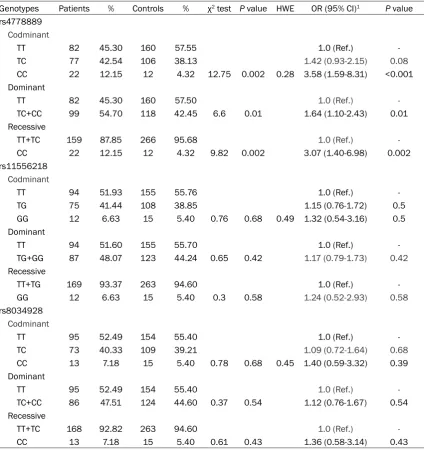
Table 2. Genotype frequencies of IL-16 rs4778889, rs11556218 and rs8034928 among the cases with RCC and controls and their association with risk of RCC
Genotypes Patients % Controls % χ2 test P value HWE OR (95% CI)1 P value
rs4778889 Codminant
TT 82 45.30 160 57.55 1.0 (Ref.) TC 77 42.54 106 38.13 1.42 (0.93-2.15) 0.08 CC 22 12.15 12 4.32 12.75 0.002 0.28 3.58 (1.59-8.31) <0.001 Dominant
TT 82 45.30 160 57.50 1.0 (Ref.) TC+CC 99 54.70 118 42.45 6.6 0.01 1.64 (1.10-2.43) 0.01 Recessive
TT+TC 159 87.85 266 95.68 1.0 (Ref.) CC 22 12.15 12 4.32 9.82 0.002 3.07 (1.40-6.98) 0.002 rs11556218
Codminant
TT 94 51.93 155 55.76 1.0 (Ref.) TG 75 41.44 108 38.85 1.15 (0.76-1.72) 0.5 GG 12 6.63 15 5.40 0.76 0.68 0.49 1.32 (0.54-3.16) 0.5 Dominant
TT 94 51.60 155 55.70 1.0 (Ref.) TG+GG 87 48.07 123 44.24 0.65 0.42 1.17 (0.79-1.73) 0.42 Recessive
TT+TG 169 93.37 263 94.60 1.0 (Ref.) GG 12 6.63 15 5.40 0.3 0.58 1.24 (0.52-2.93) 0.58 rs8034928
Codminant
TT 95 52.49 154 55.40 1.0 (Ref.) TC 73 40.33 109 39.21 1.09 (0.72-1.64) 0.68 CC 13 7.18 15 5.40 0.78 0.68 0.45 1.40 (0.59-3.32) 0.39 Dominant
TT 95 52.49 154 55.40 1.0 (Ref.) TC+CC 86 47.51 124 44.60 0.37 0.54 1.12 (0.76-1.67) 0.54 Recessive
TT+TC 168 92.82 263 94.60 1.0 (Ref.) CC 13 7.18 15 5.40 0.61 0.43 1.36 (0.58-3.14) 0.43
1Adjusted for sex, age, hypertension and diabetes.
30s, 63°C for 30 s, and 72°C for 30 s and a final extension step of 72°C for 10 min. The product sizes for IL-16 rs4778889, rs11556218 and rs8034928 were 90 bp, 136 bp and 171 bp, respectively.
Statistical analysi
The demographic and clinical data of patients with RCC and control subjects were shown as mean ± standard deviation and frequency (per-centage) of study subjects. The demographic and clinical data between patients with RCC
and control subjects were compared by t-test or χ2-test. Hardy-Weinberg equilibrium of genetic
distributions in controls was tested with a good-ness of fit χ2 test with one degree of freedom,
sig-phism was associated with development of RCC regardless of cigarette smoking and alco-hol drinking, but this SNP had interaction with hypertension (OR = 2.44, 95% CI = 1.01-6.00) and diabetes (OR = 6.91, 95% CI = 1.44-37.05) in the risk of RCC.
Discussion
In the present study, we investigated whether the three functional SNPs in IL-16 rs4778889, rs11556218 and rs8034928 could influence the susceptibility to RCC in a Chinese popula-tion. We found that the CC genotype of rs4778889 was associated with an increased risk of RCC compared to TT genotype, and we revealed the IL-16 rs4778889 polymorphisms were associated with an elevated increased risk of RCC in dominant model and recessive models, especially in patients with hyperten-sion or diabetes. Therefore, our results suggest that IL-16 rs4778889 polymorphism may play an important role in the development of RCC, and this gene could be used as a genetic mark-er for identification the development of RCC in a Chinese population.
[image:4.629.99.382.116.304.2]IL-16 is a multifunctional cytokine and plays a critical role in inflammatory diseases and tumor growth as well as tumor procession. Previous studies have reported that IL-16 gene polymor-phisms are association with the development of various cancers, such as colorectal cancer, Table 3. Stratification analysis between IL16 rs4778889 and risk
of RCC by cigarette smoking, alcohol drinking, hypertension and diabetes
Variables Patients Controls OR (95% CI) P value TT TC+CC TT TC+CC
Cigarette smoking 82 99 160 118
Never 48 54 104 76 1.54 (0.92-2.58) 0.08 Ever 34 45 56 42 1.76 (0.93-3.36) 0.06 Alcohol drinking
Never 44 52 88 66 1.58 (0.91-2.72) 0.08 Ever 38 47 72 52 1.71 (0.95-3.11) 0.06 Hypertension
No 59 70 129 102 1.50 (0.95-2.37) 0.07 Yes 23 29 31 16 2.44 (1.01-6.00) 0.03 Diabetes
No 74 82 147 114 1.43 (0.94-2.17) 0.08 Yes 8 17 13 4 6.91 (1.44-37.05) 0.005
nificant. Statistical analysis was done using statistical package SPSS 16.0 software (SPSS, Chicago, IL, USA).
Results
The baseline characteristics of patients with RCC and control subjects were described in Table 1. By χ2 test, we found that patients with
RCC were more likely to suffer from hyperten-sion (χ2 = 9.06, P = 0.003) and diabetes (χ2 =
7.91, P = 0.005). However, no significant differ-ence was found between patients with RCC and control subjects in terms of age (t = 7.91, P = 0.16), sex (χ2 = 0.17, P = 0.68), cigarette
smoking (χ2 = 3.26, P = 0.07), alcohol drinking
(χ2 = 0.24, P = 0.62) and family history of
can-cer (χ2 = 0.81, P = 0.37). Of 181 patients with
RCC, 113 (62.43%) at I-II TNM stage, 68 (37.57%) at III-IV TNM stage, and 147 (81.22%) were clear cell RCC.
By χ2 test with one degree of freedom, we found
the genotype frequencies of IL-16 rs4778889, rs11556218 and rs8034928 did not deviate from HWE, and the P values (for HWE) were 0.34, 0.22 and 0.45, respectively (Table 2). We found significant differences in the genotype frequencies of rs4778889 (χ2 = 12.75, P =
0.002); however, rs11556218 and rs8034928 exhibited no such differences. By unconditional logistic regression analysis, we found that the CC genotype of rs4778889 was associated
with an increased risk of RCC compared to TT genotype, and the adjusted OR (95% CI) was 3.58 (1.59-8.31). In dom-inant model and recessi- ve model, we found th- e rs4778889 polymorphisms were associated with an ele-vated increased risk of RCC, and the adjusted ORs (95% CI) were 1.64 (1.10-2.43) and 3.07 (1.40-6.98), respec- tively.
polymor-gastric cancer, nasopharyngeal carcinoma, hepatocellular carcinoma and glioma [17-21]. Gao et al. conducted a case-control study with 376 colorectal cancer patients and 220 gastric cancer patients in a Chinese population, and they found that the rs11556218 polymorphism was significantly associated with the suscepti-bility to colorectal cancer and gastric cancer patients [17]. In human nasophargyngeal carci-noma, Gao et al. conduced another study in a Chinese population with 206 nasopharyngeal cancer patients, and they reported that rs11556218 polymorphism contributes to the susceptibility to nasopharyngeal cancer [18]. Li et al. analyzed the association between three SNPs of IL-16 polymorphisms and development of HBV-related hepatocellular carcinoma, and they found that rs11556218 and rs4072111 were associated with susceptibility to chronic HBV infection and risk of hepatocellular carci-noma [19]. Azimzadeh et al. reported that IL-16 rs11556218 and rs4778889 polymorphisms could influence the development of colorectal cancer [20]. Qin et al. reported that IL-16 rs11556218 polymorphism was correlated with an elevated risk of nasopharyngeal carci-noma [21]. A recent meta-analysis reported that the IL-16 rs11556218 polymorphism was significantly correlated with elevated cancer risk in Asian population [22]. The above-men-tioned studies suggest that IL-16 gene polymor-phisms are associated with development of cancers.
Our study found that IL-16 rs4778889 polymor-phism played a major role in susceptibility to RCC. A possible mechanism for IL-16 rs4778889 polymorphism in modulating the development of RCC is that the IL-16 rs4778- 889 polymorphism regulates the expression of serum levels of IL-16, and the over-expressed IL-16 is associated with the development of tumorigenesis of RCC. Only one previous study has reported that IL-16 -295 T>C polymorphism is significantly associated with development of RCC [23]. However, no studies reported the association between IL16 rs4778889, rs 11556218 and rs8034928 and development of RCC. Moreover, our study found that the rs4778889 polymorphism had interaction with hypertension and diabetes in the risk of RCC. Previous studies have reported that IL-16 expression was association with development of type 2 diabetes mellitus and hypertension related diseases [24, 25]. Further studies with
large sample sizes are greatly required to con-firm our study.
Two limitations in our study should be taken into consideration. First, patients with RCC and control subjects were selected from only one hospital, which would cause selection bias in our study. However, the genotype distributions of IL-16 rs4778889, rs11556218 and rs8034928 confirm with the Hardy-Weinberg equilibrium in controls, which suggests that our population may represent the general popula-tion. Second, the sample size of our study is relatively small, which could reduce the statisti-cal power to find differences between groups. Therefore, further studies with participants from multiple locations and a larger sample size are required to confirm our results.
In conclusion, the results of our study suggest-ed an association between the IL-16 polymor-phisms and an elevated risk of RCC, especially in patients with diabetes mellitus and hyper-tension. Our study offers insights into the influ-ence of IL-16 on development of RCC.
Disclosure of conflict of interest
None.
Address correspondence to: Dr. Zongping Wang, Department of Urology, Zhejiang Cancer Hospital, 38 Guangji Road, Hangzhou 310022, Zhejiang, China. Tel: 88128021; Fax: +86-571-88122523; E-mail: [email protected]
References
[1] International Agency for Research on Cancer (IARC). GLOBOCAN 2012: Estimated Cancer Incidence, Mortality and Prevalence World-wide in 2012. http://globocan.iarc.fr/Pages/ fact_sheets_cancer.aspx. Accessed August 1, 2015.
[2] Liu XL, Du JZ, Zhou YM, Shu QF, Li YG. Interleu-k16 polymorphism is associated with an in-creased risk of ischemic stroke. Mediators In-flamm 2013; 2013: 564750.
[3] Facchini F, Chen YD, Reaven GM. Light-to-mod-erate alcohol intake is associated with en-hanced insulin sensitivity. Diabetes Care 1994; 17: 115-9.
re-cent epidemiological evidence. J Natl Cancer Inst 2004; 96: 99-106.
[5] Adams KF, Leitzmann MF, Albanes D, Kipnis V, Moore SC, Schatzkin A, Chow WH. Body size and renal cell cancer incidence in a large US cohort study. Am J Epidemiol 2008; 168: 268-77.
[6] Bellocco R, Pasquali E, Rota M, Bagnardi V, Tramacere I, Scotti L, Pelucchi C, Boffetta P, Corrao G, La Vecchia C. Alcohol drinking and risk of renal cell carcinoma: results of a meta-analysis. Ann Oncol 2012; 23: 2235-44. [7] Chang Y, Xu L, An H, Fu Q, Chen L, Lin Z, Xu J.
Expression of IL-4 and IL-13 predicts recur-rence and survival in localized clear-cell renal cell carcinoma. Int J Clin Exp Pathol 2015; 8: 1594-603.
[8] Pan D, Xu L, Liu H, Zhang W, Zhu Y, Xu J, Gu J. Interleukin-11 receptor predicts post-operative clinical outcome in patients with early-stage clear-cell renal cell carcinoma. Jpn J Clin Oncol 2015; 45: 202-9.
[9] Pu Y, Chen P, Zhou B, Zhang P, Wang Y, Song Y, Zhang L. Association between polymorphisms in IL27 gene and renal cell carcinoma. Bio-markers 2015; 20: 202-5.
[10] Shibasaki N, Yamasaki T, Kanno T, Arakaki R, Sakamoto H, Utsunomiya N, Inoue T, Tsu-ruyama T, Nakamura E, Ogawa O, Kamba T. Role of IL13RA2 in Sunitinib Resistance in Clear Cell Renal Cell Carcinoma. PLoS One 2015; 10: e0130980.
[11] Cruikshank WW, Center DM, Nisar N, Wu M, Natke B, Theodore AC, Kornfeld H. Molecular and functional analysis of a lymphocyte che-moattractant factor: association of biologic function with CD4 expression. Proc Natl Acad Sci U S A 1994; 91: 5109-13.
[12] Kai H, Kitadai Y, Kodama M, Cho S, Kuroda T, Ito M, Tanaka S, Ohmoto Y, Chayama K. In-volvement of proinflammatory cytokines IL-1beta and IL-6 in progression of human gastric carcinoma. Anticancer Res 2005; 25: 709-13. [13] Muc-Wierzgon M, Nowakowska-Zajdel E, Kokot
T, Kozowicz A, Wiczkowski A, Grochowska-Niedworok E, Mazurek U, Wierzgon J. Genetic disregulation of TNF alpha and TNF alpha type II receptors in colon cancer at the II and III stage of disease. J Biol Regul Homeost Agents 2006; 20: 10-4.
[14] Shanmugham LN, Petrarca C, Frydas S, Do-nelan J, Castellani ML, Boucher W, Madhap-pan B, Tete’ S, Falasca K, Conti P, Vecchiet J. IL-15 an immunoregulatory and anti-cancer cytokine. Recent advances. J Exp Clin Cancer Res 2006; 25: 529-36.
[15] Reich K, Westphal G, König IR, Mössner R, Krüger U, Ziegler A, Neumann C, Schnuch A.
Association of allergic contact dermatitis with a promoter polymorphism in the IL16 gene. J Allergy Clin Immunol 2003; 112: 1191-4. [16] Hosseini-Farahabadi S, Tavakkol-Afshari J,
Ra-fatpanah H, Farid Hosseini R, Khaje Daluei M. Association between the polymorphisms of IL-4 gene promoter (-590C>T), IL-13 coding re-gion (R130Q) and IL-16 gene promoter (-295T>C) and allergic asthma. Iran J Allergy Asthma Immunol 2007; 6: 9-14.
[17] Gao LB, Rao L, Wang YY, Liang WB, Li C, Xue H, Zhou B, Sun H, Li Y, Lv ML, Du XJ, Zhang L. The association of interleukin-16 polymorphisms with IL-16 serum levels and risk of colorectal and gastric cancer. Carcinogenesis 2009; 30: 295-9.
[18] Gao LB, Liang WB, Xue H, Rao L, Pan XM, Lv ML, Bai P, Fang WL, Liu J, Liao M, Zhang L. Ge-netic polymorphism of interleukin-16 and risk of nasopharyngeal carcinoma. Clin Chim Acta 2009; 409: 132-5.
[19] Li S, Deng Y, Chen ZP, Huang S, Liao XC, Lin LW, Li H, Peng T, Qin X, Zhao JM. Genetic polymor-phism of interleukin-16 influences susceptibil-ity to HBV-related hepatocellular carcinoma in a Chinese population. Infect Genet Evol 2011; 11: 2083-8.
[20] Azimzadeh P, Romani S, Mohebbi SR, Kazemi-an S, Vahedi M, Almasi S, Fatemi SR, Zali MR. Interleukin-16 (IL-16) gene polymorphisms in Iranian patients with colorectal cancer. J Gas-trointestin Liver Dis 2011; 20: 371-6.
[21] Qin X, Peng Q, Lao X, Chen Z, Lu Y, Lao X, Mo C, Sui J, Wu J, Zhai L, Yang S, Li S, Zhao J. The as-sociation of interleukin-16 gene polymor-phisms with IL-16 serum levels and risk of na-sopharyngeal carcinoma in a Chinese population. Tumour Biol 2014; 35: 1917-24. [22] Zhao Y, Tao L, Wang B, Nie P, Tang Y, Zhu M.
Interleukin-16 gene polymorphisms rs4778- 889, rs4072111, rs11556218, and cancer risk in Asian populations: a meta-analysis. Genet Test Mol Biomarkers 2014; 18: 174-82. [23] Zhu J, Qin C, Yan F, Wang M, Ding Q, Zhang Z,
Yin C. IL-16 polymorphism and risk of renal cell carcinoma: association in a Chinese popula-tion. Int J Urol 2010; 17: 700-7.
[24] Liu XL, Du JZ, Zhou YM, Shu QF, Li YG. Interleu-k16 polymorphism is associated with an in-creased risk of ischemic stroke. Mediators In-flamm 2013; 2013: 564750.