A Reranking Model for Discourse Segmentation using Subtree Features
Ngo Xuan Bach, Nguyen Le Minh, Akira Shimazu
School of Information Science
Japan Advanced Institute of Science and Technology 1-1 Asahidai, Nomi, Ishikawa, 923-1292, Japan {bachnx,nguyenml,shimazu}@jaist.ac.jp
Abstract
This paper presents a discriminative reranking model for the discourse segmentation task, the first step in a discourse parsing system. Our model exploits subtree features to rerank N-best outputs of a base segmenter, which uses syntactic and lexical features in a CRF frame-work. Experimental results on the RST Dis-course Treebank corpus show that our model outperforms existing discourse segmenters in both settings that use gold standard Penn Tree-bank parse trees and Stanford parse trees.
1 Introduction
Discourse structure has been shown to have an im-portant role in many natural language applications, such as text summarization (Marcu, 2000; Louis et al., 2010), information presentation (Bateman et al., 2001), question answering (Sun and Chai, 2007), and dialogue generation (Hernault et al., 2008). To produce such kinds of discourse structure, several attempts have been made to build discourse parsers in the framework of Rhetorical Structure Theory (RST) (Mann and Thompson, 1988), one of the most widely used theories of text structure.
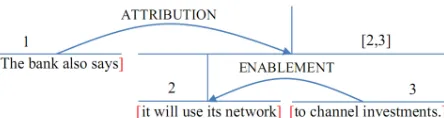
[image:1.612.316.538.251.310.2]In the RST framework, a text is first divided into several elementary discourse units (EDUs). Each EDU may be a simple sentence or a clause in a com-plex sentence. Consecutive EDUs are then put in relation with each other to build a discourse tree. Figure 1 shows an example of a discourse tree with three EDUs. The goal of the discourse segmentation task is to divide the input text into such EDUs.
Figure 1: A discourse tree (Soricut and Marcu, 2003).
The quality of the discourse segmenter con-tributes a significant part to the overall accuracy of every discourse parsing system. If a text is wrongly segmented, no discourse parsing algorithm can build a correct discourse tree.
Existing discourse segmenters usually exploit lex-ical and syntactic features to label each word in a sentence with one of two labels, boundary or no-boundary. The limitation of this approach is that it only focuses on the boundaries of EDUs. It cannot capture features that describe whole EDUs.
Recently, discriminative reranking has been used successfully in some NLP tasks such as POS tag-ging, chunking, and statistical parsing (Collins and Koo, 2005; Kudo et al., 2005; Huang, 2008; Fraser et al., 2009). The advantage of the reranking method is that it can exploit the output of a base model to learn. Based on that output, we can extract long-distance non-local features to rerank.
In this paper, we present a reranking model for the discourse segmentation task. We show how to use subtree features, features extracted from whole EDUs, to rerank outputs of a base model. Exper-imental results on RST Discourse Treebank (RST-DT) (Carlson et al., 2002) show that our model
performs existing systems.
The rest of this paper is organized as follows. Sec-tion 2 summarizes related work. SecSec-tion 3 presents our method. Experimental results on RST-DT are described in Section 4. Finally, Section 5 gives con-clusions.
2 Related Work
Several methods have been proposed to deal with the discourse segmentation task. Thanh et al. (2004) present a rule-based discourse segmenter with two steps. In the first step, segmentation is done by us-ing syntactic relations between words. The segmen-tation algorithm is based on some principles, which have been presented in Corston (1998) and Carlson and Marcu (2001), as follows:
1. The clause that is attached to a noun phrase can be recognised as an embedded unit. If the clause is a subordinate clause, it must contain more than one word.
2. Coordinate clauses and coordinate sentences of a complex sentence are EDUs.
3. Coordinate clauses and coordinate elliptical clauses of verb phrases (VPs) are EDUs. Co-ordinate VPs that share a direct object with the main VP are not considered as a separate dis-course segment.
4. Clausal complements of reported verbs and cognitive verbs are EDUs.
The segmenter then uses cue phrases to correct the output of the first step.
Tofiloski et al. (2009) describe another rule-based discourse segmenter. The core of this segmenter consists of 12 syntactic segmentation rules and some rules concerning a list of stop phrases, discourse cue phrases, and part-of-speech tags. They also use a list of phrasal discourse cues to insert boundaries not derivable from the parser’s output.
Soricut and Marcu (2003) introduce a statisti-cal discourse segmenter, which is trained on RST-DT to label words with boundary or no-boundary
labels. They use lexical and syntactic features to determine the probabilities of discourse boundaries
P(bi|wi, t), where wi is the ith word of the input
sentences,tis the syntactic parse tree ofs, andbi ∈ {boundary, no-boundary}. Given a syntactic parse
treet, their algorithm inserts a discourse boundary
after each word wfor whichP(boundary|w, t) >
0.5.
Another statistical discourse segmenter using arti-ficial neural networks is presented in Subba and Di Eugenio (2007). Like Soricut and Marcu (2003), they formulate the discourse segmentation task as a binary classification problem of deciding whether a word is the boundary or no-boundary of EDUs. Their segmenter exploits a multilayer perceptron model with back-propagation algorithm and is also trained on RST-DT.
Hernault et al. (2010) propose a sequential model for the discourse segmentation task, which considers the segmentation task as a sequence labeling prob-lem rather than a classification probprob-lem. They ex-ploit Conditional Random Fields (CRFs) (Lafferty et al., 2001) as the learning method and get state-of-the-art results on RST-DT.
In our work, like Hernault et al. (2010), we also consider the discourse segmentation task as a se-quence labeling problem. The final segmentation result is selected among N-best outputs of a CRF-based model by using a reranking method with sub-tree features.
3 Method
3.1 Discriminative Reranking
In the discriminative reranking method (Collins and Koo, 2005), first, a set of candidates is generated us-ing a base model (GEN). GEN can be any model for the task. For example, in the part-of-speech (POS) tagging problem, GEN may be a model that gener-ates all possible POS tags for a word based on a dic-tionary. Then, candidates are reranked using a linear score function:
score(y) = Φ(y)·W
whereyis a candidate,Φ(y)is the feature vector of candidatey, andW is a parameter vector. The final
output is the candidate with the highest score:
To learn the parameterW we use the average
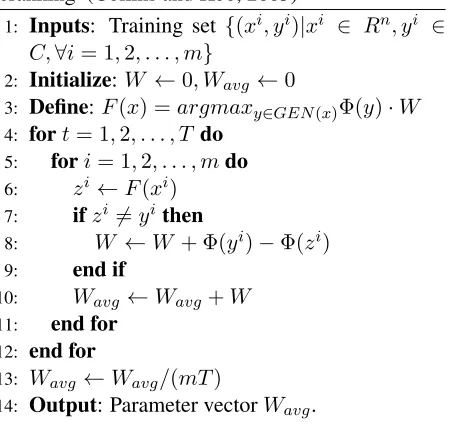
per-ceptron algorithm, which is presented as Algorithm 1.
Algorithm 1 Average perceptron algorithm for reranking (Collins and Koo, 2005)
1: Inputs: Training set {(xi, yi)|xi ∈ Rn, yi ∈
C,∀i= 1,2, . . . , m}
2: Initialize:W ←0, Wavg ←0
3: Define:F(x) =argmaxy∈GEN(x)Φ(y)·W
4: fort= 1,2, . . . , T do
5: fori= 1,2, . . . , mdo
6: zi←F(xi)
7: ifzi 6=yi then
8: W ←W + Φ(yi)−Φ(zi)
9: end if
10: Wavg ←Wavg +W
11: end for
12: end for
13: Wavg ←Wavg/(mT)
14: Output: Parameter vectorWavg.
In the next sections we will describe our base model and features that we use to rerank candidates.
3.2 Base Model
Similar to the work of Hernault et al. (2010), our base model uses Conditional Random Fields1 to
learn a sequence labeling model. Each label is either
beginningof EDU (B) or continuationof EDU (C). Soricut and Marcu (2003) and Subba and Di Euge-nio (2007) useboundarylabels, which are assigned to words at the end of EDUs. Like Hernault et al. (2010), we usebeginninglabels, which are assigned to words at the beginning of EDUs. However, we can convert an output withboundary, no-boundary
labels to an output withbeginning,continuation la-bels and vice versa. Figure 2 shows two examples of segmenting a sentence into EDUs and their correct label sequences.
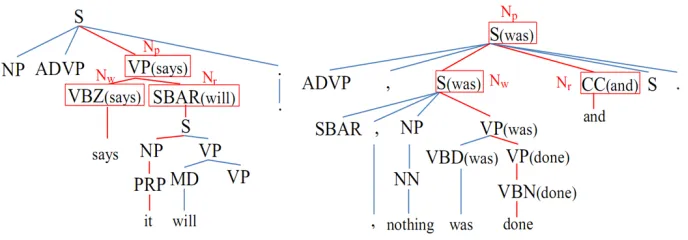
We use the following lexical and syntactic infor-mation as features: words, POS tags, nodes in parse trees and their lexical heads and their POS heads2.
When extracting features for word w, let r be the
1We use the implementation of Kudo (Kudo, CRF++). 2Lexical heads are extracted using Collins’ rules (Collins,
[image:3.612.76.302.133.345.2]1999).
Figure 2: Examples of segmenting sentences into EDUs.
word on the right-hand side ofwandNpbe the
deep-est node that belongs to both paths from the root to
w and r. Nw and Nr are child nodes of Np that
belong to two paths, respectively. Figure 3 shows two partial lexicalized syntactic parse trees. In the first tree, ifw=saysthenr=it,Np =V P(says),
Nw = V BZ(says), and Nr = SBAR(will). We
also consider the parent and the right-sibling ofNp
if any. The final feature set forwconsists of not only features extracted fromwbut also features extracted
from two words on the left-hand side and two words on the right-hand side ofw.
Our feature extraction method is different from the method in previous work (Soricut and Marcu, 2003; Hernault et al., 2010). They defineNw as the
highest ancestor ofwthat has lexical headwand has
a right-sibling. ThenNp andNr are defined as the
parent and right-sibling ofNw. In the first example,
our method gives the same results as the previous one. In the second example, however, there is no node with lexical head “done” and having a right-sibling. The previous method cannot extract Nw,
Np, andNr in such cases. We also use some new
features such as the head node and the right-sibling node ofNp.
3.3 Subtree Features for Reranking
We need to decide which kinds of subtrees are useful to represent a candidate, a way to segment the input sentence into EDUs. In our work, we consider two kinds of subtrees:bound treesandsplitting trees.
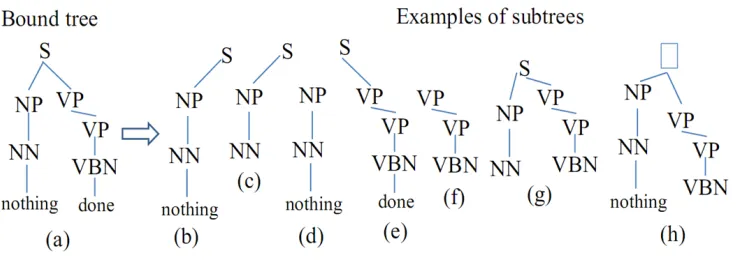
The bound tree of an EDU, which spans from word uto word w, is a subtree which satisfies two
Figure 3: Partial lexicalized syntactic parse trees.
1. its root is the deepest node in the parse tree which belongs to both paths from the root of the parse tree touandw, and
2. it only contains nodes in two those paths.
Thesplitting treebetween two consecutive EDUs, from word u to word w and from wordr to word v, is a subtree which is similar to a bound tree, but
contains two paths from the root of the parse tree to
w andr. Hence, a splitting treebetween two
con-secutive EDUs is abound treethat only covers two words: the last word of the first EDU and the first word of the second EDU. Bound trees will cover the whole EDUs, while splitting trees will concentrate on the boundaries of EDUs.
From a bound tree (similar to a splitting tree), we extract three kinds of subtrees: subtrees on the left path (left tree), subtrees on the right path (right tree), and subtrees consisting of a subtree on the left path and a subtree on the right path (full tree). In the third case, if both subtrees on the left and right paths do not contain the root node, we add a pseudo root node. Figure 4 shows the bound tree of EDU “ noth-ing was done” of the second example in Figure 3, and some examples of extracted subtrees.
Each subtree feature is then represented by a string as follows:
• A left tree (or a right tree) is represented by concatenating its nodes with hyphens between nodes. For example, subtrees (b) and (e) in Fig-ure 4 can be represented as follows:
S-NP-NN-nothing, and
S-VP-VP-VBN-done.
• A full tree is represented by concatenating its left tree and right tree with string ### in the middle. For example, subtrees (g) and (h) in Figure 4 can be represented as follows:
S-NP-NN###S-VP-VP-VBN, and
NP-NN-nothing###VP-VP-VBN.
The feature set of a candidate is the set of all sub-trees extracted from bound sub-trees of all EDUs and splitting trees between two consecutive EDUs.
Among two kinds of subtrees, splitting trees can be computed between any two adjacent words and therefore can be incorporated into the base model. However, if we do so, the feature space will be very large and contains a lot of noisy features. Because many words are not a boundary of any EDU, many subtrees extracted by this method will never be-come arealsplitting tree (tree that splits two EDUs). Splitting trees extracted in the reranking model will focus on a small but compact and useful set of sub-trees.
4 Experiments
4.1 Data and Evaluation Methods
We tested our model on the RST Discourse Treebank corpus. This corpus consists of 385 articles from the Penn Treebank, which are divided into a Training set and a Test set. The Training set consists of 347 articles (6132 sentences), and the Test set consists of 38 articles (991 sentences).
Figure 4: Subtree features.
method (Hernault et al., 2010) measures both be-ginning andcontinuation labels (B and C labels)3.
This method first calculates scores on B labels and scores on C labels, and then produces the average of them. Due to the number of C labels being much higher than the number of B labels, the second eval-uation method yields much higher results. In Her-nault et al. (2010), the authors compare their systems with previous work despite using different evalua-tion methods. Such comparisons are not valid. In our work, we measure the performance of the pro-posed model using both methods.
4.2 Experimental Results
We learned the base model on the Training set and tested on the Test set to get N-best outputs to rerank. To learn parameters of the reranking model, we con-ducted 5-fold cross-validation tests on the Training set. In all experiments, we set N to 20. To choose the number of iterations, we used a development set, which is about 20 percent of the Training set.
Table 1 shows experimental results when evaluat-ing only beginning(B) labels, in which SPADE is the work of Soricut and Marcu (2003), NNDS is a segmenter that uses neural networks (Subba and Di Eugenio, 2007), and CRFSeg is a CRF-based seg-menter (Hernault et al., 2010). When using gold parse trees, our base model got 92.5% in the F1 score, which improves 1.3% compared to the state-of-the-art segmenter (CRFSeg). When using Stan-ford parse trees (Klein and Manning, 2003), our base model improved 1.7% compared to CRFSeg. It demonstrates the effectiveness of our feature
[image:5.612.313.548.249.397.2]ex-3Neither evaluation method counts sentence boundaries.
Table 1: Performance when evaluating on B labels
Model Trees Pre(%) Re(%) F1(%)
SPADE Penn 84.1 85.4 84.7
NNDS Penn 85.5 86.6 86.0
CRFSeg Penn 92.7 89.7 91.2
Base Penn 92.5 92.5 92.5
Reranking Penn 93.1 94.2 93.7
CRFSeg Stanford 91.0 87.2 89.0
Base Stanford 91.4 90.1 90.7
Reranking Stanford 91.5 90.4 91.0
Human - 98.5 98.2 98.3
traction method in the base model. As expected, our reranking model got higher results compared to the base model in both settings. The rerank-ing model got 93.7% and 91.0% in two settrerank-ings, which improves 2.5% and 2.0% compared to CRF-Seg. Also note that, when using Stanford parse trees, our reranking model got competitive results with CRFSeg when using gold parse trees (91.0% com-pared to 91.2%).
Table 2 shows experimental results when evaluat-ing on bothbeginningandcontinuationlabels. Our models also outperformed CRFSeg in both settings, using gold parse trees and using Stanford parse trees (96.6% compared to 95.3% in the first setting, and 95.1% compared to 94.1% in the second setting).
Table 2: Performance when evaluating on B and C labels
Model Trees Pre(%) Re(%) F1(%)
CRFSeg Penn 96.0 94.6 95.3
Base Penn 96.0 96.0 96.0
Reranking Penn 96.3 96.9 96.6
CRFSeg Stanford 95.0 93.2 94.1
Base Stanford 95.3 94.7 95.0
Reranking Stanford 95.4 94.9 95.1
gold parse trees and Stanford parse trees, respec-tively.
We do not compare our segmenter to systems de-scribed in Thanh et al. (2004) and Tofiloski et al. (2009). Thanh et al. (2004) evaluated their system on only 8 texts of RST-DT with gold standard parse trees. They achieved 81.4% and 79.2% in the preci-sion and recall scores, respectively. Tofiloski et al. (2009) tested their system on only 3 texts of RST-DT and used different segmentation guidelines. They reported a precision of 82.0% and recall of 86.0% when using Stanford parse trees.
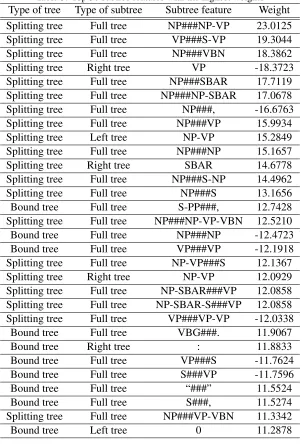
An important question is which subtree features were useful for the reranking model. This question can be answered by looking at the weights of sub-tree features (the parameter vector learned by the average perceptron algorithm). Table 3 shows 30 subtree features with the highest weights in absolute value. These features are thus useful for reranking candidates in the reranking model. We can see that most subtree features at the top are splitting trees, so splitting trees have a more important role than
bound trees in our model. Among three types of subtrees (left tree, right tree, andfull tree),full tree
is the most important type. It is understandable be-cause subtrees in this type convey much informa-tion; and therefore describesplitting treesandbound treesmore precise than subtrees in other types.
4.3 Error Analysis
[image:6.612.327.525.67.298.2]This section discusses the cases in which our model fails to segment discourses. Note that all errors be-long to one of two types, over-segmentation type (i.e., words that are not EDU boundaries are mis-taken for boundaries) and miss-segmentation type (i.e., words that are EDU boundaries are mistaken for not boundaries).
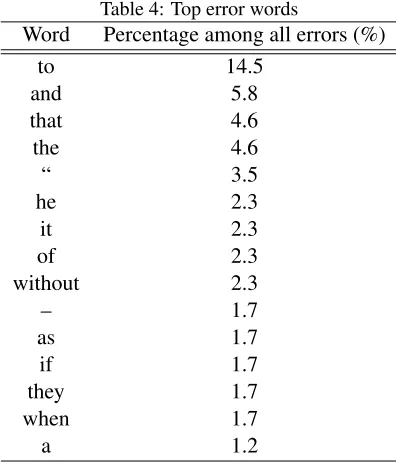
Table 4: Top error words
Word Percentage among all errors (%)
to 14.5
and 5.8
that 4.6
the 4.6
“ 3.5
he 2.3
it 2.3
of 2.3
without 2.3
– 1.7
as 1.7
if 1.7
they 1.7
when 1.7
a 1.2
Tabel 4 shows 15 most frequent words for which our model usually makes a mistake and their per-centage among all segmentation errors. Most errors are related to coordinating conjunctions and subor-dinators (and,that,as,if,when), personal pronouns (he,it,they), determiners (the, a), prepositions (of,
without), punctuations (quotes and hyphens), and the wordto.
Figure 5 shows some errors made by our model. In these examples, gold (correct) EDU boundaries are marked by bracket squares ([]), while predicted boundaries made by our model are indicated by ar-rows (↓or↑). A down arrow (↓) shows a boundary which is predicted correctly, while an up arrow (↑) indicates an over-segmentation error. A boundary with no arrow means amiss-segmentationerror. For example, in Sentence 1, we have a correct boundary and anover-segmentationerror. Sentences 2 and 3 show twoover-segmentationerrors, and sentences 4 and 6 show twomiss-segmentationerrors.
[image:6.612.72.304.76.180.2]Table 3: Top 30 subtree features with the highest weights
Type of tree Type of subtree Subtree feature Weight
Splitting tree Full tree NP###NP-VP 23.0125
Splitting tree Full tree VP###S-VP 19.3044
Splitting tree Full tree NP###VBN 18.3862
Splitting tree Right tree VP -18.3723
Splitting tree Full tree NP###SBAR 17.7119
Splitting tree Full tree NP###NP-SBAR 17.0678
Splitting tree Full tree NP###, -16.6763
Splitting tree Full tree NP###VP 15.9934
Splitting tree Left tree NP-VP 15.2849
Splitting tree Full tree NP###NP 15.1657
Splitting tree Right tree SBAR 14.6778
Splitting tree Full tree NP###S-NP 14.4962
Splitting tree Full tree NP###S 13.1656
Bound tree Full tree S-PP###, 12.7428
Splitting tree Full tree NP###NP-VP-VBN 12.5210
Bound tree Full tree NP###NP -12.4723
Bound tree Full tree VP###VP -12.1918
Splitting tree Full tree NP-VP###S 12.1367
Splitting tree Right tree NP-VP 12.0929
Splitting tree Full tree NP-SBAR###VP 12.0858
Splitting tree Full tree NP-SBAR-S###VP 12.0858
Splitting tree Full tree VP###VP-VP -12.0338
Bound tree Full tree VBG###. 11.9067
Bound tree Right tree : 11.8833
Bound tree Full tree VP###S -11.7624
Bound tree Full tree S###VP -11.7596
Bound tree Full tree “###” 11.5524
Bound tree Full tree S###, 11.5274
Splitting tree Full tree NP###VP-VBN 11.3342
Bound tree Left tree 0 11.2878
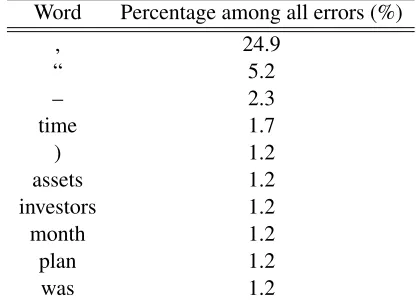
Table 5: Most frequent words that appear before error words
Word Percentage among all errors (%)
, 24.9
“ 5.2
– 2.3
time 1.7
) 1.2
assets 1.2
investors 1.2
month 1.2
plan 1.2
was 1.2
5 Conclusion
This paper presented a reranking model for the dis-course segmentation task. Our model exploits sub-tree features to rerank N-best outputs of a base model, which uses CRFs to learn. Compared with the state-of-the-art system, our model reduces 2.5% among 8.8% errors (28.4% in the term of error rate) when using gold parse trees, and reduces 2% among 11% errors (18.2% in the term of error rate) when using Stanford parse trees. In the future, we will build a discourse parser that uses the described dis-course segmenter.
Acknowledgments
This work was partially supported by the 21st Cen-tury COE program ‘Verifiable and Evolvable e-Society’, and Grant-in-Aid for Scientific Research, Education and Research Center for Trustworthy e-Society.
The authors would like to thank the three anony-mous reviewers for the time they spent reading and reviewing this paper and Michael Strube for his comments during the revision process of the paper.
References
J. Bateman, J. Kleinz, T. Kamps, and K. Reichenberger. 2001. Towards Constructive Text, Diagram, and Lay-out Generation for Information Presentation. Compu-tational Linguistics, 27(3), pp. 409-449.
L. Carlson and D. Marcu. 2001. Discourse Tagging Manual. ISI Technical Report, ISI-TR-545.
L. Carlson, D. Marcu, and M.E. Okurowski. 2002. RST Discourse Treebank. Linguistic Data Consor-tium (LDC).
M. Collins. 1999. Head-Driven Statistical Models for Natural Language Parsing. Ph.D. Thesis, University of Pennsylvania.
S. Corston-Oliver. 1998. Computing Representations of the Structure of Written Discourse.Ph.D. Thesis, Uni-versity of California, Santa Barbara.
M. Collins and T. Koo. 2005. Discriminative Rerank-ing for Natural Language ParsRerank-ing.Computational Lin-guistics, 31(1), pp. 25-70.
A. Fraser, R. Wang, and H. Sch¨utze. 2009. Rich Bitext Projection Features for Parse Reranking. In Proceed-ings of the 12th Conference of the European Chapter of the ACL (EACL), pp. 282-290.
H. Hernault, P. Piwek, H. Prendinger, and M. Ishizuka. 2008. Generating Dialogues for Virtual Agents Using Nested Textual Coherence Relations. InProceedings of IVA, pp. 139-145.
H. Hernault, D. Bollegala, and M. Ishizuka. 2010. A Se-quential Model for Discourse Segmentation. In Pro-ceedings of the 11th International Conference on Intel-ligent Text Processing and Computational Linguistics (CICLing), pp. 315-326.
L. Huang. 2008. Forest Reranking: Discriminative Pars-ing with Non-Local Features. InProceedings of the 46th Annual Meeting of the Association for Computa-tional Linguistics (ACL), pp. 586-594
D. Klein and C. Manning. 2003. Accurate Unlexicalized Parsing. InProceedings of the 41st Annual Meeting of the Association for Computational Linguistics (ACL), pp. 423-430.
T. Kudo. CRF++: Yet Another CRF toolkit. Available at http://crfpp.sourceforge.net/
T. Kudo, J. Suzuki, and H. Isozaki. 2005. Boosting-based parse reranking with subtree features. In Pro-ceedings of the 43rd Annual Meeting of the Associ-ation for ComputAssoci-ational Linguistics (ACL), pp. 189-196.
J. Lafferty, A. McCallum, and F. Pereira. 2001. Con-ditional random fields: Probabilistic models for seg-menting and labeling sequence data. InProceedings of the 18th International Conference on Machine Learn-ing (ICML), pp.282-289.
A. Louis, A. Joshi, and A. Nenkova 2010. Discourse indicators for content selection in summarization. In
Proceedings of the 11th annual SIGdial Meeting on Discourse and Dialogue (SIGDIAL), pp.147-156. W.C. Mann and S.A. Thompson. 1988. Rhetorical
Struc-ture Theory. Toward a Functional Theory of Text Or-ganization.Text8, pp. 243-281.
R. Soricut and D. Marcu. 2003. Sentence Level Dis-course Parsing using Syntactic and Lexical Informa-tion. In Proceedings of the North American Chap-ter of the Association for Computational Linguistics (NAACL), pp. 149-156.
R. Subba and B. Di Eugenio. 2007. Automatic Discourse Segmentation using Neural Networks. InProceedings of the Workshop on the Semantics and Pragmatics of Dialogue (SemDial), pp. 189-190.
M. Sun and J.Y. Chai. 2007. Discourse Processing for Context Question Answering Based on Linguis-tic Knowledge. Knowledge-Based Systems. 20(6), pp. 511-526.
H.L. Thanh, G. Abeysinghe, and C. Huyck. 2004. Auto-mated Discourse Segmentation by Syntactic Informa-tion and Cue Phrases. InProceedings of IASTED. M. Tofiloski, J. Brooke, and M. Taboada. 2009. A
Syntactic and Lexical-Based Discourse Segmenter. In