Learning with Partially Ordered Representations
Jane ChandleeTri-Co Department of Linguistics Haverford College
R´emi Eyraud QARMA team, LIS Aix-Marseille University [email protected]
Jeffrey Heinz Department of Linguistics
Institute for Advanced Computational Science Stony Brook University
Adam Jardine Department of Linguistics
Rutgers University
Jonathan Rawski Department of Linguistics
Institute for Advanced Computational Science Stony Brook University
Abstract
This paper examines the characterization and learning of grammars defined with enriched representational models. Model-theoretic ap-proaches to formal language theory tradition-ally assume that each position in a string be-longs to exactly one unary relation. We con-sider unconventional string models where po-sitions can have multiple, shared properties, which are arguably useful in many applica-tions. We show the structures given by these models are partially ordered, and present a learning algorithm that exploits this order-ing relation to effectively prune the hypothe-sis space. We prove this learning algorithm, which takes positive examples as input, finds the most general grammar which covers the data.
1 Introduction
Foundational connections between formal lan-guages, finite-state automata, and logic have been known for decades (B¨uchi,1960;Thomas,1997). Logical approaches are advantageous since they flexibly admit different representations. In many domains, such as biological sequencing or linguis-tics, shared properties of symbols in sequences provide information currently ignored by string-based inference algorithms, which largely focus on learning automata (de la Higuera,2010). Here we explore the idea that domain-specific knowl-edge can be encoded representationally via model
theory (Libkin,2004), and shows how these repre-sentations can facilitate pattern learning.
This paper synthesizes results in grammatical inference and model theory to present a novel al-gorithm which learns classes of formal languages using enriched representations of strings. In fact, our model-theoretic approach immediately gen-eralizes these results to arbitrary data structures. Here we are concerned with the learning of those formal languages which can be defined via a set of structural constraints, such as the Strictly k-Local and Strictlyk-Piecewise languages (Rogers and Pullum, 2011; Rogers et al., 2010). Models of strings in the languages must not contain these forbidden structures (Rogers et al.,2013). Specif-ically, we define a learner whose hypothesis space is structured as a partial order by the relational sig-nature of the particular model theory. We show how to traverse this space bottom-up from posi-tive data to find a grammar which covers the data with the most general constraints.
al-1 a
2 b
3 b
4 a
/ / /
1 a
2 b
3 b
4 a < < <
< <
[image:2.595.133.466.66.125.2]<
Figure 1: Visualizations of the successor (left) and precedence (right) models ofabba.
gorithm takes advantage of. Section 6 defines a learning problem and criteria for selecting ade-quate solutions. Section 7 presents a general-to-specific, bottom-up algorithm which provably sat-isfies the learning criteria. Section 8 concludes the paper.
2 Preliminaries
2.1 Elements of Language Theory
The set of all possible finite strings of symbols from a finite alphabet Σand the set of strings of length ≤n are Σ∗ and Σ≤n, respectively. The unique empty string is represented with λ. The
length of a stringw is|w|, so|λ|=0. If uandv are two strings then we denote their concatenation
withuv. Ifwis a string andσ is theith symbol in
wthenwi=σ, soabcd2=b.
The set of prefixes of w, Pref(w), is {p∈Σ∗ |(∃s∈Σ∗)[w= ps]}, the set of suffixes ofw, Suff(w), is {s∈Σ∗|(∃p∈Σ∗)[w=ps]}, the set of substrings, Substr(w), is {u ∈ Σ∗ | (∃l,r ∈ Σ∗)[w = lur]}, and the set of subsequences, Subseq(w) =
u1u2· · ·un|∃v0·v1· · ·vn∈Σ∗[w=v0u1v1· · ·unvn]
2.2 Elements of Finite Model Theory
Model theory, combined with logic, provides a powerful way to study and understand mathemat-ical objects with structures (Enderton, 2001). In this paper we only consider finite relational mod-els (Libkin,2004) of strings inΣ∗.
Definition 1(Models). Amodel signatureis a tu-ple S=hD;R1,R2, . . . ,Rmiwhere the domain D is a finite set, and each Ri is a ni-ary relation over
the domain. A model for a set of objects Ω is
a total, one-to-one function from Ωto structures
whose type is given by a model signature.
For example, a conventional model for strings in Σ∗ is given by the signature
Γ de f= hD;,[Rσ]σ∈Σi and the function M :
Σ∗ →Γ such that M(w)de f= hDw;,[Rwσ]σ∈Σi
where Dw de f= {1, . . . ,|w|} is the domain,
de f= {(i,i+1) ∈ D×D} is the successor relation which orders the elements of the domain, and [Rwσ]σ∈Σ is a set of |Σ| unary relations such
that for eachσ∈Σ,Rwσ de f= {i∈Dw|wi=σ}. We will usually omit the superscriptwsince it will be clear from the context.
For example, with Σ = {a,b,c} and the model above for strings, we have M(abba) =
hD={1,2,3,4};={(1,2),(2,3),(3,4)},Ra = {1,4},Rb={2,3},Rc=/0i.
Figure1illustratesM(abba)on the left. Another conventional model is the precedence
model, with the signatureΓ<de f= hD;<,[Rσ]σ∈Σi.
It differs from the successor model only in that the order relation is defined with general precedence
<de f= {(i,j)∈D×D|i< j} (B¨uchi, 1960; Mc-Naughton and Papert,1971;Rogers et al.,2013). Under this signature, the stringabbahas the fol-lowing model.
M<(abba) = hD = {1,2,3,4};<=
{(1,2),(1,3),(1,4),(2,3),(2,4),(3,4)},Ra = {1,4},Rb={2,3},Rc=/0i.
Figure1illustratesM<(abba)on the right. The model-theoretic framework is not unique to strings. It extends to arbitrary data structures by expanding parts of the model signature. For ex-ample,Rogers(2003) describes a model-theoretic characterization of trees of arbitrary dimension-ality where the domain D is a Gorn tree domain (Gorn,1967). This is a hereditarily prefix closed set Dof node addresses, that is to say, for every
d∈Dwithd=αi, wherei∈N, α∈N∗ it holds
thatα∈D, and for everyd∈Dwithd=αi6=α0,
thenα(i−1)∈D.
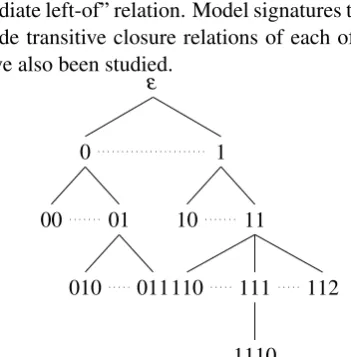
two-dimensional trees, then, relate nodes to one-dimensional trees (strings) by immediate domi-nance. A three-dimensional tree relates nodes to two-dimensional, i.e. standard trees, correspond-ing to Tree-Adjoincorrespond-ing Grammar derivations. In general, a d-dimensional tree is a set of nodes ordered by d dominance relations such that the
n-th dominance relation relates nodes to (n−1)
-dimensional trees (for d = 1, single nodes are zero-dimensional trees).
While a Gorn tree domain as written encodes these dominance and precedence relations implic-itly, we may explicitly write them out model-theoretically so that a signature for aΣ-labeled 2-dtree isΓ≺=hD;,≺,[Rσ]σ∈Σiwhereis the
“immediate dominance” relation and≺is the “im-mediate left-of” relation. Model signatures that in-clude transitive closure relations of each of these have also been studied.
ε
0
00 01
010 011 1
10 11
110 111
[image:3.595.86.262.283.462.2]1110 112
Figure 2: 2-dimensional tree model. Dominance and precedence relations shown with solid/dashed and dot-ted lines, respectively
2.3 Unconventional Word Models
Whereas Rogers(2003) generalized conventional word models to trees, here we generalize word models in a different way. Conventional string models are the successor and precedence models introduced previously. What makes these mod-els conventional is the unary relations which es-sentially label each domain element with a single, mutually exclusive, property: the property of be-ing someσ∈Σ.
In contrast, unconventional models for strings recognize that distinct alphabetic symbols may share properties, and expands the model signa-ture by including these properties as unary re-lations (Strother-Garcia et al., 2016; Vu et al., 2018). For example, a conventional model of
Σ={a, . . . ,z,A, . . . ,Z}would include 52 unary re-lations, one for each lowercase and capital letter. On the other hand, an unconventional model might only include 27: 26 for the letters, and one unary relationCapital. Then, lettersAandashare the ‘A’ property andAadditionally has the property of beingCapital.
In linguistics, speech sounds are commonly decomposed into binary features based on their phonetic properties. So the set of segments {z,Z,d,b,g,. . .} all share the property +Voice, meaning the vocal cords are activated, while the segments {s,S,t,p,k,. . .} share the property
-Voice, meaning the vocal cords are not acti-vated. Thus unconventional models may refer to individual features in defining grammatical con-straints, rather than each individual segment.
Different representations of strings and trees provide a unified perspective on well-known sub-classes of the regular languages from a model-theoretic and logical perspective (Thomas, 1997; Rogers et al.,2013). However, they also open up new doors for grammatical inference by allowing one to consider other models for strings (Strother-Garcia et al.,2016;Vu et al.,2018).
3 Subfactors, Superfactors, Ideals and Filters
We sometimes refer to the model of a stringwas a structure. However, structures are more general in that they correspond to any mathematical structure conforming to the model signature. As such, while a model of a stringwwill always be a structure, a structure will not always be a model of a string w. Thesizeof a structureS, denoted|S|, coincides with the cardinality of its domain.
We next wish to introduce a partial ordering over structures. To do so, we must define the terms
connected, restriction, andfactor. For each
struc-tureS=hD;,R1, . . .Rnilet the binary “connect-edness” relationCbe defined as follows.
C de f= {(x,y) ∈ D × D | ∃i ∈
{1. . .n},∃(x1. . .xm) ∈ Ri,∃s,t ∈ {1. . .m},x = xs,y=xt}
Informally, domain elementsxandybelong to C provided they belong to some non-unary rela-tion. LetC∗ denote the symmetric transitive clo-sure ofC.
For example, M(abba) above is a connected structure. However, the structure Sab,ba shown below which is identical to M(abba) except it omits the pair (2,3) from the order relation is not connected since none of (1,3),(1,4), (2,3) nor (2,4) belong toC∗.Sab,ba=hD={1,2,3,4};= {(1,2),(3,4)},Ra={1,4},Rb={2,3},Rc=/0i
1 a
2 b
3 b
4 a
/ /
Note that no string inΣ∗has structureSab,baas its model.
Definition 3. A = hDA;,RA1, . . . ,RAni is a re-striction of B=hDB;,RB1, . . . ,RBni iff DA ⊆DB
and for each m-ary relation Ri, we have RAi =
{(x1. . .xm)∈RiB|x1, . . . ,xm∈DA}.
Informally, one identifies a subset Aof the do-main ofBand stripsBof all elements and relations which are not wholly withinA. What is left is a re-striction ofBtoA.
Definition 4. Structure A is asubfactorof
struc-ture B (AvB) if A is connected, there exists a
re-striction of B denoted B0, and there exists h:A→
B0 such that for all a1, . . .am∈A and for all Ri in the model signature: if h(a1), . . .h(am)∈B0 and Ri(a1, . . .am) holds in A then Ri(h(a1), . . .h(am)) holds in B0. If AvB we also say that B is a super-factorof A.
In other words, properties that hold of the con-nected structureAalso hold in a related way within B.
If A v B and |A|= k then we say A is a
k-subfactor of B. For all w ∈ Σ∗, and for
any model M of Σ∗, let the subfactors of w be Subfact(M,w) = {A | A v M(w)} and
the k-subfactors of w be Subfactk(M,w) =
{A | A v M(w), |A|≤ k}. We also define Subfact(M,Σ∗)to beSw∈Σ∗Subfact(M,w)and
Subfactk(M,Σ∗) to be
S
w∈Σ∗Subfactk(M,w).
When M is understood from context, we write Subfact(w) instead of Subfact(M,w). We de-fine the sets of superfactors Supfact(M,w) and Supfact(M,Σ∗)similarly.
Observe that (Subfact(M,w),v)is a partially ordered set (poset). The next definition and lemma establishes that models of strings are principal el-ements of ideals and filters.
Definition 5(Ideals). A subset I of a poset is an Ideal if
• I is non-empty
• for every x in I, y≤x implies that y is in I
• for every x,y in I, there exists some element z
in I, such that x≤z and y≤z.
The dual of an ideal is a filter.
Definition 6(Filters). A subset F of a poset is a filteriff
• F is non-empty
• for every x in F, x≤y implies that y is in F
• for every x,y in F, there exist some element z
in F, such that z≤x and z≤y.
Definition 7 (Principal Ideals, Filters and Ele-ments). For any poset hX,≤i, the smallest filter
containing x∈X is a principal filter and x is the
principal elementof this filter. Similarly, the
small-est ideal containing x∈X is aprincipal idealand
x is theprincipal elementof this ideal.
Remark 1. Given a model M of Σ∗ and k > 0, Subfactk(M,w) is a principal ideal in Subfact(M,Σ∗) whose principal element is M(w). Supfactk(M,w) is a principal filter in Supfact(M,Σ∗) whose principal element is M(w). The empty structure h/0; /0, . . ./0i is a sub-factor of every structure inSubfact(M,Σ∗).
The next two propositions show how this rep-resentational perspective unifies the treatment of substrings and subsequences. They are subfactors under the successor and precedence models, re-spectively. A stringx=x1· · ·xnis a substring ofy iff there existsl,r such thaty=lxr. Stringxis a subsequence ofy iff there existsv0,v1, . . .vnsuch thatw=v0x1v1· · ·xnvn.
Proposition 1 (Substrings are subfactors under M). For all strings x,y∈Σ∗, x is a substring of y iff M(x)vM(y).
Proof. Note that the result trivially holds forx=
λ: we restrict ourselves to the case x6=λ. Let
M(x) =hDx;,[Rxσ]iandM(y) =hDy;,[Ryσ]i (⇒). Suppose x is a substring of y: it exists l,r such that y = lxr = σ1. . .σ|l|σ|l|+1. . .σ|l|+|x|σ|l|+|x|+1. . .σ|l|+|x|+|r|.
This implies that, for all i, 1≤i≤ |x|, d∈Ryσ|
l|+i
iff d ∈Rxσi. Thus, if we set the isomorphism φ
to be such that φ(i) =|l|+i for 1≤i≤ |x|, we
haveφ(M(x))that is a restriction ofM(y), and
(⇐). Letybe the sequence of lettersσ1. . .σ|y|
and supposeM(x)vM(y): there exists a iso-morphismφ:{1, . . . ,|x|} → {1, . . . ,|y|}such that φ(M(x))is a restriction of M(y). This means thatφ(Dx)⊆Dy and for all σ: φ(Rxσ) ={φ(i)∈
Ryσ |φ(i)∈φ(Dx)} (Definition 3). This implies
that x=σφ(1). . .σφ(|x|). Given that ={(i,i+
1) ∈D×D}, we have φ(i+1) =φ(i) +1 and
thus there exist l and r in Σ∗ such that y = lσφ(1). . .σφ(|x|)r=lxr.
Proposition 2(Subsequences are subfactors under M<). For all strings x,y∈Σ∗, x is a subsequence of y iff M<(x)vM<(y).
Proof. We leave this proof to the Reader since it
is of similar nature to the previous one.
4 Grammars, Languages, and Language Classes
Factors can define grammars, formal languages, and classes of formal languages. Usually a model signature provides the vocabulary for some logi-cal language. Sentences in this logilogi-cal language define sets of strings as follows. The language of a sentenceφ is all and only those strings whose
models satisfy φ. Within the regular languages,
many well-known subregular classes can be char-acterized logically in this way (McNaughton and Papert, 1971; Rogers and Pullum, 2011; Rogers et al.,2013;Thomas,1997).
Intuitively, the grammars we are interested in consist of a finite list of forbidden subfactors, whose largest size is bounded by k. Strings in the language of this grammar are those which do not contain any forbidden subfactors. In this way these grammars are like logical expressions which are ”conjunctions of negative literals” (Rogers et al.,2013) where the negative literals are played by the the forbidden factors.
Each forbidden subfactor is a principal element of a filter and the language is all strings whose models are not in any of these filters. For each k, there is a class of languages including all and only those languages that can be defined in this way. For example, the Strictly k-Local (SLk) and Strictly k-Piecewise languages can be de-fined in this way; they are languages which forbid finitely many substrings or subsequences, respec-tively (Garcia et al., 1990; Rogers et al., 2010). Formally:
Definition 8. Let k be some positive integer, and
M a model of Σ∗ with signature Γ. A grammar
G is a subset ofSubfactk(M,Σ∗). Thelanguage
of G is L(G) ={w∈Σ∗|Subfactk(M,w)∩G=
/0}. Theclass of languagesL(M,k) ={L| ∃G⊆ Subfactk(M,Σ∗),L(G) =L}.
The elements ofGare principal elements of fil-ters, and are called forbidden subfactors.
As an example, let Σ={a,b,c} and consider G={M(aa),M(bb),M(c)}. L(G) includes the strings(ab)+ and(ba)+ and no other strings, because the substringsaa,bb, andcare all forbid-den. This language belongs toL(M,2).
Proposition 3. For each w∈L(G) and each g∈ G, Subfact(M,w) has a zero intersection with Supfact(g).
Proof. Suppose there exists A ∈ Subfactk(Σ∗)
such thatAvM(w)andgvA. This implies that gvM(w)and thus thatSubfactk(M,w)∩G6=/0 which contradicts Definition8.
In other words, the principal ideal of M(w) is disjoint from the principal filters of the elements ofG.
5 Grammatical Entailments
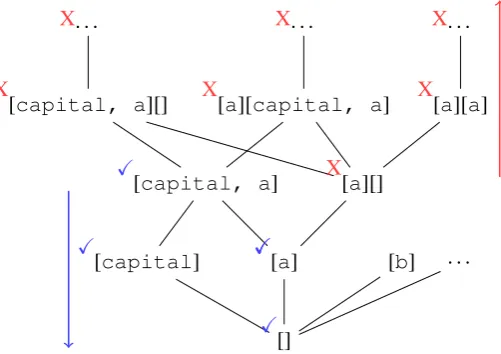
Given a grammar G, we call a subfactor s in Subfact(Σ∗) ungrammatical if it belongs to a principal filter of any element of G. Subfactors that are not ungrammatical are called grammat-ical. Lemma 14 ensures that grammaticality is downward entailing, in the sense that if a model of the wordM(w)is not contained in the principal filters of the elements of the grammar, then neither are the subfactors ofM(w). But it also ensures that ungrammaticality is upward entailing: if a model of the wordM(w) belongs to the principal filters of the elements of the grammar, then all of the su-perfactors ofM(w)in that filter are likewise con-tained.
[]
[capital] [a] [b] . . . [capital, a] [a][]
[capital, a][] [a][capital, a] [a][a]
. . . .
X X
X
X
X X X
X X
[image:6.595.177.428.63.240.2]X X X
Figure 3: The Structure ideals(blue) and filters(red) for a capitalized letter model.
5.1 Example: Text Capitalization
As an example, consider capitalized letters as dis-cussed above. In an unconventional word model, each capital letter at some position x is rep-resented as satisfying one of the relations R ∈ {a(x),b(x), . . . ,z(x)} as well as the unary rela-tion capital(x). Thus the relation a(x) is true of both lowercase aand uppercase A, but a(x)∧ capital(x)is only true of uppercaseA. Note also that in this model no positionxof a structure can satisfy both predicatesa(x)andb(x). We return to this point in§7.
Figure 2 showcases the relationship among these structures under a model M. The struc-ture for A, [capital,a], contains as subfactors
[capital], [a], [], and the empty structure (not shown). The empty structure is a subfactor of [], and [] in turn is a subfactor of[capital]and
[a]. The subfactor [a] contains the subfactor [], the domain element with no relations, but has su-perfactors [capital,a], which has one domain element and two relations, and [a][], which has two domain elements, and the first satisfying the propertya. Subfactors and superfactors are listed above and below each other, respectively, with lines between them. Members of one ideal are noted with a blue checkmark, and members of a filter are noted by a red asterisk.
Applying this to the example in Figure3, if the structure[capital,a]is grammatical, then all of its subfactors, such as [capital] and [a], and [] are grammatical. Since those are grammatical, each of their subfactors is also grammatical, which in this case is just [ /0], shown in blue in Figure3. Conversely, if the structure [a][] is known to be
ungrammatical, then any structure which has it as a subfactor is also ungrammatical (in this exam-ple, [capital,a][], shown in Red in Figure3. To see the importance, consider a string with only lowercase letters. In a connected model, the gram-mar would ban 26 forbidden factors (A,B,C,...), but the “capital” model bans just one, [capital].
5.2 Example: Long Distance Linguistic Dependencies
As another example, sequences of speech sounds as mentioned earlier may be decomposed into binary features based on their phonetic proper-ties like anteriority (±ant — whether it oc-curs in the anterior of the vocal tract), stri-dency (±str — whether it produces a high-intensity fricative noise), or voicing (±voi — whether it activates the vocal chords), among oth-ers (Hayes, 2009). Each sound at some posi-tion x is represented as satisfying relations R∈ {±voi(x),±str(x), . . . ,±ant(x)}. Thus the re-lation +str(x) is true of both the sound sas in the first sound of “sue” and S, as in “shoe”, but
+str(x)∧ −ant(x)is only true ofS.
Note also that in this model no positionx of a structure can satisfy both predicates+str(x)and −str(x). We return to this point in§7below. We again use square brackets to delimit the domain el-ements and write the unary features within them, so a model representation like h+str+anti h+str-anti has the following visual representation:
+str
[] . . . . . . . h+str +ant i [+str]
. . .
h+str
+ant
i h+str
+ant
i h+str
+ant
i h+str
-ant i " +voi +str +ant # h+str +ant
i h+str
+ant
i+voi
[image:7.595.162.445.65.255.2]+str -ant +voi +str +ant h+str -ant i . . . . . . . X X X X X X X X X X X X
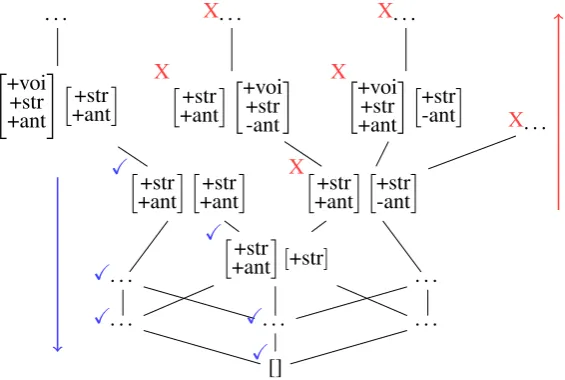
Figure 4: Structure ideals(blue) and filters(red) for a phonological precedence model.
To ease the exposition, we will use square brackets to delimit the domain elements and write the unary relations within them instead of specify-ing the model in mathematical detail. In an uncon-ventional subsequence word model, then, one pos-sible structure of the subsequences...S is writ-tenh+str+anti h+str-anti.
In many languages, the presence of certain seg-ments is dependent on the presence of another segment. In Samala, subsequences like s...s
are allowed but s...S are not, so words like
hasxintilawas are allowed but words like
hasxintilawaS are not (Hansson, 2010). In an unconventional model, banning structures of the form [+str][+str] is insufficient, since all these segments share that stridency property, while a structure like
h +str +ant i h +str -ant i will dis-tinguish them, since they disallow stridents which disagree on the ±ant(x) relations. The struc-ture [+ant][-ant] however, is insufficient, since consonants like p,b,m have that feature, and would incorrectly ban acceptable strings. To see the importance, a conventional string model must ban multiple sibilant factorssS,zS,sZ,zZ, while an unconventional model must just ban one,
h+str +ant
i h+str -ant i
Figure 4 showcases the relationship among these structures under a precedence model M<. The structure for
h +str +ant i
[+str]contains as sub-factors (among others) [+str] [+str], [+str] [], [], and the empty structure (not shown). The empty structure is a subfactor of [], and [] in turn is a subfactor of [+ant]and [-str], and so on.
If the structure h+str+anti h+str+anti is grammatical, then all of its subfactors, are grammatical, and so are their subfactors, in turn. Conversely, if the structure
h+str +ant
i h+str -ant i
is known to be un-grammatical, then any structure which has it as a subfactor is also ungrammatical (for example,
" +voi +str +ant # h+str -ant i
, where the first segment is also
voiced+voi), shown in Red in Figure4.
The structure filters give the learner an advan-tage when confronting hypothesis spaces under a particular model. In particular, it allows the learner to prune vast swathes of the hypothesis space as it reaches for principal elements of fea-tures. If a learner identifies one structure as being grammatical, the learner may infer that all of its subfactors are also grammatical and not have to consider them. Alternatively, if the learner knows a structure is ungrammatical, it may infer that the ideals above it are also ungrammatical.
Generally, these reductions can be exponential: an alphabet of size 2n can be represented with n unary relations in the model signature. How-ever, this exponential reduction does not neces-sarily make learning any easier. The reason for this is that the size of Subfactk(M,Σ∗) equals
6 The Learning Problem
For some M,k, is L(M,k) learnable from posi-tive data? The short answer is Yes (Heinz,2010; Heinz et al.,2012). The solution presented in these papers can be thought of as using the function Subfactk(M,w) to identify permissiblek-factors in wordswin the positive data. Thek-factors that are not permissible are forbidden. With sufficient positive data, such a learning algorithm will con-verge to a grammar that generates any target lan-guage in the class. While this solution is sound in theory, when the space ofk-factors is very large, it is not practical. Here, we make clear the problem the learning algorithm solves.
We state the learning problem not in terms of converging to a correct grammar in the limit as previously studied, but instead of returning an ‘ad-equate’ grammar given a finite positive sample. Determining what counts as an adequate grammar is what (De Raedt,2008) calls a Quality Criterion. Definition 9 (The Learning Problem). Fix Σ, model M, and positive integer k. For any language
L∈L(M,k) and for any finite D⊆L, return a
grammar G such that
1. Gis consistent, that is, it covers the data:D⊆ L(G);
2. L(G)is a smallest language inL which cov-ers the data: so for allL∈L whereD⊆L, we haveL(G)⊆L; and
3. Gincludes structuresSthat are restrictions of structuresS0 included in other grammars G0 that also satisfy (1) and (2): for allG0 satisfy-ing the first two criteria for allS0∈G0, there existsS∈Gsuch thatSvS0.
The first criterion is self-explanatory. The sec-ond criterion is motivated by Angluin’s (1980) analysis of identification in the limit. The third cri-terion requires that the grammar contain the most “general” subfactors. An example will help illus-trate this criterion.
Consider again the grammar G =
{M(aa),M(bb),M(c)} with Σ = {a,b,c}. L(G) is the same as L(H) where H =
{M(aa),M(bb),M(ac),M(bc),M(cc), M(ca),M(cb)}. InHall the forbidden subfac-tors are of size 2, whereas G encapsulates all of the 2-factors in H which include c with a single 1-factor M(c). Both grammars G and H may satisfy criteria (1) and (2) butHwould not satisfy criterion (3) because ofG.
7 A Bottom-Up Learning Algorithm (De Raedt, 2008) identifies two directions of in-ference: specific-to-general (i.e., ‘top-down’) and general-to-specific (i.e., ‘bottom-up’). Since we are trying to find the most general subfactors, top-down inference has the potential to consider expo-nentially many more subfactors than bottom-up in-ference. It makes mores sense to traverse bottom-up, that is, from the most general subfactors possi-ble to the most specific. Additionally, once a sub-factor is identified as an element of the grammar, none of its superfactors (elements of its principal filter) need to be considered further.
A bottom-up learner is shown in Algorithm 1. Its input is a positive data sampleDand an integer kthat identifies the upper bound on the size of the subfactors.
Data:positive sampleD, empty structures0,
max constraint sizek
Result:G, a set of constraints
Q← {s0};
G←/0;
V←/0;
whileQ6=/0do
s←Q.dequeue();
V←V∪ {s};
if∃x∈D such that svxthen
S←NextSupFact(s);
S0← {s∈S| |s|≤k∧(¬∃g∈G)[gvs]∧s6∈
V};
Q.enqueue(S0);
end else
G←G∪ {s};
end end
returnG;
[image:8.595.343.489.560.664.2]Algorithm 1: Bottom-up learning algorithm for lattice-structured constraints
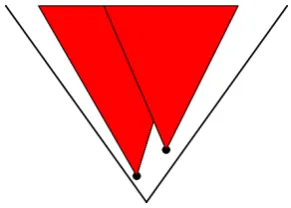
Figure 5: Pruning the hypothesis space
con-sidered one at a time, in order, and as each subfac-tor s is considered it is added toV. Ifs is not a subfactor of the model of any word in the positive sampleD(i.e., not contained by any data point in
D), then it is added to the grammarG.
If s is a subfactor of the sample, it is sent to the function NextSupFact, which returns a set ofleast superfactors for s. For concreteness, NextSupFact(s)may be defined formally as fol-lows:
NextSupFact(s) ={S ∈Subfactk(Σ∗) |s v S,¬∃S0[svS0vS]}.
Practically NextSupFactwill be defined con-structively so that each subfactor inSubfactk(Σ∗) is constructed only once as needed. Thus, not only will it not be needed to store the whole set Subfactk(Σ∗) in memory, but the set V may be excluded from the algorithm as well.
This set of superfactors is then filtered by the following criteria: they must be smaller thank+1, they must contain no element ofGas a subfactor, and they must not have been previously considered (i.e., they cannot be inV). Those structures that survive this filter are added toQ. This procedure continues until there are no more structures left to consider inQ.
Theorem 1. For any L∈L(M,k), and any finite
set P⊆L provided as input to Algorithm1, it
re-turns a grammar G satisfying Definition9.
Proof. Consider any x ∈D. Algorithm 1 only
adds elements toGthat are not subfactors ofx, so x6∈Supfact(G). Thus x∈L(G) andD⊆L(G), satisfying Condition (1).
Consider any L0 ∈L with D⊆L0. To show L = L(G) ⊆ L0, consider any w ∈ L. Then Subfact(w)⊆Subfact(D) andSubfact(D)⊆ Subfact(L0) sinceD⊆L. Then Subfact(w)⊆ Subfact(L0). Hence,w∈L0, and soL⊆L0, satis-fying Condition (2).
For condition (3), we use the fact that elements in the grammarGwere in Q at some point. Sup-poses,s0are subfactors such thats∈G,s0vs, and (¬∃x∈D)[s0vM(x)]. Sinces∈G, then at some points∈Q.
If s0 vs then s0 will be added to Q before s is generated by NextSupFact. Because Q is a queue, s0 will also be removed from Q before s is generated byNextSupFact. Sinces0is not con-tained by anyM(x)withx∈D, it will be added to
G. Whens is generated byNextSupFact, it will
not pass the filter because it fails the second crite-rion sinces0vsands0∈G. Thensis never added
toQ, and therefores∈/G, contra our original
as-sumption. Thus Condition (3) is satisfied.
One aspect of the algorithm to highlight is that when a subfactorgis added toG, it is not added to
Q. Consequently,NextSupFact(g)is never added
to Q. In this way, finding elements of G prunes
the remainder of the space to be searched (see fig-ure5). In general, it is not the case that every el-ement in the principal filter ofg will not be gen-erated byNextSupFactsince some of these ele-ments may belong to NextSupFact(x) for other subfactors x on the Q. We expect subfactors on the ‘border’ ofSupfact(g)to be generated in this way (and then they are filtered out). This pruning, especially when the subfactors are quite general, can significantly reduce the remaining space to be traversed.
In regard to efficiency, in the worst case, the el-ements of G are all very specific subfactors and are greatest elements of Subfactk(Σ∗). In this case, every subfactorSubfactk(Σ∗)will be added to Q and the time complexity is thus exponen-tial. However, we are primarily interested in the case when Subfactk(D) are a small proportion of Subfactk(Σ∗). This constitutes an example of data sparsity. In this case, we believe the ele-ments of the target grammar will be much ‘lower’ in the partial order and thus will be found much more quickly. Determining what conditions on Subfactk(D)andSubfactk(Σ∗)result in a poly-nomial time run in the size ofDis a focus of cur-rent research activity.
Another area of active research is developing a recipe for theNextSupFactfunction for mod-els with a successor or precedence order relation and arbitary unary relations. The basic idea un-derlying the bottom-up algorithm is to develop a spanning tree for the poset Subfact(Σ∗) and to traverse this tree in a breadth-first manner. The functionNextSupFacthelps control this search. Ideally, NextSupFactwould only generate each subfactor once, which obviates the need to store visited subfactors inV. This can be accomplished to some extent in different ways. For incompatible unary relations, likeaandbin our capitalization example,NextSupFactcan be defined to prevent adding propertyato a position that already satis-fies propertyb.
capital in our capitalization example, an or-dering over the unary relations such as a<b< capital can help eliminate generating the same subfactor in different ways. For example, if NextSupFactis defined to only add ‘lesser’ unary relations to positions that already have them then it would only output [capital,a] given the sub-factor [a] as input. On the other hand, when given as input the subfactor [capital], it could not add any unary relation to this position.
8 Conclusion
In this paper, we considered the problem of learn-ing formal languages defined as the complement of the union of finitely many principal filters, whose principal elements make up the grammar. This is one way to characterize the Strictlyk-Local and Strictly k-Piecewise languages, but the gen-eralization here lets us consider enriched repre-sentations of strings where different elements in a string can be said to share properties. it also lets us learn the shortest forbidden substrings inSLk(Ron et al., 1996) This is useful in many applications where domain-specific knowledge is available and should be taken advantage of. Such enriched rep-resentations, however, have a drawback. The num-ber of subfactors is large which makes identifying the principal elements of the filters difficult. This paper showed that the partial ordering of the sub-factors motivates a bottom-up learning algorithm which finds the least subfactors whose filters do not include the positive data.
Acknowledgments
We would like to thank James Rogers for very helpful discussion on the notion of subfac-tor. This work was supported by NIH grant #R01HD87133-01 to JH.
References
Dana Angluin. 1980. Inductive inference of formal languages from positive data. Information Control, 45:117–135.
J. Richard B¨uchi. 1960. Weak second-order arithmetic and finite automata. Mathematical Logic Quarterly, 6(1-6):66–92.
Luc De Raedt. 2008.Logical and Relational Learning. Springer-Verlag Berlin Heidelberg.
Herbert B. Enderton. 2001. A Mathematical Introduc-tion to Logic, 2nd ediIntroduc-tion. Academic Press.
Pedro Garcia, Enrique Vidal, and Jos´e Oncina. 1990. Learning locally testable languages in the strict sense. InProceedings of the Workshop on Algorith-mic Learning Theory, pages 325–338.
Saul Gorn. 1967. Explicit definitions and linguistic dominoes. InSystems and Computer Science, pages 77–115, Toronto. University of Toronto Press.
Gunnar Hansson. 2010. Consonant Harmony: Long-Distance Interaction in Phonology. Number 145 in University of California Publications in Linguistics. University of California Press, Berkeley, CA. Avail-able on-line (free) at eScholarship.org.
Bruce Hayes. 2009. Introductory Phonology. Wiley-Blackwell.
Jeffrey Heinz. 2010. String extension learning. In Pro-ceedings of the 48th Annual Meeting of the Asso-ciation for Computational Linguistics, pages 897– 906, Uppsala, Sweden. Association for Computa-tional Linguistics.
Jeffrey Heinz, Anna Kasprzik, and Timo K¨otzing. 2012. Learning with lattice-structured hypothesis spaces. Theoretical Computer Science, 457:111– 127.
Colin de la Higuera. 2010. Grammatical Inference: Learning Automata and Grammars. Cambridge University Press.
Leonid Libkin. 2004. Elements of Finite Model The-ory. Springer.
Robert McNaughton and Seymour Papert. 1971. Counter-Free Automata. MIT Press.
James Rogers. 2003. Syntactic structures as multi-dimensional trees. Research on Language and Com-putation, 1(3-4):265–305.
James Rogers, Jeffrey Heinz, Gil Bailey, Matt Edlef-sen, Molly Visscher, David Wellcome, and Sean Wibel. 2010. On languages piecewise testable in the strict sense. InThe Mathematics of Language, vol-ume 6149 ofLecture Notes in Artifical Intelligence, pages 255–265. Springer.
James Rogers, Jeffrey Heinz, Margaret Fero, Jeremy Hurst, Dakotah Lambert, and Sean Wibel. 2013. Cognitive and sub-regular complexity. In Formal Grammar, volume 8036 ofLecture Notes in Com-puter Science, pages 90–108. Springer.
James Rogers and Geoffrey K. Pullum. 2011. Aural pattern recognition experiments and the subregular hierarchy. Journal of Logic, Language and Infor-mation, 20:329–342.
Kristina Strother-Garcia, Jeffrey Heinz, and Hyun Jin Hwangbo. 2016. Using model theory for grammati-cal inference: a case study from phonology. In Pro-ceedings of The 13th International Conference on Grammatical Inference, volume 57 ofJMLR: Work-shop and Conference Proceedings, pages 66–78.
Wolfgang Thomas. 1997. Languages, automata, and logic. InHandbook of Formal Languages, volume 3, chapter 7. Springer.