Proceedings of NAACL-HLT 2018, pages 1446–1459
A Neural Layered Model for Nested Named Entity Recognition
Meizhi Ju1,3, Makoto Miwa2,3andSophia Ananiadou1,3
1National Centre for Text Mining, University of Manchester, United Kingdom 2Toyota Technological Institute, Japan
3Artificial Intelligence Research Center (AIRC),
National Institute of Advanced Industrial Science and Technology (AIST), Japan
{meizhi.ju, sophia.ananiadou}@manchester.ac.uk [email protected]
Abstract
Entity mentions embedded in longer entity mentions are referred to as nested entities. Most named entity recognition (NER) sys-tems deal only with the flat entities and ignore the inner nested ones, which fails to capture finer-grained semantic information in underly-ing texts. To address this issue, we propose a novel neural model to identify nested enti-ties by dynamically stacking flat NER layers. Each flat NER layer is based on the state-of-the-art flat NER model that captures sequen-tial context representation with bidirectional long short-term memory (LSTM) layer and feeds it to the cascaded CRF layer. Our model merges the output of the LSTM layer in the current flat NER layer to build new represen-tation for detected entities and subsequently feeds them into the next flat NER layer. This allows our model to extract outer entities by taking full advantage of information encoded in their corresponding inner entities, in an inside-to-outside way. Our model dynamically stacks the flat NER layers until no outer enti-ties are extracted. Extensive evaluation shows that our dynamic model outperforms state-of-the-art feature-based systems on nested NER, achieving 74.7% and 72.2% on GENIA and ACE2005 datasets, respectively, in terms of F-score.1
1 Introduction
The task of named entity recognition (NER) in-volves the extraction from text of names of en-tities pertaining to semantic types such as per-son (PER),location (LOC) andgeo-political en-tity (GPE). NER has drawn the attention of many researchers as the first step towards NLP applica-tions such as entity linking (Gupta et al.,2017), re-lation extraction (Miwa and Bansal, 2016), event 1Code is available at https://github.com/
meizhiju/layered-bilstm-crf
LOC
PER
GPE GPE
The premier of the western Canadian province of British Columbia ...
LOC
PER
GPE GPE
The premier of the western Canadian province of British Columbia ...
Figure 1: A sentence from ACE2005 (Walker et al., 2006) containing the nested 4 entities nested 3 levels deep.
extraction (Feng et al.,2016) and co-reference res-olution (Fragkou,2017;Stone and Arora,2017).
Due to the properties of natural language, many named entities containnested entities: embedded names which are included in other entities, illus-trated in Figure1. This phenomenon is quite com-mon in many domains (Alex et al.,2007;Byrne,
2007;Wang, 2009;M`arquez et al., 2007). How-ever, much of the work on NER copes only with non-nested entities which are also calledflat enti-tiesand neglects nested entities. This leads to loss of potentially important information, with nega-tive impacts on subsequent tasks.
Traditional approaches to NER mainly in-volve two types of approaches: supervised learning (Ling and Weld, 2012; Marci´nczuk,
2015; Leaman and Lu, 2016) and hybrid
ap-proaches (Bhasuran et al., 2016; Rockt¨aschel et al.,2012;Leaman et al.,2015) that combine su-pervised learning with rules. Such approaches re-quire either domain knowledge or heavy feature-engineering. Recent advances in neural networks enable NER without depending on external knowl-edge resources through automated learning high-level and abstract features from text (Lample et al.,
2016; Ma and Hovy, 2016; Pahuja et al., 2017;
Strubell et al.,2017).
In this paper, we propose a novel dynamic neu-ral model for nested entity recognition, without re-lying on any external knowledge resources or lin-guistics features. Our model enables sequentially
O B-DNA I-DNA I-DNA I-DNA O
O B-protein O O O O
Mouse interleukin-2 receptor alpha gene expression
O B-Protein O O O O
O B-DNA I-DNA I-DNA I-DNA O
O O O
Gold labels Embedding layer Flat NER layer Flat NER layer Flat NER layer
Sequence
Inner
Outer
Dropout Dropout
CRF CRF
LSTM Unit LSTM Unit
Label Label
Word representation Word representation
Flat NER Unit Flat NER Unit
O B-DNA I-DNA I-DNA I-DNA O
O B-protein O O O O
Mouse interleukin-2 receptor alpha gene expression
O B-Protein O O O O
O B-DNA I-DNA I-DNA I-DNA O
O O O
Gold labels Embedding layer Flat NER layer Flat NER layer Flat NER layer
Sequence
Inner
Outer
Dropout
CRF
LSTM Unit
Label
[image:2.595.119.490.68.241.2]Word representation Flat NER Unit
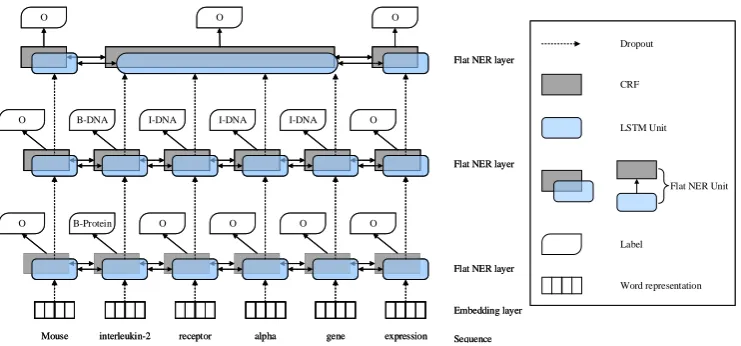
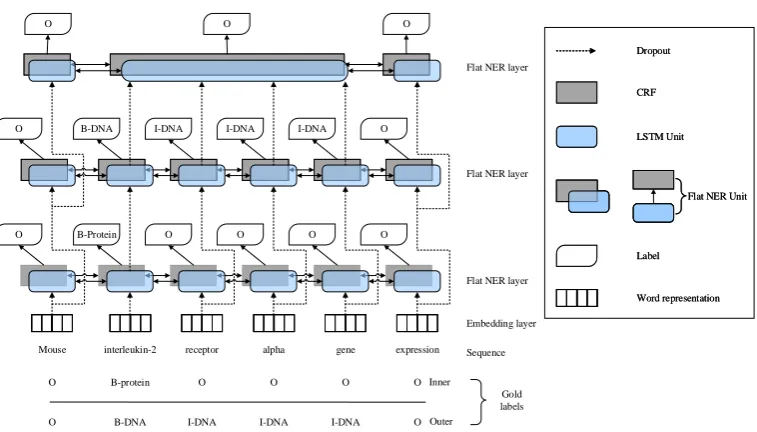
Figure 2: Overview of our layered model architecture. “interleukin-2” and “interleukin-2 receptor alpha gene” are nested entities.
stacking flat NER layers from bottom to up and identifying entities in an end-to-end manner. The number of stacked layers depends on the level of entity nesting and dynamically adjusts to the input sequences as the nested level varies from different sequences.
Given a sequence of words, our model first represents each word using a low-dimensional vector concatenated from its corresponding word and character sequence embeddings. Taking the sequence of the word representation as in-put, our flat NER layer enables capturing con-text representation by a long short-term mem-ory (LSTM) (Hochreiter and Schmidhuber,1997) layer. The context representation is then fed to a CRF layer for label prediction. Subsequently, the context representation from the LSTM layer is merged to build representation for each detected entity, which is used as the input for the next flat NER layer. Our model stops detecting entities if no entities are predicted by the current flat NER layer. Through stacking flat NER layers in order, we are able to extract entities from inside to out-side with sharing parameters among the different LSTM layers and CRF layers.
We gain 3.9 and 9.1 percentage point improve-ments regarding F-score over the state-of-the-art feature-based model on two nested entity corpora: GENIA (Kim et al.,2003) and ACE2005 (Walker et al.,2006), and analyze contributions of inner en-tities to outer entity detection, drawing several key conclusions.
In addition, experiments are conducted on a flatly annotated corpora JNLPBA (Kim et al.,
2004). Our model can be a complete NER model as well for flat entities, on the condition that it is trained on annotations that do not account for nested entities. We obtain 75.55% in terms of F-score that is comparable to the state-of-the-art per-formance.
2 Neural Layered Model
Our nested NER model is designed based on a sequential stack of flat NER layers that detects nested entities in an end-to-end manner. Fig-ure 2 provides the overview of our model. Our flat NER layers are inspired by the state-of-the-art model proposed inLample et al. (2016). The layer utilizes one single bidirectional LSTM layer to represent word sequences and predict flat enti-ties by putting one single CRF layer on top of the LSTM layer. Therefore, we refer to our model as Layered-BiLSTM-CRF model. If any entities are predicted, a new flat NER layer is introduced and the word sequence representation of each detected entity by the current flat NER layer is merged to compose a representation for the entity, which is then passed on to the new flat NER layer as its in-put. Otherwise, the model terminates stacking and hence finishes entity detection.
In this section, we provide a brief description of the model architecture: the flat NER layers and their stacking, the embedding layer and their train-ing.
2.1 Flat NER layer
bidi-rectional context representation of sequences and subsequently feeds it to the CRF layer to globally decode label sequences.
LSTMis a variant of recurrent neural networks (RNNs) (Goller and Kuchler, 1996) that incor-porates a memory cell to remember the past in-formation for a long period of time. This en-ables capturing long dependencies, thus reducing the gradient vanishing/explosion problem existing in RNNs. We employ bidirectional LSTM with no peephole connection. We refer the readers to
Hochreiter and Schmidhuber(1997) for more de-tails of LSTM used in our work.
CRFs are used to globally predict label se-quences for any given sese-quences. Given an input sequenceX = (x1, x2, . . . , xn)which is the
out-put from the LSTM layer, we maximize the log-probability during training. In decoding, we set transition costs between illegal transitions, e.g., transition from O to I-PER, as infinite to restrict illegal labels. The expected label sequence y = (y1, y2, . . . , yn) is predicted based on maximum
scores in decoding.
2.2 Stacking flat NER layers
We stack a flat NER layer on the top of the cur-rent flat NER layer, aiming to extract outer en-tities. Concretely, we merge and average current context representation of the regions composed in the detected entities, as described in the following equation:
mi=
1
end−start+ 1
end X
i=start
zi, (1)
where zi denotes the representation of the i-th
word from the flat NER layer, and mi is the
merged representation for an entity. The region starts from a positionstartand ends at a position endof the sequence. This merged representation
of detected entities allows us to treat each detected entity as a single token, and hence we are able to make the most of inner entity information to en-courage outer entity recognition. If the region is detected as a non-entity, we keep the representa-tion without any processing. The processed con-text representation of the flat NER layer is used as the input for the next flat NER layer.
2.3 Embedding layer
The input for the first NER layer is different from the remaining flat NER layers since the first layer
g e n e gene
Characters Word LSTM LSTM LSTM LSTM
[image:3.595.322.508.68.247.2]Word representation
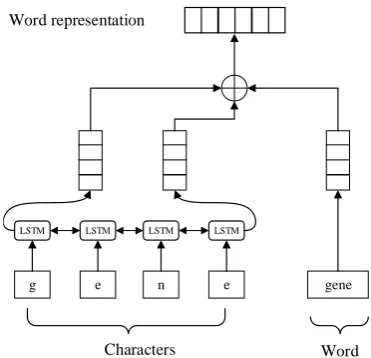
Figure 3: Word representation of a word ‘gene’. We concatenate the outputs of character embedding from LSTM and word embedding to obtain its final word representation.
has no previous layers. We thus represent each word by concatenating character sequence embed-dings and word embedembed-dings for the first flat NER layer. Figure 3 describes the architecture of the embedding layer to produce word representation.
Following the successes ofMa and Hovy(2016) andLample et al.(2016) in utilizing character em-beddings on the flat NER task, we also represent each word with its character sequence to capture the orthographic and morphological features of the word. Each character is mapped to a randomly ini-tialized vector through a character lookup table. We feed the character vectors comprising a word to a bidirectional LSTM layer and concatenate the forward and backward representation to obtain the word-level embedding.
Differently from the character sequence embed-dings, the pretrained word embeddings are used to initialize word embeddings. When evaluating or applying the model, words that are outside of the pretrained embeddings and training dataset are mapped to anunknown(UNK) embedding, which is randomly initialized during training. To train the UNK embedding, we replace words whose fre-quency is 1 in the training dataset with the UNK embedding with a probability 0.5.
2.4 Training
As our model detects entities from inside to out-side, we keep the same order in preparing the gold labels for each word sequence. We call it the de-tection order rule. Meantime, we define that each entity region in the sequence can only be tagged once with the same entity type, referred to as the non-duplicate rule. For instance, in Figure 2, 2” is tagged first while “interleukin-2 receptor alpha gene” is subsequently tagged fol-lowing the above two rules. When assigning the labelOto non-entity regions, we only follow the detection order rule. As a result, two gold label sequences {O, B-Protein, O, O, O, O} and {O, B-DNA, I-DNA, I-DNA, I-DNA, O}are assigned to the given word sequence “Mouse interleukin-2 receptor alpha gene expression” as shown in Fig-ure2. With these rules, the number of labels for each word equals the nested level of entities in the given word sequence.
We employ mini-batch training and update the model parameters using back-propagation through time (BPTT) (Werbos,1990) with Adam (Kingma
and Ba, 2014). The model parameters include
weights, bias, transition costs, and embeddings of characters. We disable updating the word em-beddings.2 During training, early stopping,
L2-regularization and dropout (Hinton et al., 2012) are used to prevent overfitting. Dropout is em-ployed to the input of each flat NER layer. Hyper-parameters including batch size, number of hid-den units in LSTM, character dimensions, dropout rate, Adam learning rate, gradient clipping and weight decay (L2) are all tuned with Bayesian op-timization (Snoek et al.,2012).
3 Evaluation Settings
We employed three datasets for evaluation: GE-NIA3(Kim et al.,2003), ACE20054(Walker et al., 2006) and JNLPBA5(Kim et al.,2004). We briefly
explain the data and task settings and then intro-duce model and experimental settings.
3.1 Data and Task Settings
We performed nested entity extraction experi-ments on GENIA and ACE2005 while we con-2We tried updating and disabling updating word
embed-dings. The former trial did not work.
3http://www.geniaproject.org/
genia-corpus/term-corpus
4https://catalog.ldc.upenn.edu/
ldc2006t06
5http://www.nactem.ac.uk/tsujii/GENIA/
ERtask/report.html
ducted flat entity extraction on the JNLPBA dataset. For the details of data statistics and pre-processing, please refer to the supplementary ma-terials.
GENIA involves 36 fine-grained entity cate-gories among total 2,000 MEDLINE abstracts. Following the same task settings as inFinkel and Manning(2009) andLu and Roth(2015), we col-lapsed all DNA subcategories as DNA. The same setting was applied to RNA, protein, cell line and cell type categories. We used same test portion as
Finkel and Manning(2009),Lu and Roth (2015) andMuis and Lu(2017) for the direct comparison.
ACE2005 contains 7 fine-grained entity cate-gories. We made same modifications described in
Lu and Roth (2015) andMuis and Lu (2017) by keeping files from bn, bw, nw and wl and spit-ting them into training, development and tesspit-ting datasets at random following same ratio 8:1:1, re-spectively.
JNLPBA defines both training and testing datasets. These two datasets are composed of 2,000 and 404 MEDLINE abstracts, respectively. JNLPBA is originally from the GENIA cor-pus. However, only flat and topmost entities in JNLPBA are kept while nested and discontinuous entities are removed. Like our preprocessing on the GENIA corpus, subcategories are collapsed and only 5 entity types are finally reserved. We randomly chose the 90% sentences of the original training dataset as our training dataset and the re-maining as our development dataset.
Precision (P), recall (R) and F-score (F) were used for the evaluation metrics in our tasks. We define that if the numbers of gold entities and pre-dictions are all zeros, the evaluation metrics all equal one hundred percent.
3.2 Model and Experimental Settings
Our model was implemented with Chainer6(Tokui et al., 2015). We initialized word embeddings in GENIA and JNLPBA with the pretrained em-beddings trained on MEDLINE abstracts (Chiu et al., 2016). For ACE2005, we initialized each word with the pretrained embeddings which are trained by Miwa and Bansal (2016). Except for the word embeddings, parameters of word embed-dings were initialized with a normal distribution. For LSTM, we initialized hidden states, cell state and all the bias terms as 0 except for the forget gate
bias that was set as 1. For other hyper-parameters, we chose the best hyper-parameters via Bayesian optimization. We refer the readers to the sup-plemental material for the settings of the hyper-parameters of the models and Bayesian optimiza-tion.
For ablation tests, we compared with our layered-BiLSTM-CRF model with two models that produce the input for next flat NER layer in different ways. The first model is called layered-BiLSTM-CRF w/o layered out-of-entities which uses the input of the current flat NER layer for out-of-entity words. We name the second model aslayered-BiLSTM-CRF w/o layered LSTM as it skips all intermediate LSTM layers and only uses output of embedding layer to build the input for the next flat NER layer. Please refer to supple-mental material for the introduced two models.7
To investigate the effectiveness of our model on different nested levels of entities, we evaluated the model performance on each flat NER layer on GE-NIA and ACE2005 test datasets.8 When
calcu-lating precision and recall measurements, we col-lected the predictions and gold entities from the corresponding flat NER layer. Since predicted en-tities on a specific flat NER layer might be from other flat NER layers, we defined extended preci-sion (EP), extended recall (ER) and extended F-score (EF) to measure the performance. We cal-culated EP by comparing the predicted entities in a specific flat NER layer with all the gold entities, and ER by comparing the gold entities in a specific flat NER layer with all the predicted entities. EF was calculated in the same way with F.
In addition to experiments on nested GENIA and ACE2005 datasets, flat entity recognition was conducted on the JNLPBA dataset. We trained our flat model that only kept the first flat NER layer and removed the following stacking layers. We follow the hyper-parameters settings by Lample et al.(2016) for this evaluation.
7We examined the contributions of predicted labels of the
current flat NER layer to the next flat NER layer. For this, we introduced label embeddings into each test by combining the embedding with context representation. Experiments show that appending label embedding hurts the performance of our model while gain slight improvements in the rest 2 models on development datasets.
8We removed entities which were predicted in previous
flat NER layers during evaluation.
4 Results and Analysis
4.1 Nested NER
Table 1 presents the comparisons of our model with related work including the state-of-the-art feature-based model by Muis and Lu (2017). Our model outperforms the state-of-the-art mod-els with 74.7% and 72.2% in terms of F-score, achieving the new state-of-the-art in the nested NER tasks. For GENIA, our model gained more improvement in terms of recall with enabling ex-tract more nested entities without reducing pre-cision. On ACE2005, we improved recall with 12.2 percentage points and obtained 5.1% rela-tive error reductions. Compared with GENIA, our model gained more improvements in ACE2005 in terms of F-score. Two possible reasons account for it. One reason is that ACE2005 contains more deeper nested entities (maximum nested level is 5) than GENIA (maximum nested level is 3) on the test dataset. This allows our model to capture the potentially ‘nested’ relations among nested enti-ties. The other reason is that ACE2005 has more nested entities (37.45%) compared with GENIA (21.56%).
Settings P (%) R (%) F (%) P (%) R (%) F (%)GENIA ACE2005
Finkel and Manning(2009) 75.4 65.9 70.3 - -
-Lu and Roth(2015) 72.5 65.2 68.7 66.3 59.2 62.5
Muis and Lu(2017) 75.4 66.8 70.8 69.1 58.1 63.1
[image:6.595.114.489.62.147.2]Our model 78.5 71.3 74.7 74.2 70.3 72.2
Table 1: Comparisons of our model with the state-of-the-art models on nested NER.
Settings P (%) R (%) F (%) P (%) R (%) F (%)GENIA ACE2005
Layered-BiLSTM-CRF 78.27 75.97 77.10 75.37 69.41 72.27 Layered-BiLSTM-CRF w/o
layered non-entities 76.55 77.01 76.78 72.90 65.54 69.02 Layered-BiLSTM-CRF w/o
[image:6.595.109.491.179.279.2]layered LSTM 75.76 74.60 75.18 69.94 61.94 65.70
Table 2: Performances of ablation tests on development datasets.
Entity type P (%) R (%) F (%)
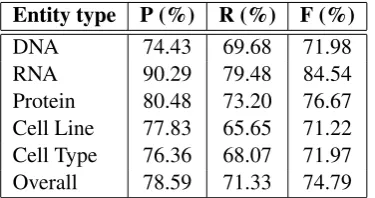
[image:6.595.89.277.316.415.2]DNA 74.43 69.68 71.98 RNA 90.29 79.48 84.54 Protein 80.48 73.20 76.67 Cell Line 77.83 65.65 71.22 Cell Type 76.36 68.07 71.97 Overall 78.59 71.33 74.79
Table 3: Results of all entities for each type in GENIA test dataset.
Entity type P (%) R (%) F (%)
PER 78.82 77.37 78.09 LOC 54.54 43.47 48.38 ORG 63.25 54.20 58.38 GPE 76.92 78.98 77.94 VEH 61.53 48.48 54.23 WEA 66.66 53.73 59.50 FAC 49.19 35.26 41.07 Overall 74.27 70.34 72.25
Table 4: Results of all entities for each type in ACE2005 test dataset.
the word embeddings as the input for the flat NER layers. Therefore, we have no chance to take ad-vantage of the context representation and instead we only manage to use the word embeddings as the input for flat NER layers in this case.
Table 3 and Table 4 describe the performance for each entity type in GENIA and ACE2005 test datasets, respectively. In GENIA, our model per-formed best in recognizing entities with typeRNA.
This is because most of the entities pertaining to RNA mainly end up either with “mRNA” or RNA. These two words are informative indicators ofRNA entities. For entities in rest entity types, their performances are close to the overall perfor-mance. One possible reason is that there are many instances to model them. This also accounts for the high performances of entity types such asPER, GPEin ACE2005. The small amounts of instances of entity types likeFAC in ACE2005 is one rea-son for their under overall performances. We refer readers to supplemental material for statistics de-tails.
When evaluating our model on top level which contains only outermost entities, the precision, recall and F-score were 78.19%, 75.17% and 76.65% on GENIA test dataset. For ACE2005, the corresponding precision, recall and F-score were 68.37%, 68.57% and 68.47%. Compared with the overall performance listed in Table1, we obtained higher top level performance on GENIA but lower performance in ACE2005. We discuss details of this phenomena in the following tables.
[image:6.595.88.275.459.585.2]Layer P (%) R (%) F (%) EP (%) ER (%) EF (%) #Predictions #Gold Entities
Layer 1 72.86 69.82 71.31 78.46 71.06 74.57 4,783 4,991 Layer 2 56.88 27.59 37.15 81.15 73.98 77.39 276 569
[image:7.595.77.531.61.122.2]Layer 3 0.00 0.00 0.00 0.00 60.00 0.00 1 15
Table 5: Results of layer evaluation on GENIA test dataset.
Layer P (%) R (%) F (%) EP (%) ER (%) EF (%) #Predictions #Gold Entities
Layer 1 74.46 73.39 73.92 75.84 73.77 74.79 2,894 2,936 Layer 2 60.28 50.49 54.95 66.19 58.41 62.05 423 505 Layer 3 51.02 24.51 33.11 51.02 37.25 43.06 49 102
Layer 4 0.00 0.00 0.00 0.00 10.00 0.00 0 10
Layer 5 0.00 0.00 0.00 0.00 0.00 0.00 0 1
Table 6: Results of layer evaluation on ACE2005 test dataset.
NER layer was different in terms of extended eval-uation metrics. For the first two flat NER layers, performance of extended evaluation is better than the performance of standard evaluation. It indi-cates that gold entities correspond to some of the predictions on the specific flat NER layer are from other flat NER layers. This may lead to the zero performances for the last flat NER layer. In ad-dition, performance on the second flat NER layer was higher than it was on the first flat NER layer in terms of extended F-score. This demonstrates that our model is able to obtain higher performance on top level of entities than innermost entities.
Table6lists the results of each flat NER layer on ACE2005 test dataset. Similar to GENIA, the first flat NER layer achieved better performance than the rest flat NER layers. Performances decreased in a bottom-to-up manner regarding model archi-tecture. This phenomena was the same with the extended evaluation performances, which reflects that some of the predictions in a specific flat NER layer were detected in other flat NER layers. Un-like rising tendency (except last flat NER layer) regarding extend F-score in GENIA, performance in ACE2005 was in downtrend. This accounts for the fact that F-score on top level was lower than it on the fist flat NER layer. Even though the decline trend in extended F-score, the first flat NER layer contained the largest proportion of predictions for the gold entities, the overall performance on all nested entities showed in Table 1 was still high. Unlike GENIA, our model in ACE2005 stopped before reaching the maximum nested level of enti-ties. It indicates our model failed to model the ap-propriate nested levels. This is one of the reasons that account for the zero predictions on the last
flat NER layer. One reason is that our model The sparse instances on the high nested levels could be another reason that resulted in the zero perfor-mances on the last flat NER layer.
4.2 Flat NER
Compared with the state-of-the-art work on JNLPBA (Gridach,2017) which achieved 75.87% in terms of F-score, our model obtained 75.55% in F-score. Since both the model byGridach(2017) and our flat model are based on Lample et al.
(2016), so it is reasonable that both models were able to get comparable performance.
4.3 Error analysis
[image:7.595.70.530.152.237.2]inde-pendent sentences, thus possibly containing many modifiers. For example, in this sentence “A man who has been to Baghdad many times and can tell us with great knowledge exactly what it’s going to be like to fight on those avenues in that sprawl-ing city of Baghdad - Judy .”, “A man who has been to Baghdad many times and can tell us with great knowledge exactly what it’s going to be like to fight on those avenues in that sprawling city of Baghdad” is annotated as PER while our model could only extract “A man who has been to Bagh-dad many times” and predicted it asPER.
Errors on the first flat NER layer, we got 41% in type error and 11% of partial prediction error, re-spectively. Apart from this, our model recognized predictions from other flat NER layers, leading to 5% errors. We define this error type aslayer error. Unlike the first flat NER layer, 26% of errors were caused by layer error. Additionally, 17% of the er-rors belong to type error. In particular, 22% erer-rors were due to the type error. As for the last flat NER layer, 40% errors were caused by partial prediction error. The rest errors were different from the men-tioned error types. One possible reason is that we have less gold entities to train this flat NER layer compared with previous flat NER layers. Another reason might be the error propagation.
Similarly, 200 sentences were randomly se-lected from GENIA test dataset. We got 20% rors of predictions in the subset. Among these er-rors, 17% and 24% of errors were separately due to type error and partial prediction error. In addi-tion, 24% of the predictions on the first flat NER layer were incorrect. Among them, the top error types were layer error, partial prediction error and type error, accounting for 21%, 18% and 13%, re-spectively. Errors on the second flat NER layer were mainly caused by type error and the and par-tial prediction error.
5 Related Work
The success of neural networks has boosted the performance of flat named NER in different do-mains (Lample et al.,2016;Ma and Hovy,2016;
Gridach,2017;Strubell et al.,2017). Such mod-els achieved the state of the art without any hand-crafted features and external knowledge resources. Contrary to flat NER, much fewer attempts have emphasized the nested entity recognition. Exist-ing approaches to nested NER (Shen et al.,2003;
Alex et al.,2007;Finkel and Manning, 2009;Lu
and Roth,2015;Xu and Jiang,2016;Muis and Lu,
2017) mainly rely on hand-crafted features. They also failed to take advantage of the dependencies among nested entities. Our model enables cap-turing dependencies and automatic learning high-level abstract features from texts.
Early work regarding nested NER involve mainly hybrid systems that combined rules with supervised learning algorithms. For example,
Shen et al.(2003), Zhou et al.(2004) and Zhang
et al. (2004) employed a Hidden Markov Model
to GENIA to extract inner entities and then used rule-based methods to obtain the outer entities. Furthermore, Gu (2006) extracted nested entities based on SVM which were trained separately on both inner entities and outermost entities without putting the hidden relations between nested enti-ties into consideration. All these methods failed to capture the dependencies between nested en-tities. One trial work is that Alex et al. (2007) separately built a inside-out and outside-in layered CRFs which were able to use the current guesses as the input for next layer. They also cascaded separate CRFs of each entity type by using output from previous CRFs as features of current CRFs, yielding best performance in their work. One of the main drawbacks in the cascading approach was that it failed to handle nested entities sharing the same entity type, which were quite common in natural languages.
Finkel and Manning(2009) proposed a discrim-inative constituency tree to represent each sen-tence where the root node was used for connec-tion. All entities were treated as phrases and repre-sented as subtrees following the whole tree struc-ture. Unlike our linguistic features independent model, Finkel and Manning (2009) used a CRF-based approach driven by entity-level features to detect nested entities
entity representation. This allows us to represent outer entities based on inner entity representation, thus managing to capture the relations between in-ner and outer entities, and hence overcoming the spurious entity structure problem.
As an improvement in overcoming spurious structure issue in Lu and Roth (2015),Muis and Lu(2017) further incorporated mention separators along with features to yield better performance on nested entities. BothLu and Roth(2015) andMuis and Lu(2017) rely on hand-crafted features to ex-tract nested entities without incorporating hidden dependencies in nested entities. In contrast, we make the most of dependencies of nested entities in our model to encourage outer entity recognition by automatic learning of high-level and abstract features from sequences.
Shared tasks dealing with nested entities like SemEval-2007 Task 99 and GermEval-201410
were held in order to advance the state-of-the-art on this issue. Additionally, as subtasks in KBP 201511 and KBP 201612, one of the aims
in tri-lingual Entity Discovery and Linking Track (EDL) track was extracting nested entities from textual documents varying from English, Chinese and Spanish. Following this task, Xu and Jiang
(2016) firstly developed a new tagging scheme which is based on fixed-size ordinally-forgetting encoding (FOFE) method for text fragment rep-resentation. All the entities along their contexts were represented using this novel tagging scheme. Different from the extensively used LSTM-RNNs in sequence labeling task, a feed-forward neural network was used to predict labels on entity level for each fragment in any of given sequences. Ad-ditionally, Li et al. (2017) used the model pro-posed in Lample et al.(2016) to the extract both flat entities and components composed in nested and discontinuous entities. Another BiLSTM was applied to combine the components to get nested and discontinuous entities. However, these meth-ods failed to capture and utilize the inner entity representation to facilitate outer entity detection.
9http://nlp.cs.swarthmore.edu/semeval/
tasks/index.php
10https://sites.google.com/site/
germeval2014ner/
11https://tac.nist.gov//2015/KBP/ 12https://tac.nist.gov//2016/KBP/
6 Conclusion
This paper presented a dynamic layered model which takes full advantage of inner entity infor-mation to encourage outer entity recognition in an end-to-end manner. Our model is based on a flat NER layer consisting of LSTM and CRF, so our model is able to capture context representa-tion of input sequences and globally decode pre-dicted labels at a flat NER layer without relying on feature-engineering. Our model automatically stacks the flat NER layers with sharing the param-eters of LSTM and CRF in the layers. The stack-ing continues until the current flat NER layer pre-dicts sequences as all outside of entities, which en-ables stopping dynamically stacked flat NER lay-ers. Each flat NER layer receives the merged con-text representation as input for outer entity recog-nition, based on the predicted entities from the previous flat NER layer. With this dynamic end-to-end model, our model is able to outperform existing models, achieving the-state-of-art on two nested NER tasks. In addition, the model can be flexibly simplified as a flat NER model by remov-ing components cascaded after the first NER layer. Extensive evaluation shows that utilization of inner entities significantly encourages outer en-tities detection with improvements of 3.9 and 9.1 percentage points in F-score on GENIA and ACE2005, respectively. Additionally, utilization of only current context representation contributes to the performance improvement than use of con-text representation from multi-layers.
Acknowledgments
We thank the anonymous reviewers for their valuable comments. The first author is finan-cially supported by the University of Manchesters 2016 Presidents Doctoral Scholar Award. Sophia Ananiadou acknowledges BBSRC BB/P025684/1 Japan Partnering Award and BB/M006891/1 Em-pathy. This research has also been carried out with funding from AIRC/AIST and results ob-tained from a project commissioned by the New Energy and Industrial Technology Development Organization (NEDO).
References
BioNLP 2007: Biological, Translational, and Clin-ical Language Processing. Association for Com-putational Linguistics, Association for Computa-tional Linguistics, Stroudsburg, PA, USA, pages 65–
72. http://dl.acm.org/citation.cfm?
id=1572392.1572404.
Balu Bhasuran, Gurusamy Murugesan, Sabenabanu Abdulkadhar, and Jeyakumar Natarajan. 2016. Stacked ensemble combined with fuzzy matching for biomedical named entity recognition of diseases.
Journal of biomedical informatics 64(Supplement C):1–9. https://doi.org/https://doi. org/10.1016/j.jbi.2016.09.009.
Kate Byrne. 2007. Nested named entity recog-nition in historical archive text. In ICSC. IEEE Computer Society, pages 589–596. http://dblp.uni-trier.de/db/conf/ semco/icsc2007.html#Byrne07.
Billy Chiu, Gamal Crichton, Anna Korhonen, and Sampo Pyysalo. 2016. How to train good word embeddings for biomedical NLP. Proceedings of the 15th Workshop on Biomedical Natural Lan-guage Processingpages 166–174. http://www. aclweb.org/anthology/W16-2922.
HC Cho, N Okazaki, M Miwa, and J Tsujii. 2010. Nersuite: a named entity recognition toolkit. Tsu-jii Laboratory, Department of Information Sci-ence, University of Tokyo, Tokyo, Japan http:// nersuite.nlplab.org/.
Xiaocheng Feng, Lifu Huang, Duyu Tang, Heng Ji, Bing Qin, and Ting Liu. 2016. A language-independent neural network for event detection. In
Proceedings of the 54th Annual Meeting of the Association for Computational Linguistics (Volume 2: Short Papers). Association for Computational Linguistics, Berlin, Germany, volume 2, pages 66–71. http://anthology.aclweb.org/ P16-2011.
Jenny Rose Finkel and Christopher D Manning. 2009. Nested named entity recognition. In Proceedings of the 2009 Conference on Empirical Methods in Natural Language Processing: Volume 1-Volume 1. Association for Computational Linguistics, As-sociation for Computational Linguistics, Singapore, pages 141–150. http://www.aclweb.org/ anthology/D/D09/D09-1015.
Pavlina Fragkou. 2017. Applying named entity recog-nition and co-reference resolution for segmenting english texts. Progress in Artificial Intelligence
6(4):325–346. https://doi.org/10.1007/ s13748-017-0127-3.
Christoph Goller and Andreas Kuchler. 1996.Learning task-dependent distributed representations by back-propagation through structure. InNeural Networks, 1996., IEEE International Conference on. IEEE, volume 1, pages 347–352. https://doi.org/ 10.1109/ICNN.1996.548916.
Mourad Gridach. 2017.Character-level neural network for biomedical named entity recognition. Journal of biomedical informatics 70:85–91. https:// doi.org/10.1016/j.jbi.2017.05.002. Baohua Gu. 2006. Recognizing nested named
enti-ties in GENIA corpus. InProceedings of the HLT-NAACL BioNLP Workshop on Linking Natural Lan-guage and Biology. Association for Computational Linguistics, New York, New York, LNLBioNLP ’06, pages 112–113. http://www.aclweb. org/anthology/W/W06/W06-3318.
Nitish Gupta, Sameer Singh, and Dan Roth. 2017. Entity linking via joint encoding of types, de-scriptions, and context. In Proceedings of the 2017 Conference on Empirical Methods in Natu-ral Language Processing. Association for Compu-tational Linguistics, Copenhagen, Denmark, pages 2671–2680. https://www.aclweb.org/ anthology/D17-1284.
Geoffrey E Hinton, Nitish Srivastava, Alex Krizhevsky, Ilya Sutskever, and Ruslan R Salakhutdinov. 2012. Improving neural networks by prevent-ing co-adaptation of feature detectors. CoRR
abs/1207.0580. http://arxiv.org/abs/ 1207.0580.
Sepp Hochreiter and J¨urgen Schmidhuber. 1997. Long short-term memory. Neural computa-tion 9(8):1735–1780. https://doi.org/10. 1162/neco.1997.9.8.1735.
Jin-Dong Kim, Tomoko Ohta, Yuka Tateisi, and Ju-nichi Tsujii. 2003. GENIA corpus a semantically annotated corpus for bio-textmining. Bioinformat-ics19(suppl. 1):i180–i182.
Jin-Dong Kim, Tomoko Ohta, Yoshimasa Tsuruoka, Yuka Tateisi, and Nigel Collier. 2004. Introduc-tion to the bio-entity recogniIntroduc-tion task at JNLPBA. In Proceedings of the international joint workshop on natural language processing in biomedicine and its applications. Association for Computational Lin-guistics, pages 70–75.
Diederik Kingma and Jimmy Ba. 2014. Adam: A method for stochastic optimization. CoRR
abs/1412.6980. https://arxiv.org/abs/ 1412.6980.
Guillaume Lample, Miguel Ballesteros, Sandeep Sub-ramanian, Kazuya Kawakami, and Chris Dyer. 2016. Neural architectures for named entity recognition. InProceedings of the 2016 Conference of the North American Chapter of the Association for Compu-tational Linguistics: Human Language Technolo-gies. Association for Computational Linguistics, San Diego, California, pages 260–270. http:// www.aclweb.org/anthology/N16-1030. Robert Leaman and Zhiyong Lu. 2016.
Robert Leaman, Chih-Hsuan Wei, and Zhiyong Lu. 2015. tmChem: a high performance ap-proach for chemical named entity recognition and normalization. Journal of cheminformat-ics 7(1):S3. https://doi.org/10.1186/ 1758-2946-7-S1-S3.
Fei Li, Meishan Zhang, Bo Tian, Bo Chen, Guo-hong Fu, and DongGuo-hong Ji. 2017. Recogniz-ing irregular entities in biomedical text via deep neural networks. Pattern Recognition Letters
105:105–113. https://doi.org/10.1016/ j.patrec.2017.06.009.
Xiao Ling and Daniel S. Weld. 2012. Fine-grained entity recognition. In Proceedings of the Twenty-Sixth AAAI Conference on Artificial Intelligence. AAAI Press, AAAI’12, pages 94–
100. http://dl.acm.org/citation.cfm?
id=2900728.2900742.
Wei Lu and Dan Roth. 2015. Joint mention extrac-tion and classificaextrac-tion with menextrac-tion hypergraphs. In
Proceedings of the 2015 Conference on Empirical Methods in Natural Language Processing. Associ-ation for ComputAssoci-ational Linguistics, Lisbon, Por-tugal, pages 857–867. http://aclweb.org/ anthology/D15-1102.
Xuezhe Ma and Eduard H. Hovy. 2016. End-to-end sequence labeling via bi-directional lstm-cnns-crf pages 1064–1074. http://www.aclweb.org/ anthology/P16-1101.
Christopher D Manning, Mihai Surdeanu, John Bauer, Jenny Rose Finkel, Steven Bethard, and David Mc-Closky. 2014. The stanford corenlp natural lan-guage processing toolkit. InProceedings of 52nd Annual Meeting of the Association for Computa-tional Linguistics: System Demonstrations. Asso-ciation for Computational Linguistics, pages 55–
60.http://www.aclweb.org/anthology/
P14-5010.
Michał Marci´nczuk. 2015. Automatic construc-tion of complex features in condiconstruc-tional random fields for named entities recognition. In Pro-ceedings of the International Conference Recent Advances in Natural Language Processing. IN-COMA Ltd. Shoumen, BULGARIA, Hissar, Bul-garia, pages 413–419. http://www.aclweb. org/anthology/R15-1054.
Llu´ıs M`arquez, Luis Villarejo, M. A. Mart´ı, and Mar-iona Taul´e. 2007. Semeval-2007 task 09: Multi-level semantic annotation of catalan and spanish. In Proceedings of the 4th International Workshop on Semantic Evaluations. Association for Computa-tional Linguistics, Stroudsburg, PA, USA, SemEval ’07, pages 42–47. http://dl.acm.org/ citation.cfm?id=1621474.1621482. Makoto Miwa and Mohit Bansal. 2016. End-to-end
relation extraction using LSTMs on sequences and tree structures pages 1105–1116. http://www. aclweb.org/anthology/P16-1105.
Aldrian Obaja Muis and Wei Lu. 2017. Label-ing gaps between words: RecognizLabel-ing overlap-ping mentions with mention separators. In Pro-ceedings of the 2017 Conference on Empirical Methods in Natural Language Processing. Associ-ation for ComputAssoci-ational Linguistics, Copenhagen, Denmark, pages 2598–2608. https://www. aclweb.org/anthology/D17-1276.
Vardaan Pahuja, Anirban Laha, Shachar Mirkin, Vikas Raykar, Lili Kotlerman, and Guy Lev. 2017. Joint learning of correlated sequence labeling tasks us-ing bidirectional recurrent neural networks pages 548–552. https://doi.org/10.21437/ Interspeech.2017-1247.
Tim Rockt¨aschel, Michael Weidlich, and Ulf Leser. 2012. ChemSpot: a hybrid system for chem-ical named entity recognition. Bioinformatics
28(12):1633–1640.
Dan Shen, Jie Zhang, Guodong Zhou, Jian Su, and Chew-Lim Tan. 2003. Effective adaptation of a hid-den markov model-based named entity recognizer for biomedical domain. InProceedings of the ACL 2003 workshop on Natural language processing in biomedicine-Volume 13. Association for Computa-tional Linguistics, Association for ComputaComputa-tional Linguistics, Sapporo, Japan, pages 49–56. https: //doi.org/10.3115/1118958.1118965.
Jasper Snoek, Hugo Larochelle, and Ryan P Adams. 2012. Practical bayesian optimization of ma-chine learning algorithms. In Advances in neural information processing systems. Cur-ran Associates Inc., USA, pages 2951–2959. http://dl.acm.org/citation.cfm?id= 2999325.2999464.
M. Stone and R. Arora. 2017. Identifying nominals with no head match co-references using deep learn-ing. CoRR abs/1710.00936. https://arxiv. org/abs/1710.00936.
Emma Strubell, Patrick Verga, David Belanger, and Andrew McCallum. 2017. Fast and accurate en-tity recognition with iterated dilated convolutions. In Proceedings of the 2017 Conference on Em-pirical Methods in Natural Language Processing. Association for Computational Linguistics, Copen-hagen, Denmark, pages 2670–2680. https:// www.aclweb.org/anthology/D17-1283.
Seiya Tokui, Kenta Oono, Shohei Hido, and Justin Clayton. 2015. Chainer: a next-generation open source framework for deep learning. InProceedings of workshop on machine learning systems (Learn-ingSys) in the twenty-ninth annual conference on neural information processing systems (NIPS). vol-ume 5.
Yefeng Wang. 2009. Annotating and recognising named entities in clinical notes. In Proceedings of the ACL-IJCNLP 2009 Student Research Work-shop. Association for Computational Linguistics, Stroudsburg, PA, USA, ACLstudent ’09, pages 18–
26. http://dl.acm.org/citation.cfm?
id=1667884.1667888.
Paul J Werbos. 1990. Backpropagation through time: what it does and how to do it. Proceedings of the IEEE 78(10):1550–1560. https://doi.org/ 10.1109/5.58337.
Mingbin Xu and Hui Jiang. 2016. A FOFE-based local detection approach for named entity recog-nition and mention detection. arXiv preprint arXiv:1611.00801https://arxiv.org/abs/ 1611.00801.
Jie Zhang, Dan Shen, Guodong Zhou, Jian Su, and Chew-Lim Tan. 2004. Enhancing HMM-based biomedical named entity recognition by studying special phenomena. Journal of biomedical informatics 37(6):411–422. https://doi.org/https://doi.org/ 10.1016/j.jbi.2004.08.005.
Guodong Zhou, Jie Zhang, Jian Su, Dan Shen, and Chewlim Tan. 2004. Recognizing names in biomed-ical texts: a machine learning approach. Bioinfor-matics 20(7):1178–1190. https://doi.org/ 10.1093/bioinformatics/bth060.
A Data Statistics and Preprocessing
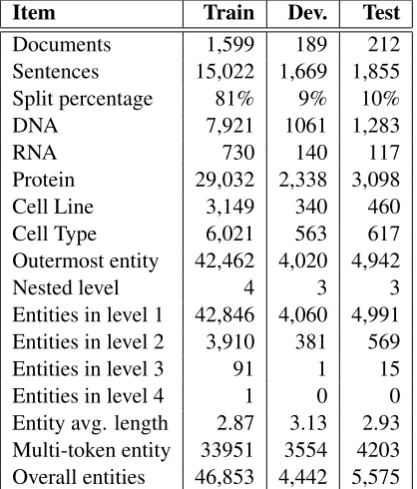
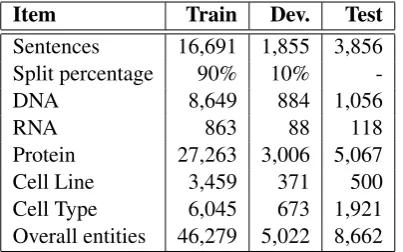
Statistics of GENIA, ACE2005 and JNLPBA are described in Tables7,8and9, respectively.
We used NERSuite (Cho et al., 2010) for GENIA to perform tokenization while Stanford CoreNLP (Manning et al., 2014) was used for ACE2005. The JNLPBA dataset has already been went through tokenization and sentence splitting, so we did not apply any preprocessing.
For GENIA, we had to manually revolve the fol-lowing two issues, in addition to the above prepro-cessing.
One of the issues we had in this corpus is the re-moval of discontinuous entities during parsing. In provided GENIA XML file, each flat entity is an-notated with ‘lex’ (lexical) and ‘sem’ (semantics) attributes while discontinuous and nested entities may have none, one or two attributes when these entities embed with each other, making it diffi-cult to extract the strictly nested ones. Taken the text “recombinant human nm23-H1, -H2, mouse nm23-M1, and -M2 proteins” as an example, there are six discontinuous entities, “recombinant human nm23-H1 protein”, “recombinant human
Item Train Dev. Test
Documents 1,599 189 212 Sentences 15,022 1,669 1,855 Split percentage 81% 9% 10%
DNA 7,921 1061 1,283
RNA 730 140 117
Protein 29,032 2,338 3,098 Cell Line 3,149 340 460 Cell Type 6,021 563 617 Outermost entity 42,462 4,020 4,942
Nested level 4 3 3
[image:12.595.313.522.63.308.2]Entities in level 1 42,846 4,060 4,991 Entities in level 2 3,910 381 569 Entities in level 3 91 1 15 Entities in level 4 1 0 0 Entity avg. length 2.87 3.13 2.93 Multi-token entity 33951 3554 4203 Overall entities 46,853 4,442 5,575
Table 7: Statistics of GENIA.
Item Train Dev. Test
Documents 370 43 51
Sentences 9,849 1,221 1,478
FAC 924 83 173
GPE 4,725 486 671
LOC 763 81 69
ORG 3,702 479 559
PER 13,050 1,668 1,949
VEH 624 81 66
WEA 652 94 67
Outermost entity 18,455 2,285 2,724
Nested level 6 4 5
Entities in level 1 19,676 2,429 2,936 Entities in level 2 3,934 448 505 Entities in level 3 731 85 102 Entities in level 4 90 10 10 Entities in level 5 7 0 1 Entities in level 6 2 0 0 Entity avg. length 2.28 2.33 2.28 Multi-token entity 10,577 1,323 1,486 Overall entities 24,440 2,972 3,554
Table 8: Statistics of ACE2005.
Item Train Dev. Test
Sentences 16,691 1,855 3,856 Split percentage 90% 10%
-DNA 8,649 884 1,056
RNA 863 88 118
[image:13.595.82.284.62.188.2]Protein 27,263 3,006 5,067 Cell Line 3,459 371 500 Cell Type 6,045 673 1,921 Overall entities 46,279 5,022 8,662
Table 9: Statistics of JNLPBA.
Hyper params Range Best
[image:13.595.74.291.221.336.2]Batch size [16 – 256] 67 No. of hidden units 200, 250, 300 200 Dim. of char. emb. [15 – 50] 35 Dropout rate [0.1 – 0.5] 0.2144 Learning rate [0.001 – 0.02] 0.00754 Gradient clipping [5 – 50] 27 Weight decay (L2) [10-8– 10-3] 4.54-5
Table 10: Value range and best value of tuned hyper parameters in GENIA.
Hyper params Range Best
[image:13.595.73.292.379.492.2]Batch size [16 – 256] 91 No. of hidden units 200, 250, 300 200 Dim. of char. emb. [15 – 50] 28 Dropout rate [0.1 – 0.5] 0.1708 Learning rate [0.001 – 0.02] 0.00426 Gradient clipping [5 – 50] 11 Weight decay (L2) [10-8– 10-3] 9.43-5
Table 11: Value range and best value of tuned hyper parameters in ACE2005.
Hyper Parameters Initialized Value
Acquisition Function gp hedge
n-calls 10
n random state None
n random starts 10
Acquisition Optimizer lbfgs n restarts optimizer 100
noise gaussian
n points 50000
xi 0.1
n jobs 1
Table 12: Hyper parameters used of Bayesian Opti-mization.
is an connection indicator of the separated texts in discontinuous entities. Meanwhile, each of the
separated texts has no ‘sem’ attribute unless itself is an innermost entity. Unfortunately, there are some inconsistent cases such as “c-fos and c-jun transcripts” where symbol * should be in the ‘lex’ attribute as the discontinuous entity “c-fos tran-script” is connected by “c-fos” and “trantran-script” while “c-jun transcript” is connected by “c-jun” and “transcript”. These two entities share the same text “transcript”. However, each of them is anno-tated with two attributes: ‘lex’ and ‘sem’, follow-ing the same annotation for flat entities. Although it is possible to ignore the latter entity based on ‘lex’ attribute and its belonging sentence, this rule fails to deal with entity “c-jun gene” in the exam-ple of “c-fos and c-jun genes” as the ‘lex’ of “c-jun gene” is mistaken as “c-jun genes”. Therefore, in this case, we ignored “c-fos transcript” and instead kept the “c-jun transcripts” as a flat entity.
Another issue is the incomplete tokenization. The label assignment to one word was conducted on the word-level instead of character level, but there are entities that correspond to parts of words. An example is “NF-YA subunit”, which contains two protein entities: “NF-Y” and “A subunit”. To cope with this problem, we treat both two entities as false negative entities in training dataset as there are only 13 such entities in the training data set.
B Bayesian Optimization Setting
The hyper-parameters which were tuned for our model are listed in Table10and Table11. These hyper-parameters are tuned by Bayesian optimiza-tion with the hyper parameters listed in Table12.
C Model Structure
Figure 4 shows the model architecture when we skip all intermediate LSTM layers and only word embeddings are used to produce the input for the next flat NER layer.
[image:13.595.82.283.534.688.2]O B-DNA I-DNA I-DNA I-DNA O
O B-protein O O O O
Mouse interleukin-2 receptor alpha gene expression
O B-Protein O O O O
O B-DNA I-DNA I-DNA I-DNA O
O O O
Gold labels Embedding layer Flat NER layer Flat NER layer Flat NER layer
Sequence
Inner
Outer
Dropout Dropout
CRF CRF
LSTM Unit LSTM Unit
Label Label
Word representation Word representation
Flat NER Unit Flat NER Unit
O B-DNA I-DNA I-DNA I-DNA O
O B-protein O O O O
Mouse interleukin-2 receptor alpha gene expression
O B-Protein O O O O
O B-DNA I-DNA I-DNA I-DNA O
O O O
Gold labels Embedding layer Flat NER layer Flat NER layer Flat NER layer
Sequence
Inner
Outer
Dropout
CRF
LSTM Unit
Label
[image:14.595.113.505.108.326.2]Word representation Flat NER Unit
Figure 4: Overview of the model architecture with skipping representation for non-entity words. “interleukin-2” and “interleukin-2 receptor alpha gene” are nested entities.
O B-DNA I-DNA I-DNA I-DNA O
O B-protein O O O O
Mouse interleukin-2 receptor alpha gene expression
O B-Protein O O O O
O B-DNA I-DNA I-DNA I-DNA O
O O O
Gold labels Embedding layer Flat NER layer Flat NER layer Flat NER layer
Sequence
Inner
Outer
Dropout Dropout
CRF CRF
LSTM Unit LSTM Unit
Label Label
Word representation Word representation
Flat NER Unit Flat NER Unit
[image:14.595.122.501.461.677.2]