Recognizing, Developing and Evaluating
Business Opportunities to Successfully Create
and Deliver Additional Value to ParnasSys Users
“Recognizing, Developing and Evaluating Business Opportunities to
Successfully Create and Deliver Additional Value to ParnasSys Users”
August 19th, 2010.
Author:
Raymond Bramer S0066036
Business Administration University of Twente
Committee:
Dr. M.L. Ehrenhard Dr. A.B.J.M. Wijnhoven M. de Goffau
Project Information:
Topicus (EduTopics B.V.)Leeuwenbrug 23 7411TE Deventer Tel: 0570 - 6626622
Web: http://www.topicus.nl
University of Twente
School of Management and Governance Postbus 217
7500AE Enschede
3
Preface
After a year of considerable study and hard work, the research that I have executed to acquire my Master´s degree and complete my education at the University of Twente has come to an end. The Master thesis lying in front of you is the result of my research at Topicus, focusing on new business opportunities that can be developed for ParnasSys, in order to create and deliver additional value to its users.
Although this research is completed, the implications of the conclusions and recommendations, and the development and implementation of new services that follows has yet to begin. I leave this challenge in the capable hand of the professionals at Topicus.
This thesis can be regarded as the starting point of the development of new services. It presents the important value attributes of ParnasSys users, identifies business opportunities and selects interesting business opportunities for further development into business models, based on relevant criteria. Two of these business opportunities stand out in the creation and delivery of user value, which is why these are recommended to be implemented in the ParnasSys system.
The completion of this thesis would not have been possible without the help of the people around me. Therefore I want to thank a number of people for their support, their help or their patience. First of all I want to thank Martin de Goffau for hiring me for this assignment, assisting me in acquiring the data and information required, and offering me the flexibility and patience to determine my own schedule. Without this flexibility and patience, this result would not have been possible.
Second, the employees of Topicus with which I shared an office space have brought fun to the hours that I have spent in Deventer, and have provided me with the space and information I needed to complete the research. Their support made me feel like home from day one, has kept me motivated to achieve the best possible outcome for ParnasSys, and we´ve even created some new friendships in the process.
Third, I would like to thank dr. Ehrenhard and dr. Wijnhoven from the University of Twente for their advice and their patience with my elaborate emails, my hard-minded convictions of being right and my prolonged graduation period.
Finally, I am grateful to my friends and family and my fellow students for helping me with comments and remarks, as they have been of great value to me in the last stage of my education. In particular, I want to mention Ramon Schutte as my absolute savior in distress. Without his assistance in my other obligations, the combination of responsibilities would have surely failed.
Raymond Bramer
Management Summary
ParnasSys is an online student administration and tracking system that can be used by primary schools in order to manage student data and student performance efficiently and effectively. The system consists of several modules, which are all charged for separately by an annual license fee per student. In order to stay competitive, Topicus, the owner of the ParnasSys system, wants to implement new services that can create and deliver additional value to its users.
This research was started to determine which services should be developed in order to achieve the creation and delivery of this additional user value to ParnasSys users. Therefore, the research goal is stated as follows:
“The goal of this research is to develop a method to recognize, develop and evaluate opportunities, and to identify which services can best be developed in order to create and deliver value to the fixed user base of ParnasSys”
The first step of business opportunity development is to determine which unfulfilled desires, wants and needs are present in the market. The next step is to determine if there are methods in which ParnasSys can fulfill these needs. Depending on the method of determining business opportunities, this process can also be reversed, when underutilized resources are detected and a certain market need is sought to exploit with this underutilized resource.
Regardless of how the development process is executed, the “fit” between what our users want and the possibilities that exist to fulfill these desires are the business opportunities that are sought. When a business opportunity is identified, it can be developed in the business development process, until finally a business model is created that can be executed to realize the value creation and delivery to the users of the ParnasSys system. Business models describe the delivery of value to all actors involved in the process. It prescribes that for a service to be successful, business models should offer some positive value to all involved actors.
The data gathering process indicates what our users want, and whether or not ParnasSys is capable of developing this opportunity into a service that can create and deliver user value for this need. Four sources were used to acquire the required data: Financial reports of 31 schools over three school boards, twelve semi-structured interviews with ParnasSys users (four interviews with members of each user group: schools, school boards and parents), several unstructured conversations with sales agents within Topicus, and the Delphi users society, in which complaints and suggestions for improvement are made and reviewed by ParnasSys users that have access to the Delphi system.
5
What should ParnasSys do?
From a comparison between the interviews with ParnasSys users, and the conversations with sales- agents, it is clear that there exists a “gap” between the user’s perceived value from ParnasSys, and how ParnasSys employees estimate this value. This research is a first step in closing that “gap”.
A list of business opportunities that were identified is presented in the results section in Chapter 4. From these results, two business opportunities stand out, based on an estimate of how much value is expected to be delivered to an individual user, and the number of users that can benefit from this business opportunity, thus the total value creation and delivery that can be realized by developing this business opportunity.
The first business opportunity is a Single Sign-On (SSO) system. The intention of this business opportunity is to relieve users of the need to remember usernames and passwords of the systems that they use besides ParnasSys. There are many companies and institutions that require some form of login to web-based systems in order to provide its services to the schools. This research shows that many users experience the login process as irritating. It has become a symbol of the use of IT-systems, of which especially the employees of schools generally have an aversion. The SSO system can take away this burden by logging the user in into external systems automatically after clicking on a button, without requiring the user to enter the actual login data.
It is expected that this system provides user value in the form of usability, which is important to school employees. Moreover, a large portion of ParnasSys users can benefit from this system. Since age is an important factor in the acquisition and application of IT systems (Davies & Westerman, 2000) and the average age of employees at schools is expected to increase in the coming years, it can be expected that the SSO system will continue to provide value to ParnasSys users for the foreseeable future. This business model is deemed both feasible and viable.
The second business opportunity that is developed is the error analysis system for Cito tests. An error analysis system provides users with the possibility of analyzing what a student did wrong in Cito tests, and to detect patterns of errors that indicate an arrearage in a certain area.
There is no LVS-system in the market that offers this possibility in combination with storing method-related test scores and other student data. Therefore, many schools use two separate LVS systems. With this system, ParnasSys would be the sole supplier of a complete LVS system that leaves other systems redundant. The value creation and delivery would lead to an increase in the ease of use of LVS systems in general, since all relevant student performance data can be tracked in one system. It also provides the possibilities to create a better image of how a student is performing, thus creating opportunities to increase the quality of the education provided by the school.
Content
Preface ... 3
Management Summary ... 4
Chapter 1: Introduction ... 11
1.1 Company Description ... 11
1.2 ParnasSys ... 12
1.3 Research Goal ... 13
1.4 Research Questions ... 14
1.5 Research Approach ... 15
1.6 Structure of this report ... 16
1.7 Relevancy ... 17
1.7.1 Scientific Contribution ... 17
1.7.2 Economic contribution ... 17
1.8 Limitations ... 17
Chapter 2. Literature Review ... 18
2.1 Theoretical framework ... 18
2.2 Opportunity identification ... 19
2.3 Opportunity Development ... 22
2.3.1 Basic concept and functions ... 23
2.3.2 The Service domain ... 25
2.3.3 The Technology domain ... 25
2.3.4 The Organizational domain ... 26
2.3.5 The Finance domain ... 26
2.3.6 From business model components to business model design ... 27
2.4 Opportunity Evaluation ... 28
2.4.1 Uncertainty and Risk ... 28
2.4.2 Analyzing feasibility and viability ... 29
2.4.3 Value and Revenue ... 30
Chapter 3: Methodology ... 33
3.1 Population and sample ... 33
3.1.1 Schools ... 33
3.1.2 School boards ... 33
3.1.3 Parents ... 34
7
3.2 Measurement ... 35
3.2.1 Market needs ... 35
3.2.2. Value Attributes... 35
3.3 Data collection ... 36
3.4 Qualitative Data Analysis ... 37
3.4.1 Business opportunity identification ... 38
3.4.2 Business Opportunity development ... 38
3.4.3 Business opportunity Evaluation ... 40
Chapter 4: Results ... 41
4.1 Financial analysis ... 41
4.2 Value Attributes... 42
4.2.1 Value attributes for schools ... 42
4.2.2 Value attributes to School boards ... 44
4.2.3 Parents ... 45
4.2.4 ParnasSys users in general ... 46
4.3 Recognized Business Opportunities ... 46
4.4 Business Opportunity Identification ... 47
4.5 Business Opportunity Development ... 48
4.6 Business Opportunity Evaluation ... 48
4.7 Ranking Business Opportunities ... 49
Chapter 5: Conclusions & Recommendations ... 50
5.1 Conclusions ... 50
5.1.1 Value attributes ... 50
5.1.2 Single Sign-On System ... 51
5.1.3 Cito Error Analysis ... 51
5.1.4 Scientific implications ... 52
5.2 Recommendations... 54
5.3: Discussion ... 54
5.4 Suggestions for further research ... 56
5.4.1 Bundling or stand alone ... 56
5.4.2 Parent portal usage ... 56
5.4.3 Business opportunity identification ... 57
References ... 58
Appendix A: Single-Sign-On Module ... 61
A.2: The business model ... 62
A.2.1 The service concept... 62
A.2.2 The Technological concept ... 65
A.2.3 The organizational concept ... 66
A.2.4 The financial concept ... 66
A.3 Business opportunity evaluation ... 67
A.3.1 Feasibility analysis ... 67
A.3.2 Viability analysis ... 67
A.3.3 New Venture Template ... 67
Appendix B: Error Analysis system ... 68
B.1 Introduction... 68
B.2 The Business model ... 69
B.2.1 The service concept ... 69
B.2.2 The Technological concept ... 70
B.2.3 The organizational concept ... 71
B.2.4 The Financial concept ... 72
B.3. Business opportunity evaluation ... 73
B.3.1 Feasibility analysis ... 73
B.3.2 Viability analysis ... 73
B.3.1 Assumptions ... 73
B.3.2 Viability ... 73
B.3.3 Sensitivity ... 74
B.3.4 New Venture Template ... 75
Appendix C: Additional study materials ... 76
C.1 Reasons for this business model. ... 76
C.2 The idea ... 76
C.2.1 When is additional help required ... 76
C.2.2 The advice... 77
C.3 Sale of additional materials ... 78
C.3.1 The service concept. ... 78
C.3.2. The technology concept ... 79
C.3.3 The organizational concept ... 79
C.3.4 The financial concept ... 79
C.4 Network of tutors ... 80
9
C.4.2 The technology concept. ... 81
C.4.3 The organizational concept ... 81
C.4.4 The financial concept ... 81
C.5 Online Practicing Software ... 81
C.5.1 Het service concept ... 81
C.5.2 The technological aspect ... 82
C.5.3 The Organizational aspect ... 82
C.5.4 The Financial concept. ... 82
C.6 Business Opportunity Evaluation ... 83
C.6.1 Feasibility Analysis ... 83
C.6.2 Viability analysis ... 83
C.6.3 New Venture Template ... 84
Appendix D: Data Backup Possibility ... 85
D.1 Reasons for this business model ... 85
D.2 The idea ... 85
D.3 The Business model (outline) ... 86
D.3.1 The service concept ... 86
D.3.2 The Technology concept ... 87
D.3.3 The Organizational concept ... 87
D.3.4 Het Financial concept ... 87
D.4 Business model evaluation ... 88
D.4.1 Feasibility analysis ... 88
D.4.2 Viability analysis ... 88
D.4.3 New Venture Template ... 89
Appendix E: Digital study materials ... 90
E.1 Reasons for this business model ... 90
E.2 The idea ... 90
E.3 The business model ... 90
E.3.1 Het service concept ... 90
E.3.2 The Technological concept ... 92
E.3.3 The Organizational concept ... 92
E.3.4 The Financial concept ... 93
E.3.5 Division of revenue ... 94
E.4 Business Model Evaluation ... 95
E.4.2 Viability analysis ... 95
E.4.3 New venture template ... 96
Appendix F: Financial analysis ... 97
Appendix G: Delphi suggestions and complaints ... 99
Appendix H: Intermediation ... 101
H.1 Basic concepts and functions ... 101
H.2 Market imperfections vs. Transaction costs ... 101
H.3 Market Makers ... 102
H.4 Baligh-Richartz effect ... 103
Appendix I: New Venture Template ... 104
Appendix J: Opportunity Identification ... 109
11
Chapter 1: Introduction
This report is written as a Master’s thesis for Business Administration, and it focuses on new business opportunities for ParnasSys. This chapter starts with the company description and a short summary of the ParnasSys system. Section 1.3 and onwards form the detailed description of this research.
1.1 Company Description
Topicus is a Dutch innovative IT-service provider founded in 1998. The company offers IT solutions for companies and institutions in the sectors healthcare, finance and education. Because of its divisional structure, in which divisions are called cells, the company is located in 4 buildings in the center of Deventer. Its total revenue in 2009 was just under €
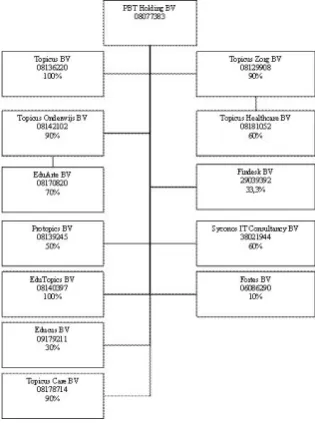
[image:11.595.183.341.402.614.2]20.000.000,-Topicus believes that the company as a whole should be regarded as an organism. Each cell can be kept small and dynamic and it can operate in its own field, while the organism as a whole can grow to be big and strong. If a cell grows larger and requires more personnel and resources, Topicus tries to split up the cell into two smaller cells to keep this structure functioning optimally. This can be seen in the organogram in figure 1.1, where several company names show large similarities, e.g. Topicus Zorg BV and Topicus Healthcare BV. By doing this, the company can both benefit from the energy and commitment that employees have in small companies and have the bargaining power and the economies of scale of a large IT service provider. Currently Topicus has around 190 fte’s.
Figure 1.1: Organogram of PBT Holding BV (Powered by Topicus).
Topicus is a company concept: Every cell moves according to this concept.
Topicus is a product concept: Every cell develops products according to this concept.
Topicus is clear on the position of and the relation between employer and employee.
Topicus specializes in SaaS-applications, which are gaining in popularity all over the world. SaaS stands for Software as a Service. It entails that software applications are no longer offered as a package that can be installed locally on a computer, but as software applications that are accessible through the internet. This way, the only requirement to use Topicus’s products is a computer with an internet connection. Also, maintenance and updates are controlled by the SaaS provider, and data can be stored and managed safely, without any danger that outdated firewalls, virus scanners or computer hardware of users can affect the safety of the software service or the data behind it.
One of the main advantages of the SaaS concept is the information sharing possibilities that it provides. Supply Chain Integration and Process Management are keywords in this. In healthcare for example, the information sharing between medical professionals and pharmacies can improve the service level provided to customers, prevent mistakes and provide massive efficiency gains for the entire supply chain.
The part of Topicus that focuses on the education sector has developed several SaaS systems. Topicus Onderwijs BV is responsible for the development of these systems. Alleva is developed for kindergarten and daycare centers for small children below the age of four. ParnasSys is developed for primary schools with children ranging from ages four through twelve, Vocus is for high schools that educate children from ages twelve through eighteen and EduArte is developed for vocational education.
EduTopics BV is responsible for the exploitation of ParnasSys, and it is for this cell that this assignment is executed. EduTopics is the only full daughter company of Topicus. The other cells are all in some form collaborations with other companies. EduTopics is also the only company within Topicus that exploits one of their products. The exploitation of other SaaS systems is done by external parties, which makes EduTopics different from all other cells within Topicus. EduTopics currently employs twelve fte’s, that operate either in sales or in helpdesk functions.
1.2 ParnasSys
ParnasSys is a student administration and performance tracking system for primary education, designed, developed and maintained by Topicus. The system is designed for primary schools, therefore it tracks children from ages around four through twelve. All students have their own record and depending on the school, all kinds of information is stored.
One important aspect of the ParnasSys system is that it is completely web-based. All information is stored in one location, which makes data backup and accessibility easier and safer to manage. Another advantage of the web-based system is that no installation is required on customer’s computers. Therefore, setting up the system for a new customer is very easy.
13
modify information that is stored in the database through their web portal which gives them access to all relevant information, like names, addresses, absences, etc. The second is the student tracking system. This system allows teachers to keep track of the grades for all the tests the students make, and it provides the report cards at the end of every period. This is the basic system that Topicus provides to schools in order to manage their students data and performance efficiently. Access to this system is provided on a license based on the number of children listed in the school’s student database. A fee of € 3,24 (excl. VAT) is charged per student per year.
There are several modules that can be added to the ParnasSys system. One is the access for school boards. These boards get access to information of every school under their control and they can review the performances per student, per group or per school individually. A fee of € 1,00 per student per year is charged for this module, on top of the standard license fee of € 3,24. 501 school boards make use of this system.
Another available module is the parent module, which gives parents of children listed in the school access to information regarding their child. Again, this information is provided through a secure connection between the central database and the internet browser of the user. Schools decide which information is shown, and which information is not. Again, a fee of € 1,00 per student per year is charged for this module, on top of the standard license fee. At this point, 132 schools have adopted the parent module, but not all of these 132 schools actually use this system.
The final module that is available for schools is the “Zien!” system. This system allows schools to keep track of relevant social and emotional information of children like undesired behavior, social skills and motivational issues. It also suggests solutions to detected problems and provides contact with experts on these issues. Tracking this data is obligated by law. This module is also available for a license fee of € 1,00 per student per year. At this point, 573 schools that use the ParnasSys system adopt the Zien! module and nine schools use the standalone version of Zien! Screenshots and detailed information about ParnasSys can be found on www.parnassys.nl.
Currently ParnasSys serves over 2750 schools (ParnasSys, 2010) of the 7546 primary schools (CBS, 2009) in The Netherlands, which is a market share close to 40%. The web-based system is generally regarded as superior to systems developed by large competitors, but competitors are trying to close the gap between ParnasSys and their system. This causes many schools to make the switch to ParnasSys as the development of competitor’s new systems result in bugs and other problems that schools would rather avoid. The advantage of the completed and relatively bug-free system is considered to be the main reason for the rapid growth in market share in the past months.
1.3 Research Goal
At this point, Topicus only generates revenue from these user groups by charging license fees for the use of the system and some extra applications. From its core business of chain integration, Topicus wants to do more with these communities. Therefore they have started experimenting to see which possibilities can be exploited. This research was started to shed light on this topic.
present a competitive advantage and have a direct or indirect effect on the profitability and continuity of ParnasSys without generating a direct revenue stream. Therefore the user value is the key variable of this research. To prevent any ambiguity about the term customers or users, the term “users” will be used in this research, and this term implies everyone who has access to ParnasSys through their login data.
This research is set up to identify which opportunities are available to generate user value, and to determine how to make use of these opportunities in order to create and deliver user value, and eventually to generate revenue. It’s expected that some business opportunities will use ParnasSys as an intermediary, between the user groups and companies and institutions that want to reach these user groups or are specialized in certain fields of interest. Therefore, the research goal is defined as:
“The goal of this research is to develop a method to recognize, develop and evaluate opportunities, and to identify which services can best be developed in order to create and deliver value to the fixed user base of ParnasSys”
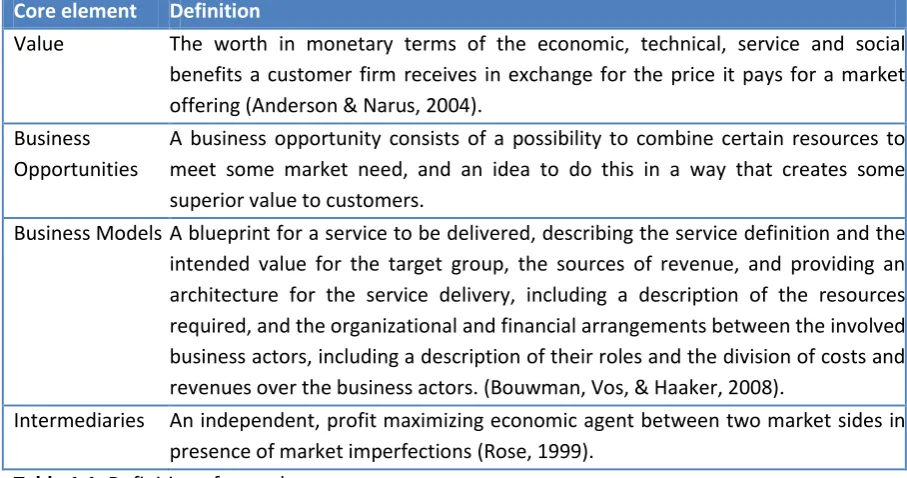
The most important core elements of this research are defined below:
Core element Definition
Value The worth in monetary terms of the economic, technical, service and social benefits a customer firm receives in exchange for the price it pays for a market offering (Anderson & Narus, 2004).
Business Opportunities
A business opportunity consists of a possibility to combine certain resources to meet some market need, and an idea to do this in a way that creates some superior value to customers.
Business Models A blueprint for a service to be delivered, describing the service definition and the intended value for the target group, the sources of revenue, and providing an architecture for the service delivery, including a description of the resources required, and the organizational and financial arrangements between the involved business actors, including a description of their roles and the division of costs and revenues over the business actors. (Bouwman, Vos, & Haaker, 2008).
[image:14.595.64.518.336.575.2]Intermediaries An independent, profit maximizing economic agent between two market sides in presence of market imperfections (Rose, 1999).
Table 1.1: Definition of core elements
This research goal presents two major topics that have to be addressed. The first is the exploration of the business opportunities that exist for ParnasSys to create value, and the second is the determination of how to turn these possibilities into successful business models for ParnasSys that deliver this value to the fixed user base. This is elaborated in the next section.
1.4 Research Questions
15
1: What are the most important value attributes for ParnasSys users?
To answer this research question, the following sub questions have been devised. A literature study, complemented by desk research and interviews answers this research question.
Who are the ParnasSys users?
What is user value, and how can user value be determined?
Which value attributes are the most important for ParnasSys users?
2: Which business opportunities offer the most value for ParnasSys users?
There are endlessly many possibilities to create (some form of) value for ParnasSys users. It is important to determine which business opportunities deliver the most value. Interviews should present an answer to this research question.
Which business opportunities can be devised to deliver this user value?
How can business opportunities be evaluated?
Which criteria for business opportunities are important for ParnasSys?
3: How can the value generation and delivery to ParnasSys users be realized?
After determining which business opportunities are the most successful in delivering user value, business models can be designed to realize the value creation and delivery. Literature study presents the answer to this research question.
What are intermediaries?
What are business models?
How can business models be designed?
Which criteria for business models are important for ParnasSys?
1.5 Research Approach
To achieve the research goal stated above, first a literature study was performed. Based on literature regarding user value determination, business opportunities and business models, the basis on which this research is grounded is designed. Based on opportunity recognition and user value determination literature, the data gathering methods were selected. A total of four data sources are used to explore the user value and the business opportunities. These data sources are the financial annual reports of schools and school boards, the Delphi users society, the ParnasSys sales/helpdesk agents, and the users themselves.
The financial annual reports of 31 schools in three school boards are used to determine how schools spend their money. The Delphi users society uses a system in which users can post requests for changes and their wishes for ParnasSys, which may present new business opportunities. The sales agents/helpdesk employees are asked in several unstructured interviews (conversations) about opportunities that they feel may be interesting to exploit. The information gained from this is relevant to both understand the market and to determine the attractiveness of the business opportunities that are developed.
that are deemed to be of relevance to the outcomes of the interviews. Moreover, an attempt was made to interview subjects with different functions within the schools and school boards to broaden the understanding of the aspects that the users value. For parents, the estimated income of the parents was used to select subjects. A list of six questions was devised to structure the interviews, based on the outcomes of the literature study.
The data acquired by the interviews was analyzed by using the general inductive approach. This approach provides a convenient and efficient way of analyzing qualitative data for many research purposes (Thomas, 2003). This analysis presents the attributes that ParnasSys users value, the relevant differences within user groups, and the business opportunities that can be developed into business models.
The evaluation of business opportunities, and the design of business models for these business opportunities concludes this research, and presents recommendations for the implementation of new ways of generating user value. The design of business models for other business opportunities is outside of the scope of this research, but the methodology used to design business models in this research can be used for designing other business models as well.
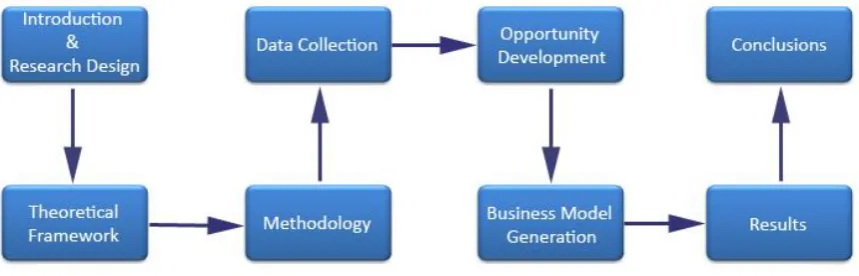
1.6 Structure of this report
[image:16.595.84.514.491.629.2]This section presents a step by step overview of the steps that are executed in this research. The first step in this research is presenting the research setting and the research design. Chapter 1 describes the company background, the markets in which Topicus operates and the research design. Chapter 2 addresses the theoretical framework that is used to validate this research and to collect the required information to execute it. The framework addresses customer value determination, business opportunities and (intermediary) business models. In chapter 3 the methodology that is used to execute this research is described.
Figure 1.2: Research approach
17
1.7 Relevancy
1.7.1 Scientific Contribution
The identification of business opportunities, and its development through business models into successful products and services is well discussed in recent literature. Although there is some ambiguity about the term business opportunity, the identification of business opportunities is usually done by detecting a market need and trying to find ways of meeting this need, or detecting an un(der)utilized resource and searching for a market need to fulfill with this. This research differs from the normal identification of business opportunities because the starting point of the identification is the current user base of ParnasSys, not a single market need or a resource.
The determination of value attributes from the current user base of ParnasSys is done through Customer Value Determination. The results of these efforts are used to evaluate numerous business opportunities. The most interesting business opportunities are selected, and these opportunities are developed into business models. By doing this, this research presents a method to create and deliver additional value to an existing user base by developing services that deliver value in attributes that are generally considered to be important to that user base. Moreover, this research presents empirical data regarding the applicability of this description of business opportunities, and regarding the model that is designed to recognize and evaluate these opportunities.
1.7.2 Economic contribution
This research is aimed at creating additional value for ParnasSys users. This can, in time, lead to the generation of additional revenue, both for ParnasSys and for companies and institutions that are involved in the business models. Furthermore, it presents the first outlines of business models for an error analysis system, which offers new possibilities like the use of digital study materials, that may lead to an improvement of the quality of education in schools. This may revolutionize the way primary schools organize their lessons.
1.8 Limitations
Some limitations to this research are important, and need to be addressed. The first limitation is in space. Since ParnasSys is focused on the Dutch market for primary schools, the business opportunities should comply with this. Therefore, this research will only take into account the possibilities that the Dutch market presents.
Another major limitation is in ethics. ParnasSys is aimed at primary schools and its stakeholders, and they share one common interest, which is the benefit and wellbeing of the children attending these primary schools. All opportunities that this research will take into account will have to be suited for primary schools. When dealing with children and their education directly, the question comes to mind whether advertisements or revenue generation options should be included in the first place.
Chapter 2. Literature Review
2.1 Theoretical framework
In order to achieve the goals of this research, the literature study provides the basis on which this research is performed. It provides knowledge of the topics of interest, discovered in prior research. The literature review should present the knowledge that exists on the topics of relevance.
The search for relevant literature is done through several search engines and databases. A first selection of literature is made based on the abstract of the articles on the topics that were addressed. A further study into these articles distinguished relevant from irrelevant articles. The relevant articles were studied, and where a more thorough analysis of a subject was deemed desirable, the articles from other authors that have been cited in the article at hand were retrieved.
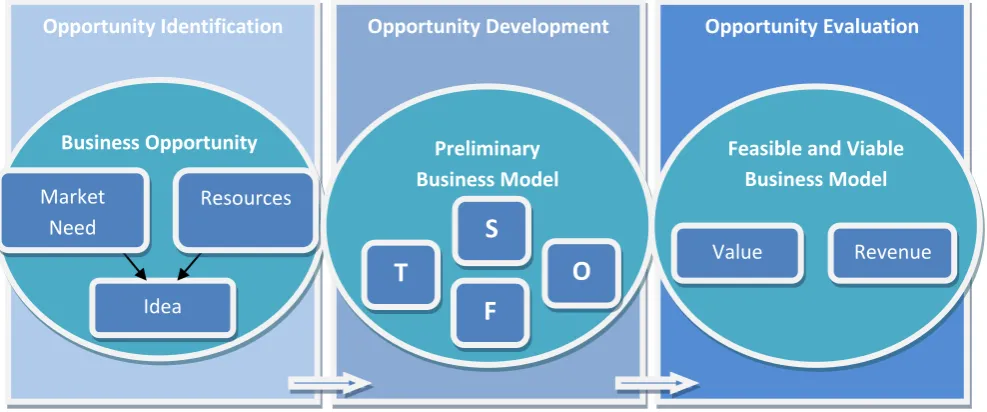
When determining which services should be developed to create and deliver additional value to a fixed user base, the first step is to identify ideas or opportunities that can provide value to the user base. The next step is to develop these ideas or opportunities into complete descriptions of the service, and the value delivery that is intended. Finally, these business models that have been created have to be evaluated to determine the feasibility and viability of the opportunity. These steps have been used to develop a theoretical framework that can be used to perform this research. This framework is graphically represented below.
Figure 2.1: Theoretical Framework for Developing Business Opportunities
In this figure, the squares represent the processes that have to be performed by the researcher, the oval shapes represent the end result of these processes, which serve as the starting point for the next step. The result of this model is a business model for an opportunity, that can be used as the starting point for the execution of the idea, created to benefit from an opportunity.
Each step of this model is addressed in detail in the next sections. Section 2.2 addresses opportunity identification, section 2.3 addresses the development of opportunities, and opportunity evaluation is addressed in section 2.4.
Opportunity Identification Opportunity Development Opportunity Evaluation
Business Opportunity
Idea Market
Need
Resources
Preliminary Business Model
S
O
T
F
Feasible and Viable Business Model
[image:18.595.48.542.398.604.2]19
2.2 Opportunity identification
The first stage of this model is identifying business opportunities. In literature this process is also called opportunity identification, opportunity recognition or opportunity discovery. There are infinitely many business opportunities that can be developed. Identifying and selecting the right opportunities are amongst the most important abilities of a successful entrepreneur (Stevenson, Roberts, & Grousbeck, 1985). In order to perform this step, two questions are important: What are business opportunities? And How can business opportunities be identified? Ardichvili et. al. define business opportunities as the chance to meet a market need (or interest or want) through a creative combination of resources to deliver superior value (Ardichvili, Cardozo, & Ray, 2003). Many authors build on this definition, but there are some irregularities, that need to be addressed.
The opportunities that are seen from the perspective of customers represent value sought (expected value). The un- or under employed resources or capabilities are called value creation capabilities (intended value). Prospective customers may or may not be able to articulate their needs. Even if they are unable to do so, they may still be able to recognize the value to them in something new when they are presented with it and have its operation and benefits explained (Ardichvili, Cardozo, & Ray, 2003). The under-employed resources, as well as new capabilities and technologies offer possibilities to create and deliver new value for prospective customers, even though the precise forms that new value will take may be undefined.
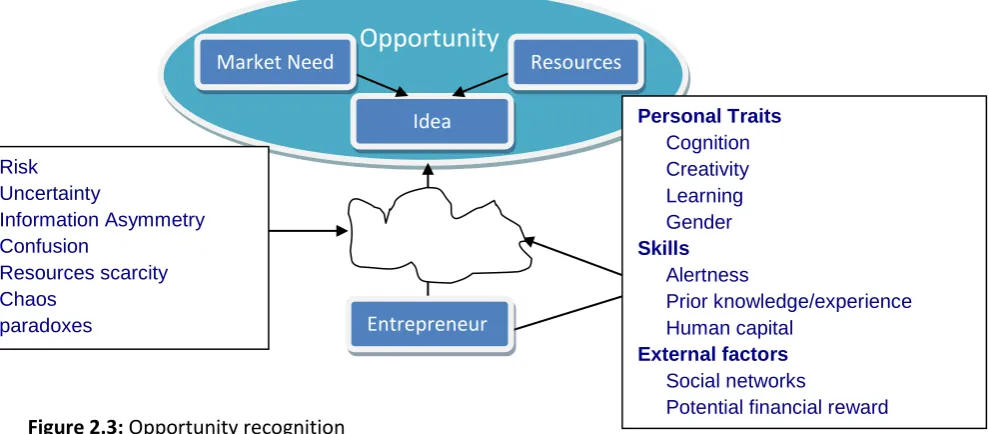
[image:19.595.73.523.491.754.2]Both the market need, and the resources to meet them are not dependent on any individual to exist. Opportunities emerge – and become available for discovery by specific individuals – out of a combination of many factors, economic, technological, and social (Baron & Shane, 2008). So why do some individuals recognize business opportunities, where others don’t? Many variables affect an individual’s ability to recognize business opportunities. The table below summarizes what is written about this up to 2003 (Shepherd & DeTienne, 2005).
Recent literature from 2005 to present seems to focus on cognition processes as the most important area of research (Krueger, 2005) (Mitchell, et al., 2006). There is a growing interest in the role of cognitive psychology as a driver of entrepreneurial initiatives (Kasouf, 2007). Gender can also be of influence as to which opportunities are recognized, but not to its success. (DeTienne & Chandler, 2007.)
Some elements reduce the chance of an entrepreneur recognizing an opportunity. Surrounding the process of opportunity recognition are elements such as chaos, information asymmetries, resource scarcity, uncertainty, risk, paradoxes, confusion (Timmons, 1994). Moreover, Timing is an important element in opportunity recognition. Recognizing an opportunity too early or too late may render the opportunity useless for the individual that recognized it.
Although this information is useful in determining why certain individuals recognize opportunities, and others don’t, it doesn’t explain how these entrepreneurs recognize opportunities. Singh, Hills and Lumpkin have suggested in 1999 to distinguish between a new venture idea and an entrepreneurial opportunity (Singh, Hills, & Lumpkin, 1999), but this hasn’t been adopted in later research. Ardichvili et al suggest three phases in opportunity recognition: perception, discovery and creation. This suggests that perception is the first phase of opportunity recognition, but this also doesn’t provide a starting point for opportunity recognition.
This raises the question whether opportunity recognition is something that can be done, rather than something that overcomes you. According to several authors, it can be taught. Long and McMullan describe the opportunity recognition process as being at least partially under the control of the entrepreneur. They argue that a combination of factors, including both uncontrollable and controllable factors, affect the ability of an individual to recognize the opportunity (Long & McMullan, 1984). Krueger states that the ability to recognize opportunities comes forth from both personal trait level phenomena, such as tolerance for uncertainty, and some necessary skills, like critical thinking (Krueger, 2005). Kasouf (2007) states that the interplay between individual factors that may affect efficacy have the potential to explain how some individuals recognize opportunities where others with similar backgrounds or technical skills do not (Kasouf, 2007).
DeTienne and Chandler (2004) have shown that opportunity identification is a competency that can be developed just like any other competency. This means that there are ways to increase the chances for an individual to recognize opportunities. They have discovered that literature proposes four opportunity identification methods: active search, passive search, fortuitous discovery, and the creation of opportunities (DeTienne & Chandler, 2004). Ardichvili et. al. (2003) only distinguish between discovery and purposeful search.
21
A possibility is simply something that is possible. An opportunity is some favorable or advantageous circumstance or combination of circumstances, or a chance for progress or advancement (The Free Dictionary, 2010). If the “opportunity” that is discussed emerges from external developments, and is not dependable on the entrepreneur to detect it for it to exist, then it cannot be called an opportunity.The exact same “opportunity” may be a threat to another entrepreneur, who would call the emergement from developments unfavorable. I therefore suggest to use the word possibility for the chance to combine resources to meet some market need. This possibility can only be called an opportunity when some entrepreneur has an idea to benefit from it, hence having a favorable combination of circumstances, that can result in the creation and delivery of value to customers.
So to comply with both statements, that alternative version should comprise that a possibility of meeting some market need with certain resources emerges from external developments, an individual can recognize that possibility, and create and develop an idea to benefit from it, and thus creating an opportunity from a possibility. Therefore the definition of a business opportunity is: a business opportunity consists of a possibility to combine certain resources to meet some market need, and an idea to do this in a way that creates some superior value to customers.
[image:21.595.57.552.482.699.2]Identifying market needs or finding un(der)utilized resources is not a deterministic process. It’s not true that everyone will detect an opportunity, when they try long and hard enough. However, by increasing the controllable factors that are of relevance to the identification process or reducing the elements that form the cloud, the chance that an entrepreneur discovers an opportunity can be increased. From the literature described above, I propose the following framework for opportunity identification. The process of perception, discovery and creation can be seen as breaking through the cloud in the picture below. This breaking through the cloud can be enhanced by increasing the entrepreneurial traits and skills that can be influenced by an individual, or by reducing the elements that form the cloud.
Figure 2.3: Opportunity recognition
Recognizing opportunities that exist for a fixed user base has never been studied in literature. The closest to this topic is customer retention by innovating and developing products and services, but this does not explain anything about opportunity recognition for new services. Building on the
Opportunity
Idea
Market Need Resources
Entrepreneur
Personal Traits
Cognition Creativity Learning Gender
Skills
Alertness
Prior knowledge/experience Human capital
External factors
Social networks
Potential financial reward Risk
Uncertainty
Information Asymmetry Confusion
Resources scarcity Chaos
literature of opportunity recognition in general, I propose the following model for opportunity recognition for a fixed user base.
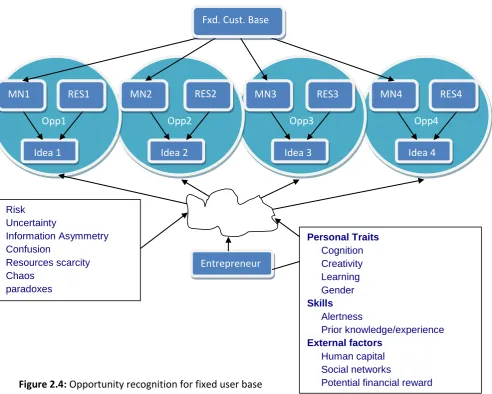
Assuming that the user base is fixed, and the users can be contacted, it is possible to explore the market needs of the users by actively searching for them in a data gathering process, thus providing a starting point for actively searching for opportunities. Since this assignment focuses on creating additional value for users, it makes sense to explore the value attributes of users while seeking these market needs, as it is important to deliver value to all users, and not just a small number of them.
When the entrepreneur understands certain market needs, he can attempt to meet them by combining or bundling resources in a way that value is created and can be delivered to the users, thus creating an idea to benefit from a possibility. This model is depicted in the figure below.
[image:22.595.52.545.265.659.2]
Figure 2.4: Opportunity recognition for fixed user base
2.3 Opportunity Development
As the combination of the imprecisely defined market need and/or the un(der)utilized resource becomes more precisely defined, a business concept begins to emerge out of the idea that is created to benefit from an opportunity. The process of idea development then forces the entrepreneur to fill in specific details. If the concept originated as a market need (value sought), the type and amount of resources required to address that need will be identified. If the concept arose from underemployed
Opp4
Opp3
Opp2
Opp1
Idea 1 Idea 2 Idea 3 Idea 4
MN1 RES1 MN2 RES2 MN3 RES3 MN4 RES4
Fxd. Cust. Base
Entrepreneur
Risk Uncertainty
Information Asymmetry Confusion
Resources scarcity Chaos
paradoxes
Personal Traits
Cognition Creativity Learning Gender
Skills
Alertness
Prior knowledge/experience
External factors
Human capital Social networks
23
resources (value creation capability), the benefits and value that the capability brings to particular users and uses will become more explicitly detailed (Ardichvili, Cardozo, & Ray, 2003). This process eventually develops the business concept into a business model, in which the service is described, and the value that is intended to each actor is clear.
Business models are perhaps the most discussed and least understood terms and aspects in the areas of eBusiness, eCommerce and markets. Importance is usually regarded as high, since a sound business model seems to influence the (potential) revenues and the future success of the eBusiness initiative. However, there are multiple indications that neither the understanding nor the elements of business models are broadly available (Alt & Zimmermann, 2001). The lack of sound business models has led to the failure of many eVentures (Vickers, 2000). This section presents the aspects of business models and its design.
2.3.1 Basic concept and functions
Recent studies and literary reviews provide insight in the concept of a business model. Although there are many different definitions of the term business model, many of these revolve around two central themes: Value and Revenue. The main goal of e-business modeling is to reach agreement amongst stakeholders regarding the question “who is offering what of value to whom and expects what of value in return” (Gordijn & Akkermans, 2001).
A straightforward and generally accepted definition of business models does not seem to exist, as many authors define it differently. A single coherent description is lacking due to the multi-disciplinary nature of business models (Mahadevan, 2000). Hedman and Kalling (2003) point out that the relevant literature regarding business models is dominated by descriptions of “specific” empirically identified business models, and that little attention has been paid to the theoretical sub-constructs of these models (Hedman & Kalling, 2003).
The lack of a common understanding on both the definition of business models and its content has some implications for this research. The selection of the references that will be used to build the theoretic framework of this research has to be done carefully as a different selection of business model literature may present different outcomes of the literary review and thus differences in the results of this research. In recent literature, two articles elaborate on the sub-constructs of business models that are required to design new business models. These articles are addressed below.
EBusiness model design, classification and measurements
Dubosson-Torbay, Osterwalder and Pigneur (2002) present a fairly elaborate description of business models and their constructs. They define a business model as “nothing else than the architecture of a firm and its network of partners for creating, marketing and delivering value and relationship capital to one or several segments of customers in order to generate profitable and sustainable revenue streams” (Dubosson-Torbay, Osterwalder, & Pigneur, 2002).
Mobile Service Innovation and Business Models
Bouwman, De Vos & Haaker (2008) have composed and co-written a book on business models, business model design and the application to mobile services, in which a similar description is given. They refer to Dubosson-Torbay, Osterwalder & Pigneur’s article, but they present their own definition of a business model:
“A business model is a blueprint for a service to be delivered, describing the service definition and the intended value for the target group, the sources of revenue, and providing an architecture for the service delivery, including a description of the resources required, and the organizational and financial arrangements between the involved business actors, including a description of their roles and the division of costs and revenues over the business actors.” (Bouwman, Vos, & Haaker, 2008).
From this, they define four components of which business models should exist. These are: (1) the Service domain, in which the value offering is described, (2) the Technology domain, in which the technology requirements that result from the service domain are described. (3) the Organization domain, which presents the resources and capabilities necessary to deliver the value offering, and (4) the Finance domain, in which the revenues, risks and costs are described.
Comparison
The intention of this research is not to falsify one of these models, nor is it aimed at ranking them. What is relevant is which model is more appropriate to this research. To a large extent, these definitions are similar. Differences exist in the separation of the infrastructure component (A) into the technology domain and the organization domain (B), and the combination of the product/service innovation and the relationship capital with customers (A) into the service domain (B). These differences do not seem to have any material effect on the content of a business model when designed according to these papers.
However, Bouwman, de Vos & Haaker elaborate on the subject by decomposing the term value into four types, giving critical design issues and critical success factors that need to be addressed when designing a business model, and they present a method with which business models can be designed, called the STOF-method. Their definition of business models captures the central notions of value and revenue, and it involves the partners for value creation and delivery, and the customers that receive the value offering. Moreover, it is composed for ICT and mobile services, which is the focus of this research. Therefore, this method is more appropriate for this research, and will be used as a guideline for designing business models in the second phase of the theoretical framework.
As with the definition of a business model, no general consensus exists on the elements that should be addressed when designing a business model. The existence of so many different classifications of components, illustrate the lack of a common framework (Haaker & de Vos, 2008).
25
Figure 2.6: Business model components (Bouwman, Vos, & Haaker, 2008)
2.3.2 The Service domain
The service domain is the starting point of the STOF approach. It entails an elaborate description of the service that will be offered, the value proposition and the customers, and it serves as a reference for the other domains. Every service has specific issues that ask for closer attention, but some generic issues are relevant to all services.
The most important aspect of the service domain is the customer value of a product or service that an individual company or network of companies has to offer and which will satisfy customer demands (Bouwman, Vos, & Haaker, 2008). To be able to satisfy customer demand, a thorough knowledge of the customers and end-users is required. The term customer is used to refer to the person(s) paying for the service and end-user to refer to the person(s) actually using the service.
Within the markets on which a company offers its services, different market segments can be distinguished, each with different needs, wishes and preferences. Important aspects of market segments are the size of the installed base, size of the target group and the maximal size of the potential market. Knowing and understanding customers and end-users is crucial to successful innovation, and must serve as a starting point for formulating intended value.
Furthermore, the context in which the service is offered, the price of the service, the effort users have to make, and the bundling of services should be addressed in this domain. In this research the concept of intermediation can be important, as offering services of other companies through the ParnasSys system may provide a substantial amount of customer value. Intermediation is therefore addressed in detail in appendix H.
2.3.3 The Technology domain
2.3.4 The Organizational domain
The organizational domain describes the value network that is needed to realize the particular service offering. A value network consists of actors with certain resources and capabilities, which interact and together perform value activities to create value for customers and to realize their own strategies and goals. Resources include all assets, capabilities, organizational processes, firm attributes, information, knowledge, etc. controlled by a firm that enable it to conceive of and implement strategies that improve its efficiency and effectiveness (Barney, 1991).
An organization has to collaborate with others in order to be able to provide all the necessary resources and capabilities that are required for developing and offering the service to the market and to develop a viable business model for involved actors. From a value chain perspective, processes create value, and it is important to determine where these value creation activities are executed. This differs from the resource based view, in which the competitive advantage of a firm is derived from the resources and capabilities the firm controls that are valuable, rare, imperfectly imitable and not substitutable. Both perspectives illustrate the importance of determining the key value creating activities/products/processes.
Value networks need to be customer aligned, collaborative with network partners in a systemic an information based way, and they have to be agile and scalable to be able to react to changes from the environment. These characteristics determine the advantages of the value network with regard to traditional businesses.
2.3.5 The Finance domain
The financial resources are the most important resources to be required by the value network. The main components that make up the financial domain are Investment decisions and revenue models. These aspects have to take into account the costs, revenues, risks and pricing methods of the service.
Revenue models specify how a firm translates customer value into a revenue stream. In effect, they specify where the money comes from (Hoffman & Novak, 2004). Revenue models indicate what methods of payment are used, what is being paid for, and thus in what way income is generated (Bouwman, Faber, Hakker, Kijk, de Reuver (2008)). The web makes possible a variety of revenue models for a firm, and it can be expected that further types of revenue models will be available in the future (Rayport and Sviokla, 1995). Hoffman & Novak have devised a list of 17 different revenue models, but also state that this list is non-exhaustive.
Dealing with risks means addressing both positive and negative aspects, taking the likelihood and subsequent consequences of any defined event into account. Actors involved in a value network constantly examine the prospects of new technologies, possibilities and performance, and must decide whether or not to replace existing technologies.
27
2.3.6 From business model components to business model design
In order to develop business models that create and deliver value to the actors involved, just determining the components of business models is insufficient. Haaker & De Vos indicate that for business models to be successful, they have to match their environment, and be ‘balanced’ properly on the issues that are important. They describe this by defining critical design issues and critical success factors.
Critical Design Issues (CDI)
To develop insight into how organizations can design ‘balanced’ business models, designers need to understand the critical design issues (CDIs) in business models and their interdependencies. A CDI is defined as a design variable that is perceived to be (by practitioner and/or researcher) of eminent importance to the viability and sustainability of the business model under study. For each of the four elements in the STOF model, these CDIs can be defined.
For the Service domain targeting, creating value elements, branding and customer retention are critical processes that have to be executed in order to design feasible and viable business models. Because the importance of the design issues is perceived by the designer, other CDI’s may be applicable, depending on the service at hand.
The technology domain requires designers to consider security, the quality of service, system integration, accessibility for customers and management of user profiles when designing business models. Again, other CDI’s may be included when this is relevant.
For the Organizational domain, Partner selection, network openness, network governance and network complexity are issues that have to be addressed. In innovating companies and network relations the openness is of particular importance. The open vs. closed innovation discussion can be very relevant in this case. Finally, the financial domain requires pricing, division of investments, valuation of contributions and benefits and the division of costs and revenues to be discussed in detail.
In all these CDI’s, the right balance has to be found to develop business models that are both viable and feasible. For example, in designing the quality of service, a balance has to be found between the quality level, and the costs incurred. Too much quality will result in high additional costs, whereas to low quality will result in customer complaints or in the worst case, termination of relationships.
Critical Success Factors (CSF)
The viability of a business model is determined by the creation of value for the customers and for the organizations in the business network. Critical success factors (CSF) refer to the limited number of areas in which satisfactory results will ensure that the business model creates value for the customer and for the business network.
To achieve high scores on these critical success factors, the critical design issues mentioned above need to be properly designed. A service that generates customer value in the long run can be expected to result in a viable business model.
For the creation of network value, there are four CSFs that are relevant: an Acceptable profitability, Acceptable risks, sustainable network strategy and acceptable division of roles. High scores on these success factors will result in a win-win situation where value is created for the customers and for the network partners that provide the service. It can be expected that network value in the long run will result in a viable business model.
The CDI´s in the organizations domain are instrumental for dividing value activities among multiple actors and aligning their resources, capabilities and strategic interests. Similarly, the CDI´s in the finance domain are instrumental in defining financial arrangements that lead to a profitable business for all parties involved.
Together, these relations form a causal model that explains the viability of business models based on the assumption that a viable business model should provide both customer and network value. In this model, the CDI´s are the instruments used to influence business model feasibility and viability.
In addition, the offerings from other companies or institutions may be of particular relevance in the organization of additional value offerings. Therefore, the process of intermediation can also be important, and needs to be addressed.
2.4 Opportunity Evaluation
At each stage of the development process, the idea has to be evaluated in order to determine the attractiveness of pursuing the opportunity. Two elements return in literature regarding the evaluation or screening of business opportunities or business plans, namely uncertainty and risk (Palich & Bagby, 1995), (Sherman, Digman, Sebora, & Hansen, 2006). Where one individual may detect a certain opportunity, but regard it as having too much uncertainty, and thus being too risky, another may see an opportunity to create and deliver value to its prospective customers.
2.4.1 Uncertainty and Risk
Uncertainty is inherent in the entrepreneurial process, and in the evaluation of opportunities. This uncertainty can present itself in many forms, like uncertainty regarding market demand, availability of sufficient resources, competition, etc. This uncertainty eventually results in risk. Opportunity evaluation is a critical step in the entrepreneurial process and inextricability tied to risk (Sherman, Digman, Sebora, & Hansen, 2006). The ability and tolerance to deal with this risk is key in predicting the success of a new opportunity.
29
entrepreneurship reduces this bias, and allows entrepreneurs to develop a better risk perception of their opportunity, thus improving the quality of the evaluation (Sherman, Digman, Sebora, & Hansen, 2006). It can be expected that previous experience with entrepreneurship has a similar effect on cognitive biases.
De Koning (1999) claims that entrepreneurs evolve opportunities by pursuing cognitive activities through active interaction with an extensive network of people (De Koning, 1999). From this can be concluded that in dealing with the uncertainty and risk involved in developing new opportunities, literature indicates that many of the variables that determine an individual’s ability to recognize opportunities are important in the evaluation process as well. Both the personal traits and the skills of an entrepreneur, and its environment that are important in opportunity identification are important in opportunity evaluation. This makes it easy to understand that Ardichvili et al (2003) regard changes that are made in the development stage of the opportunity as recognizing a better idea for the same opportunity. However, this does not mean that an individual who is good at recognizing opportunities will also be good at developing and evaluating them.
2.4.2 Analyzing feasibility and viability
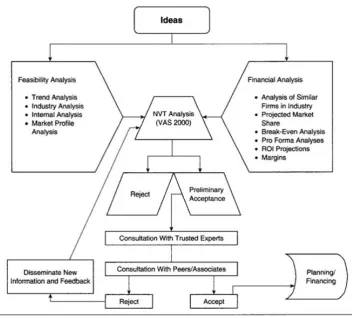
[image:29.595.109.462.404.722.2]Again, this information is useful in determining why certain individuals develop successful opportunities and others don’t, but it doesn’t prescribe how entrepreneurs evaluate opportunities. Morse & Mitchell have developed a model for evaluating business opportunities. Their version of opportunity evaluation consists of a feasibility analysis, and a financial analysis, or viability analysis.
The feasibility analysis consists of a PEST analysis, an industry analysis, an internal analysis and a market profile analysis. The viability analysis includes looking at similar firms in the industry, projecting market share, margin, break-even point, etc.
The next step in their opportunity analysis model is to combine the results of both analyses to project the success of the proposed venture. They suggest to do this by answering 15 questions about the opportunity. A list of these questions is added in appendix I. If the answer to any of the questions is no, do not go on, but review the information and (partially) redo the analysis. If the answers to all questions is yes, continue to consulting peers/associates or experts. If that proves the idea to be favorable, move on to the planning, etc. This is called their New Venture Template (NVT).
While these variables (risk, ROI, Break even point, etc.) typically arise in many models for evaluating business opportunities, there is no generally accepted list of criteria (how much risk is tolerated, how much ROI, when to break even, etc.) for use in forecasting business success or failure (Lussier, 1995). Bouwman et al. describe some critical success factors, and use terms like acceptable, clearly defined and sustainable (Bouwman, Vos, & Haaker, 2008), which are terms that need to be specified for each opportunity. Therefore, no prescribed checklist can be used to evaluate business opportunities and the criteria to which business opportunities should meet should be defined with regard to the environment of the opportunity, and the preferences of the entrepreneur.
McGrath & MacMillan agree with this and indicate that the entrepreneur should develop screening-in and screenscreening-ing-out criteria that are consistent with their defscreening-inition of which kscreening-ind of opportunity to develop. Screening out are “drop dead” if a proposal has that characteristic. Screening-in criteria are “the more the merrier” (Gunther McGrath & MacMillan, 2000).
Literature presents a fairly commonly accepted method of opportunity evaluation. Morse & Mitchell’s model has all the elements in it, so this model can be used for this research. This method (and the others for that matter) eventually result in a reject or an accept statement, so multiple business opportunities, that have been developed into detailed business models, and evaluated on their feasibility and viability can and will be accepted. Unfortunately, this model doesn’t rank business opportunities based on their relative attractiveness.
Since entrepreneurs develop business opportunities to create and deliver value for stakeholders (Ardichvili, Cardozo, & Ray, 2003) it would make sense to select the business opportunities that are expected to deliver the most value to its stakeholders. This research attempts to create additional user value, and therefore, the accepted business opportunities are developed into fully developed business models, and then a ranking is made based on their relative attractiveness, based on how much value is expected to be created, and what type of value this business opportunity creates.
2.4.3 Value and Revenue
31
What is value?
In order to do this, it’s important to define value, and to discover how to determine what customers and end-users value. Anderson and Narus (2004) define value in business markets as the worth in monetary terms of the economic, technical, service and social benefits a customer firm receives in exchange for the price it pays for a market offering. This definition has two elements that are fundamental to market offerings: value and price. Since the market offering takes place within a certain context, there is always a competitive alternative to the product or service that is offered. Therefore, the essence of the concepts of value can be captured in the fundamental value equation:
(valuef – Pricef) > (Valuea – Pricea)
Anderson and Narus define the outcome of value minus price the customer incentive to purchase. In this concept of value, raising or lowering the price doesn’t change the value of the offering. Rather, it changes the customer’s incentive to purchase that offering. The value offered has to exceed the price paid for a certain offering because if the price exceeds the value offered, the incentive to purchase would be negative, hence the offering will not be purchased.
Monroe (1990, from Woodruff (1997)) state that buyers’ perceptions of value represent a tradeoff between the quality or benefits they perceive in the product relative to the sacrifice they perceive by paying the price. This implies that the value of an offering does increase when the price of the offering is lowered. Both authors agree however that a reduction in the (perceived) purchasing price does increase the attractiveness of an offering to a customer.
The determination of value in monetary terms is argued (Monroe, 1990), (Woodruff, 1997), since not all aspects of a service can easily be expressed in money. However, since the value of the services a company will offer to its users is linked to its price through the process of transactions, customers have to consider the perceived value of the offering to be higher than the price they pay for that service, hence the value of the service is expressed in monetary terms. Therefore, this definition of value is suited for this research.
Anderson an