Development of Spatial Mental Representations
in an Embodied Artificial Neural Network
Using Sequential and Egocentric Data
Development of Spatial Mental Representations in an Embodied
Artificial Neural Network Using Sequential and Egocentric Data
Master thesis by Merijn Bruijnes
s0097519
17 August 2011
University of Twente
Faculty of Behavioral Sciences, Psychology
Department of Cognitive Psychology & Ergonomics
2 Acknowledgments
Writing this thesis was a very pleasant process for me, largely due to the support of all the people around me. I would like to thank a number of people in particular.
First, I would like to thank my supervisors, Frank van der Velde and Matthijs Noordzij. They were enthusiastic about my ideas and gave me free reign on the project. Without their help, this project would not have been successful and might not have finished in time. A special thanks to Frank, for being available during the weekend near the end of the project.
Next, I would like to thank a wonderful group of fellow students. I had a great time during the long days (and sometimes nights) were we studied together in our little office. Without your support, and the occasional coffee break, the completion of this thesis would have taken a long time and most importantly, would not have been as satisfying.
Other people helped me during the project, in various ways. My little brother, Florian Bruijnes, gave me a crash course in math, to revive my faded math skills. As I am no programmer, the programming part of the project benefited greatly from the help of Koos Mavrakis, who gave me some pointers when I was stuck. I am also very grateful to all the people that proofread (parts of) my thesis. Thanks to Gerrit Bruijnes (my dad), Eva Beltman, Alfons Laarman, and Lucas Meertens this thesis is of the current quality.
3 Abstract
4 Table of contents
1. Introduction ... 7
1.1 Psychology and artificial intelligence ... 7
2. Spatial Cognition ... 10
2.1 Psychology ... 10
2.2 Neuroscience ... 14
2.3 Artificial cognition ... 17
3. Neural network models ... 20
3.1 Neural networks ... 20
3.2 Spatial cognitive neural model for route information ... 23
4. Methods... 25
4.1 Modeling the neural network ... 25
4.2 The spatial environment ... 26
4.3 Training the network ... 27
4.4 Embodying ... 28
4.5 Lane keeping ... 31
4.6 Testing the network... 32
4.7 Network analysis ... 32
5. Results ... 34
5.1 Virtual results ... 34
5.2 Analog results ... 34
5.3 Network analysis ... 35
6. Discussion and conclusions ... 42
6.1 Theoretic demands from psychology ... 42
5
6.3 Model improvement ... 47
6.4 Embodied system ... 49
6.5 Practical implications and future directions ... 51
References ... 54
Appendix A: Dynamic field theory... 59
Appendix B: Artificial neural networking and back propagation ... 61
Appendix C: Guidance ... 65
Guide to MemBrain ... 65
Guide to code changes in BricxCC ... 68
Guide to Lego Mindstorms ... 69
Building guide to Wobot ... 72
Appendix D: Neural network in MemBrain ... 73
Appendix E: NXC code, algorithms ... 74
7 1. Introduction
Humans are very capable of finding their way in known and unknown environments. It is such a natural activity for most that they do not even pay much attention to the task. They just do and when they get lost, asking for directions generally solves the problem. A helpful passerby gives a sequence of directions and we are able to form an idea of where we are, where our goal is, and how to get there. It has been widely found that humans are very flexible in completing various route finding tasks (e.g. Noordzij, Zuidhoek & Postma, 2006). To complete such tasks, it is necessary to have some mental representation of the spatial information. However, the nature of the representations necessary for spatial tasks is still under debate (e.g. Burgess, 2006). This thesis tries to model such spatial representations in an artificial system.
In this chapter, I first explain why it is useful for psychology to investigate artificial systems performing human tasks. In the next chapter, an outline of the field is given, in order to show where hiatus are and how they might be filled. The third chapter ends with a description of an embodied artificial neural model that can perform a route-finding task.
1.1 Psychology and artificial intelligence
8 contemporary language (Hothersall, 2004, p.18). Behaviorism (focus on behavior), combined with some introspection, were the main psychologists tools for the bulk of the psychological history. It provided us with some great theories of mind, but was largely limited to behavior and did not reveal much of the inner workings of the brain.
10 2. Spatial Cognition
This chapter presents theoretical background on spatial cognition. The goal is to formulate a set of design constraints or guidelines for an artificial neural network. Psychological and neurobiological literature is discussed, after which some examples from artificial intelligence are presented.
2.1 Psychology
The cognitive mechanisms involved during navigation center on the creation, retrieval, and application of spatial representations. The factors involving differences between spatial representations were summed up aptly in four factors by Taylor, Brunyé, and Taylor: “The nature of […] spatial mental representations may vary as a function of at least the following: extent of experience […], nature of experience […], environmental scale and complexity […], and individual differences” (p.2, Taylor, Brunyé, & Taylor,
2008). These factors relate to human cognition. This thesis, however, will describe an embodied artificial neural model that can perform a route-finding task. Since the goal is to create an artificial system that is rooted in (human) cognition, these human factors will have to be taken into account.
11 independent of the observer, thus in object-object or location-location relations (e.g. Burgess, 2006; Zaehle, Jordan, Wüstenberg, Baudewig, Dechent, & Mast, 2007).
Burgess (2006), in an opinion piece, summed up behavioral data, which suggests that both representations are products of distinct systems. These two systems can operate separately but they can also cooperate. As an example of separation, experiments by Waller and Hodgson (2006) showed that the spatial cognitive system is able to switch between representations. They showed participants an array of objects briefly, then rotated the participant and asked them to point towards an object. An increase in pointing error variation occurred after 135° of rotation but not after 90° or less. According to the authors, this indicates a switch from one representation to another instead of a slow compromise of one representation (Waller & Hodgson, 2006). This seems to indicate that both systems can operate separately. However, the systems clearly have to work together. For more supporting empirical evidence, please refer to Wang and Spelke (2000) or Burgess (2006).
12 King, & O‟Keefe, 2001). This means that an artificial system that can form (only) egocentric representations is rooted in (neuro)psychological reality. However, it seems important for such an egocentric artificial system to be compatible with an allocentric artificial system (more on this in the discussion).
13 a spatial mental representation benefits if the spatial description is given in a familiar or consistent way.
To understand the flexibility of spatial mental representations further, it is important to consider the goals under which the representations are formed or used. Without a goal, one would be wandering around aimlessly. It might not be possible to not have a goal; even if one is wandering around aimlessly, it might be exactly the fulfillment of the goal „wandering around aimlessly‟. Also, consider the example given earlier; a mental spatial representation built from the description of a route or survey can be used to complete the same tasks (Noordzij, & Postma, 2005). During training, the goal might be composing an elaborate mental spatial model, for example with the intention to do well on a test. Later the spatial knowledge acquired might be used in fulfilling the goal of getting to a location as quickly as possible (e.g. Maguire et al., 2000). Goals seem sufficiently important to address them explicitly in the embodied artificial neural model, which is discussed later in this thesis.
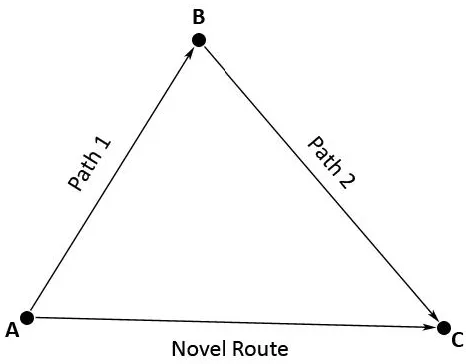
14 Figure 1: Three destinations (A, B, C). Two learned paths (A-B and B-C) leave one novel route to be discovered (A-C).
Summarizing, we can already specify some of the requirements the artificial neural network should meet. For the artificial neural network to be an approximation of how humans build and use spatial mental representations, it must:
(1) Consist of separate, but closely intertwined, systems for different spatial reference frames;
(2) Benefit from a spatial description given in a familiar or consistent way during training;
(3) Make use of goals in building and using a spatial mental representations; (4) Be capable of selecting familiar routes and computing novel routes.
2.2 Neuroscience
15 the representations required. Zaehle and colleagues (2007) investigated the difference between an egocentric and an allocentric frame of reference in an fMRI study. They found that the processing of egocentric spatial relations caused activation in the medial superior–posterior areas, whereas allocentric spatial coding seemed to require an additional involvement of the right parietal cortex, the ventral visual stream and the hippocampal formation (Zaehle, Jordan, Wüstenberg, Baudewig, Dechent, & Mast, 2007). This suggests that in the human spatial cognitive system the egocentric spatial coding only requires a subsystem of the entire processing resources needed for an allocentric spatial coding task. Note, however, that Zaehle et al. used novel spatial stimuli in their experiment.
Mellet et al. (2000) compared brain activation in route and survey navigation tasks, using pre-learned spatial information, with PET. It seems logical that route navigation would have an egocentric frame of reference, while survey navigation would use allocentric representations. They found that the tasks shared some brain activation, but also caused activation in distinct areas. The right hippocampus was active in both survey and route tasks, and therefore might hold the neural equivalent of a dual-perspective representation. During a route navigation task, additional activity was found in the parahippocampal gyrus. This suggests, this area is used when there are landmarks in the environment (Mellet et al., 2000). Similar results were found when imaging the active brain areas during mental replay of navigation (Ghaem et al., 1997).
16 task, while Mellet and colleagues (2000) asked participants to imagine navigating an environment. Therefore, the discrepancy might be due to the difference in task or a difference between learning and recovering spatial information.
Both findings, however, do seem to indicate that there are distinct, albeit closely related, systems for different forms of spatial information. In other words, there seems to be neuroanatomical evidence that egocentric and allocentric spatial information are processed in distinct areas of the brain. This gives some legitimacy to a model that is fairly specific for one spatial task (i.e., there might be different models for different tasks). However, a spatial model should be versatile and with minor adjustments or additions capable of performing different tasks.
The structure of the cortex, and that of the bordering hippocampi, is highly regular. There are distinct layers of neurons stacked on top of each other. Across these layers are small vertical columns spanning the layers. Both layers and columns are strongly intra- and interconnected. Further, neurons within a column generally have similar response characteristics and it is suggested that they operate as a (functional) group. Finally, similar cortical circuits are found all over the cortex (e.g. van der Velde, 2010). This pushes us further to try to find simple and versatile mechanisms of cognition that are like building blocks. One such neural circuitry building block might not be powerful enough to perform anything but the most basic form of cognitive operations, but more blocks together might show more complex computing power.
17 as a taxi driver correlated positively with posterior hippocampal volume. This coincides nicely with the idea that this area is responsible for storing spatial information about the environment (Maguire et al., 2000). It might also imply that the mechanism responsible for building and using spatial mental representations can recruit more neurons if necessary, which is of importance to keep our (artificial) mental model rooted in biology.
Summarizing we can specify some more requirements an artificial neural network should meet. In order for an artificial neural network to maintain a root in biology, it should follow these guidelines:
(5) The model can be (single) task specific;
(6) The model should have a simple mechanism to produce cognition; (7) These mechanisms should be like building blocks;
(8) It should be possible to change or combine these simple basic building blocks to change their function.
2.3 Artificial cognition
Now that it is clear what the spatial mental model and the artificial neural network should be able to do, it is time to review what artificial models are out there and which we might use. First, some descriptions of mental models are given and from these models, a spatial mental model that can represent route information emerges.
18 we also need to understand the mechanisms that generate them. To accomplish this we can try to model such mechanisms, while of course adhering to the constraints that came from psychological and neuroscientific research. Modeling cognition forces us to acknowledge factors that might have stayed hidden otherwise.
Many AI researchers stem from computer sciences and, therefore, often find symbolic, mathematic, and algorithmic solutions to model cognition. Such symbolic solutions can be very powerful, see for example the “Walter Simulation” by Ballard and Sprague (2006). Their modeled virtual character “Walter” is capable of a lane keeping task while avoiding obstacles and collecting collectables. They accomplished this by dividing a task into behaviors and each behavior into microbehaviors. Such microbehaviors can be accomplished by fairly simple programs. When more of such microbehaviors are combined, behavior that is more complex can be accomplished (Ballard & Sprague, 2006). Such studies show the success of a modular approach to cognition. Also, it gives further credibility to a model that tries to explain just one (or a few) aspect of cognition, which is exactly the scope of this thesis.
20 3. Neural network models
In this chapter, some existing artificial neural network models are discussed. A combination of existing models leads to a model that can learn and represent a route.
3.1 Neural networks
The most basic feed-forward neural network has two distinct layers, made up of input and output neurons respectively. Each neuron has a certain activation value, which is loosely related to the firing rate of a biological neuron. The neurons in the input layer are connected to the neurons in the output layer via synapses. Each synapse or connection has a certain weight, which is based on the strength of a biological synapse. The activation of each neuron is based on the activations of the neurons that have connections to it, and the weight of those connections. Often there is another layer of neurons, a hidden layer, between the input and output layer, with which the network can perform computations or integrate, extract or retrieve more complex forms of information. The activation of a neuron i is updated using the following formula:
Where the activation for neuron i (Acti) can be calculated by summing the activation of
all j neurons that have a connection to i with weight ij minus the resistance to activation change by neuron i (ActThresi). This value is put into a logistic function with β as slope
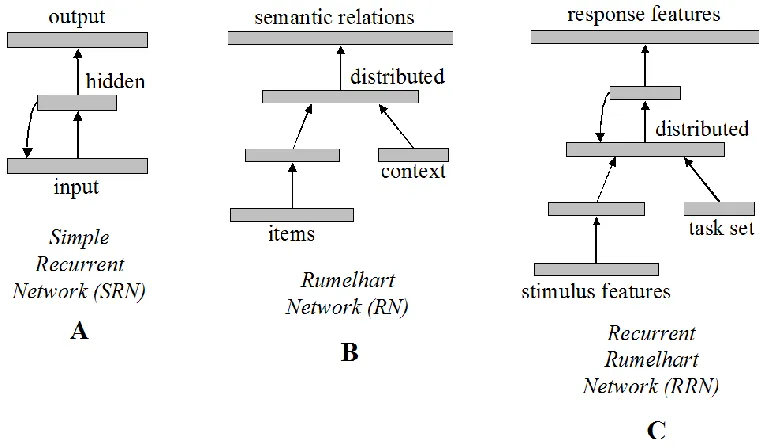
21 Figure 2: A simple recurrent network (A), a Rumelhart network (B), and a Recurrent Rumelhart network (C).
A network designer can hardwire the way in which the neurons are interconnected and the weight of these connections into the network. Most feed-forward neural networks, however, employ back propagation as a learning mechanism. Back propagation is a method in which the error, the difference between the current output and the desired output, of a neural network is reduced by altering the (synaptic) connections between the neurons of the network (Hecht-Nielsen, 1989). For a more detailed description of neural networking, the math, and learning by back propagation refer to appendix B.
[image:23.612.116.496.73.296.2]22 (using back propagation) the simple recurrent network can 'predict' the next item in the sequence (Elman, 1991). This ability might be useful as a building block for route finding skills. The simple recurrent network could report the next step, the direction to turn, in a route that it knows. However, it cannot discriminate between (overlapping) routes.
23 A Rumelhart network (see figure 2 B) can represent context and as such it might discriminate between sequences, grammatical context, or perhaps routes as in our case. For example, in a language case the network could learn the difference between 'canary can fly' and 'canary has wings'. When the same input is given, 'canary', the network can distinguish between outputs „fly‟ or „wings‟ because of the context, either 'can' or 'has' (McClelland & Rogers, 2003). However, the Rumelhart network is not capable of learning sequential information (such as a route).
3.2 Spatial cognitive neural model for route information
24 possible to start midway in a learned route, as long as the „start‟ location is in one of the learned routes to the goal. Starting midway in a route comes with the additional constraint that the direction an embodied network (e.g. robot) is facing is compliant with the direction of the route.
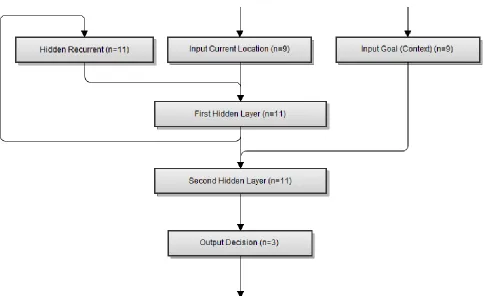
Now that an artificial spatial (route) neural model is presented (see figure 3), I will repeat the requirements stipulated earlier from the psychological and neuroanatomical review. The described neural network was embodied and tested against the requirements, see chapter 4. The results (chapter 5) are discussed in the discussion, chapter 6. In order for the artificial neural network to be a possible approximation of how humans build and use spatial mental representations, it must:
(1) Consist of separate, but closely intertwined, systems for different spatial reference frames;
(2) Benefit from a spatial description given in a familiar or consistent way during training;
(3) Make use of goals in building and using a spatial mental representations; (4) Be capable of selecting familiar routes and computing novel routes.
Moreover, in order for an artificial neural network to maintain a root in biology it should follow these guidelines:
(5) The model can be (single) task specific;
(6) The model should have a simple mechanism to produce cognition; (7) These mechanisms should be like building blocks;
25 4. Methods
In this chapter, a description is given of how the neural network was modeled, what it learned, and how it learned. Also, it is reported in what way the neural network was embodied and what tasks this embodied network performed. Finally, a description is given of the methods that were used to test whether the network could perform the task and how it could perform the task. The results of these tests can be found in the next chapter. The results are discussed in chapter 6.
4.1 Modeling the neural network
26 level. More on the training of the network later, first the spatial environment that was taught will be discussed.
4.2 The spatial environment
The (embodied) network will navigate a grid-like maze. For this thesis a maze with nine intersections or positions was used, however an arbitrary number of positions can be used if enough neurons are available in the neural net. Intersection, position, and location are used as synonyms throughout this thesis. Each position has a number and positions double as destinations. As the (embodied) network traverses through the maze, it makes a turning decision at each intersection (even if there is only one possibility). Thus, a route (e.g. to P5) consists of a sequence of positions (e.g. P1, P4, P7, P8, P5) with the
[image:28.612.241.375.405.564.2]corresponding directions to turn (e.g. straight, straight, right, right).
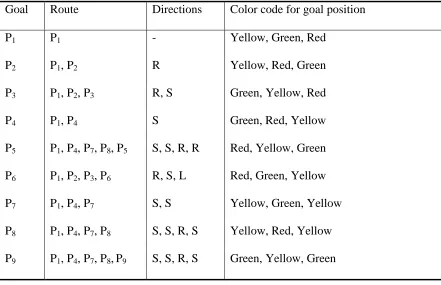
27 Table 1: The routes to the various goals and the corresponding directions at the positions during the route (S = straight, R = right, and L = left). Also, the color code for each goal/position is shown.
Goal Route Directions Color code for goal position
P1 P1 - Yellow, Green, Red
P2 P1, P2 R Yellow, Red, Green
P3 P1, P2, P3 R, S Green, Yellow, Red
P4 P1, P4 S Green, Red, Yellow
P5 P1, P4, P7, P8, P5 S, S, R, R Red, Yellow, Green
P6 P1, P2, P3, P6 R, S, L Red, Green, Yellow
P7 P1, P4, P7 S, S Yellow, Green, Yellow
P8 P1, P4, P7, P8 S, S, R, S Yellow, Red, Yellow
P9 P1, P4, P7, P8,P9 S, S, R, S Green, Yellow, Green
Further, in this particular case each route started at the same position, at the X in figure 4. Some “roads” were closed to decrease the complexity of the maze, as fewer routes are possible, see figure 4. Also, this ensures that the routes are highly overlapping. A route was constructed to each location, see table 1 for all the routes and their corresponding directions.
4.3 Training the network
[image:29.612.85.526.154.439.2]28 current output and the desired output, of a neural network is reduced by altering the (synaptic) connections between the neurons of the network (Hecht-Nielsen, 1989). Before training starts, the weights of the links in the untrained network are randomized. In training, there are two phases for each stimulus, the feed forward and the back propagation. The first input of a sequence is presented as input to the network. The network feeds this input forward and produces an output, which is likely to be far from the desired output. This difference between desired and actual output is designated as the error. Next, the contribution to the error is calculated for each neuron in the previous layer and the weight of its connection is altered accordingly. This back propagation of error is carried out for each layer in the network. When the back propagation is complete, the next item in the stimulus set is presented as input and the cycle repeats (cf. appendix B, Hecht-Nielsen, 1989).
Back propagation is a powerful learning tool. However, presenting the entire set of stimuli once is often not enough to get a well-trained network, especially if the stimulus set is large. After little training, the network will continue to make errors. It is difficult to predict how many training cycles are necessary to get adequate network performance. This is solved by setting an error level that the network has to reach. Training continues until this level is reached. The time (amount of training cycles) to reach the desired error level varies, as the network is randomized before training.
4.4 Embodying
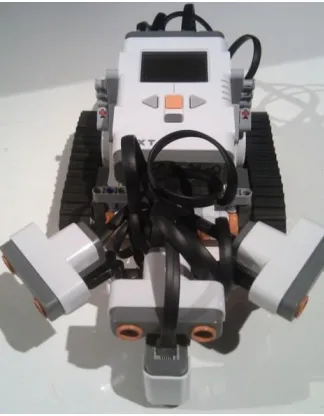
29 with this platform, see figure 5, was named Wobot (Wayfinding Robot). The processing power and memory of the platform is limited therefore, it was not feasible to teach the neural network using the processor in the robot. This means Wobot cannot drive around and learn new things. It was also considered whether a Bluetooth link to a PC could be used to exchange real-time sensor data from the robot to the neural network and issue real-time motor commands from the network to the robot. Such a real-time link proved very troublesome, so a more proof-of-concept approach was taken. Please refer to the appendix C for a more detailed description of the Mindstorms platform and its limitations (also cf. Toledo, 2006). The neural network was trained on a PC and the trained network was uploaded to the robot. Thus, to teach Wobot a new route a new (trained) network has to be uploaded. The robot is capable of supplying the network with sensor data and computing the output of the network. The network output, in turn, influences Wobot‟s motors. This cycle was real-time. The exact procedures of uploading a neural network, along with the programming code used to embody the network, can be found in appendix C, E, and F.
30 to ambiguity as some colors are assigned to more than one location. This was solved by using a three-color barcode that identifies a location, see figure 6 and table 1. As you can see from figure 6, red looks more like pink, this is intentional and because the color sensor detected red more reliable, if the actual color was pink rather than red. A signaling color (white) was used as a signal in the software that a route was coming up; this means that if the sensor detected the signaling color the robot would start keeping count of what colors it saw. When the signaling color was detected again, the color code was finished and the code could be looked up. The resulting location was fed to the neural network to get a direction. In addition, the signaling color prevents interference from the color of the ground, as the ground color might be used in a color code.
[image:32.612.226.388.347.555.2]31 Figure 6: A photograph of one of the intersections (P5) in the real world maze.
Figure 7: The simple neural network that handles lane keeping. The distance sensors provide input to the top three neurons. The input neurons feed into a hidden layer of some (four) neurons. The hidden layer feeds the two output neurons, which drive their respective motor.
4.5 Lane keeping
[image:33.612.227.386.254.420.2]32 left distance sensor detects decreasing distance, the right motor is slowed down, thus turning right. Lane keeping did is switched off during a turn and switched back on when the turn is complete.
4.6 Testing the network
Testing whether the neural network architecture works (after training) can be done virtual, by presenting input to the network and check whether the output is as expected. Also, it is possible to test analog, embodied, in the real world. Both ways of testing were done, albeit an analog test was executed only with one version of the neural network (as a proof of concept). The results of the tests are presented in the results chapter.
4.7 Network analysis
The successful completion of the tests shows whether a neural network has managed to build some representation with which it can solve the spatial navigation task. It is more interesting, however, to see how the network managed to solve its task. To reiterate the point made in the introduction, in order to understand cognition it is necessary to understand the mechanisms behind cognition. One way to approach this is to understand the way in which an artificial neural network managed to solve a task. The solution to a task an artificial neural network found might not at all resemble the way a biologic neural network solves the same task. Nonetheless, investigating the artificial neural network can give us an idea how a biological system might work.
33 activation of the (hidden) neurons can be scrutinized for every (environmentally) possible input. This shows how all possible states are represented in the network. However, simply looking at the hidden neuron activation patterns might not reveal much, as this would be a diagram with as many dimensions as hidden neurons. Therefore, I conducted a rotation of the axes of the dimensions, using principal component analysis (PCA). This technique can be used to find the axis along which the most variance occurs. This means that it can reveal the structure of the data as it is represented in the neural network (see also Elman, 1991, & Kutner, Nachtheim, Neter, & Li, 2005).
34 5. Results
In this chapter, the results are summed up. The results are discussed in detail in the next chapter.
5.1 Virtual results
For the current spatial neural network, an error level of 1e-7 was reached after about 100 training cycles. This training provided already adequate network performance. The maximum error level for the network in this thesis, however, was set to 1e-10, which generally took over 6.000 training cycles to reach. The 1e-10 threshold was chosen as it makes errors during testing extremely unlikely. Also, because processing power was not an issue. No errors were found, the network performed perfectly accurate on all learned routes.
5.2 Analog results
The spatial neural network performed equally well in the embodied environment. There were many instances where the robot provided erroneous data to the network, which led to a failure to reach the goal location.
35 platform). Whenever the color sensor worked appropriately, however, Wobot was consistently able to find its way in the maze.
5.3 Network analysis
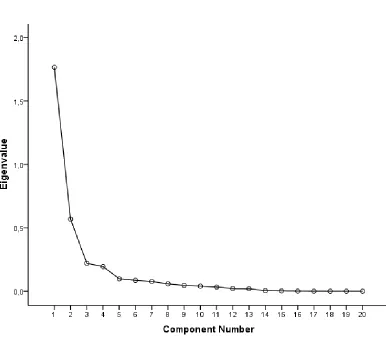
[image:37.612.119.505.269.609.2]The PCA of the spatial neural network revealed 20 components from which four are relevant, see figure 8. The four relevant components combined, explain 84,9% of the variance.
36 The four relevant components were investigated using component plots of the factors, figures 9, 10, 11, and 12. In such plots, each factor is noted as a point along the component scale. Each factor, or instance, represents a decision point along a route. This means that destinations are not shown in the figures, as these require no further action by the network. Names of the instances were constructed as follows: the goal location _ the name of the position along the route _ the rank in the route and the direction to turn at this position (L = left, S = straight, and R = right). This makes it relatively easy to interpret what the components encode.
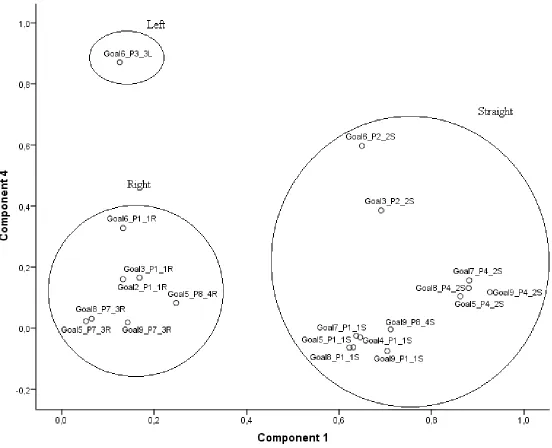
Component 1 seems to encode for the decision to go straight versus turning, as all straight instances score above 0.6 on the scale, see figure 9. Right and left turns are scoring below 0.3.
Component 2 is not so easy to interpret. It seems to encode for location 1 versus other locations, as all location 1 instances score above 0.6 on the scale, see figure 10. However, in combination with other components, for example component 3, it is possible to see a clustering of most locations, see figure 10.
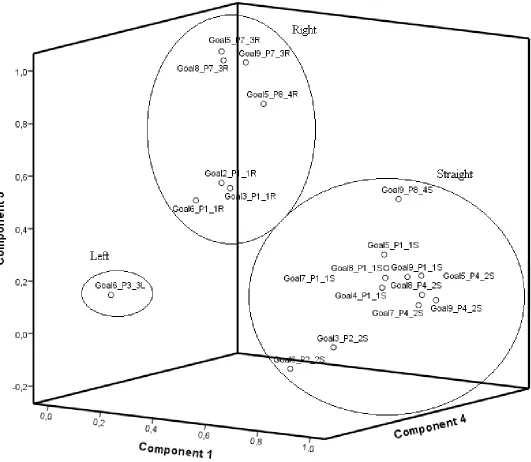
Component 3 seems to encode for the right turns. All right turn instances are scoring above 0.4 on the components‟ scale. However, so does one instance where the decision is straight (i.e. Goal9_P8_4S), see figure 10.
37 is required to go straight (S) here. The interesting thing is, however, that the instance that will follow Goal6_P2_2S will require the network to go left and that the P2 instance seems to represent this. The instance is scoring higher on component 4, which encodes for a left turn.
42 6. Discussion and conclusions
First, in this chapter the theoretical demands, which became apparent in the introduction chapter, are recapitulated to discuss the success of the neural network model. Second, some possible improvements to the current neural network model are discussed, and some alternative neural networks are proposed. A preliminary analysis of these alternative networks is described. Third, the embodied network and the robotic platform used are discussed and possible improvements are mentioned. Finally, this chapter discusses future directions for spatial artificial neural models and the current model in particular.
6.1 Theoretic demands from psychology
The introduction summed up some demands that a spatial artificial neural network should meet to be rooted in psychology. First, these points are repeated, and then the results of the current network are viewed in light of these points. For the artificial neural network to approximate how humans build and use spatial mental representations, it must:
(1) Consist of separate, but closely intertwined, systems for different spatial reference frames;
(2) Benefit from a spatial description given in a familiar or consistent way during training;
(3) Make use of goals in building and using a spatial mental representations; (4) Be capable of selecting familiar routes and computing novel routes.
43 frames (1). It is difficult to investigate this with the current network, as it does not have the capability to understand or express anything allocentric. The network is fed spatial information with an egocentric frame of reference (current location) and produces egocentric spatial information (turn decisions). The network performs well with this egocentric task. Interestingly, the PCA revealed that the network did form a representation that seems compatible with the basis of an allocentric representation of the maze, see figure 12. Clustering of locations was observed. In itself, this is not enough to form an allocentric representation. The crucial difference between an egocentric and an allocentric spatial representation is the way in which the relation between the objects is represented. The egocentric perspective represents all locations relative to the self, in other words, to the current location. The allocentric frame of reference represents a spatial environment in object-object relations. In our case, this would be location-location relations. To form location-location relations, the network needs to represent locations separately. This is accomplished to some extent already, as shown by the clustering of locations in figures 10 and 12. However, to form an allocentric representation, it is also necessary to form some sort of relation between the locations.
44 relation between the two locations (P2 and P3) and their relative turning decisions. This is a consequence of the sensitivity for sequential information of this network, as it has a recurrent loop (Elman, 1991). It is possible to interpret this effect as a preparation effect, a preparation or expectation to go left shortly. However, it is also possible to interpret this as a location-location relation or an emerging allocentric representation.
Humans seem to benefit from a consistent frame of reference when learning spatial relations (2). As of yet, this is not possible to test with the current neural network, as it can only be fed (and thus learn) egocentric relations. Even if there is a hint at different frames of reference in the spatial representation, the network cannot express such knowledge. Thus, multi-frame of reference information would remain implicit. Therefore, whether an artificial neural network would benefit from a consistent frame of reference can only be investigated if such a network can understand and express different frames of reference.
The use of goals in the network (3) was implemented successfully. The network consistently reached the goal. In addition, it was tested whether an artificial neural network could learn overlapping routes without the aid of goals. This was not possible, without the goals, the network was not able to discern between routes. That meant that at a choice intersection, the network „chose‟ the direction that occurred most often in the learned set.
45 location 5 would be P1, P2, P5. Not surprisingly, the network was unable to find such alternate routes. It did not have any information to infer that this would be possible. To make this possible, the network needs to know that P2 and P5 are adjacent.
In an informal follow up experiment, only the routes to each possible „end point‟ were taught to the network (the routes to P5, P6, and P9), see figure 4. The network was able to get to each of these locations, following the learned route. However, the network was not able to reach the locations in between the „end points‟. Therefore, it seems that the network had not induced the other locations as possible goals. Concluding, it seems unlikely an artificial neural network such as the current network, will be able to compute novel routes.
Summarizing, of the demands that came from the psychology literature, demands 1 and 3 were implemented successfully in the current mental model. The neural network was devised with egocentric representations in mind. It was fed only egocentric information, yet it managed to form a representation that hinted at an emerging allocentric representation. In addition, the use of goals was implemented successfully and goals were found to be instrumental to distinguish between overlapping routes. Novel route finding is not a capability of this network. Finally, the benefit of frame of reference consistency was untestable, as the network was not able to express itself in other frames of reference than the egocentric frame.
6.2 Theoretic demands from neurophysiology
46 current network is reviewed in light of these points. In order for the artificial neural network to maintain rooted in biology, it should follow these guidelines:
(5) The model can be (single) task specific;
(6) The model should have simple mechanisms to produce cognition; (7) Such mechanisms should be like building blocks;
(8) It should be possible to change or combine these simple basic building blocks to change their function.
First, point (5) is not really a demand; it is more of an allowance. The network was able to perform a route navigation task only. A next generation of this artificial neural model should have more abilities. For example, it should have the ability to learn and express different frames of reference. Many additions to the current network can be envisioned, which brings us to the next neurobiological specifications.
The current neural network was constructed from several building blocks (7). Primary building blocks are the input, output, and hidden layers, which make up many neural networks. These building blocks are simple (6) and can be combined in many ways (8).
47 best of our knowledge, no other integration of a recurrent and a contextual network exists at this moment.
6.3 Model improvement
Clearly, there is room for improvement to the current network model. In this section, ideas for improving the current model are discussed. As mentioned earlier, the network was not able to infer novel routes. Informal analysis showed this is not possible with the current neural network (see discussion of point (4) earlier). This did not come as a surprise, because with the data the network had available, even humans would unlikely infer novel routes. Foo et al. (2005) found that humans were able to infer novel routes only when landmarks were available. Therefore, it seems logical that some form of landmark recognition is needed in the artificial mental model, before novel route finding can be expected.
The current model could only handle a situation in which the starting location was known. From this starting position (the X in figure 4), each location taught, was reachable. This was also true if the robot started at an intermediate location on the route, as long as the direction the robot was facing was as prescribed by the route. If, for example, we would put the robot in front of location 3, it would not be able to reach any location other than location 6. Moreover, this would only work if the robot was facing in the correct direction, between locations 2 and 3 and towards location 3 (see figure 4). This is of course a serious limitation and should be improved in a future model.
48 explicitly aware of where it was before, in addition to where it is now. In this manner, it should be possible to infer the direction of travel. Considering the maze (figure 4), for example, if the current location is 3 and the previous location was 2, it can be inferred we are traveling „east‟. If such a system is implemented, it is possible to find any goal location, provided a route towards the goal was learned. The robot could wander around randomly, until it recognizes a piece of the route (or the goal itself). Once the robot is on the route to the goal, to reach the goal the route can be followed.
49 Figure 13: A preliminary neural network model that might eventually be able to start anywhere in a maze and still get to its specified goal. Both previous and current location are presented as input.
6.4 Embodied system
[image:51.612.66.563.73.419.2]51 Figure 14: The neural network model is capable of predicting the next location in a route, in addition to the direction to turn in order to get there.
6.5 Practical implications and future directions
[image:53.612.51.568.83.405.2]52 it did not visit for a long time and use the network to navigate there. Especially in combination with the ability to learn new environments on its own, this could be a application.
Another application lies in combining several artificial neural networks, to create machines that can display more elaborate and complex behavior. There is a very wide array of artificial neural networks with different functions out there. A route-finding network like the current network, combined with a visual recognition network might yield a system for, for example, search tasks where route information is vital. In particular, after a disaster, it can be useful to have small robots search the rubble of a collapsed building for survivors. It might be possible to get the robots to deliver vital supplies, such as water, to the survivor, sustaining them while they wait for rescue workers to reach them.
53 to avoid collisions. This lane-keeping network was completely independent from the route-finding network, however.
54 References
Ballard, D., & Sprague, N. (2006). Modeling the brain‟s operating system using virtual humanoids. International Journal of Pattern Recognition and Artificial Intelligence, 20 (6), 797-815.
Bechtel, W., & Abrahamsen, A. (2001). Connectionism and the mind: an introduction to parallel processing in networks. Blackwell Publishers.
BricxCC. (2011). Version 3.3.8.10, downloaded March 2011 via http://bricxcc.sourceforge.net.
Brunyé, T.T., Rapp, D.N., & Taylor, H.A. (2008). Representation flexibility and specificity following spatial descriptions of real-world environments. Cognition, 108, 418-443.
Burgess, N. (2006). Spatial memory: how egocentric and allocentric combine. Trends in Cognitive Sciences, 10 (12), -551-557.
Burgess, N., Becker, S., King, J.A., & O‟Keefe, J. (2001). Memory for events and their spatial context: models and experiments. Philosophical Transactions of the Royal Society B: Biological Sciences, 356 (1413), 1493-1503.
Cocude, M., Mellet, E., & Denis, M. (1999). Visual and mental exploration of visuo-spatial configurations: Behavioral and neuroimaging approaches. Psychological Research, 62, 93–106.
Denis, M., & Zimmer, H.D. (1992). Analog properties of cognitive maps constructed from verbal descriptions. Psychological Research, 54, 286-298.
55 Egmont-Petersen, M., de Ridder, D., & Handels, H. (2001). Image processing with neural
networks--a review, Pattern Recognition, 35 (10), 2279-2301.
Elman, J.L. (1991). Distributed representations, simple recurrent networks, and grammatical structure. Machine Learning, 7, 195-225.
Erlhagen, W., Bastian, A., Jancke, D., Riehle, A., & Schöner, G. (1999). The distribution of neuronal population activation (DPA) as a tool to study interaction and integration in cortical representations. Journal of Neuroscience Methods, 94, 53-66.
Foo, P., Warren, W.H., Duchon, A., & Tarr, M.J. (2005). Do humans integrate routes into a cognitive map? Map- versus landmark-based navigation of novel shortcuts. Journal of Experimental Psychology: Learning, Memory, and Cognition, 31 (2), 195-215. Ghaem, O., Mellet, E., Crivello, F., Tzourio, N., Mazoyer, B., Berthoz, A., & Denis, M.
(1997). Mental navigation along memorized routes activates the hippocampus, precuneus, and insula. NeuroReport, 8, 739-744.
Grossberg, S. (1980). Biological competition: Decision rules, pattern formation, and oscillations. Proceedings of the National Academy of Sciences (USA), 77, 2338-2342. Hecht-Nielsen, R. (1989). Theory of the backpropagation neural network. Neural
Networks, 1989. IJCNN., International Joint Conference, 1, 593-605.
HiTechnic. (2011). NXT Color Sensor Version 2 for LEGO MINDSTORMS NXT, downloaded June 2011 via:
http://www.hitechnic.com/cgi-bin/commerce.cgi?preadd=action&key=NCO1038 Hothersall, D. (2004). History of Psychology, Mc Graw Hill Companies, New York. Kutner, M.H., Nachtsheim, C.J., Neter, J, & Li, W. (2005). Applied Linear Statistical
56 Lipinski, J., Sandamirskaya, Y., & Schöner, G. (2009). Swing it to the Left, Swing it to the Right: Enacting Flexible Spatial Language Using a Neurodynamic Framework. Cognitive Neurodynamics 3(4), 1-39.
Maguire, E.A., Gadian, D.G., Johnsrude, I.S., Good, C.D., Ashburner, J., Frackowiak, R.S.J., & Frith, C.D. (2000). Navigation-related structural change in the hippocampi of taxi drivers. PNAS, 97 (8), 4398-4403.
Mayerich, D., Abbott, L., & McCormick, B. (2008). Knife-edge scanning microscopy for imaging and reconstruction of three-dimensional anatomical structures of the mouse brain. Journal of Microscopy, 231, 134-143.
Mellet, E., Bricogne, S., Tzourio-Mazoyer, N., Ghaëm, O., Petit, L., Zago, L., Etard, O., Berthoz, A., Ma-zoyer, B., & Denis, M. (2000). Neural Correlates of Topographic Mental Exploration: The Impact of Route versus Survey Perspective Learning. NeuroImage, 12, 588-200.
MemBrain. (2010). Version 03.06.02.00, downloaded January 2011 via www.membrain-nn.de.
Noordzij, M. L., & Postma, A. (2005). Categorical and metric distance information in mental representations derived from route and survey descriptions. Psychological Research, 69, 221-232.
Noordzij, M.L., Zuidhoek, S., & Postma, A. (2006). The influence of visual experience on the ability to form spatial mental models based on route and survey descriptions. Cognition, 100, 321-342.
57 Rogers, T.T., & McClelland, J.L. (2008). Précis of Semantic Cognition: A Parallel
Distributed Processing Approach. Behavioral and Brain Sciences, 31, 689-714. Ruini, F., Cangelosi, A., & Zetule, F. (2009). Individual and cooperative tasks performed
by autonomous MAV teams driven by embodied neural network controllers. Proceedings of international joint conference on neural networks.
Schöner, G. (2006). Dynamical systems approaches toward cognition. In R.Sun (Ed.), Cambridge handbook of computational psychology (pp. 101–126). New York: Cambridge University Press. Downloaded from: http://fog.its.uiowa.edu/~icdls/dft-school/documents/DFT_Publications/cambridge_chapter_schoner.pdf
Taylor, H.A., Brunyé, T.T., & Taylor, S.T. (2008). Spatial Mental Representation: Implications for Navigation System Design. Reviews of Human Factors and Ergonomics, 4, 1-40.
Toledo, S. (2006). Analysis of the NXT Bluetooth-Communication Protocol. Retrieved February 10, 2011, from http://www.tau.ac.il/~stoledo/lego/btperformance.html van Gelder, T., & Port, R.F. (1995). It‟s about time: An overview of the dynamical
approach to cognition. In: Mind as motion, ed. R. F. Port & T. van Gelder, 1-44. MIT Press.
van der Velde. F. (2010). Where Artificial Intelligence and Neuroscience Meet: The Search for Grounded Architectures of Cognition. Advances in Artificial Intelligence, 2010, 1-18.
58 Wang, R.F., & Spelke, E.S. (2000). Updating egocentric representations in human
navigation. Cognition, 77, 215-250.
Wang, R.F., & Spelke, E.S. (2002). Human spatial representation: insights from animals. Trends in Cognitive Sciences, 6 (9), 376-382.
Zaehle, T., Jordan, K., Wüstenberg, T., Baudewig, J., Dechent, P., & Mast, F.W. (2007). The neural basis of the egocentric and allocentric spatial frame of reference. Brain Research, 1137, 92-103.
59 Appendix A: Dynamic field theory
In this appendix, I discuss another way to model (neural) representations, dynamic fields. The discussion given in this appendix is far from complete. It is meant to show that there are other mental modeling techniques out there. It is wise to keep an open mind to alternative ideas and techniques, even if they are not utilized.
Dynamic fields are mathematical representations of the activation distributions such as found using brain imaging techniques like EEG or fMRI on the working brain. Dynamic field theories have many „synonyms‟ like dynamic systems (e.g. Schöner, 2006), dynamical hypothesis (e.g. van Gelder, & Port, 1995), neural dynamics (e.g. Grossberg, 1980; Lipinski, Sandamirskaya, Schöner, 2009), and population coding (e.g. Erlhagen, Bastian, Jancke, Riehle, & Schöner, 1999). Dynamic field modeling is a technique that generally does not model individual neurons; it models activation of areas. Such activation is explained as a competitive system in which neurons compete for activation by local excitation and global inhibition. This local excitation and global inhibition makes local peaks grow stronger while inhibiting peaks further away. It then becomes a competition between peaks, the peak with the highest (external or initial) excitation wins and (completely) inhibits the other peaks, see figure A1. The resulting activation peak, for lack of a better word, represents a certain input or answer to a computation (Schöner, 2006). Such an activation peak is not that different to a certain activation pattern in an artificial neural network.
60 activations and that the dynamical fields describe the overall distribution of activation. Another way of putting it, dynamic fields use an „infinite‟ number of neurons to plot an activation pattern, while neural networks use a finite number.
61 Appendix B: Artificial neural networking and back propagation
The most basic feed-forward neural network has two distinct layers, made up of input and output neurons respectively. Each neuron has a certain activation value, which is related to the firing rate of a biological neuron. The neurons in the input layer are connected to the neurons in the output layer via synapses. Each synapse or connection has a certain weight, which is based on the strength of a biological synapse. The activation of each neuron is based on the activations of the neurons that have connections to it, and the weight of those connections. Often there is another layer of neurons, a hidden layer, between the input and output layer, see figure B1. A neural network can perform simple computations with an input and output layer. However, with a hidden layer (one or more), a network can compute, represent, integrate, extract or retrieve more complex forms of information. The activation of a neuron i is updated using the following formula:
With:
Where the activation for neuron i (Acti) can be calculated by summing the activation of
all j neurons (Actj) that have a connection to i with weight ij minus the resistance to
activation change by neuron i (ActThresi). This value is put into a logistic function with β
as slope constant (Hecht-Nielsen, 1989).
62 Figure B1: A simple feed forward network. Two input neurons in the input layer at the top, feed into two hidden neurons in the hidden layer, which feed into the single output neuron in the output layer at the bottom.
63 neural network is reduced by altering the weight of the (synaptic) connections between the neurons of the network (Hecht-Nielsen, 1989).
Often, learning starts with a randomization of all the weights. This insures that all connections have a value, which can be of importance in some programming languages. Next, each item in a training set is presented to the network. When the input layer of the network is stimulated in accordance with an item, the network calculates the activation of each neuron (using the formula described above). This feed forward phase will generate an activation for the output neurons that is likely incorrect. Thus, for every output neuron (u) there is a difference between desired output activation (du) and actual output
activation (au). The error of the entire network is calculated as follows:
When the error of network is found, the relative culprits to the error have to be found. In other words, the portion that each neuron contributes to the error has to be calculated in order to change the weight of the connection between the two neurons involved. The portion of error fed to the output neurons came from the hidden layer (one layer up). Therefore, the weight change necessary for all weights has to be calculated:
and
thus,
64 where
Now the input is traced back to the neuron in the layer above, in this case the hidden layer (h). First, calculate the portion of activation this weight contributed:
So, now finally it is possible to calculate the portion of error this weight contributed:
Now change of weight can be calculated using the Hebbian learning rule:
Where, lrate is the learning rate. Thus, the weight change is calculated:
Weight changes deeper in the network are calculated iteratively. This means that the delta for the hidden layer (deltah) nests the delta for the output layer (deltau):
For the three-layered network, as displayed in figure B1, the final weight change is calculated as follows:
65 Appendix C: Guidance
In this appendix, four guides are included. The programs used to create the neural network for this thesis are discussed first. Next, the code is discussed and it is explained how to update the current code with another neural net. For example, if a new spatial environment is learned. Next, the platform used to embody the neural network is discussed. Special focus is on the limitations of the platform. Finally, a building guide is included to recreate Wobot, the robot used in this thesis.
Guide to MemBrain
Modeling an artificial neural network with many neurons is not easy, especially if you want to test many different versions of a neural network model. Fortunately, there are off-the-shelf tools available that can assist in such a task. MemBrain Neural Network Simulator, version 03.06.02.00, is such a tool. It allows users to model, teach, test, and export neural networks of arbitrary size and architecture (MemBrain, 2011).
[image:67.612.111.499.571.649.2]MemBrain offers sufficient tutorials for novices to become acquainted with the program and its capabilities. Therefore, I will not describe how to create or teach a neural network. In order to use the trained neural network, it has to be exported. MemBrain can export a network in C code. Via the menu bar, code can be generated, see figure C1.
66 Figure C2: A very simple neural network in MemBrain. At the top, an input neuron (named 1) with activation 1 is visible. In the middle, the hidden neurons (2 and 3) are shown. At the bottom, output neuron (4) is visible. The weights are visible as the numbers on the lines between the neurons. The activation of the neurons is visible beneath the neuron.
The generated code for a very simple network, see figure C2, is located in a file named NeuralNetDef.c. Not shown in the figure are the activation thresholds of the hidden neurons, which are 0.22 for neuron 2 and 0.33 for neuron 3. The values of interest in this file look like this:
// additional parameters for all hidden neurons
const SHiddenNeuronParms NEURON_PARMS_HIDDEN[] = {
(FLOAT32)0.22, 0, 1, (FLOAT32)0.33, 1, 1 };
/// additional parameters for all output neurons
const SOutputNeuronParms NEURON_PARMS_OUTPUT[] = {
[image:68.612.222.395.72.296.2]67
/// parameters for all links
const SNeuralLinkParms NEURAL_LINK_PARMS[] = {
(FLOAT32)0.12, 0, (FLOAT32)0.13, 0, (FLOAT32)0.24, 1, (FLOAT32)0.34, 2 };
For the NXC compiler to understand this code, some modifications are needed. Refer to appendix F for the proper syntax. The parameters for the hidden neurons consist of three values; the activation threshold, and two values that are used in looking up the weights for the incoming links to this neuron. For example for neuron 2: we know it has an activation threshold of 0.22. We can look this up in the array and notice neuron two is described in the first line (i.e. 0.22, 0, 1). The first number is the activation threshold. The second number is the location of the first link in the array with link information (NEURAL_LINK_PARMS). The third number (1) is the amount of input links, and thus the amount of lines in the link-array that have to be read. Observing the first line in the NEURAL_LINK_PARMS array confirms this is correct. We can observe the correct weight (0.12) for the link to neuron 2. In addition, in this line we observe another number. This number corresponds to an input neuron. In our case this is 0, as the input neuron is the first neuron (and in computer languages it is common to start counting at 0). To confirm this, we can look at the second line in the links-array and see that the second number is also a 0, which is fortunate because the weight 0.13 corresponds to the other link to the input neuron.
68 some effort on my part to comprehend this exported code, but with the above (and perhaps some trial-and-error); it should possible for others to understand it readily.
Guide to code changes in BricxCC
The Lego Mindstorms brick can be programmed in Not eXactly C (NXC), which is a high-level language similar to C. NXC code can be compiled and uploaded to the brick using, BricxCC (BricxCC, 2011). For this thesis, the code was divided in two files; the algorithms (see appendix E) and the variables (see appendix F). The code in appendix E includes the 'task main', which starts all other tasks and sub routines. The code in appendix F is included at the top of the code in appendix E, effectively telling the compiler to start the byte-code with F and follow with E.
In most cases, changes in the code are done in appendix F only. For example, if the network learned new routes, the new exported network should replace the current network in the code. In addition, if the network layout has changed, values for the network layout in appendix F may have to be updated.
69 to the navigation. This navigation task holds the artificial neural network. The network generates a turning decision (left, right or straight). A left or right turn cannot be executed by the lane-keeping task, and thus a separate task turns the robot in the desired direction. If the turn is completed, or no turn was required, the control task restarts the lane-keeping task. This moves the robot forward, until another (new) location is found.
Guide to Lego Mindstorms
The Lego Mindstorms platform is a very sophisticated toy, but a toy nonetheless. Maybe as such, it has its limitations, most notably for this thesis, the color sensor. It was not very reliable and extremely sensitive to the distance to the object. As described in the thesis, the sensor had problems with determining the correct color (e.g., the sensor found pink more red that actual red). Also, the sensor would only operate correctly if it was exactly 2 mm above the colored surface. Any bump in the surface or vibrations as the robot drove along caused the distance between sensor and surface to change. This meant the sensor registered black or more sporadically a different, unpredictable color. Often, this made the robot unable to reach its destination. It got lost.
71 The Lego Mindstorms brick features a very limited amount of memory and little processing power. It has a 16 MHz processor and only 256 kilobytes of memory (shared storage and working memory). The processing and memory limits led to a pursuit of a setup in which the neural network could be run externally (on a PC). This would circumvent the limits of the brick and allow for online learning of the neural network.
72 Figure C4: The HiTechnic NXT Color Sensor Version 2 for LEGO MINDSTORMS NXT in a setup that shows its optimal positioning (HiTechnic, 2011).
Building guide to Wobot
I created a Lego building guide for the robot. The guide is not included here, as it is rather voluminous. It is available on Google Docs, via:
https://docs.google.com/viewer?a=v&pid=explorer&chrome=true&srcid=0B4oq088EBZ
73 Appendix D: Neural network in MemBrain
In this appendix, the route finding network as modeled using MemBrain (2011) is displayed. This neural network learned a set of routes and the necessary turning decisions at the various locations along each route. In the figure location 9 is the goal and the current location is 8, resulting in the output 'straight'. See figure D1 caption for more details on the network layout.
[image:75.612.41.589.240.475.2]74 Appendix E: NXC code, algorithms
The code used to embody the artificial neural network in the Lego Mindstorms robot is displayed in this and the next appendix. The code is organized in two appendices, because a differentiation was made between algorithms and variables. This appendix (E) contains all algorithms and the next appendix (F) contains all variables, including the variables for the neural networks. This means that someone who wants to change the weights of the neural network described in this thesis or the amount of neurons in the network, only makes changes to appendix F. If you wish to implement a different network, changes to the code described in this appendix might be necessary.
The code is written in Not eXactly C (NXC), which is a high-level language similar to C. It can be used to program the Lego Mindstorms NXT brick. NXC programs can be compiled and uploaded to the Lego Mindstorms brick using Bricx Command Center (BricxCC, 2011).
#include "include.nxc"
//using buttons to select goal, returns goal sub goalbutton()
{
TextOut(0, LCD_LINE1, "Select goal and"); TextOut(0, LCD_LINE2, "press start:"); goal = 1;//start at
while ( ButtonPressed(BTNCENTER, true) != true ) //wait for start {
ClearLine(LCD_LINE4); NumOut(0,LCD_LINE4, goal);
if ( ButtonPressed(BTNRIGHT, true) != false) //press right is +1 {
if (goal < aant_locations) //highest goal is number of locations in maze {goal++;
Wait(300);} else
75
else if ( ButtonPressed(BTNLEFT, true) != false) //left is -1 {
if (goal > 1) //lowest goal is 1 {goal--; Wait(300);} else } else } ClearScreen();
TextOut(0,LCD_LINE1, "Ok, going to"); NumOut(0,LCD_LINE2, goal);
Wait(1000); ClearScreen(); } //end goalbutton
//sensor can be called to renew sensordata (distance) sub sensor()
{
//what sensor on what port SetSensorLowspeed(IN_1); SetSensorLowspeed(IN_2); SetSensorLowspeed(IN_3);
//reading sensor values DistMid = SensorUS(IN_1); DistRight = SensorUS(IN_2); DistLeft = SensorUS(IN_3); } //end sensor
//sensorcolor can be called to update sensordata (color)
sub sensorColor() //extra steps because of noisy color sensor data {
SetSensorColorFull(IN_4); int sensorraw;
int ik =0;
while (true) //executes till new color is confirmed {
sensorraw = Sensor(IN_4); Wait(1);
if (sensorraw == Sensor(IN_4)) //true if after 1ms color is the same {
ik++; }