IJEDR1801149
International Journal of Engineering Development and Research (
www.ijedr.org
)
858
A Novel Query Adaptive Image Retrieval Framework
with colour Averaging Techniques
1Nishanth R. 2Abin John Joseph, 3Suryalakshmi .S 1,2Assistant Professor, CUCEK, Kerala 3Assistant Manager, Genpact, Bangalore
________________________________________________________________________________________________________
Abstract- The capacity of quick comparability picture look in light of visual similitude in an expansive scale dataset is of awesome significance to numerous sight and sound applications. In spite of the fact that hashing has been demonstrated successful for visual pursuit, among different hashing approaches semantic hashing (SH) has indicated promising execution. It quickens closeness seek, by outlining smaller paired codes for an expansive number of pictures with the goal that semantically comparable pictures are mapped to close codes. Recovering comparable neighbors is then basically refined by recovering pictures that include codes inside a little Hamming separation of the code of the inquiry. However in this strategy the memory usage and question execution time are the significant issues, so by proposing a consolidated arrangement of strategies in light of shading averaging system to accomplish higher recovery proficiency and execution. Right off the bat, a normal mean based strategy with lessened component measure is proposed. Also, a component extraction strategy in view of focal inclination is proposed. Analyses on a Flicker picture dataset demonstrate clear upgrades from this proposed approach.
IndexTerms— Picture, Semantic Hashing
________________________________________________________________________________________________________
I. INTRODUCTION
Image search is particular information seek used to discover pictures. To scan for pictures, a client may give question terms, for example, Watchword, picture document or connection, or tap on some picture, and the framework will return pictures "comparable" to the inquiry. The similitude utilized for seek criteria could be metatags, shading dispersion in pictures, area or shape traits, and so on. Picture meta look - inquiry of pictures in light of related metadata, for example, catchphrases, content, and so forth. Content-based image recovery (CBIR) – the use of PC vision to the picture recovery. CBIR goes for maintaining a strategic distance from the utilization of printed depictions and rather recovers pictures in view of similitudes in their substance (surfaces, hues, shapes and so forth.) to a client provided inquiry picture or client determined picture highlights.
1.1 PROBLEM STATEMENT
The blast of pictures on the Internet, there is a solid need to create systems for productive and adaptable picture seeks, while conventional picture web search tools vigorously depend on printed words related to the pictures, adaptable substance based hunt is getting expanding consideration. Aside from giving better picture look understanding to normal Web clients, vast scale comparative picture seek has additionally been exhibited to be extremely useful for settling various difficult issues in PC vision and media, for example, picture order. For the most part a substantial scale picture look framework comprises of two key segments a compelling picture highlight portrayal and an effective inquiry instrument. The nature of list items depends intensely on the portrayal energy of picture highlights. A productive inquiry component, is basic since existing picture highlights are for the most part of high measurements and current picture databases are immense, over which thoroughly contrasting a question and each database test is computationally restrictive. Pack of-visual-words (BoW) framework, where nearby invariant picture descriptors (e.g., SIFT) are removed and quantized in view of an arrangement of visual words. The BoW highlights are then implanted into conservative hash codes for proficient hunt. Best in class methods including semi-administered hashing and semantic hashing with profound conviction systems. Hashing is best finished tree-based ordering structures (e.g., kd-tree) as it by and large requires incredibly diminished memory and furthermore works better for high-dimensional examples. With the hash codes, picture closeness can be effectively estimated (utilizing legitimate XOR tasks) in Hamming space by Hamming separation, a whole number esteem got by checking the quantity of bits at which the twofold esteems are unique. In extensive scale applications, the measurement of Hamming space is generally set as a modest number to lessen memory cost and maintain a strategic distance from low review.
IJEDR1801149
International Journal of Engineering Development and Research (
www.ijedr.org
)
859
system, thus suggesting ideas for the improvement of the existing system. There are very good surveys on general image retrieval task. See Smeulders et al. [11] for works from the 1990s and Datta et al. [12] for those from the past decade. Many people adopted simple features such as color and texture in systems developed in the early years [13], while more effective features such as GIST [14] and SIFT [3] have been popular recently [2], [15]. In this work, we choose the popular bag-of-visual-words representation grounded on the local invariant SIFT features. The effectiveness of this feature representation has been verified in numerous applications. Since the work in this paper is more related to efficient search, this section mainly reviews existing works on efficient search mechanisms, which are roughly divided into three categories: inverted file, tree-based indexing, and hashing. Inverted index was initially proposed and is still very popular for document retrieval in the informational retrieval community
III. SYSTEM DESIGN
Systems design is the process of defining the architecture, components, modules, interfaces, and data for a system to satisfy specified requirements.
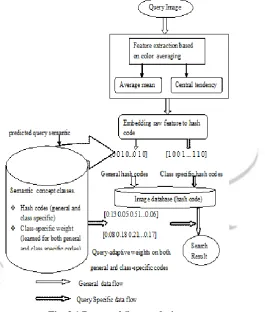
Fig. 3.1 Proposed System design
The overall design of the Query adaptive image retrieval system is shown in Fig.3.1. In the proposed system an image is given as query. The first step is feature extraction of the image, which mainly concentrate on the color feature. Then the average mean and central tendency of the color feature is calculated which reduce the color feature of the image. In the hash coding technique, Bag of Words is used, to split the extracted feature in to character manner in-order to calculate the hamming distance of query image .Relate to query image distance, the image is searched from the database. This method takes place by two hash code method. General hash code and Class specific hash code. Related to hamming distance, the appropriate image is retrieved from the image database ,then query adaptive weight is calculate for both hash code ,both code which generate different value, the class specific hash code generate better result than the general hash code . The minimum values are taken for retrieval which relate to hamming weight of query image. Such images are retrieved from the database and the results are generated according to the ranking of each image, as a retrieved image result.
3.1.1 system modules
IJEDR1801149
International Journal of Engineering Development and Research (
www.ijedr.org
)
860
1. Feature extraction based on color averaging 2. Embedding Raw Feature Of hash code 3. Query Adaptive Ranking
This extraction is done by two ways, a. Average Mean
b. Central Tendency
The Query adaptive image search can be done by using this module and are described below,
3.1.1.1 Feature extraction based on color averaging:
One of the fundamental operations of CBIR is feature extraction. In this work, color averaging based feature vector is used. It involves averaging the intensity values of row mean and column mean of an image. The advantage of taking average color as the feature vector is that, the complexity is minimum and the technique gives better performance with high precision and recall values compared to other efficient techniques.
3.1.1.2 Average Mean
Feature extraction is based on the combination of row mean, column mean and diagonal mean of a gray scale image .The size of feature vector is 3 for a gray scale image and features of an RGB image is extracted using a combination of row mean and column mean of an image. Here, the size of the feature vector is 6, which includes 3 features for row mean and 3 features for column mean which is given by,
Feature vector (Kekre) = [(Rrm,Rcm) (Grm,Gcm) (Brm,Bcm)] (1)
The size of feature vector plays a major role in optimization of algorithm. As the feature vector size is reduced, the memory space required for storing the feature vector also gets reduced. In order to reduce the dimension of the feature vector a new approach based on the mathematical property is proposed which states the average of row-mean or the average of column-mean of an mxn matrix results to be same.
RowMean= (2) ColumnMean= (3) Where,
Rm = row pixels, Cm = column pixel nr,nc = No.of rows and No. of Columns respectively.
The results obtained clearly show that average of row mean is same as average of column mean. Hence, the proposed mean technique with reduced feature vector, the feature vector is generated by considering the row mean alone.
Feature vector = [(Rrm Grm Brm)] (4)
It is important to note that, dimension reduction based on reduction in the size of feature vector from 6 features to 3 features does not significantly change the retrieval results. But with reduction in the dimension of feature vector greatly reduces the memory utilised for storing the image features in feature database. As the memory required for storing image features in feature database is reduced, the time taken to retrieve relevant images from image database also gets reduced. 3.1.1.3 Colour averaging techniques
A. All Image Coefficients
In this method all image pixels are considered as feature vector and Euclidean distance is used in RGB plane to find the best match, which is used to calculate precision and recall.
B. Row Mean of Image (RM)
In this method row mean of image is calculated as the feature vector and then Euclidean distance is used in RGB plane to find the best match, which is used to calculate precision and recall.
C. Column Mean of Image (CM)
Here feature vector is composed of column mean of image, calculated and then Euclidean distance is used in RGB plane to find the best match, which is used to calculate precision and recall.
D. Row & Column Mean of Image (RCM)
In this method row and column mean of image are considered together as feature vector and then Euclidean distance is used in RGB plane to find the best match, which is used to calculate precision and recall.
E. Backward Diagonal Mean of Image (BDM)
In this method backward diagonal mean of image is considered as feature vector and then Euclidean distance is used in RGB plane to find the best match, which is used to calculate precision and recall.
F. Forward Diagonal Mean of Image (FDM)
In this method forward diagonal mean of image is calculated and then Euclidean distance is used in RGB plane to find the best match, which is used to calculate precision and recall.
G. Forward & Backward Diagonal Mean of Image (FBDM)
IJEDR1801149
International Journal of Engineering Development and Research (
www.ijedr.org
)
861
--- (5) Where q=1, 2……10.
Finally, the average precision is given by:
--- (6) 3.1.1.4 Central Tendency
Median, mode, max and min are used to represent image data or information. They are collectively called as the measures of central tendency. These descriptive measures have bit differences from one another that play an important role in feature extraction. The mode is the most dominant pixel in the image. Median is a middle pixel from an ordered set of data that is in the middle of an image. Max and Min are the maximum and minimum intensity pixel in the image. The distance between the feature vector of query image and images in database is calculated using euclidean distance. An image with minimum distance is considered as better match and it is given by,
(7)
where and are the extracted features of database image and query image respectively with size ‘n’. IV. PERFORM ANCE MEASURES
The measure of performance used in image retrieval borrows from the field of information retrieval and are based on two primary figures of metric which is precision and recall. Precision is the number of relevant documents retrieved. Recall is the number of relevant documents in the database which should have been retrieved. Where A represent the number of relevant images that are retrieved, B, the number of irrelevant items and the C, number of relevant items those were not retrieved. The number of relevant items retrieved is the number of the returned images that are similar to the query image in this case. The total number of items retrieved is the number of images that are returned by the search engine. Precision can be interpreted as a measure of exactness, whereas recall provides a measure of completeness. A perfect precision score of 1.0 means that every retrieved image is relevant but it does not provide any insight as to whether all relevant documents are retrieved. A perfect recall score of 1.0 means that all relevant images is retrieved but says nothing about how many irrelevant images might have also been retrieved. Each query returns the top 10 images from database, and the calculated precision values using the equation 5, and average precision using equation 6 are given in the Tables. The average Precision value indicates the better retrieval results than others.
4.1 EXPERIMENTAL RESULTS
The proposed method has been implemented using Matlab 7.3 and tested on a general-purpose WANG database containing 1,000 images of the Corel stock photo, in JPEG format of size 384x256 and 256x386. The search is usually based on similarity rather than the exact match. The quality of the image retrieval has been evaluated by randomly selecting 10 query images, of each category, from the image database.
IJEDR1801149
International Journal of Engineering Development and Research (
www.ijedr.org
)
862
Fig.4.2 Browsing the Image
Fig.4.3 Selecting the query image
IJEDR1801149
International Journal of Engineering Development and Research (
www.ijedr.org
)
863
Fig.4.5 Selecting the number of image
Fig.4.6 Loading image in database
IJEDR1801149
International Journal of Engineering Development and Research (
www.ijedr.org
)
864
Fig.4.8 Loading the database
Fig.4.9 Database loading completion
IJEDR1801149
International Journal of Engineering Development and Research (
www.ijedr.org
)
865
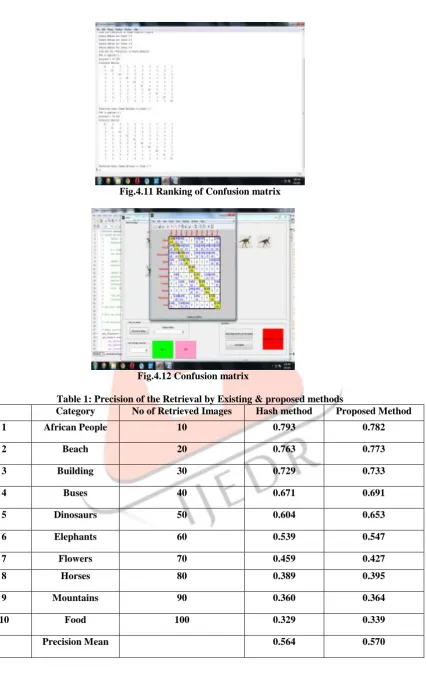
Fig.4.11 Ranking of Confusion matrix
Fig.4.12 Confusion matrix
Table 1: Precision of the Retrieval by Existing & proposed methods Classes
Category No of Retrieved Images Hash method Proposed Method
1 African People 10 0.793 0.782
2 Beach 20 0.763 0.773
3 Building 30 0.729 0.733
4 Buses 40 0.671 0.691
5 Dinosaurs 50 0.604 0.653
6 Elephants 60 0.539 0.547
7 Flowers 70 0.459 0.427
8 Horses 80 0.389 0.395
9 Mountains 90 0.360 0.364
10 Food 100 0.329 0.339
IJEDR1801149
International Journal of Engineering Development and Research (
www.ijedr.org
)
866
00.2 0.4 0.6 0.8
prec
isio
n
Catagory
Hash method
Proposed Method
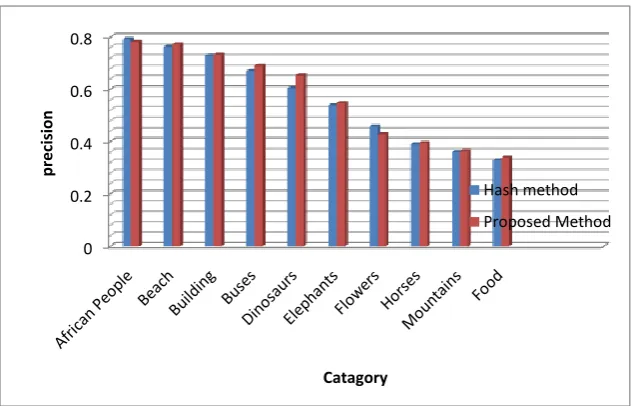
Chart 1: Precision of the Retrieval by Existing & proposed methods
Table 2: Recall of the Retrieval by Existing & proposed methods
Classes Category No of Retrieved Images Hash method Proposed Method
1 African People 10 0.207 0.241
2 Beach 20 0.229 0.266
3 Building 30 0.263 0.298
4 Buses 40 0.296 0.334
5 Dinosaurs 50 0.337 0.359
6 Elephants 60 0.379 0.311
7 Flowers 70 0.402 0.464
8 Horses 80 0.417 0.486
9 Mountains 90 0.434 0.516
10 Food 100 0.463 0.525
IJEDR1801149
International Journal of Engineering Development and Research (
www.ijedr.org
)
867
0 0.1 0.2 0.3 0.4
R
e
cal
l
catagory
Hash method
Proposed
Chart 2: Average Precision Recall values of Existing Method
For each query, we examined the precision of the retrieval, based on the relevance of the image semantics. The semantic relevance is determined by manual trotting the query image and each of the retrieved images in the retrieval. The precision values, calculated by using the equation 1 and also the average precision using the equation 2 are shown in Table 1. The query retrievals by the proposed method are shown in Simulation results,
with an average retrieval time as 1min. These results clearly show that the performance of the proposed method is better than the other methods.
IJEDR1801149
International Journal of Engineering Development and Research (
www.ijedr.org
)
868
Graph 2: Average Precision Recall values of Existing Method
V. CONCLUSION
So far numerous CBIR methods have been proposed. Yet, the scientists are till needing for better and quicker picture recovery arrangements. This undertaking has proposed a novel picture recovery method in light of shading averaging utilizing column COIL picture database with 1080 pictures. The test comes about have demonstrated that the shading averaging strategies beat the CBIR method utilizing all pixel information. In nonexclusive image database forward corner to corner mean gives most astounding accuracy and review hybrid esteem demonstrating best execution and all other proposed procedures perform superior to all pixel information. Indeed, even in COIL picture database push mean, segment mean, forward askew mean and in reverse corner to corner mean. The methods were tried on two diverse picture databases as nonexclusive picture database with 1000 pictures and procedure beats the all pixel information based CBIR. The troublesome undertaking of enhancing the execution of substance based picture recovery procedures with diminishment in time many-sided quality is accomplished here with help of shading averaging based strategies. By bridling a substantial arrangement of pre-characterized semantic idea classes, this approach can anticipate question versatile bitwise weights of hash codes progressively, with which list items can be quickly positioned by weighted Hamming separation at better grained hash code level. This capacity to a great extent mitigates the impact of a coarse positioning issue that is basic in hashing-based picture look. Test comes about on a broadly embraced Flicker picture dataset affirmed the adequacy of this proposition.
VI. REFERENCE
1. Bentley J. L, “Multidimensional binary search trees used for associa- tive searching,” Commun. ACM, vol. 18, no. 9, pp. 509–517, 1975.
2. Bronstein M.M, Bronstein A.M , Michel.F, and Paragios.N, “Data fusion through cross- modality metric learning using similarity-sen- sitive hashing,” in Proc. IEEE Conf. Computer Vision and Pattern Recognition, 2010. 3. Chum.O, Perdoch.M, and Matas.J, “Geometric min-hashing: Finding a (thick) needle in a haystack,” in Proc. IEEE Conf. Computer Vision and Pattern Recognition, 2009.
4. Datta.R, Joshi.D, Li.J, and Wang .J.Z, “Image retrieval: Ideas, influences, and trends of the new age,” ACM Comput. Surveys, vol. 40, no.2,
5. Hinton.G and Salakhutdinov.R, “Reducing the dimensionality of data with neural networks,” Science, vol. 313, no. 5786, pp. 504–507, 2006.
6. Huang.J, Kunar.S.R, Mitra.M, Zhu.W.J, and Zabih.R, 1997, “Image indexing using color correlogram”, in Proc. IEEE Comp. Soc. Conf. Comp. Vis. and Patt. Recog. pp.762-768.
7. Indyk.P,Goodman.J.E and Rourke.J.O, Eds., “Nearest neighbors in high-dimensional spaces,” Handbook of Discrete and Computa- tional Geometry. Boca Raton, FL: CRC, 2004, ch.
8. Indyk.P and Motwani.R, “Approximate nearest neighbors: Towards removing the curse of dimensionality,” in Proc. Symp. Theory of Computing, 1998
9. Jegou.H, Douze.M, and Schmid.C, “Packing bag-of-features,” in Proc. IEEE Conf. Computer Vision and Pattern Recognition, 2009.
10. Jia.Y, Wang.J ,Zeng.G, Zha.H, and X.-S. Hua, “Optimizing KD-trees for scalable visual descriptor indexing,” in Proc. IEEE Conf. Computer Vision and Pattern Recognition, 2010, pp. 3392–3399.
11. Kekre.H, Sudeep D. Thepade, Akshay Maloo,” Query by Image Content Using Colour Averaging Techniques “Dr. H.B. Kekre et al. / International Journal of Engineering Science and Technology Vol. 2(6), 2010, 1612-1622.
IJEDR1801149
International Journal of Engineering Development and Research (
www.ijedr.org
)
869
15. Puviarasan.N, Bhavani.R ,” Retrieval of Images Using Cascaded Features” et al Int. Journal of Engineering Research and Applications ISSN : 2248-9622, Vol. 4, Issue 3( Version 1), March 2014, pp.248-25316. Seetharaman .K , Hemalatha.T,” A simple but efficient scheme for colour image retrieval based on statistical tests of hypothesis” Ictact Journal On Image And Video Processing, February 2011, Volume: 01, Issue: 03
17. Shaila S G, Vadivel A, “Block Encoding of Color Histogram for Content Based Image Retrieval Applications”, Procedia Technology (Elsevier), vol.6, pp.526-533, 2012.
18. Wang.J, Kumar.S, and Chang.S.F, “Semi-supervised hashing for scalable image retrieval,” in Proc. IEEE Conf. Computer Vision and Pattern Recognition, 2010.
19. N. Yu, “Complementary hashing for approximate nearest neighbor search,” in Proc. IEEE Int. Conf. Computer Vision, 2011.