Geschke Center
Doctoral Dissertations Theses, Dissertations, Capstones and Projects
2010
The implementation of connection prompts in
building substantive engagement in the 2nd-grade
classroom through book club conversations
Amy Alamar
Follow this and additional works at:https://repository.usfca.edu/diss
This Dissertation is brought to you for free and open access by the Theses, Dissertations, Capstones and Projects at USF Scholarship: a digital repository @ Gleeson Library | Geschke Center. It has been accepted for inclusion in Doctoral Dissertations by an authorized administrator of USF Scholarship: a digital repository @ Gleeson Library | Geschke Center. For more information, please [email protected].
Recommended Citation
Alamar, Amy, "The implementation of connection prompts in building substantive engagement in the 2nd-grade classroom through book club conversations" (2010).Doctoral Dissertations. 385.
The University of San Francisco
THE IMPLEMENTATION OF CONNECTION PROMPTS IN BUILDING
SUBSTANTIVE ENGAGEMENT IN THE 2nd-GRADE CLASSROOM
THROUGH BOOK CLUB CONVERSATIONS
A Dissertation Presented to
The Faculty of the School of Education Learning and Instruction Department
In Partial Fulfillment of the Requirements of the Degree
Doctor of Education
ii
The Implementation of Connection Prompts in Building Substantive Engagement in the
2nd-Grade Classroom Through Book Club Conversations
Conversation is a strategy that helps students build reading skills and improve
reading comprehension. It is not widely used in the primary grades due to limited time
and perceived effort by the teacher. This study describes the implementation of
connection prompts with second-grade students in book clubs. These prompts were cues
implemented by the teacher that helped students make predictions, question the text, and
help initiate conversation. Research suggests that once conversation is initiated, students
learn how to continue to initiate conversation. A qualitative research design was used to
identify key themes that emerged in field notes from multiple visits to the classroom. The
connection prompts resulted in an increase over time in the frequency of students making
connections/predictions, questioning the text, questioning other students, using the
connections to think about the text, and working together to build a deeper understanding
of the text. Further, the connection prompts helped the teacher and students remain
focused and on-task. The connection prompts are a simple tool for teachers. They
promoted conversations in the classroom immediately and stimulated deeper
conversations in a six-week period. This study suggests that second-grade students are
fully capable of conducting conversations with critical thinking about literature and that
iii
and approved by the members of the committee, has been presented to and accepted by
the Faculty of the School of Education in partial fulfillment of the requirements for the
degree of Doctor of Education. The content and research methodologies presented in this
work represent the work of the candidate alone.
Amy Alamar 09-21-2010
Candidate Date
Dissertation Committee
Dr. Mathew Mitchell 11-22-2010
Chairperson Date
Dr. Xornam Apedoe 09-21-2010 Date
iv
Dr. Mitchell, you took me on when I had a simple thought and helped me grow it
to a true research project. The process has been incredibly exciting and satisfying. We
met almost every two weeks through the fall semester, and without fail, I would have
butterflies as I waited to hear your response, sure I had gone astray. Each time, you were
able to ask the questions and make the suggestions that would help me to rethink my
work into something I was proud of. You amaze me with your ability to dig deeper in a
way that I could understand and your ability to bring out my best. You are an insightful
and patient man, and it has been a true honor and joy working with you.
Dr. Apedoe, I do not think it is any secret that I felt overwhelmed during proposal
seminar. You were patient and helped me walk through countless ideas. You made me
take my time and give myself room to process. It was your confidence in me and your
willingness to listen that got me through that painful semester and on to a project of
which I am truly proud. Thank you for your patience, understanding, time, and probing
questions. You are a master of the Socratic method.
Dr. Williamson, it has been a pleasure to work with you. You took an interest in
my proposal early on and guided me with reading suggestions and reflections of my
ideas. Conversations with you are animated and engaging – authentic to say the least. I
thank you for your perspective and commitment. You are a true inspiration.
This research would not exist without the energy, support, and cooperation of the
classroom teacher and head of school who gave of their ideas, support, and time. Thank
you to the teacher for your willingness to try something new, your commitment to the
v
your interest and with your signature. Thank you for welcoming me and my research to
the school. You are a strong and inspirational leader.
To the families and students of the school, I thank you for supporting the research.
It was a pleasure to work with the students. They were full of interesting ideas and made
my job fun.
To my sisters, Lora and Lisa, I never even tried to compete with you because you
are both too smart! Better, I have learned from you. You have always been (and still are)
the models of intellect, compassion, and trust that I strive to achieve in my life. I love you
both so much and depend on you!
Mom and Dad, you made this adventure possible financially. Even more, you
have read draft after draft, and I thank you for your critical and responsive touch. Mom,
you were there from the conception of this masterpiece, through all my research and
questioning, and you gave me new ideas when I was running short. Dad, I will always
think of you as a grammar connoisseur, and both Misses Forrest and Swift would be
proud!
Alexander, Maitlynne, and Teddy, thank you for your love and your attitude.
There were times I felt overwhelmed, and you got me through them with your hugs,
smiles, and votes of confidence. You gave me reason to shut the books and sleep the
computer when enough was enough, and you respected my time when I needed to push
through. You mean the world to me and make my life worth living.
Thank you finally to my dear husband, Ben. You have been a pillar of strength
vi
daily basis and for helping me through this process by giving me support,
vii
To my children, the children involved in this project, and children around the
world, I wish you years of reading for education, for necessity, and mostly for pleasure. It
is the gift of literacy that will enable you to know, but it is your experience and reflection
that will make it worthwhile. I will leave you with a quote by one of my favorite
philosophers, John Locke: “Reading furnishes the mind only with materials of
viii
List of Tables ... ix
List of Figures ... ix
Chapter I: Statement of the Problem... 1
Purpose... 3
Significance ... 4
Background and Need... 5
Theoretical Rationale... 20
Definition of Terms ... 32
Chapter II: Review of the Literature... 34
Engagement ... 34
Conversation ... 37
Questioning... 42
Connection Prompts... 45
CHAPTER III: Methodology... 51
Research Design ... 51
Sample ... 52
Treatment ... 53
Procedures... 54
Data Analysis... 59
Chapter IV: Results... 64
Characterizing the Reading Instruction Prior to the Intervention... 64
Characterizing the Book Clubs ... 66
Findings ... 69
Discussion... 84
Chapter V: Summary and Conclusions... 86
Conclusions... 88
Implications ... 96
Limitations ... 101
Summary... 101
ix
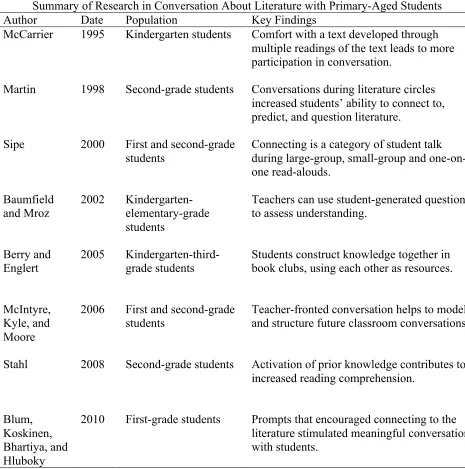
Table 1: Summary of Research in Conversation About Literature with Primary-Aged
Students... 13
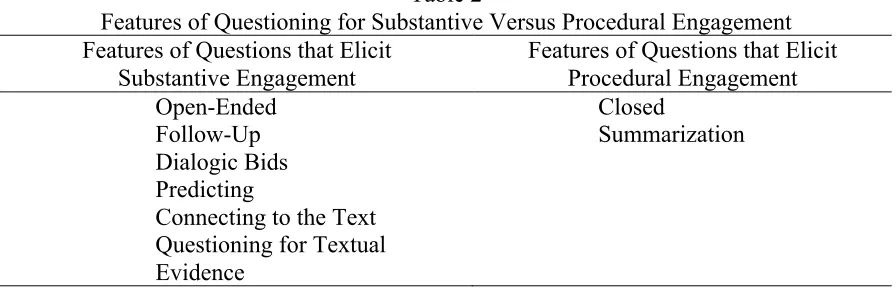
Table 2: Features of Questioning for Substantive Versus Procedural Engagement ... 45
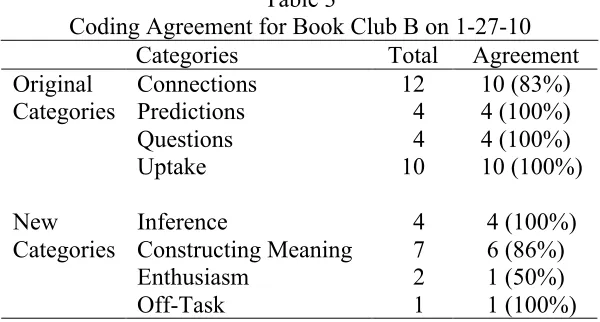
Table 3: Coding Agreement for Book Club B on 1-27-10 ... 62
Table 4: Total Occurrences by Category and Book Club Session... 70
LIST OF FIGURES Figure 1. An integrative model of the theoretical framework. ... 21
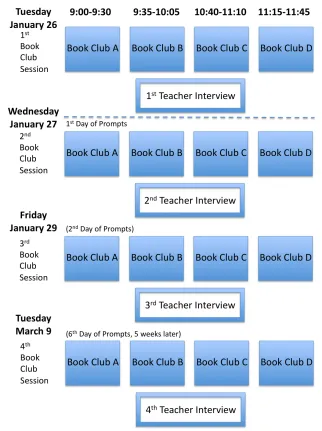
Figure 2. Chronological progression of book clubs and interviews. ... 55
Figure 3. Average time of book club sessions in minutes. ... 66
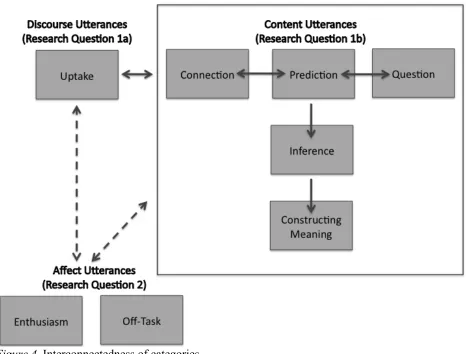
Figure 4. Interconnectedness of categories... 71
CHAPTER I
STATEMENT OF THE PROBLEM
Reading comprehension scores in California are below average nationally and
internationally (National Assessment of Educational Progress, 2007). Research repeatedly
suggests that questioning and making connections are effective strategies for improving reading
comprehension (National Reading Panel, 2000b; Stahl, 2008). This study investigated the use of
connection prompts, a tool which aims to help students make connections through questions.
Connection prompts are verbal cues a teacher can use to help students connect to literature while
exploring meaning. In theory, connection prompts help initiate and increase instructional
conversation and quality of conversation (Blum, Koskinen, Bhartiya, & Hluboky, 2010). These
conversations are predicted to contribute to student reading comprehension.
Conversation is not widely used in schools, though it is suggested by research to be
effective in supporting reading comprehension (Alvermann, 1987; Nystrand & Gamoran, 1990;
Almasi, 1995; Sipe, 2000; Stahl, 2008). Conversation is difficult to conduct in a classroom
setting because it requires time, a shift in teacher and student roles, and teacher-training
(Nystrand & Gamoran, 1990; Almasi, O’Flahaven, & Arya, 2001; Baumfield & Mroz, 2002;
Maloch, 2002; Berry & Englert, 2005). While conversation is not often used, Almasi (1995) and
Gambrell (1996) note that it can lead to critical thinking, which is a key component of reading
comprehension.
Conversation creates a context in which students can explore areas of text with other
students and make connections (Gambrell & Almasi, 1996). Connections students make can be
text-to-life (i.e. “My neighbor is a fireman, and I know he drives a truck”), text-to-text (i.e. “I
read a book about a fire in the character’s apartment”), or text-to-self (“I remember when my
use of connection prompts, which were predicted to encourage students to make connections and
explore reading more deeply. It is theorized by the researcher that the conversation following the
connection prompts provided students with opportunities to make connections and build
meaning.
Baumfield and Mroz (2002) suggest that conversation is beneficial to student
understanding and that questioning triggers and facilitates conversation. To use conversation as
an instructional tool the teacher must demonstrate, model, and scaffold conversation in action.
There is a need for research in the area of instructional conversation, specifically in how to
initiate and support it. The connection prompts used in this study were designed to help a teacher
initiate and support conversation about literature.Research suggests that prompts are useful in
supporting conversation, as well as questioning and making connections (Nystrand & Gamoran,
1990; Martin, 1998; Blum et al., 2010). Connection prompts combine these effective
conversation supports and were predicted by the researcher to help students make meaning
through conversation that would foster improved reading comprehension.
Conversation can be used in large-group or small-group settings in the classroom. Book
clubs are small groups of students (from three to six) that read a common book and discuss the
text together. They are also referred to as literature discussion groups and literature circles. Book
clubs are growing in popularity in educational settings and are suggested to be an appropriate
and effective form of instruction for developing and practicing reading strategies (Martin, 1998;
Evans, 2002; Maloch, 2002). The intimate nature of the groups allows students to try out new
ideas and test their own understanding. Some research suggests students in the primary grades
(first and second grades) are capable of participating in book clubs and conversation (McIntyre,
participation in conversation around literature only five include book club discussions (as
opposed to large-group discussions). Further, there is a lack of research describing the process of
teaching primary-aged students through conversation.
Purpose
The purpose of this study was to investigate the use of connection prompts as a tool to
help initiate and sustain conversation around literature and to examine the possible effect
connection prompts have in helping students build meaning about literature through the
conversation. Using a sociocultural theoretical framework, the notion of practical and conceptual
tools for teaching are hypothesized to lead students to internalize a process. A practical tool, such
as the prompts used in this study, function as pedagogical strategies or devices a teacher can
implement in instruction. This study describes the implementation of connection prompts with
second-grade students in book clubs. The connection prompts were used during and after the
reading to help support student conversation and reinforce reading strategies to encourage
engaged reading. These prompts are cues in the form of questions that helped the reader make
predictions and question the text in order to initiate conversation. Research suggests that once
conversation is initiated and supported, students learn how to continue to initiate and use
conversation independently of direct instruction from the teacher (Vygotsky, 1978; Almasi et al.,
2001).
Primary-aged learners may struggle with the procedural issues involved in book clubs
such as off-task talking, assuming leadership positions) (Almasi et al., 2001; Christoph &
Nystrand, 2001; Baumfield & Mroz, 2002; Maloch, 2004b; Berry & Englert, 2005; Clark &
Graves, 2005; Anagnostopoulos, Smith, & Nystrand, 2008). The connection prompts in this
prompts were an extension of strategies the teacher had already begun to use in the classroom,
such as making predictions, connecting, and questioning in large-groups or pairs. In this study,
the students were in book clubs of five students working with one teacher. When exposing
students to conversational conventions, the conversations should be teacher-fronted (which may
lead to more teacher talk than student talk) in the beginning to model and guide student
conversations (McIntyre, 2007). The book clubs in this study provided a transition for the
students because they are small and led by the teacher. It is theorized that once students are able
to participate meaningfully in a social setting (in this case, book clubs), they will transfer their
conversation skills to other academic settings (Vygotsky, 1978), however this is not the focus of
this study.
Significance
This study is significant for three reasons: (a) the proposed connection prompts aim to
lead to meaningful conversations which contribute to reading comprehension; (b) the
second-grade is a foundation year for learning literacy skills, and there is a lack of research in
conversation for young learners; and (c) teachers struggle with facilitation of conversation, and
the connection prompts are a tool teachers can use. Reading comprehension is necessary for
success in academics and employment as an adult (Council on Advancing Adolescent Literacy,
2010). Reading comprehension is defined in this study as understanding the literal and intended
meaning of a text and critically evaluating it (Harris & Hodges, 1995). The foundation years are
critical when it comes to literacy skills because students are expected to function as capable
readers across the curriculum by third grade. Unfortunately, despite the fact that our national and
state standards reinforce reading comprehension skills, American and specifically California’s
Conversation is an instructional tool teachers can use to practice standard reading
strategies such as critical thinking, comparing and contrasting, reflecting, predicting, and
connecting. These strategies all contribute to improved reading comprehension. As readers
approach a text, they bring a perspective built on prior experience, knowledge, and expectations.
This perspective directly influences the way a reader reads a text, understands it, and applies the
knowledge from it (Rosenblatt, 1978). When engaging in conversation about text, students can
share their conceptions and clarify misunderstandings. Knowledge is built during the
conversation, and perspectives are influenced. The student leaves the conversation with this
changed perspective, which will make her or him a more informed and critical reader.
The first and second grades in American schools are the foundation years for literacy
learning. It is crucial to prepare first and second-grade students with literacy skills they will use
for the rest of their lives. While research documents the benefit of conversation in teaching these
skills in the third-grade through university-level academics, very little research has been done in
the area of conversation with primary-aged learners. This study contributes to the field of
research focused on conversations about literature in the primary classroom. Specifically, it
addresses the use of connection prompts as a specific way to promote and facilitate conversations
that utilize effective reading strategies which contribute to reading comprehension.
Background and Need
This section describes reading comprehension and strategies used to promote reading
comprehension. Specifically, the section will address engagement and the use of conversation to
enhance substantive engagement. Research presented suggests the use of questioning and
Reading Comprehension
Reading comprehension is crucial to students of all levels and in every subject area
because students need to acquire and apply information from texts. It is complex because it
requires skills in basic literacy and critical thinking, and therefore it is difficult to define and
assess. For young learners this involves understanding that reading is a meaning-making process
as well as the ability to make personal, text, and world connections to the reading. For adolescent
learners, reading comprehension is necessary across the curriculum (Council on Advancing
Adolescent Literacy, 2010). They will use reading comprehension skills in their academic and
everyday lives (National Reading Panel, 2000a). Further, as our students enter the work force,
their literacy skills need to be in line with those of our international competitors. Despite the
need for reading comprehension across the curriculum, reading comprehension is a challenge
because it requires students to decode language, process meaning, and connect the text to other
information. Harris and Hodges (1995) suggest that at its most basic level, comprehension
involves understanding a literal meaning from a text although it can also involve critically
evaluating it. Nationally, we define reading comprehension as the ability to comprehend and
apply what is read (Ambruster, Lehr, & Osborn, 2003). The National Reading Panel (NRP)
(2000) calls for students to be able to ask and generate questions, summarize, identify story
structure, clarify, and predict. In its state-curriculum standards, California expects its students to
demonstrate reading comprehension in the primary grades through retelling, generating and
responding to questions, making predictions, and comparing texts (Academic Standards
Commission, 1998).
Students in the United States, and in California in particular, are not living up to
Study, fourth-grade students in the United States of America rank 22 out of 45 countries in
reading comprehension (Baer, Baldi, Ayotte, & Green, 2007). Nationally, students in California
rank 48th (National Assessment of Educational Progress, 2007). Only one third of the states
showed a statistically significant increase in reading scores since 2004, and California is not one
of those states. Furthermore, the standardized assessments used to measure reading measure
comprehension only to the extent of basic understanding and analytical skills. First and second
grades are the foundation years for students to become fluent readers who understand that
reading relates to meaning, not only to decoding words. It is important to support reading
comprehension early in education so students can apply reading strategies instinctively
throughout their school years.
Reading Comprehension Strategies
There is a large body of research in the area of reading comprehension for young
learners. Questioning and collaborative learning are repeatedly suggested as effective tools to
encourage reading comprehension. In a literature review of experimental and quasi-experimental
research in the area of reading acquisition strategies and selected studies in English-language,
peer-reviewed journals that looked at students in grades K through 12, the NRP (2000b) reports
that comprehension is increased when readers can connect to the text personally (linking text to
prior knowledge and incorporating new information into their schema). Further, there are
specific strategies that novice learners can use to help with comprehension; some are learned
through practice, but many need to be taught formally and practiced until the student can
incorporate them instinctively as she or he reads or listens to books.
The seven strategies for reading comprehension identified and recommended by the NRP
organizers, (d) question answering, (e) question generation, (f) story structure, and (g)
summarization. These strategies all include active student participation. In order to monitor
comprehension, students must be aware of what they are, and what they are not, understanding.
For cooperative learning they must be willing to listen and process what is said as well as to
contribute ideas. Graphic and semantic organizers require students to demonstrate understanding
of text structure and details. Question answering, question generation, story structure, and
summarization involve understanding of plot and sequence, as well as speculation.
In another literature review of reading comprehension strategies for young learners, Stahl
(2004) examined strategies backed by research and frequently used. These include: (a) guided
retelling, (b) story maps, (c) teacher-generated questions, and (d) reciprocal teaching. Guided
retelling is teacher-facilitated summarizing of the narrative. Story maps are visual representations
of story structure. Teacher-generated questions are questions about the text the teacher poses for
student response. Teacher-generated questions can be closed (with a prescribed or expected
answer) or open (with no prescribed answer). They can require lower or higher-order thinking.
Reciprocal teaching, based on Palincsar and Brown’s (1984) model, helps to encourage
self-monitoring by having students practice summarizing, questioning, clarifying, and predicting
during the reading process.
Stahl (2004) notes that strategies backed by research but not widely used by teachers are:
(a) targeted activation of prior knowledge, (b) text talk, (c) directed-reading-thinking-activity, (d)
literature webbing, (e) visual imagery training, (f) video, and (g) transactional strategy
instruction. Targeted activation of prior knowledge includes leading students to making
connections to the text. Text talk encourages students to refer back to the text and asks that
makes use of students’ background knowledge to help them to make predictions. The teacher
guides students through the text, portion-by-portion, stopping, making predictions, reading,
confirming or correcting predictions, and continues throughout the text. Literature webbing
involves students ordering pictures of the story, predicting the order the actual story will take.
Visual imagery training helps students to retain and use information from a text by having them
form a mental image of the text. According to Stahl (2004), visual imagery training is better for
novice readers but less helpful for more proficient readers. Combining video versions of stories
with print versions has been shown to improve reading comprehension of readers with limited
literacy experience and with children who have difficulty maintaining attention for long stories.
Transactional strategy instruction includes linking text to prior knowledge and constructing
meaning within a group. The meaning constructed by the group reflects the thinking of the
group, not just one individual in the group. All of these strategies encourage the use of activating
prior knowledge and making predictions.
Engagement
Engagement refers to student involvement and degree of being on-task during instruction.
Students are generally engaged in class, but the engagement can be either substantive or
procedural (Nystrand & Gamoran, 1991). Nystrand and Gamoran (1990) describe the usual
interaction between teacher and student as initiation-response-evaluation (IRE). In this
interaction the teacher initiates a thought or asks a question, a student responds, and the teacher
evaluates the response with a comment or physical acknowledgement. IRE is appropriate to
check for literal understanding but does not support critical thinking. Defining engagement is
difficult because engagement might be evident in a variety of ways. A student who is engaged
procedurally is concerned with the assigned and expected tasks and is not as invested
intellectually. Both students could be doing the work and might not be disruptive, but the student
who is engaged substantively is likely to do better in terms of achievement (Nystrand &
Gamoran, 1991; Almasi, 1995).
Nystrand (1991) analyzed student discourse and found students to be substantively
engaged when exposed to more conversation-style instruction, while they were more
procedurally engaged during recitation-style instruction. In Almasi’s (1995) study, students were
responding with greater complexity and depth when they were engaged substantively and with
less complexity when they were engaged in the more typical teacher-centered discussion.
Conversation
An effective instructional approach that supports reading comprehension is the use of
conversation to clarify, connect to, and explore literature (Rosenblatt, 1978; Nystrand &
Gamoran, 1990; Almasi, 1995; McCarrier, 1995; Mercer, 1995; Gambrell & Almasi, 1996; Sipe,
2000). While conversation as an instructional tool is a well-researched area, it is not used often
with regard to reading in early grades (Almasi et al., 2001; Christoph & Nystrand, 2001; Berry &
Englert, 2005). Teachers regard discussion as a valuable tool, but they admit to not using it.
Commeyras and Degruff (1998) reported that only 33% of teachers indicated they frequently use
conversation around literature (in the format of book clubs) in their classrooms, while 95%
indicated they believe it to be useful. Typically, classroom conversation is dominated by the
teacher and teacher-directed activities (Mercer, 1995; Nystrand, Wu, Gamoran, Zeiser, & Long,
2003). In a study of classroom discourse, Nystrand (2003)noted thatteacher-directed activities
& Mroz, 2002), and teacher questions are primarily closed or procedural (Groenke & Paulus,
2007).
Conversation can be a tool teachers use to engage students substantively (Nystrand &
Gamoran, 1991; Almasi, 1995). It is an instructional approach which embeds six of the seven
strategies suggested by the NRP (2000b), and seven of Stahls’ (2004) twelve noted successful
strategies. The six strategies suggested by the NRP include: (a) comprehension monitoring, (b)
cooperative learning, (c) question answering, (d) question generation, (e) story structure, and (f)
summarization. The seven strategies recommended by Stahl are: (a) guided retelling, (b)
teacher-generated questions, (c) reciprocal teaching, (d) targeted activation of prior knowledge, (e) text
talk, (f) directed-reading-thinking-activity, and (g) transactional strategy instruction. In this study
conversation refers to student responses to teacher comments and questions, uptake with other
student comments and questions, and listening by all participants. It is measured by
demonstration of ability to respond to one another, maintaining a thread of discussion beyond the
characteristic classroom dialogue of teacher initiations, student response, and teacher evaluation.
Students can demonstrate critical reading by making connections to the text, asking their own
questions, and making predictions.Through conversation students are able to monitor their own
understanding. As a student faces conflict with another student’s interpretation, she or he will
likely try to reconcile the conflict by either defending her or his original understanding or by
trying to understand the new perspective. In doing so, she or he will realize that one works better
than the other (or possibly a third option) and will construct new knowledge. Further, the student
will now approach future reading with a more critical eye, knowing that there are possible
alternative perspectives. Teachers are also able to assess student understanding through listening
constructing knowledge when guided and facilitated by a teacher (Mercer, 1995). Conversations
are often initiated and propelled by question answering and question generation. Through
conversations, students often refer back to story structure and summarization strategies to clarify,
connect, and expand their knowledge. Further, the NRP (2000) report cited conversation as
having a positive effect on comprehension across grade levels. Each of these strategies can be
used effectively with second-grade students, who are the focus of this study.
Conversation can be initiated and facilitated through the use of questioning. When
conversation is used instructionally in the classroom, it is initiated and led by the teacher,
supports student knowledge and beliefs, and perpetuates further conversation with student
participation (McIntyre et al., 2006). At its best, it is facilitated by the teacher and structured with
the use of specific prompts (Rosenblatt, 1978; Nystrand & Gamoran, 1991; McCarrier, 1995;
Sipe, 2000; Baumfield & Mroz, 2002; Berry & Englert, 2005; Clark & Graves, 2005; McIntyre
et al., 2006; Blum et al., 2010). Prompts, which are statements or questions posed by the teacher
and used by the students to form responses to text read in the classroom, can be used to initiate
conversation. By modeling prompts, teachers promote student questioning, which in turn
decreases teacher-led conversations (Wells & Arauz, 2006). The guided instructional
conversation, if well supported, develops into conversation.
Research in Conversation
Most of the research on conversation around literature in the classroom investigates
conversation at the third grade or higher (Sipe, 2000; Stahl, 2008). There are eight studies in the
past 20 years in English-language peer-reviewed journals that investigate conversation of
English-speaking, primary-age students with regard to literature. The studies are summarized in
participate in conversations around literature, and the primary grades are an ideal place to mold
the foundation. As students practice strategies for participating in conversations, they will be
able to use the strategies independently (Stahl, 2004).
Table 1
Summary of Research in Conversation About Literature with Primary-Aged Students
Author Date Population Key Findings
McCarrier 1995 Kindergarten students Comfort with a text developed through
multiple readings of the text leads to more participation in conversation.
Martin 1998 Second-grade students Conversations during literature circles
increased students’ ability to connect to, predict, and question literature.
Sipe 2000 First and second-grade
students
Connecting is a category of student talk during large-group, small-group and one-on-one read-alouds.
Baumfield
and Mroz 2002 Kindergarten-elementary-grade students
Teachers can use student-generated questions to assess understanding.
Berry and Englert
2005
Kindergarten-third-grade students
Students construct knowledge together in book clubs, using each other as resources.
McIntyre, Kyle, and Moore
2006 First and second-grade
students Teacher-fronted conversation helps to model and structure future classroom conversations.
Stahl 2008 Second-grade students Activation of prior knowledge contributes to
increased reading comprehension.
Blum, Koskinen, Bhartiya, and Hluboky
2010 First-grade students Prompts that encouraged connecting to the
In a qualitative study of Kindergarten students McCarrier (1995) investigated the nature
of student talk during several read-alouds (an event during which the teacher reads a story aloud
to a group of students). McCarrier (1995) analyzed field notes, audio and video of the
conversations, and the talk of students during multiple readings of a pattern book and during
multiple readings of a folktale. Findings indicate that as students gained comfort with the texts,
they participated more in the conversation. The conversation helped the students understand the
texts better. They had an opportunity to express understanding and misunderstanding and to
clarify. McCarrier (1995) does not analyze what specifically initiates the conversation, such as
teacher prompting.
Martin (1998) presents a small action-research study of literature circles in her
second-grade classroom. The purpose of her study was to investigate whether or not literature circles
increased students’ ability to apply three commonly used reading comprehension strategies: (a)
predicting, (b) questioning, and (c) connecting to the text. Using a pre and post test for strategy
use and a discussion rubric, Martin (1998) noticed an increase in scores for predicting for 75% of
students and an increase in scores for questioning and connecting for 83% of students.
In a descriptive qualitative study Sipe (2000) investigated first and second-grade student
conversation as a measure of understanding literature. Using audio tapes of conversations in
three settings (large-group, small-group, and one-on-one read-alouds), Sipe categorized the type
of talk that emerged during the read-alouds. One category, personal talk, included talk that
demonstrated the student making a connection. The connections were either text-to-life, in which
the student used a portion of the text to explain, elaborate, or understand something in his or her
life. On the other hand, a life-to-text connection involved a student using her or his personal life
describing the types of talk, he does not indicate or speculate on what stimulated the talk, nor
what stimulated each type of talk.
Baumfield and Mroz (2002) cite the importance of increasing student-generated questions
to improve student understanding. Student questions allow the teacher to gauge student
understanding and help the student to clarify misconceptions and expand her or his knowledge.
The researchers investigated the impact of a community of inquiry on the development of student
questions with five-to-nine-year old students. In their study, the students found they needed to
justify their answers and were exposed to alternative responses. Analyzing the student-generated
questions as data, Baumfield and Mroz (2002) identified nine categories of student-generated
questions. Most of the questions fell into 5 categories (factual plot-related, character motivation,
wondering about possibilities, open-ended summary, and speculation on circumstances before or
after the story). The researchers did not investigate the use of teacher guidance during this study
or how teacher facilitation might have enhanced the higher-order thinking of the questions
students generated.
Berry and Englert (2005) investigated the teacher’s role in developing and conducting
book clubs (referred to in this study as book discussions) with Kindergarten through third-grade
students and the nature of the talk in those discussions. Using audio of the book discussions and
teacher interviews, the researchers analyzed the type of talk that took place in the literature
discussion circles. The conversations were initiated by visual prompts (written questions and
statements on a poster) to remind students of reading strategies to help them stay on task. The
key findings in their study were that student-selected topics increased conversation and that the
teacher was integral in creating the conversation for young learners by scaffolding the actual
available. In the later discussion groups the posted prompts were removed, and the conversation
increased (this was measured in length of turns per topic). Berry and Englert acknowledge the
importance of the scaffolding in the beginning, especially for students with special needs. Berry
and Englert further suggest that future research investigate teacher-student dialogues and the way
a teacher can guide the conversation. They assert that these conversations are where students
construct knowledge using each other as resources. The current study investigated a tool to help
facilitate conversation.
McIntyre, Kyle, and Moore (2006) followed a teacher’s implementation of conversation
in a primary-grade class (first and second-grade). The data they collected include observations,
videotaping of class time, interviews with students and teachers, student assessments, and
interviews with family. Using grounded theory the researchers analyzed their data from a
sociocultural perspective but also transitioned to interactionism as they observed that following
conversations required a new way of analyzing the data. The researchers coded the content of the
teacher talk, the procedures the teacher used to implement conversation, the responses from the
students, and the prompts (which they refer to as cues) to encourage conversation. One of the
major findings reported by McIntyre et al. (2006) is that teacher-fronting (heavy amounts of
teacher talk) in the beginning of a conversation helps to structure the conversation for the
students as they gradually take over more of the ocnversation. This further argues for teacher
facilitation. Secondly, what helped to promote dialogue in the study in addition to verbal
prompting was the use of praise, encouragement, non-evaluative comments, and non-verbal
prompts (such as hand gestures, longer pauses, and pacing). These prompts are more evidence of
Stahl (2008) investigated the effects of three reading interventions on reading
comprehension and science-content learning. The three different reading interventions were: (a)
picture walks, (b) know-want-to-know-learn, and (c) directed reading-thinking activity with
second-grade students. All three reading interventions included the use of conversation, student
participation, and student question-generation. All were recorded on audiotape. One of the key
findings in Stahl’s (2008) study is that activation of prior knowledge is a contributing factor to
increased reading comprehension. Activating prior knowledge asks students to make
connections. Additionally, while all three strategies help to increase vocabulary development,
picture walks and directed reading-teaching activities are more effective than commonly used
instructional tools in promoting fluent reading and basic comprehension (literal understanding).
Directed reading-thinking activity was the most effective of the three interventions at eliciting
higher order comprehension. Stahl suggests that directed reading-thinking activity is so effective
because it not only incorporates much of what the other interventions use but also requires a
strong teacher facilitation and conversation in which students can reconcile misunderstandings.
Blum, Koskinen, Bhartiya, and Hluboky (2010) noticed an increase in meaningful
conversation with the introduction of four consistent prompts for literature discussions with first-
grade students. The prompts used were in the form of statements and helped students connect to
the text. Teachers in the study believed conversation to be a meaningful instructional tool and
were interested in ways to promote it. The teachers felt that the prompts were an appropriate and
helpful tool.
The research to date suggests primary-age children are able to participate in conversation
that prompts (especially in the form of questions) help to stimulate conversation, and that
draw on prior knowledge, and construct new knowledge (Rosenblatt, 1978; Nystrand &
Gamoran, 1990; McCarrier, 1995; Martin, 1998; Baumfield & Mroz, 2002; Berry & Englert,
2005; McIntyre et al., 2006; Blum et al., 2010). There is some research on the types of talk of
which primary-age students are capable. The research on conversation concerning literature
among young learners highlights the use of tried and true methods (questions to prompt
conversation) and suggests further study into specific ways to implement those questions. It does
not examine connection prompts in the form of questions.
Questioning
Questioning is shown to help stimulate and guide conversation (Nystrand & Gamoran,
1991; Almasi, 1995). The questions posed by a teacher can lead the conversation to substantive
or procedural engagement. Features of questions that lead toward substantive engagement
include: (a) no prescribed answer, (b) connections to the literature, and (c) predictions. Features
of questions that lead toward procedural engagement include: (a) prescribed answers and (b)
summarization.
Questioning using the aforementioned features is not widely used due to lack of time,
energy, and skill (Tharp & Gallimore, 1988; Goldenberg, 1992; Almasi et al., 2001; Christoph &
Nystrand, 2001; Berry & Englert, 2005). Questioning does take time but is also shown to be
associated with achievement in reading comprehension (Nystrand, Gamoran, & Heck, 1993;
Gambrell & Almasi, 1996; Clark & Graves, 2005). There are instructional tools teachers can use
to help guide questioning, and one of those tools is connection prompts.
Connection Prompts
Prompts are statements or questions that cue a reader to respond to literature. Prompts
conversation around literature and questioning suggests the use of teacher facilitation and
modeling to initiate and increase conversation (McCarrier, 1995; Sipe, 2000; Baumfield & Mroz,
2002; Nystrand et al., 2003; Berry & Englert, 2005; Clark & Graves, 2005; McIntyre, 2007;
Stahl, 2008). One way for teachers to initiate and facilitate conversation is to guide it with the
use of questions. In this study the teacher used an intervention of connection prompts, which are
open-ended questions that ask the student to make connections and predictions. Open-ended
questions, connections, and predictions are three features of questioning that have been shown to
lead to substantive engagement.
Broadly speaking, researchers and teachers may not all use the same terminology. That
said, teachers use prompts, sometimes intentionally and sometimes haphazardly. Clark and
Graves (2005) describe the idea of scaffolding student reading comprehension through
conversation. They use data from their previous studies to offer examples of scaffolding but do
not actually investigate the strategies suggested. To stimulate conversation Clark and Graves
suggest the use of questions and incorporating responses in future instruction. Nystrand, Wu,
Gamoran, Zeiser, and Long (2003) suggest the use of prompts (which they refer to as dialogic
bids) to initiate and sustain conversation. These prompts are authentic questions, to which there
are no prescribed answers.
A connection prompt is one that asks the student to associate the text with his or her
personal life, general observations, or other texts. Connection prompts can be in the form of
statements or questions. An example of a statement connection prompt is “This book reminds me
of” (Blum et al., 2010). The same connection prompt as a question would read: “What does this
book remind you of?” When a teacher uses a connection prompt, the students are encouraged to
prompts is shown to encourage and support conversations. Prompts can also be used to connect
learning to prior knowledge. Connection prompts are in the form of questions in this study.
While the research looks at what kind of conversation young learners are capable of, only
one article investigates connection prompts specifically. Blum et al., (2010) suggest specific
connection prompts are useful in helping the students connect to the literature and construct
meaning. The prompts used in the study were statement prompts, and this current study
investigates the use of question connection prompts (questions that encourage the reader to
connect to the literature aloud through an interaction with other readers) in initiating and
sustaining conversation.
Research suggests that questions, specifically those that elicit connections, predictions,
and have no prescribed answer, along with facilitation, lead to improved conversations. None of
the nine studies reviewed looked specifically at connection prompts in the form of questions.
What may be a promising way of promoting these conversations is by thoughtfully and
systematically using a tried and true instructional tool (questions) in the form of connection
prompts. The current study suggests that the use of connection prompts in the form of questions
leads students to deeper and more meaningful conversations. From that it can be theorized that
the conversations lead to substantive engagement.
Theoretical Rationale
This study draws on three theories: (a) Rosenblatt’s (1978) Transactional Theory of
Reading, (b) Langer’s (1990) Theory of Envisionments, and (c) Vygotsky’s (1978) Sociocultural
Learning Theory. The first two theories describe an individual reader’s experience with a text,
and both of them indicate that a social environment contributes positively toward the experience
development of the individual and the internalization of skills and vocabulary learned in the
social context. The students in this study engaged in a social context facilitated by a teacher. It is
theorized that the students internalized the conversational skills as well as the reading strategies
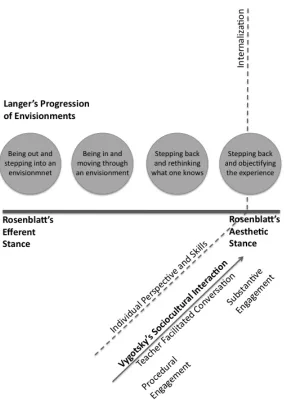
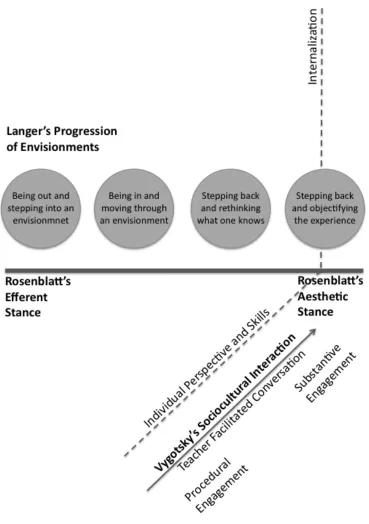
reinforced by the conversation through connection prompts. An integrative model of the three
theories is depicted in Figure 1.
All three theories described below in this section recognize the individual reader and her
or his learning experience. Rosenblatt (1978) stresses the importance of how the reader
approaches a text. She also explains the importance of recognizing that each reading experience
is different and builds on the reader’s experiential reservoir informing the future reading
experiences. Similarly, Langer (1990) recognizes the reader’s orientation. She continues to
describe the process a reader goes through, and her second, third, and fourth envisionment occur
fully with a reading for literary understanding orientation or, as Rosenblatt asserts, aesthetic
reading. Vygotsky (1978) is central to the proposed study in that he defines the experience of
learning through social interactions. The treatment in this study was administered in a social
setting with the intent of teaching through social interaction. It was predicted that this would not
only help students make meaning of the text, but bring the experience with them (as with
Rosenthal and Langer’s theories) and internalize the skills used to construct meaning. Figure 1
outlines the theoretical framework for this study by incorporating Rosenblatt’s continuum,
Langer’s envisionments, and Vygotsky’s theory of social learning. Rosenblatt’s continuum, the
horizontal line, goes from efferent (on the left) to aesthetic (on the right). Langer’s
envisionments (the circles) also progress from an efferent stance to an aesthetic stance with the
implementation of a social (teacher-facilitated) environment. The dashed line represents the
individual progressing through the envisionments while exposed to the social experience
(indicated by the solid line with an arrow). Student discourse develops within the social
experience. As the student moves vertically through a social experience, she or he is predicted to
encounter Langer’s four envisionments. This happens only as she or he also moves horizontally,
Rosenblatt’s Transactional Theory of Reading
Rosenblatt’s (1978) transactional theory of reading and writing addresses the transaction
between reader and text, which happens when a reader decodes a text (or hears a text) and
integrates the information from the text into her or his schema. Rosenblatt uses the term
transaction to emphasize the importance of both the reader and the text in every reading event.
The reader arrives at a text with an experiential reservoir: a combination of experiences and
attitudes about exchanges with the world. The reader draws on this reservoir to understand the
text and uses the text to make better sense of the reservoir. Rosenblatt argues the reader
continually processes information and recognizes and/or adjusts his or her perspective as he or
she proceeds through a text. Rosenblatt claims that even a re-reading of the same text will be a
unique event. The meaning of a text, according to Rosenblatt (1978), is constructed when a
reader reads and interprets the text. Full comprehension includes literal understanding and
critical evaluation of the text. There are several factors that contribute to the interpretation, such
as context of, and purpose for, reading. The reader’s cultural, social, and personal life will affect
the pacing, organization, and synthesizing of the text. In short, the reader is changed having gone
through the experience of reading. According to Rosenblatt, understanding the text is the process
of reading and evoking literal understanding and sensations and emotions, not simply decoding
combinations of symbols (Rosenblatt, 1982). The idea of a transaction between reader and text is
echoed by The National Reading Panel (2000), which asserts that reading comprehension is what
follows from “an intentional and thoughtful interaction between reader and text” (NRP, p.13).
The text is incorporated into the reader’s schema as it is processed. The meaning of the
text changes as the reader moves through and transacts with it. Overall generalizations about the
can be reconciled with new information. Rosenblatt (1991) describes the transaction as
constructing an interpretation through an interaction with a “persona” author.
According to Rosenblatt, language is personalized by the reader; the reader reads and
speaks about the text from a personal perspective. This personalization of language is part of the
reader’s transaction. Language is made up from the individual’s experiences in his or her life,
and she or he brings those experiences and his or her perspective to the text. For example, as a
second-grade student living on a farm reads White’s (1952) Charlotte’s Web, she or he will come
to the text with a strong knowledge of farm animals and how a farm works. The idea of killing a
pig for money or food will not necessarily come as a surprise. However, when an urban
second-grade student approaches the same text, she or he may be taken aback at the idea of killing the
pig. According to Rosenblatt, both readers are correct in their response to the text.
Rosenblatt (1991) describes a reading stance continuum on which one end is the efferent
(literal and direct understanding) stance, and on the other is the aesthetic (lived-through and
experiential understanding) stance. The reader comes to a text with their experiential reservoir,
and the reader’s stance “reflects” the reader’s purpose. It is important to note that it is the reader
that falls on the continuum, not the text. As a reader approaches a text, the reader adopts a stance
along Rosenblatt’s (1991) continuum. Typically, the stance is influenced by the prompts in the
text (which Rosenblatt refers to as cues). These prompts can be format or language prompts. For
example, a poem might offer a format prompt of large margins and nontraditional punctuation,
and a mathematics textbook might offer a format prompt of visual step-by-step directions in
boxes. A novel might offer a language prompt through dialogue, helping to indicate date or
location. Readers must be able to make a shift in stance when appropriate (Rosenblatt, 1978). For
Sorcerer’s Stone, with an efferent stance if it is assigned for homework, and she or he knows she
or he will be accountable for the information. But, as she or he reads, it will become clear that
while there are some things true to life, it is a fantasy book, and not everything in it should be
understood literally. The reader must understand the emotions and excitement of the novel and
feel the confusion of the characters and not be baffled by the fact that there are dragons which
are not real. The stance can also be altered by teacher input, other readers, or the context in
which the text was chosen. For example, the text could be assigned as homework or chosen for
pleasure reading.
The efferent stance implies a focus on the meaning of the text and the information the
reader wants to carry away from the text after reading. For example, if someone is stuck on a
highway with a flat tire and does not know how to change the tire, she or he will read the car
manual for directions with an efferent stance. The person simply needs information quickly to
apply to an immediate situation. Readers often take an efferent stance with textbook reading.
With textbooks students focus on the facts and which facts should be retained after reading. With
efferent reading, the purpose for reading is to understand literal meaning. Beginning readers
more often take on an efferent stance no matter the reading material.
The aesthetic stance refers to what the reader experiences during the reading of a text.
Aesthetic reading involves feeling the emotions the text elicits and understanding the conflicts or
emotions in the text. A young child reading Judy Blume’s Superfudge can identify with the
protagonist, Peter, in a variety of ways. Peter experiences difficulties with friends, has to move to
a new home, takes care of a pet, and experiences challenges in being an older sibling. Older
siblings reading the book might understand Peter’s struggles with his younger brother, Fudge.
event is unique and allows for a personal connection to the text. The purpose of reading is to
achieve the lived-through experience with aesthetic reading.
Often accomplished readers take on a more aesthetic stance with poems or novels. Even
very young learners can read aesthetically. Rosenblatt (1982) argues that a reader cannot develop
a full response to literature until she or he has had an aesthetic experience. Aesthetic reading,
according to Rosenblatt (1982), helps the reader (especially the young reader) to develop a richer
experiential reservoir with which to approach new texts and life. Depending on the context, a
reader may switch from one stance to another. Reading tends to be more efferent for the young
reader, no matter the genre, because she or he is developing in all areas of reading and is not able
to absorb all the prompts present in the text. However, Rosenblatt (1978) suggests that we urge
our young readers to embrace the full continuum of reading including aesthetic reading with
literature.
Rosenblatt (1978) argues that generally schools teach literature from an efferent stance,
encouraging students to simply understand the basics of the reading and not to feel the
lived-through experience that goes along with aesthetic reading of literature. She claims that we lose a
sense of the literature when we ask students to read efferently when we should be encouraging
them to read aesthetically. Rosenblatt (1978) notes that reading comprehension assessments
often require only efferent reading, and because reading is on a continuum, those assessments do
not measure all reading. To measure reading efferently is to ask for efferent reading. Rosenblatt
argues that schools teach for efferent reading, even of literature. When students are assessed for
efferent understanding it changes the entire purpose for reading.
Rosenblatt (1991) stresses the importance of creating environments in which students can
transactions that students experience. She argues conversation provides a place for students to
pose and hear different perspectives and interpretations of text. Each text is written with and read
from a personal, cultural, and linguistic perspective. Conversation among students could help the
students link the meaning from the text to themselves and therefore personalize the information
and clarify where there are gaps in understanding due to perspective. Misconceptions come from
approaching a text with a preconceived notion that is incorrect (Rosenblatt, 1978). Conversation
is a specific way for students to express their transactions and understandings and to hear
alternative perspectives. Rosenblatt (1978) argues that a shift in perspective can occur during a
conversation. When participants in conversation hear alternative explanations and reactions to a
text, they compare the alternatives to their original understanding. They may decide after that
comparison that they feel stronger in their original opinion. Conversely, a student may change
her or his mind after weighing an alternate response to her or his own original response. This
shift in response alters the student’s experiential reservoir. After this experience the student not
only changes her or his perspective regarding this text but will now approach new texts with this
shift in perspective. Conversation essentially allows for a meeting of personalized perspectives
and can result in shifts within personalized perspectives. This shift can be enough to approach
new texts and experiences with a more critical manner.The participants may leave the
conversation with completely different interpretations. Conversation, Rosenblatt (1978) suggests,
is a means toward deeper understanding of text.
Exposure to alternative interpretations offers students an opportunity for critical thinking
as they absorb the new ideas and attempt to incorporate the ideas into their personal schema.
Rosenblatt’s approach to literature will lead to better reading comprehension as defined by the
improved reading comprehension skills such as retelling and clarifying, as currently assessed
with standardized tests, but aesthetic reading will address the more complex needs and standards
nationally accepted, some of which are not sufficiently assessed with standardized tests
(Rosenblatt, 1978).As students recognize that one text can elicit different interpretations, they
will begin to read with a stronger sense of their own reading process.
Rosenblatt’s Transactional Theory speaks closely to the aims of this particular study in
that this study examines the transaction between the reader and the text through analysis of
student responses. Much of the research in the area of conversation of young learners makes use
of Rosenblatt’s theory (Almasi, 1995; Sipe, 2000; Almasi et al., 2001; McIntyre et al., 2006;
Heller, 2006; Tolentino, 2007). Rosenblatt (1991) argues that transactional theory is appropriate
for all levels of reading and that there is a need for research on how teacher’s guide conversation
at the lower grade levels. This study investigates student expressions of their transactions with
text via conversation.
Langer’s Theory of Envisionments
Langer (2001) posits the idea of envisionments, which are personalized ideas about a text
or conversation, and how the text fits within a personal schema. Langer suggests that readers
develop a relationship with the text, as with Rosenblatt’s transaction, and that they explore as
they read. As readers approach a text, they immediately receive prompts (which she refers to as
clues and Rosenblatt refers to as cues). These prompts can be language, context, format, or of
another variety, and they lead the reader into the text. Also similar to Rosenblatt, Langer
suggests that readers take on either an informative (efferent) or literary (aesthetic) approach to
texts (Langer, 1990). The reader cannot help but use prior knowledge to adjust to the text and
constantly revised understanding, Langer’s envisionments change as the reader progresses
through the text and absorbs new prompts and makes new connections (Langer, 1990; Langer,
2001).
Langer (2001) proposes four stances of envisionment and suggests that readers move
through them as they dive deeper into understanding. The first of the four stances is being out
and stepping into an envisionment. The reader in this stance is making initial contact with the
text and picking up on the prompts described above. These prompts help the reader to engage
with the text because the prompts will offer the reader hints about the text such as genre or plot.
Langer likens this experience to a child starting a new school. As the child begins at the school,
she or he will pick up clues to inform her or himself about the school. She or he will arguably
use this information to get to know the environment better.
The second stance is being in and moving through an envisionment. Langer argues that
readers must immerse themselves in a text in order to understand it. They combine their
experiences and prior knowledge to make sense of the text and literally understand its direct
meaning (characters, setting, and plot). In the example of the child at a new school, the child will
no doubt use experiences from a previous school to help her or him adjust to the new experience.
For example, she or he will realize that like the old school, there are routines and schedules, but
theses routines and schedules might be different.
Once in the text the reader can then go to the third stance, stepping back and rethinking.
In this stance the reader can take the new information from the text and actively connect it to
prior knowledge. Instead (as in the first stance) of using prior knowledge to understand the text,
the reader is using new information to make better sense of the world. Langer’s example of the
moment to think about the relationships and use the information to inform her or himself about
past relationships at the old school. As she or he realizes it’s hard to make friends as a new
student, she or he might reflect on a time at the previous school when she or he could have been
more friendly and accepting of a new student.
The fourth and final stance is one in which the reader steps back and objectifies the
experience. At this point in reading the reader is able to think about the reading as an experience
which will help her or him to make judgments about the text, such as about the structure or
intended meaning. The new student in Langer’s example in this stance might be able to objectify
the benefits and drawbacks of switching schools. She or he may realize that indeed the
homework is harder, but she or he is more confident in spelling.
As students move from one stance to another, Langer (1990) suggests they develop new
perceptions and perspectives. This shift is part of analytic thinking, which is part of reading
comprehension. Langer argues that conversation is one reliable strategy toward literary
understanding. Further, questions are essential in helping students move from one stance to the
next and toward discussion (Applebee, Langer, Nystrand, & Gamoran, 2003). As readers enter
the conversation, they use their envisionments as a frame of reference and begin to build deeper
understanding as they work with others to synthesize a more developed understanding of the text
(Langer, 1990).
Both Rosenblatt and Langer view the reading experience as a progression of
understanding through connecting to the literature. Rosenblatt’s continuum and Langer’s
envisionments allow students to map out their thinking process throughout a reading. Langer
would argue that in the first envisionment, parallel to Rosenblatt’s efferent stance, the reader is
only understanding literal meaning. Both would likely agree that the reader needs motivation to
move toward the aesthetic stance or fourth envisionment. For early readers the motivation could
be prompted by the teacher. Once the student understands the joy and importance of reading, she
or he would likely internalize it and develop personal motivation. In this study, Rosenblatt’s
continuum and Langer’s envisionments help to guide the analysis of the content of what is said
in the book clubs.
Vygotsky’s Sociocultural Theory
Much of the research in the area of conversation around literature cites Vygotsky’s
(1978) sociocultural theory because it describes the nature of linguistic and cognitive
development through socialization. Vygotsky’s theory supports the current study in that it
investigates a social interaction (conversation). Students bring certain individual skills to
reading, and if those skills are fairly basic (which they can be in the second grade), the reading
will tend to be more efferent in nature. Through facilitation the teacher can use questions to
encourage a conversation with students that will lead to a deeper reading. The students will use
the experience of the interaction to approach new texts. They will embrace each new reading
experience with a new perspective which is influenced by the facilitated experience. This can
lead to a more aesthetic reading.
Vygotsky (1978) argues that social experiences influence an individual’s thinking and
perspective. The individual is not independent of his or her social environment. The classroom is
a social setting in which the students learn from each other and the teacher. Vygotsky notes the
importance of a more knowledgeable other, another individual that has experience or knowledge
to share. The more knowledgeable other can support a student with her or his experiences and
would argue, than a didactic approach where a teacher simply disseminates information. Students
can be more knowledgeable in various areas and are therefore able to act as a more
knowledgeable peer at different times. Vygotsky would support the role of the teacher as a more
knowledgeable other, often referred to in the research literature as a facilitator. In this study, the
teacher acts as a more knowledgeable other in facilitating the book clubs, and students have the
opportunity to share their knowledge during the conversation.
The individual internalizes language, ideas, and processes learned in social settings. In
this study the prompts help to stimulate the social setting (the conversation). Based on Vygotsky,
it is theorized that the reader will internalize the experience of the conversation and the reader
will then be able to approach a new text with an enhanced ability to read with a critical
perspective and better conversation skills.
Definition of Terms
Authentic Questions: Authentic questions are questions with no prescribed answer. The
teacher poses authentic questions leaving the responses open for alternate ideas. Authentic
questions are also known as open-ended questions.
Book Clubs:Book clubs are small groups of students (three to six) that meet to discuss
commonly read text. In this study, book clubs are the forum in which students discuss books read
aloud by the teacher while the students read along with their own copy. Book clubs are also
known as literature discussion groups.
Connection Prompts:Connection prompts are prompts that lead students to make
connections to the text and talk about them. In this study, connection prompts are in the form of