Optimized Resource Sharing for Federated
Cloud Services with Desired Performance
and Limited OpEx
Raouf Abozariba
*, Anas Amjad
*and Mohammad N. Patwary
†*
School of Creative Arts and Engineering, Staffordshire University, Staffordshire ST4 2DE, UK
†School of Computing and Digital Technology, Birmingham City University, Birmingham B4 7BD, UK
[email protected]
,
[email protected]
,
[email protected]
Abstract—The provision of cloud resources to meet user demands in 5G wireless networks is a challenging task due to the high workload predicted to be experienced by cloud service providers (CSPs). Cloud federation has emerged as a paradigm to support CSPs with resource limitations by borrowing surplus resources of other CSPs in periods of high demands. The major concern of each CSP with resource limitations is to borrow resources from other federation participants in such a way that cloud services are provided to the end-users with a desired grade of service (GoS) as well as the overall profit is maximized. This paper proposes an efficient mechanism based on the merchant mode to dynamically facilitate optimal allocation of cloud re-sources, maximizing the profit of CSPs as well as improving the GoS. The robustness of the proposed optimal scheme is evaluated by comparing it with the heuristic algorithm. The simulation results demonstrate that at each trading window, the proposed optimal scheme outperforms its heuristic counterpart. Moreover, after 50 trading windows, the proposed approach results in 43.5% gain in net profit to CSPs as well as facilitating 3.35% of additional resource.
Index Terms—Cloud computing, cloud federation, internet of things, resource sharing, profit maximization.
I. INTRODUCTION
In future generation of wireless networks, the provision of reliable connectivity is one of the primary concerns due to the exponentially growing number of connected devices [1], [2], [3]. In recent years, the advances in Internet of Things (IoT) have shown promising solutions to dynamically sustain network connectivity over global infrastructures [1], [3]. In order to cope with the limited computational and storage capabilities of diversely located devices, the integration of IoT with cloud computing has shown promising developments for a broad spectrum of applications [4], [5], [6]. Cloud computing facilitates user access to a shared pool of virtually unlimited available resources. Nevertheless, due the growing demand from users to access cloud services, a performance bottleneck is expected to be experienced by the federation participants. In order to guarantee the global success of 5G, the coupling of IoT and cloud computing is required to assure maximum possible service provision reliability. Therefore, assuming unlimited cloud resources for future generation of
wireless network design may not be able to meet the users’ expectations [7], [8], [9].
Exploiting the potential of cloud computing, cloud service providers (CSPs) have to meet users’ requirements by de-livering services in a flexible manner with acceptable delay [10]. The end-users are mostly concerned about the cloud services they require, the services cost and the grade of service (GoS) experienced; regardless of the underlying infrastructure [11]. Cloud federations have emerged as an appealing way to isolate the underlying infrastructure from end-users and deliver services with an improved degree of flexibility [12]. In a cloud federation, independent CSPs collaborate dynamically for load balancing, capacity management, efficient utilisation of surplus resources, minimizing failures, improving GoS and enhancing cost efficiency [13], [14]. Within the federation, if a particular CSP’s available resources are insufficient to fulfil all the requests due to high workload, it can borrow resources from other CSPs having surplus resources on a pay-per-use basis. Such an approach can minimise the possibility of violating service level agreements (SLAs) and ensures high level of service provision. In such a scenario, one of the primary concerns is to select particular CSPs for borrowing their resources in a cost effective manner as well as without compromising on the target service denial probability.
Global cloud federation controller Cloud federation
CSP 1 CSP 2
CSP 3 CSP N
Cloud federation
S-CSP K P-CSP 1
P-CSP 2 P-CSP N-K
Global cloud federation controller
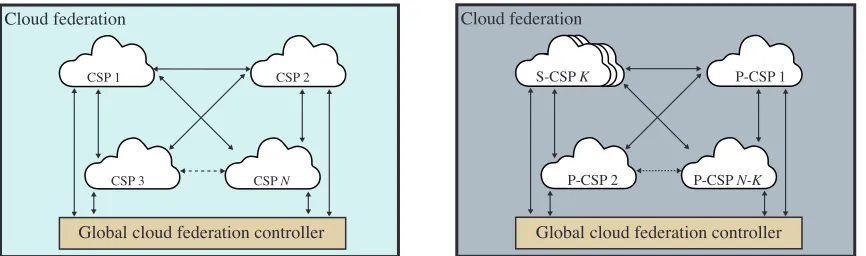
Fig. 1: Cloud services management model (a) generalized model comprising N number of federated cloud service providers (CSP) (b) classification of N CSPs into K secondary cloud service providers (S-CSPs) and N −K primary cloud service providers (P-CSP) at anith trading window.
federation environments. Considering a broker-based market, a strategy for resource requests outsourcing is proposed in [18] to maximize the social welfare of the cloud federation. In [19], a dynamic trading and scheduling algorithm is proposed for optimal management and allocation of jobs with different SLAs to a suitable cloud resource resulting in net profit maxi-mization of each CSP. Within the context of cloud computing, a comprehensive study on auction mechanisms can be found in [20].
The majority of the existing work study the case where the total demand from overloaded providers is higher than the available resources for lease, thus game theoretic approaches and auction theory was implemented to solve a variety of opti-mization problems. However, the scenario when there is more resources for secondary access than the secondary demand, was not investigated. In addition, none of the aforementioned studies have modeled the required demand as a function of grade of service (GoS) target. To complement the well established auction models and the existing literature we adopt merchant mode to address how the secondary CSPs borrow the resources from the primary providers to achieve certain GoS considering lower demand than available resources. The main contributions of this paper are as follows:
• A novel purchase approach for dynamic resource man-agement in a cloud federation scenario.
• A formulation of a finite horizon and non-linear optimiza-tion problem in merchant mode solved using stochastic modeling.
• A versatile approach to automation of cloud service provision within merchant mode.
Cloud services management model is described next. Sec-tion III describes the problem formulaSec-tions. In SecSec-tion IV, we present the analytical results. Finally, Section V summarizes our conclusions and future work.
II. CLOUD SERVICES MANAGEMENT MODEL A cloud services management model is shown in Fig. 1(a), which comprises ofN number of federated CSPs; where each cloud provider offers services to a number of end-users. There are two basic classes of workload considered by the cloud
providers which can be modeled by: (i) a delay system with arrival (λd) where we assume that there is a finite queue length
(i.e.,0< Lq <∞whereLqis the queue length) and (ii) a loss
system with arrival (λl) withL
q = 0, i.e., no buffer capacity.
Assume the service rate is represented by µl andµd for the
loss and delay system respectively. Suppose CSPs divide their resources into equal blocksrlandrd, where each block can be a computational resource, a storage resource etc. Considering the attainable performance thresholds, cloud providers within the federation are required to dynamically maintain suitable levels of certain parameters such as service denial probability and delay tolerance. However, provision of services by CSPs to the end-users in scenarios with high fluctuating workload is a challenging task. In order to improve the efficiency of cloud re-sources in such scenarios, CSPs may desire to share rere-sources among multiple providers. In high demand periods, CSPs with limited resources, that are unable to meet users’ demands, may borrow sequential (uninterrupted) resource blocks from other providers within the federation to maintain a particular grade of service. The CSPs which borrows resources is referred to as secondary cloud service providers (S-CSPs) while the CSPs which lease resources are referred to as primary cloud service providers (P-CSPs). In such setting, P-CSPs offer resource blocks to S-CSPs in return for monetary rewards. Typically, the price per resource block is expected to vary from one P-CSP to another depending on various factors such as the current workload, the geographical location of servers etc.
Each P-CSP announce information related to its available resources for lease and their respective prices at the start of
ith trade window, where i∈ {1,2, . . . , I} andI denotes the total number of trading windows. Supposezipˆdenote the state
of apˆth CSP at the beginning of anith trading window, where
ˆ
p∈ {1,2, . . . , N};zipˆ= 0or1 refers to being overloaded or
underloaded, respectively. Let the announcement for sale of the
ˆ
pth CSP’s resources at the start of an ith trading window is represented byaiˆp, whereaiˆp= 1refers to the announcement
that no resources are available for sale andaiˆp = 0refers to
the announcement of available resources for sale. Supposeti
denote the state of an ith trading window, i.e. ti = 0 means
activated trading window. The following condition is used to determine the state of an ith trading window
ti=
1, if1− N
Q
ˆ p=1
ziˆp
1−
N
Q
ˆ p=1
aipˆ
= 1
0, otherwise
(1)
In case of ti = 1, CSPs are classified into P-CSPs and
S-CSPs for an activated trading window, as shown in Fig. 1(b). The aforementioned process is repeated by the global cloud federation controller (GCFC) at each trading window. Our merchant market is modeled so that trading is allowed between the participants separately for each class of arrival in each of successive trade windows. Once a S-CSP borrows resources from a P-CSP, the S-CSP would use the purchased blocks for the entire duration of the trading window after which the S-CSP returns the resources to the P-S-CSP. Due to the availability of multiple CSPs in the federation, each offering resource blocks at different prices, the aim of the S-CSPs is to minimize the total operating expenditure. The incentive to minimize the operating expenditure is not only economical but also due to regulations which could be imposed by the federation arrangement. The federation controller may also consider to set a particular operating expenditure (OpEx) limit to prevent monopoly abuses. Therefore, the objective of our problem is to maximize profit under limited expenditure. In order to dynami-cally maintain the desired level of performance, we propose an autonomous cloud services management model that is able to make necessary borrowing from other CSPs in the federation, making sure that the profit of S-CSPs is maximized. The next section describes the problem formulation and presents the proposed optimized resource sharing scheme.
III. PROBLEM FORMULATION
For the efficient operation of the cloud federation, the key question for the CSPs is “how they should manage their re-sources dynamically?”, based on time varying demand arising from their users while satisfying a desired grade of service. This is the central focus of this paper. In the previous section we have described the cloud federation which is comprised of |N| (N ≥ 2) CSPs, where overloaded service providers (with ξc > ξd or c > d) borrow resource blocks from
the underloaded providers (with ξc ≤ ξd or c ≤ d) in the
federation facilitated by the global cloud federation controller (GCFC). The GCFC tracks availability of the resources and receives requests from CSPs. As |K| S-CSPs aim to borrow additional resource blocks from|N−K|P-CSPs, the resource borrowing is performed with the objective to either achieve a desired service denial probability (ξd) or a desired delay tolerance (d) in each trading window. The GCFC perform resource block management by borrowing resources from
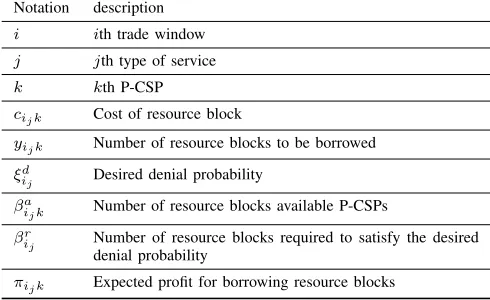
|N −K| P-CSPs to maximize profit of the S-CSPs under restricted operating expenditure scenario (b) which maybe imposed by the federation. Table I lists the key notations used in the paper. The objectives of the GCFC is to maximize profit and to improve service quality of the cloud providers. At
TABLE I: Notation used Notation description
i ith trade window
j jth type of service
k kth P-CSP
cijk Cost of resource block
yijk Number of resource blocks to be borrowed
ξd
ij Desired denial probability
βa
ijk Number of resource blocks available P-CSPs
βr
ij Number of resource blocks required to satisfy the desired
denial probability
πijk Expected profit for borrowing resource blocks
each trade window P-CSP broadcast their available resource blocks {βa
ijk} and the corresponding cost per block {cijk}
(where c > 0). The GCFC evaluates the expected profit
{πijk} which could be made from each resource acquisition.
However, to formulate the optimization problem, the we make the following assumptions.
Assumption. Parameters which are assumed to be known to
the GCFC at each trade window are: arrival rates (λlandλd),
service rate (µl and µd), initial available resources (rl ij and
rd
ij), borrowing cost cijk, budget for borrowingbij, available
number of resourcesβa
ijk and expected profitπijk.
Accordingly, profit maximization problem can be formally defined as follows:
(P) : max
I
X
i=1 J
X
j=1 (N−K)j
X
k=1
πijk · yijk
s.t.
(C1A) : arg min yij k∀i,j,k
Pλl, µl, βirjk+r l ij
≤ξdij, ∀ij, k
for a denial system and
(C1B) : arg min yij k∀i,j,k
Wλd, µd, βirjk+ridj, Lq
≤dij, ∀ij, k
for a delay system.
(C2) : yijk ≤β a
ijk, ∀ij, k
(C3) : Kij
X
k=1
yijk ≤β r ij, ∀ij, k
(C4) : Kj
X
k=1
cijk ·yijk≤bij, ∀ij, k,
πijk in (P) is comprised of the expected revenueRij and cost
cijk, which can be obtained simply by
Although in some instances the cost of the resource block exceeds the revenue of a S-CSP and this yields a negative profit margin, however, for simplicity we considerRijk > cijk
to generate a positive profit for each resource acquisition. The inequality constraint (C4) implies that the GCFC optimizes profit to S-CSPs not only by taking into account the cost variations of the utility, but also by considering the budget constraint (bij) in every trade window.
A. Optimal algorithm
The above non-linear optimization problem is solved by two steps as follows.
Step 1: Queueing analysis: The S-CSPs set their desired
denial probability for each upcoming trade window (e.g.,
ξd = 0.001 for a denial system) (e.g., d = 0.01 sec. for
a delay system). The required resources βr
ij of each S-CSP
is calculated according to the type of the arrival request to achieve the desired denial probability or the desired delay tolerance for ith trade window. For the zero delay tolerance arrival requests, the well-known denial probability formula [21] is used at theith trade window of all S-CSPs. The denial probability formula can be written as
ξ(rl) = 1
rl!
λl
µl
rl
rl
X
n=0 1
n!
λl µl
n
. (3)
In (3) we assume that at every trade window the capacity of a S-CSP belongs to one of the states {0,1,· · ·, n}.rl is the existing cloud computing capacity. Given the existing capacity, the total required resource blocks βij to achieve the desired
denial probability can be calculated by
βij =g
−1Pλl, µl, rl ij
, (4) where g−1(·) the inverse function of ξ(rl) is used to derive the required capacity over the existing capacity. The problem is solved iteratively by performing a search over different values of βij as shown in Algorithm 1. β
r
ij is then obtained
by subtractingrl
ij fromβij.
For the arrival requests with delay tolerance greater than zero, (5) is used for each S-CSP and at each trade window.
(rd) = 1
λd ·Lq (5)
where
Lq =
1 (rdµd−λd)rd ·
(rdλd/µd)rd
rd!(1−λd/µd)
P0 (6)
with
P0=
rd−1
X
l=0
(rdλd/µd)l
l! +
(rdλd/µd)rd
rd!(1−λd/µd)
. (7) Given the existing capacity rd, the total required resource
Algorithm 1: Computing required resources for
de-nial system.
1 Initialization: let number of trading windows = I
2 fori←1 :I do
3 forj ←1 : length (ξd)do
4 ξc = P(λl,µl,rl
ij)
5 βij = r
l ij
6 whileξc > ξd do
7 ξ(w)= P(λl,µl,rl
ij)
8 βij = βij + 1
9 returnRequired resource blocks
Algorithm 2:Computing required resources for delay
sys-tem.
1 Initialization: let number of trading windows = I
2 fori←1 :I do
3 forj ←1 : length (d)do
4 c = W(λd,µd,rd
ij,Lq)
5 βij = r
d ij
6 whilec > d do
7 c = W(λd,µd,rd
ij,Lq)
8 βij = βij + 1
9 returnRequired resource blocks
blocksβij to achieve the desired delay tolerance is given by
βij =g
−1Wλd, µd, rd ij, Lq
, (8) and the solution is provided iteratively by Algorithm 2.
In a nutshell, the computational approach used in Algorithm 1 and 2 is to evaluate the required resources (of one CSP) of a simulated system, introducing random variations of a specific probability distribution to the parameter values at each trade window.
Step 2: Optimization:Given the information obtained in the
previous step, the borrowing selection performed by the GCFC are made subject to achieving the maximum profit to S-CSPs. The spending capacity of the S-CSP is constrained by budget
bij. If the acquired resources β a
ijk are insufficient to meet
the desired denial probability (desired delay tolerance) (i.e.,
βirjk−βiajk >0), then the GCFC perform borrowing from the remaining resources from the setβa
ijk6∈ {β a ij1, β
a
ij2, . . . , β a ijJ}
for which the profit is maximum. If the desired performance is met, then the GCFC ends the process of borrowing new resource for the current trading window. Algorithm 3 summa-rizes the optimal solution.
B. Heuristic algorithm
Algo-Algorithm 3: Optimal resource borrowing under limited budget.
1 bij,cijk,β a
ijk andβ r
ijk are obtained ∀i, j, k.
2 for i←1 :I do
3 for k= 1 : (N−K)do
4 Solve the nonlinear stochastic problem (P) s.t.
(C1A or C1B), (C2), (C3) and (C4).
5 return Profit of the cloud service operator
rithm 4 performs borrowing randomly from the set{βiajk}, to satisfy the demand βr
ij. The constraints (C2), (C3) and (C4)
are satisfied by using
yijk =
βia
jk, β r ij ≥β
a
ijk, bij ≥cijk
βr ij, β
r ij < β
a
ijk, bij ≥cijk 0, bij < cijk orβ
r ij = 0.
(9)
Note that whenPβa ijk ≤β
r
ij, the heuristic algorithm performs
as well as the optimal algorithm. We also note that when PJij
k=1β a ijk > β
r
ij, the heuristic algorithm may still provide
outcome in line with the optimal method in terms of achieved profit, however, this is a result of random variation with probability 1
J, β
a ijk ≥β
r ij,∀ij 1
D,
X
m {β¯a
ijlm, ∀l, m} ≥β r ij,∀ij
(10)
where {β¯a
ijlm, ∀l, m} ⊂ {β a
ijk,∀ij, k} and D =
{
¯
βa ij..}
is the number of subsets in the set {β¯a
ij..} which satisfy
the demand. Of course, the probability is 1 if PJij k=1β
a ijk ≤
βr ij,∀ij.
Once the problem is solved, either by the optimal or the heuristic algorithm, the new access denial probability can be calculated as
ξc=P
λl, µl,
rilj +
Kij
X
k=1
yijk
(11)
and the new delay is calculated by
c =W
λd, µd,
rdij +
Kij
X
k=1
yijk
. (12) To compute the required resource, the non-linear constraints,
C1A andC1B are solved iteratively using Algorithm 1 and 2,
respectively. The optimization problem is then solved with the remaining constraints by the revised simplex method given in Algorithm 3. Algorithm 3 is clearly a polynomial time (O(n)) while the heuristic algorithm (Algorithm 4) is quadratic (O(n2)) with number of P-CSP (N−K) or exponential time
(O(2n)) with number of trading windows (I).
Algorithm 4: Heuristic resource borrowing under limited
budget.
1 bij,cijk,β a ijk andβ
r
ijk are obtained∀i, j, k.
2 for i←1 :I do
3 Setyijk ← {φ}, where {φ} is an empty set. 4 Set counter←Pkyijk.
5 Choose a random integern∈ {1,2, . . . ,(N−K)}.
6 forallP-CSPs k=n: (N−K) and 1 : (n−1)do
7 if(0< βia jk)≤(β
r
ij -counter) & (cijk∗β
a
ijk)≤bij then
8 yijk ←β
a ijk.
9 counter←counter+Pyijk.
10 bij ←bij−
P(y
ijk∗cijk).
11 else if(βia
jk >0) &cijk ≤(bij −counter) & (βa
ijk∗cijk)≥bij then
12 yijk ←
b
ij
cijk
(wherebxcmeans floor of x.
13 counter←counter+Pyijk.
14 bij ←bij−
P
yijk.∗cijk.
15 else ifcounter≤βir
j &β a
ijk >0&
βiajk ≥(βirj −counter) & (βiajk∗cijk)≤bij then
16 yijk ←βir
j −counter. 17 counter←counter+Pyijk.
18 bij ←bij−
P
yijk.∗cijk.
19 break
20 else ifcounter≤βir
j &β a
ijk >0&
βa ijk ≥(β
r
ij −counter) & (β a
ijk∗cijk)≥bij then
21 yijk ←min
b
ij
cijk
.
22 counter←counter+Pyijk.
23 bij ←bij−
P
yijk∗cijk.
24 else
25 yijk ←0.
26 returnProfit of the cloud service operator
IV. RESULTS AND ANALYSIS
Trading window index
1 2 3 4 5 6 7 8 9 10
Expected Profit of the SCSPs
0 10 20 30 40 50 60 70
Profit (Optimal) Profit (Heuristic)
Fig. 2: A comparison of profit made with heuristic and optimal resource selection per trading window.
CSPs are categorized into P-CSPs and S-CSPs depending on their workload. CSPs that are unable to meet their users’ demands are classified as S-CSPs, whereas, CSPs with surplus resources are categorized into P-CSPs. Two types of systems are considered - denial system and delay system; which have been presented in Algorithm 1 and Algorithm 2 respectively to estimate the number of required resources for a S-CSP to meet its users’ demands. In order to evaluate efficiency of the proposed optimal solution presented in Algorithm 3 for profit maximization under restricted budget, we compare the performance of the optimal solution with a heuristic model given in Algorithm 4. In the simulation model, the budget of each CSP is considered to be 50. Although, in the simulations we consider a fixed budget, the proposed model is capable of leading to an optimized solution for dynamically changing available budget of CSPs. Depending on the workload, once the CSPs are categorized into P-CSPs and S-CSPs, the latter are expected to lease resources from the former in order to provide services to the end-users with minimized blocking probability and maximized profit.
Considering the aforementioned simulation settings and 10 trading windows, Fig. 2 illustrates comparative perfor-mance analysis of the heuristic and optimal resource selection schemes within the context of the profit made per trading window. It can be observed from the results that the optimal resource allocation scheme results in profit maximization for every trading window as compared to its heuristic counterpart. Moreover, in order to estimate the overall performance gain, 50 trading windows are considered for setting up the simulations and, it is found that on average, the optimal approach leads to 25.35% profit gain per trading window compared to the heuristic solution.
In order to gauge performance of the proposed optimal scheme compared to the heuristic approach in terms of the total profit made for a number of trading windows, simulation results are shown in Fig. 3. Considering a range set of the number of trading windows, that spans from 5 to 50, it can be noticed from the results that at the 50th trading window, S-CSPs can achieve net profit gain of 43.5% by utilizing the proposed strategy for optimal resource allocation.
Number of trading windows
5 10 15 20 25 30 35 40 45 50
Expected Profit of the SCSPs
0 500 1000 1500 2000 2500
Profit (Optimal) Profit (Heuristic)
Fig. 3: A comparison of total profit made with heuristic and optimal resource selection for a number of trading windows.
Number of trading windows
10 15 20 25 30 35 40 45 50
Number of resource blocks borrowed
200 400 600 800 1000 1200 1400 1600 1800
Optimal Heuristic
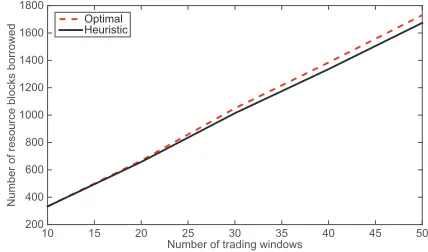
Fig. 4: A comparison of the total number of resource blocks borrowed with random and optimal resource selection for a number of trading windows.
In the earlier discussion, the superior performance of the proposed optimal scheme over the heuristic approach has been demonstrated in terms of profit maximization. Nevertheless, further investigation is required to strengthen such analysis by taking into account the number of resource blocks borrowed by S-CSPs. Therefore, a comparison of the proposed optimal scheme with heuristic approach in terms of the number of resource blocks leased by S-CSPs from P-CSPs is shown in Fig. 4. It can be observed from the results that the optimal scheme leads to a higher number of borrowed resource blocks under the restricted budget and at the same time maximizes the overall profit. As an example, the optimal solution results in 3.35% additional resource allocations after 50 trading windows compared to the heuristic algorithm.
200 150
Available budget 100 50 0 0.8 0.7 Desired service denial probability
0.6 0.5 0.4 0.3 0.2 0.1 0 30
25
20
15
10
5
0 35 40
Expected Profit of the SCSPs
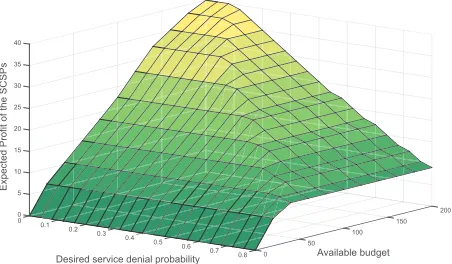
Fig. 5: Expected profit of the S-CSPs for resource borrowing at one trading window with desired service denial blocking probability as a function of budget.
the proposed formulation can assist the CSPs to efficiently choose suitable level of service denial probability and budget for expected revenue generation.
V. CONCLUSION
As networking has become major innovation driver for the Internet of Things (IoT), cloud computing has attracted a remarkable interest from research community not only because of its ability to lower costs and increase revenue, but also because it can improve existing computing services. In this context we have proposed a framework to model merchant market in a cloud federation scenario. The model categorizes and computes the required resource blocks to meet a certain GoS for cloud federation participants. We have focused pri-marily on delivering the CSP’s demand by using an automated purchasing mechanism with the aim to maximize profit to overloaded service providers. To solve the problem we have developed two algorithms; an optimal and a heuristic solution. The optimal algorithm is evaluated against heuristic model. Our analytical results revealed that our approach leads to higher profit to CSPs, especially when the underutilized com-putational resources of the P-CSPs are higher than the demand from the S-CSPs. By adding the functionalities of types of demand and types of services provided by the CSP into our framework, we can conclude that our automation model is more versatile than those available in the literature. Although we have focused on maximizing profit, our framework could easily be modified to optimize other measures such as, cost and energy. Another contribution of this paper is that it provides a complementary approach to the well studied auction mode. As a future work, our model could be jointly implemented with auction mode to provide an all-round framework for automation of cloud federation market within 5G.
REFERENCES
[1] N. Saxena, A. Roy, B. J. R. Sahu, and H. Kim, “Efficient IoT gateway over 5G wireless: A new design with prototype and implementation results,”IEEE Communications Magazine, vol. 55, no. 2, pp. 97–105, February 2017.
[2] Department for Culture, Media & Sport, “Next Generation Mobile Tech-nologies: A 5G strategy for the UK,” https://www.gov.uk/government/ publications/next- generation- mobile- technologies- a- 5g- strategy- for-the-uk, Policy paper, 2017.
[3] M. R. Palattella, M. Dohler, A. Grieco, G. Rizzo, J. Torsner, T. Engel, and L. Ladid, “Internet of things in the 5G era: Enablers, architecture, and business models,”IEEE Journal on Selected Areas in Communica-tions, vol. 34, no. 3, pp. 510–527, March 2016.
[4] M. S. Hossain and G. Muhammad, “Cloud-assisted industrial internet of things (IIoT) - enabled framework for health monitoring,”Computer Networks, vol. 101, pp. 192–202, 2016.
[5] L. Kong, M. K. Khan, F. Wu, G. Chen, and P. Zeng, “Millimeter-wave wireless communications for IoT-cloud supported autonomous vehicles: Overview, design, and challenges,” IEEE Communications Magazine, vol. 55, no. 1, pp. 62–68, January 2017.
[6] J. Jin, J. Gubbi, S. Marusic, and M. Palaniswami, “An information framework for creating a smart city through internet of things,” IEEE Internet of Things Journal, vol. 1, no. 2, pp. 112–121, April 2014. [7] C. You, K. Huang, H. Chae, and B. H. Kim, “Energy-efficient resource
allocation for mobile-edge computation offloading,”IEEE Transactions on Wireless Communications, vol. 16, no. 3, pp. 1397–1411, March 2017.
[8] A. Amjad, F. Rabby, S. Sadia, M. Patwary, and E. Benkhelifa, “Cognitive edge computing based resource allocation framework for Internet of Things,” in 2nd International Conference on Fog and Mobile Edge Computing (FMEC). IEEE, 2017, pp. 1–7.
[9] A. Ahmed and E. Ahmed, “A survey on mobile edge computing,” in
2016 10th International Conference on Intelligent Systems and Control (ISCO). IEEE, 2016, pp. 1–8.
[10] A. Beloglazov, J. Abawajy, and R. Buyya, “Energy-aware resource allocation heuristics for efficient management of data centers for cloud computing,” Future generation computer systems, vol. 28, no. 5, pp. 755–768, 2012.
[11] K. Chard and K. Bubendorfer, “Co-operative resource allocation: Build-ing an open cloud market usBuild-ing shared infrastructure,”IEEE Transac-tions on Cloud Computing, 2016.
[12] A. Celesti, M. Fazio, M. Giacobbe, A. Puliafito, and M. Villari, “Characterizing cloud federation in iot,” in 30th International Confer-ence on Advanced Information Networking and Applications Workshops (WAINA), March 2016, pp. 93–98.
[13] M. Assis and L. Bittencourt, “A survey on cloud federation architec-tures: Identifying functional and non-functional properties,”Journal of Network and Computer Applications, vol. 72, pp. 51–71, 2016. [14] D. G. Kogias, M. G. Xevgenis, and C. Z. Patrikakis, “Cloud federation
and the evolution of cloud computing,”Computer, vol. 49, no. 11, pp. 96–99, Nov 2016.
[15] N. Samaan, “A novel economic sharing model in a federation of selfish cloud providers,”IEEE Transactions on Parallel and Distributed Systems, vol. 25, no. 1, pp. 12–21, Jan 2014.
[16] L. Mashayekhy, M. M. Nejad, and D. Grosu, “Cloud federations in the sky: Formation game and mechanism,” IEEE Transactions on Cloud Computing, vol. 3, no. 1, pp. 14–27, Jan 2015.
[17] M. M. Hassan, M. Abdullah-Al-Wadud, A. Almogren, B. Song, and A. Alamri, “Energy-aware resource and revenue management in feder-ated cloud: A game-theoretic approach,”IEEE Systems Journal, vol. PP, no. 99, pp. 1–11, 2015.
[18] L. Tang and H. Chen, “Double auction mechanism for request outsourc-ing in cloud federation,” in 2015 IEEE International Conference on Communication Workshop (ICCW), June 2015, pp. 1889–1894. [19] H. Li, C. Wu, Z. Li, and F. C. M. Lau, “Virtual machine trading in a
federation of clouds: Individual profit and social welfare maximization,”
IEEE/ACM Transactions on Networking, vol. 24, no. 3, pp. 1827–1840, June 2016.
[20] “A systematic study of double auction mechanisms in cloud computing,”
Journal of Systems and Software, vol. 125, pp. 234–255, 2017. [21] K. I. Aardal, S. P. Van Hoesel, A. M. Koster, C. Mannino, and
A. Sassano, “Models and solution techniques for frequency assignment problems,”Annals of Operations Research, vol. 153, no. 1, pp. 79–129, 2007.
[22] A. Verma, P. Ahuja, and A. Neogi, “pmapper: power and migra-tion cost aware applicamigra-tion placement in virtualized systems,” in