https://doi.org/10.5194/jsss-8-161-2019
© Author(s) 2019. This work is distributed under the Creative Commons Attribution 4.0 License.
Impedance model for a high-temperature ceramic
humidity sensor
Henrik Lensch, Manuel Bastuck, Tobias Baur, Andreas Schütze, and Tilman Sauerwald
Laboratory for Measurement Technology, Saarland University, Saarbrücken, 66123, Germany
Correspondence:Henrik Lensch ([email protected]) and Tilman Sauerwald ([email protected])
Received: 28 September 2018 – Revised: 17 January 2019 – Accepted: 18 March 2019 – Published: 18 April 2019
Abstract. We present an equivalent circuit model for a titanium dioxide-based humidity sensor which enables discrimination of three separate contributions to the sensor impedance. The first contribution, the electronic conductance, consists of a temperature-dependent ohmic resistance. The second contribution arises from the ionic pathway, which forms depending on the relative humidity on the sensor surface. It is modeled by a constant-phase element (CPE) in parallel with an ohmic resistance. The third contribution is the capacitance of the double layer which forms at the blocking electrodes and is modeled by a second CPE in series to the first CPE. This model was fitted to experimental data between 1 mHz and 1 MHz recorded at different sensor temperatures (between room temperature and 320◦C) and different humidity levels. The electronic conductance becomes negligible at low sensor temperatures, whereas the double-layer capacitance becomes negligible at high sensor temperatures in the investigated frequency range. Both the contribution from the ionic pathway and from the double-layer capacitance strongly depend on the relative humidity and are, therefore, suitable sensor signals. The findings define the parameters for the development of a dedicated Fourier-based impedance spectroscope with much faster acquisition times, paving a way for impedance-based high-temperature humidity sensor systems.
1 Introduction
Detection and quantification of humidity as a process param-eter are important for many different branches of industry like food processing, medicine, climate control, or indus-trial drying (Blank et al., 2016). While capacitance measure-ment is by far the most common sensor principle at room temperature, current capacitance sensors cannot be used at higher temperatures due to their limited temperature stabil-ity and their bad sensitivstabil-ity at low relative humidstabil-ity (Blank et al., 2016; Lee and Lee, 2005; Wagner et al., 2011). Ca-pacitance sensors in general exploit a permittivity change in the material caused by adsorbed or intercalated water. Ceramic-based sensors are an alternative choice with better temperature stability (Farahani et al., 2014). Titanium diox-ide (TiO2) is a ceramic well known for its humidity
sens-ing capabilities as well as its robustness at high tempera-tures (Blank et al., 2016). Humidity-dependent permittivity changes have been reported for TiO2 (Lee and Lee, 2005),
however, with poor sensitivity at low humidity. An
alterna-tive read-out method of TiO2-based sensors measures the
humidity-dependent conduction, providing better sensitivity at low temperatures. Conduction in TiO2 has been well
de-scribed by several groups covering several conducting mech-anisms (Traversa, 1995; Wang et al., 2011; Wu et al., 2017). These different mechanisms can be identified by impedance spectroscopy, which is a powerful tool to characterize elec-trochemical systems and therefore a promising method to gain many different, humidity-dependent signals from one physical sensor. This multitude of signals can help in under-standing the physical processes on the sensor surface, as well as lead to a more robust sensor system working within a wide temperature range.
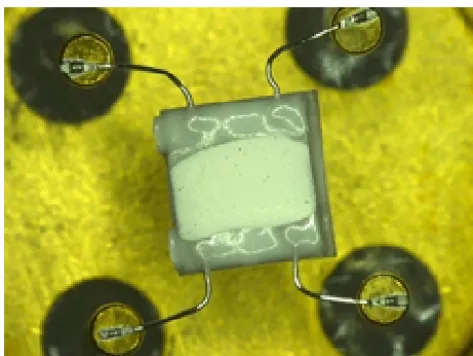
spec-Figure 1.Optical micrograph of the sensor. The size of the sensor element is 2 mm×2.3 mm. The white material is TiO2, whereas the grey material is the alumina substrate.
trum and the measurement time must be made (Cooper et al., 2008). Long measurement times are especially problem-atic as the environmental conditions could change during the measurement, which makes quick measurements a key re-quirement for impedance spectroscopic measurements not only with chemical sensors (Cooper et al., 2008). A Fourier-based impedance spectroscope (FoBIS) mitigates this issue since the measurement time for a complete spectrum can be reduced to the period time of the lowest measured frequency (Doerr et al., 2018; Schüler et al., 2015). A FoBIS, however, must always be carefully designed with respect to the dy-namic frequency and impedance range to obtain the desired resolution and accuracy. To this end, the impedance charac-teristic of a newly developed TiO2sensor has been carefully
characterized using a highly versatile laboratory impedance spectroscope of the frequency response analyzer type. Based on this characterization, a suitable physical sensor model, which despite its simplifications yields very high accuracy, has been developed. Interesting parts of the impedance spec-trogram were identified and will be used in the future to tai-lor the newly developed FoBIS towards quick measurements which can be fitted with this physical model.
2 Materials and methods
2.1 Sensor prototype
The measurements were performed with prototype sensor samples from Umweltsensortechnik GmbH, Geschwenda, Germany. The sensor consists of a ceramic carrier substrate (Al2O3) with a micro-structured platinum thin-film layer for
the interdigital electrodes and a platinum heater (Pt-10) as well as a humidity-sensitive TiO2 mixed oxide thick film.
The sensor substrate is mounted by platinum wires in a
four-pin TO39 case. Figure 1 shows an optical micrograph of the sensor.
2.2 Experimental setup
Humidity measurements were carried out in a gas mix-ing system consistmix-ing of two mass flow controllers (MFCs) which provide a defined gas flow ratio between dry and hu-mid air. The dry air is taken from a zero-air generator with catalytic combustion and was fed through a bubbler flask filled with water to generate the humid air stream. This bub-bler flask is followed by a second flask filled with glass wool to separate aerosols like water droplets. The whole humidi-fier system is placed in a climate chamber, which can be set to an elevated temperature to provide high absolute humid-ity (up to 447 mbar partial pressure of the humidhumid-ity at 80◦C). The sensor is placed outside the climate chamber, for easy ac-cess and connections, in a heated sensor chamber. The sensor chamber and the humidifier are interconnected with a heated transfer line (T =120◦C) to prevent condensation. The sen-sor itself will be heated with its platinum heating element (Pt-10) providing quick heating and cool-down times (time constant below 10 s). For room temperature measurements, the heating system is switched off.
The impedance spectra are recorded with a Solartron 1260 frequency response analyzer. Some of the measurements, es-pecially those at high impedances, were performed with the addition of the Solartron 1296 dielectric interface. For high impedance measurements the lower boundary of the inves-tigated frequency was set to 1 mHz. For any other measure-ments, the lower boundary was set to 1 Hz to reduce the mea-surement time. The highest measured frequency was 1 MHz in all measurements. The following graphs will, however, in some cases be clipped to lower frequency ranges to highlight the effects in the shown range.
3 Results
3.1 Electronic conductance
We measured the contribution of electronic conductance at 0 %RH from room temperature (Fig. 2) up to 250◦C (Fig. 3). The impedance was completely capacitive over the measured frequency range. This is directly visible in the slope of the magnitude or the absolute value of the phase angle; therefore, Bode diagrams are used instead of the also common Nyquist diagram. The slope of the magnitude in the Bode diagram is approx.−1 with a phase of approx.−90◦. These values
Figure 2.Magnitude of the sensor at room temperature in dry air. The outlier represents 50 Hz noise.
At elevated temperatures (150, 180, 200, 250◦C), a dif-ferent shape for the impedance spectra is observed (Fig. 3). In general, the magnitude decreases, especially at low fre-quency, with increasing temperature. The near resistor-like behavior (phase at −3◦ except at 150◦C) in the low-frequency regime makes the sensor exhibit anR||Cbehavior together with the geometrical capacitance. Consequently, the phase angle converges to 0◦for low frequencies. For 180, 200 and 250◦C this effect can be observed unambiguously. We presume that for the 150◦C spectrum the phase angle would as well converge to 0◦, but at frequencies below 1 mHz.
3.2 Humidity measurements at room temperature
Impedance measurements are taken at room temperature with an increasing relative humidity from 10 %RH to 85 %RH in 5 %RH steps (Fig. 4) at a constant total gas flow of 100 mL min−1. Ten spectra from 100 mHz to 1 MHz were recorded for each humidity concentration. The noisy sig-nal at 10 %RH and 15 %RH is due to the limit of the fre-quency response analyzer’s measurement range. The phase angles below 10 %RH were neither continuous nor below 0◦ and the corresponding measurements are, therefore, not
considered in the data evaluation. The magnitude over log-arithmic frequency shows two to three domains with differ-ent slopes, shifting with humidity. At low humidity the low-frequency domain cannot be observed. This is probably be-cause the respective element simply dominates outside the lower-frequency boundary. All three domains show neither ideal resistor-like nor ideal capacitor-like behavior, but can be described by a constant-phase element (CPE) (Barsoukov
Figure 3.Bode plot of the sensor at different temperatures in dry air.
and Macdonald, 2005). The complex impedance of a CPE is shown in Eq. (1), whereQis the prefactor of the CPE,j is the complex unit,ω is the circular frequency, and αis the CPE’s exponent.
Z(ω)= 1
Q·(jω)α (1)
The CPE becomes frequency-independent for an exponent α=0 so thatZbehaves like a resistor with a resistanceR= 1/Q. For an exponent ofα=1,Zequals a capacitor with the capacitanceC=Q. Hence, the exponent must always be in the range between 0 and 1, and we can determine a resistor-like behavior (α< 0.5) or a capacitor-like behavior (α> 0.5). Consequently, a CPE with lower alpha will be considered to be more resistive-like.
In a Bode plot, where a CPE is the dominant element for the impedance in a certain frequency range, the exponentα resembles the negative slope in this frequency range. This relationship is depicted in Eq. (2), describing the magnitude of a single CPE in a Bode plot. With suitable substitutions, the equation’s linear character becomes obvious.
log10|Z| =log10 1
Q
−α·log10
1
log10ω
(2)
Figure 4.Bode diagram of the sensor at different relative humidity levels at room temperature. The missing datapoint at 188.4 mHz in each spectrum is a systematic error and is therefore not plotted for better clarity.
at 25 %RH up to 100 Hz at 85 %RH. All graphs run in par-allel in this resistive section. Note the significant drop in magnitude from 15 %RH to 20 %RH, which could indicate a percolation effect (Sauerwald and Russ, 2013). After the resistive plateau, the slope of the amplitude changes again to follow a strong capacitive behavior where, eventually, all spectra collapse to one curve with a slope of−1. At high hu-midity (70 %RH and above) the upper frequency boundary of 1 MHz is not sufficient anymore to observe this collapse.
The information in the phase plot is consistent with the magnitude plot. In the low-frequency domain, the lowest phase angle is −55◦ at approx. 1 Hz at 85 %RH. Below 55 %RH the phase angle has not reached the inflection point yet. An angle below −45◦ represents a predominantly ca-pacitive behavior. Ignoring the outliers due to the noise in the first two humidity levels, we observe a maximum phase angle of−7◦which corresponds to the slope of the
resistive-like section in the magnitude plot. The gap between 15 %RH and 20 %RH represents the visible drop in magnitude. In the high-frequency domain, the phase angle changes to−90◦and we can see that the upper limit of 1 MHz is not sufficient to see all humidity levels change to−90◦.
3.3 Humidity measurements at elevated temperature
High-temperature measurements were carried out with the humidifier and sensor chamber heated to 80◦C to create high absolute humidity (up to 447 mbar). Simultaneously, the sen-sor itself was heated to 320◦C to create a high-temperature
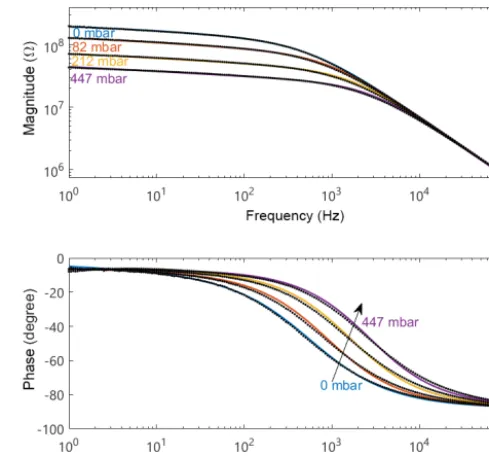
Figure 5.Bode diagram of the sensor at different relative humid-ity levels at elevated temperature. The colored dots represent the experimental data to which the model was fitted (colored lines).
environment on the sensor surface (the change in relative humidity at an absolute humidity of 82 to 447 mbar ranges from 0.07 %RH to 0.38 %RH at a surface temperature of 320◦C). Preliminary measurements had shown a frequency range from 1 Hz to 1 MHz to be enough. The plots in this section were clipped to highlight the contribution of non-geometric effects below 100 kHz.
The amplitude plot exhibits two distinct slope domains at high temperature instead of the three at room temperature. The first slope (−0.07) indicates a resistive-like behavior, whereas the second slope is the geometrical capacitance as in the room-temperature measurements before. The phase plot shows an intersection at 3 Hz and a phase angle of−6.3◦. On the low-frequency end, the phase rises towards 0◦in low
hu-midity and decreases in high huhu-midity (Fig. 5). On the high-frequency end, all measurements collapse, again, at the min-imum phase angle of about−90◦.
3.4 Impedance model for room temperature measurements
The general principle of ceramic humidity sensors is based on adsorption of water molecules on the material surface (Farahani et al., 2014). Depending on temperature and cov-erage, they change the sensor’s impedance characteristics in certain frequency ranges distinctively (Faia et al., 2009). The most commonly used sensor effect is the humidity-dependent change in the permittivity of the sensor material, i.e., a porous ceramic like TiO2, between the sensor
hu-midity, the change in capacitance is negligible and the dom-inant humidity-dependent mechanism is the adsorption of ionic species at the sensor surface (Faia et al., 2009; Fara-hani et al., 2014). At low relative humidity, the surface oxy-gen vacancies of TiO2promote the dissociation of water to
hydroxyl groups which adsorb at the vacancies and provide protons as charge carriers (Xie et al., 2015). When this first, chemisorbed layer has completely covered the sensor sur-face, subsequent layers will physisorb on the chemisorbed layer and build clusters of hydroxyl groups which promote proton hopping between these clusters and a proton trans-fer between adjacent hydronium and water molecules within the clusters (Traversa, 1995). At a certain level of humid-ity this physiosorbed layer forms a closed path between the electrodes of the sensor, causing a sudden increase in con-ductance (Wang et al., 2011).
However, the blocking nature of the electrode towards ionic charge carriers will cause a specific conduction mech-anism at the electrode–electrolyte interface. Charge carriers move to the charged electrode and create a double-layer ca-pacitance (Traversa, 1995). The phase angle of this capaci-tance differs from the ideal capacitor due to the fractal level of the sensor material. This effect is usually modeled as a constant-phase element (Faia et al., 2005). Depending on the nature of the charge-transfer process, the electrodes are either fully blocking (no charge transfer) or porous (charge trans-fer), which is then modeled through an additional charge-transfer resistance (Rdl) in parallel to the capacitance (Cdl)
(Barsoukov and Macdonald, 2005).
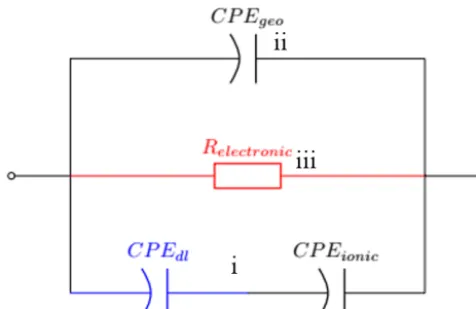
These different conduction models of water can be rep-resented as elements in an electrical equivalent circuit as shown in Fig. 6. Since the electronic conductivity of TiO2
at room temperature is negligible (Fig. 2), we can assume that only ionic charge carriers are present at the electrode– electrolyte interface and, therefore, we use a blocking elec-trode (Rdl= ∞) in the model. Because diffusion takes place
on the sensor surface (and not in the bulk) it is a kind of non-linear diffusion and should have a phase angle which differs from an ideal capacitor or a linear diffusion element (Bis-quert and Compte, 2001). This can be modeled as a constant-phase element CPEdl. We propose that this double-layer
ca-pacitance is the predominant caca-pacitance visible at the low-frequency domain of the Bode plot in Fig. 4.
The ionic conductance is dependent on the location of the oxygen vacancies of the sensor (Pan et al., 2013) and, there-fore, on the morphology of the sensor material. For porous and especially for fractal geometries this can be modeled as one CPEion(Ruiz and Felice, 2015). The high-frequency
do-main of the spectrum in Fig. 4 shows the capacitance be-tween the electrodes. This element is visible independent of the surface conductivity and is an almost ideal capacitorCgeo
in parallel with all other elements.
3.5 Impedance model for elevated temperature measurements
The easiest identified element is the already discussed geo-metrical capacitanceCgeo. In humid air, hydroxyl groups can
still be found on the sensor surface at the sensor temperatures (320◦C) applied in this work (Trimboli et al., 2006; Wu et al., 2017). This means that the humidity-dependent conduction mechanism is still an ionic pathway between the electrodes on the sensor surface, as already discussed for room temper-ature. Therefore, we can use the previously discussed ele-ments to model the double-layer capacitance and ionic con-ductivity. At elevated temperature the sensor material’s elec-tronic conductance cannot be neglected and must be consid-ered to be an additional influence on the sensor impedance (Wahlström et al., 2004). TiO2 is an n-type semiconductor
with deep donors 3 eV below the conduction band (Pan et al., 2013). Therefore, most donors are not ionized at 320◦C, leading to a temperature dependence of the electronic con-ductance. This can be described by an ohmic resistor, which can be seen in the phase plots of Figs. 3 and 4, since the maximum phase angle of the sensor in dry air collapses at about−0.1◦, whereas all humid measurements show a com-mon maximum phase at around −6.25◦. This angle repre-sents a strongly resistive CPE, the ionic pathway, which does not exist at 0 mbar humidity.
4 Fitting
4.1 Equivalent circuit
The resulting equivalent circuit is a superposition of the con-ductivity mechanisms described above forming three parallel pathways.
The first path (i) describes the ionic conductance through the double-layer capacitance (CPEdl) in series with the ionic
conductance (CPEionic).
The second path (ii) is the geometric capacitance. At higher frequencies the geometric capacitance which is in-dependent of the surface conductance becomes the domi-nant element and must, therefore, be in an additional, par-allel branch (ii) of the equivalent circuit. When modeled as a CPE, the fitted exponent lies above 0.93 in all measurements, which makes the CPE resemble a near-ideal capacitance.
A third path (iii) represents electronic conductance which is only visible at elevated temperatures as seen by the pure capacitive behavior in Fig. 2 and the beginning of the resistor-like behavior in Fig. 3. Therefore, it cannot be mod-eled for the room temperature measurements.
Figure 6.Proposed equivalent electrical circuit for humidity sens-ing in a broad temperature range. CPEdlis highlighted in blue be-cause it can only be fitted at room temperature. At high temperature this element is shorted.Relectronicis highlighted in red because its only visible in the elevated temperature model.
make it visible the lowest measured frequency would have to be far below 1 mHz, which would result in an unreason-ably long measurement time, or the dew point of 80◦C must be increased to achieve higher relative humidity at the sen-sor surface. Thus, CPEdlis modeled as short in the elevated
temperature model.
The electronic path (iii) is regarded as open in the low tem-perature model and consequently Relectronichas been
omit-ted for all fits of low-temperature measurements, since the sensor is purely capacitive at 0 %RH at room temperature (Fig. 2). Even for high temperatures, the electronic path (iii) only dominates the conductance at very low humidity and in the range of low frequencies. As the CPEionicis very
resistor-like, the discrimination between path (ii) and (iii) from the spectra would require measurements at very low frequencies. To avoid cross-related wrongful determinations ofRelectronic
and CPEionic, we setRelectronicto a constant value of 2.4 G
in the fit algorithm for measurements at 320◦C, making use of the fact that Relectronic is not humidity-dependent. The
value of 2.4 Gis taken from a measurement at 0 %RH in which no ionic conductance is prevalent.
4.2 Results of fits
All measurements have been fitted with the EES as described above with the following results for the parameters.
4.2.1 Ionic path
As already mentioned in Sect. 3.4 the diffusion process of ions at this interface is bound to the geometry of the sensor material and is, therefore, nonlinear. The CPEdlcan only be
observed at low temperatures in the humidity range at and above 20 %RH. The exponent is in the range of 0.6, indi-cating a nonlinear diffusion element (Bisquert and Compte,
2001). Below 20 %RH, CPEdlis not visible in the Bode
dia-gram (in the observed frequency range) and, therefore, can-not be fitted properly. Consequently, this effect is never vis-ible at high temperatures and, thus, the element is shorted in the model, leaving CPEionicto be the only element in the
pathway. The exponent of CPEionicis in the range of 0.1,
dicating a resistor-like but not ideal conductance. At both in-vestigated temperatures, i.e., room temperature and 320◦C, CPEionicbecomes more resistive-like with increasing
humid-ity. This could be due to the hydroxyl clusters on the surface growing in size, decreasing the distance between them. This, in turn, leads to more conductive and less capacitive behav-ior. With the start of multilayer adsorption, the increase in conduction is even larger, providing more ionic pathways for the ionic charge carriers. The exponentαionicis much higher
at elevated temperature than at room temperature. It drops from 0.26 to a close to ideal resistive behavior of 0.09. Since the relative humidity on the sensor surface is extremely low due to its high temperature, a closed chemisorbed layer can-not be built, which hinders the hopping of protons between the hydroxyl clusters. This leads to an increased capacitive-like behavior (α=0.27 at 0 mbar andα=0.15 at 82 mbar) which changes to a near resistive-like behavior with increas-ing humidity as the distance between the clusters becomes smaller (αgets below 0.1 with increasing humidity).
4.2.2 Geometrical (capacitive) path
For the room temperature measurement, the exponentαgeo
is always close to 1 and slightly decreasing with increasing humidity (Fig. 7). Since the phase angle of−90◦ in Fig. 4 moves out of the observed frequency range with increasing humidity, the exponent will also move away from an ideal capacitor. At high temperature the exponent (Fig. 8) shows a near-ideal capacitive behavior over the entire measurement range. Based on these measurements, we strongly presume that CPEgeois an ideal capacitor and that the decrease at high
relative humidity is simply due to the fact that a small part of the ionic conductance is wrongly attributed to CPEgeo.
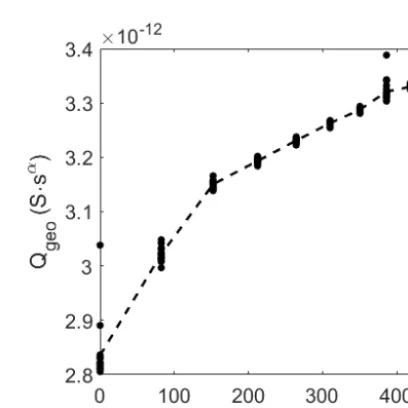
As described in the model in Sect. 3.4 the geometric capac-itance increases almost linearly with relative humidity in the range from 10 %RH to 60 %RH (Fig. 9). At about 75 %RH the capacitance starts to increase more than linearly. This in-crease depends on the same effect as the slow dein-crease in the exponentαgeo. Hence, CPEgeo cannot be fitted properly
in this regime, which is obvious from the increasing varia-tion of the fit above 75 %RH. These results strongly suggest that at humidity levels below 60 %RH the adsorption can be seen as a multi-layer physisorption as described in Faia et al. (2005) linear to the partial pressure (according to Henry’s law), while for humidity higher than 75 %RH a multilayer adsorption with additional pore condensation is dominant.
Figure 7.Exponents of every CPE over relative humidity at room temperature. The dots represent the value of the fit of each measure-ment. The dashed lines represent the mean of the dots.
Figure 8. Exponents of every CPE over absolute humidity at 320◦C. The dots represent the value of the fit of each measurement. The dashed lines represent the mean of the dots.
is too small (between 0 %RH and 0.4 %RH) to cause a strong adsorption of humidity with a following strong effect on the capacitance.
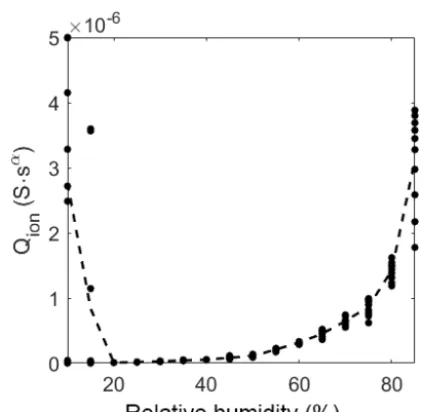
Figure 11 shows the behavior of the ionic conductivity at different humidity levels. At low humidity levels, the signal is very noisy, and the fit will, therefore, exhibit large errors. However, a strong tendency to a low ionic conductance can still be found. After the drop in magnitude between 15 %RH and 20 %RH, the impedance becomes measurable with a near resistive-like, linearly increasing behavior. With high relative humidity (above 55 %RH) the slope gets more than linear,
Figure 9.Prefactor of CPEgeoover relative humidity at room tem-perature. The dots represent the value of the fit of each measure-ment. The dashed line represents the mean of the dots.
Figure 10.Prefactor of CPEgeoover absolute humidity at 320◦C. The dots represent the value of the fit of each measurement. The dashed line represents the mean of the dots.
indicating a sudden increase in possible ionic pathways, like multilayer adsorption.
The prefactor of CPEion(Fig. 12) increases linearly with
increasing humidity, as opposed to the room temperature measurement where it increases more than linearly at high relative humidity (above 20 %RH). This high relative humid-ity is not present at high temperatures.
Figure 11.Prefactor of CPEionover relative humidity at room tem-perature. The dots represent the value of the fit of each measure-ment. The dashed line represents the mean of the dots.
Figure 12.Prefactor of CPEionover absolute humidity at 320◦C. The dots represent the value of the fit of each measurement. The dashed line represents the mean of the dots.
and increases linearly with increasing humidity (Fig. 13). This is consistent with the presence of more ionic charge car-riers on the sensor surface increasing the capacitance at the electrode–electrolyte interface. At elevated temperatures this feature is not present at all and, therefore, CPEdlis shorted in
the equivalent circuit.
Figure 13.Prefactor of CPEdlover relative humidity at room tem-perature. The dots represent the value of the fit of each measure-ment. The dashed line represents the mean of the dots.
5 Conclusions
We were able to demonstrate that the impedance of a TiO2
-based sensor can conclusively be described by a universal model at different humidity levels at room temperature and an elevated temperature of 320◦C. Even though a very
lim-ited number of electrical equivalent elements have been used, the accuracy of the fit is very high. Based on known physi-cal models for electric and ionic conductance mechanisms of TiO2, an electrical equivalent circuit with four free
Data availability. Research data are available upon request to the authors.
Supplement. The supplement related to this article is available online at: https://doi.org/10.5194/jsss-8-161-2019-supplement.
Author contributions. HL and TS designed the experiments and developed the model for humidity sensing. HL performed and eval-uated most of the measurements and wrote the fitting software. TB and MB supported the experimental setup and performed some of the data evaluation. HL, AS and TS discussed the results of the ex-periments. HL wrote the manuscript with contributions from all au-thors. All authors contributed to the discussions.
Competing interests. The authors declare that they have no con-flict of interest.
Special issue statement. This article is part of the special issue “Sensors and Measurement Systems 2018”. It is a result of the “Sen-soren und Messsysteme 2018, 19. ITG-/GMA-Fachtagung”, Nürn-berg, Germany, from 26 June 2018 to 27 June 2018.
Acknowledgements. This research has been funded by the fed-eral ministry of education and research of Germany (BMBF) in the framework of HT-HUMISENS (project number: 16ES0485).
We thank the project partners for their vivid discussion and sup-port and for the supplied sensor samples.
Review statement. This paper was edited by Gerhard Fischer-auer and reviewed by two anonymous referees.
References
Barsoukov, E. and Macdonald, J. R.: Impedance Spectroscopy: Theory, Experiment, and Applications, 2nd Edn., Wiley-VCH-Verlag, 2005.
Bisquert, J. and Compte, A.: Theory of the electrochemical impedance of anomalous diffusion, J. Electroanal. Chem., 499, 112–120, https://doi.org/10.1016/S0022-0728(00)00497-6, 2001.
Blank, T. A., Eksperiandova, L. P., and Belikov, K. N.: Recent trends of ceramic humidity sensors develop-ment: A review, Sensor. Actuat. B-Chem., 228, 416–442, https://doi.org/10.1016/j.snb.2016.01.015, 2016.
Cooper, K. R., Smith, M., and Johnson, D.: Development and demonstration of measurement-time efficient methods for impedance spectroscopy of electrode and sensor arrays, Sensors, 8, 1774–1796, https://doi.org/10.3390/s8031774, 2008. Doerr, J., Nienhaus, C., Selke, M., Kunze, M., and Dreyer,
M.: Ein modulares System zur fourier-basierten Impedanzspek-troskopie an Sensoren, Sensoren und Messsyst, Beiträge der
19. ITG/GMA-Fachtagung 26–27 Juni 2018 Nürnberg, 176–180, 2018.
Faia, P. M., Furtado, C. S., and Ferreira, A. J.: AC impedance spec-troscopy: A new equivalent circuit for titania thick film humidity sensors, Sensor. Actuat. B-Chem., Vol. 107, Elsevier, 353–359, 2005.
Faia, P. M., Ferreira, A. J., and Furtado, C. S.: Establishing and interpreting an electrical circuit representing a TiO2-WO3series of humidity thick film sensors, Sensor. Actuat. B-Chem., 140, 128–133, https://doi.org/10.1016/j.snb.2009.04.016, 2009. Farahani, H., Wagiran, R., and Hamidon, M. N.: Humidity
sen-sors principle, mechanism, and fabrication technologies: A comprehensive review, Sensors (Switzerland), 14, 7881–7939, https://doi.org/10.3390/s140507881, 2014.
Lee, C.-Y. and Lee, G.-B.: Humidity Sensors: A Review, Sens. Lett., 3, 1–15, https://doi.org/10.1166/sl.2005.001, 2005.
Pan, X., Yang, M.-Q., Fu, X., Zhang, N., and Xu, Y.-J.: Defective TiO2 with oxygen vacancies: synthesis, prop-erties and photocatalytic applications, Nanoscale, 5, 3601, https://doi.org/10.1039/c3nr00476g, 2013.
Ruiz, G. A. and Felice, C. J.: Electrochemical-fractal model ver-sus randles model: A discussion about diffusion process, Int. J. Electrochem. Sci., 10, 8484–8496, 2015.
Sauerwald, T. and Russ, S.: Percolation Effects in Metal Oxide Gas Sensors and Related Systems, Gas Sensing Fundamentals, 247– 278, https://doi.org/10.1007/5346_2013_53, 2013.
Schüler, M., Sauerwald, T., Walter, J., and Schütze, A.: High speed impedance spectroscope for metal oxide gas sensors, in: Lecture Notes on Impedance Spectroscopy, CRC Press, 111–122, 2015. Traversa, E.: Ceramic sensors for humidity detection: the
state-of-the-art and future developments, Sensor. Actuat. B-Chem., 23, 135–156, https://doi.org/10.1016/0925-4005(94)01268-M, 1995.
Trimboli, J., Mottern, M., Verweij, H., and Dutta, P. K.: Interaction of water with titania: Implications for high-temperature gas sensing, J. Phys. Chem. B, 110, 5647–5654, https://doi.org/10.1021/jp0551519, 2006.
Wagner, T., Krotzky, S., Weiß, A., Sauerwald, T., Kohl, C. D., Roggenbuck, J., and Tiemann, M.: A high temperature capaci-tive humidity sensor based on mesoporous silica, Sensors, 11, 3135–3144, https://doi.org/10.3390/s110303135, 2011. Wahlström, E., Vestergaard, E. K., Schaub, R., Rønnau, A.,
Vestergaard, M., Lægsgaard, E., Stensgaard, I., and Besen-bacher, F.: Electron Transfer-Induced Dynamics of Oxygen Molecules on the TiO2(110) Surface, Science, 303, 511–513, https://doi.org/10.1126/science.1093425, 2004.
Wang, Z., Shi, L., Wu, F., Yuan, S., Zhao, Y., and Zhang, M.: The sol-gel template synthesis of porous TiO2 for a high performance humidity sensor, Nanotechnology, 22, 275502, https://doi.org/10.1088/0957-4484/22/27/275502, 2011. Wu, C.-Y., Tu, K.-J., Deng, J.-P., Lo, Y.-S., and Wu, C.-H.:
Markedly Enhanced Surface Hydroxyl Groups of TiO2 Nanopar-ticles with Superior Water-Dispersibility for Photocatalysis, Ma-terials, 10, 566, https://doi.org/10.3390/ma10050566, 2017. Xie, T., Sullivan, N., Steffens, K., Wen, B., Liu, G.,