1575
Materials Management on Construction Sites
Using RFID Technique
Osama Ali Ibrahim Ibrahim Abed Mohammed Ibrahim Farouq Varouqa
Abstract— Traditional methods are still used in the world of material management, although they neither adequately meet site needs nor suits the overall management process. There is a consumption of labor’s capacity, which affects productivity and is time-consuming in material reception and inspection. In addition, there is a difficulty in obtaining good inventory control and accurate information about items. While there are some large companies around the world that apply modern systems, the majority of companies do not pay much attention to this matter. Therefore, this research represents an attempt to develop a Radio Frequency Identification (RFID) system to solve the administrative problems facing material management construction sites and facilitate tasks for project managers. The methodology that has been adopted in this research included reviewing previous studies, a field survey and interviews with a number of site experts. Also, a questionnaire has been constructed to summarize the main problems of the management process. The results revealed that there is no application of modern systems, such as RFID. In addition, there are some problems facing material management on site, like time consumption, using excessive labor, poor inventory control, absence of databases and delay of receiving reports about material inspection. The study recommends the application of Radio Frequency Identification (RFID) system, as using a very accurate system for managing materials on construction sites is essential to prevent problems that could affect the management process.
————————————————————
Introduction
Construction projects are somehow complex as they involve many participants, including clients, engineers, contractors, etc. So, conflicts in different points of view are highly expected [1]. Therefore, the process of management should be perfectly organized. Material management is defined as the process of directing and controlling resources [2]. Another definition that has been suggested by the National Association of Purchasing Management states that Material Management is "an organizational concept in which a single manager has authority and responsibility for all activities principally concerned with the flow of materials into an organization”. According to [3], these responsibilities include purchasing, planning, shipping, stock control, reception, and storing. Material management has been defined by a business roundtable on modern management systems as the process of planning and controlling all operations related to quantity and quality of materials so that they are appropriately specified on time, obtained at affordable cost and are available when needed [4]. Construction materials contribute between 50% and 60% of the overall budget of the project [4]. This percentage might reach to 70% in large and unique projects [5]. This means that material management is a very important element in the project budget. So, planning at the beginning of a construction project must take into consideration the construction materials as a critical and essential issue. Also, poor material management has a negative affect on the overall construction time and quality. Material management aims to assure that the right materials are used in the right place and that appropriate warehouse is under perfect conditions
and available whenever needed. Phases of material management are multi-faceted. Therefore, they are susceptible to troubles in each phase. These phases include processes and functions, such as project planning, material take-off, purchasing, shipping, warehousing and material control. For example, receiving items not at the right time affects productivity, leads to loss and damage and so do poor material handling, placing materials not in the right place and deficiency in tracking items in and out of the stores. Material management involves the three most important elements (cost, time, and quality), and these elements are always negatively affected when there is no real control of materials. Most of recent research studies are focusing on the usage of Information and Communication Technology (ICT) tools and techniques for controlling and monitoring materials in order to make it easier to reduce losses by finding the best way for storing and handling materials. Information and Communication Technology (ICT) systems have played an effective role in managing and tracking inventories in contrast to traditional material management methods which are labor-intensive, time-depleting and erroneous. Using bar-coding technology in tracking materials or Radio Frequency Identification (RFID) and Global Positioning System (GPS) in material management will be the main concern of this research.
1.1 Research Justification
Due to the importance of materials, specifically building materials, which account for about 70% of the overall budget of the construction project [5], which is a high percentage that pushes researchers to think that project managers are facing significant challenges. Therefore, this research will reconsider finding new technologies and strategies to compensate traditional methods. In addition, complexities facing construction projects especially huge ones will be addressed. Justifications of this research can be summarized as follows:
1. Weaknesses in material management.
2. Shortage in smart systems for controlling and tracking materials.
Keywords: Construction project, Material management, RFID system, Tracking, Classification and Codification, Inventory control, Large and unique projects.
_______________________
Osama Ali Ibrahim, his email is ([email protected]). Isra University.
Ibrahim Abed Mohammed, his email is ([email protected]). Isra University.
1576
3. Lack of achieving optimum flow of materials on construction sites, as a result of using traditional methods.
1.2 Research Objectives
The research objectives and contributions can be stated as follows:
1. Identifying the problems and weaknesses in handling and transferring of materials on site.
2. Identifying the issues related to inspecting and storing materials as well as the tracking process.
3. Identifying the traditional methods of material management.
4. Improving the strategies of conventional material management methods.
5. Proposing an RFID system that regulates all movements of materials to assist in controlling and handling resources on construction sites.
1.3 Research Limitations
An RFID system will be constructed in this research, covering the whole material management process beginning with material reception and ending with warehousing. This process includes material inspection, handling and tracking. The proposed system provides all the necessary information in a very accurate manner.
2.
Literature Review
The uses of radio frequency identification technology will be highlighted in this sub-section in order to identify the most important features of RFID systems, particularly those can be applied in the material management field. RFID applications will be reviewed, [6] utilized an RFID system in the process of managing nuclear materials, which was found to be very important in reducing direct handling of materials. Recycling of waste materials is another RFID system application to identify recyclable materials. [7] classified a huge quantity of waste materials using an RFID system which was found to be very useful in this case. In addition to scientific research and industrial management, RFID has an important role in healthcare area. [8] started that using an RFID system in tracking medical equipment to protect them from theft is very beneficial. It is also possible through using such as system to follow the patients themselves but this could be more complicated for the patients, because they think that this could violate their privacy. Another problem is that the frequency of the system may affect medical devices. Nevertheless, RFID systems still have the chance to be applied in this area to reduce medical errors, improve health services and have optimum access to patient’s information. There are still uses of RFID system in many areas. RFID technology has been adopted in education. [9] discussed how an RFID system works differently compared with conventional methods for inputting student’s information (name, number, …, etc.). Each student should have a smart card which contains a serial number and includes his/her information. So, this would be useful when taking attendance in classrooms without resorting to traditional methods like calling or signing on papers. Transportation management systems, particularly smart parking, use RFID technology. [10] investigated check-in and check-out of cars under
RFID control. Tickets are no longer needed when using this smart system. Information of vehicles is inserted in a central database to facilitate identification of vehicles. For example, under normal conditions, if any vehicle checks in without RFID notification, it will not be able to check out. This software can be generalized and used to control parking areas in cities utilizing a tag reader. Car anti-theft systems appley RFID technology according to [11]. Recently RFID system played a good role in this area as noted in previous studies. The system is based on integrated based on disabling the car’s engine to protect it from non-permitted access. So, a secret code is required by the system if the engine is stopped to restart it. According to [12], an algorithm has been developed using RFID system in retail markets to meet customers’ needs and manage stock. More clearly, in huge brands with hundreds of items the process becomes more complicated without sorting and locating items in order to identify what customers are looking for and where it is, in addition to identifying any shortage in these items. Due to rare and expensive jewelry pieces, an RFID system can be used for tracking jewelry. This kind of use needs intensive monitoring and tight security. So, RFID is suitable to have this process done [13]. There are still hundreds of fields related to the use of such smart systems, but it is difficult to harvest and collect them all. The applications mentioned above are preliminary indications of the importance and the intelligence of RFID technology. According to [14] implemented a Quality Assurance System (QAS) to enhance the monitoring process, improve inventory management, facilitate decision making and reduce labor cost. Also, [15] explained that material inspection needs intensive labor for collecting, retrieving and analyzing information. However, modern systems such as RFID can help perform these missions more less time and cost. RFID is getting into various fields, such as security, logistics, supply chain management, scientific research, … etc. According to [16], RFID systems have not been widely included in construction projects. Therefore, it’s mandatory to use an RFID system in equipment and material management to reduce time and cost and improving quality and safety at the same time. The use of smart systems, such as RFID, in material tracking makes it easier to control and manage materials on site. Besides, such systems can help reduce problems of project delays, decrease working hours and improve labor productivity. Traditional management of construction materials is still used in construction projects. It takes extra time, intensive labor and provides errors [17] and [18]. So, the time has come to use modern technological approaches, such as RFID and GPS. These approaches can facilitate work, minimize cost and maximize productivity. In addition, such systems are fully automatic so that they will provide high accuracy in data collection and material tracking. An RFID system has been applied in water supply projects [19] gave some tips about it, reviewing its advantages as follows:
1. Maintaining all major materials. 2. Recording items received on site.
1577
4. Tracking the locations of materials to ensure that quantities have been updated.
Improvements, such as long-range distance between reader and tags, should be adopted as a technical enhancement that will be very useful in the material management process. Construction projects should take into consideration the coding and flow of materials (e.g. building and infrastructure projects). Interference problems between different project management systems must be taken into account to ensure that there is no interference between input and output data of these systems. Actually, when smart systems are integrated with each other, the results will be very good in terms of performance and accuracy, [20] mentioned uses of RFID with other systems, like RFID with total station, laser scanning, GPS/GIS and BIM (Building Information Modeling). Conventional practices of material management are still implemented in construction projects and it’s time to use RFID instead [21]. The results of this research showed a number of serious challenges faced by traditional material management methods which can be summarized as follows:
1. Time consumption; 2. Shortage in information;
3. Intensive labor resulting in more errors; 4. Paper-based usage.
5. Undelivered materials.
Recently, [22] proposed an RFID system with the possibility of application in building construction projects, as well as a future overview for enhancing the system. But, before that, a detailed analysis of material management is needed. This analysis includes: (location of stores, quantities and criteria needed). This research is concentrated on the way how an RFID system is constructed, showing its components and how the whole material management process should take place, from receiving materials, until having them stored. It is worth mentioning that traditional material management methods include seven steps in sequence, while an RFID system can reduce them to four.
3.
Main Issues of Construction Material
Management
There are some major problems and challenges facing material management on construction sites. According to [23] and [17], these problems and challenges are:
1. Materials required but not purchased;
2. Materials purchased but haven’t been received yet; 3. Materials received with wrong quality;
4. Materials received at the wrong time;
5. Material specifications that do not correspond to those in the purchase order;
6. Absence of information about the status of orders; 7. Shortage in updated information regarding the arrival of
materials on site;
8. Deficiency in up-to-date information regarding site stock;
9. Lack or excess of materials;
10. The dimensions of storage areas being not satisfactory to contain materials;
11. Searching for materials and material tracking being time-consuming;
12. Project delays due to lack of timely availability of materials, which, in turn, impede project productivity; 13. Penalties imposed on contractors in contracts in cases
of delay in delivery;
14. Increase in project costs as a result of payment of workers' wages during the interruptions in the work; 15. The problems related to agreed payments by clients
due to non-conforming with the planned time schedule as a result of lack of materials on site.
4.
Factors Affecting Material Management
There are some economic factors that have a significant impact on the material management process. These factors will be outlined below with the relevant legal issues and other considerations, according to [24]
1. Type of economic system; whether being a free market system or a planned economic system, as well as the possibility of importing materials from abroad;
2. Procedures adopted by the state in terms of procurement from abroad and custom control;
3. Import taxes and duty-free lists;
4. Restrictions on imported materials, noting that some countries rely on the use of local materials only; 5. Economic stability in the country and the inflation of
price rates;
6. Technologies used in producing and using materials, both locally and globally;
7. The ease of delivery of items required to the sites by the transportation system available. This point is related to local and imported materials.
5.
Methodology
The methodology adopted in this research involves two stages, which are: literature review and questionnaire development. A comprehensive literature review was conducted through which learned most of the problems facing material management on sites and practical solutions which must be adopted to come up with an integrated solution. It was necessary to develop a questionnaire to know more about the situation of movement of materials on construction sites in order to reach the best way of material management.
6.
Data Collection and Analysis
1578
specialized in large and unique projects in the Hashemite Kingdom of Jordan, as well as four project managers from different sites in the industrial city of Tafilah and Jarash in Jordan for interviews, in addition to one of the managers of rapid bus service of Amman city, all with more than 10 years of experience. A field survey was also conducted to investigate how to deal with materials on construction sites of the projects mentioned above. As pointed out by the filed survey conducted on the projects under investigation, there are deficiencies in dealing with materials on construction sites. There are no appropriate systems followed on construction sites to manage materials. There is unjustified time consumption in material reception, with the absence of special storehouses for materials, where it was noticed that materials are stored in unsuitable rooms in the same building to be constructed, causing material damage and spoilage and consequently financial losses. Through personal reviews, it was uncovered that there is no database that documents material reception, inspection or status. Furthermore, some project managers are not aware of the modern technologies adopted in material management and the benefits presented by modern management systems.
7.
RFID System Development
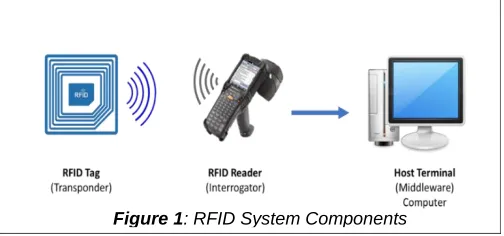
A Radio Frequency Identification (RFID) wireless communication system depends on radio waves in the data transfer process. It is defined as a technique that depends on the use of electromagnetic or electrostatic coupling to identify objects by a unique code identification that the system can recognize and read. Information and details about items can be read from a specified rang via wireless connection. Items will be individually tracked from industrialization to consumption [25]. A chip (tag, also called Transponder) is connected through antenna waves to the reader, also called (Interrogator). The reader is also connected to a host terminal, also called (Middleware), which is a computer device to transfer information received by tags to be installed on. The RFID system can read several tags immediately and jointly without having to sort out the materials or set them apart. It is a good technique that is worth to be applied, because of its features that could serve in many sectors. The beginnings of using RFID technology were in World War II (1940) by the US military forces, where this technology was used firstly to monitor and track aircraft and later on to distinguish between enemy and friendly aircraft.
8.
Components of RFID
This system is divided into three main components; the tag, reader and computer on which the program and database are installed [26], in addition to the antenna that helps increase the network communication for providing wide-range waves for readers on construction sites.
8.1 Tags
Also called transponder, a tag is defined as an ambulant memory placed on a microchip, saving all dynamic detailed information about the item attached to the product [26]. It is read by a unique code, utilizing radio waves received by an antenna that then sends data to the reader. It can be stuck on products including:
1. Materials, apparel and baggage; 2. Vehicles;
3. Equipment; 4. Staff and laborers;
5. Computers, pets, … etc. This means that almost anything can be attached to and tracked by tags.
In addition, tags are obtainable in different shapes and sizes that suit the nature of the product for which they are used. They can be screw-shaped to be used with wooden items or credit card shaped for access applications. Besides, heavy tools like (heavy machinery, trucks, … etc.) use a rectangular tag with a specific dimension. Types of tags will be shown according to the storage space and radio frequency range used to cover working areas.
8.1.1 Passive Tag
A passive tag is consisting of two major components, which are the tag’s antenna and the microchip or the integrated circuit (IC) [26]. Passive tags have no internal power supply, which means that they are working according to the tag structure, specifically the tag’s antenna part. The energy that moves from the antenna to the IC causes the chip to produce a signal that goes back to the Radio Frequency (RF) system. This process is called backscattering which refers to changes in the electromagnetic RF waves, which will then be discovered by the reader that detects and reads the information. Generally, passive tags are categorized into two main types: inlay tags and hard tags. Hard tags are sturdy and made of rubber, ceramic, metal or plastic with different sizes and shapes designed for a specific task, material and application. Some kinds of RFID passive hard tags will be reviewed with their uses as follows:
1. Hight-temperature passive tags: these are designed to resist high temperature. They suit applications like healthcare and certain industries.
2. Rugged passive tags: some applications require tags that can resist environmental and external factors outdoors and can be stored in harsh conditions like snow, potential crushing under the wheels of vehicles and dust.
1579
3. Size: tracking may be restricted by certain conditions; for example, tracking large or small goods. Here, the choice of tags depends on size.
4. Material: in case of tracking metal materials, metal-mount passive tags are required.
5. Passive RFID inlay tags: roll inlay passive tags are the cheapest RFID tags, but that does not mean that there is a relationship between price and performance. 6. Dry inlay passive tags: a dry inlay passive tag consists
of a microchip and an antenna joined to a material named web, with no adhesive backing.
7. Wet inlay passive tags: a wet inlay passive tag consists of microchip and an antenna joined to a material with adhesive backing and can simply be glued to the item to be tracked.
8. Paper face tags: this type is used in applications that require numbers or logos to be visible on the item front to for easier identification.
9. Embeddable passive tags: some applications are associated with wear and tear problems. In this case, a coating can be applied to the tag, using materials such as epoxy. The embeddable type can fill in small cracks and fix problems.
8.1.2 Active Tag
An active tag has three main components represented by the RFID reader also, called analyzer, the RFID antenna and the tag itself [26]. It is unlike a passive RFID tag, where an active tag has an internal power source which is a battery that usually lasts between three and five years. The battery can be helpful in enabling tags to have a very long reading range, as well as a large memory storage. In case of battery failure, the tag should be replaced. However, this is not the optimum solution; battery changing is better for saving costs. The size of an active tag is much larger than that of a passive tag, which is due to the large size of the battery and other internal ingredients. Active tags are commonly used for tracking high-value and worthy items, especially when these items are necessary for the success of a certain process. Types of active tags are shown below:
1. Beacons: a beacon sends a signal every three to five seconds without waiting for any signal issued by the reader. Beacons are widely used in oil and gas industries, construction and tracking applications. They have the potential to read information hundreds of meters away. But this would be illogical due to the need to save the battery life. So, the reading range is reduced to a hundred meters only.
2. Transponders: these are highly efficient in serving the battery life when being out of the range of the reader. The most common areas in which transponders used are: secure access control and payment systems.
8.2 RFID Reader
Also known as (Interrogator), an RFID reader consists of an external scanning antenna that reads and records data via
radio waves and then transfers it to the host terminal (computer). Reader types depend on the task performed, where a reader can be fixed at a fixed point such as (gate entrance and exit, warehouse or sale point) or handheld (portable type). Types vary in terms of readability range and
use as well. According to [27] an RFID reader can release radio waves that may reach a range of 60 m or more, considering battery power and frequency of radio waves used.
8.3 Host Terminal
A host terminal is a computer device that stores a database for a specific organization. It is called (Middleware). Management software will be installed on it to input data received by the reader in order to be retrieved when requested. Several services can be provided by Middleware, such as filtering and improving data, monitoring and coordinating various readers in one single software.
8.4 System Database
The database is a component of the RFID system which is stored in the host terminal. C-shape and Visual Basic (programming language) are adopted to construct a program linked with a cloud website server to save the database. Due to the amount and overlap of information at the same time and the number of tags used in the RFID system, a cloud has to be used to coordinate and organize information which can be easily accessed through web windows, so that the database is permanently connected to the internet and at any time and place, a user can access the server to request or enter any information. Figure (2) shows the login window of the program as an administrator or user depending on the responsibilities of the user.
Figure 2: Program Login Window
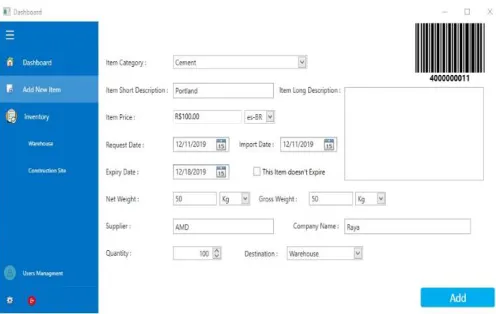
Figure (3) shows the dashboard program, including the parameters of the items, such as category, price, dates of request and reception, weight, quantity and the unique tag code. Also, the destination of materials to the warehouse or construction site is included. There are some features that need to be considered such as minimum and maximum charges for material quantities in the warehouse to prevent any shortage or surplus. So, the system can send a warning message to fix this problem according to inventory records
1580 Figure 3: Dashboard Parameters
Figure (4) shows the server database of Google cloud linked with the dashboard of the RFID program, that can be reachable at any time and from everywhere. The database is secured by the Google cloud, which is just for easy viewing of a daily report of materials.
Figure 4: Server Database (Google Cloud)
9.
RFID Development Kit
The development kit equipped for this research consists of an RFID reader, an RFID antenna and 5 pieces of encoded passive tags. To complete the system so that it is ready for a, input and output data must be included. Figure (5) shows the RFID development kit.
Figure 5: RFID Development Kit
10.
Conclusion
First of all, since conventional material management methods used on construction sites are associated with problems impeding administrative work, it is necessary at least to make sure that they are applied correctly. Being indispensable in some cases, answering the questions asked in the questionnaire helps integrate traditional and
modern methods to reach the best decisions. According to the results of the questionnaire, field survey and personal interviews the researcher was able to determine the most important factors and considerations related to strategies adopted in material management on construction sites, including material purchasing, reception, inspection, classification and codification and stock control affecting the movement of materials on construction sites. Conclusion drawn can be presented as follows:
1. Traditional methods of material management are the most commonly used on construction sites, nothing that these methods do not provide material management; 2. These are difficulties in obtaining information due to
loss of printed documents;
3. Conventional material management methods are time-consuming due to matching documents in the reception stage;
4. Labor capacity is intensively consumed in the inspection and reception stages, which will significantly impact productivity;
5. There are no warehouses leads to receive materials in batches or store them in unsuitable rooms in the same building to be constructed;
6. Final inspection of imported materials is approved only from a local authority. If the materials are rejected, this will cause delays in the implementation of activities on construction sites as well as financial loss;
7. There are delays in receiving of information about the status of material inspection in the lab and issuing the final report;
8. There is no electronic tracking of materials from the supplier to the site, although most of the materials come from a local destination;
9. There are no modern systems used except for some phone applications;
10. There are no RFID system uses on sites;
11. Some project managers see that RFID systems would be more effective if applied in large projects with wide materials diversity and implementation periods of 5-10 years;
12. Managers labor on construction sites are not familiar with RFID systems so, there is a need to promote using such systems in different ways.
References
[1] A. Hujazzy, “Materials Management on Construction projects.” Damascus University, Damascus, 2012. [2] Susan M. Brownell, Material Management. 2014. [3] L. M. C. J. R. Tony Arnold, Stephen N. Champman,
“Introduction to Materials Management,” pp. 30–46, 2011.
[4] Z. M. Jusoh and N. Kasim, “A Review on Implication of Material Management to Project Performance,” MATEC
Web of Conferences, vol. 87. p. 01012, 2017.
[5] B. T. Arijeloye and F. O. Akinradewo, “Assessment of materials management on building projects in Ondo State, Nigeria,” WSN World Scientific News, vol. 55, no. 55. pp. 168–185, 2016.
1581 Secur. Radioact. Mater., vol. 19, no. 1, pp. 41–46,
2008.
[7] S. Abdoli, “RFID application in municipal solid waste management system,” 2009.
[8] W. Yao, C.-H. Chu, and Z. Li, “The use of RFID in healthcare: Benefits and barriers,” in 2010 IEEE International Conference on RFID-Technology and Applications, 2010, pp. 128–134.
[9] A. S. Dawood, “Automatic Identification System Based on RFID Technology.” University of Technology, 2015. [10]Z. Pala and N. Inanc, “Smart parking applications using
RFID technology,” in 2007 1st Annual RFID Eurasia, 2007, pp. 1–3.
[11]P. C. Eze, P. N. Achebe, L. Jeremiah, and T. A. Ageh, “Anti-Theft System for Car Security using RFID,” 2018. [12]S. H. Choi, Y. X. Yang, B. Yang, and H. H. Cheung,
“Item-level RFID for enhancement of customer shopping experience in apparel retail,” Comput. Ind., vol. 71, pp. 10–23, 2015.
[13]D. C. Wyld, “24-karat protection: RFID and retail jewelry marketing,” Int. J. UbiComp, vol. 1, no. 1, pp. 1– 14, 2010.
[14]J. Lyu Jr, S.-Y. Chang, and T.-L. Chen, “Integrating RFID with quality assurance system–Framework and applications,” Expert Syst. Appl., vol. 36, no. 8, pp. 10877–10882, 2009.
[15]L.-C. Wang, “Enhancing construction quality inspection and management using RFID technology,” Autom. Constr., vol. 17, no. 4, pp. 467–479, 2008.
[16]W. Lu, G. Q. Huang, and H. Li, “Scenarios for applying RFID technology in construction project management,”
Autom. Constr., vol. 20, no. 2, pp. 101–106, 2011. [17]J. M. Sardroud, “Influence of RFID technology on
automated management of construction materials and components,” Sci. Iran., vol. 19, no. 3, pp. 381–392, 2012.
[18]A. Costin, N. Pradhananga, and J. Teizer, “Leveraging passive RFID technology for construction resource field mobility and status monitoring in a high-rise renovation project,” Autom. Constr., vol. 24, pp. 1–15, 2012. [19]Z. Ren, C. J. Anumba, and J. Tah, “RFID-facilitated
construction materials management (RFID-CMM)–A case study of water-supply project,” Adv. Eng. Informatics, vol. 25, no. 2, pp. 198–207, 2011.
[20]E. Valero and A. Adán, “Integration of RFID with other technologies in construction,” Measurement, vol. 94, pp. 614–620, 2016.
[21]N. Kasim et al., “Automatic Materials Tracking Practices Through RFID Implementation in Construction Projects,” in MATEC Web of Conferences, 2019, vol. 266, p. 5001.
[22] Y. Ren and H. Li, “Building materials management system based on RFID technology,” Int. J. RF Technol., vol. 9, no. 1–2, pp. 63–74, 2018.
[23] F. H. Ahmed, “Improving Construction Materials Management Practices in Construction Sites.” Universiti Tun Hussein Onn Malaysia, 2017.
[24] V. Kulkarni, R. Sharma, and M. Hote, “Factors affecting
material management on construction site,”
International Research Journal of Engineering and Technology, vol. 4, no. 1. pp. 474–478, 2017.
[25] M. Roberti, “The History of RFID Technology,” RFID
Journal, 2005. [Online]. Available:
https://www.rfidjournal.com/articles/view?1338. [Accessed: 13-Jul-2019].
[26] Suzanne Smiley, “Active RFID vs. Passive RFID: What’s the Difference,” AtlasRFIDStore, 2019. [Online]. Available: https://blog.atlasrfidstore.com/active-rfid-vs-passive-rfid. [Accessed: 05-Aug-2019].