Original Research Article
Diabetic foot self-care: awareness and practice among type 2 diabetic
patients in primary healthcare centers, Dubai Health Authority
Maira K. Mehmood
1*, Almas Z. Parkar
1, Nayab T. Mustafa
1, Sarah S. Mustafa
1,
Momina A. Makin
1, Fatheya Alawadi
2, Samia Farghaly
1INTRODUCTION
According to International Diabetes Federation (IDF), approximately 425 million people worldwide suffer from diabetes.1 1.6 million deaths per year are directly attributed to it.2
Currently 39 million people in the MENA region suffer with diabetes.1 This region also has the second highest
rate of increase in diabetes globally, where the number of people with diabetes is predicted to increase by 96.2% in 2035.3 15% of the U.A.E adult population are categorized as patients of type-2 diabetes mellitus (DM).1Trends in 2015 also indicate that the prevalence of diabetes in the UAE is rising at a faster rate than both the MENA region and the rest of the world. This becomes a burden in terms of costs of treatment and affects the management of the impending complications as well.4
ABSTRACT
Background: Diabetic foot disease is the most common complication of diabetes mellitus. With appropriate management, approximately 49-85% of diabetic foot complications can be prevented. This study was carried out due to lack of population-based studies on foot self-care in the U.A.E. The aim of this study is to assess the awareness and practice of foot self-care in patients with type 2 diabetes and study the factors affecting foot self-care.
Methods: A cross-sectional study was conducted amongst patients of type-2 diabetes attending the diabetic clinics in primary healthcare centers under Dubai Health Authority. 488 participants were interviewed on a pre-tested structured questionnaire. The cumulative score of awareness and practice was classified into poor (<50 percentile), average (50-75 percentile) and good (>(50-75 percentile).
Results: 47% participants had an overall poor awareness and 46% had an overall poor practice of foot self-care. Compliance of medications to avoid complications had the highest awareness (83%) and practice (91%). Avoiding moisturizing between toes had the least awareness (40%) and practice (38%). Awareness was better in 59% of UAE nationals and 74% of postgraduates. Practice was better in 60% of males and 73% of participants with uncontrolled HbA1c. Participants who received prior information had better awareness (55%). Participants receiving information from Dubai Diabetes Centre (DDC) had better awareness (66%) and practice of foot self-care (66%).
Conclusions: Almost half of the diabetic patients attending primary healthcare centers in Dubai have limited awareness and practice regarding diabetic foot self-care.
Keywords: Diabetes, Awareness, Practice, Foot self-care, Primary healthcare, Diabetic foot
1
Dubai Medical College for Girls, Dubai, United Arab Emirates
2Endocrine Department, Dubai Hospital, Dubai Health Authority, Dubai, United Arab Emirates
Received: 04 November 2018
Revised: 10 December 2018
Accepted: 12 December 2018
*Correspondence:
Dr. Maira K. Mehmood,
E-mail: [email protected]
Copyright: © the author(s), publisher and licensee Medip Academy. This is an open-access article distributed under the terms of the Creative Commons Attribution Non-Commercial License, which permits unrestricted non-commercial use, distribution, and reproduction in any medium, provided the original work is properly cited.
Among the complications of diabetes, the most common is diabetic foot disease. It results in deteriorating conditions such as diabetic neuropathy and foot ulcers causing a potentially devastating sequelae of mortality and morbidity.5 Fortunately, diabetic foot complications are also the most preventable if appropriate measures are taken.6
Patient education is the most effective way to reduce the complications of diabetes. Since the patient is the primary foot care taker, good awareness and practice of foot self-care is essential to reduce the incidence of diabetic foot disease.7-13
Since there is a lack of population-based studies available on awareness and practice of diabetic foot self-care in the U.A.E, this study was conducted to determine the awareness and practice of foot self-care in diabetics and study the factors affecting it.
METHODS
Study design and setting
A cross sectional study was conducted in the diabetic clinics in primary healthcare centers (PHC) under Dubai Health Authority (DHA) from May 2017 to December 2017.
Sample size and procedure
The sample size was calculated to be 488 using the computer program Epi-info version 7.1. It was calculated on 10500 diabetic patients registered in PHC, 30.7% estimated poor knowledge (ref), 95% confidence interval and 4% degree of precision.
Inclusion criteria
Inclusion criteria were type-2 DM (minimum one year duration); patients attending diabetic clinics in PHC in Dubai; all genders; all nationalities.
Exclusion criteria
Exclusion criteria were type-1 DM patients;
hearing/cognitive impairment; gestational diabetes.
Data collection plan
The respondents were interviewed on a pre-tested structured questionnaire after their written informed consent. It was validated in both English and Arabic.
The questionnaire included questions on demographics, diabetes related questions, source of information regarding foot self-care and 19 questions on awareness and practice of foot self-care derived from foot care practices advised by American Diabetic Association
(ADA), Summary of Diabetes Self-Care Activities (SDSCA) and John Hopkins Medical review.
Each response for awareness and practice to foot care question was scored either 1 or 0 depending on yes or no respectively. The cumulative score was then classified into:
Poor (<50 percentile)
Average (50-75 percentile)
Good (>75 percentile)
Data was analysed via Microsoft Excel, 2016 and SPSS software
RESULTS
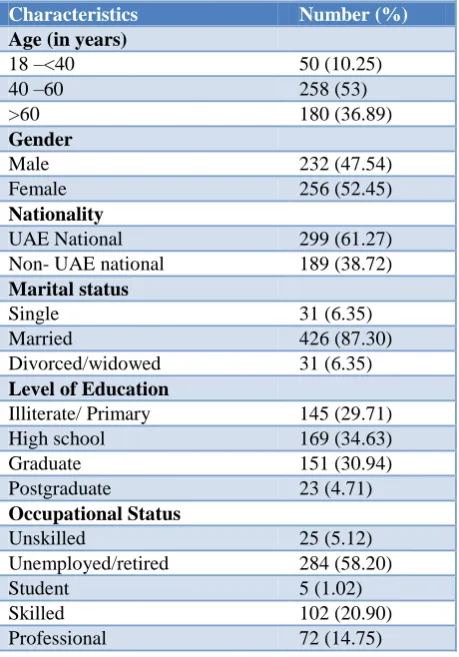
In this study, 52.5% of the participants were females and 47.5% were males. UAE nationals were 61.3% (Table 1).
Table 1: Distribution of participants according to background characteristics.
Characteristics Number (%)
Age (in years)
18 –<40 50 (10.25)
40 –60 258 (53)
>60 180 (36.89)
Gender
Male 232 (47.54)
Female 256 (52.45)
Nationality
UAE National 299 (61.27)
Non- UAE national 189 (38.72)
Marital status
Single 31 (6.35)
Married 426 (87.30)
Divorced/widowed 31 (6.35)
Level of Education
Illiterate/ Primary 145 (29.71)
High school 169 (34.63)
Graduate 151 (30.94)
Postgraduate 23 (4.71)
Occupational Status
Unskilled 25 (5.12)
Unemployed/retired 284 (58.20)
Student 5 (1.02)
Skilled 102 (20.90)
Professional 72 (14.75)
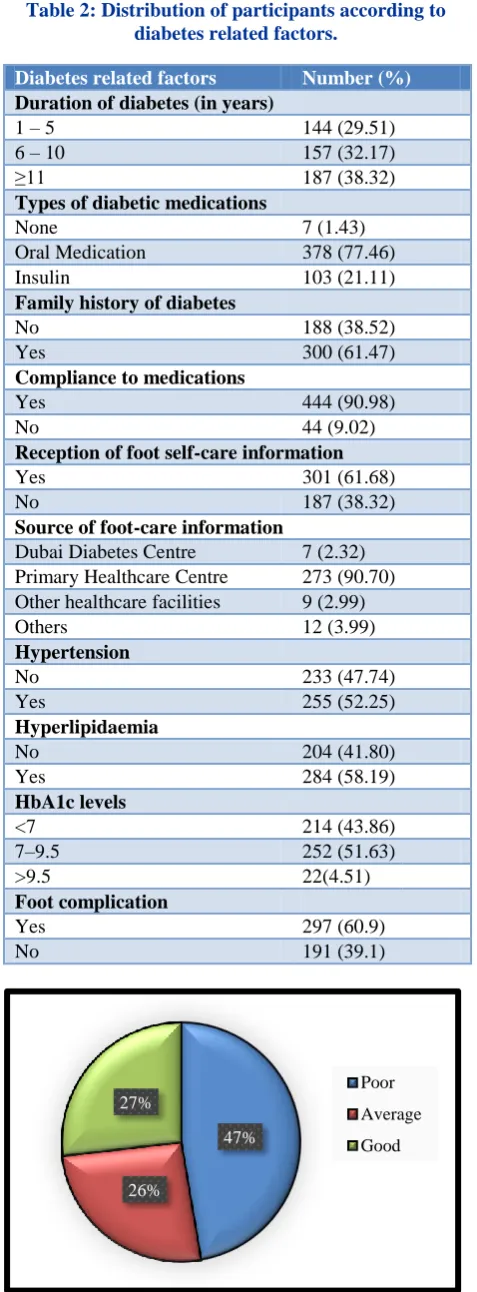
Table 2: Distribution of participants according to diabetes related factors.
Diabetes related factors Number (%)
Duration of diabetes (in years)
1 – 5 144 (29.51)
6 – 10 157 (32.17)
≥11 187 (38.32)
Types of diabetic medications
None 7 (1.43)
Oral Medication 378 (77.46)
Insulin 103 (21.11)
Family history of diabetes
No 188 (38.52)
Yes 300 (61.47)
Compliance to medications
Yes 444 (90.98)
No 44 (9.02)
Reception of foot self-care information
Yes 301 (61.68)
No 187 (38.32)
Source of foot-care information
Dubai Diabetes Centre 7 (2.32)
Primary Healthcare Centre 273 (90.70)
Other healthcare facilities 9 (2.99)
Others 12 (3.99)
Hypertension
No 233 (47.74)
Yes 255 (52.25)
Hyperlipidaemia
No 204 (41.80)
Yes 284 (58.19)
HbA1c levels
<7 214 (43.86)
7–9.5 252 (51.63)
>9.5 22(4.51)
Foot complication
Yes 297 (60.9)
No 191 (39.1)
Figure 1: Distribution of participants according to level of awareness of foot self-care.
The overall awareness of foot self-care was found to be poor in 47%, average in 26% and good in only 27% of the participants (Figure 1).
Figure 2: Distribution of participants according to level of practice of foot self-care.
The overall practice of foot self-care was found to be poor in 46%, average in 26% and good in only 28% of the participants (Figure 2).
Figure 3: Distribution of participants according to history of foot complications.
Almost 36.7% reported to have calf pain while walking and 2.3% were found to have a history of foot amputation (Figure 3).
It was found that 83.0% were aware of the importance of compliance of medications to avoid complications and 91.0% practiced it. Participants were least aware of the importance of avoiding moisturizing between toes (40.0%) and only 37.9% practiced it (Table 3).
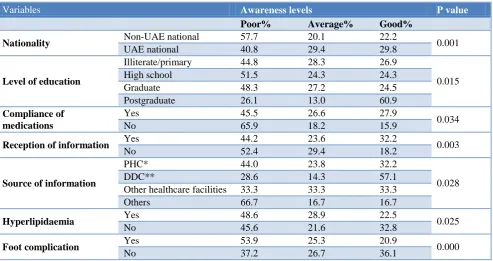
Participants who received previous information on foot self-care had better awareness than those who did not by 7%. It was also observed that 59.2% of UAE nationals had better level of awareness when compared to 42.3% of the non-UAE nationals (Table 4).
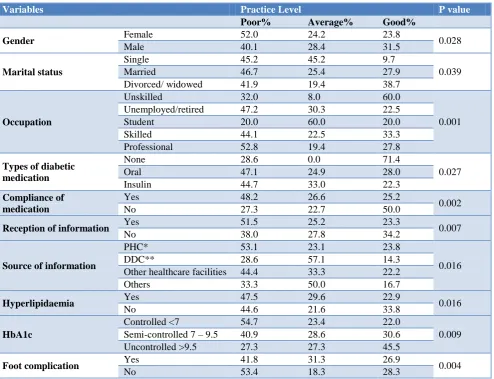
Men had a significant better level of practice than women by 12.0%. Almost 60% of the unskilled participants were found to have good levels of practice as compared to
47%
26% 27%
Poor Average Good
46%
26%
28% Poor
Average
Good
37% 30% 28%
18% 7% 6% 2% 63% 70% 72%
82%
93% 94% 98%
0% 20% 40% 60% 80% 100%
Foot Complications
33.3% of participants with skilled jobs. 51.5% who received previous information were found to have poor levels of practice than those who did not. Patients receiving information from Dubai Diabetes Centre had better level of practice than those receiving from PHC by
20%. Average to good levels of practice was seen in 72.8% of participants with an uncontrolled HbA1c and 58.2% of those who have had foot complications (Table 5).
Table 3: Distribution of participants according to awareness and practice of foot self-care measures.
Foot self-care measures Awareness (%) Practice (%)
Compliance of medications 405 (82.99) 444 (90.98)
Proper fitting shoes 371 (76.02) 361 (73.97)
Consultation on cuts 336 (68.85) 293 (60.04)
Consultation on inflammation 337 (69.05) 273 (55.94)
Specific foot care 322 (65.98) 293 (60.04)
Checking foot wear 322 (65.98) 298 (61.06)
Drying feet 317 (64.95) 323 (66.18)
Avoid smoking 312 (63.93) 278 (56.96)
Daily changing of socks 312 (63.93) 292 (59.83)
Trimming toenails 312 (63.93) 312 (63.93)
Annual feet exam 312 (63.93) 298 (61.06)
Avoid walking barefoot 307 (62.90) 298 (61.06)
Check water temperature 303 (62.09) 274 (56.14)
Drying between toes 298 (61.06) 293 (60.04)
Using warm water 293 (60.04) 298 (61.06)
Moisturizing feet 283 (57.99) 254 (52.04)
Daily foot inspection 278 (56.96) 244 (50.00)
Avoid soaking feet in water 259 (53.07) 215 (44.05)
Avoid moisturizing between toes 195 (39.95) 185 (37.90)
Table 4: Distribution of participants according to level of awareness in relation to different variables.
Variables Awareness levels P value
Poor% Average% Good%
Nationality Non-UAE national 57.7 20.1 22.2 0.001
UAE national 40.8 29.4 29.8
Level of education
Illiterate/primary 44.8 28.3 26.9
0.015
High school 51.5 24.3 24.3
Graduate 48.3 27.2 24.5
Postgraduate 26.1 13.0 60.9
Compliance of medications
Yes 45.5 26.6 27.9
0.034
No 65.9 18.2 15.9
Reception of information Yes 44.2 23.6 32.2 0.003
No 52.4 29.4 18.2
Source of information
PHC* 44.0 23.8 32.2
0.028
DDC** 28.6 14.3 57.1
Other healthcare facilities 33.3 33.3 33.3
Others 66.7 16.7 16.7
Hyperlipidaemia Yes 48.6 28.9 22.5 0.025
No 45.6 21.6 32.8
Foot complication Yes 53.9 25.3 20.9 0.000
No 37.2 26.7 36.1
Table 5: Distribution of participants according to level of practice in relation to different variables.
Variables Practice Level P value
Poor% Average% Good%
Gender Female 52.0 24.2 23.8 0.028
Male 40.1 28.4 31.5
Marital status
Single 45.2 45.2 9.7
0.039
Married 46.7 25.4 27.9
Divorced/ widowed 41.9 19.4 38.7
Occupation
Unskilled 32.0 8.0 60.0
0.001
Unemployed/retired 47.2 30.3 22.5
Student 20.0 60.0 20.0
Skilled 44.1 22.5 33.3
Professional 52.8 19.4 27.8
Types of diabetic medication
None 28.6 0.0 71.4
0.027
Oral 47.1 24.9 28.0
Insulin 44.7 33.0 22.3
Compliance of medication
Yes 48.2 26.6 25.2
0.002
No 27.3 22.7 50.0
Reception of information Yes 51.5 25.2 23.3 0.007
No 38.0 27.8 34.2
Source of information
PHC* 53.1 23.1 23.8
0.016
DDC** 28.6 57.1 14.3
Other healthcare facilities 44.4 33.3 22.2
Others 33.3 50.0 16.7
Hyperlipidaemia Yes 47.5 29.6 22.9 0.016
No 44.6 21.6 33.8
HbA1c
Controlled <7 54.7 23.4 22.0
0.009
Semi-controlled 7 – 9.5 40.9 28.6 30.6
Uncontrolled >9.5 27.3 27.3 45.5
Foot complication Yes 41.8 31.3 26.9 0.004
No 53.4 18.3 28.3
*Primary Healthcare Centres; **Dubai Diabetes Centre.
DISCUSSION
The level of awareness and practice of foot self-care was found to be poor in several studies conducted worldwide.14-18 Our study shows a similar result wherein almost half of the participants had an overall poor awareness (47%) and poor practice (46%). The level of awareness and practice is similar to each other, which is in concordance with studies conducted on foot care practice in Nigeria and India.16,19 This outcome can be explained by lack of awareness regarding prevention of diabetic foot disease and its major complications, including lower limb amputation.
The specific measures of foot self-care that received the worst responses were daily foot inspection, avoiding soaking feet in water and avoiding moisturizing between the toes, which had the least score of them all. These results were also seen in studies conducted on knowledge and practice of diabetic foot self-care in Malaysia and Nigeria.5,16 The deficiency in the knowledge and therefore the practice may be due to poor communication between the doctors and patients. It can also be attributed
to lack of proper counselling by the doctors and nurses due to a busy clinic schedule.
An important finding of our study was that approximately half of the patients with poor levels of awareness of foot self-care had a low level of education. Studies conducted in Nigeria, Pakistan,India, and Tanzania concluded that low awareness scores were common with poor formal education.16,17,20,21 The knowledge of appropriate foot care is positively influenced by patient education which in turn reduces the risk of foot ulceration and amputation in high-risk diabetics.22 This association can be attributed to the ability of the educated patients to read and comprehend educational supportive materials as well as the use of technology to obtain more information about their disease.
socioeconomic impact, characterized by foot lesions and finally leg amputation in majority of the cases.17 However, diabetic foot care studies conducted in Saudi Arabia and in Italy, found better practice levels in patients of higher socioeconomic level.14,23
A positive association was discovered between
nationality and the level of awareness of foot care. U.A.E. nationals had a higher overall awareness than non-U.A.E. nationals.
Men had a higher score in terms of practice than females by approximately 12%. This is in concordance with a study conducted in Durban, South Africa.7
Our study showed that participants who received previous information on foot self-care had better awareness but poor practice. This could be due to the patients’ attitude towards the disease. Significant association was also found between the source of information on foot care and awareness and practice level. The level of awareness and practice was higher for those who acquired information from Dubai Diabetic Centre when compared to primary healthcare centres. This can be explained by the focused approach of Dubai Diabetes Centre towards diabetic complications and its management.
Practice levels were found to be better in patients with higher HbA1c levels and those using insulin therapy. Studies conducted in Taiwan and Iran on assessment of risk factors, found these to be important risk factors for diabetic complications.24,25 More than 60% of our participants with high HbA1c were found to have a history of foot complication/s. It is found that patients practice foot care measures when they experience the complications and are aware that these are preventable. Studies conducted on prevention of foot ulcers in India and another study conducted in China on knowledge and practice of foot care reveal similar results.19,26
A study conducted in the U.S.A. found that foot self-care practices were better in patients with duration of diabetes more than or equal to 10 years.27 Such a significant relation was not found in this study. Similarly, there is no significant association found between awareness and practice level with age or family history of diabetes. Similar results were found in other studies conducted worldwide.5,7,16,18
CONCLUSION
Almost half of our patients attending primary healthcare centres in Dubai have limited awareness and practice regarding diabetic foot self-care. This is mainly observed in Non-U.A.E. nationals and in females. This calls for a collaboration of the authorities to augment the patients’ education and replicate such surveys to monitor the improvement.
Recommendations
Educating patients using internationally approved guidelines for foot self-care including prevention and control of diabetic comorbidities.
Educating the patients at an early stage beginning from pre-diabetes with focus on high risk patients.
Increasing consultation time specific for educating the patients on diabetic foot self-care and ensuring its practice.
All electronic and printed media in various languages must be engaged to enhance the public awareness of diabetes and its complications.
Providing group counselling and peer support groups on diabetic foot self-care at health facilities so that patients can share knowledge of diabetic foot care.
Collaborating with other healthcare providers such as podiatrists, diabetic educators and specialized centres such as diabetic centres.
Implementing regular clinical audits to ensure standards of care for diabetic patients.
Similar researches also assessing the attitude of patients should be conducted in the U.A.E. on a larger scale.
Limitations
The sample predominantly consisted of patients attending the primary health care centers in Dubai, thus the sample does not represent the actual population of the U.A.E.
ACKNOWLEDGEMENTS
We would like to sincerely thank Dr. Nehad Mahdy for her continuous support and guidance throughout this study. We would also like to extend our gratitude to the patients who participated in this study.
Funding: Dubai Medical College for Girls Conflict of interest: None declared
Ethical approval: The study was approved by the Institutional Ethics Committee, Dubai Health Authority
REFERENCES
1. International Diabetes Federation. Members: Middle East and North Africa, 2017. Available at:
https://www.idf.org/our-network/regions- members/middle-east-and-north-africa/members/49-united-arab-emirates.html. Accessed 5 June 2018. 2. World Health Organization. Fact sheet: Diabetes,
2017. Available at: http://www.who.int/news-room/fact-sheets/detail/diabetes. Accessed 10 September 2018.
3. International Diabetes Federation. IDF Diabetes
atlas: 8th edition, 2017. Available at:
http://www.diabetesatlas.org/. Accessed 5 June 2018.
https://www.unitedhealthgroup.com/newsroom/201 0/1207whitepaperuaediabetes.html. Accessed 11 September 2018.
5. Muhammad-Lutfi A, Zaraihah M, Anuar-Ramdhan
I. Knowledge and Practice of Diabetic Foot Care in an In- Patient Setting at a Tertiary Medical Center. Malaysian Orthopaedic J. 2014;8(3):22-6.
6. Dereck L. Diabetes: foot ulcers and amputations. BMJ Clinical Evidence. 2011;2011:1-44
7. Thea T, Mergan N. Awareness of diabetic foot disease amongst patients with type 2 diabetes
mellitus attending the chronic outpatients
department at a regional hospital in Durban, South Africa. African J Primary Health Care Family Med. 2016;8(1).
8. Leung P. Diabetic foot ulcers – A comprehensive review. The Surgeon. 2007;5(4):219-31.
9. Frykberg R, Zqonis T, Armstrong D, Driver V, Giurini J, Kravitz S et al. Diabetic foot disorders: A clinical practice guideline. The J of Foot & Ankle Surgery. 2006;45(5):S1-S66.
10. UpToDate. Patient education: Foot care in diabetes mellitus, 2017. Available at: https://www.uptodate. com/contents/foot-care-in-diabetes-mellitus-beyond-the-basics. Accessed 11 September 2018
11. Dilek G, Tuglular S, Onder H, Altun A, Archer A, Akalin S. Awareness of diabetic foot disease in a group of Turkish and English patients with type 2 diabetes mellitus: Assessment of the status and the efficacy of diabetic foot education programs. Turkish J Endocrinol Metabol. 1999;2:65-70.
12. Pinto A, Tuttolomondo A, Di Raimondo D,
Fernandez P, La Placa S, Di Gati M et al. Cardiovascular risk profile and morbidity in subjects affected by type 2 diabetes mellitus with and without diabetic foot. Metabolism. 2008;57(5):676-82.
13. Ekore R, Ajayi I, Arije A, Ekore J. Knowledge of and attitude to foot care amongst type 2 diabetes patients attending a university-based primary care clinic in Nigeria. African J Primary Health Care Family Med. 2010;2(1):1–3.
14. Qadi M, Al Zahrani H. Foot Care Knowledge and Practice among Diabetic Patients Attending Primary Health Care Centers in Jeddah City. J of King Abdulaziz University-Med Sci. 2011;18(2):55-71.
15. Khamseh ME, Vatankhah N, Baradaran HR.
Knowledge and practice of foot care in Iranian people with type 2 diabetes. International Wound J. 2007;4(4):298–302.
16. Desalu O, Salawu F, Jimoh A, Adekoya A, Busari O, Olokoba A. Diabetic foot care: Self reported knowledge and practice among patients attending three tertiary hospital in Nigeria. Ghana Med J. 2011;45(2):60-5.
17. Hasnain S, Sheikh NH. Knowledge and practices regarding foot care in diabetic patients visiting diabetic clinic in Jinnah Hospital, Lahore. J of Pakistan Medical Association. 2009;59(10):687-90. 18. Pollock R, Unwin N, Connolly V. Knowledge and
practice of foot care in people with diabetes. Diabetes Res Clin Pract. 2004;64(2):117-22.
19. Chellan G, Srikumar S, Varma AK, Mangalanandan
T, Sundaram K, Jayakumar R, et al. Foot care practice – The key to prevent diabetic foot ulcers in India. The Foot. 2012;22(4):298–302.
20. Selvakumar S, Shah P. Awareness and practice regarding foot self-care among patients of known type 2 diabetes mellitus in a rural area. International J Community Med Public Health. 2016;3(4):861-4.
21. Chiwanga FS, Njelekela MA. Diabetic foot:
prevalence, knowledge, and foot self-care practices among diabetic patients in Dar es Salaam, Tanzania – a cross-sectional study. J Foot Ankle Res. 2015;8(20):1-7.
22. Singh N, Armstrong DG, Lipsky BA. Preventing foot ulcers in patients with Diabetes. JAMA. 2005;293(2):217-28.
23. Berardis GD, Pellegrini F, Franciosi M, Belfiglio M, Nardo BD, Greenfield S, et al. Are Type 2 diabetic patients offered adequate foot care? The role of physician and patient characteristics. J Diabetes Complications. 2005;19(6):319–27.
24. Tseng C-H. Prevalence and Risk Factors of Diabetic Foot Problems in Taiwan: A cross-sectional survey of non-type 1 diabetic patients from a nationally
representative sample. Diabetes Care.
2003;26(12):3351.
25. Shahbazian H, Yazdanpanah L, Latifi SM. Risk assessment of patients with diabetes for foot ulcers according to risk classification consensus of international working group on diabetic foot (IWGDF). Pakistan J Med Sci. 2013;29(3):730-4. 26. Li R, Yuan L, Guo X-H, Lou Q-Q, Zhao F, Shen L,
et al. The current status of foot self-care knowledge, behaviours, and analysis of influencing factors in patients with type 2 diabetes mellitus in China. Int J Nursing Sci. 2014;1(3):266–71.
27. Bell R, Arcury T, Snively B, Smith S, Stafford J, Dohanish R et al. Diabetes Foot Self-care Practices in a Rural, Triethnic Population. The Diabetes Educator. 2005;31(1):75-83.