http://www.ijcmph.com pISSN 2394-6032 | eISSN 2394-6040
Original Research Article
Knowledge attitude and practice of blood donation in Hail University
Manal Th. Alanazi*, Halima Elagib, Hanin R. Aloufi, Beshayer M. Alshammari,
Samiyah M. Alanazi, Shaden F. Alharbi, Hadeel K. Alshamasy, Rawan N. Alrasheedi
INTRODUCTION
Blood and blood products are essential for life-saving situations in different medical as well as emergencies, and shortage of blood supply would subsequently have delirious consequences on human morbidity and mortality. Currently, the demand for blood and blood products witnessed a steep increase worldwide, especially among developing countries.1,2 However, blood donation does not match with the increasing demands. Thus, it is essential to study the reasons behind this mismatch.
Because blood is a natural human product that cannot be manufactured and has no other sources rather than blood donation, it is fundamental for every heath sector to put into consideration the importance of providing satisfactory blood and blood products for their patients.
Blood donation can be voluntary, remunerated, replaced via relatives, family members, or paid donors. It is generally recommended that blood donation I to be confined only to voluntary blood donation because of the growing figures of infection transmission during the
ABSTRACT
Background: Medical students should be well educated about blood donation and its importance, and their knowledge reflects what will be transferred to the community. Thus, the aim of this study was to explore the knowledge, attitude, and practice of blood donations among medical students in Hail University.
Methods: Three hundred medical students from 2nd to 6th grade participated in this self-administered questionnaire that included their demographic data, questions about their previous experience with blood donation, and questions about their knowledge and attitudes about blood donation.
Results: Out of the 300 students (50 males and 50 females), among them about 88% of students knew their blood group. About 75% knew that infections can be transmitted through blood donation, especially HIV (90%), HBV (73%), HCV (71.3%), and malaria (48%). One third believed that the minimum hemoglobin level for blood donation is 12.5 g/L in men and 12 g/L in women. Negative attitudes towards blood donation included donation to relative request only (24%), paid donations (29.7%), and belief of probability to get infected (34%). Positive attitudes were addressed beliefs that donation saves lives (72%), donation is a moral activity (43%), and importance of disclosing real information before donation (46.3%). Males donated blood more than females (p<0.001), whilst females were more fearful of needles (p=0.001). Gender was significantly correlated with blood donation with an Odd's ratio of 0.28 (p<0.001).
Conclusions: Knowledge, attitude, and practice of medical students about blood donation are highly variable among different grades and genders of students in Hail University.
Keywords: Blood donation, Knowledge, Attitude, Practice, Hail University College of Medicine, University of Hail, Hail, Saudi Arabia
Received: 10 January 2017
Revised: 22 January 2018
Accepted: 24 January 2018
*Correspondence:
Dr. Manal Th. Alanazi, E-mail: [email protected]
Copyright: © the author(s), publisher and licensee Medip Academy. This is an open-access article distributed under the terms of the Creative Commons Attribution Non-Commercial License, which permits unrestricted non-commercial use, distribution, and reproduction in any medium, provided the original work is properly cited.
process of blood transfusion.3,4 In Saudi Arabia, only voluntary non-remunerated blood donation is allowed which adds to the challenge and shortage of blood products required to meet the requirements.5 For motivating voluntary donors to be engaged regularly in blood donation processes, it is essential to study their general knowledge about blood donation and their views and attitudes.
In this survey, the targeted population to be studied were the medical students, not only because they would be potential healthy large sector blood donors, but also because they are the source of information and health education to the community, and their opinions represent what will be transmitted to the general population, and thus a reflection of the community view of blood donation. Identification of the negative attitudes about blood donation, the motivational factors that may encourage blood donation, and general knowledge about blood donation would facilitate and improve the process of blood donation and help to decrease the gap between the increasing demands and the stationary inadequate supply among different nations.
METHODS
This was a cross-sectional survey between October 2016 and December 2016, it was conducted on 300 medical students in Hail University, Saudi Arabia to assess their knowledge, attitude, and practice about blood donation. The students were given a self-administered questionnaire to fill. The questionnaire contained demographic data including age, sex, and blood group (if known). It also contained a second section addressing their knowledge about blood donation. The questions used in this section were whether a person can be infected by receiving blood or not, what disease can be transmitted by blood transfusion, how often an individual can donate, who can donate blood (men, women, young, or old people), what volume of blood can be donated at a session, what the duration of donation process is, the minimum volume of blood to be donated, and the minimum hemoglobin for blood donation in men and women. The third section of the questionnaire aimed at exploring the negative attitudes of medical students towards blood donation such as requesting blood donation from relatives, paid blood donations, compensations for blood donors, belief that blood donors are vulnerable to infections, belief that blood donation can weaken donors, and donating blood to get free investigations. Lastly, the fourth section of the used questionnaire included questions about positive attitudes among medical students about blood donations such as beliefs that blood donation may save people lives, and is considered a moral activity, beliefs that young people should frequently donate blood more than elderly, and that the best way to donate blood is voluntary non-remunerated, and that every person should always disclose correct information about their health before donating blood.
Participating medical students were also questioned about their previous blood donations, their satisfaction about that, being unfit to donate, their need to donate for friends or relatives, fear of needles, fear of knowing their status, selling donated blood, and donating blood for no money.
Data collection
Surveys were conducted by student representatives. The survey packet contained a cover letter and a questionnaire with English version. The survey has been handed to each student to read and decide whether to participate or not.
Statistical analysis
All collected data were fed into the computer, and analyzed statistically using SPSS software. Linear regression was conducted between blood donation and gender. For data analysis, SPSS 24 for Windows (SSPS Inc., Chicago, IL, USA) were used. Linear regression was conducted between blood donation and gender.
RESULTS
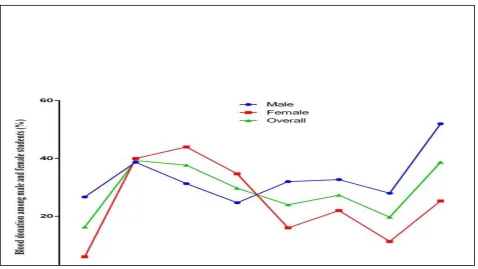
This was a cross-sectional self-administered survey conducted on 300 medical students (150 males and 150 females) among different grades, from the second to the sixth grade, it showed a slight difference in overall practice comparing males and females (Figure 1). The highest participation was noted from students of the third and the sixth grades. Up to 90% of students knew their blood group, especially students of the third, fifth, and sixth-grades, whereas the second and the fourth-grade students were less likely to know their group (p<0.001). More than one half of the participating students (58%) had blood group O positive. Next came were A positive, B positive, AB positive, O negative, A negative, B negative, and AB negative with values of 14%, 9%, 6.7%, 5.8%, 3%, 2.3%, and 1.7%, respectively (p<0.002). The details of demographic data are depicted in Table 1.
97% of students thought that men can donate blood, 87% thought that women can donate, 15.3% thought that young individuals can donate, and only 11% thought that old individuals can donate. The vast majority of students (44.3%) did not know the volume of blood that is collected each donation, and about 45% thought that 50
Kilograms is the minimum weight of a person who can donate blood. One third of students reported that the minimum hemoglobin level for blood donation for men is 12.5 and for women is 12 g/l, whereas one third reported that they don't know.
Table 1: Baseline demographic and disease characteristics of participants.
Question, N (%) 2nd 3rd 4th 5th 6th Total P-value ¥
Age
19-20 24 (85.7) 36 (52.9) 18 (56.3) 19 (17.3) 0 (0.0) 97 (32.3)
>0.001**
21-22 4 (14.3) 27 (39.7) 12 (37.5) 71 (64.5) 2 (3.2) 116 (38.7)
23-24 0 (0.0) 4 (5.9) 2 (6.3) 20 (18.2) 59 (95.2) 85 (28.3)
25 and
above 0 (0.0) 1 (1.5) 0 (0.0) 0 (0.0) 1 (1.6) 2 (0.7)
Gender Male 9 (32.1) 39 (57.4) 32 (100.0) 49 (44.5) 21 (33.9) 150 (50) >0.001**
Female 19 (67.9) 29 (42.6) 0 (0.0) 61 (55.5) 41 (66.1) 150 (50)
Do you know the common blood groups?
Yes 20 (71.4) 91.2) 21 (65.6) 102 (92.7) 58 (93.5) 263 (87.7)
>0.001**
No 8 (28.6) 6 (8.8) 11 (34.4) 8 (7.3) 4 (6.5) 37 (12.3)
Do you know your blood group?
Yes 23 (82.1) 67 (98.5) 22 (68.8) 105 (95.5) 56 (90.3) 273 (91)
>0.001**
No 5 (17.9) 1 (1.5) 10 (31.3) 5 (4.5) 6 (9.7) 27 (9)
Which is your blood group?
O+ 22 (78.6) 33 (48.5) 28 (87.5) 65 (59.1) 26 (41.9) 174 (58)
0.002*
O- 1 (3.6) 9 (13.2) 1 (3.1) 4 (3.6) 1 (1.6) 16 (5.3)
A+ 4 (14.3) 7 (10.3) 3 (9.4) 16 (14.5) 12 (19.4) 42 (14)
A- 1 (3.6) 3 (4.4) 0 (0.0) 5 (4.5) 0 (0.0) 9 (3)
B+ 0 (0.0) 7 (10.3) 0 (0.0) 8 (7.3) 12 (19.4) 27 (9)
B- 0 (0.0) 1 (1.5) 0 (0.0) 4 (3.6) 2 (3.2) 7 (2.3)
AB+ 0 (0.0) 7 (10.3) 0 (0.0) 5 (4.5) 8 (12.9) 20 (6.7)
AB- 0 (0.0) 1.5) 0 (0.0) 3 (2.7) 1 (1.6) 5 (1.7)
¥ Chi-square test; *statistically significant (>0.05); **statistically significant (>0.001).
Table 2: Knowledge about blood donation among medical students.
Question, N (%) 2nd 3rd 4th 5th 6th Total
Can a person be infected by receiving blood transfusion?
Yes 10 (35.7) 52 (76.5) 14 (43.8) 89 (80.9) 61 (98.4) 226 (75.3)
No 4 (14.3) 3 (4.4) 1 (3.1) 3 (2.7) 1 (1.6) 12 (4)
Don't know 14 (50.0) 13 (19.1) 17 (53.1) 18 (16.4) 0 (0.0) 62 (20.7)
What diseases are the diseases that transmitted by blood
transfusion?
HIV 23 (82.1) 57 (83.8) 31 (96.9) 103 (93.6) 57 (91.9) 271 (90.3)
HBV 20 (71.4) 34 (50.0) 29 (90.6) 94 (85.5) 42 (67.7) 219 (73)
HCV 19 (67.9) 37 (54.4) 27 (84.4) 90 (81.8) 41 (66.1) 214 (71.3)
Malaria 10 (35.7) 18 (26.5) 29 (90.6) 64 (58.2) 23 (37.1) 144 (48)
Don’t know 0 (0.0) 3 (4.4) 3 (9.4) 4 (3.6) 1 (1.6) 11 (3.7)
How often can an individual donate?
Weekly 0 (0.0) 1 (1.5) 1 (3.1) 3 (2.7) 2 (3.2) 7 (2.3)
Monthly 0 (0.0) 11 (16.2) 1 (3.1) 5 (4.5) 4 (6.5) 21 (7)
3 months 10 (35.7) 15 (22.1) 12 (37.5) 59 (53.6) 17 (27.4) 113 (37.7)
6 months 4 (14.3) 21 (30.9) 0 (0.0) 19 (17.3) 29 (46.8) 73 (24.3)
Annually 2 (7.1) 3 (4.4) 0 (0.0) 1 (0.9) 3 (4.8) 9 (3)
Don’t know 12 (42.9) 17 (25.0) 18 (56.3) 23 (20.9) 7 (11.3) 77 (25.7)
Who should donate blood?
Men 28 (100) 65 (95.6) 30 (93.8) 108 (98.2) 61 (98.4) 292 (97.3)
Women 26 (92.9) 51 (75.0) 31 (96.9) 98 (89.1) 54 (87.1) 260 (86.7)
Young 4 (14.3) 15 (22.1) 1 (3.1) 13 (11.8) 13 (21.0) 46 (15.3)
Old 0 (0.0) 12 (17.6) 3 (9.4) 12 (10.9) 6 (9.7) 33 (11)
What volume of blood is collected during each donation?
500 ml 8 (28.6) 18 (26.5) 12 (37.5) 37 (33.6) 25 (40.3) 100 (33.3)
500-1000 ml 8 (28.6) 11 (16.2) 12 (37.5) 22 (20.0) 14 (22.6) 67 (22.3)
Question, N (%) 2nd 3rd 4th 5th 6th Total
What is the duration of a donation process?
<20 minutes 6 (21.4) 25 (36.8) 1 (3.1) 9 (8.2) 23 (37.1) 64 (21.3)
20-60 minutes 3 (10.7) 25 (36.8) 5 (15.6) 43 (39.1) 17 (27.4) 93 (31)
Don't know 19 (67.9) 18 (26.5) 26 (81.3) 58 (52.7) 22 (35.5) 143 (47.7)
Minimum weight for blood
donation?
50 Kg 13 (46.4) 20 (29.4) 15 (46.9) 51 (46.4) 36 (58.1) 135 (45)
70 Kg 5 (17.9) 38 (55.9) 6 (18.8) 41 (37.3) 26 (41.9) 116 (38.7)
100 Kg 10 (35.7) 10 (14.7) 11 (34.4) 18 (16.4) 0 (0.0) 49 (16.3)
Minimum Hemoglobin for male donation?
11.5 g/dl 2 (7.1) 9 (13.2) 2 (6.3) 12 (10.9) 5 (8.1) 30 (10)
12.5 g/dl 8 (28.6) 22 (32.4) 2 (6.3) 42 (38.2) 29 (46.8) 103 (34.3)
13.5 g/dl 4 (14.3) 14 (20.6) 1 (3.1) 39 (35.5) 17 (27.4) 75 (25)
Don't know 14 (50.0) 23 (33.8) 27 (84.4) 17 (15.5) 11 (17.7) 92 (30.7)
Minimum Hemoglobin for female donation?
11 g/dl 16 (57.1) 7 (10.3) 2 (6.3) 9 (8.2) 14 (22.6) 48 (16)
12 g/dl 3 (10.7) 22 (32.4) 3 (9.4) 48 (43.6) 16 (25.8) 92 (30.7)
13 g/dl 2 (7.1) 20 (29.4) 3 (9.4) 19 (17.3) 15 (24.2) 59 (19.7)
Don't know 7 (25.0) 19 (27.9) 24 (75.0) 34 (30.9) 17 (27.4) 101 (33.7)
Table 3: Negative attitudes on blood donation among medical students.
Question, N (%) 2nd 3rd 4th 5th 6th Total P-value ¥
1. In my opinion the best way to donate blood is at the request of relatives
Strongly
agree 17 (60.7) 27 (39.7) 5 (15.6) 16 (14.5) 7 (11.3) 72 (24)
>0.001**
Agree 6 (21.4) 15 (22.1) 6 (18.8) 35 (31.8) 18 (29) 80 (26.7)
Uncertain 3 (10.7) 11 (16.2) 1 (3.1) 36 (32.7) 15 (24.2) 66 (22)
Disagree 1 (3.6) 7 (10.3) 7 (21.9) 20 (18.2) 18 (29) 53 (17.7)
Strongly
disagree 1 (3.6) 8 (11.8) 13 (40.6) 3 (2.7) 4 (6.5) 29 (9.7)
2. In my opinion the best way to donate blood is paid donation
Strongly
agree 7 (25) 11 (16.2) 6 (18.8) 13 (11.8) 1 (1.6) 38 (12.7)
>0.001**
Agree 5 (17.9) 31 (45.6) 15 (46.9) 30 (27.3) 8 (12.9) 89 (29.7)
Uncertain 5 (17.9) 7 (10.3) 7 (21.9) 30 (27.3) 9 (14.5) 58 (19.3) Disagree 9 (32.1) 10 (14.7) 3 (9.4) 21 (19.1) 26 (41.9) 69 (23) Strongly
disagree 2 (7.1) 9 (13.2) 1 (3.1) 16 (14.5) 18 (29) 46 (15.3)
3. I think people who donate blood should receive something in exchange
Strongly
agree 5 (17.9) 8 (11.8) 4 (12.5) 19 (17.3) 2 (3.2) 38 (12.7)
>0.001**
Agree 11 (39.3) 32 (47.1) 9 (28.1) 26 (23.6) 12 (19.4) 90 (30)
Uncertain 7 (25) 12 (17.6) 11 (34.4) 20 (18.2) 21 (33.9) 71 (23.7)
Disagree 4 (14.3) 9 (13.2) 1 (3.1) 29 (26.4) 13 (21) 56 (18.7)
Strongly
disagree 1 (3.6) 7 (10.3) 7 (21.9) 16 (14.5) 14 (22.6) 45 (15)
4. I think people who donate blood can contract disease
Strongly
agree 6 (21.4) 15 (22.1) 4 (12.5) 15 (13.6) 3 (4.8) 43 (14.3)
>0.001**
Agree 13 (46.4) 23 (33.8) 6 (18.8) 41 (37.3) 19 (30.6) 102 (34)
Uncertain 3 (10.7) 10 (14.7) 9 (28.1) 27 (24.5) 14 (22.6) 63 (21)
Disagree 3 (10.7) 12 (17.6) 2 (6.3) 19 (17.3) 18 (29) 54 (18)
Strongly
disagree 3 (10.7) 8 (11.8) 11 (34.4) 8 (7.3) 8 (12.9) 38 (12.7)
5. I think people who donate blood are
temporarily weakened
Strongly
agree 1 (3.6) 13 (19.1) 7 (21.9) 20 (18.2) 2 (3.2) 43 (14.3)
0.03*
Agree 8 (28.6) 24 (35.3) 8 (25) 36 (32.7) 14 (22.6) 90 (30)
Uncertain 8 (28.6) 19 (27.9) 7 (21.9) 22 (20) 20 (32.3) 76 (25.3)
Disagree 8 (28.6) 6 (8.8) 4 (12.5) 22 (20) 18 (29) 58 (19.3)
Strongly
Question, N
(%) 2
nd
3rd 4th 5th 6th Total P-value ¥
6. I donate blood to get free
investigations
Strongly
agree 7 (25) 24 (35.3) 11 (34.4) 9 (8.2) 4 (6.5) 55 (18.3)
>0.001**
Agree 2 (7.1) 15 (22.1) 14 (43.8) 33 (30) 10 (16.1) 74 (24.7)
Uncertain 13 (46.4) 11 (16.2) 0 (0) 19 (17.3) 15 (24.2) 58 (19.3) Disagree 5 (17.9) 10 (14.7) 3 (9.4) 21 (19.1) 22 (35.5) 61 (20.3) Strongly
disagree 1 (3.6) 8 (11.8) 4 (12.5) 28 (25.5) 11 (17.7) 52 (17.3)
¥ Chi-square test; *statistically significant (>0.05); **statistically significant (>0.001).
Table 4: Positive attitude on blood donation among medical students.
Question, N (%) 2nd 3rd 4th 5th 6th Total P-value ¥
I think blood donation saves life
Strongly
agree 9 (32.1) 51 (75) 27 (84.4) 87 (79.1) 43 (69.4) 217 (72.3)
0.001* Agree 10 (35.7) 7 (10.3) 4 (12.5) 13 (11.8) 15 (24.2) 49 (16.3)
Uncertain 5 (17.9) 4 (5.9) 1 (3.1) 5 (4.5) 1 (1.6) 16 (5.3)
Disagree 3 (10.7) 3 (4.4) 0 (0) 1 (0.9) 1 (1.6) 8 (2.7)
Strongly
disagree 1 (3.6) 3 (4.4) 0 (0) 4 (3.6) 2 (3.2) 10 (3.3)
I think blood donation is a moral activity
Strongly
agree 1 (3.6) 23 (33.8) 18 (56.3) 62 (56.4) 26 (41.9) 130 (43.3)
>0.001**
Agree 7 (25) 26 (38.2) 1 (3.1) 21 (19.1) 23 (37.1) 78 (26)
Uncertain 3 (10.7) 6 (8.8) 6 (18.8) 17 (15.5) 10 (16.1) 42 (14)
Disagree 4 (14.3) 5 (7.4) 3 (9.4) 4 (3.6) 2 (3.2) 18 (6)
Strongly
disagree 13 (46.4) 8 (11.8) 4 (12.5) 6 (5.5) 1 (1.6) 32 (10.7)
I think young people should frequently donate blood rather than old
Strongly
agree 8 (28.6) 15 (22.1) 5 (15.6) 22 (20) 19 (30.6) 69 (23)
>0.001** Agree 9 (32.1) 24 (35.3) 1 (3.1) 43 (39.1) 23 (37.1) 100 (33.3)
Uncertain 7 (25) 10 (14.7) 18 (56.3) 22 (20) 14 (22.6) 71 (23.7)
Disagree 1 (3.6) 5 (7.4) 6 (18.8) 10 (9.1) 5 (8.1) 27 (9)
Strongly
disagree 3 (10.7) 14 (20.6) 2 (6.3) 13 (11.8) 1 (1.6) 33 (11)
I think people having more knowledge on blood donation donate more often
Strongly
agree 3 (10.7) 15 (22.1) 1 (3.1) 16 (14.5) 14 (22.6) 49 (16.3)
0.017* Agree 8 (28.6) 15 (22.1) 4 (12.5) 37 (33.6) 19 (30.6) 83 (27.7)
Uncertain 6 (21.4) 19 (27.9) 13 (40.6) 27 (24.5) 18 (29) 83 (27.7) Disagree 4 (14.3) 10 (14.7) 9 (28.1) 18 (16.4) 11 (17.7) 52 (17.3) Strongly
disagree 7 (25) 9 (13.2) 5 (15.6) 12 (10.9) 0 (0) 33 (11)
In my opinion the best way to donate blood is voluntary non-remunerated
Strongly
agree 2 (7.1) 23 (33.8) 10 (31.3) 16 (14.5) 27 (43.5) 78 (26)
>0.001** Agree 18 (64.3) 18 (26.5) 3 (9.4) 49 (44.5) 25 (40.3) 113 (37.7)
Uncertain 2 (7.1) 11 (16.2) 8 (25) 38 (34.5) 7 (11.3) 66 (22)
Disagree 3 (10.7) 6 (8.8) 4 (12.5) 5 (4.5) 2 (3.2) 20 (6.7)
Strongly
disagree 3 (10.7) 10 (14.7) 7 (21.9) 2 (1.8) 1 (1.6) 23 (7.7)
I think every person should always disclose correct information about his/her health before donating blood
Strongly
agree 4 (14.3) 32 (47.1) 15 (46.9) 46 (41.8) 42 (67.7) 139 (46.3)
>0.001** Agree 19 (67.9) 27 (39.7) 1 (3.1) 52 (47.3) 17 (27.4) 116 (38.7)
Uncertain 3 (10.7) 7 (10.3) 6 (18.8) 8 (7.3) 1 (1.6) 25 (8.3)
Disagree 1 (3.6) 2 (2.9) 5 (15.6) 1 (0.9) 1 (1.6) 10 (3.3)
Strongly
disagree 1 (3.6) 0 (0) 5 (15.6) 3 (2.7) 1 (1.6) 10 (3.3)
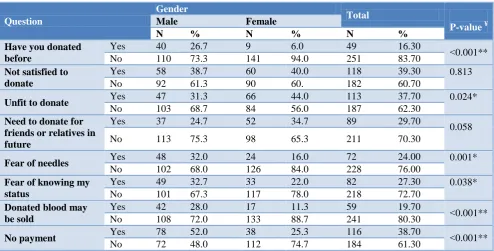
Table 5: Practice on blood donation among male and female students.
Question
Gender
Total
P-value ¥
Male Female
N % N % N %
Have you donated before
Yes 40 26.7 9 6.0 49 16.30
>0.001**
No 110 73.3 141 94.0 251 83.70
Not satisfied to donate
Yes 58 38.7 60 40.0 118 39.30 0.813
No 92 61.3 90 60. 182 60.70
Unfit to donate Yes 47 31.3 66 44.0 113 37.70 0.024*
No 103 68.7 84 56.0 187 62.30
Need to donate for friends or relatives in future
Yes 37 24.7 52 34.7 89 29.70
0.058
No 113 75.3 98 65.3 211 70.30
Fear of needles Yes 48 32.0 24 16.0 72 24.00 0.001*
No 102 68.0 126 84.0 228 76.00
Fear of knowing my status
Yes 49 32.7 33 22.0 82 27.30 0.038*
No 101 67.3 117 78.0 218 72.70
Donated blood may be sold
Yes 42 28.0 17 11.3 59 19.70
>0.001**
No 108 72.0 133 88.7 241 80.30
No payment Yes 78 52.0 38 25.3 116 38.70 >0.001**
No 72 48.0 112 74.7 184 61.30
*The Chi-square statistic is significant (P>0.05); †The Chi-square statistic is significant (P>0.001); N=Number of observations.
Table 3 demonstrates the negative attitudes medical students have about blood donation including beliefs that donating blood should be at request of relatives, should be paid, and that donors should receive something in exchange. Students were also asked if they thought that blood donors can contract disease or are temporarily weakened. One fourth of the students (24%) strongly agreed and another fourth (26.7%) agreed that the best way to donate blood is at request of relatives (p<0.001). Similarly, 29.7% agreed that the best way to donate blood is paid donation. Thirty percent agreed that people should receive something in exchange for their donation. Thirty-four percent agreed that blood donors can contract disease and 30% agreed that the donners are temporarily weakened.
The positive attitudes assessed in this study included blood donation to get free investigations, beliefs that blood donation can save people life, beliefs that young people should frequently donate blood more than elderly, beliefs that the best way to donate blood is voluntary non-remunerated, and beliefs that blood donors should always disclose correct information about their health before donating blood (Table 4). One fourth of the participating students (24%) agreed for donating blood to get free investigation, whereas one fifth (20%) disagreed with that. About three-fourths (72.3%) of the participating students, especially six-grade students, strongly agreed that blood donation saves lives. However, only 43% of them agreed strongly that blood donation is a moral activity, especially fourth, fifth, and sixth-grade students. One fourth (27.7%) agreed that young people should frequently donate blood rather than elderly, whereas another fourth (27.7%) were uncertain about that.
Additionally, 26% strongly agreed and 37.7% agreed that the best way to donate blood is voluntary non-remunerated donation. About 46.3% strongly agreed and 38.7% agreed that blood donors should always disclose correct information about their health before blood donation, the difference between the different medical grades was not statistically different.
Table 6: Practice on blood donation among medical students.
Question, N (%) 2nd 3rd 4th 5th 6th Total P-value ¥
Have you donated before
Yes 2 (7.1) 15 (22.1) 7 (21.9) 11 (10) 14 (22.6) 49 (16.3) 0.059
No 26 (92.9) 53 (77.9) 25 (78.1) 99 (90) 48 (77.4) 251 (83.7)
Not satisfied to donate
Yes 3 (10.7) 24 (35.3) 13 (40.6) 39 (35.5) 39 (62.9) 118 (39.3)
>0.001** No 25 (89.3) 44 (64.7) 19 (59.4) 71 (64.5) 23 (37.1) 182 (60.7)
Unfit to donate Yes 5 (17.9) 24 (35.3) 10 (31.3) 38 (34.5) 36 (58.1) 113 (37.7) 0.002*
No 23 (82.1) 44 (64.7) 22 (68.8) 72 (65.5) 26 (41.9) 187 (62.3)
Need to donate for friends or relatives in future
Yes 12 (42.9) 19 (27.9) 0 (0) 30 (27.3) 28 (45.2) 89 (29.7)
>0.001** No 16 (57.1) 49 (72.1) 32 (100) 80 (72.7) 34 (54.8) 211 (70.3)
Fear of needles Yes 0 (0) 21 (30.9) 0 (0) 31 (28.2) 20 (32.3) 72 (24) >0.001**
No 28 (100) 47 (69.1) 32 (100) 79 (71.8) 42 (67.7) 228 (76)
Fear of knowing my status
Yes 3 (10.7) 30 (44.1) 13 (40.6) 21 (19.1) 15 (24.2) 82 (27.3)
>0.001** No 25 (89.3) 38 (55.9) 19 (59.4) 89 (80.9) 47 (75.8) 218 (72.7)
Donated blood may be sold
Yes 5 (17.9) 18 (26.5) 7 (21.9) 16 (14.5) 13 (21) 59 (19.7)
0.400 No 23 (82.1) 50 (73.5) 25 (78.1) 94 (85.5) 49 (79) 241 (80.3)
No payment Yes 10 (35.7) 20 (29.4) 21 (65.6) 46 (41.8) 19 (30.6) 116 (38.7) 0.006* No 18 (64.3) 48 (70.6) 11 (34.4) 64 (58.2) 43 (69.4) 184 (61.3)
¥Chi-square test; *statistically significant (>0.05); **statistically significant (>0.001).
Table 7: Linear regression testing association between blood donation and different demographic parameters.
Predictors B S.E. Adjusted OR (95% CI) † P-value
Age 0.002 0.03 0.01 (-0.07-0.07) 0.947
Gender 0.21 0.04 0.28 (0.13-0.29) >0.001**
Class -0.01 0.02 -0.04 (-0.05-0.03) 0.58
B=Regression coefficient; SE=Standard error of regression coefficient; OR=Odds Ratio; CI=Confidence Interval; *statistically significant (>0.05).
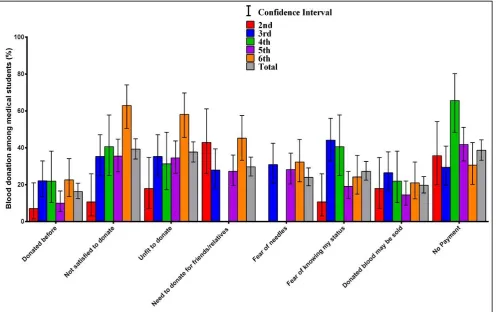
Figure 2: Comparing different class years regarding donation practices.
The correlation between blood donation with some variables was studies, including age, gender, and class (Table 7). Gender was found to be the only variable that was significantly associated with blood donation (OR=0.28, p<0.001).
DISCUSSION
Undergraduate medical students are a considerable sector of the community that can share in increasing blood donation both directly, through donating blood themselves, and indirectly through educating the community about the importance and safety of blood donations. Thus, this study was conducted to assess the medical students' knowledge, attitudes, and practices about blood donation, so as to have a clue about what they actually view and to implement strategies that would correct any malalignment discovered.
The vast majority of the recruited sample had fair general knowledge about blood donation, such as blood groups, frequency and requirements of blood donation, and the risk and consequences of blood donation (Figure 2). This goes in agreement with many literature studies that did not report any significant insufficient knowledge about blood donation among medical students.6–8 Knowledge about blood donation, probability of transmitted infection, and the diseases than can be transmitted through blood donation and transfusion was higher among elder grades especially the fourth, fifth, and
sixth-grade students, probably with accumulated educational studies.
A considerable portion of the participating students – in agreement with some literature reports had positive attitude towards blood donation, they believed that blood donation do save people lives and it is a moral activity, and they encouraged that young individuals should donate blood frequently, and that the best way for blood donation is the voluntary non-remunerated donation. 9–11 They accepted donating blood just to get free investigations and they understood the importance of disclosing correct information before blood donation. However, more than 90% of females and three-fourths of males did not donate blood before. This figure is similar to studies conducted on medical students in India, China, and Pakistan.6,8,12 In agreement with our results, females were less likely to donate blood than males in previous studies.6,11,13 Gender was the only variable that was significantly correlated with blood donation in our study (OR=0.28 and p<0.001). Such difference may be partially explained by the significantly higher proportion of females who reported fear of needles among the recruited sample (p=0.0038).
as a source of blood products. They believed that blood donors should get something in exchange, and that they are getting weakened temporarily due to blood donation. They also believed strongly that blood donors can contract infection during the donation process. Similar negative attitudes were reported among medical students in literature with figures closely similar to our results.14–16
Whilst the vast majority of students did not donate blood before, they did not report that they were unsatisfied to donate. Furthermore, they refused that the blood donated is supposed to be sold. And whereas females were more fearful of needles, males were more fearful of knowing their status during blood donation. The differences between the different grades studies among recruited students were significant. Elder grades had higher levels of knowledge about the importance of blood donations, the requirements and criteria for donation, and the possible hazardous consequences of blood donation. Middle grades (such as the third and fourth) were more enthusiastic, more involved in donation processes, more accepting donation for no money, and less fearful of needles. They had also higher beliefs in the moral aspects of donation than older and younger grades (p<0.001).
CONCLUSION
Knowledge, attitude, and practice of medical students about blood donation are highly variable among different grades and genders of students in Hail University, and whilst positive attitudes and beliefs such as the belief in the importance of blood donation and its relation to moral aspects, the belief that blood donation should not be non-remunerated, the belief that young individuals should donate blood frequently, and their acceptance to donate blood to get free investigations, still a considerable proportion of them has negative thoughts including the belief that blood should be donated upon request from relatives, or to implement paid donations, and that blood donation has deleterious impacts on health either temporarily or on the long-term through infection transmission. So, proper education and motivation of medical students in Hail University should be adopted to encourage blood donation in Saudi Arabia.
ACKNOWLEDGEMENTS
The authors would like to thank Hail University ethical board for their cooperation and guidance through the whole process, and we like to thank all the students that were part of this study, for taking their time to complete the survey.
Funding: No funding sources Conflict of interest: None declared
Ethical approval: The study was approved by the Institutional Ethics Committee
REFERENCES
1. Organization WH. WHO Global Data Base on Blood Safety, Summary Report. Geneva.
2. Blood safety and availability. 2014. [Online]. Available at: http://www.who.int/mediacentre/fact sheets/fs279/en/.
3. Hollingsworth B, Wildman J. What population factors influence the decision to donate blood? Transfus Med. 2004;14(1):9-12.
4. Politis C. Blood donation systems as an integral part of the health system. Arch Hell Med. 2000;17(4):354-7.
5. Abolfotouh MA, Al-Assiri MH, Al-Omani M, Al Johar A, Al Hakbani A, Alaskar AS. Public awareness of blood donation in central Saudi Arabia. Int J Gen Med. 2014;7:401-10.
6. Ahmed Z. Knowledge, Attitude and Practices about Blood Donation among Undergraduate Medical Students in Karachi. J Infect Dis Ther. 2014;2(2):2-5.
7. Raghuwanshi B, Pehlajani NK, Sinha MK. Voluntary Blood Donation among Students - A Cross-Sectional Study on Knowledge and Practice vs. Attitude. J Clin Diagn Res. 2016;10(10):18-22. 8. Kowsalya V, Vijayakumar R, Chidambaram R,
Srikumar R, Reddy EP, Latha S, et al. A study on knowledge, attitude and practice regarding voluntary blood donation among medical students in Puducherry, India. Pakistan J Biol Sci. 2013;16(9):439-42.
9. Hosain GMM, Anisuzzaman M, Begum A.
Knowledge and attitude towards voluntary blood donation among Dhaka University students in Bangladesh. East Afr Med J. 1997;74(9):549-53. 10. Wiwanitkit V. Knowledge about blood donation
among a sample of Thai university students. Vox Sang. 2002;83(2):97-9.
11. Amatya M. Study on knowledge, attitude and practice of blood donation among students of different colleges of Kathmandu, Nepal. Int J Pharm Biol Arch. 2013;4(3):424-8.
12. Gao L, Wang Q. Survey on knowledge, attitude and practice about blood donation among continuing medical education (CME) students in Sichuan
province, China. Transfus Apher Sci.
2017;56(3):454-8.
13. Wiwanitkit V. A study on attitude towards blood donation among people in a rural district, Thailand. Southeast Asian J Trop Med Public Health. 2000;31(3):609-11.
14. Juarez-Ocana S, Pizana-Venegas JL, Farfan-Canto JM, Espinosa-Acevedo FJ, Fajardo-Gutierrez A. Factors that influence non-donation of blood in relatives of patients at a pediatric hospital. Gac Med Mex. 2001;137(4):322-5.
Regular Students, Ambo Town, Ethiopia. J Community Med Health Educ. 2014;4(5).
16. Ogboghodo EO, Ofili AN, Ogunbor OJ, Ogenyi CC, Okpala C. Knowledge, attitude and practice of voluntary non-remunerated blood donation among medical students in a tertiary institution in Southern Nigeria. J Med Biomed Res. 2015;14(2):104-17.