Original Research Article
Knowledge, attitude and practice regarding blood donation among
medical students of Tamil Nadu- a cross sectional study
Venkatesh Govindasamy, Devendiran Sivasankaran*, Vaithiyanathan Purushothaman
INTRODUCTION
“Blood connects us all” was the theme of the world blood donor’s day 2018 and one cannot reiterate the truth behind this enough. The importance of human blood lies in the very fact that it is the elixir of life and has no substitute for it. Thus access to safe blood is the key to an effective health care and blood donors are the basis of a safe blood supply. The source of donated blood at present is a combination of voluntary donors and replacement donors; however voluntary remunerated donors remain the cornerstone. Against 8.5 million units/year requirement, the availability is only 4.4 million units/year.1 Thus there is a serious mismatch between demand and availability of blood in the country. Hence
arise the need for motivation of voluntary blood donors on regular basis.
As per WHO standards, India’s demand for blood and blood components should be 1% of total population.2 This goal can only be achieved by recruiting adequate number of voluntary blood donors. There are various barriers to donating blood that influence the behaviour of people towards blood donation such as cultural backgrounds, socioeconomic factors and the knowledge or the lack of with regards to blood donation. Habitually the people in the medical field are looked upon as people with the ultimate knowledge regarding issues pertaining to the medical issues including blood donations. We presume that medical students in particular owing to their
ABSTRACT
Background: Blood can save millions of life. Blood transfusion is one of the most crucial interventions in conditions like trauma, childbirth, and various other medical and surgical life-saving procedures. In spite of extensive efforts and a number of blood donation programs being organized worldwide, the availability of blood remains too short to meet the demand. Students of health education form a potential source of eligible regular voluntary donors and also play a cruel role in motivating potential donors from the general population.
Methods: A cross sectional study was conducted among the medical students and interns of Government Thiruvannamalai Medical College in July 2018. Universal sampling was done for this study. A pretested structured questionnaire was used for data collection. Data entry and analysis was done using SPSS software version 21.
Results: Out of 460 students, 53.3% have adequate knowledge about blood donation. 57.8% of students have positive attitude towards blood donation. Only 31.4% of them have donated blood before and anaemia was found to be the main reason among non-donors for not having donated blood.
Conclusions: More than half of the students have adequate knowledge and positive attitude towards blood donation. Less than one-third have donated blood. It is recommended that there is a need to adopt strategies to sensitize and motivate them towards voluntary blood donation early in their medical career.
Keywords: Blood donation, Medical students, Knowledge, Attitude
Department of Community Medicine, Government Thiruvannamalai Medical College and Hospital, Tamil Nadu, India
Received: 01 September 2019
Accepted: 09 September 2019
*Correspondence:
Dr. Devendiran Sivasankaran, E-mail: [email protected]
Copyright: © the author(s), publisher and licensee Medip Academy. This is an open-access article distributed under the terms of the Creative Commons Attribution Non-Commercial License, which permits unrestricted non-commercial use, distribution, and reproduction in any medium, provided the original work is properly cited.
education can be a valuable resource to become voluntary non replacement blood donors when compared to the general population. They also prove to be a source of good motivation and spread the propaganda in the near future. With this background this study was conducted to determine knowledge attitude and practice regarding blood donation among medical students of government Thiruvannamalai Medical College in Tamil Nadu.
METHODS
This cross sectional study was conducted among the medical students and interns of Government Thiruvannamalai Medical College, Thiruvannamalai during a period of 31 days from 1st to 31st July 2018. A total of 500 students were enrolled by universal sampling. Those who refused to participate and those who could not be contacted during the data collection period were excluded from the study. A pretested structured questionnaire was used for data collection. Four sections namely socio-demographic variables, knowledge, attitude and practice regarding blood donation were included. Informed verbal consent was obtained and confidentiality was assured. The study was approved by the institutional ethics committee, Government Thiruvannamalai Medical College, Thiruvannamalai.
The participant’s level of knowledge was assessed through a set of 28 questions. Maximum score a
respondent could get was 28 and the score obtained out of 28 was calculated for each participant. Adequate knowledge was classified as having a score of 12 and above (mean=12).
The respondents attitude regarding blood donation were assessed using 19 statements out of which 7 positive statements, scored 3 [agree], 2 [neutral],1 [disagree] and 12 negative statements scored 1 [agree], 2 [neutral], 3 [disagree]. Mean score obtained being 48, those who scored ≥48 were assumed to have positive attitude in comparison to the rest.
The data collected was entered using SPSS software version 23 and analysed using frequency, mean and percentage. Chi-square test was used for testing the significance between the proportions.
RESULTS
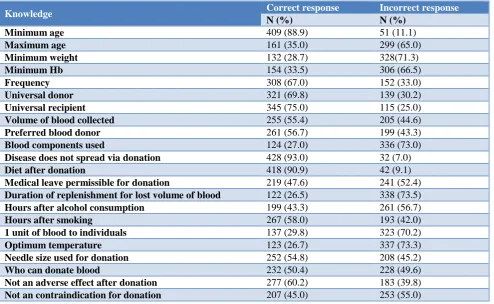
The study sample consists of 460 medical students in the age group of 18-31 years. The mean age of respondents was 21 years. The response rate was 92%. More number of females participated in the study [58% vs 42%]. Majority of the participants were Hindus. Participant’s knowledge towards blood donation is represented in table 1.
Table 1: Knowledge towards blood donation (n=460).
Knowledge Correct response Incorrect response
N (%) N (%)
Minimum age 409 (88.9) 51 (11.1)
Maximum age 161 (35.0) 299 (65.0)
Minimum weight 132 (28.7) 328(71.3)
Minimum Hb 154 (33.5) 306 (66.5)
Frequency 308 (67.0) 152 (33.0)
Universal donor 321 (69.8) 139 (30.2)
Universal recipient 345 (75.0) 115 (25.0)
Volume of blood collected 255 (55.4) 205 (44.6)
Preferred blood donor 261 (56.7) 199 (43.3)
Blood components used 124 (27.0) 336 (73.0)
Disease does not spread via donation 428 (93.0) 32 (7.0)
Diet after donation 418 (90.9) 42 (9.1)
Medical leave permissible for donation 219 (47.6) 241 (52.4)
Duration of replenishment for lost volume of blood 122 (26.5) 338 (73.5)
Hours after alcohol consumption 199 (43.3) 261 (56.7)
Hours after smoking 267 (58.0) 193 (42.0)
1 unit of blood to individuals 137 (29.8) 323 (70.2)
Optimum temperature 123 (26.7) 337 (73.3)
Needle size used for donation 252 (54.8) 208 (45.2)
Who can donate blood 232 (50.4) 228 (49.6)
Not an adverse effect after donation 277 (60.2) 183 (39.8)
Not an contraindication for donation 207 (45.0) 253 (55.0)
On the basis of the scoring scale described earlier the proportion of students having adequate knowledge about
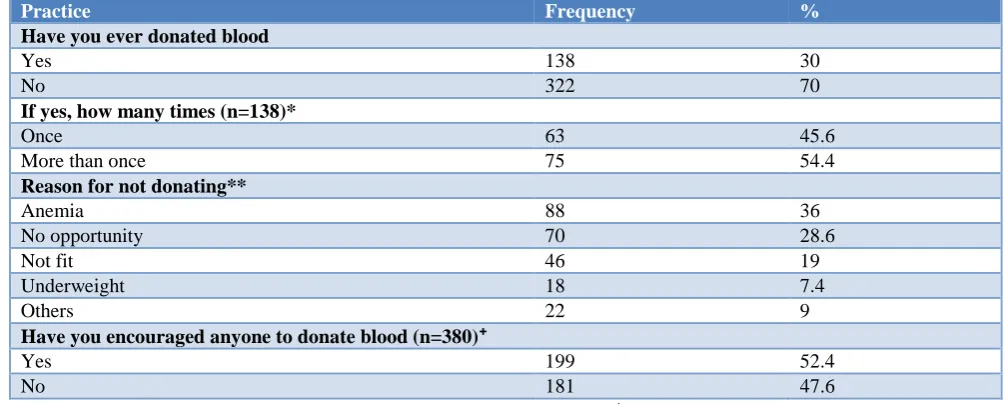
were willing to become a voluntary blood donor in future and motivate family members in doing the same. Most of the students stated the reason as of not donating blood as either not being fit or the absence of an opportunity to do so. Only 30% of respondents had ever donated blood.
Amongst those who had donated blood over 50% had donated more than once. The main reason cited for not having donated was either anaemia or not having an opportunity to do so.
Table 2: Attitude towards blood donation (n=460).
S.
No. Statement
Disagree Neutral Agree
N (%) N (%) N (%)
1 Blood donation is safe 15 (3.3) 67 (14.5) 378 (82.2)
2 Blood donation is painful 259 (56.3) 126 (27.4) 75 (16.3)
3 Blood donation is harmful to health 416 (90.4) 34 (7.4) 10 (2.2)
4 Never had an opportunity to donate blood 254 (55.2) 80 (17.4) 126 (27.4)
5 Blood donation is long and boring 366 (79.6) 73 (15.8) 21 (4.6)
6 I’m afraid of needles 275 (59.8) 70 (15.2) 115 (25.0)
7 I’m not fit to donate 223 (48.5) 83 (18.0) 154 (33.5)
8 Blood will be misused by the blood bank 283 (61.5) 124 (27.0) 53 (11.5)
9 Blood will be wasted 295 (64.1) 113 (24.6) 52 (11.3)
10 Fear that too much blood will be collected 316 (68.7) 75 (16.3) 69 (15.0)
11 Blood donors should receive compensation 235 (51.1) 112 (24.3) 113 (24.6)
12 Prefer to donate any one in need 24 (5.2) 68 (14.8) 368 (80.0)
13 Main motive to donate is to save a life and serve
the society 21 (4.5) 33 (7.2) 406 (88.3)
14 Will motivate family members to donate blood 20 (4.3) 61 (13.3) 379 (82.4)
15 Blood donation will cause anemia 274 (59.6) 100 (21.7) 86 (18.7)
16 Lose immunity after blood donation 337 (73.3) 85 (18.4) 38 (8.3)
17 Blood donation is against my religious belief 406 (88.2) 27 (5.9) 27 (5.9)
18 Blood in blood bank is safe 54 (11.7) 142 (30.9) 264 (57.4)
19 Will become a voluntary regular blood donor 61 (13.3) 148 (32.1) 251 (54.6)
Table 3: Practice regarding blood donation (n=460).
Practice Frequency %
Have you ever donated blood
Yes 138 30
No 322 70
If yes, how many times (n=138)*
Once 63 45.6
More than once 75 54.4
Reason for not donating**
Anemia 88 36
No opportunity 70 28.6
Not fit 46 19
Underweight 18 7.4
Others 22 9
Have you encouraged anyone to donate blood (n=380)⁺
Yes 199 52.4
No 181 47.6
*: No of respondents who had donated blood; **: multiple responses were allowed; ⁺: missing response.
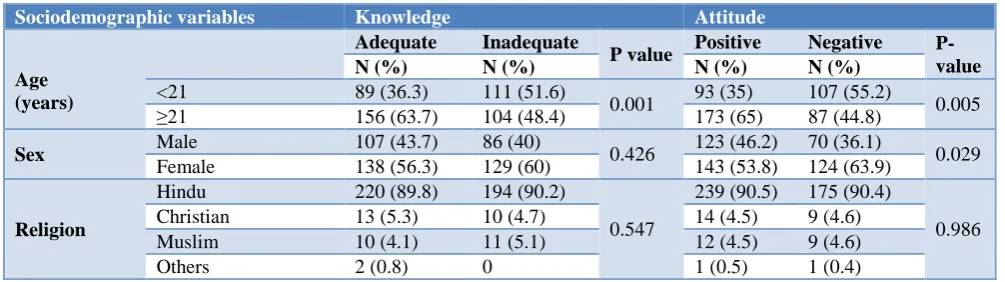
It was found that age had a significant association to knowledge regarding blood donation. In particular those ≥21 years had adequate knowledge than their counterpart. Sex and religion failed to prove a significant association with blood donation. Through this study it was revealed that age and sex had a significant association with
Table 4: Association between sociodemographic variables and blood donation.
Sociodemographic variables Knowledge Attitude
Age (years)
Adequate Inadequate
P value Positive Negative P-value
N (%) N (%) N (%) N (%)
<21 89 (36.3) 111 (51.6)
0.001 93 (35) 107 (55.2) 0.005 ≥21 156 (63.7) 104 (48.4) 173 (65) 87 (44.8)
Sex Male 107 (43.7) 86 (40) 0.426 123 (46.2) 70 (36.1) 0.029 Female 138 (56.3) 129 (60) 143 (53.8) 124 (63.9)
Religion
Hindu 220 (89.8) 194 (90.2)
0.547
239 (90.5) 175 (90.4)
0.986 Christian 13 (5.3) 10 (4.7) 14 (4.5) 9 (4.6)
Muslim 10 (4.1) 11 (5.1) 12 (4.5) 9 (4.6)
Others 2 (0.8) 0 1 (0.5) 1 (0.4)
DISCUSSION
Despite extensive research with regards to blood and its substitute, a true substitute for this life savior is yet to be found. Thus with the growing demands for blood in the trauma care and other fields of health care the need for remunerable voluntary blood donors is inevitable. Medical students being a source of easily accessible and readily available donors can prove as a true asset if duly motivated.
In our study 53.3% have adequate knowledge about blood donation which is comparable to the study done by Ponmari et al and significantly higher than the study done by Manikandan et al, Sanayaima et al and contrary to the study done by Alisha et al (9%).3-5,8 By organising CME periodically, their doubts regarding voluntary blood donation should be cleared and they should be encouraged to donate blood on regular basis.
The present study indicates majority of the participants never donated blood and observed positive attitude (57.8%) which is comparable to the study done by Manikandan et albut higher than the study conducted by Sanayaima et al.4,5 Therefore, different fears, ignorance, lack of information and motivation may serve as important issues to be addressed when organizing blood camps. Around 28% of the participants cited the fact of not having an opportunity in donating blood. This must be overcome by sensitizing the students regarding the activities of the college. It was found through the study that age had a significant association with both knowledge and attitude towards blood donation, in particular those ≥21 years. This might be due to the fact that the current lineage of progeny is well informed and aware of the situation with regards to the subject. Blood donation practices were found to be significantly higher among males and were comparable to the study conducted by Danasikaran et al and other.6-10 Most of the students were willing to donate blood which was higher than the findings of Manikandan et al and Kowsalya V et al.4,11 Blood donation practices which is low among females may be attributed to a greater reliance on parental permission, anemia and the willingness on the part of the female students before they can make their decisions.
Religion failed to have a significant association with blood donation in terms of knowledge or attitude, substantiating the fact that the noble act of blood donation is indeed secular.
CONCLUSION
It was found in this study that though over half of the respondents had adequate knowledge and attitude regarding blood donation and intended to become donors in the future, only a far from few had actually donated in the past. With regards to practice, males were found to be active donors rather than females. Age had a significant association with both knowledge and attitude towards blood donation while sex had an association with practice regarding blood donation.
Funding: No funding sources Conflict of interest: None declared
Ethical approval: The study was approved by the Institutional Ethics Committee
REFERENCES
1. National AIDS control Programme. Available at: http://www.nacoonline.org/National_AIDS_ Control_Program/Services_for_prevention/Access_t o_safe_blood/. Accessed on 5 Spetember 2019. 2. Dubey A, Sonker A, Chaurasia R, Chaudhay R.
Knowledge attitude and beliefs of people regarding blood donation in North India. Blood Transfus. 2014;12:21-7.
3. Ponmari JS, Sivaraman M, Balasubramanian A. A study on knowledge, attitude and practice on blood donation among medical students in a tertiary care teaching hospital, Chennai, Tamil Nadu, India. Int J Basic Clin Pharmacol. 2016;5(3):802-4.
6. Alisha J, Akoijam BS, Kumar S. Assessment of knowledge, perception and practice of voluntary blooddonation among health professional students in RIMS, Imphal. IOSR J Dent Med Sci. 2016;15(10):26-30.
7. Danasikaran R, Mani G, Annadurai K. A cross-sectional study on awareness and practices about blood donation among medical students. Int J Multidisciplinar Res Develop. 2014;1(6):131-4. 8. Shidam UG, Lakshminarayanan S, Saurabh S, Roy
G. Knowledge and attitude regarding blood donation in rural Puducherry, India. Natl J Community Med. 2015;6:64-8.
9. Salaudeen AG, Odeh E. Knowledge and behavior towards voluntary blood donation among students of a tertiary instituition in Nigeria. Niger J Clin Pract. 2011;14:303-7.
10. Mullah F, Kumar D, Antani D, Gupta M. Study of knowledge, perception and practices related to blood donation among healthcare support staff of a tertiary care hospital in Gujarat, India. J Health Allied Sci. 2013;12(1):1-4.
11. Kowsalya V, Vijayakumar R, Chidambaram R. A study on knowledge, attitude and practices regarding voluntry blood donation among medical students of Puducherry, India. Pak J Biol Sci. 2013;16(9):439-4.