Volume 4, Issue 3, March 2015
Abstract— A wireless sensor network (WSN) consists of a large
number of sensor nodes which are deployed over the geographical area. Each node in the network is equipped with a battery, but it is nearly very difficult to change or recharge batteries. Therefore the aim of this project is to use energy efficiently.
The existing scheme uses Power-Aware Relay Selection (PARS) minimizes the overall transmit power and helps to select the best relay among all the relays. However the relaying in the existing scheme is static which may give rise to usage of large number of relay nodes, which leads to larger power consumption in the overall network. Hence this project work proposes Relative Power Adaptable Distance Aware Routing for the less energy consumption. The relay in the proposed scheme is mobile. Therefore the energy consumption for each node and also the number of relay nodes gets decreased.
Index Terms— BS, Ms, RS, Wireless sensor network, PARS.
I. INTRODUCTION
WIRELESS sensor networks (WSNs) are an important technology that can enhance our capability of monitoring and interacting with the physical world. The development of wireless sensor networks was originally motivated by military applications. However, wireless sensor networks are now used in many civilian application areas. A WSN (WSN) consists of a set of sensors that are interconnected by a communication network. The sensors are deeply embedded devices that are integrated with a physical environment and capable of acquiring signals, processing the signals, communicating and performing simple computation tasks.
Each sensor network node has several parts such as a radio transceiver with an internal antenna or connection to an external antenna, a microcontroller, an electronic circuit
Manuscript
S.Girija, Electronics and Communication Engineering , Manakula
Vinayagar Institute of Technology ,Pondicherry,india, (e-mail: [email protected]).
Mr.S.Arunmozhi M.tech (Phd) Head of the department, Electronics and
Communication Engineering , Manakula Vinayagar Institute of Technology ,Pondicherry,india.
Mr.S.Anbazhagan M.tech ,Assistant Professor Electronics and
Communication Engineering , Manakula Vinayagar Institute of Technology ,Pondicherry,india..
for interfacing with the sensors and an energy source, usually a battery or an embedded form of energy harvesting. The efficient usage of energy is a critical issue in wireless sensor networks. There are many causes which lead to depletion of wireless sensor batteries which ultimately leads to failure of the network. When the distance between the base station and sink is larger than the transmission range means sensor node cannot send data directly to the sink then there is need for relay node placement. Originally, relay station is introduced in the next generation network due to enhancing network coverage and improving boundary capacity. However the energy consumption in relay system is still severe. The energy-efficiency problem in the relay system is more complex comparing with the network without RSs, and it becomes a focus of the current research.
Recent work showed that the energy consumption of WSNs can be significantly reduced by using the mobility of nodes. Several different approaches have been proposed. This paper proposes a new sensing model, the “mobile relay node” sensing model, where nodes that transmit data are physically detached from nodes that collect data. More specifically, relay nodes that roam around the area receive data from fixed sensors and transmit them to sink. In this paper, we make use of low cost disposable mobile relays to minimize the total energy consumption of data-rigorous WSNs.
II.
RELATED WORKIn [1,2] joint subchannel and power allocation problems were studied in OFDMA relay cellular networks where RSs can perform network coding with downlink as well as uplink sessions of an MS. However, they did not consider a practical duplexing scheme for the transmission of data where the network coding is applied. Network coding is a simple extension of routing that allows for any node in the network to perform operations on its received data before it transmits any data. It is an elegant technique introduced to improve network throughput and performance [3],[4],[5], [6].The practical XOR coding scheme [7] demonstrates throughput enhancement in 802.11 networks uses a single common frequency.
Performance Analysis of Energy Utilization in
Static and Mobility Relaying in WSN
A mobile base station moves around the network and collects data from the nodes. All nodes are always performing multiple hop transmissions to the base station, and the aim is to rotate which nodes are nearer to the base station in order to balance the transmission load [8], [9], [10]. In other work, nodes only transmit to the base station when it is close to them. The goal is to calculate a mobility path to collect data from visited nodes previous to those nodes suffer buffer overflows [11], [12], [13], [14].
Data mules are same as mobile base stations [15], [16], [17]. They collect data from the sensors and deliver it to the sink. In [18], the data mule visits all the sources to pick up data, transports data over few distance, and then send it to the static base station through the network. The aim is to find a movement path that minimizes both communication and mobility energy conservation .Similar to mobile base stations, datamules produces more delays since sensors have to wait for a mule to pass by priory starting their transmission. The network consists of mobile relay nodes together with static base station and data sources. Relay nodes do not transport data; instead, they move to different locations to decrease the transmission costs. We use the mobile relay approach in this work. Goldenberg et al. [19] showed that the mobility algorithm where each relay node get a move on to the midpoint of its neighbors produces on the optimal solution for a single routing path. However, they do not account for the cost of moving the relay nodes. In [22], mobile nodes decide to move only when moving is welfare, but only the position assumed is the midpoint of neighbors. Many papers have considered the use of mobile relays to alleviate the problem that nodes nearer to a base station tend to quickly deplete their energy [20, 21,22].
III.
EXISTING METHOD All the sensors are static and then the network is considered as static network. The Base station forwards the data to the user through relay.Fig.1.System Model
In this work, a static network contains single base station with two relay station and number of users. Relays station operates
on unidirectional routing and Xor network coding concept is applied to relay station. A unidirectional network is a network appliance or device allowing data to travel only in one direction.
Fig.2.Network Coding Process in RS
The RSs are considered to perform XOR network coding, and the BS and all MSs are assumed to store the data transmitted of a subframe to RSs within their own buffer. Hence, if RSs XOR the downlink and uplink sessions of an MS, the corresponding MS and BS are able to decode the received signal by XORing the combined data with the stored data in their buffers. BS stores the data transmitted in a subframe of all MS, while MS only stores its own data in a subframe.
T
he storages for the data are not too big for both of BS and MSs. Besides, the extra overhead focusing on the XOR operation is very small. Therefore, network coding is very easily implemented in relay network.A.
POWER AWARE RELAY SELECTIONALGORITHM
In a typical network, the route of a packet will be determined by calculating which path is either fastest, or has the least amount of hops. This may mean that some nodes in the network get far more usage than others. If nodes have a limited power supply, such as laptop, extreme usage could quickly drain the battery. A temporary mobile network, such as an ad hoc network, would benefit from Power Aware Routing. When you can adjust the transmission power of nodes, hop count may be replaced by consumption metrics .A node sends out a control message at a set power. Other nodes can determine the distance of the sending node based on the strength of the signal. Messages will typically be sent through a series of ‘shortest hops’ until it reaches its destination. This is done to minimize the energy expended by any single node. This method helps to find the most power efficient path of transmission.
Volume 4, Issue 3, March 2015
The receiver power on a subcarrier for supporting b bits per symbol is given as N 0
Q −1
P
E
Rx
(b) =
^2 3
4
WhereP
E is the bit error rate
N0 is the noise power
Q is the beamforming directed frequency factor.
1
1
Q =
*
2 ∞2 * pi
−t
2∫e
x =1The Transmission power on subcarrier is given by
Rx
(b)
TX
(b) =
H
k ,nWhere
H
k,ndenotes the channel gain of user k’s
subcarrier n.
The total power used for the subcarrier is given as
p
(x)
=
RX
(b)
+TX
(b)
R
Power utilized by single relay is given as 6
=
∑
p
(x)
P
relay rX =1
Total energy consumed by relays in the network is given as
n
p
total=
∑
p
relay(r)
r =1Xor network coding is performed in the relay. The packet from the base station is received by the relay station and performs Xor operation and then it forwards to the particular user. Therefore decode and forward method is applied in relay station. The total energy utilized by a relay in a network and the delay performance is calculated.
IV.
PROPOSED METHODThe network consists of single base station along with one mobile relay nodes and number of users. Relay can be connected to two nodes. Based on the mobility relay is selected. Consider two relay namely A and B. If the mobility of relay A is lesser than the mobility of relay B. Then the relay A is selected. Receive and forward method is used and bidirectional routing is applied.
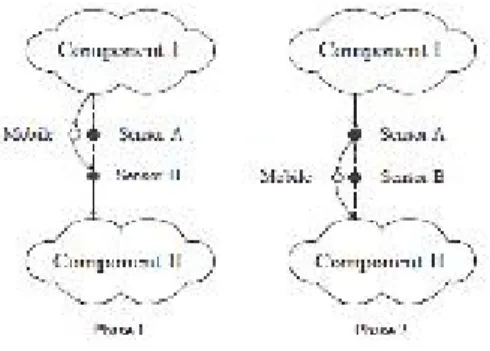
Here low-cost disposable mobile relays to reduce the total energy consumption of data intensive WSNs. Not like mobile base station or data mules, mobile relays do not send data; instead, they move to various locations and then remain stationary to forward data along the paths from the sources to the base station. In mobile nodes decide to move only when moving is beneficial.
Fig .3.Static Relay Vs Mobile Relay
Figure 3 shows a sample network, where the use of mobile nodes as relays can significantly improve the lifetime of the network. Suppose that the network is composed of two components which are connected via two sensor nodes A and B. Assume that these are the critical bottleneck nodes in the network and the lifetime of these two nodes is T, while other sensors have lifetime much longer than T. If we have one mobile node with the same transmission range and reception range as the sensor nodes, then the network lifetime can be at least doubled. A simple algorithm for this would be for the mobile node to shuttle between node A and node B and inherit the responsibilities of the node with which it is co-located. It is clear that with an appropriate shuttling schedule, the network lifetime can be doubled to 2T. We assume here that the energy resource at the mobile node is far greater than that of any of the sensing nodes.
A.
RELAY MOBILITY POWERLet as take the relay node as i. Then the mobility of the relay is calculated as below
Mobility of relay (i) = Avg velocity(i) + [pause time(i) * d(i) ]
The relative power can be calculated as Pr(i) =
*
(
)
*
(
)
*
)
+
*
2
1
TX
i
BCST
i
M
pi
TX
pausetime
Idlepower
RX
*
)
(
8
^
10
*
3
Whereas BCST(i) is the broadcasting range of the ith relay. Whereas BCST(i) is the broadcasting range of the ith relay.
Tx is the transmitted power of the ith relay Rx is the received power of the ith relay
Tx =
IE
n
Tx
x
b
n r*
)
(
*
1∑
= Rx =IE
n
Rx
y
A
n r*
)
(
*
2∑
=Whereas IE is the ideal energy of the node Tx(n) is the transmitted power of the node Rx (n) is the received power of the node
The relative power is the total amount of energy used by the relay in the network. The delay is equal to the sum of transmission delay and relay assigning time. Both the parameters are calculated by using formula.
V.
SIMULATIONWe carried out simulations on 100 randomly generated initial topologies, each of which has 100 nodes placed uniformly at random within a 150 m by 150 m area.r1 represents the proposed system and r2 represents the existing system.
Fig.5. Energy Utilized By Mobile Relay Vs Static Relay
From the figure 5 it is shown that the energy utilized by static relay is more than the energy utilized by mobile relay. However the relaying in the existing scheme is static which may give rise to usage of large number of relay nodes, which leads to larger power consumption in the overall network. The relay in the proposed scheme is mobile whereas the user and Base station is assumed to be static. Therefore the energy consumption for each node and also the number of relay nodes gets decreased because of using mobile relay nodes and hence the network lifetime gets enhanced.
Fig.6.Delay Graph Using Mobile Relay
From the figure 6 it is shown that the delay formed by static relay is more than the delay formed by mobile relay. Since network coding and static relay in the existing method creates more delay .
Volume 4, Issue 3, March 2015
VI.
CONCLUSIONEach sensor node in wireless network is equipped with limited battery supplied energy and this determines how long the node in sensor network is alive. By using proposed Relative Power Adaptable Distance Aware Routing algorithm the energy consumed by the nodes in the network is less. This is achieved by deploying the mobile relay in the network unlike static relay in existing scheme. Hence energy utilization in the network increases thereby the network lifetime gets increased and in the meantime the smaller delay is achieved thereby transmitting messages between sender and receiver in the shorter duration. Also by using the mobile relay the number of nodes gets decreased and eventually the complexity and cost of the network gets decreased.
SCOPE FOR FUTURE WORK
Thus by employing proposed Relative Power Adaptable Distance Aware Routing in wireless sensor network less energy is consumed and lower delay is achieved. But there is no significant improvement of Throughput in proposed scheme. Throughput is the significant parameter in the networking environment, that defines the number of message bits successfully transmitted through the communication channel. In the wireless sensor network throughput based analysis will be considered. Hence the future work focuses on proposing the efficient algorithm that can maximize the throughput and in the mean time consuming lesser energy and producing smaller delay.
REFERENCES
[1] Y. Xu, J.C.S. Lui, D.M. Chiu, Analysis and scheduling of practical network coding in OFDMA relay networks, Elsevier Computer Networks 53 (12) (2009) 2120–2139.
[2] H. Xu and B. Li, XOR-assisted cooperative diversity in OFDMA wireless networks: optimization framework and approximation algorithms, in: IEEE INFOCOM 2009, Rio de Janeiro, Brazil, and April 19–25, 2009.
[3] N. Wang and N. Ansari, “Identifying the Network Coding Opportunity,” Sarnoff Symposium, IEEE 2010
[4] D. S. Lun and M. M´edard, and R. Koetter, “Network Coding for Efficient Wireless Unicast,” 2006.
[5] M. J. Chaudhry, F. Saleemi, and F. J. Chaudhry, “Achieving QoS Through Network Coding,” in Proc. of the World Congress on Engineering, 2009.
[6] C. Fragouli, J. Y. L. Boudec, and J. Widmer, “Network Coding-An Instant Primer,” ACM SIGCOMM Computer Communication Review , 2006
[7] S. Katti, H. Rahu, W.J. Hu, D. Katabi, J. Crowcroft, XORs in the air: practical wireless network coding, in: Proceedings of ACM Sigcomm’06, Pisa, Italy, 2006.
[8] S.R. Gandham, M. Dawande, R. Prakash,and S. Venkatesan, “Energy Efficient Schemes for Wireless Sensor Networks with
Multiple Mobile Base Stations,” Proc. IEEE GlobeCom, 2003. [9] J. Luo and J.-P. Hubaux, “Joint Mobility and Routing for Lifetime
Elongation in Wireless Sensor Networks,” Proc. IEEE INFOCOM, 2005.
[10] Z.M. Wang, S. Basagni, E. Melachrinoudis, and C. Petrioli, “Exploiting Sink Mobility for Maximizing Sensor Networks
Lifetime,”Proc. 38th Ann. Hawaii Int’l Conf. System Sciences (HICSS), 2005.
[11] Kansal, D.D. Jea, D. Estrin, and .B.Srivastava,“Controllably Mobile Infrastructure for Low Energy Embedded Networks,” IEEE Trans. Mobile Computing, vol. 5, no. 8, pp. 958-973, Aug. 2006.
[12] G. Xing, T. Wang, W. Jia, and M. Li,“Rendezvous Design Algorithms for Wireless Sensor Networks with a Mobile Base Station,” Proc. ACM MobiHoc, pp.231-240, 2008. [13] A.A. Somasundara, A. Ramamoorthy, and M.B. Srivastava, “Mobile Element Scheduling with Dynamic Deadlines,” IEEE Trans. Mobile Computing, vol. 6, no. 4, pp.395-410, Apr. 2007. [14]Y. Gu, D. Bozdag, and E. Ekici, “Mobile Element Based
Differentiated Message Delivery in Wireless Sensor networks,” Proc. Int’l Symp. World of Wireless, Mobile and Multimedia Networks
(WoWMoM), 2006.
[15] D. Jea, A.A. Somasundara, and M.B.Srivastava, “Multiple Controlled Mobile Elements (Data Mules) for Data Collection in Sensor Networks,” Proc. IEEE First Int’lConf. Distributed
Computing in Sensor Systems (DCOSS), 2005.
[16]R. Shah, S. Roy, S. Jain, and W. Brunette, “Data Mules: Modeling a Three-Tier Architecture for Sparse Sensor networks,”Proc. IEEE First Int’l Workshop Sensor Network Protocols and
Applications(SNPA), 2003.
[17]S. Jain, R. Shah, W. Brunette, G. Borriello, and S. Roy, “Exploiting Mobility for Energy Efficient Data Collection in
Wireless Sensor Networks,” Mobile Networks and Applications, vol. 11, pp.327-339, 2006.
[18] C.-C. Ooi and C. Schindelhauer, “Minimal Energy Path Planning for Wireless Robots,”Proc. First Int’l Conf. Robot
Comm. And Coordination (ROBOCOMM), p. 2, 2007. [19]D.K. Goldenberg, J. Lin, and A.S. Morse, “Towards
Mobility as a Network Control Primitive,” Proc. ACM MobiHoc, pp. 163- 174, 2004.
[20] C-h. Ou, K-f. Ssu, “Routing with mobile relays in opportunistic sensor networks”, 18th IEEE Int’l Symposium on
Personal, Indoor and Mobile Radio Communications, PIMRC 2007. [21] S. Basagni, A. Carosi, E. Melachrinoudis, C. Petrioli, Z. M. Wang,“Controlled sink mobility for prolonging wireless sensor networks lifetime”, Journal on Wireless Network, 2007.
[22] J. Luo, J. Panchard, M. Piorkowski, M. Grossglauser, J-P. Hubaux,“MobiRoute: Routing towards a Mobile Sink for Improving Lifetime in Sensor Networks”, IEEE/ACM DCOSS, 2006.