Performance Analysis of Bandwidth Allocations for
Multi-Services Mobile Wireless Cellular Networks
*
*The research was supported in part by grants from Hong Kong Research Gants Council (RGC) under contracts HKUST 6163/00E, N-HKUST 605/02 and HKUST 6196/02E.
Lizhong Li
1Bin Li
2Bo Li
1Xi-Ren Cao
21Department of Computer Science
2Department of Electrical and Electronic Engineering
Hong Kong University of Science and Technology, Hong Kong, China
Abstract – One of the key challenges in the design of
bandwidth allocation policies for a multi-services mobile cellular network is to guarantee the potentially different Quality of Service (QoS) requirement from diverse applications, while at the same to ensure that the scarce bandwidth be utilized efficiently.
Complete Sharing (CS) and Dynamic Partition (DP) schemes have
been shown as viable techniques for managing the bandwidth. However, there has been no study that compares their respective performance, which is the focus of this paper. Specifically, in this paper, through both analysis and simulation, we demonstrate that both schemes can achieve comparable performance by proper manipulation of control parameters. The tradeoff is that DP scheme can more easily achieve the target QoS requirement, at the expense of over-provisioning, thus can potentially lead to less channel efficiency when comparing to a CS based scheme.
Index Terms – Bandwidth allocation, guarded channel policy,
handoff, and mobile cellular networks
I. INTRODUCTION
We have recently witnessed phenomenal growth in the development and deployment of wireless services, evident from the proliferation of cellular data services and the emerging wireless multimedia applications. This opens up a new research avenue and calls for the re-examination of some of the fundamental issues in wireless cellular networks. Various issues such as QoS guarantee have to be carefully examined. One of the key elements in providing QoS guarantee is an effective bandwidth allocation policy, which not only has to ensure that the system guarantee potentially different QoS
requirements and provide the necessary service differentiation from diverse applications, but at the same time has to fully utilize the scarce wireless bandwidth available in the wireless cellular networks. Moving from a voice-centric macro-cell wireless network to a multi-services micro-cell or/and pico-cell wireless network brings several new challenges: 1) the characteristics of data and multimedia applications are typically different from that of voice, e.g., data traffic usually consumes more bandwidths than that of voice, but can be adaptive, thus has less stringent service requirement; 2) The limited wireless resources have to be utilized effectively, and
fairly allocated to different types of traffic with potentially different service requirements and service differentiation; 3) smaller cell potentially results in more handoffs, making it more difficult to provide the necessary QoS guarantee.
Bandwidth allocation has been extensively studied in single-service wireless cellular networks. The Guarded Channel (GC)
schemes have been shown to be effective for providing the necessary QoS guarantee in terms of both call termination and call blocking probabilities [1-4]. One of the challenges in moving to a multi-service system is that the limited bandwidth has to be shared among multiple traffics. In [5] a Complete
Sharing (CS) and Complete Partition (CP) schemes were
investigated for two types of traffic, namely narrow-band and
wideband. It assumed that wideband traffic does not have
handoff. Huang et al proposed a movable boundary allocation scheme for voice and data traffic [6], in which bandwidth is divided into two sub-pools by two thresholds that can be dynamically adjusted. This facilitates the bandwidth provisioning for different QoS requirements and is adaptive to the changing traffic. The limitations are that both voice and data require the same bandwidth, and there is no service differentiation between voice new calls and handoff.
To the best of our knowledge, there has been no comparative study that investigates the performance of different bandwidth allocation schemes for multi-service wireless cellular networks. This is the focus of this paper. Specifically, we are interested in obtaining the quantitative performance measures for different bandwidth allocation schemes. Although our analysis in this paper focuses on two traffic types, but the derivation and conclusions also provide insight for arbitrary number of traffic types.
A variety of bandwidth allocation schemes have been proposed to support multiple traffics, which can be classified
as Complete Partitioning (CP), Complete Sharing (CS) or
hybrid schemes, depending on how the bandwidth are allocated among diverse traffic. In this paper, we first extend
H a n d o f f v o i c e N e w v o i c e M i x e d d a t a To ta l c h an ne l n u m be r: C S h a r e d c h a n n e l s K1 K2 K3 Tota l c ha nn el n um b er : C M i x e d d a t a K1 K2 N e w v o i c e H a n d o f f v o i c e c a l l s c a l l s c a l l s c a l l s c a l l s c a l l s F i g . 1 ( a ) : D P c o n t r o l s c h e m e F i g . 1 ( b ) : D T B R c o n t r o l s c h e m e
the movable boundary scheme [6] to consider different
bandwidth consumption by the two traffic types, referred as
Dynamic Partition (DP). We compare this with a CS scheme
we proposed in [7], called Dual Threshold Bandwidth
Reservation (DTBR). We compare their respective
performance using both analysis and simulation. The study reveals a number of interesting observations and provides insight in searching more suitable bandwidth allocation schemes.
The rest of the paper is organized as follow. We describe the DP and DTBR schemes in Section 2. We present the analytical models in Section 3, following by the numerical studies in Section 4. We conclude the paper in Section 5 with discussions on possible avenue for further study.
II. BANDWIDTH ALLOCATION STRATEGIES
We assume that each cell have a total of C channels. The bandwidth requirements for voice calls and data calls are fixed as 1 and B units, respectively.
A. Dynamic Partition (DP) Scheme
In [6], Haung et al proposed a voice and data integrated system with finite buffers, in which bandwidths assigned to voice and data are separated (i.e., complete partition). The unique feature of this scheme is that the boundary for the partition is “movable”, thus can effectively deal with the traffic changes in the system. In this scheme, however, handoff calls were not differentiated form new calls, thus the strict requirement of handoff dropping probability cannot be met. Furthermore it was assumed that the data requires one unit of bandwidth. We extend the movable boundary scheme to differentiate handoff calls and further take into account the different bandwidth requirement. In the new scheme, called
Dynamic Partition (DP) scheme (see Fig.1 (a)), among C
channels, K1 channels (voice only area) are reserved exclusively for new/handoff voice calls and K2 channels (data only area) are reserved exclusively for new/handoff data calls. The other C−K1−K2 channels (shared area) are fairly shared by both voice and data calls. In order to maintain a low handoff dropping probability for voice calls, we further restrict that
new voice calls can only use the K3 out of K1 voice channels (i.e., Guarded Channel policy). But handoff voice calls can use all the K1 channels, the handoff voice will be dropped only if there is no channel available in both the voice only area and the shared area. New voice call will be rejected if the number of channel occupancy exceeds the threshold K3 in the voice only area and there is no idle channel in the shared area. Data call (new or handoff) will be accepted only if there are at least B
idle channels in the data only area or in the shared area.
B. Dual-Threshold Bandwidth Reservation (DTBR)
The rationale for adopting a CS approach in the proposed
Dual-Threshold Bandwidth Reservation (DTBR) scheme [7]
(see Fig. 1(b)) is that it can achieve the maximum channel efficiency, while at the same time still being able to provide service guarantee and differentiation from diverse traffic. In the DTBR scheme, C channels of each cell are divided into
three regions by two thresholdsK1andK2. When the number
of channels occupied is less than the threshold K2, then both data and voice traffic can be admitted into the system; when the number of channels occupied is over the threshold K2, no data traffic is allowed; when the number of channels occupied is more than the threshold K1, then only handoff voice calls can be allowed. The handoff voice call will be dropped only if there is no channel available. Under this basic control model, the handoff voice gets highest priority, while data receives lowest service. The reason is that the data traffic can tolerate certain degree of service degradation, while voice cannot. There can be a number of variations using this basic model, for example, whether or not to use a queue to further buffer the handoff request when the requested channels are not available [7]. This has been shown to reduce the handoff dropping probability [1, 3]. In this study, for simplicity and for fair comparison with the DP scheme, we only consider the DTBR scheme without queuing.
III. PERFORMANCE ANALYSIS
We consider a homogeneous wireless network where all cells have the same number of channels and experience the same new and handoff call arrival rates. In each cell, the arrivals of new voice calls, new data calls, handoff voice calls
and handoff data calls are Poisson distributed with arrival rate vn
λ , λdn, λvhand λdhrespectively. Thus the total voice call arrival rate and data call arrival rate are λv =λvn +λvh and
dh dn
d λ λ
λ = + respectively. Since data can usually tolerate some degree of service degradation, new data calls and handoff data calls are not distinguished. Call duration times or call holding times of voice and data are exponentially distributed with the average call duration time 1/µvr and 1/µdr . In addition, the handoff voice and the handoff data are exponentially distributed with mean µvh and µdh respectively. This set of assumptions have been found reasonable as long as the number mobiles is much larger than the number of channels in a cell, and have been widely used in literature [1-7]. The exponential call holding time has also been shown to be valid for a wide range of systems [8-10]. For simplifying notations, we assume K2 is a multiple of B.
A. Dynamic Partition Scheme
Scheme DP can be modeled as a three-dimensional Markov chain. It is ergodic [16] if ρd <(C−K1)/B. Let Pijk be the steady probability that there are i new voice calls, j handoff voice calls and k data calls in the system. Let
x denote the greatest integer less than or equal to x. The steady-state balance equations of DP scheme are shown as below.Case 1: if i= j=k=0, then 001 010 100 000 ) (λv+λd P =µvP +µvP +BµdP (1) Case 2: if 0≤i+ j≤K1and0≤k<
(C−K1)/B
, or
C i j B
k and K C j i K1< + < − 2 0< < ( − − )/ , then 1 , , 1 , , 1 1 , , 1 , , 1 ( 1) ( 1) ) 1 ( ) ( − − − + + + + + + + + + + + = + + + + + k ij d k j i vh jk i vn k ij d k j i v jk i v ijk d v v d vh vn P P P P B k P j P i P kB j i λ λ λ µ µ µ µ µ µ λ λ λ (2)Case 3: if 0<i+ j<K3andk=
(C−K1)/B
, then1 , , 1 , , 1 , 1 , , 1 ( 1) ) 1 ( ) ( − − − + + + + + + + + = + + + + k ij d k j i vh jk i vn k j i v jk i v ijk d v v vh vn P P P P j P i P kB j i λ λ λ µ µ µ µ µ λ λ (3)
Case 4: If K3≤i+ j<K1and k=
(C−K1)/B
, then1 , , 1 , , 1 , 1 , ) 1 ( ) ( − − − + + + + + = + + + k ij d k j i vh jk i vn k j i v ijk d v v vh P P P P j P kB j i λ λ λ µ µ µ µ λ (4) Case 5: if i+ j=K1and k=
(C−K1)/B
, or
C i j B
k and K C j i K1< + < − 2 = ( − − )/ , or B K k and K C j i+ = − 2 = 2/ , then 1 , , 1 , , 1 ) (iµv+ jµv+kBµd Pijk =λvnPi− jk +λvhPi j− k+λdPijk− (5)Case 6: if i+ j=C−K2and k<K2/B, then
1 , , 1 , , 1 1 , ) 1 ( ) ( − − − + + + + + = + + + k ij d k j i vh jk i vn k ij d ijk d v v d P P P P B k P kB j i λ λ λ µ µ µ µ λ (6)
B. Complete Sharing Scheme DTBR
Scheme DTBR can be modeled as a two-dimensional Markov chain. It is ergodic [16] if ρd <K2/B. Let Pijbe the steady probability that there are i voice calls and j data calls in the system. The steady-state balance equations of DTBR scheme are shown as below.
If j≠K2/B, then < < = = + + + < + < + + + + + + + + + = + + + + + + + < + < + + + + + + + = + + + + + + < + < + + + + + + = + + > + = − + − + − + − + + − + + − + + − + − 0 0 0 0 0 ) 1 ( 0 ) 1 ( ) 1 ( ) 1 ( ) 1 ( ) 1 ( ) 1 ( ) 1 ( ) 1 ( ) 1 ( ) 1 ( 0 1 , 0 , 1 2 1 , 1 , , 1 , 1 2 1 , 1 , , 1 , 1 1 2 1 , , 1 , 1 1 1 , , 1 , 1 1 1 , , 1 , 1 , 1 j or i if j and i if P B P i K jB i if jB i P P B j P P i K jB i if jB i P P B j P P i K jB i K if jB i P B j P P i K jB i if jB i P B j P P i C jB i K if jB i P B j P P i C jB i if jB i P i jB C P d v i d v d d v v j i d j i d j i v j i v d v v j i d j i d j i v j i v d v v j i d j i v j i v d v vh j i d j i v j i v d v vh j i d j i vh j i v d v j i vh ij λ λ µ µ λ µ µ λ λ µ λ µ µ µ λ λ µ λ µ µ µ λ µ λ µ µ µ λ µ λ µ µ µ λ µ λ µ µ µ λ (7) If j=K2/B, then < = + + + − < < + + + + − = + + + + − < < − + + + + − = + − > = − + − + − + − + − 0 0 0 ) 1 ( 0 ) 1 ( ) 1 ( ) 1 ( 0 1 , , 1 2 1 , 1 , 1 2 1 , 1 , 1 2 2 1 , 1 , 1 2 , 1 2 i if i if jB P P i K K i if jB i P P i K K i if jB i P P i K C i K K if jB i P P i K C i if jB i P K C i if P d v j i d j i v d v v j i v j i v d v vh j i v j i v d v vh j i vh j i v d v j i vh ij µ λ λ µ µ µ λ λ µ µ µ λ λ µ µ µ λ λ µ µ µ λ (8)
Both models can be solved by a recursive technique developed by Herzog [11], which is based on the typical feature of Champan-Kolmogoroff equations that there exist a subset of the state probabilities, called them boundaries, and all states can be expressed as a function of boundary states. The basic idea of this technique is to choose the boundaries first and to derive the expressions for all remaining state probabilities as functions of the boundary values, and then solve a reduced system of equations for these boundaries. After that, determine all state probabilities by means of the boundaries. This has been shown to be suitable for solving a wide class of queuing problems. Due to the length limitation, we omit the details of the analytical derivations, and leave it to the full length paper [12].
IV. NUMERICAL RESULTS AND REMARKS
In this section, we present numerical results and compare the above two schemes. In order to validate the accuracy of the analysis, we also develop an event-driven simulation. The system performance parameters considered in this paper are handoff voice dropping probability, voice call blocking probability, data call blocking probability and overall channel utilization. We consider the following system configuration. The total channel number C of each cell is set to be 30 and the bandwidth requirement of data calls B is set to be 2. The data call intensity ρd is set to be 7, with the average arrival rate of
1 007 . 0 − = S d
λ and the average service rate of =0.001S−1 d
µ .
This is reasonable for typical Internet type of traffic [13]. For voice call, the average service rate is assumed to be =0.0083S−1
v
µ , while the voice call intensity can vary from 6 to 16. To alleviate the transient effect, the simulation was run for a long duration in order to reach the steady state, and the system performance measures were obtained by averaging over the results of 10 independent rounds of simulations.
Handoff voice call dropping probability is a key QoS
measures in wireless cellular networks, so in this paper, we set the target of the handoff voice call dropping probability to be
3
10− [4], and study the system performance under a wide range of call intensity.
For DP allocation scheme, among all the sets of thresholds )
, ,
(K1 K2 K3 that can guarantee target handoff voice call dropping probability (10−3) at =16
v
ρ , only the one with the highest channel utilization is chosen as representative here (see [12] for detail) to compare with DTBR scheme with different
) ,
(K1 K2 values. In the determination of (K1,K2) value for DTBR scheme, we first set the value for K1, then change the value of K2 from high to low, till the handoff voice call dropping probability equals to 10−3 at =16
v
ρ .
Figs. 2 to 5 depict the system performance when
v
vh λ
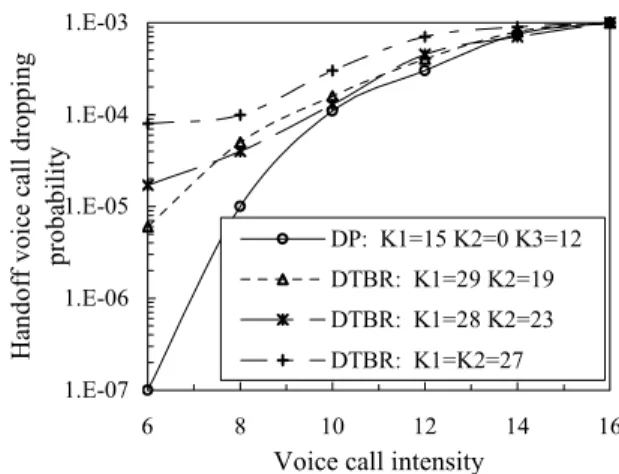
λ =0.2 . Fig. 2 demonstrates that, compared with DTBR scheme, DP scheme usually provides much lower handoff voice call dropping probability when ρv is low. This is
because in complete partition DP scheme, those voice only channels needed to maintain target handoff voice call dropping probability at ρv =16 cannot be shared by data calls, thus results in an over-provisioning of the bandwidth when ρv is low. On the contrary, in DTBR scheme, no channels are dedicated to voice calls. Except those ( C−K2 ) channels needed to keep target handoff voice call dropping probability at 16ρv= , all other channels can be shared statistically by
voice calls and data calls. Thus when voice call intensity becomes low, because there still exist impacts from data calls, handoff voice call dropping probability cannot decrease rapidly.
Fig. 3 shows that, among all the cases of DTBR scheme (here for clarity we only present three cases) and DP scheme, DTBR with one threshold K1=K2=27 has the highest channel utilization. The reason is that, in this case, no priority is given to new voice calls. Except a small amount of channels (C−K2 =3 in this case) are reserved for handoff voice calls to keep target QoS, all other available channels can be shared by voice calls and data calls equally. Thus leads to much higher channel utilization. This can further explain that DTBR with 27K1=K2= can achieve the lowest data call blocking probability as observed from Fig. 4.
The high channel utilization and low data call blocking probability for DTBR with one threshold K1=K2=27 is obtained at the expense of higher new voice call blocking probability, as indicated in Fig. 5. This is because in this case, no priority is given to new voice calls. New voice calls have to contend with handoff voice calls and data calls to get access. When we increase λvhto0.4λv(i.e., higher user mobility),
similar results can be obtained. These are illustrated in Figs. 6 to 9. Noticeably the main difference is the selection of the control thresholds in both schemes.
From the above results, in order to maintain the target handoff voice call dropping probability, we can draw the following conclusions:
(1) DP scheme has the lowest voice handoff dropping probability and relative lower data call blocking probability, while at the same time keeping relative higher channel utilization.
(2) DTBR scheme with one threshold (i.e., there is no channel reserved for new voice call) can achieve the highest channel utilization and the lowest data call dropping probability.
(3) If more stringent handoff voice call dropping probability and voice call blocking probabilities are required, DTBR schemes with two thresholds yield the best performance. This is achieved at the expense of lower channel utilization and potentially higher data call blocking probability.
Ⅴ. CONCLUSIONS
In this paper, we study and compare the performance of two bandwidth allocation schemes for multi-service cellular
network, namely Dynamic Partition (DP) and Dual-Threshold Bandwidth Reservation (DTBR) schemes. From the results obtained from both analysis and simulation, we can conclude that, by keeping the stringent handoff voice call dropping probability under given traffic loads: (1) DP scheme always has the lowest handoff voice call dropping probability; (2) DTBR scheme with one threshold can achieve the highest channel utilization and the lowest data call blocking probability; (3) DTBR scheme with two thresholds can achieve the lower new voice call blocking probability.
There are a number of issues that will be addressed in our future research: 1) the bandwidth allocation schemes discussed in this paper are static. However as shown in [4,14], dynamic schemes can always achieve better performance; 2) the handoff rates for both voice and data following convention have been assumed given, as there lacks adequate model that can derive handoff rates based on other parameters such as new call arrival rates and mobility, similar to those in [10]. We are currently working on the dynamic control policy based on the DP scheme, and the online parameters estimation algorithm proposed in [15] seems to be a viable technique. Finally, we will be considering more realistic data arrival using TCP traffic, and exploring the self-similar behavior of the data arrival observed in [13].
REFERENCES
[1] R. Guerin, “Queuing-blocking systems with two arrival streams and guarded channels,” IEEE Transactions on Communications. Vol. 36, No. 2, February 1988.
[2] R. Ramjee, R. Nagarajan and D. Towsley, “On optimal call admission control in cellular networks,” IEEE Infocom’96, San Francisco, March 1996.
[3] B. Li, C. Lin and S. Chanson, “Analysis of a hybrid cutoff priority scheme for multiple classes of traffic in multimedia wireless networks,”
ACM/Baltzer Journal of Wireless Networks, Vol. 4, No. 4, August 1998.
[4] S. Wu, K. Y. M. Wong and B. Li, “A dynamic call admission policy with precision QoS guarantee using stochastic control for mobile wireless networks,” IEEE/ACM Transactions on Networking, Vol. 10, No. 2, April 2002.
[5] B. Epstein and M. Schwartz, “Reservation strategies for multimedia traffic in a wireless environment,” IEEE VTC’95.
[6] Y.-R. Haung, Y.-B. Lin and J. M. Ho, ‘Performance analysis for voice/data integration on a finite mobile systems,” IEEE Transactions on Vehicular
Technology, Vol. 49, No. 2, February 2000
[7] H.-L. Wu, L.-Z. Li, B. Li, L. Yin, I. Chlamtac and B. Li, On handoff performance for an voice/data integrated cellular system, part II: data buffer case, IEEE PIMRC’2002, Lisbon, Portugal, Sept 2002.
[8] Y. Fang and I. Chlamtac, “Teletraffic analysis and mobility modeling of PCS networks,” IEEE Journal on Selected Areas in Communications, Vol. 17, No. 7, July 1999.
[9] Y. Fang, Y.-B. Lin and I. Chlamtac, “Channel occupancy times and handoff rate for mobile computing and PCS networks,” IEEE Transactions
on Computer, Vol. 47, No. 6, June 1998.
[10] Y.-B. Lin, “Performance modeling for mobile telephone networks,” IEEE
Networks, Nov/Dec 1997.
[11] Herzog, L. Woo, K.Chandy, “Solution of queuing problems by a recursive technique,” IBM Journal of Research Development, May 1975.
[12] B. Li, L.-Z. Li, B. Li and X.-R. Cao, “On handoff performance for an integrated voice/data cellular system,” to appear in ACM/Kluwer Journal
of Wireless Networks,2002.
[13] M. Cheng and L.-F. Chang, “Wireless dynamic channel assignment performance under packet data traffic,” IEEE Journal on Selected Areas
in Communications, Vol. 17, No. 7, July 1999.
[14] X. Luo, B. Li, I. Thng, Y.-B. Lin and I. Chlamtac, “A measurement-based pre-assignment scheme with connection-level QoS support for
multiservice mobile networks,” IEEE Transactions on Wireless
Communications, Vol. 1, No. 2, Mach 2002
[15] B. Li, L. Yin, K. Y. Michael Wong and S. Wu, “An efficient and adaptive bandwidth allocation scheme for mobile wireless networks based on on-line local parameter estimations,” ACM/Kluwer Journal of Wireless
Networks, Vol. 7, No. 2, March/April 2001
[16]L. Kleinrock, Queueing systems, Vol.1: Theory. NewYork: Wiley, 1975
1.E-07 1.E-06 1.E-05 1.E-04 1.E-03 6 8 10 12 14 16
Voice call intensity
H andof f voic e c all dr opping proba bility DP: K1=15 K2=0 K3=12 DTBR: K1=29 K2=19 DTBR: K1=28 K2=23 DTBR: K1=K2=27
Figure 2. Handoff voice call dropping probability of DP and DTBR schemes when λvh=0.2λv. 0.5 0.6 0.7 0.8 0.9 6 8 10 12 14 16
Voice call intensity
C hannel utilization DP: K1=15 K2=0 K3=12 DTBR: K1=29 K2=19 DTBR: K1=28 K2=23 DTBR: K1=K2=27
Figure 3. Channel utilization of DP and DTBR schemes when
v
vh λ
0 0.2 0.4 0.6 0.8 6 8 10 12 14 16
Voice call intensity
Da ta c all bloc king proba bility DP: K1=15 K2=0 K3=12 DTBR: K1=29 K2=19 DTBR: K1=28 K2=23 DTBR: K1=K2=27
Figure 4. Data call blocking probability of DP and DTBR schemes when
v vh λ λ =0.2 . 1.E-05 1.E-04 1.E-03 1.E-02 1.E-01 1.E+00 6 8 10 12 14 16
Voice call intensity
Ne w voic e c all bloc king proba bility DP: K1=15 K2=0 K3=12 DTBR: K1=29 K2=19 DTBR: K1=28 K2=23 DTBR: K1=K2=27
Figure 5. Voice call blocking probability of DP and DTBR schemes when
v vh λ λ =0.2 . 1.E-07 1.E-06 1.E-05 1.E-04 1.E-03 6 8 10 12 14 16
Voice call intensity
H andof f voic e c all dr opping proba bility DP: K1=15 K2=0 K3=8 DTBR: K1=29 K2=17 DTBR: K1=28 K2=20 DTBR: K1=K2=25
Figure 6. Handoff voice call dropping probability of DP and DTBR schemes when λvh=0.4λv. 0.4 0.5 0.6 0.7 0.8 6 8 10 12 14 16
Voice call intensity
C
h
annel utilization DP: K1=15 K2=0 K3=8 DTBR: K1=29 K2=17 DTBR: K1=28 K2=20 DTBR: K1=K2=25
Figure 7. Channel utilization of DP and DTBR schemes when
v vh λ λ =0.4 . 0 0.2 0.4 0.6 0.8 6 8 10 12 14 16
Voice call intensity
Data call blocking probability
DP: K1=15 K2=0 K3=8 DT BR: K1=29 K2=17 DT BR: K1=28 K2=20 DT BR: K1=K2=25
Figure 8. Data call blocking probability of DP and DTBR schemes when
v vh λ λ =0.4 . 1.E-05 1.E-04 1.E-03 1.E-02 1.E-01 1.E+00 6 8 10 12 14 16
Voice call intensity
Ne w voic e c all bloc king proba bility DP: K1=15 K2=0 K3=8 DTBR: K1=29 K2=17 DTBR: K1=28 K2=20 DTBR: K1=K2=25
Figure 9. Voice call blocking probability of DP and DTBR schemes when
v
vh λ