DOI: 10.1007/s11633-014-0776-7
Strategies and Methods for Cloud Migration
Jun-Feng Zhao Jian-Tao Zhou
College of Computer Science, Inner Mongolia University, Hohhot 010021, China
Abstract: Legacy system migration to the cloud brings both great challenges and benefits, so there exist various academic research and industrial applications on legacy system migration to the cloud. By analyzing the research achievements and application status, we divide the existing migration methods into three strategies according to the cloud service models integrally. Different processes need to be considered for different migration strategies, and different tasks will be involved accordingly. The similarities and differences between the migration strategies are discussed, and the challenges and future work about legacy system migration to the cloud are proposed. The aim of this paper is to provide an overall presentation for legacy system migration to the cloud and identify important challenges and future research directions.
Keywords: Migration, legacy system, cloud, infrastructure as a service (IaaS), platform as a service (PaaS), software as a service (SaaS).
1
Introduction
Clouds are a large pool of easily usable and accessible virtualized resources such as hardware, development plat-forms, and services[1]. These resources can be dynamically re-configured to adjust to a variable load, allowing for op-timal resource utilization[2]. According to the virtualized resources, three cloud service models emerged: infrastruc-ture as a service (IaaS), platform as a service (PaaS) and software as a service (SaaS)[3−5]. The business model of the cloud is pay-as-you-go, so enterprises can reduce capital ex-penditure by leveraging the cloud service[6−8]. Based on these characteristics, cloud computing provides many ben-efits needed by enterprise, such as no up-front investment, lower operating cost, high scalability, and so on[9]. Software migration is the process of switching from one operating en-vironment to another that in most cases is considered to be better[10]. A legacy system is an outdated computer system that remains in use even after more modern technology has emerged either because the organization may have invested considerable time and money in it or the legacy system holds valuable data. In order to take advantage of cloud computing and protect the existing investment to legacy system, enterprise are eager to migrate legacy systems to the cloud. As a result, the study in academia and the prac-tice in industry on migrating legacy systems to cloud com-puting are very widespread today.
So far, much research has been done in this field. Some works[11−15]focus on decision making support for cloud mi-gration in enterprise, since benefits, risks, costs, and orga-nizational and socio-technical factors must be considered before migration. More researchers concentrate on mi-gration methods, mainly about how to efficiently migrate legacy system to the cloud[16−21]. Some organizations
de-Manuscript received July 31, 2013; revised December 30, 2013 This work was supported by National Natural Science Foundation of China (No. 61262082), Key Project of Chinese Ministry of Ed-ucation (No. 212025), Inner Mongolia Science Foundation for Dis-tinguished Young Scholars (No. 2012JQ03), Inner Mongolia Natu-ral Science Foundation of Inner Mongolia (No. 2011MS0911), Post-graduate Scientific Research Innovation Project of Inner Mongolia (No. 1402020201013).
vote themselves to providing development tool for migrating legacy system to the cloud[22−25]. Up to now, some innova-tive methods have been proposed, related tools have been developed, and lots of organizations have made some trials in migrating legacy systems to cloud computing.
In this paper, we review the research achievements and application status on cloud migration, make a comprehen-sive analysis of existing migration methods, classify them into five migration strategies, and finally identify the cor-responding considerations of each respective strategy. Mi-gration strategy is used to classify cloud miMi-gration on the whole. According to the cloud service model, the migration to the cloud is classified into three strategies integrally in this paper. Different migration strategy focuses on different tasks, fits special migration scenarios and possesses charac-teristic virtues. To the practitioner of migration, the ana-lytic results above will benefit them. In the end, we present some challenges and research topics for future, which may provide some guideline to the research beginner in cloud migration.
The rest of this paper is organized as follows. In Sec-tion 2, existing migraSec-tion strategies are reviewed, and a classification is proposed. Section 3 surveys the existing methods of migration to IaaS and PaaS, and analyzes the similarities and differences of tasks in these two strategies. Section 4 investigates the work about migration to SaaS and compares the proposed migration strategies from dif-ferent aspects. The related development tools are reviewed in Section 5. Section 6 discusses the challenges and future research topics in cloud migration. Finally, the paper con-cludes in Section 7.
2
Migration strategy
With regard to the migration classification, there exist different classification cases in different literature. Binz et al.[17] classified the migration into three types: Standard-ized Format Migration, Component Format Migration and Holistic Migration. The component implemented in stan-dardized, self-contained format is migrated in Standardized Format Migration such as VMware or Open Virtualization
is Format images. The format of the respective component transformed into another format in the second type, for ex-ample, transforming a virtual machine image or enabling the execution of scripting languages on PaaS. Holistic mi-gration aims to realize mimi-gration to complete application built out of multiple components by migrating each com-ponent separately. According to the holistic migration, the authors proposed the cloud motion framework that could leverage existing application models and provide support to migrate composite applications to cloud[17]. Reference [18] identified four migration types that could cloud-enable applications by adaptation. The first type replaces compo-nents with cloud offerings, which is the least invasive type of migration. The second describes the case that migrates some of the application functionality to the cloud. The third is the classic migration case where the whole software stack of the application is migrated to the cloud. The last is complete migration of the application, which requires the migration of data and business logic for the cloud. While Gartner[26] suggests information technology (IT) organiza-tions consider the following five oporganiza-tions when they seek to move legacy systems to the cloud: rehost on infrastruc-ture as a service, refactor for platform as a service, revise for IaaS or PaaS, rebuild on PaaS and replace with soft-ware as service. However, Cisco considers three application migration options including SaaS, PaaS and IaaS in white paper for migration of enterprise application to the cloud. They think the migration to SaaS is no longer an applica-tion migraapplica-tion but more of a replacement of the existing application with a SaaS. Migration to PaaS is an option for migrating business applications that are based on stan-dard application server software such as JavaEE or .net platforms. Migration to IaaS involves deploying the appli-cation on the cloud service providers servers. In addition, the criteria that are used for considering every application migration are discussed[27]. Similarly, Solentive software proposed three main approaches for migrating legacy sys-tem to the cloud in a white paper, namely Iaas, PaaS and SaaS. The white paper looks at these approaches in detail and analyzes the benefits and disadvantages of each[28].
Through comparing and analyzing, we can categorize the migration into three strategies integrally: migration to IaaS, migration to PaaS and migration to SaaS. The first strategy implements migration only by porting legacy sys-tem to the cloud by using IaaS. The legacy syssys-tem will be migrated to the cloud by system refactoring according to the platform of PaaS in the second strategy. As to the mi-gration to SaaS, it can be divided into three sub-strategies concretely, namely replacing by SaaS, revising based on SaaS and reengineering to SaaS. To the first sub-strategy,
legacy systems will be completely replaced by commercial software delivered as a cloud service. Based on the second sub-strategy, some functionality of legacy systems will be replaced by cloud service. To the third sub-strategy, legacy systems will be reengineered to cloud service. In reality, en-terprises often migrate their legacy systems to cloud plat-form by adopting the first strategy. To this strategy, the migration is relatively easy to implement and has good cost-benefit. But the migration could not take full advantage of cloud platform. To the second strategy, legacy systems need to be adapted according to the target platform, which can bring disadvantages include missing capabilities, transitive risk, and framework lock-in. To the SaaS related strategy, if legacy system is replaced by commercial software delivered as a service, the migration effort will be reduced greatly and reengineering is unnecessary. When replacing some business logic with existing cloud service, the adaption to the legacy system is necessary. But to reengineer legacy system to cloud service, the related work will be very challenging, and may require reverse engineering, structure redesign, service generation, and so on. After comparing and analyzing, we map the migration methods mentioned above to these five specific strategies. The mapping result is showed in Table 1.
The proposed strategies realize classification to cloud mi-gration in essence, which can cover all mimi-gration cases. Through mapping existing migration methods to the pro-posed strategies, the migration methods can be better un-derstood and compared explicitly.
3
Migration to IaaS and PaaS
3.1
Migration to IaaS
Infrastructure as a service is a form of hosting, which in-cludes network access, routing services, and storage. IaaS provider generally provides hardware and administrative services used to store applications and a platform for run-ning applications. A virtual machine is built for an applica-tion, which is loaded with all the software that will eventu-ally run in the cloud. Then the virtual machine is uploaded to IaaS vendors hosting environment and deployed to run. IaaS is the best choice for moving applications to the cloud when there is no time to reengineer the applications for a cloud[29].
With respect to migration method, cloud comput-ing service providers, such as Amazon and Cisco, pro-vide the details for migrating legacy systems to their platforms[27,30]. Zhang[31] conducted migration studies by migrating Hadoop and RUBiS to EC2 cloud platform.
Table 1 Mapping existing migration methods to proposed strategies
Migrate to IaaS Migrate to PaaS Replace by SaaS Revise based on SaaS Reengineer to SaaS
Reference [17] type I, type III type II, type III − type III −
Reference [18] type III type I,type II − type I, type IV type IV
Reference [26] rehost, revise refactor, revise, rebuild replace − −
Reference [27] to IaaS to PaaS to SaaS − −
Through experiments, the installation mistakes and config-uration errors were identified as the two major sources of errors in migration. Then a migration management frame-work was proposed for providing the installation automa-tion and configuraautoma-tion validaautoma-tion, which uses templates to simplify the largescale enterprise system installation process and uses policy to validate the configuration and monitor the configuration changes[31].
Besides technology domain need to be taken into account, there are a number of factors to weigh before migrating legacy system to IaaS such as meaningful prerequisites, fi-nancial and legal considerations, culture shift, and so on. If these conditions cannot be satisfied, migration of legacy system to IaaS will be harder[32]. By presenting the re-sult of a case study that investigated the migration of an IT system from a companys in-house data center to EC2, reference [16] discussed the implications of migrating legacy systems to the cloud from the perspective of an enterprise or organization. In addition to the benefits of using the cloud, the significant risks, such as deterioration of customer care and service quality, increased dependence on external third party, lack of supporting resources, and so on, will come up. Enterprise decision-makers should consider the overall orga-nizational implications of the changes brought by migrating legacy system to the cloud, so they can avoid implementing local optimizations at the cost of organization-wide perfor-mance.
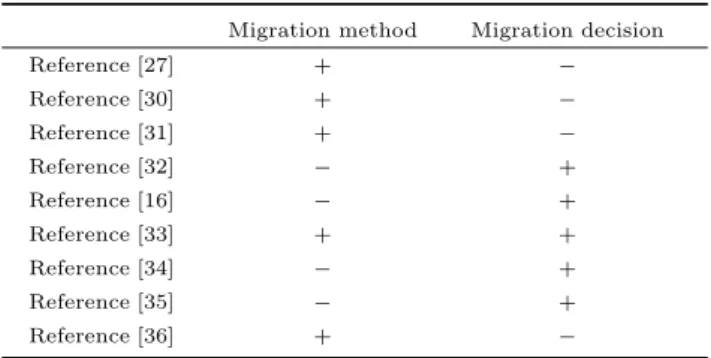
Many general instructions have been proposed to pro-vide guidance for application migration to IaaS. For ex-ample, Kothari and Arumugam[33]introduced guidelines to assess the feasibility of migrating applications to the cloud and suggested a general migration strategy for applications. Sattaluri[34]discussed different aspects that need to be con-sidered during the application migration to IaaS. While Yunus[35]presented costs and risks of application migration to IaaS, Mossburg listed four important points that lead to a successful cloud migration. These works provide general instructions for migration to IaaS. Reference [36] gave fur-ther details about what to do and how to do for application migration to IaaS. The existing research mentioned above can be divided into two aspects on the whole, namely mi-gration method and mimi-gration decision. We present Table 2 to show the focus of the existing research.
Table 2 Focus of the existing research in migration to IaaS
Migration method Migration decision
Reference [27] + − Reference [30] + − Reference [31] + − Reference [32] − + Reference [16] − + Reference [33] + + Reference [34] − + Reference [35] − + Reference [36] + −
In short, users have full privileges on the allocated virtual machine (VM) in migration to IaaS. They could do anything to the VM, but there is something need to be considered before conducting migration:
1) Dynamic resource requirement. 2) Restriction to data storage location. 3) Requirement of special hardware devices. 4) Amount of data stream.
3.2
Migration to PaaS
Platform as a service is an application development and deployment platform delivered as a service to developers over the web, which provide the hardware plus a certain amount of application software such as databases, middle-ware, and development tools. Migration based on PaaS is not mandatory for resource management, but it is required to make the legacy system compatible to the requirement of PaaS provider.
Microsoft, Cisco, and Solentive provide guide for migra-tion to PaaS from technology domain[27,37,38], but these guidelines are restricted to the PaaS they provide and not applicable to other general cases. For the general cases, reference [36] specified further checking steps for applica-tion migraapplica-tion to PaaS, including programming language, database, restrictions and limitations of the selected PaaS besides checking specific requirements related to hardware, software and input data as discussed in migration to IaaS. Furthermore, the general solutions to solve incompatibil-ity issues of database migration were discussed. Tran et al.[39] defined the scope of migration software system for the cloud. They identified all activities in migration that start from getting familiar with the application, the target cloud platform, and the third party tool, then to build the environment and get ready for migration, as well as to mod-ify and test to ensure that the application properly runs in the cloud. Finally based on the experience of migrating PetShop. Net to Windows Azure and migrating Java Pet Store to Amazon EC2, they compared the difference be-tween migrating legacy system to PaaS and to IaaS.
In brief, PaaS supplies a complete cloud IT stack for soft-ware development and delivery, which makes it possible to build “true” cloud applications and release them in a scal-able and elastic environment. Moreover, it also produces numerous restrictions at every technology layer of the ap-plication stack:
1) Programming language. 2) Database.
3) Middleware. 4) Third party library.
5) Restriction of the selected PaaS.
4
Migration related SaaS and
compar-ison among strategies
SaaS is a software delivery model in which software and associated data are centrally hosted on the cloud. SaaS is typically accessed by users using a thin client via a web browser, which has many advantages over the traditional software delivery model. The recurring revenue stream, simpler maintenance and application update, and the lower cost of delivery and distribution are especially attractive for both application provider and end users. These advantages are driving a growing number of organizations of all sizes to adopt SaaS solutions in order to achieve their business
objectives.
The migration strategy through replacing legacy system by SaaS does not refer to reengineering the legacy system, and the only work needs to be done is to export local data to the cloud database. For the migration strategy of revis-ing based on SaaS, some functionality of legacy system will be outsourced to the cloud, and then the business process is used to integrate cloud and non-cloud services. There are significant advances in service and data integration[40,41] and service composition[42,43] in service oriented architec-ture (SOA). For the migration strategy of reengineering to SaaS, SOA and Cloud need to be considered jointly. The SOA and Cloud are enabling technologies for each other. SOA decomposes the whole architecture into coarse-grain components providing business services. The scalability and possibility to multiply more instances of one component can be obtained by decomposing the architecture, which fits rightly to the Cloud deployment paradigm. On the con-trary, due to network latencies in the cloud environment, developer must ensure that the application can run on a set of low performance resources. This necessitates decomposi-tion and decoupling of the applicadecomposi-tion architecture, which is similar to SOA paradigm. So, SOA and Cloud are per-fectly complementary. SOA provides the guideline for mak-ing the software architecture scalable, while Cloud enables deployment of architecture scale[44]. So the convergence of cloud computing and SOA supports the development of SaaS. When reengineering a legacy system to SaaS, migrat-ing the system to SOA necessitates in general. Reference [45] stated that recasting existing systems into services is a prerequisite to move towards cloud computing.
4.1
Migration to SOA
SOA is a set of principles and methodologies for design-ing and developdesign-ing software in the form of interoperable services. These services are well-defined business function-alities and built as software components that can be reused for different purposes. SOA can expose the functional-ity of the legacy systems as services, presumably without making significant changes to the legacy systems, so mi-gration of legacy system to service-oriented environments has significant value. So far researchers have paid much attention to migration of legacy systems to SOA. A lot of migration methods have been proposed, which can be roughly classified into three perspectives. The first con-centrates on planning the migration. The feasibility of mi-gration process is assessed based on business drivers and characteristics of legacy system. The second focuses on im-plementing the migration which usually covers techniques to adapt a segment of legacy code to web services. The last perspective aims for fulfilling the whole migration pro-cess that is comprised of two major steps: forward service development and reverse service extraction.
The representative work of the first perspective is ser-vice migration and reuse technique (SMART). Carnegie Mellon Software Engineering Institute developed SMART to help organizations make initial decisions about the feasibility of reusing legacy components as services within an SOA environment. SMART considers the specific in-teractions that will be required by target SOA environ-ment and any changes that must be made to the legacy
components[46]. Reference [47] presented an overview of the application reengineering decisions in SOA, which identified the key issues involved in each decision, and pro-posed a decision model for application reengineering for SOA.
Zhang et al.[48] proposed an architecture-based oriented approach to modernize legacy system in a service-based computing environment. The approach empha-sizes service identification and packaging. The modern-ization of the legacy system is implemented in five steps, including legacy system evaluation, architecture recovery, service identification, service packaging and service pub-lication; Oldevik et al.[49] proposed a model-driven appr-oach for migrating legacy systems to service-oriented ar-chitecture. The migration strategy is implemented by wrapping existing legacy components. Unified modeling language (UML) is used to specify migration models, or wrappers, that are fed to model-driven code generators to generate a deployable service. The migration approach was tested on an oil drift prediction system by modeling and generating the services and wrappers required for in-tegration with the various legacy components[49]. These works does not involve re-factoring or re-engineering, they only focus on the implementation of migration by wrapping.
Reference [50] proposed a service-oriented software reengineering (SoSR) methodology that can be applied to reengineer a legacy software system into a service-oriented software system. The methodology is formed by a set of best practices that is architecture-centric, service-oriented, role-specific, and model-driven. Winter and Ziemann[51] proposed an approach toward migrating legacy systems to service oriented architectures by relating the intended enter-prise model to the legacy software system. The approach is model-based, where appropriate models represent software artifacts on all levels of abstraction. The activities in the migration process, such as reverse engineering, enterprise modeling, forward engineering, and legacy migration, rely on these models that serve as base for extracting abstrac-tions or transformaabstrac-tions. These approaches cover the whole migration process.
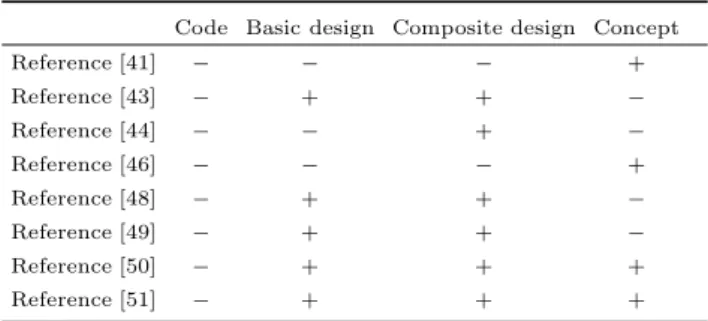
Although there is much work on SOA migration, they mainly differ in the way they provide solutions for two key problems, namely what can be migrated and how the mi-gration is performed. In order to understand, compare, and analyze the existing methods, a conceptual framework for SOA migration was proposed by Maryam Razavian and Patricia Lago, which provides a holistic illustration of the SOA migration process, along with the distinct conceptual elements of the process. SOA-MF addresses the question of “what does the migration of legacy sys-tems to SOA entail”. The migration process follows the horseshoe model by first recovering the lost abstractions and eliciting the legacy fragments that are suitable for mi-gration to SOA, then altering and reshaping the legacy abstractions to the service based abstractions, and finally renovating the target system based on transformed ab-stractions as well as new requirements. It could be per-formed at different levels of abstraction ranging from “code-level” to “enterprise-“code-level”[52]. After analyzing the migra-tion approaches menmigra-tioned above according to SOA-MF,
we present Table 3 that maps them to the abstraction tiers described in SOA-MF.
Table 3 Mapping existing migration approaches to abstraction tier
Code Basic design Composite design Concept
Reference [41] − − − + Reference [43] − + + − Reference [44] − − + − Reference [46] − − − + Reference [48] − + + − Reference [49] − + + − Reference [50] − + + + Reference [51] − + + +
4.2
Migration related SaaS
In order to provide some guidance on modifying architec-ture of a service-based system for cloud computing, Babar and Chauhan[20] revealed some insights when they under-took a research and development project aimed at mod-ernizing an open source software framework, Hackystat, for leveraging the flexibility and scalability of the cloud com-puting paradigm. In the process of migration, the key re-quirements that can be migrated to the cloud are identified firstly. Having identified the key requirements, the next task is to analyze those requirements in the context of the existing architecture in order to gain a good understanding of the kinds of architectural change needed to be made. Fi-nally, the architecture will be modified in accordance with the identified architecture change. Because this work fo-cused on the migration of the service-based system to cloud computing platform, it did not involve reverse engineering. Zhang et al.[19]proposed a generic methodology to guide how to migrate legacy system to cloud platform. The generic methodology includes the following steps: represen-tation of the legacy application, redesign the architecture model with identified services, model driven architecture (MDA) transformation, web service generation, invocation of legacy functionalities, selection of a suitable cloud com-puting platform, and provision of cloud web service to the end users. This seven-step methodology guides developers to migrate legacy systems step by step and improves the productivity and effectiveness of migration.
In addition to the migration methodology, some re-search on the implementation of migration to SaaS was carried out. Current approaches are often limited to spe-cific cloud environments or do not provide automated sup-port for the alignment with a cloud environment. Frey and Hasselbring[53] proposed a model-based approach Cloud-MIG for migrating legacy software system to scalable and resource-efficient cloud-based application. CloudMig con-centrates on the SaaS provider perspective and facilitates the migration of enterprise software system towards generic IaaS and PaaS-based cloud environment. CloudMIG can generate considerable parts of a resource-efficient target ar-chitecture utilizing a rule-based heuristics, so it helps SaaS providers to semi-automatically migrate existing software to the cloud computing platform. Li[21]looked into the mi-gration towards the cloud in his dissertation for masters degree. The research focuses on the derivation of legacy
structure, the redesign of the system structure and deploy-ment of the redesigned system. A framework MOMISC was presented, which offers a set of solutions and tools to support migrating existing systems to the cloud. Based on the framework, a hotel booking application was migrated to EC2 for verifying the feasibility of the framework.
Through investigation of existing research, reuse and mi-gration of legacy applications to interoperable cloud services (REMICS), a research project supported by the European Commission that started in 2010 for a period of three years, has identified further work that needs to be done in the project. Specifically, knowledge discovery involves business and rule recovery that are necessary for identifying services and designing new business processes except reverse engi-neering of legacy code. Comprehensive methodology is em-ployed to address dedicated design patterns and transfor-mations, especially for migration to the cloud. Migration tools and methods need integration with model-based de-velopment methods. PIM for SOA and cloud computing can adapt many different platforms in the cloud and di-verging technologies. These problems have been partially addressed by developing methods, languages, transforma-tions and tools. The REMICS methodology will integrate all these in an agile, model-driven, and service-oriented methodology for modernizing legacy systems in the end. The migration starts with the recover activity which ex-tracts the architecture of the legacy application. The re-cover activity is implemented by knowledge disre-covery and reverse engineering. The source architecture helps to ana-lyze the legacy system, identify the best ways for migration, and benefit from model-driven engineering technologies for generation of the new system. The migrate activity reforms the source architecture into target architecture for service cloud platform. In migration activities, SOA and cloud computing patterns are applied, legacy components may be replaced or wrapped, architecture may be redesigned by service composition. After obtaining target architecture, the service cloud implementation is achieved by MDA. In short, REMICS proposes a leap progress in legacy systems migration to service clouds, which significantly improves the baseline ADM concept[44,54−56]. This project involves the most advanced research in migrating legacy system to service cloud now.
In summary, migration to SaaS requires to consider the specific migration strategy according to legacy system and existing SaaS. If existing SaaS has the same business func-tionality of legacy system, users can replace legacy system by SaaS. When some business functionality has been real-ized by existing SaaS, legacy system can be modernreal-ized by revising legacy system based on existing SaaS. Users can take full advantage of the virtue of the cloud by reengi-neering legacy system to SaaS, but the challenge cannot be ignored.
4.3
Comparison between the migration
strategies
The most ideal strategy for a special migration to the cloud relies on the individual needs of each organization and the condition of the legacy system, so organizations need to choose the most rational strategy before the migration.
With the PaaS strategy, organizations need to determine the extent of modifications required for the application to be compatible with the cloud platform. If extensive modi-fications are needed for PaaS, the IaaS strategy may be a better choice. As an effective software-delivery mechanism, SaaS could be an ideal choice for independent software ven-dors, but the challenge for reengineering to SaaS is obvious. Through integral analysis, we present Table 4 to compare the characteristics of these five migration strategies.
5
Related development tools
MoDisco is a generic and extensible open source reverse engineering solution, which intensively uses MDE princi-ples and techniques to improve existing approaches for re-verse engineering. In comparison to many development tools that focus on UML generation from a specific tech-nology and vice versa, MoDisco provides generic support for different target meta models and extensibility to other technologies[22]. MoDisco supports four use-cases of ex-isting software modernization. The first use-case is qual-ity assurance which aims at verifying whether an existing system meets the required qualities. The second is docu-mentation which focuses on the extraction of information from an existing system to help understand one aspect of the system. The third is improvement which concentrates on transformation of an existing system to integrate bet-ter coding norms or design patbet-terns. The last is migration which implements transformation to the component, the framework, the language, or the architecture of legacy sys-tem. In each case, modernizing an existing software system includes three phases. Firstly the information should be extracted out of the artifacts of the system. Then the ex-tracted information will be understood in order to take good modernization decisions. Finally the information is trans-formed to new artifacts which may be metrics, document, code and so on[23].
Blu Age is another agile solution for application mod-ernization which focuses on extracting legacy architecture into a PIM presentation and regenerates it to a modern-ized system using MDA approach. Blu Age application is based on three complementary products. Blu Age re-verse modeling extracts the business code of legacy appli-cation and transforms it into UML2 model independent of any technology. Blu Age database modernization migrates database technologies by modernizing data and strengthen-ing their integrity. Blu Age forward engineerstrengthen-ing generates
applications by compiling UML2 models. Blu Age engineer-ing automates 100% of the developments and reduces costs significantly[24].
Modelio is an open source modeling environment which supports SoaML, the SOA architecture modeling standard, with specific editors dedicated to SOA architecture mod-eling and architecture implementation model generation. Modelios core architecture is based on a meta-meta in-frastructure. The core architecture supports extensibility mechanisms, notably for UML profile definition, and pro-vides the concept of modules, which package extensions and can be dynamically applied to or withdrawn from an exist-ing model[25].
Modisco and Blu Age are both ADM compliant case tools which can extract architecture model from legacy system. The extracted model will be the start point of the following forward engineering. Modelio imports the recovered system model and generates SOA models through componentiza-tion and refactoring. SOFTTEAM developed a series of migration tools based Modelio environment. Now the link between Blu Age and Modelio is fully functional.
6
Challenges and future work
Based on the above comparison and analysis, we identi-fied the following challenges that could be research topics in the future.
1) Holistic methodology
Up to now, the existing research mostly focused on the consideration of a special migration approach. A holistic methodology of migrating legacy systems to the cloud is needed. Firstly, the migration of legacy systems to the cloud should be divided into reasonable types, the Cloud providers and legacy systems should be classified, too. Then, according to a specific kind of legacy system, the selection of Cloud providers, the migration type to be ap-plied, and the required adaption for the migration should be made. At the same time, the advantages and risks accom-panying the migration should be advertised. Based on the information, organizations can make decision to migration strategy. Finally, the methodology should propose adaption processes in accordance with the given migration. With the guidance of this holistic methodology, organization can ef-ficiently migrate legacy systems to the cloud, rather than hesitate about what to do and how to do when facing a migration task.
2) Scalability in IaaS
Table 4 Comparison between the migration strategies
Migrate to IaaS Migrate to PaaS Replace by SaaS Revise based on SaaS Reengineer to SaaS
Migration workload Little Moderate Little Moderate Much
Migration complexity Easy Moderate Easy Moderate Difficult
Modify application Service and Reverse engineering,
Adaption No need to be compatible No need data integration, redesign structure,
with PaaS service composition forward engineering
Save capital Flexible pricing Flexible pricing Flexible pricing
Effect expenditure Free from resource mechanism, mechanism, mechanism, convenient
for hardware management convenient convenient maintenance, reuse,
For the migration to IaaS, if the amount of resources required by the application is stable, it is unnecessary to adapt the application for migration. However, for some ap-plications, resource requirements might vary significantly from time to time, organization must implement a new resource management component so that resources could be acquired and released automatically on demands. This component can efficiently optimize resource consumption in the cloud. The discussion on how to realize resource man-agement is absent at present, so related solutions should be identified to solve this problem.
3) Usage of essential cloud characteristics
For the migration to PaaS, in addition to the adaption to programming languages, databases and third-party compo-nents, organization needs to consider redesigning some busi-ness processes in order to exploit essential cloud character-istics. For example, PaaS provides MapReduce program-ming model which is a simple data-parallel programprogram-ming model designed for scalability and fault-tolerance. MapRe-duce can automatically parallelize and execute the program on a large cluster of commodity machines. When the legacy system involves processing of large data sets, the related business process needs to be redesigned for migration in accordance with MapReduce programming model. Never-theless, existing work have not paid enough attention to take full advantage of the essential cloud characteristics.
4) Architecture refactoring
To reengineer legacy system to SaaS, the architecture of existing legacy applications need to be refactored using design patterns for SOA and cloud computing. SOA and cloud computing technologies complement each other. SOA enables software architecture better scalability and reuse of application components. While the Cloud computing ad-dresses the deployment architecture that easily scale. SOA has been paid much attention for several years, and cur-rently it is in an established state. On the contrary, there is little research in cloud design pattern due to the novelty of the domain.
5) Integrated development environment
For the migration to SaaS, it refers to an integral reengi-neering. Good tools are prerequisite to successful execution of a job. An integrated development environment can pro-mote migration efficiency, which should incorporate model recovery tool, migration process tool, component recovery tool, pattern composition tool and service generation tool. Model recovery tool is used to extract model from the legacy system. Migration process tool offers support for the ap-proach of migrating legacy systems to SOA application de-ployed on cloud computing platforms. The component re-covery tool is responsible for component identification, dis-covery of services, interfaces and dependencies. The pattern composition tool adopts SOA and cloud computing design patterns to source architecture, which implements the it-erative refactoring of legacy architecture to the targeted service cloud architecture. Service generation tool auto-mates the target code framework or target code generation according to MDA. A series of tools are planned to be devel-oped in REMICS, and some have been released. Since the links between these development tools are mostly manual, the integration between them is necessary. Otherwise more outstanding tools are beneficial to facilitate the migration
of legacy systems to SaaS. 6) Other research topics
Besides migrating legacy system from traditional envi-ronments to cloud platforms, application migration between cloud platforms may be necessary in the future. So how to migrate applications from one cloud platform to another will be a research topic. In addition, testing strategies need to be studied to verify whether the generated system af-ter migration has the same functionality and betaf-ter perfor-mance as before.
7) Our ongoing work
Now we are focusing on migrating a workflow manage-ment system to cloud platform Aneka. Through migration, the existing workflow management system running in the in-house data center will be provided as SaaS to end users. The target workflow system will concentrate on scientific computing on large data, which can take full advantage of the virtue of the cloud. In the migration process, the essen-tial cloud characteristics will be considered adequately. For example, Mapreduce programming model can be adopted to implement parallel processing of big data and to analyze the execution log of workflow system. In order to achieve the aforementioned objectives, we will employ reengineer-ing to SaaS to carry out the system migration, and further explore the reengineering to SaaS and try to propose some innovative methods. The key work and challenges involved are as follows:
i) Software structure recovery
The workflow management system is implemented using an object-oriented language. We will discover the static model of this system using Modisco. After obtaining the static model, the classes will be grouped into layers through a link analysis algorithm, which usually include user inter-face layer, business logic layer, and data access layer. Be-cause the business process of a system is realized in logic layer, the business logic layer needs to be further analyzed for service identification in migrating legacy system to SaaS. To further analyzing the logic layer, special clustering al-gorithm will be adopted for extracting function modules in legacy systems. By adopting the orthogonal structure analysis method, the obtained function modules through software structure recovery will be more accurate service candidates.
ii) Service identification
For the target service, we will conduct analysis from two aspects, namely, target system requirement and legacy sys-tem implementation. Based on requirement analysis of the target workflow system, some business functions will be identified which are appropriate for providing as services. The function modules in the legacy system implementa-tion have been discovered in the first step. Based on these works, we will match the business functions with the func-tion modules. The candidate services in legacy system and new services will be found. As a result, the function mod-ules in legacy system can be efficiently reused.
iii) Model refactoring
After service identification, we need to refactor the exist-ing software architecture to integrate them. Moreover, for some special candidate services such as those related to pro-cessing the big data, we need to recover the dynamic model of their implementation in the legacy system. Through
an-alyzing the dynamic model we will find the business logic that can be improved by the virtue of cloud computing and adapt the dynamic model. Then, we will reimplement the business process based on the cloud programming model so that the target system can take full advantage of the cloud characteristics.
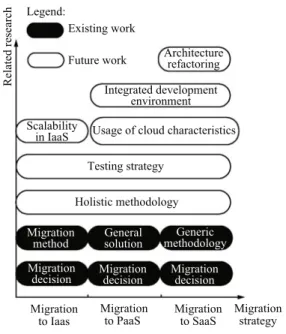
Finally, we explicitly describe the research status on cloud migration by Fig. 1. The coordinate x represents migration strategies, and the coordinate y describes the related research corresponding to the specific migration strategies. The existing research fields are denoted by solid graph elements, and the unresolved research fields by hollow elements.
Fig. 1 The distribution of related research
7
Conclusion
Software migration is the process of moving legacy sys-tems from one operation environment to another, that is, in most cases, thought to be better. Migrating legacy sys-tem to cloud computing can effectively protect software assets and take advantage of cloud computing. Many re-search projects have been carried out, and some innovative methods and tools have been proposed so far. By inves-tigating the existing literature, we classify the migration into five strategies, then review and compare the related researches on every migration strategy. In addition, re-lated development tools are surveyed. Based on the existing research achievements and application status, some future work are identified including holistic methodology, redesign and adaption to application for special migration, architec-ture refactoring, integrated development environment, and so on. Besides, we notice the most advanced research in migration of legacy software to cloud computing has been performed in REMICS, so some further work in this re-search field should be carried out based on the achievement obtained in this project.
References
[1] L. M. Vaquero, L. Rodero-Merino, J. Caceres, M. Lindner. A break in the clouds: Towards a cloud definition. ACM Sigcomm Computer Communication Review, vol. 39, no. 1, pp. 50–55, 2008.
[2] J. Geelan.Twenty Experts Define Cloud Computing, [On-line], Available: http://cloudcomputing.syscon.com, July 18, 2008.
[3] M. Armbrust, A. Fox, R. Griffith, A. D. Joseph, R. H. Katz, A. Konwinski, G. Lee, D. A. Patterson, A. Rabkin, I. Sto-ica, M. Zaharia. Above the Clouds: A Berkeley View of Cloud Computing, Technical Report, Department of Elec-trical Engineering and Computer Sciences, University of California, Berkeley, 2009.
[4] R. Buyya, C. S. Yeo, S. Venugopal. Market-oriented cloud computing: Vision, hype, and reality for delivering it ser-vices as computing utilities. In Proceedings of the 10th IEEE International Conference on High Performance Com-puting and Communications, IEEE, Dalian, China, pp. 5– 13, 2008.
[5] C. Y. Low, Y. Chen, M. C. Wu. Understanding the determi-nants of cloud computing adoption.Industrial Management & Data Systems, vol. 111, no. 7, pp. 1006–1023, 2011. [6] G. Gruman, E. Knorr.What cloud computing really means,
[Online], Available: http://www.infoworld.com, July 18, 2013.
[7] Roy Bragg. Cloud Computing: When Computers Really Do Rule, [Online], Available: http://www.technewsworld.com, July 16, 2008.
[8] P. Watson, P. Lord, F. Gibson, P. Periorellis, G. Pitsilis. Cloud computing for e-science with Carmen. In Proceed-ings of the 2nd Iberian Grid Infrastructure Conference Pro-ceedings, Porto, Portugal, pp. 3–14, 2008.
[9] Q. Zhang, L. Cheng, R. Boutaba. Cloud computing: State-of-the-art and research challenges.Journal of Internet Ser-vices and Applications, vol. 1, no. 1, pp. 7–18, 2010. [10] Definition Migration, [Online], Available: http://searchcio.
techtarget.com, July 17, 2013.
[11] A. Khajeh-Hosseini, I. Sommerville, J. Bogaerts, P. Tere-gowda. Decision support tools for cloud migration in the enterprise. InProceedings of the 2011 IEEE International Conference on Cloud Computing (CLOUD), IEEE, Wash-ington, DC, USA, pp. 541–548, 2011.
[12] A. Khajeh-Hosseini, D. Greenwood, J. W. Smith, L. Som-merville. The cloud adoption toolkit: Supporting cloud adoption decisions in the enterprise.Software: Practice and Experience, vol. 42, no. 4, pp. 447–465, 2012.
[13] C. Ward, N. Aravamudan, K. Bhattacharya, K. Cheng. Workload migration into clouds challenges, experiences, op-portunities. InProceedings of the 2010 IEEE International Conference on Cloud Computing (CLOUD), IEEE, Miami, FL, USA, pp. 164–171, 2010.
[14] Cloud Adoption Assessment, [Online], Available: http://www.eduserv.org.uk, July 20, 2013.
[15] M. Menzel, R. Ranjan. CloudGenius: decision support for web server cloud migration. InProceedings of the 21st In-ternational Conference on World Wide Web, ACM, New York, NY, USA, pp. 979–988, 2012.
[16] A. Khajeh-Hosseini, D. Greenwood, I. Sommerville. Cloud migration: A case study of migrating an enterprise IT sys-tem to IaaS. InProceedings of the 2010 IEEE International Conference on Cloud Computing (CLOUD), IEEE, Miami, FL, USA, pp. 450–457, 2010.
[17] T. Binz, F. Leymann, D. Schumm. CMotion: A frame-work for migration of applications into and between clouds. InProceedings of the 2011 IEEE International Conference on Service-Oriented Computing and Applications, IEEE, Irvine, CA, USA, pp. 1–4, 2011.
[18] V. Andrikopoulos, T. Binz, F. Leymann, S. Strauch. How to adapt applications for the cloud environment. Computing, vol. 95, no. 6, pp. 1–43, 2013.
[19] W. Q. Zhang, A. J. Berre, D. Roman, H. A. Huru. Migrat-ing legacy applications to the service Cloud. InProceedings of the 14th Conference Companion on Object Oriented Pro-gramming Systems Languages and Applications, pp. 59–68, 2009.
[20] M. A. Babar, M. A. Chauhan. A tale of migration to cloud computing for sharing experiences and observations. In Pro-ceedings of the 2nd International Workshop on Software Engineering for Cloud Computing, ACM, New York, USA, pp. 50–56, 2011.
[21] W. B. Li. Model Driven Migration of Legacy Systems to the Cloud, Master dissertation, Harbin Institute of Technology, China, 2010. (in Chinese)
[22] H. Bruneliere, J. Cabot, F. Jouault, F. Madiot. MoDisco: A generic and extensible framework for model driven reverse engineering. In Proceedings of IEEE/ACM International Conference on Automated Software Engineering, ACM, New York, USA, pp. 173–174, 2010.
[23] MoDisco, [Online], Available: http://www.eclipse.org/ MoDisco/, July 22, 2012.
[24] Blu Age Legacy Application Modernization, [Online], Available: http://www.bluage.com/en, July 23, 2012. [25] Modelio, [Online], Available: http://www.modelio.org,
June 23, 2012.
[26] 5 Ways to Migrate Applications to the Cloud, [Online], Available: http://www.cioupdate.com, May 20, 2012. [27] Planning the Migration of Enterprise Applications to the
Cloud, Cisco White paper, 2010.
[28] Migrating to the Cloud 3 Main Approaches, Solentive White paper, 2011.
[29] S. Bhardwaj, L. Jain, S. Jain. Cloud computing: A study of infrastructure as a service (IAAS).International Journal of Engineering and Information Technology, vol. 2, no. 1, pp. 60–63, 2010.
[30] Migrating your Existing Applications to the AWS Cloud, Amazon White paper, 2010.
[31] G. Zhang. Data and Application Migration in Cloud based Data Centers: Architectures and Techniques, Ph. D. disser-tation, Georgia Institute of Technology, USA, 2011. [32] Infrastructure as a Service, [Online], Available: http://
www.educause.edu, July 20, 2013.
[33] C. Kothari, A. K. Arumugam. Cloud application mi-gration, [Online], Available: http://cloudcomputing.sys-con.com/node/1458739, July 12, 2010.
[34] R. Sattaluri. Application migration considerations for cloud computing, [Online], Available: http://www.sys-con.com/node/1686320, January 28, 2011.
[35] M. Yunus. Understanding enterprise-to-cloud migra-tion costs and risks, [Online], Available: http://www. ebizq. net/ topics/ cloud computing/ features/ 12741. html, June 14, 2010.
[36] Q. H. Vu, R. Asal. Legacy application migration to the cloud: Practicability and methodology. In Proceedings of the 2012 IEEE Eighth World Congress on Services, IEEE, Washington, DC, USA, pp. 270–277, 2012.
[37] Microsoft. Moving applications to the cloud on the Mi-crosoft Windows Azure Platform.MSDN Magazine, pp. 68– 73, March, 2013.
[38] Microsoft. Tips for migrating your applications to the cloud.
MSDN Magazine, pp. 36–45, August, 2010.
[39] V. Tran, J. Keung, A. Liu, A. Fekete. Application migration to cloud: A taxonomy of critical factors. InProceedings of the 2nd International Workshop on Software Engineering for Cloud Computing, ACM, New York, USA, pp. 22–28, 2011.
[40] H. R. M. Nezhad, B. Benatallah, F. Casati, F. Toumani. Web services interoperability specifications. Computer, vol. 39, no. 5, pp. 24–32, 2006.
[41] A. Halevy, A. Rajaraman, J. Ordille. Data integration: The teenage years. In Proceedings of the 32nd International Conference on Very Large Data Bases, VLDB Endowment, pp. 9–16, 2006.
[42] S. Dustdar, W. Schreiner. A survey on web services com-position.International Journal of Web and Grid Services, vol. 1, no. 1, pp. 1–30, 2005.
[43] A. Brogi, S. Corfini, R. Popescu. Semantics-based composition-oriented discovery of web services. ACM Transactions on Internet Technology, vol. 8, no. 4, Article 19, 2008.
[44] State of the art on modernization methodolo-gies, methods and tools, [Online], Available: http://www.remics.eu/publicdeliverables, July 20, 2013. [45] G. Canfora, M. D. Penta, L. Cerulo. Achievements and
chal-lenges in software reverse engineering.Communications of the ACM, vol. 54, no. 4, pp. 142–151, 2011.
[46] G. Lewis, E. J. Morris, D. B. Smith, S. Simanta. Smart: Analyzing the Reuse Potential of Legacy Components in A Service-oriented Architecture Environment, Technical Re-port, SEI, volume CMU/SEI-2008-TN-008, 2008.
[47] A. Umar, Z. Adalberto. Reengineering for service oriented architectures: A strategic decision model for integration versus migration.Journal of Systems and Software, vol. 82, no. 3, pp. 448–462, 2009.
[48] Z. P. Zhang, R. M. Liu, H. J. Yang. Service identification and packaging in service oriented reengineering. In Proceed-ings of the 17th International Conference on Software Engi-neering and Knowledge EngiEngi-neering (SEKE 2005), Taipei, Taiwan, China, vol. 5, pp. 620–625, 2005.
[49] J. Oldevik, G. K. Olsen, U. Br¨onner, N. R. Bodsberg. Model-driven migration of scientific legacy systems to service-oriented architectures. InProceedings of the 1st In-ternational Workshop on Model-driven Software Migration, pp. 4–7, 2011.
[50] S. Chung, J. B. C. An, S. Davalos. Service-oriented soft-ware reengineering: SoSR. InProceedings of the 40th An-nual Hawaii International Conference on System Sciences, IEEE, Waikoloa, HI, USA, pp. 172c, 2007.
[51] A. Winter, J. Ziemann. Model-based migration to service-oriented architectures. In Proceedings of the 11th Euro-pean Conference on Software Maintenance and Reengineer-ing (CSMR 2007), Vrije Universiteit Amsterdam, pp.107– 110, 2007.
[52] M. Razavian, P. Lago. Understanding SOA migration us-ing a conceptual framework.Journal of Systems Integration, vol. 1, no. 3, pp. 33–34, 2010.
[53] S. Frey, W. Hasselbring. Model-based migration of legacy software systems to scalable and resource-efficient cloud-based applications: The cloudMIG approach. In Proceed-ings of the 1st International Conference on Cloud Comput-ing, GRIDs, and Virtualization, pp. 155–158, 2010. [54] PIM4Cloud, [Online], Available: http://www.remics.eu/
publicdeliverables, July 10, 2013.
[55] Remics Migrate Toolkit, Preliminary Release, [Online], Available: http://www.remics.eu/publicdeliverables, July 11, 2013.
[56] Remics Migrate Toolkt, interim release, [Online], Available: http://www.remics.eu/publicdeliverables, July 12, 2013.
Jun-Feng Zhao received his B. Sc. de-gree in computer science from Inner Mon-golia Normal University, China, and his M. Sc. degree in software engineering from National University of Defense Technology, China in 2006. He is currently a lecturer and a Ph. D. candidate at College of Com-puter Science, Inner Mongolia University.
His research interests include software reengineering, formal modeling and cloud computing.
E-mail: [email protected]
Jian-Tao Zhou received her Ph. D. de-gree from Tsinghua University in 2005. She is a professor and Ph. D. supervisor in Col-lege of Computer Science, Inner Mongolia University.
Her research interests include network computing and formal methods.
E-mail: [email protected] (Correspon-ding author)