Variance Risk Premia
∗PETERCARR†
Bloomberg L.P. and Courant Institute LIUREN WU‡
Zicklin School of Business, Baruch College First draft: July 26, 2003
This version: May 27, 2004
Filename:VarianceSwap15.tex
∗We thank David Hait and OptionMetrics for providing the option data, Alex Mayus for clarifying trading practices, Rui
Yao for help on data processing, and Turan Bali, David Bates, Menachem Brenner, Mikhail Chernov, Robert Engle, Dilip Madan, Benjamin Wurzburger, Jin Zhang, Chu Zhang, and seminar participants at Baruch College, Hong Kong University of Science and Technology, New York University, for comments and discussions. We assume full responsibility for any errors. We welcome comments, including references we have inadvertently missed.
†499 Park Avenue, New York, NY 10022; tel: (212) 893-5056; fax: (917) 369-5629;[email protected].
‡One Bernard Baruch Way, Box B10-225, New York, NY 10010; tel: (646) 312-3509; fax: (646) 312-3451; Liuren [email protected];http://faculty.baruch.cuny.edu/lwu.
Variance Risk Premia
ABSTRACT
We propose a direct and robust method for quantifying the variance risk premium on financial assets. We theoretically and numerically show that the risk-neutral expected value of the return variance, also known as the variance swap rate, is well approximated by the value of a particular portfolio of options. Ignoring the small approximation error, the difference between the realized variance and this synthetic variance swap rate quantifies the variance risk premium. Using a large options data set, we synthesize variance swap rates and investigate the historical behavior of vari-ance risk premia on five stock indexes and 35 individual stocks.
JEL CLASSIFICATIONCODES: G10, G12, G13, C51.
KEY WORDS: Stochastic volatility; variance risk premia; variance swap; volatility swap; option pric-ing; expectation hypothesis; leverage effect.
Variance Risk Premia
1. Introduction
The grant of the 2003 Nobel prize in economics has made available to the general public the well-documented observation that return variances are random over time. Therefore, when investing in a security such as a stock or a stock portfolio, an investor faces at least two sources of uncertainty, namely the uncertainty about the return as captured by the return variance, and the uncertainty about the return variance itself.
It is important to know how investors deal with the uncertainty in return variance to effectively manage risk and allocate assets, to accurately price and hedge derivative securities, and to understand the behavior of financial asset prices in general. We develop a direct and robust method for quantifying the return variance risk premium on an asset using the market prices of options written on this asset. Our method uses the notion of a variance swap, which is an over-the-counter contract that pays the difference between a standard estimate of the realized variance and the fixed swap rate. Since variance swaps cost zero to enter, the variance swap rate represents the risk-neutral expected value of the realized return variance. We theoretically and numerically show that the variance swap rate can be synthesized accurately by a particular linear combination of option prices. Ignoring the small approximation error, the difference between the ex-post realized variance and this synthetic variance swap rate quantifies the variance risk premium. Using a large options data set, we synthesize variance swap rates and analyze the historical behavior of variance risk premia on five stock indexes and 35 individual stocks.
If variance risk is not priced, the time series average of the realized return variance should equal the variance swap rate. Otherwise, the difference between the expected value of the return variance under the statistical probability measure and the variance swap rate reflects the magnitude of the variance risk premium. Therefore, by comparing the variance swap rate to the ex-post realized return variance, we can empirically investigate the behavior of the variance risk premium.
Widespread appreciation of the significance of variance risk by the practitioner community has recently engendered the introduction of a slew of financial products with payoffs that are directly tied
to estimates of realized variance or volatility. Nowadays, variance and volatility swaps trade actively over the counter on major stocks, stock indexes, and currencies. On September 22, 2003, the Chicago Board Options Exchange (CBOE) redefined its well-known volatility index (VIX) in such a way that it approximates the 30-day variance swap rate of the S&P 500 index return. On March 26, 2004, the CBOE launched a new exchange, the CBOE Futures Exchange (CFE) to start trading futures on VIX. These futures contracts represent a simple way to trade variance realized over a future time period. At the time of this writing, options on the VIX are also planned.
Despite the recent surge in liquidity in volatility contracts, high-quality historical time-series data on variance swap rates are not yet available. In this paper, we circumvent this issue by synthesizing re-turn variance swap rates. Working in complete generality, we show how the payoff of a rere-turn variance swap can be accurately approximated theoretically by combining the payoff from a static position in a continuum of European options with a dynamic trading strategy in the underlying futures. We show that a sufficient condition for our replication strategy to be exact is that the underlying asset’s return dynamics are continuous over time. It is important to appreciate that no restrictive assumptions are necessary on the dynamics followed by the return variance. In particular, the instantaneous variance rate can jump and it need not even be observable. In this sense, the replicating strategy is robust.
When the underlying asset price can jump, the strategy fails to replicate perfectly. We show that the instantaneous approximation error is third order in the size of the jump. When applying the theoretical relation in practice, we also introduce an approximation error due to the interpolation and extrapolation needed to generate the required continuum of option prices from the finite number of available option quotes. We numerically show that both sources of approximation errors are small under realistic price processes and market settings.
Variance swaps are not the only volatility derivatives that can be robustly replicated. Carr and Lee (2003a) develop robust replicating strategies for any contracts with terminal payoffs that are functions of the realized variance and final price. In particular, they develop the replicating strategy for a volatility swap, the payoff of which is linear in the square root of the realized variance. They argue that the Black and Scholes (1973) at-the-money implied volatility is an accurate approximation of the volatility swap rate. We numerically confirm the accuracy of their theoretical arguments. We conclude that variance
swap rates and volatility swap rates can both be accurately approximated using market prices of options and their underlying assets.
Given these conclusions, we synthesize variance and volatility swap rates using options data on five of the most actively traded stock indexes and 35 of the most actively traded individual stocks during the past seven years. We compare the synthetic variance swap rates to the corresponding realized return variance and investigate the historical behavior of the variance risk premia for different assets. We find that the average risk premia on return variances are strongly negative for the S&P 500 and 100 indexes and for the Dow Jones Industrial Average. The variance risk premia for the Nasdaq 100 index and for most individual stocks are also negative, but with a smaller absolute magnitude. The negative sign on the variance risk premia indicates that variance buyers are willing to suffer a negative average excess return to hedge away upward movements in the index return variance.
We investigate whether the classical Capital Asset Pricing Model (CAPM) can explain the negative variance risk premia. We find that the well-documented negative correlation between index returns and volatility generates a strongly negative beta, but this negative beta can only explain a small portion of the negative variance risk premia. The common risk factors identified by Fama and French (1993) cannot explain the strongly negative variance risk premia, either. Therefore, we conclude that either the market for variance risk is highly inefficient or else the majority of the variance risk is generated by an independent risk factor, which the market prices heavily.
We further analyze the dynamics of the variance risk premia by formulating regressions based on various forms of the expectation hypothesis that assume constant or independent variance risk premia. Under the null hypothesis of constant variance risk premia, a regression of the realized variance on the variance swap rate will result in a slope estimate of one. We find that the sample estimates of the regression slope are positive for all stocks and stock indexes, but are significantly lower than the null value of one for over half of the stocks and stock indexes.
The distributions of the return variance and variance risk premia are highly non-normal. The dis-tribution becomes much closer to normal when we represent the variance in log terms and the variance risk premia in log differences. Under the null hypothesis of constant or independent log variance risk premia, a regression of the log realized variance on the log variance swap rate should result in a slope of
one. We find that this hypothesis is supported by the data. At the 95 percent confidence level, the null hypothesis cannot be rejected for any of the five stock indexes and for 24 of the 35 individual stocks.
Since the floating part of the variance swap payoff is just the square of the floating part of the volatility swap payoff, Jensen’s inequality dictates that the variance swap rate is greater than the square of the volatility swap rate. The difference between the variance swap rate and the volatility swap rate squared measures the risk-neutral variance of the return volatility. Using the synthesized variance swap rate and the at-the-money implied volatility, we obtain a time series of the risk-neutral variance of the return volatility for each of the five stock indexes and the 35 stocks. Since variance or volatility risk premia compensate for uncertainty in return volatility, we hypothesize that the variance risk premia become more negative when the variance of the return volatility is high. Regressing the negative of the variance risk premia on the variance of volatility, we obtain positive slope estimates for most of the stock indexes and individual stocks, with more than half of them statistically significant.
Finally, we run an expectation hypothesis regression that uses the log variance and controls for the variation in the variance of volatility. The regression slope estimate on the log variance swap rate is no longer significantly different from its null value of one for all but five of the individual stocks.
In the vast literature on stock market volatility, the papers most germane to our study are the recent works by Bakshi and Kapadia (2003a,b). These studies consider the profit and loss (P&L) arising from delta-hedging a long position in a call option. They persuasively argue that this P&L is approximately neutral to the directional movement of the underlying asset return, but is sensitive to the movement in the return volatility. By analyzing the P&L from these delta-hedged positions, Bakshi and Kapadia are able to infer some useful qualitative properties for the variance risk premia without referring to a specific model. Our approach maintains and enhances the robustness of their approach. In addition, our approach provides a quantitative measure of the variance risk premia. As a result, we can analyze not only the sign, but also the quantitative properties of the premia. The quantification enables us to investigate whether the magnitude of the variance risk premia can be fully accounted for by the classical CAPM or by Fama-French factors, and whether the variance risk premia satisfy various forms of the expectation hypothesis.
Chernov (2003), Eraker (2003), Jones (2003), and Pan (2002) analyze the variance risk premia in conjunction with return risk premia by estimating various parametric option pricing models. Their results and interpretations hinge on the accuracy of the specific models that they use in the analysis. Ang, Hodrick, Xing, and Zhang (2003) form stock portfolios ranked by their sensitivity to volatility risk and analyze the difference among these different portfolios. From the analysis, they can infer indirectly the impact of volatility risk on the expected stock return. Also related is the work by Coval and Shumway (2001), who analyze how expected returns on options investment vary with strike choices and whether the classic capital asset pricing theory can explain the expected option returns.
The underlying premise for studying variance risk premia is that return variance is stochastic. Nu-merous empirical studies support this premise. Prominent empirical evidence based on the time se-ries of asset returns includes Andersen, Benzoni, and Lund (2002), Andersen, Bollerslev, Diebold, and Ebens (2001), Andersen, Bollerslev, Diebold, and Labys (2001, 2003), Ding, Engle, and Granger (1993), Ding and Granger (1996), and Eraker, Johannes, and Polson (2003). Evidence from the options market includes Bakshi, Cao, and Chen (1997, 2000a,b), Bakshi and Kapadia (2003a,b), Bates (1996, 2000), Carr and Wu (2003), Eraker (2001), Huang and Wu (2004), and Pan (2002).
Our analysis of the variance risk premia is based on our theoretical work on synthesizing a variance swap using European options and futures contracts. Carr and Madan (1998), Demeterfi, Derman, Kamal, and Zou (1999a,b), and Britten-Jones and Neuberger (2000) have used the same replicating strategy, but under the assumption of continuity in the underlying asset price. Our derivation is under the most general setting possible. As a result, our theoretical work quantifies the approximation error induced by jumps. In a recent working paper,
Also relevant is the large strand of literature that investigates the information content of Black-Scholes implied volatilities. Although conclusions from this literature have at times contradicted each other, the present consensus is that the at-the-money Black-Scholes implied volatility is an efficient, although biased, forecast of the subsequent realized volatility. Examples of these studies include Latane and Rendleman (1976), Chiras and Manaster (1978), Day and Lewis (1988), Day and Lewis (1992), Lamoureux and Lastrapes (1993), Canina and Figlewski (1993), Day and Lewis (1994), Jorion (1995), Fleming (1998), Christensen and Prabhala (1998), Gwilym and Buckle (1999), Hol and Koopman
(2000), Blair, Poon, and Taylor, (2000a,b), Hansen (2001), Christensen and Hansen (2002), Tabak, Chang, and de Andrade (2002), Shu and Zhang (2003), and Neely (2003).
The remainder of this paper is organized as follows. Section 2 shows the extent to which the pay-off to a variance swap can be theoretically replicated by combining the paypay-off from a static position in European options with the gains from a dynamic position in futures on the underlying asset. We also discuss the relation between volatility swaps and variance swaps in this section. Section 3 uses three standard models of return dynamics to numerically investigate the magnitude of the approxima-tion error due to price jumps and discrete strikes. Secapproxima-tion 4 lays down the theoretical foundaapproxima-tion for various expectation hypothesis regressions. Section 5 discusses the data and the methodologies used to synthesize variance and volatility swap rates and to calculate realized variance. Section 6 empirically investigates the behavior of the variance risk premia. Section 7 concludes.
2. Synthesizing a Return Variance Swap
A return variance swap has zero net market value at entry. At maturity, the payoff to the long side of the swap is equal to the difference between the realized variance over the life of the contract and a constant fixed at inception called the variance swap rate. If t denotes the entry time and T denotes the payoff time, the terminal payoff to the long side of the swap at T is:
[RVt,T−SWt,T]L, (1)
where RVt,T denotes the realized annualized return variance between time t and T , and SWt,T denotes
the fixed swap rate, which is determined at time t and is paid at time T . The letter L denotes the notional dollar amount that converts the variance difference into a dollar payoff. Since the contract has zero market value at initiation, no-arbitrage dictates that the variance swap rate equals the risk-neutral expected value of the realized variance,
whereEQt [·]denotes the expectation operator under some risk-neutral measureQand conditional on the information up to time t.
In what follows, we show that under relatively weak assumptions on the price process of the under-lying, the risk-neutral expected value of the return quadratic variation from time t to T can be approx-imated from the time-t prices of out-of-the-money European options maturing at time T . Numerical calculations from realistic price processes and strike spacings indicate that the total approximation error is small. Hence, the risk-neutral expected value at t of the increase in the return quadratic variation over [t,T]can be effectively determined at t from an implied volatility smile of maturity T . Thus, assuming continuous monitoring of the underlying asset’s price path, we have effectively determined the fixed rate for a variance swap.
2.1. Synthesizing the return quadratic variation by trading options and futures
It is well known that the geometric mean of a set of positive numbers is never more than the arithmetic mean. Furthermore, the larger the variance of the numbers, the greater is the difference between the arithmetic mean and the geometric mean. This section exploits these observations to extract the risk-neutral expected value of realized variance from option prices.
To fix notation, we let St denote the spot price of an asset at time t ∈[0,
T
], whereT
is somearbitrarily distant horizon. We let Ft denote the time-t futures price of maturity T >t. For simplicity,
we assume that the futures contract marks to market continuously. We also assume that the futures price is always positive, although it can get arbitrarily close to zero. No arbitrage implies that there exists a risk-neutral probability measureQdefined on a probability space(Ω,
F
,Q)such that the futures price Ft solves the following stochastic differential equation:dFt=Ft−σt−dWt+
Z
R0Ft−(e
x−1) [µ(dx,dt)−ν
t(x)dxdt], t∈[0,
T
], (3)starting at some fixed and known value F0>0. In equation (3), Wt is aQstandard Brownian motion, R0denotes the real line excluding zero, Ft− denotes the futures price at time t just prior to any jump
at t, and the random counting measure µ(dx,dt) realizes to a nonzero value for a given x if and only if the futures price jumps from Ft− to Ft =Ft−ex at time t. The process {νt(x),x∈R0,t ∈[0,
T
]}compensates the jump process Jt ≡
Rt
0 R
R0(ex−1)µ(dx,ds), so that the last term in equation (3) is the
increment of aQ-pure jump martingale. This compensating processνt(x)must satisfy (Prokhorov and
Shiryaev (1998)):
Z R0
¡
|x|2∧1¢νt(x)dx<∞, t∈[0,
T
].In words, the compensator must integrate the square of the small jumps (|x|<1) to have a well-defined quadratic variation. Furthermore, large jumps (|x|>1) must not be so frequent as to have infinite ag-gregate arrival rate. Thus, equation (3) models the futures price change as the sum of the increments of two orthogonal martingale components, a purely continuous martingale and a purely discontinu-ous (jump) martingale. This decomposition is generic for any continudiscontinu-ous-time martingale (Jacod and Shiryaev (1987)).
To avoid notational complexity, we assume that the jump component of the returns process exhibits finite variation:
Z
R0(|x| ∧1)νt(x)dx<∞, t∈[0,
T
].The time subscripts on σt− andνt(x) indicate that both are stochastic and predictable with respect to
the filtration
F
t. We further restrictσt−andνt(x)so that the futures price Ft is always positive. Finally,we assume deterministic interest rates so that the futures price and the forward price are identical.1 So long as futures contracts trade, we need no assumptions on dividends.
Under the specification in equation (3), the quadratic variation on the futures return from time t to T is Vt,T = Z T t σ 2 s−ds+ Z T t Z R0x 2µ(dx,ds). (4)
The annualized quadratic variation is RVt,T=T1−tVt,T. We show that this return quadratic variation can
be replicated up to a higher-order error term by a static position in a portfolio of options of the same horizon T and a dynamic position in futures. As futures trading is costless, the risk-neutral expected value of the quadratic variation can be approximated by the forward value of the portfolio of European options. The approximation is exact when the futures price process is purely continuous. When the futures price can jump, the instantaneous approximation error at time t is of order O((dFt
Ft−)
Theorem 1 Under no arbitrage, the time-t risk-neutral expected value of the return quadratic variation of an asset over horizon T−t defined in (4) can be approximated by the continuum of European out-of-the-money option prices across all strikes K>0 and with maturity T :
EQt [RVt,T] = 2 T−t Z ∞ 0 Θt(K,T) Bt(T)K2 dK+ε, (5)
whereεdenotes the approximation error, Bt(T)denotes the time-t price of a bond paying one dollar
at T , andΘt(K,T)denotes the time-t value of an out-of-the-money option with strike price K>0 and
maturity T ≥t (a call option when K>Ft and a put option when K≤Ft). The approximation error
ε is zero when the futures price process is purely continuous. When the futures price can jump, the approximation errorεis of order O((dFt
Ft−)
3)and is determined by the compensator of the discontinuous component, ε= −2 T−tE Q t Z T t Z R0 · ex−1−x−x 2 2 ¸ νs(x)dxds. (6)
Proof. Let f(F)be a twice differentiable function of F. By Itˆo’s lemma for semi-martingales:
f(FT) = f(Ft) + Z T t f′(Fs−)dFs+ 1 2 Z T t f′′(Fs−)σ2s−ds + Z T t Z R0[f(Fs−e x) −f(Fs−)−f′(Fs−)Fs−(ex−1)]µ(dx,ds), (7)
Applying equation (7) to the function f(F) =ln F, we have:
ln(FT) = ln(Ft) + Z T t 1 Fs− dFs− 1 2 Z T t σ 2 s−ds+ Z T t Z R0[x−e x+1]µ(dx,ds). (8)
Adding and subtracting 2[FT
Ft −1] + RT
t x2µ(dx,ds)and re-arranging, we obtain the following
represen-tation for the quadratic variation of returns:
Vt,T ≡ Z T t σ2 s−ds+ Z T t x2µ(dx,ds) =2 · FT Ft − 1−ln µ FT Ft ¶¸ +2 Z T t · 1 Fs−− 1 Ft ¸ dFs −2 Z T t Z R0 · ex−1−x−x 2 2 ¸ µ(dx,ds). (9)
A Taylor expansion with remainder of ln FT about the point Ft implies: ln FT=ln Ft+ 1 Ft (FT−Ft)− Z Ft 0 1 K2(K−FT) +dK − Z ∞ Ft 1 K2(FT−K) +dK. (10)
Combining equations (9) and (10) and noting that FT =ST, we have:
Vt,T = 2 ·Z Ft 0 1 K2(K−ST) +dK+Z ∞ Ft 1 K2(ST−K) +dK ¸ +2 Z T t · 1 Fs− − 1 Ft ¸ dFs −2 Z T t Z R0 · ex−1−x−x 2 2 ¸ µ(dx,ds). (11)
Thus, we can replicate the return quadratic variation up to time T by the sum of (i) the payoff from a static position in2dKK2 European options on the underlying spot at strike K and maturity T (first line), (ii)
the payoff from a dynamic trading strategy holding 2Bs(T)
h 1 Fs−− 1 Ft i
futures at time s (second line), and (iii) a higher-order error term induced by the discontinuity in the futures price dynamics (third line). The options are all out-of-the money forward, i.e., call options when Ft >K and put options
when K≤Ft.
Taking expectations under measureQon both sides, we obtain the risk-neutral expected value of the quadratic variation on the left hand side. We also obtain the forward value of the sum of the startup cost of the replicating strategy and the replication error on the right hand side:
EQt [Vt,T] = Z ∞ 0 2Θt(K,T) Bt(T)K2 dK−2EQt Z T t Z R0 · ex−1−x−x 2 2 ¸ νs(x)dxds.
By the martingale property, the expected value of the gains from dynamic futures trading is zero under the risk-neutral measure. Dividing by (T−t) on both sides, we obtain the result on the annualized return quadratic variation.
Equation (5) forms the theoretical basis for our empirical study. We will numerically illustrate that the approximation error is small. Then we use the first term on the right hand side to determine the synthetic variance swap rate on stocks and stock indexes. The relevant return variance underlying the
deterministic interest rates. Comparing the synthetic variance swap rate to the realized return variance, we will investigate the behavior of the variance risk premia on different stocks and stock indexes.
2.2. Volatility swaps
In many markets especially currencies, an analogous volatility swap contract also exists that pays the difference between the realized volatility and a fixed volatility swap rate,
£p
RVt,T−V St,T
¤
L, (12)
where V St,T denotes the fixed volatility swap rate. Since the contract has zero value at inception,
no-arbitrage dictates that the volatility swap rate equals the risk-neutral expected value of the square root of the realized variance,
V St,T =EQt
£p
RVt,T
¤
. (13)
Volatility swaps and variance swaps serve similar purposes in hedging against uncertainty in return volatility. Carr and Lee (2003b) show that there is a robust replicating portfolio for a volatility swap under the sufficient conditions of continuous futures prices and a stochastic volatility process whose coefficients and increments are independent of returns. The replicating portfolio requires dynamic trading in both futures and options, rendering the replication much more difficult in practice than the replication of a variance swap. However, it is actually much easier to robustly approximate the initial price of a volatility swap than a variance swap. Carr and Lee (2003a) show that the volatility swap rate is well approximated by the Black and Scholes (1973) implied volatility for the at-the-money forward (K=F) option of the same maturity, AT MV ,
V St,T=. AT MVt,T. (14)
This approximation is accurate up to the third order O(σ3)when the underlying futures price is purely continuous and the volatility process is uncorrelated with the return innovation. The at-the-money im-plied volatility remains a good first-order approximation in the presence of jumps and return-volatility correlations. Appendix A provides more details on the derivation.
Comparing the definitions of the variance swap rate in equation (2) and the volatility swap rate in equation (13), we observe the following relation between the two:
Vart
¡p
RVt,T
¢
=SWt,T−V S2t,T, (15)
where VartQ(·)denotes the conditional variance operator under the risk-neutral measure. The standard quotation convention for variance swaps and volatility swaps is to quote both in volatility terms. Using this convention, the variance swap rate should always be higher than the volatility swap rate by virtue of Jensen’s inequality. When the variance swap rate and the volatility swap rate are both represented in terms of variance, the difference between the two is just the risk-neutral variance of realized volatility. The two swap rates coincide with each other when return volatility is constant.
Remark 1 The difference between the variance swap rate and the volatility swap rate squared mea-sures the degree of randomness in return volatility.
The remark is an important observation. The existence of risk premia for return variance or volatil-ity hinges on the premise that the return variance or volatilvolatil-ity is stochastic in the first place. The remark provides a direct measure of the perceived riskiness in return volatility based on observations from the options market. Using the market prices of options of the same maturity but different strikes, we can approximate the variance swap rate according to equation (5). We can also approximate the volatility swap rate using the Black-Scholes implied volatility from the at-the-money option. The difference be-tween the two swap rates reveals the (risk-neutral) variance of the return volatility and hence provides a direct measure of the perceived riskiness in return volatility.
3. Numerical Illustration of Standard Models
The attempted replication of the payoff to a variance swap in equation (5) has an instantaneous error of order O((dFt
Ft−)
3). We refer to this error as jump error as it vanishes under continuous path monitoring if there are no jumps. Even if we ignore this jump error, the pricing of a variance swap still requires
practice at a discrete number of strike levels. Clearly, some form of interpolation and extrapolation is necessary to determine the variance swap rate from the available quotes. The interpolation and extrapolation introduce a second source of error, which we term discretization error. The discretization error would disappear if option price quotes were available at all strikes.
To gauge the magnitude of these two sources of approximation error, we numerically illustrate three standard option pricing models: (1) the Black-Scholes model (BS), (2) the Merton (1976) jump-diffusion model (MJD), and (3) a combination of the MJD model with Heston (1993) stochastic volatil-ity (MJDSV). The MJDSV model is due to Bates (1996), who estimates it on currency options. Bakshi, Cao, and Chen (1997) estimate the models on S&P 500 index options.
The risk-neutral dynamics of the underlying futures price process under these three models are:
BS: dFt/Ft = σdWt,
MJD: dFt/Ft− = σdWt+dJ(λ)−λgdt,
MJDSV: dFt/Ft− = √vtdWt+dJ(λ)−λgdt,
(16)
where W denotes a standard Brownian motion and J(λ) denotes a compound Poisson jump process with constant intensityλ. Conditional on a jump occurring, the MJD model assumes that the size of the jump in the log price is normally distributed with mean µj and varianceσ2j, with the mean percentage
price change induced by a jump given by g=eµj+12σ2j−1. In the MJDSV model, the diffusion variance rate vt is stochastic and follows a mean-reverting square-root process:
dvt=κ(θ−vt)dt+σv√vtdZt, (17)
where Zt is another standard Brownian motion, correlated with Wt byEQ[dZtdWt] =ρdt.
The MJDSV model nests the MJD model, which in turn nests the BS model. We regard the progres-sion from BS to MJD and then from MJD to MJDSV as one of increasing complexity. All three models are analytically tractable, allowing us to numerically calculate risk-neutral expected values of variance and volatility, without resorting to Monte Carlo simulation. The difference in the BS model between the synthetic variance swap rate and the constant variance rate are purely due to the discretization error, since there are no jumps. The increase in the error due to the use of the MJD model instead of BS
allows us to numerically gauge the magnitude of the jump error in the presence of discrete strikes. The change in the approximation error from the MJD model to the MJDSV model allows us to numerically gauge the impact of stochastic volatility in the presence of discrete strikes and jumps. In theory, the addition of stochastic diffusion volatility does not increase the approximation error in the presence of a continuum of strikes. However, the reality of discrete strikes forces us to numerically assess the magnitude of the interaction effect.
In the numerical illustrations, we normalize the current futures price to $100 and assume a constant riskfree rate at r =5.6 percent. We consider the replication of a return variance swap rate over a one-month horizon. The option prices under the Black-Scholes model can be computed analytically. Under the MJD model, they can be computed using a weighted average of the Black-Scholes formula. For the MJDSV model, we rely on the analytical form of the characteristic function of the log return, and compute the option prices based on the fast Fourier inversion method of Carr and Madan (1999). Table 1 summarizes the model parameter values used in the numerical illustrations. These parameters reflect approximately those estimated from S&P 500 index option prices, e.g., in Bakshi, Cao, and Chen (1997).
3.1. Variance swap rate
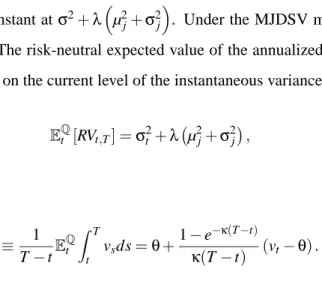
Under the BS model, the annualized return variance rate is constant atσ2. Under the MJD model, this variance rate is also constant atσ2+λ³µ2j+σ2
j
´
. Under the MJDSV model, the realized return variance rate is stochastic. The risk-neutral expected value of the annualized variance rate, hence the variance swap rate, depends on the current level of the instantaneous variance rate vt,
EQt [RVt,T] =σ2t +λ ¡ µ2j+σ2j¢, (18) whereσ2t is given by σ2 t ≡ 1 T−tE Q t Z T t vsds =θ+1−e−κ (T−t) κ(T−t) (vt−θ). (19)
Our replicating strategy implicit in equation (5) is exact when the underlying dynamics are purely continuous, but has a higher order approximation error in the presence of jumps. Thus, under the BS model, the theoretical approximation error is zero: ε=0. Under the other two jump models MJD and MJDSV, the compound Poisson jump component has the following compensator:
ν(x) =λq1 2πσ2j e− (x−µ j)2 2σ2j . (20)
We can compute the approximation errorεfrom equation (6):
ε=2λ¡g−µj−σ2j/2
¢
. (21)
Thus, the approximation error depends on the jump parameters(λ,µj,σj).
The other obvious source of error is from the interpolation and extrapolation needed to obtain a continuum of option prices from the finite number of available option quotes. To numerically gauge the impact of this discretization error, we assume that we have only five option quotes at strike prices of $80, $90, $100, $110, and $120, based on a normalized futures price level of $100. All the stock indexes and individual stocks in our sample average no less than five strikes at each chosen maturity. Hence, the choice of just five strike prices is conservative.
To gauge the magnitude of the total approximation error, we first compute the option prices under the model parameters in Table 1 and compute the option implied volatility at the five strikes. Then, we linearly interpolate the implied volatility across the five strikes to obtain a finer grid of implied volatilities. For strikes below $80, we use the implied volatility level at the strike of $80. Similarly, for strikes above $120, we use the implied volatility level at the strike of $120. This interpolation and extrapolation scheme is simple and conservative. There might exist more accurate schemes, but we defer the exploration of such schemes for future research.
With the interpolated and extrapolated implied volatility quotes at all strikes, we apply the Black-Scholes formula to compute the out-of-the-money option prices at each strike level. Then, we approx-imate the integral in equation (5) with a sum over a fine grid of strikes. We set the lower and upper bounds of the sum at ±8 standard deviations away from at the money, where the standard deviation
is based on the return variance calculation given in equation (18). The fine grid used to compute the sum employs 2,000 strike points within the above bounds. We perform this analysis based on a one-month horizon (T−t=1/12). Following this numerical approximation procedure, we compute the synthesized annualized variance swap rate over this horizon,SWct,T, where the hat stresses the
approxi-mations involved. The difference between this approximate variance swap rateSW and the analyticallyc computed annualized varianceEtQ[RVt,T]represents the aggregate approximation error.
Table 2 summarizes our numerical results on the approximation error of the variance swap rates under the title “Variance Swap.” Under the BS model, the analytical approximation error is zero. Furthermore, since the implied volatility is constant and equal toσat all strikes, there is no interpolation or extrapolation error on the implied volatility. The only potential error can come from the numerical integration. Table 2 shows that this error is not distinguishable from zero up to the fourth reported decimal point.
Under the MJD model, the analytical error due to jumps is 0.0021, about 1.51 percent of the total variance (0.1387). The aggregate error via numerical approximation is also 0.0021. Hence again, numerical approximation via five strike levels does not induce noticeable additional errors.
Under the MJDSV model, we consider different instantaneous variance levels, represented as its log difference from the mean, ln(vt/θ). As the current instantaneous variance level vt varies, the analytical
error due to the jump component is fixed at 0.0021, because the arrival rate of the jump component does not change. But as the aggregate variance level varies from 0.0272 to 2.3782, the percentage error due to jumps varies accordingly from 7.72 percent to 0.09 percent. The aggregate numerical error also varies at different volatility levels, but the variation and the magnitude are both fairly small. The interpolation across the five option strikes does not add much additional approximation error, indicating that our simple interpolation and extrapolation strategy works well.
Our numerical results show that the jump error is small under commonly used option pricing models and reasonable parameter values. The additional numerical error due to discretization is also negligible. Hence, we conclude that the synthetic variance swap rate matches closely the analytical risk-neutral expected value of the return variance.
3.2. Volatility swap rate
Under the BS model, the volatility swap rate and the variance swap rate coincide with each other and with the realized return varianceσ2when they are represented in the same units. Under the MJD model, the return quadratic variation Vt,Tas defined in (4) is random due to the random arrival of jumps
of random size. Under the MJDSV model, Vt,T has another source of randomness due to stochastic
volatility. The randomness in Vt,T under these two models generates a difference between the variance
swap rate and the volatility swap rate due to Jensen’s inequality, as captured by equation (15).
To compute the analytical volatility swap rate under the MJD and MJDSV models, we use the following mathematical equality for any positive number q,
√q= 1 2√π Z ∞ 0 1−e−sq s3/2 ds. (22) Appendix B provides the proof for this equality. Then, by replacing q with Vt,T and taking expectations
on both sides, we can represent the volatility swap rate as a function of the Laplace transform of the quadratic variation, EQt £pVt,T ¤ = 1 2√π Z ∞ 0 1−EQt £e−sVt,T¤ s3/2 ds. (23) Under the MJD model, this Laplace transform can be represented as an infinite sum:
EQt £e−sVt,T¤=e−sσ2(T−t) ∞
∑
n=0 eλ(T−t)(λ(T−t)) n n! ¡ 1+2σ2js¢− n 2e− nµ2js 1+2σ2js , (24)where the first term is due to the constant diffusion component. Under the MJDSV model, this first term changes due to stochastic volatility,
EtQ£e−sVt,T¤=e−b(T−t)vt−c(T−t) ∞
∑
n=0 eλ(T−t)(λ(T−t)) n n! ¡ 1+2σ2js¢− n 2e− nµ2js 1+2σ2js , (25) where b(t) = 2η 2s(1−e−ηt) −(η−κ)(1−e−ηt), c(t) = κθσ2 v h 2 ln ³ 1−η2−ηκ(1−e−ηt)´+ (η−κ)ti, (26)and
η=
q
κ2+2σ2
vs.
Given these two Laplace transforms, we can solve for the volatility swap rate for the two models via numerical integration of equation (23). We use an adaptive Lobatto quadrature method to evaluate this integral numerically with a tolerance level of 10−9. We then compare how the volatility swap rates match the at-the-money implied volatility from each model.
Under the title “Volatility Swap,” Table 2 reports the accuracy of using the at-the-money implied volatility to approximate the volatility swap rate. For ease of comparison to the variance swap rate, we report the squares of the volatility. Under the Black-Scholes model, the volatility swap rate and the implied volatility coincide becauseσ=0.37 is constant.
Under the MJD and MJDSV models, we observe some differences between the at-the-money im-plied volatility and the analytical volatility swap rate. But in all cases, the differences are fairly small, with the magnitudes similar to the approximation errors for the variance swap rates.
Historically, many studies have used at-the-money implied volatilities as proxies for the true volatil-ity series to study its time series property and forecasting capabilities. Our numerical results, together with the theoretical results in Carr and Lee (2003a), show that these studies have indeed chosen a good proxy. Although it is calculated using the Black-Scholes formula, the at-the-money implied volatility represents an accurate approximation for the risk-neutral expected value of the return volatility under much more general settings.
4. Expectation Hypotheses
If we usePto denote the statistical probability measure, we can link the variance swap rate and the annualized realized variance as follows:
SWt,T = EP
t [Mt,TRVt,T] EPt [Mt,T]
where Mt,Tdenotes a pricing kernel and mt,T represents its normalized version, which is aP-martingale, EPt[mt,T] =1. Assuming a constant interest rate, we have:
EPt [Mt,T] =Bt(T) =e−r(T−t). (28)
For traded assets, no-arbitrage guarantees the existence of at least one such pricing kernel (Duffie (1992)).
We decompose equation (27) into two terms:
SWt,T =EPt [mt,TRVt,T] =EPt [RVt,T] +CovPt(mt,T,RVt,T). (29)
The first term EtP[RVt,T] represents the time-series conditional mean of the realized variance. The
second term captures the conditional covariance between the normalized pricing kernel and the realized variance. The negative of this covariance defines the return variance risk premium.
Dividing both sides of (29) by SWt,T, we can also represent the decomposition in excess returns:
1=EPt · mt,T RVt,T SWt,T ¸ =EPt · RVt,T SWt,T ¸ +CovPt(mt,T, RVt,T SWt,T ). (30)
If we regard SWt,T as the forward cost of our investment,(RVt,T/SWt,T−1)captures the excess return
from going long the variance swap. The negative of the covariance term in equation (30) represents the variance risk premium in terms of the excess return. Based on the decompositions in equations (29) and (30), we analyze the behavior of the variance risk premia. We also test several forms of the expectation hypothesis on the variance risk premia.
Using the volatility swap rate, we can analogously define the volatility risk premium and analyze its empirical properties. We have done so. The results are qualitatively similar to the results on the variance risk premia. We only report the results on the variance risk premia in this paper to avoid repetition.
4.1. The average magnitude of the variance risk premia
From equation (29), a direct estimate of the average variance risk premium is the sample average of the difference between the variance swap rate and the realized variance, RPt,T ≡RVt,T−SWt,T.
This difference also measures the terminal capital gain from going long on a variance swap contract. From equation (30), we can also compute an average risk premia in excess return form by computing the average excess return of a long swap position. To make the distribution closer to normality, we represent the excess return in continuously compounded form and label it as the log variance risk premium, LRPt ≡ln(RVt,V/SWt,T).
The most basic form of the expectation hypothesis is to assume zero variance risk premium. There-fore, the null hypothesis is: RPt,T =0 and LRPt,T =0. We empirically investigate whether the average
(log) variance risk premium is significantly different from zero.
4.2. Expectation hypothesis on constant variance risk premia
A weaker version of the expectation hypothesis is to assume that the variance risk premium is constant or independent of the variance swap rate. Then, we can run the following regressions to test the hypothesis:
RVt,T = a+b SWt,T+et,T, (31)
ln RVt,T = a+b ln SWt,T+et,T. (32)
The null hypothesis underlying equation (31) is that RPt,T is constant or independent of the variance
swap rate. Under this null hypothesis, the slope estimate b should be one. The null hypothesis under-lying equation (32) is that the log variance risk premia LRPt,T is constant or independent of the log
variance swap rate. The null value of the slope estimate is also one. Under the null hypothesis of zero risk premia, the intercepts of the two regressions should be zero. Therefore, tests of these expectation hypotheses amount to tests of the null hypotheses: a=0 and b=1 for the two regressions.
4.3. Hypothesis on the link between the variance risk premia and variance of volatility
The existence of nonzero variance risk premia hinges on the existence of randomness in volatility. In a world where return variances are constant, no risk and hence no premium would exist on volatil-ity. We hypothesize that the magnitude of the variance risk premium is positively correlated with the magnitude of the uncertainty in the return volatility.
Remark 1 proposes an observable measure for the uncertainty in return volatility. The difference between the variance swap rate and the volatility swap rate squared measures the variance of the return volatility under the risk-neutral measure. Therefore, we can run the following regression:
ln(RVt,T/SWt,T) =a+b(SWt,T−V St2,T) +e, (33)
and test whether the slope coefficient differs from zero.
4.4. Expectation hypothesis under the Heston model
To illustrate the economic intuition behind the average variance risk premia and the expectation hypothesis regression slope estimates, we go through a simple example based on the stochastic volatility model of Heston (1993). This model assumes that the instantaneous return variance, vt, follows a
square-root process under the risk-neutral measureQ:
dvt=κ(θ−vt)dt+σv√vtdZt, (34)
where Zt denotes a standard Brownian motion,θis the long-run mean instantaneous variance rate,κis
A common assumption for the square-root model is that the market price of risk due to shocks in the Brownian motion Z is proportional to the diffusion component of the instantaneous variance process:2
γ(vt) =γσv√vt. (35)
In words, a zero cost portfolio with unit exposure to the increment dZt would be expected to change
in value as compensation for uncertainty in the realization of Z. Under the statistical measureP, the assumed absolute appreciation rate for this portfolio isγσv√vtper unit time, whereγis real and possibly
negative.
Under assumption (35), Girsanov’s theorem implies that the diffusion of the vt process remains the
same under the statistical measureP, but the drift of vt changes to the following,
µ(vt) =κ(θ−vt) +γσ2vvt =κP
¡θP
−vt
¢
, (36)
which remains affine in the instantaneous variance rate vt. TheP-long-run mean and the mean-reversion
speed are θP= κ κ−γσ2 v θ, κP=κ −γσ2v. (37)
When the market price of Z risk is positive (γ>0), the long-run mean of the variance rate under the statistical measureP,θP, becomes larger than the long-run meanθunder the risk-neutral measureQ.
The mean-reversion speedκP under measurePbecomes smaller (slower). The opposite is true when the market price of Z risk is negative.
2Examples of square-root stochastic volatility models with proportional market price of risk include Pan (2002) and Eraker
(2003). Many term structure models also assume proportional market price of risk on square-root factors. Examples include Cox, Ingersoll, and Ross (1985), Duffie and Singleton (1997), Roberds and Whiteman (1999), Backus, Foresi, Mozumdar, and Wu (2001), and Dai and Singleton, (2000, 2002).
Assuming the square-root process in (34) and the proportional market price of Z risk in (35), we can derive the conditional expected value of the realized aggregate variance under the two measures:
SWt,T ≡ EQt [RVt,T] =θ+ 1−e−κ(T−t) κ(T−t) (vt−θ), (38) EtP[RVt,T] = θP+ 1−e−κP(T−t) κP(T−t) ¡ vt−θP ¢ . (39)
Both are affine in the current level of the instantaneous variance rate vt. Therefore, the conditional
vari-ance risk premium as measured by the difference between the two expected values, RPt=EtP[RVt,T]− EQt [RVt,T], is also affine in vt and is hence also given by a stochastic process.
The long-run mean of vt isθPandθunder measuresPandQ, respectively. The unconditional mean
of the variance risk premium under measurePis equal to:
EP[RPt] = EP[RVt,T−SWt,T] =θP− " θ+1−e− κ(T−t) κ(T−t) ¡ θP −θ¢ # = " 1−1−e −κ(T−t) κ(T−t) # γσ2 v κ−γσ2 v θ. (40)
Therefore, the average variance risk premium is positive when the market price of Z riskγis positive and negative when the market price of Z riskγis negative. The average risk premium becomes zero whenγ=0.
Now we consider the expectation hypothesis regression:
RVt,T=a+b SWt,T+e. (41)
The missing variable in the expectation regression is the variance risk premium, RPt, which is affine in
vt. Since the swap rate SWt,Tis also affine in vt, the missing risk premium in the regression is correlated
with the regressor. Thus, the slope estimate for b will deviate from its null value of one. From equations (38) and (39), we can derive the population value for the regression slope:
b=Cov P¡EP t [RVt,T],SWt,T ¢ VarP(SW t,T) =κ ³ 1−e−κP(T−t) ´ κP¡1−e−κ(T−t)¢, (42)
where VarP(·)and CovP(·,·)denote variance and covariance under measureP, respectively. The slope is equal to the null value of one only whenκ=κP. To see exactly how the slope deviates from the null
value, we Taylor expand the two exponential functions up to second order and obtain:
b=κ ³ 1−e−κP(T−t)´ κP¡1−e−κ(T−t)¢ . =1− 1 2κ P(T−t)) 1−12κ(T−t) . (43)
Therefore, the slope is less than one whenκP>κ, or whenγ<0. The slope is greater than one when κP<κ, orγ>0.
The relation becomes complicated when the regression is on log variance. Taylor expanding the logarithms of SWt,T andEPt [RVt,T]around their respective long-run means generates the following
first-order approximations: ln SWt,T =. lnθ+ 1−e−κ(T−t) θκ(T−t) (vt−θ), (44) lnEPt [RVt,T] =. lnθP+ 1−e−κP(T−t) θPκP(T−t) ¡ vt−θP ¢ . (45)
The regression slope on the log variances is approximately,
b=Cov P¡lnEP t [RVt,T],ln SWt,T ¢ VarP(ln SW t,T) . =θ ¡ 1−12κP(T−t))¢ θP¡1−1 2κ(T−t) ¢. (46)
Whether this slope is greater or less than the null value of one becomes ambiguous. For example, when γ>0, we haveθ<θP, but¡1−1 2κP(T−t)) ¢ >¡1−1 2κ(T−t) ¢
. The two conflicting impacts generate ambiguous regression slopes that will depend on the exact value of the model parameters.
Finally, under the Heston model with proportional market price of Z risk, the variance risk premium is proportional to the instantaneous variance rate. Therefore, any other variable that is related (and ideally proportional) to the instantaneous variance rate would also have explanatory power for the risk premium. Equation (33) proposes to use the risk-neutral variance of return volatility, VartQ
¡√
RVt,T
¢
as the explanatory variable. Under the Heston model and the proportional market price of risk assumption, this conditional variance of volatility is indeed related to vt, but in a complicated nonlinear way. Thus,
we expect the variable to have some explanatory power for the variance risk premium at least under the Heston example.
5. Data and Methodologies
Our options data are from OptionMetrics, a financial research and consulting firm specializing in econometric analysis of the options markets. The “Ivy DB” data set from OptionMetrics is the first widely-available, up-to-date, and comprehensive source of high-quality historical price and implied volatility data for the U.S. stock and stock index options markets. The Ivy DB database contains accurate historical prices of options and their associated underlying instruments, correctly calculated implied volatilities and option sensitivities, based on closing quotes at the Chicago Board of Options Exchange (CBOE). Our data sample starts from January 1996 and ends in February 2003.
From the data set, we filter out market prices of options on five stock indexes and 35 individ-ual stocks. We choose these stocks and stock indexes mainly based on the quote availability, which approximates the stocks’ trading activity. Table 3 provides the list of the five stock indexes and 35 individual stocks in our sample, as well as the starting and ending dates, the sample length (N), and the average number of strikes (NK) at the chosen maturities for each stock (index). The list includes op-tions on the S&P 500 index (SPX), the S&P 100 index (OEX), the Dow Jones Industrial Index (DJX), and the Nasdaq-100 index (NDX). The index options on SPX, DJX, and NDX are European options on the spot indexes. The OEX options and options on the other 35 individual stocks and the QQQ (the Nasdaq-100 tracking stock) are all American options on the underlying spot.
Index options are more active than the individual stock options. On average, more than 20 strikes are available at the chosen maturity for the S&P index options, but the number of available strikes at the chosen maturity for individual stock options is mostly within single digits. Therefore, inferences drawn from the index options data could be more accurate than those drawn from the individual stock options.
The data set includes closing quotes for each option contract (bid and ask) along with Black-Scholes implied volatilities based on the mid quote. For the European options, implied volatilities are directly
inferred from the Black-Scholes option pricing formula. For the American options, OptionMetrics employs a binomial tree approach that takes account of the early exercise premium. The data set also includes the interest rate curve and the projected dividend yield.
In parallel with our numerical studies in the previous section, we choose a monthly horizon for the synthesis of variance swap rates. At each date for each stock or stock index, we choose to the two nearest maturities, except when the shortest maturity in within eight days, under which scenario we switch the next two maturities to avoid the potential microstructure effects of the very short-dated options. We only retain options that have strictly positive bid quotes and where the bid price is strictly smaller than the ask price.
Analogous to the numerical illustrations, at each maturity, we first linearly interpolate implied volatilities at different moneyness levels, defined as k≡ln(K/F), to obtain a fine grid of implied volatilities. For moneyness levels k below the lowest available moneyness level in the market, we use the implied volatility at the lowest strike price. For k above the highest available moneyness, we use the implied volatility at the highest strike. Using this interpolation and extrapolation procedure, we generate a fine grid of 2,000 implied volatility points with a strike range of ±8 standard deviations from at-the-money. The standard deviation is approximated by the average implied volatility.
Given the fine grid of implied volatility quotes, IV , we compute the forward price of a European option of strike K and maturity T using the Black (1976) formula,
Θt(K,T) Bt(T) = FtN(d1)−KN(d2) K>Ft −FtN(−d1) +KN(−d2) K≤Ft , (47) with d1= ln(Ft/K) +IV2(T−t)/2 IV√T−t , d2=d1−IV √ T−t. (48) We can rewrite the initial cost of the approximate replicating portfolio in equation (5) as
EQt [RVt,T]=. 2 T−t ·Z 0 −∞ ³ −e−kN(−d1(k)) +N(−d2(k)) ´ dk+ Z ∞ 0 ³ e−kN(d1(k))−N(−d2(k)) ´ dk ¸ , (49)
with d1(k) =− k+IV2(k)(T−t)/2 IV(k)√T−t , d2(k) =d1(k)−IV(k) √ T−t. (50) Therefore, the value of this portfolio does not depend directly on the spot or forward price of the underlying, but only on the moneyness level k and the implied volatility at each moneyness level k.
Based on the implied volatilities at the two nearest maturities that are no shorter than eight days, we compute the synthetic variance swap rates at these two maturities. Then, we linearly interpolate to obtain the variance swap rate at a 30-day horizon. We also linearly interpolate to obtain the at-the-money implied volatility over a 30-day horizon as an approximation for the volatility swap rate. We do not extrapolate. When the shortest maturity is over 30 days, we use the variance swap rate and at-the-money implied volatility at the shortest maturity.
At each day, we also compute the relevant forward price F of each stock based on the interest rates, dividend yields, and the spot price level. Then, we match the variance swap rate with an ex-post annualized realized variance estimate over the next 30 calendar days,
RVt,t+30= 365 30 30
∑
i=1 µ Ft+i,t+30−Ft+i−1,t+30 Ft+i−1,t+30 ¶2 , (51)where Ft,T denotes the time-t forward price with expiry at time T . The estimation of the ex-post
real-ized variance defined in equation (51) is similar to the way that the floating component of the payoff to a variance swap contract is calculated in practice. A small difference exists between the return variance defined in equation (51) and the quadratic variation in (4) due to the difference between daily moni-toring and continuous monimoni-toring. The forward price has a fixed maturity date and hence a shrinking time-to-maturity as calendar time rolls forward. Since the stock prices in the OptionMetrics data set are not adjusted for stock splits, we manually adjust the stock splits for each stock in calculating the realized variance. We have also downloaded stock prices from Bloomberg to check for robustness. Furthermore, we have also computed alternative realized variances based on spot prices, and based on demeaned returns. These variations in the definition of the realized variance do not alter our conclu-sions. We report our results based on the realized variance definition in equation (51).
At each day, we have computed a 30-day variance swap rate, a 30-day volatility swap rate, and a 30-day ex-post realized variance (the realized variance from that day to 30 days later). In our analysis,
we apply the following filters to delete inactive days that occur mainly for individual stock options: (1) The nearest available maturity must be within 90 days. (2) The actual stock price level must be greater than one dollar. (3) The number of strikes is at least three at each of the two nearest maturities. For a stock with active options trading, the most active options are usually the ones that mature in the current or next month. Hence, an absence of quotes for these short-term options is an indication of inactivity. Furthermore, since a stock will be delisted from the stock exchange if the stock price stays below one dollar for a period of time, options trading on such penny stocks are normally very inactive. The last filter on the number of strikes at each maturity is needed to accurately estimate the variance swap rate. None of these filters are binding for the S&P 500 and 100 index options.
Table 4 reports the summary statistics for the realized variance (RV ), the synthetic variance swap rate (SW ), and the synthetic volatility swap rate (V S). For ease of comparison, we represent all three series in percentage volatility units. Of the three series, the average value of the realized variance is the lowest, and the variance swap rate is the highest, with the volatility swap rate in the middle. All three rates exhibit positive skewness and positive excess kurtosis for most stocks and stock indexes.
6. The Behavior of Variance Risk Premia
In this section, we empirically investigate the behavior of the variance risk premia. First, we es-tablish the existence, sign, and average magnitude of the variance risk premia. Then, we investigate whether the classical capital asset pricing theory (CAPM) and Fama-French market factors can fully account for the premia. Finally, we analyze the dynamic properties of the risk premia using the various expectation hypotheses formulated in Section 4.
6.1. Do investors price variance risk?
If investors price the variance risk, we expect to see a difference between the sample averages of the realized variance and the variance swap rate. Table 5 reports the summary statistics of the difference between the realized variance and the variance swap rate, RP=100×(RVt,T−SWt,T), in the left panel
premia and LRP the log variance risk premia. The variance risk premia RP show large kurtosis and sometimes also large skewness. The skewness and kurtosis are much smaller for the log variance risk premia LRP.
The mean (log) variance risk premia are negative for all of the stock indexes and for most of the individual stocks. To test its statistical significance, we construct a t-statistic for the risk premia,
t-stat=√Nµj/σj, j=RP,LRP, (52)
where N denotes the sample length, µ denotes the sample average, and σ denotes the Newey and West (1987) serial-dependence adjusted standard error, computed with a lag of 30 days. We report the estimated t-values in Table 5. The largest t-statistics come from the S&P 500 and S&P 100 indexes and the Dow Jones Industrial Average, which are strongly significant for both variance risk premia and log variance risk premia. The Nasdaq-100 index and its tracking stock generate t-statistics that are much lower. The t-statistics on the two Nasdaq indexes are not statistically significant for the variance risk premia RP, albeit significant for the log variance risk premia LRP.
The t-statistics on the log variance risk premia are also negative for most of the individual stocks, but the magnitudes are smaller than that for the S&P indexes. The mean log variance risk premia are significantly negative for 21 of the 35 individual stocks. However, the mean variance risk premia (RP) are insignificant for all but three of the 35 individual stocks.
If an investor creates the fixed part of the variance swap payoff by purchasing at time t the proper portfolio of options with expiry date T and then dynamically trading futures, the initial cost of this trading strategy is given by Bt(T)SWt and the terminal payoff of this strategy at time T is the realized
variance RVt,T. Therefore, the log risk premium LRP=ln(RVt,T/SWt,T) captures the continuously
compounded excess return to such a trading strategy. The mean values of LRP in Table 5 show that on average, the investors are willing to accept a negative excess return for this investment strategy, especially on the S&P and Dow indexes. This excess return is over −50 percent per month for the two S&P 500 indexes and for Dow Jones. Therefore, we conclude that investors price heavily the uncertainty in the variance of the S&P and Dow indexes.