Transportation Research Procedia 2 ( 2014 ) 533 – 540
2352-1465 © 2014 The Authors. Published by Elsevier B.V. This is an open access article under the CC BY-NC-ND license (http://creativecommons.org/licenses/by-nc-nd/3.0/).
Peer-review under responsibility of Department of Transport & Planning Faculty of Civil Engineering and Geosciences Delft University of Technology doi: 10.1016/j.trpro.2014.09.093
ScienceDirect
The Conference in Pedestrian and Evacuation Dynamics 2014 (PED2014)
Simulation of exit selection behavior using least effort algorithm
Libi Fu
a, b, Weiguo Song
a,*, Wei Lv
c, Siuming Lo
ba State Key Laboratory of Fire Science, University of Science and Technology of China, Hefei 230027, People’s Republic of China
b Department of Architectural and Civil Engineering, City University of Hong Kong, Hong Kong, People’s Republic of China
c Research Center for Crisis & Hazard Management, Wuhan University of Technology, Wuhan 430070, People’s Republic of China
Abstract
In an evacuation process involving multi-exits, exit selection behavior is a significant concern for safe facility design. We improve the least effort algorithm to investigate pedestrian exit route decisions in simulated evacuations, considering crowd density around two exits. This modification extends the algorithm to support altering targets in the case of asymmetrical exits. We conduct simulations given some special distribution of pedestrians. Pedestrian exit selection behavior and herding behavior are clearly demonstrated. Moreover, the model is applied to identify the relationship between exit separation and evacuation time. The total exit flow rate against different initial crowd densities is also discussed.
© 2014 The Authors. Published by Elsevier B.V. Peer-review under responsibility of PED2014.
Keywords: exit selection; least effort algorithm; crowd density; simulation; evacuation
1. Introduction
Research on pedestrian evacuation has become a hotspot in recent years, due to an increase in emergency incidents such as fire, earthquake and explosion. Great losses may occur if pedestrian evacuation is not successful. Egress behavior is always a significant concern in an evacuation process, especially when involving multi-exits. Exit selection behavior is an important factor in safe facility design. It also has an effect on an effective evacuation plan. There is a need to investigate the pedestrian exit choice and its influence on evacuation processes.
* Corresponding author. Tel.: +86-551-63606415; fax: +86-551-63601669.
E-mail address: [email protected]
© 2014 The Authors. Published by Elsevier B.V. This is an open access article under the CC BY-NC-ND license (http://creativecommons.org/licenses/by-nc-nd/3.0/).
Peer-review under responsibility of Department of Transport & Planning Faculty of Civil Engineering and Geosciences Delft University of Technology
Mathematical and physical tools have been widely used to investigate evacuation problems. Modeling, for its simplicity and flexibility, enables researchers to present various characteristics of human behaviors. It has become one of the most important methods to study pedestrian dynamics. Models are usually divided into two categories, namely continuous models and discrete ones. The social force model presented by Helbing et al. (2000) is a representative continuous model. It was a successful approach to reproduce the escape panic of humans, “faster is slower” and “freezing by heat” phenomena. Some researchers [Parisi and Dorso (2005); Saboia and Goldenstein (2012); Suzuno et al. (2013)] modified this model to study different evacuation problems. Due to the complex rules of continuous models, their calculation efficiency is not high. Discrete models, such as the cellular automaton (CA) model (Weng et al. (2006)), lattice-gas model of biased random walkers (Muramatsu et al. (1999)), multi-grid model (Song et al. (2006)), floor field model (Kirchner and Schadschneider (2002)) and mean field model (Nagatani (2001)), can describe crowd behavior well, and run faster than continuous models on the same hard condition. The cellular automaton approach has been employed to investigate pedestrian movement in an open area, collision avoidance, panic spread (Fu et al., 2014) and collective phenomena such as jams, blocks and clogging (Weng et al. (2006)). It has also been used to ascertain evacuee route and exit selection behaviors (Lim (2011), Fang et al. (2010)). However, many CA models do not discuss pedestrians’ ability to select the exit route (Zainuddin and Aik (2012)). They render occupants’ decision limited by the distance to an exit rather than surrounding factors.
Pedestrian movement is always targeted at a specific physical location. In this case we can usually observe least effort path selection behavior in pedestrian movement (Sarmady et al. (2009)). Sarmady et al. (2009) presented a variation of the least effort movement model using cellular automata. They considered the effect of pedestrian groups on crowd movement, and simulated pedestrian movement toward a target location in a simple walkway scenario. However, in the case of multiple targets, such as asymmetrical exit layout, how to identify a pedestrian’s target with this algorithm has not been well investigated. As pedestrians have different characteristics and decision-making abilities, it is not suitable to randomly select an exit or the same exit. Thus, the exit route choice should be examined with this algorithm when the target is not determined, and surrounding factors should be considered.
In this paper, it is aimed to modify the least effort algorithm and incorporate crowd density to model pedestrian exit selection behavior. The remainder of this paper is organized as follows: firstly, the specific model is elaborated, and simulations are performed in the case of special distribution of pedestrians in a two-exit room. Then the influence of parameters in this model on exit selection behavior is discussed. We also employ our model to study the relationship between exit separation and evacuation time. In addition, the total exit flow rate against different initial crowd densities is analyzed. Finally, conclusions are stated.
2. Model
The modeling space is presented by two-dimensional cells with a size of W × H. Each cell is an identical square area of 0.4 m × 0.4 m, and may be empty or occupied by an obstacle or individual. We hypothesize that a pedestrian may move towards 8 directions and to one cell at each time step, as demonstrated in Fig. 1. For a pedestrian may prefer the shortest path to a target (e.g. an exit) which needs the least effort, the Moore neighboring cell nearer to a target has a higher probability for a pedestrian to move to. According to the desirability of neighboring cells, probabilities (Pi, j) are calculated (Sarmady et al., 2009) as follows:
,
=
, i j i jp
NM
(1) N ( ,1
i jN
M
¦
) is a normalization factor which adjusts the sum of probabilities of all eight cells to 1. Mi, jforeach neighboring cell is calculated by:
min , , ,
(1
)
i j i j i jD
M
n
D
(2)where Dmin = Min (Di, j), Di, j 0,and ni, j = {0, 1}. Di, j denotes the Euclidean distance between neighboring cell (i, j) and a target. If the target is one of the Moore neighboring cells and not occupied, the probability of moving into this target will be 1. Dmin/ Di, j represents the ratio of the distance of cell (i, j) to the target compared with the minimum distance of neighboring cells to this target. ni, j equals 1 if cell (i, j) is occupied, and then the probability of moving into this occupied cell is 0. Otherwise, the value of ni, j is 0. After all the values of Pi, j are calculated, we need to rank them. The first index point representing the highest value of Pi, j should be selected most of the time. As noted in Ref. (Sarmady et al., 2009), a normal distribution with the mean value of 1 and standard deviation of 0.5 is employed to generate random numbers which can be rounded to the nearest integer index numbers.
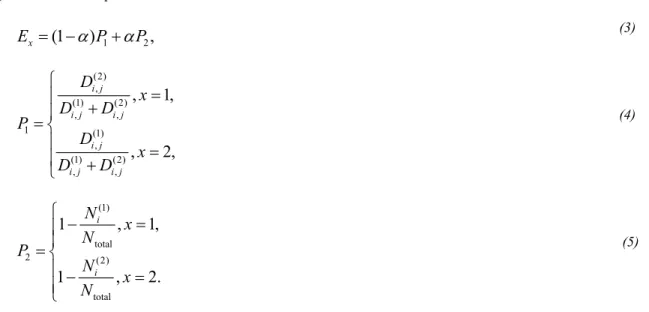
In a two-exit scenario, there are two targets for pedestrians. We should propose a method to identify pedestrian exit selection. Thus a variable Exis used to estimate the probability that exit x (x = 1, 2) is selected as a pedestrian’s target at each time step.
1 2
(1
)
,
xE
D
P
D
P
(3) (2) , (1) (2) , , 1 (1) , (1) (2) , ,,
1,
,
2,
i j i j i j i j i j i jD
x
D
D
P
D
x
D
D
°
°
®
°
°
¯
(4) (1) total 2 (2) total1
,
1,
1
,
2.
i iN
x
N
P
N
x
N
°
°
®
°
°¯
(5) (1) , i j D and (2) , i jD represent the distance of neighboring cell (i, j) to exit 1 and 2, respectively. P1 denotes the
probability of reaching the nearest exit (Eng Aik and Wee Choon, 2012). Formula (4) indicates that the shorter the distance of a pedestrian to an exit is, the higher the probability of the pedestrian selecting this exit will be. (1)
i
N and
(2)
i
N represent the number of pedestrians in the room who are nearer than pedestrian i to exit 1 and 2, respectively.
Ntotal corresponds to the total number of remaining pedestrians in the room at each time step. P2 denotes the
probability of congestion in the exit area. Thus crowd density is considered in our model. In addition, Į is a parameter that defines the degree of impatience in an evacuation process. It may influence a pedestrian’s exit route choice, as highlighted in Ref. (Eng Aik and Wee Choon, 2012).
t = 0 t = 17
t = 0 t = 6
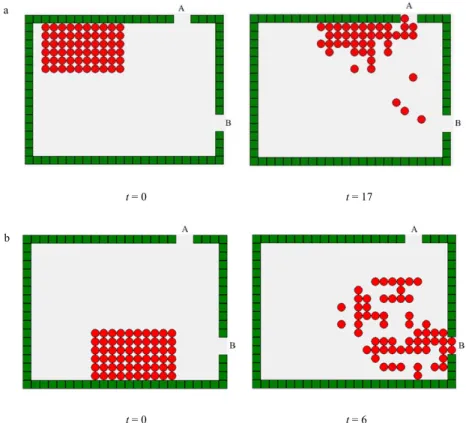
Fig. 2. Snapshots of simulation results of different initial distributions of pedestrians in a two-exit room: (a) near the left side of exit A; (b) near the left side of exit B.
According to the transition probabilities and exit selection probability above, we alter all pedestrians’ movement in the room with random shuffled sequential update at each time step. Each time step corresponds to 0.4 s. Pedestrians who leave the room will not be considered at the next time step.
3. Simulation and results
We test the proposed model in a cellular space of 18 × 24 cells with two exits (A and B). Each exit occupies two cells, as illustrated in Fig. 2. Cells marked in green are occupied as the wall. Initially, 60 pedestrians marked in red are near the left side of exit A in Fig. 2 (a) and exit B in Fig. 2 (b). This non-uniform distribution of pedestrians allows us to clearly investigate exit selection behavior. Here we just select Į = 0.5 to obtain simple simulation results. The influence of parameter Į on exit selection behavior will be discussed later. From the snapshots of simulations at some time steps, we can see that most of pedestrians prefer a nearer exit at the beginning. However, some will alter their exit choice after the crowd density in this exit area increases, and congestion occurs. This phenomenon is consistent with descriptions in some other models (Eng Aik and Wee Choon, 2012) or experiments (Fang et al., 2010; Zainuddin and Aik, 2012).
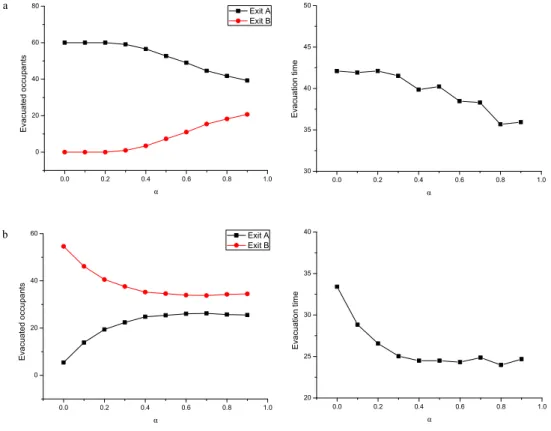
As stated above, parameter Į indicates impatience of pedestrians, and affects the evacuation process. Thus we examine its influence on exit selection and evacuation time (see Fig. 3) in scenarios shown in Fig. 2. When pedestrians are near exit A (B), more occupants will select exit A (B), but the number decreases as the value of parameter Įincreases. In contrast, the number of evacuated occupants from exit B (A) grows with an increase in the value of Į, i.e., an increase in impatience and the weighted value of crowd density.The growth rates of occupants evacuating from exits B and A respectively in Fig. 3 (a) and (b) are different. The former increases slowly when Į< 0.3, and decreases when Į> 0.6, finally leveling off. However, the latter decreases markedly at the beginning, and
a
remains unchangeable when Į > 0.6. This difference at the beginning may result from the initial pedestrian distribution. As the weighted value of the distance to an exit has more influences on pedestrians near exit A than crowd density in Fig. 3 (a) (corresponding to Fig. 2 (a)) when the value of Įis small, and most of those pedestrians are further away from exit B, resulting in no evident varying in the number of occupants evacuating from each exit. Nevertheless, in Fig. 3 (b) (corresponding to Fig. 2 (b)), with the value of Įincreasing, more pedestrians will select exit A after they move close to exit A, and consider crowd density around exit B. As to total evacuation time in both scenarios, it falls slightly with the value of Įincreasing. However, the evacuation time in Fig. 3 (b) is less than that in Fig. 3 (a), because herding behavior in Fig. 3 (a) is more evident. Therefore, incorporating crowd density, especially increasing the weighted value of crowd density in our model, can not only reproduce intelligent exit selection behavior under different conditions, but also reveal pedestrians’ decision-making ability, which will impact on evacuation time.
Fig. 3. Influence of different values of parameter Į on evacuated occupants and evacuation time in the room shown in Fig. 2.
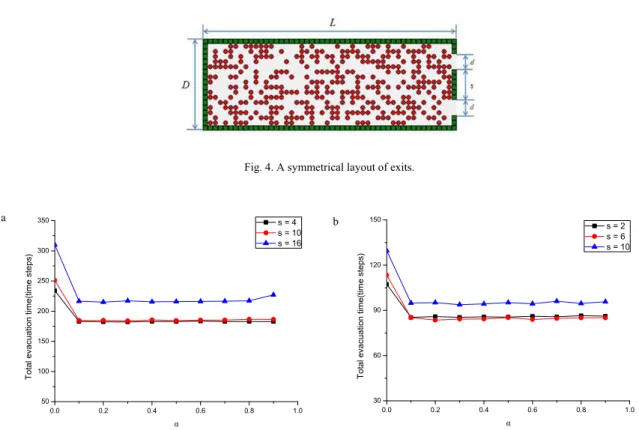
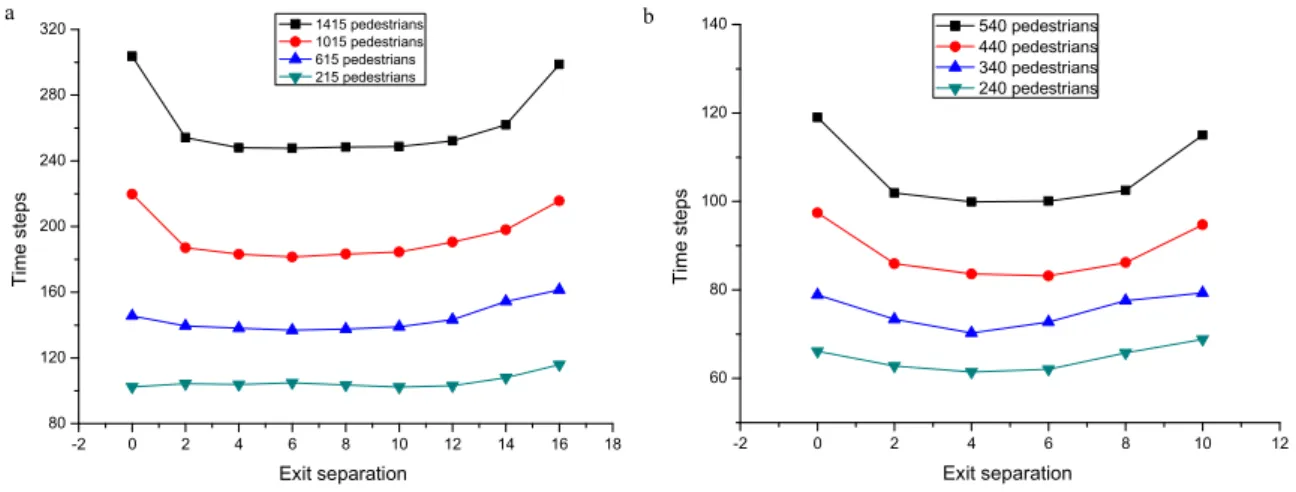
A suitable multi-exit design given exit selection behavior is important to improve evacuation efficiency. Here we employ our model to investigate the relationship between exit separation and evacuation time in a room with a symmetrical layout of two exits, as illustrated in Fig. 4. The room size is L × D. d denotes the exit width. s
represents exit separation. Initially, pedestrians are randomly distributed in the room. From Fig. 5, we can see that when Į> 0.1, it has no evident influence on total evacuation time given the same exit separation, because of the symmetrical layout of two exits. However, the total evacuation time markedly increases if Į< 0.1, which indicates that crowd density is nearly neglected. This further suggests that considering crowd density is necessary in exit selection. For succinctness, we set Į= 0.5 and d = 3 cells. Then two scenarios, namely L × D corresponding to100 × 24 cells and 50 × 18 cells, with different numbers of pedestrians and values of s are established to examine optimal exit separation. As shown in Fig. 6, total evacuation time decreases firstly, and then increases with an increase in exit separation. The optimal exit separation inducing the least evacuation time is in the range of 6 ~ 8 cells and 4 ~ 6
0.0 0.2 0.4 0.6 0.8 1.0 0 20 40 60 80 E v ac uat ed oc c upant s Į Exit A Exit B 0.0 0.2 0.4 0.6 0.8 1.0 30 35 40 45 50 Evacua tio n ti me Į 0.0 0.2 0.4 0.6 0.8 1.0 0 20 40 60 E v acua ted o c cup ants Į Exit A Exit B 0.0 0.2 0.4 0.6 0.8 1.0 20 25 30 35 40 E v ac ua ti on ti me Į a b
cells when L × D corresponds to100 × 24 cells and 50 × 18 cells, respectively. This result is in conformance to Ref. (Zhao et al., 2006), which demonstrates that the optimal exit separation is approximately 0.3D with a discrete ‘social force’ cellular automaton model.
According to the optimal exit separation, we discuss the total exit flow rate in the case of L × D (50 × 18 cells), as stated above. Because of the symmetrical layout of two exits and randomly distributed pedestrians in the room, the difference in flow rate of each exit is not evident. Hence we focus on the total exit flow rate. Here, we use s = 6 cells, Į = 0.5 and d = 3 cells. Crowd density (ȡ) in the room varies, and its corresponding value of flow rate is obtained by averaging over 500 different initial pedestrian distributions. From Fig. 7, we can see that the flow rate increases with an increase in crowd density, and reaches a maximum value (approximately 5.6 persons/(s·m)) after ȡ
= 4 persons/m2.
Fig. 4. A symmetrical layout of exits.
Fig. 5. Influence of the value of Į on total evacuation time given different exit separations (s) in scenarios: (a) L × D = 100 × 24 cells, 1015 pedestrians initially; (b) L × D = 50 × 18 cells, 440 pedestrians initially.
0.0 0.2 0.4 0.6 0.8 1.0 50 100 150 200 250 300 350 Tot al evacuat ion ti me( tim e st eps) Į s = 4 s = 10 s = 16 0.0 0.2 0.4 0.6 0.8 1.0 30 60 90 120 150 Tot al evacuat ion t im e( ti m e st eps) Į s = 2 s = 6 s = 10 a b
Fig. 6. The relationship between total evacuation time and exit separation for different numbers of pedestrians and system sizes: (a) 100 × 24 cells; (b) 50 × 18 cells.
Fig. 7. The plot of mean flow rate against crowd density for the optimal exit separation.
4. Conclusions
In this paper, we have adopted the least effort cellular automaton algorithm to model exit selection behavior in evacuation processes by considering impatience of evacuees and crowd density in the exit areas. The proposed model enables pedestrians to determine their best evacuation exit according to the distance to a target and congestion. Pedestrian movement is updated according to the transition probabilities and exit selection probability in the model. Hereby, exit selection behavior is investigated in scenarios with the asymmetrical or symmetrical exit layout. Simulations show that pedestrians may alter their exit route though the exit is further. The weighted values of distance to an exit and crowd density have an influence on the number of pedestrians evacuating from both exits and total evacuation time. This can be employed to identify different cases in evacuation processes. Moreover, exit selection behavior is important for safe facility design, which is investigated by simulating pedestrian egress behavior in the case of varying exit separation. The optimal exit separation resulting in the least evacuation time is obtained, consistent with conclusions in other references. This further reveals the feasibility of our model in exit
-2 0 2 4 6 8 10 12 14 16 18 80 120 160 200 240 280 320 Ti me s te p s Exit separation 1415 pedestrians 1015 pedestrians 615 pedestrians 215 pedestrians -2 0 2 4 6 8 10 12 60 80 100 120 140 T ime steps Exit separation 540 pedestrians 440 pedestrians 340 pedestrians 240 pedestrians 0 1 2 3 4 5 6 7 0 1 2 3 4 5 6 Flow R at e [p er so ns/(s·m)] ˄ ȡ persons/m2˅ a b
selection study. We also discuss the total flow rate under different crowd densities. Those results are helpful in evacuation organization.
The proposed model can be extended by considering effects of impatience on pedestrian movement velocity. What’s more, in future work, some related experiments will be conducted to validate our model. Thus values of model parameters can be identified according to experimental data.
Acknowledgements
This research was supported by National Natural Science Foundation of China (51178445 and 51120165001), the National Basic Research Program of China (2012CB719705), the Key Technologies R&D Program of China during the 12th Five-year Plan Period (2012BAK13B01) and the Fundamental Research Funds for the Central Universities (WK2320000014).
References
Eng Aik, L., Wee Choon, T., 2012. Simulating Evacuations with Obstacles Using a Modified Dynamic Cellular Automata Model. Journal of Applied Mathematics 2012, 1-17.
Fang, Z., Song, W., Zhang, J., Wu, H., 2010. Experiment and modeling of exit-selecting behaviors during a building evacuation. Physica A: Statistical Mechanics and its Applications 389, 815-824.
Fu, L., Song, W., Lv, W., Lo, S., 2014. Simulation of emotional contagion using modified SIR model: A cellular automaton approach. Physica A: Statistical Mechanics and its Applications 405, 380-391.
Helbing, D., Farkas, I., Vicsek, T., 2000. Simulating dynamical features of escape panic. Nature 407, 487-90.
Kirchner, A., Schadschneider, A., 2002. Simulation of evacuation processes using a bionics-inspired cellular automaton model for pedestrian dynamics. Physica A: Statistical Mechanics and its Applications 312, 260-276.
Lim, E. A., 2011. Exit-selection behaviors during a classroom evacuation. International Journal of the Physical Sciences 6, 3218-3231.
Muramatsu, M., Irie, T., Nagatani, T., 1999. Jamming transition in pedestrian counter flow. Physica a-Statistical Mechanics and Its Applications 267, 487-498.
Nagatani, T., 2001. Dynamical transition and scaling in a mean-field model of pedestrian flow at a bottleneck. Physica a-Statistical Mechanics and Its Applications 300, 558-566.
Parisi, D. R., Dorso, C. O., 2005. Microscopic dynamics of pedestrian evacuation. Physica A: Statistical Mechanics and its Applications 354, 606-618.
Saboia, P., Goldenstein, S., 2012. Crowd simulation: applying mobile grids to the social force model. The Visual Computer 28, 1039-1048. Sarmady, S., Haron, F., Talib, A. Z. H., 2009. Modeling Groups of Pedestrians in Least Effort Crowd Movements Using Cellular Automata. 2009
Third Asia International Conference on Modelling & Simulation, Vols 1 and 2, 520-525.
Song, W., Xu, X., Wang, B.-H., Ni, S., 2006. Simulation of evacuation processes using a multi-grid model for pedestrian dynamics. Physica A: Statistical Mechanics and its Applications 363, 492-500.
Suzuno, K., Tomoeda, A., Ueyama, D., 2013. Analytical investigation of the faster-is-slower effect with a simplified phenomenological model. Phys Rev E Stat Nonlin Soft Matter Phys 88, 052813.
Weng, W. G., Chen, T., Yuan, H. Y., Fan, W. C., 2006. Cellular automaton simulation of pedestrian counter flow with different walk velocities. Phys Rev E Stat Nonlin Soft Matter Phys 74, 036102.
Zainuddin, Z., Aik, L. E., 2012. Intelligent Exit-Selection Behaviors during a Room Evacuation. Chinese Physics Letters 29, 018901.
Zhao, D. L., Yang, L. Z., Li, J., Zhu, Y., Zou, L., 2006. Relationship between Performance-based Design of Building Exits and State Transition of Pedestrian Flow during Occupant Evacuation. Journal of Fire Protection Engineering 16, 269-281.