Feature Subset Selection in Intrusion Detection Using Soft Computing Techniques IFTIKHAR AHMAD STATUS OF THESIS Title of thesis: I, ___________________________________________________________________ hereby allow my thesis to be placed at the Information Resource Center (IRC) of Universiti Teknologi PETRONAS (UTP) with the following conditions:
1. The thesis becomes the property of UTP
2. The IRC of UTP may make copies of the thesis for academic purposes only. 3. This thesis is classified as
If this thesis is confidential, please state the reason:
_____________________________________________________________________ _____________________________________________________________________ _____________________________________________________________________ The contents of the thesis will remain confidential for _______ years.
Remarks on disclosure: _____________________________________________________________________ _____________________________________________________________________ _____________________________________________________________________ Endorsed by ________________________ ____________________
Signature of Author Signature of Supervisor
Iftikhar Ahmad Assoc. Prof. Dr. Azween Bin Abdullah
Department of Computer Department of Computer
Science, FUUAST, G-8 Information Sciences (CIS) Islamabad, Pakistan. Universiti Teknologi PETRONAS
Date: ______________ Date: ______________
Confidential √ Non-confidential
UNIVERSITI TEKNOLOGI PETRONAS
FEATURE SUBSET SELECTION IN INTRUSION DETECTION USING SOFT COMPUTING TECHNIQUES
By
IFTIKHAR AHMAD
The undersigned certify that they have read, and recommend to the Postgraduate Studies Programme for acceptance this thesis for the fullfilment of the requirements for the degree stated.
Signature: ____________________________________ Main Supervisor: Assoc. Prof. Dr. Azween Bin Abdullah Signature: ____________________________________ Head of Department: Dr. Mohd Fadzil Bin Hassan
FEATURE SUBSET SELECTION IN INTRUSION DETECTION USING SOFT COMPUTING TECHNIQUES
by
IFTIKHAR AHMAD
A Thesis
Submitted to the Postgraduate Studies Programme As a requirement for the degree of
DOCTOR OF PHILOSOPHY
DEPARTMENT OF COMPUTER AND INFORMATION SCIENCES UNIVERSITI TEKNOLOGI PETRONAS
BANDAR SERI ISKANDAR PERAK
IFTIKHAR AHMAD DECLARATION OF THESIS
Title of thesis Feature Subset Selection in Intrusion Detection Using Soft Computing Techniques
I, ___________________________________________________________________ hereby declare that the thesis is based on my original work except for quotations and citations, which have been duly acknowledged. I also declare that it has not been previously or concurrently submitted for any other degree at UTP or other institutions.
Witnessed by
________________________ ____________________
Signature of Author Signature of Supervisor
Iftikhar Ahmad Assoc. Prof. Dr. Azween Bin Abdullah
Department of Computer Department of Computer
Science, FUUAST, G-8 Information Sciences (CIS)
Islamabad, Pakistan. Universiti Teknologi PETRONAS
ACKNOWLEDGEMENT
I am very thankful to Almighty Allah, the most beneficent, the most merciful and the most gracious, for enhancing my courage for the completion of this work successfully. It is matter of great honor and pleasure for me to express my ineffable gratitude and profound indebtedness to Prof. Dr. Azween Bin Abdullah for his kind supervision valuable suggestions and intellectual activities, inexhaustible energy to steer forth the students. I also appreciate efforts and cooperation of management of Universiti Teknologi PETRONAS, Malaysia that makes possible for me to conduct the implementation of this research. I am also greatly obliged to my co-supervisor
Prof. Dr. Abdullah Sharaf Alghamdi, for his keen interest, guidance and moral support. Also expresses my thanks to all my colleagues who helped me whenever needed.
I am also greatly obliged to Dr. Muhammd Hussain, Dr. Mohsin Iftikhar, Dr. A. Rahim, Dr. Anwar, and Dr. Shamim Husain for their kind research guidance and moral support. I feel proud to have such a nice and distinguished ASER group fellows, FUUAST colleagues, and friends, Dr. Mahmat Issa, Irshad Ahmad Sumro, Ayaz Arshad,Imran Baig, Masood Ur Rehman, Hanif Ullah, Gul Faraz, Tazar Hussain, Muhammad Nasir, Syed Amanullah Qadri, Aman Ul Haq and other respected fellows for making the whole period a golden era.
I inexpressibly fall short of diction to express my humble obligation to my parents whose hands always rise in pray for my success and because of their whole moral support; I feel my entity at this stage. Finally, I apologize if I have happened to annoy anybody during studies in this great institution. The errors that remain are mine alone.
ABSTRACT
Intrusions on computer network systems are major security issues these days. Therefore, it is of utmost importance to prevent such intrusions. The prevention of such intrusions is entirely dependent on their detection that is a main part of any security tool such as Intrusion Detection System (IDS), Intrusion Prevention System (IPS), Adaptive Security Alliance (ASA), checkpoints and firewalls. Therefore, accurate detection of network attack is imperative. A variety of intrusion detection approaches are available but the main problem is their performance, which can be enhanced by increasing the detection rates and reducing false positives. Such weaknesses of the existing techniques have motivated the research presented in this thesis.
One of the weaknesses of the existing intrusion detection approaches is the usage of a raw dataset for classification but the classifier may get confused due to redundancy and hence may not classify correctly. To overcome this issue, Principal Component Analysis (PCA) has been employed to transform raw features into principal features space and select the features based on their sensitivity. The sensitivity is determined by the values of eigenvalues. The recent approaches use PCA to project features space to principal feature space and select features corresponding to the highest eigenvalues, but the features corresponding to the highest eigenvalues may not have the optimal sensitivity for the classifier due to ignoring many sensitive features. Instead of using traditional approach of selecting features with the highest eigenvalues such as PCA, this research applied a Genetic Algorithm (GA) to search the principal feature space that offers a subset of features with optimal sensitivity and the highest discriminatory power.
Based on the selected features, the classification is performed. The Support Vector Machine (SVM) and Multilayer Perceptron (MLP) are used for classification purpose due to their proven ability in classification. This research work uses the Knowledge Discovery and Data mining (KDD) cup dataset, which is considered
benchmark for evaluating security detection mechanisms. The performance of this approach was analyzed and compared with existing approaches. The results show that proposed method provides an optimal intrusion detection mechanism that outperforms the existing approaches and has the capability to minimize the number of features and maximize the detection rates.
ABSTRAK
Pencerobohan ke atas sistem rangkaian komputer merupakan isu keselamatan yang utama dewasa ini. Maka, adalah sangat penting untuk menghalang daripada pencerobohan ini. Langkah-langkah pencegahan ini bergantung sepenuhnya kepada sistem pengesanan di mana ia merupakan bahagian terpenting kepada alat keselamatan seperti Intrusion Detection System (IDS), Intrusion Prevention System
(IPS), Adaptive Security Alliance (ASA), checkpoints dan firewalls. Justeru dengan itu, pengesanan yang tepat daripada ancaman rangkaian perlu diberi perhatian. Terdapat pelbagai kaedah pengesanan pencerobohan tetapi masalah utama ialah prestasi, di mana ia perlu ditingkatkan dengan meningkatkan kadar pengesanan dan mengurangkan ketidaktepatan. Kelemahan teknik yang sedia ada ini telah memberi motivasi kepada kajian yang dipersembahkan dalam tesis ini.
Salah satu kelemahan kaedah pengesanan pencerobohan sedia ada adalah penggunaan set data mentah untuk pengkelasan tetapi pengelas mungkin keliru disebabkan oleh penindanan data yang mengakibatkan pengkelasan yang tidak betul. Untuk mengatasi masalah ini, Principle Component Analysis (PCA) telah digunakan untuk mengubah ciri-ciri mentah kepada ruang ciri-ciri utama dan memilih ciri-ciri berdasarkan kepada kepekaan mereka. Kepekaan ditentukan dengan eigenvalues. Kaedah terkini dengan menggunakan PCA untuk menghasilkan ciri-ciri ruang kepada ruang ciri-ciri utama dan memilih ciri-ciri bergantung kepada eigenvalues yang tertinggi, namun ciri-ciri ini mungkin tidak memiliki kepekaan yang optimum untuk pengkelasan disebabkan oleh banyak cirri-ciri yang sensitif. Kajian ini tidak menggunakan kaedah traditional dalam memilih ciri-ciri dengan menggunakan eigenvalues seperti PCA, sebaliknya kajian ini menggunakan satu Generic Algorithm (GA) untuk mencari ruang ciri-ciri utama yang menawarkan satu bahagian ciri-ciri dengan sensitiviti optimum dan kuasa diskriminasi yang tertinggi.
Berdasarkan kepada ciri-ciri pilihan, pengkelasan dilaksanakan. Support Vector Machine (SVM) dan Multiplayer Perceptron (MLP) telah digunakan untuk tujuan
pengkelasan kerana bukti keupayaan mereka dalam pengkelasan. Kerja kajian ini menggunakan Knowledge Discovery and Data Mining (KDD) set data cawan, dimana ia dianggap sebagai batu pengukur untuk menilai mekanisma pengesanan keselamatan. Prestasi kaedah ini telah dianalisa dan dibandingkan dengan kaedah-kaedah yang sedia ada. Keputusan menunjukan kaedah-kaedah yang dibentangkan menghasilkan mekanisma pengesanan pencerobohan yang optima dan mengatasi kaedah-kaedah yang sedia ada dan mempunyai keupayaan untuk mengurangkan jumlah cirri-ciri dan memaksimakan kadar pengesanan.
In compliance with the terms of the Copyright Act 1987 and the IP Policy of the university, the copyright of this thesis has been reassigned by the author to the legal entity of the university,
Institute of Technology PETRONAS Sdn Bhd.
Due acknowledgement shall always be made of the use of any material contained in, or derived from, this thesis.
© Iftikhar Ahmad, 2011
Institute of Technology PETRONAS Sdn Bhd All rights reserved.
TABLE OF CONTENTS STATUS OF THESIS………..……...i APPROVAL PAGE………..…...ii TITLE PAGE………...iii DECLARATION OF THESIS ... iv ACKNOWLEDGEMENT ... vi ABSTRACT ... vii ABSTRAK ... ix TABLE OF CONTENTS ... xi
LIST OF FIGURES ... xii
LIST OF TABLES ... xv
LIST OF ABBREVIATIONS ... xx
CHAPTER 1: INTRODUCTION ... 1
1.1 Research Motivations ... 1
1.2 Problems in Intrusion Detection ... 2
1.3 Research Objectives ... 2
1.4 Research Questions ... 3
1.5 Research Methodology ... 3
1.5.1 Selection of Dataset for Experiments ... 4
1.5.2 Pre-processing of the Dataset ... 4
1.5.3 Classification Approach ... 5
1.5.4 Training the System ... 5
1.5.5 Testing the System ... 5
1.6 Research Activities ... 6
1.7 Research Contributions ... 7
CHAPTER 2: BACKGROUND AND LITERATURE REVIEW ... 10
2.1 Introduction ... 10
2.2 Intrusion Detection Systems ... 10
2.3 IDS Functional Components ... 11
2.3.1 Information Sources ... 12
2.3.3 Response Component ... 12
2.4 Classification of Intrusion Detection Systems ... 12
2.4.1 Host-based IDS ... 13
2.4.2 Network-based IDS ... 14
2.5 Characteristics of Intrusion Detection Systems ... 15
2.6 Foundations of an Intrusion Detection System ... 16
2.6.1 Metrics ... 16
2.6.2 Models ... 16
2.6.3 Profiles ... 17
2.7 Analysis Techniques for Intrusion Detection ... 18
2.7.1 Statistical Analysis ... 18
2.7.2 Rule Based System ... 18
2.7.3 Expert Systems ... 19
2.7.4 Pattern Recognition ... 19
2.7.5 Network Monitoring ... 19
2.8 Approaches to Intrusion Detection ... 20
2.8.1 Anomaly Detection ... 20
2.8.2 Misuse Detection ... 21
2.8.3 Combined Anomaly and Misuse Detection ... 22
2.9 Attack Dataset ... 22
2.9.1 Denial of Service (DOS) Attacks ... 27
2.9.2 Probing Attacks ... 28
2.9.3 Remote to Local (R2L) Attacks ... 29
2.9. 4 User to Root (U2R) Attacks ... 30
2.9.5 Other Attacks ... 31
2.10 Soft Computing ... 31
2.10.1 Unique Property of Soft Computing ... 32
2.10.3 Future of Soft Computing ... 32
2.11 Overview of Soft Computing Techniques ... 33
2.11.1 Neural Networks (NN) ... 33
2.11.2 Support Vector Machine (SVM) ... 42
2.11.3 Genetic Algorithm (GA) ... 52
2.12 Principal Component Analysis (PCA) ... 60
2.13 Literature Review ... 63
2.14 A Systematic Review of Related Work ... 79
2.15 Issues in Existing Intrusion Detection Approaches ... 83
2.16 Summary ... 84
CHAPTER 3: METHODOLOGY ... 85
3.1 Introduction ... 85
3.2. Selection of Dataset for Training and Testing ... 86
3.2.1 Real Traffic ... 86
3.2.2 Sanitized Traffic ... 86
3.2.3 Simulated Traffic ... 87
3.3 Pre-processing of Dataset ... 88
3.3.1 Feature Transformation ... 90
3.3.2 Feature Subset Selection ... 94
3.4 Classification Approach ... 106
3.5 Training the System ... 108
3.6 Testing the System ... 113
3.6.1 Verification Step ... 114
3.6.2 Generalization Step ... 114
3.7 Summary ... 115
CHAPTER 4: SYSTEM DESIGN AND ARCHITECTURE ... 116
4.1 Introduction ... 116
4.2 Proposed Model ... 116
4.2.1 Dataset used for Experiments ... 117
4.2.2 Dataset Pre-processing for Experiments ... 117
4.2.4 Implementation ... 133
4.2.5 Training and Testing of the System ... 136
4.2.6 Results Comparison ... 142
4.3 Summary ... 142
CHAPTER 5: RESULTS AND DISCUSSION ... 143
5.1 Introduction ... 143
5.2 Experimental Results ... 143
5.2.1 MLP Experimental Results ... 144
5.2.2 SVM Experimental Results ... 153
5.2.3 Comparison between MLP and SVM ... 161
5.2.4 Comparative analysis of applied approach with other approaches ... 162
5.3 Research Contributions ... 177
5.4 Summary ... 178
CHAPTER 6: CONCLUSION AND FUTURE WORK ... 179
6.1 Introduction ... 179
6.2 Conclusion ... 179
6.3 Achievements ... 180
6.4 Limitations and Future Work ... 181
REFERENCES ... 182
APPENDIX A ... 188
PUBLICATIONS ... 188
APPENDIX B ... 190
LIST OF FIGURES
Figure 1.1 Methodology phases ... 4
Figure 1.2 Research activities ... 6
Figure 2.1 Functional components of IDS ... 12
Figure 2.2 Structure of biological neuron ... 34
Figure 2.3 Structure of artificial neuron ... 35
Figure 2.4 Feed -forward ANN ... 36
Figure 2.5 Feedback ANN ... 37
Figure 2.6 Hyper planes for classification of data ... 43
Figure 2.7 Linear SVM ... 44
Figure 2.8 Representation of hyper planes ... 45
Figure 2.9 Representation of Support Vectors ... 46
Figure 2.10 Soft margin classification ... 48
Figure 2.11 Use of kernels ... 49
Figure 2.12 Feature space representation ... 49
Figure 2.13 Roulette wheel ... 55
Figure 2.14 Graph before and after roulette wheel selection ... 56
Figure 2.15 Comparative analysis of intrusion detection approaches ... 75
Figure 2.16 Comparative analysis of NN intrusion detection approaches ... 76
Figure 2.17 Comparative analysis of supervised neural networks ... 77
Figure 2.18 Architecture of hybrid learning for NIDS ... 78
Figure 3.1 Methodology phases ... 85
Figure 3.2 PCA algorithm flow ... 91
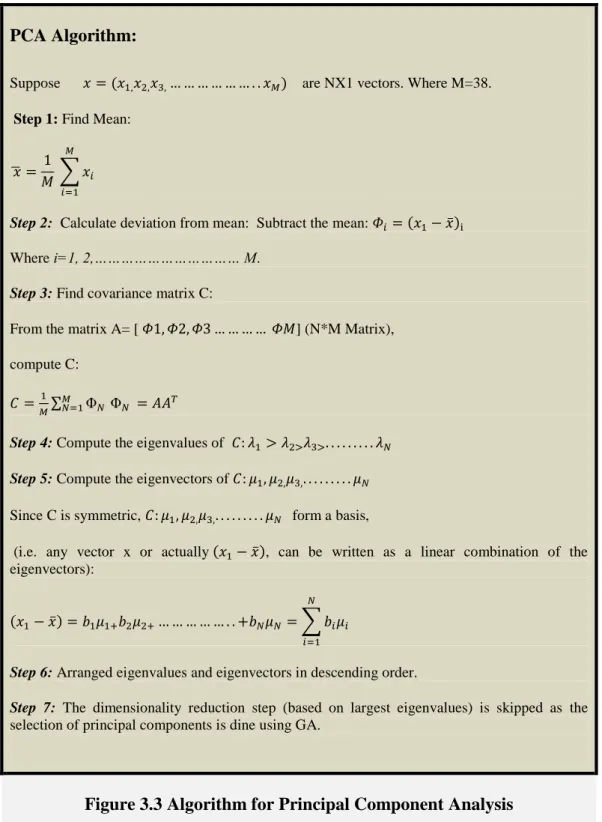
Figure 3.3 Algorithm for Principal Component Analysis ... 92
Figure 3.4 Feature subset selection based on GA+SVM ... 95
Figure 3.6 Genetic algorithm flow ... 96
Figure 3.7 Genetic algorithm ... 96
Figure 3.8 Behavior of MSE for training and test datasets ... 111
Figure 3.9 Cross validation vs. training dataset ... 112
Figure 4.1 Block diagram of proposed model ... 117
Figure 4.2 MLP architecture ... 120
Figure 4.3 Activation function of Tanh ... 121
Figure 4.4 Global and local minimum in error surface ... 123
Figure 4.5 Backpropagation Algorithm ... 125
Figure 4.6 SVM applied for intrusion analysis ... 131
Figure 4.7 Kernel Adatron Algorithm ... 132
Figure 4.8 MLP implemented architecture ... 133
Figure 4.9 SVM implemented architecture ... 135
Figure 5.1 Criteria hierarchy ... 163
Figure 5.2 MLPGA10 vs. MLPGA12 (criteria) ... 164
Figure 5.3 MLPGA10 vs. MLPGA12 (sub-criteria) ... 165
Figure 5.4 MLPGA10 vs. MLP-PCA22 (criteria) ... 166
Figure 5.5 MLPGA10 vs. MLP-PCA22 (sub-criteria) ... 166
Figure 5.6 MLPGA10 vs. MLPTF38 (criteria) ... 167
Figure 5.7 MLPGA10 vs. MLP-org-38 (criteria) ... 168
Figure 5.8 MLPGA10 vs. MLP-TF38 (sub-criteria) ... 168
Figure 5.9 MLPGA10 vs. MLP-org-38 (sub-criteria) ... 169
Figure 5.10 MLP Overall performance for intrusion detection ... 170
Figure 5.11 SVMGA10 vs. SVMGA12 (criteria) ... 171
Figure 5.12 SVMGA10 vs. SVMGA12 (sub-criteria) ... 172
Figure 5.13 SVMGA10 vs. SVMPCA22 (criteria) ... 172
Figure 5.14 SVMGA10 vs. SVMPCA22 (sub-criteria) ... 173
Figure 5.15 SVMGA10 vs. SVMTF38 (criteria) ... 175
Figure 5.16 SVMGA10 vs. SVM-TF38 (sub-criteria) ... 175
Figure 5.18 SVMGA10 vs. SVM-org-38 (sub-criteria) ... 176 Figure 5.19 SVM Overall performance for intrusion detection ... 177
LIST OF TABLES
Table 2.1 Features of KDD cup dataset ... 23
Table 2.2 Connection-based feature ... 25
Table 2.3 Content-based features ... 25
Table 2.4 Time-based features ... 26
Table 2.5 A DOS attack and its normal pattern ... 28
Table 2.6 A Probing attack and its normal pattern ... 29
Table 2.7 A R2L attack and its normal pattern ... 30
Table 2.8 A U2R attack and its normal pattern ... 30
Table 2.9 A sample of another attack and its normal pattern ... 31
Table 2.10 Systematic review of related work ... 79
Table 3.1 Feature set of a raw dataset ... 89
Table 3.2 Feature set after discarding symbolic features ... 89
Table 3.3 Feature set from PCA space ... 93
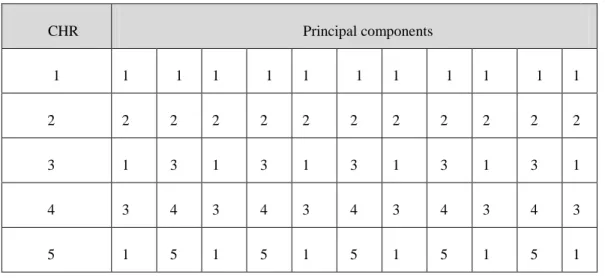
Table 3.4 A sample of five chromosomes (CHR) ... 98
Table 3.5 Fitness function ... 99
Table 3.6 Selection method ... 101
Table 3.7 Parameters used for genetic feature subset selection ... 103
Table 3.8 GA features subset selection based on MLP and SVM ... 104
Table 3.9 A sample of final subset of features for ten records ... 106
Table 3.10 A confusion matrix ... 113
Table 3.11 Statistics of dataset used in experiments ... 114
Table 4.1 Components of MLP architecture ... 133
Table 4.2 Components of SVM architecture ... 135
Table 4.3 MLP tuning parameters during training ... 137
Table 4.5 MLP parameters during testing ... 140
Table 4.6 SVM parameters during Testing ... 141
Table 5.1 System specification for experiments ... 144
Table 5.2 MLP-org-38: Sensitivity analysis of training dataset ... 145
Table 5.3 MLP-org-38: Sensitivity analysis of cross-validation dataset ... 145
Table 5.4 MLP-org-38: Sensitivity analysis of testing dataset ... 145
Table 5.5 MLP-org-38: Overall performance of testing phase ... 145
Table 5.6 MLP-org-38: Overall performance of verification phase ... 146
Table 5.7 MLP-TF38: Sensitivity analysis of training dataset ... 146
Table 5.8 MLP-TF38: Sensitivity analysis of cross-validation dataset ... 146
Table 5.9 MLP-TF38: Sensitivity analysis of testing dataset ... 147
Table 5.10 MLP-TF38: Overall performance of testing phase ... 147
Table 5.11 MLP-TF38: Overall performance of verification phase ... 147
Table 5.12 MLP-PCA22: Sensitivity analysis of training dataset ... 148
Table 5.13 MLP-PCA22: Sensitivity analysis of cross-validation dataset ... 148
Table 5.14 MLP-PCA22: Sensitivity analysis of testing dataset ... 148
Table 5.15 MLP-PCA22: Overall performance of testing phase ... 149
Table 5.16 MLP-PCA22: Overall performance of verification phase ... 149
Table 5.17 MLP-GA12: Sensitivity analysis of training dataset ... 150
Table 5.18 MLP-GA12: Sensitivity analysis of cross-validation dataset ... 150
Table 5.19 MLP-GA12:Sensitivity analysis of testing dataset ... 150
Table 5.20 MLP-GA12: Overall performance of testing phase ... 150
Table 5.21 MLP-GA12: Overall performance of verification phase ... 151
Table 5.22 MLP-GA10: Sensitivity analysis of training dataset ... 151
Table 5.23 MLP-GA10: Sensitivity analysis of cross-validation dataset ... 152
Table 5.24 MLP-GA10: Sensitivity analysis of testing dataset ... 152
Table 5.25 MLP-GA10: Overall performance of testing phase ... 152
Table 5.26 MLP-GA10: Overall performance of verification phase ... 153
Table 5.27 SVM-org-38: Sensitivity analysis of training dataset ... 153
Table 5.28 SVM-org-38: Sensitivity analysis of cross-validation dataset ... 154
Table 5.31 SVM-org-38: Overall performance of verification phase ... 154
Table 5.32 SVM-TF38: Sensitivity analysis of training dataset ... 155
Table 5.33 SVM-TF38: Sensitivity analysis of cross-validation dataset ... 155
Table 5.34 SVM-TF38: Sensitivity analysis of testing dataset ... 155
Table 5.35 SVM-TF38: Overall performance of testing phase ... 155
Table 5.36 SVM-TF38: Overall performance of verification phase ... 156
Table 5.37 SVM-PCA-22: Sensitivity analysis of training dataset ... 156
Table 5.38 SVM-PCA-22: Sensitivity analysis of cross-validation dataset ... 157
Table 5.39 SVM-PCA-22: Sensitivity analysis of testing dataset ... 157
Table 5.40 SVM-PCA-22: Overall performance of testing phase ... 157
Table 5.41 SVM-PCA-22: Overall performance of verification phase ... 158
Table 5.42 SVM-GA12: Sensitivity analysis of training dataset ... 158
Table 5.43 SVM-GA12: Sensitivity analysis of cross-validation dataset ... 158
Table 5.44 SVM-GA12: Sensitivity analysis of testing dataset ... 158
Table 5.45 SVM-GA12: Overall performance of testing phase ... 159
Table 5.46 SVM-GA12: Overall performance of verification phase ... 159
Table 5.47 SVM-GA10: Sensitivity analysis of training dataset ... 160
Table 5.48 SVM-GA10: Sensitivity analysis of cross-validation dataset ... 160
Table 5.49 SVM-GA10: Sensitivity analysis of testing dataset ... 160
Table 5.50 SVM-GA10: Overall performance of testing phase ... 160
Table 5.51 SVM-GA10: Overall performance of verification phase ... 161
Table 5.52 MLP performance for intrusion analysis ... 161
LIST OF ABBREVIATIONS
IDS Intrusion Detection System
NN Neural Network
PCA Principal Component Analysis
GA Genetic Algorithm
SVM Support Vector Machine
DOS Denial of Service Attack
R2L Remote to Local
U2R User to Root
KDD Knowledge Discovery and Data Mining
SC Soft Computing
ML Machine Learning
MLP Multilayer Perceptron
BPROP Backpropagation
CHAPTER 1 INTRODUCTION
This chapter covers the motivation, the prevalent issues in the existing intrusion detection approaches based on which this work is carried out, and the objectives to be accomplished. It also describes relevant research questions, which should be answered, the methodology adopted, and the research workflow followed. Finally, the chapter concludes with the contributions and the organization of the thesis.
1.1 Research Motivations
The rapid development of computer networks and mostly of the Internet has created many stability and security problems such as intrusions on computer and network systems. Further, the dependency of companies and government agencies is increasing on their computer networks and the significance of protecting these systems from attack is serious because a single intrusion can cause a heavy loss or the consistency of network becomes insecure. During recent years, number of intrusions has dramatically increased. Therefore, it is very important to prevent such intrusions. The hindrance of such intrusions is entirely dependent on their detection that is a key part of any security tool such as Intrusion Detection System (IDS), Intrusion Prevention System (IPS), Adaptive Security Alliance (ASA), checkpoints and firewalls. Consequently, interest in network intrusion detection has increased among the researchers (Ahmad et al. 2009), (Ahmad et al. 2008). Several intrusion detection approaches are available but the main problem is their performance, which can be enhanced by increasing the detection rates and reducing false alarms. Such weaknesses of the existing techniques motivated the research presented in this dissertation.
1.2 Problems in Intrusion Detection
The accurate intrusion detection in computer and network systems has always been an elusive aim for system administrator and security researchers. Initially, traditional intrusion detection systems (IDSs) were developed. However, these systems have many limitations like time consuming statistical analysis, regular updating, non-adaptive, accuracy and flexibility. After this, intelligent IDSs (rule based, graphical and hybrid) were introduced but they also suffered many problems such as false positive, false negative, and performance efficiency. Recently, Neural Network (NN) inspired by nervous system has become an interesting tool in the applications of intrusion detection. But it still suffers from many problems; training/learning overhead, detection rate and false alarms (Zargar and Kabiri 2010).
One of the drawbacks of the existing intrusion detection approaches is the usage of a raw dataset for classification but the classifier may get confused due to redundancy and hence may not classify correctly. To handle this problem, Principal Component Analysis (PCA) has been applied to change raw features into principal features space and select the features based on their sensitivity (Liu and Yi 2006). The sensitivity is measured by the values of eigenvalues (Sun et al. 2004). The modern methods use PCA to project features space to principal feature space and pick features corresponding to the highest eigenvalues, but the features corresponding to the highest eigenvalues may not have the finest sensitivity for the classifier due to ignoring many sensitive features. Therefore, the selection of optimized subset of features is another important issue for the intrusion detection system. Other problems include the selection of dataset for training and testing, and the classifier architecture that classifies connections into normal and intrusive.
1.3 Research Objectives
The main goal of the research is to develop an optimized intrusion detection mechanism using soft computing techniques that provide the potential to identify network activity in a robust way. To achieve this goal, a number of specific objectives have been defined as follows:
Transformation of raw features set of packet into new feature space. Selection of optimized subset of features that has higher discriminatory
power.
Selection of the most suitable architecture that identifies network activity into normal and intrusive.
Development and implementation of the proposed model for intrusion detection.
Train and test the develop system.
Implement the developed system in different case studies.
1.4 Research Questions
Based on the abovementioned issues and problems, we can derive research questions as the following:
Why did we move from conventional to unconventional IDS? Why did we use soft computing techniques?
What are the necessary components (software, services) that are desirable to support the architectural framework?
What are the specifications of the ideal network intrusion detection system (NIDS) that will ensure best performance?
How can we map soft computing techniques to NIDS?
Will the adaptation of this approach into NIDS improve NIDS in some ways or address some issues in NIDS?
How can we implement /simulate my work?
1.5 Research Methodology
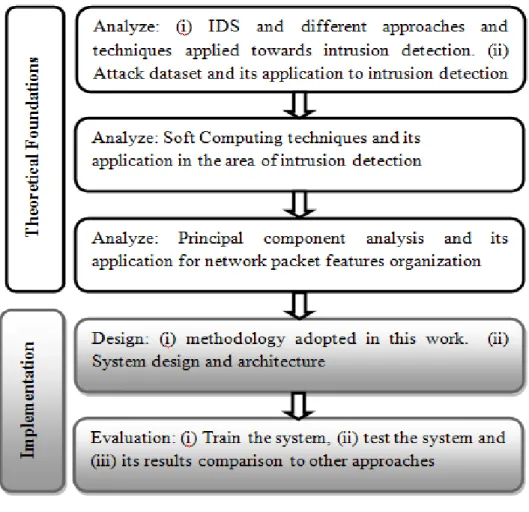
The overall research is divided into several phases, each one is concerned with the specific goals to finally fulfill the main objective. These phases are described as follows:
Figure 1.1 Methodology phases
1.5.1 Selection of Dataset for Experiments
The capability of the intrusion detection mechanism depends on the dataset. If the training data is more accurate then performance of trained system will be improved. So, the collecting of data for training and testing is a critical dilemma (Liu et al. 2007). Therefore, different issues will be discussed in obtaining or selecting dataset for experimental purpose in this research work. This phase of methodology will discuss which dataset is best and why?
1.5.2 Pre-processing of the Dataset
The selected dataset KDD cup consists of 41 raw features, which fall into different categories such as basic features and derived features (Liu et al. 2007). The basic features describe single network connection.
The derived features can be divided into content-based features and traffic based features (Ahmad et al. in 2008). The content-based features are derived using domain
knowledge and the traffic-based features are obtained by studying the sequential patterns between the connection records as well as the correlation between basic features. The second step is the pre-processing of data so that it can be given as input to my designed system. In this phase, this research work will apply PCA for features transformation and GA for the selection of optimal feature set for this proposed approach.
1.5.3 Classification Approach
After features selection, the next phase is determining the approach for classification. This is also another problem. For this purpose, this research work used the Support Vector Machine (SVM) and Multilayer Perceptron (MLP) for classification purpose due to their proven ability in classification (Sun et al. 2004) and (Pervez et al. 2007). Both approaches are applied and tested in different scenarios to compare their performance.
1.5.4 Training the System
The next phase is training the system. During training, both input patterns and desired outputs related to each input pattern are available. Further, the dataset is divided into three parts; (i) cross validation dataset, (ii) test dataset and (iii) training dataset so that better performance of the developed system may be achieved (Ahmad et al. 2007). Aim of the training is to minimize the error output produced by the system in comparison to the desired output. In order to achieve this goal, weights are updated by carrying out certain steps known as training.
1.5.5 Testing the System
After training, the weights of the system are frozen and performance of the system is evaluated. Testing the system involves two steps, which are verification step and generalization step. In verification step, system is tested against the data which is used in training. Aim of the verification step is to test how well trained system learned the
training patterns in the training dataset. In generalization step, testing is conducted with data which is not used in training. Aim of the generalization step is to measure generalization ability of the trained network (Principe et al. 2000). After training, the system only involves computation of the feed forward phase. For this purpose, this method used a production dataset that has input data but no desired data.
1.6 Research Activities
To achieve the goals, the research activities have been organized as follows:
1.7 Research Contributions
The research has significant positive impact on the performance of network intrusion detection systems, including addressing new open research issues. The main achievement is the development of intrusion detection mechanism that outperforms the existing approaches and has the capability to minimize the number of features and maximize the detection rates.
The major impact of the research span over the following areas:
Performance optimization such as improving detection rate and reducing false alarms; false positive and false negative
Minimizing training overheads and number of features for the intrusion detection approaches
Prototype of the architectural framework
Contribution to the existing intrusion detection technologies, knowledge and applications
Help and guidance for the security implementers in the area of intrusion detection
Therefore, in this research work, an optimized intrusion detection mechanism using soft computing techniques; PCA, GA, SVM and MLP is proposed and implemented. This work uses the KDD cup dataset, which is considered a benchmark for evaluating security detection mechanisms. The performance of this approach was analyzed and compared with previous approaches. The outcomes demonstrate that proposed method provides an optimal intrusion detection mechanism that outperforms the existing approaches and has the capability to reduce the number of features and increase the detection rates.
1.8 Organization of the Thesis
After describing the motivation, objectives, research questions, methodology, research workflow and contributions of the work, the remainder of the thesis is organized as follows:
Chapter 2 introduces the basic ideas about intrusion detection system, its components, classification, and foundations and describes the related approaches that are mainly used in designing intrusion detection systems. The chapter thereafter describes the KDD cup dataset that is considered standard in the evaluation of intrusion detection mechanism. Then, the chapter highlights the issues in existing intrusion detection studies and reasoning of using KDD cup dataset. Next, the chapter discusses the background of soft computing techniques, its unique property, and future of soft computing. Then, it explains an overview of applied techniques in my research. The chapter then describes the background of neural networks, Support Vector Machine and Genetic Algorithm that are basic soft computing techniques. The chapter then discusses Principal Component Analysis that is applied for features transformation and organization in this research. Further, the chapter discusses the literature consulted in order to understand and investigate the research problem in the field of network intrusion detection. The chapter then summarizes and evaluates relevant research, and discusses the relationships between different works and describes how it relates to this research. The chapter finally discusses the issues in existing literatures and directs towards methodology that is adopted in this research work.
Chapter 3 explains the set of methods, techniques, and tools used in this research. The chapter, thereafter, demonstrates the workflow process of designing the system and architecture for network intrusion detection. Then, it describes different phases of adopted methodology like selection of dataset, pre-processing of dataset, determine the architecture, training and testing the designed system. Finally, the chapter provides directions towards implementation of the proposed model.
Chapter 4 describes the proposed model with its basic architecture in block diagram, and then details of each part or block of its main architecture. Then, it explains features description of the dataset used for experiments, feature transformation process using PCA and optimal features subset selection using GA. After this, the chapter describes the details of classification architectures with basic algorithms and mathematical foundation of multilayered perceptron model (MLP) and Support Vector Machine (SVM).
Then, the chapter explains system implementation, and the basic parameters used during training and testing. Finally, the chapter concludes with the contributions, and the chapter summary
Chapter 5 presents the experimental results obtained by the developed system. After that, it discusses the performance evaluation of the system by examining the number of false positives and false negatives that they generated during testing. Then, it discusses the results and their comparison with existing published results.
Chapter 6 concludes the work by summarizing the main contributions and findings of the study, the limitations of the study and some possibilities for future research and development.
The appendix „A‟ provides a list of publications during this research work and appendix „B‟ describes some terminologies used in this thesis.
CHAPTER 2
BACKGROUND AND LITERATURE REVIEW
2.1 Introduction
This chapter describes basic background of intrusion detection systems, their functional components, classification and characteristics in the following Sequence: (i) Staging of an overview of IDS foundations and analysis techniques to intrusion detection. (ii) Description of intrusion detection approaches such as anomaly, misuse detection and combined or hybrid approach. (iii) Description of attack dataset: KDD cup dataset, a standard dataset for evaluating security detection mechanisms that is used to train and test the proposed system. (iv) An overview of the soft computing, its properties, its applications in a variety of fields and its future usage. Then, the chapter describe technical background of soft computing techniques: Neural Networks (NN), Support Vector Machine (SVM), and Genetic Algorithm (GA) utilized in this research work. Later, the chapter describes the Principal Component Analysis (PCA) and its different steps towards feature transformation into PCA space. Further, the chapter presents the literature review to intrusion detection. Followed by, the presentation of the related study to intrusion detection using SVM, MLP, PCA and GA. Finally, the chapter describes a systematic review of related work and issues in the existing intrusion detection approaches.
2.2 Intrusion Detection Systems
This section describes some basic and fundamental concepts to Intrusion Detection Systems (IDSs). First work in the field of intrusion detection was performed by Anderson in the early 1980s. Anderson defines an intrusion as any unauthorized attempt to access, manipulate, modify, or destroy information, or to render a system
unreliable or unusable (Anderson 1980). Intrusions are caused by accessing the systems from Internet, by attackers, by authorized users of the systems who attempt to gain additional privileges for which they are not authorized, and authorized users who misuse the privileges given to them. IDSs are software or hardware products that monitor the system in question and try to detect any attack against the system. A truly secure system is still a dream, as there are always bugs in application programs, and also communication protocols always have vulnerabilities that can be exploited by attackers. In addition, passwords can be cracked, users can lose their passwords, and entire crypto system can be broken. As a result, security mechanisms (e.g. firewalls), which are deployed to protect the information system, may not be able to prevent all security breaches. IDSs are usually deployed along with the other security mechanisms, such as access control, authentication and firewalls, as a last defence line to improve security of the information system (Amini and Jalili 2005). The main goal of an IDS is to provide high rates of attack detection with very small rates of false alarms (Pervez et al. 2007). There are two important types of errors in intrusion detection:
False positives: False positives are the errors occurring when IDS flags a normal activity as an attack. Simply, false positives are false alarms.
False negatives: False negatives are the errors occurring when IDS fails to detect an ongoing attack.
2.3 IDS Functional Components
This section explains functional components of IDS. An IDS consists of three functional components as shown in Figure 2.1 (Bace and Mell 2001): (1) Information source that provides a stream or flow of event records, (2) Analysis engine that analyzes and classifies intrusions; and (3) Response component that generates reactions based on the output of the analysis engine.
Figure 2.1 Functional components of IDS
2.3.1 Information Sources
The first component of an intrusion detection system is the data source, where input information, which will be analyzed, is collected. Input information can be audit trails, system logs or network packets.
2.3.2 IDS Analysis
Second component of IDS is the analysis engine, which analyse data from information source and classify it into normal or intrusive. The IDS analysis engines are classified into two categories such as misuse detection and anomaly detection.
2.3.3 Response Component
Response component is the third component of an IDS, where reaction to a detected attack is given. According to the response types, IDS can be either active or passive. An IDS is said to be active, if it actively reacts to the attack by taking corrective (closing holes) or proactive actions (logging out possible attackers, closing down services). If an IDS just generates alarms, it is said to be passive. Passive IDS responses provide information to system administrator who takes necessary actions based on that information.
2.4 Classification of Intrusion Detection Systems
This section describes two classes of IDS based on the type of the data source. According to the data sources used, IDSs can be classified into two categories;
host-2.4.1 Host-based IDS
Host-based IDSs observe activities within an individual computer system and work on information obtained from these activities (Ahmad et al. 2007). As target environment was mainframe environment, and all users were local to the system, initial researches in the field of IDSs were performed on the host-based IDSs. Host-based IDSs normally use two information sources, operating system audit trails, and system logs. Operating system trails are generally generated at the kernel level; hence they are more detailed and better protected than system logs. However, system logs are simpler and smaller than operating system trails; consequently, they can be understood more easily. Further, some benefits and drawbacks of this class of IDS are listed here.
Benefits
As host-based IDSs monitor local activities, therefore they can detect attack that can not be detected by network-based IDSs.
Information sources of the host-based IDSs are generally generated on a plaintext data, therefore they can successfully operate in an environment where network traffic is encrypted.
Performance of the host-based IDSs is not affected by the topology of the network they operate in. They successfully operate on switched networks.
Drawbacks
As host-based IDSs should be placed on every monitored host, it is harder to manage and configure host-based IDSs.
Host-based IDSs run on the host targeted by attacks, and it may be disabled by a successful attack. For instance, certain denial-of-service attacks.
As host-based IDSs can only see network packets received by its host, detection rate of host-based IDSs is poor in the case attacks are targeted to the entire network.
Amount of information used by network-based IDSs can be huge; hence host– based IDSs are unable to generate good results.
IDS may need extra storage on the system on which it is running.
Host-based IDSs share the computing resources (e.g. CPU, main memory) with the monitored host. Consequently, they cost additional operational overheads and may affect the performance of the hosting computer.
2.4.2 Network-based IDS
As computing environments shifted from mainframe to the networks of workstations, studies on intrusion detection started to focus on attacks targeted to the network. Network attacks cannot be detected by examining operating system trails or system logs, or at least detection of network attacks by examining data sources on the host computer is not an easy task. As a result, network-based IDSs were developed, which capture network packets and search attacks in these network packets. Network based IDSs monitor activities on a network segment or switch, so that they can protect hosts connected to the monitored segment (Amini et al. 2006). Network-based IDSs generally consist of sensors which are placed at various points (such as at LAN and WAN backbones) in the network. Sensors collect network packets and feed them to the network-based IDS that classify them into normal or intrusive class (Cannady 1998). Further, some benefits and drawbacks of network based IDS are listed here.
Benefits
A huge network can be monitored easily by using a few numbers of sensors, if sensors are placed at the critical parts of the network (as at hubs, routers or probes).
Network-based IDSs are generally passive devices and do not affect the normal operation of the network.
Network-based IDSs can be very secure against attacks, and even they can be made invisible to the attackers.
Drawbacks
If monitored network is large or network traffic is high, it may be difficult to process all network packets.
Problems arise when network-based IDSs are placed on a switched network. Most of the switches do not provide universal monitoring ports and this fact limits the monitoring ability of network-based IDS.
Network-based IDSs can not analyze encrypted traffic. This is due to the fact that, the sensors analyze packet headers to determine source and destination addresses and type of data being transmitted, and analyze the packet payload to discover information in the data being transmitted.
Distorted network packets may cause a network-based IDS to crash.
2.5 Characteristics of Intrusion Detection Systems
This section listed some characteristics of an ideal IDS (Ahmad et al. 2008).
Intrusion detection systems should be automatic and reliable to monitor its front end and back end running programs.
System should be fault tolerant in such a way that system crash should not affect its knowledge base where attack pattern are being stored for detecting intruders activities.
System must be able to monitor itself to ensure subversion resistant.
These systems should have less computational overhead to avoid degradation in system performance.
System should have capability to detect deviation from normal behaviour. Its defence mechanism should be adaptable to new patterns as use patterns of
every system are different.
As system behaviour changes due to the addition of new applications in the system. Therefore, the IDS should have potential to adapt these changes and be able to detect any intrusion.
Last but not the least its architecture should be like that intruders could not be successful to modify it for their desired activities.
2.6 Foundations of an Intrusion Detection System
This section describe the basic elements of IDS such as; metrics, models and profiles (Cannady 1998) and (Pervez et al. 2007). These elements are described here briefly.
2.6.1 Metrics
Any statistical intrusion detection methodology needs the use of a set of metrics. These metrics characterize the utilization of a variety of system resources (i.e., CPU usage, number of files accessed, number of login attempts). These metrics are usually one of three different types. The first metric, event counters identify the occurrences of a specific action over a period of time. These metrics may include the number of login attempts, the number of times that a file has been accessed, or a measure of the number of incorrect passwords that are entered. The second metric, time intervals identify the time interval between two related events. Each time interval compares the delay in occurrence of the same or similar event .An example of a time interval metric is the periods of time between a user‟s logins. The third metric is resource measurement that includes the expenditure of CPU time, number of records written to a database, or the number of files transmitted over the network. Keystroke dynamics is another method of quantifying a user's activities, which offers an effective measure of user identification. The concept involves the development of an electronic signature of a user based on their individual typing characteristics. These characteristics include; (i) typing speed, (ii) intervals in typing, (iii) number of errors, and (iv) the user's typing rhythm. These characteristics may be verified on login and monitored throughout a session. Complete intrusion detection mechanisms have been developed exclusively around the use of keystroke dynamics techniques.
2.6.2 Models
The selected metrics are then used in statistical models, which attempt to identify deviations from an established norm. The models, which have been most frequently used, include the operational model, average and standard deviation model, the
model makes the assumption that an anomaly can be identified through a comparison of an observation with a predefined limit. This model is frequently used in the situations where a specific number of events, (i.e., failed logins), is a direct indication of a possible attack. The average and standard deviation model is based on the traditional statistical determination of the commonness of an observation based on its position relative to a specific confidence range. This model offers the advantage that it “learns” a user‟s behavior over time instead of requiring prior knowledge of the user‟s activities. As a result, the model can establish a foundation for the identification of potential anomalies for each user and identify potential problems from users who consistently behave in a manner, which would indicate normally the misuse of system resources. This is particularly useful in identifying what is normal for an individual user without relying on a comparison with other users. The multivaried model is built upon the average and standard deviation model. The difference between these two approaches is that the multivaried model is based on a correlation of two or more metrics. This model permits the identification of potential anomalies where the complexity of the situation requires the comparison of multiple parameters. The markovian model is used with the event counter metric to determine the normalcy of a particular event, based on the events that preceded it. The model characterizes each observation as a specific state and utilizes a state transition matrix to determine if the probability of the event is high (normal) based on the preceding events. This model is particularly useful when the sequence of activities is particularly important. The final model, the Time Series Model, attempts to identify anomalies by reviewing the order and time interval of activities on the network. If the probability of the occurrence of an observation is low, then the event is labeled as abnormal. This model provides the ability to evolve over time based on the activities of the users (Denault et al. 1994) and (Denault et al. 1994).
2.6.3 Profiles
These models are then used in the development of a variety of profiles, which attempt to map the nonintrusive activities of the system. The profiles serve to establish a baseline of a user‟s behavior, which can then be used for comparisons with the current observations. Profiles usually consist of specific characteristics, such as login
information, (i.e., frequency, origin, duration), program execution information, (i.e., frequency, CPU utilization), database access information, (i.e., tables accessed, data manipulation functions), and file access information (i.e., types of files accessed, created, or destroyed) (Jonsson et al. 2004).
2.7 Analysis Techniques for Intrusion Detection
This section explains analysis techniques those are fundamental components in an intrusion detection system, which examines the captured information into normal or intrusive class (Cannady 1998) and (Pervez et al. 2007). There are many approaches towards intrusion detection but this section describes an overview of five common approaches that have been used in numerous traditional intrusion detection mechanisms.
2.7.1 Statistical Analysis
This approach involves statistical comparison of specific events based on a predetermined set of criteria. The data was collected from the system and the network. This collected data was tested for attack analysis by statistical models.
The models which have been used most frequently, include the operational model, average and standard deviation model, the multivaried model, the markovian model, and the time series model. This was much laborious and time consuming work.
2.7.2 Rule Based System
This approach relies on sets of predefined rules, which are provided by an administrator, automatically created by the system, or both. Each rule is mapped to a specific operation in the system. The rules serve as operational preconditions, which are continuously checked in the audit record by the intrusion detection mechanism. If the required conditions of a rule are satisfied by user activity, the specified operation is executed. This approach was unable to detect novel intrusion. A frequent update of
2.7.3 Expert Systems
The use of expert system techniques in intrusion detection mechanisms was a significant milestone in the development of effective intrusion detection system in information security systems. An expert system consists of a set of rules, which encode the knowledge of a human "expert". Unfortunately, expert systems require frequent updates by a system administrator to remain current. The lack of maintenance or update will degrade the security of the entire system by causing the system's users to be misleading into believing that the system is secure, even as one of the key components becomes increasingly futile over time (Mukherjee et al. 1994).
2.7.4 Pattern Recognition
In this approach, a series of penetration scenarios are coded into the system. Pattern recognition possesses a distinct advantage over anomaly and misuse detection methods in that it is capable of identifying attacks, which may occur over an extended period of time, or by multiple attackers working in concert. This approach is effective in reducing the need to review a potentially large amount of audit data.
2.7.5 Network Monitoring
This technique monitors network activity for indications of attacks. The greatest advantage of network monitoring mechanisms is its independence on audit data. Because this method does not require input from any operating system's audit trail, it can use standard network protocols to monitor heterogeneous sets of operating systems and hosts.
2.8 Approaches to Intrusion Detection
The following are the approaches being utilized to accomplish the desirable elements of an intrusion detection system (Fox et al. 1990). This section describe here these approaches briefly.
2.8.1 Anomaly Detection
Anomaly detection is the general category of intrusion detection, which works by identifying activities, which vary from established patterns for users, or groups of users. Anomaly detection typically involves the creation of knowledge bases which contain the profiles of the monitored activities (Khan et al. 2007). This approach has some benefits and drawbacks those are listed below.
Benefits
As any significant deviation from normal profile will be flagged as anomalous, anomaly detectors can detect unknown attacks.
Anomaly detectors do not require constant updating of rules or signatures of novel intrusion.
Anomaly detectors can produce information that can in turn be used to define signatures for misuse detectors.
Drawbacks
The high false positive rate is the main drawback of the anomaly IDSs. This is due to the fact that, the normal profile of a system cannot be fully learned and/or behavior of users or programs may change over time.
In order to build normal profile of a system, system in question should be monitored and information should be collected, which in turn will be used to draw normal behaviour of the system. However, if the collected information
contains attacks, intrusive behavior will be a part of the normal profile, and in future, these attacks will go undetected.
Anomaly detection approaches need extensive data sets to build profile of the system.
2.8.2 Misuse Detection
The second general approach to intrusion detection is misuse detection. This technique involves the comparison of a user's activities with the known behaviors of attackers attempting to penetrate a system. Misuse detection also utilizes a knowledge base of information (Mukherjee et al. 1994). This approach has some benefits and drawbacks those are listed below.
Benefits
Misuse IDSs can detect intrusion with a certain degree of certainty. Misuse detectors are very effective in detecting attacks without giving high false alarm rates.
Misuse IDSs can detect all intrusions whose signatures are known.
Misuse IDSs are easy to implement (state machine, signature analysis) and deploy (no need to form a profile of the system).
Drawbacks
Detection ability of misuse detectors is limited to signatures that they posses. A new intrusion or even a variation of a known intrusion may be undetected. So misuse IDS require regular updates of signatures in order to remain current.
2.8.3 Combined Anomaly and Misuse Detection
Research has also been conducted into intrusion detection methodologies, which combine the anomaly detection approach and the misuse detection approach. The combined approach permits a single intrusion detection system to monitor for indications of external and internal attacks (Pervez et al. 2007).
All current intrusion detection systems make four statements about the systems that they are designed to protect:
Activities taken by system users, either authorized or unauthorized, can be monitored.
It is possible to identify those actions, which are indications of an attack on a system
Information obtained from the intrusion detection system can be utilized to enhance the overall security of the network.
A fourth element, which is desirable from any intrusion detection mechanism, is the ability of the system to make an analysis of an attack in real-time.
2.9 Attack Dataset
This section explains attack dataset that has used in this research work. The defense advanced research projects agency (DARPA) project was prepared and executed by the Massachusetts Institute of Technology (MIT) Lincoln Laboratory, USA (Pervez et al. 2007), (Bankovic et al. 2009). One of the reasons for choosing this dataset is that the dataset is standard. This will make it easy to compare the results of this work with other similar works. Another reason is that it is difficult to get another data set, which contains so rich a variety of attacks as the one used here.
There are 41 features, which fall into different categories such as basic features and derived features. The basic features describe single network connections. The derived features can be divided into content-based features and traffic based features.
The content-based features are derived using domain knowledge and the traffic-based features are obtained by studying the sequential patterns between the connection records as well as the correlation between basic features.
In order to create the feature set, the raw tcpdump data has been pre-processed into connection records. The basic features are directly obtained from the connection records. The derived features fall into two groups; (i) Content-based features and (ii) Traffic based features. Table 2.1 explains 41 features of KDD cup dataset in terms of feature number, name of feature and type of feature. These features form a record that represents an attack or normal activity. Table 2.2 shows connection-based features, Table 2.3 shows content-based features and Table 2.4 shows nine time-based features from the KDD cup dataset
Table 2.1 Features of KDD cup dataset
Feature # Name of feature Type of feature
1 DURATION CONTINUOUS 2 PROTOCOL_TYPE SYMBOLIC 3 SERVICE SYMBOLIC 4 FLAG SYMBOLIC 5 SRC_BYTES CONTINUOUS 6 DST_BYTES CONTINUOUS 7 LAND SYMBOLIC 8 WRONG_FRAGMENT CONTINUOUS 9 URGENT CONTINUOUS 10 HOT CONTINUOUS 11 NUM_FAILED_LOGINS CONTINUOUS 12 LOGGED_IN SYMBOLIC 13 NUM_COMPROMISED CONTINUOUS 14 ROOT_SHELL CONTINUOUS 15 SU_ATTEMPTED CONTINUOUS
Feature # Name of feature Type of feature 16 NUM_ROOT CONTINUOUS 17 NUM_FILE_CREATIONS CONTINUOUS 18 NUM_SHELLS CONTINUOUS 19 NUM_ACCESS_FILES CONTINUOUS 20 NUM_OUTBOUND_CMDS CONTINUOUS 21 IS_HOST_LOGIN SYMBOLIC 22 IS_GUEST_LOGIN SYMBOLIC 23 COUNT CONTINUOUS 24 SRV_COUNT CONTINUOUS 25 SERROR_RATE CONTINUOUS 26 SRV_SERROR_RATE CONTINUOUS 27 RERROR_RATE CONTINUOUS 28 SRV_RERROR_RATE CONTINUOUS 29 SAME_SRV_RATE CONTINUOUS 30 DIFF_SRV_RATE CONTINUOUS 31 SRV_DIFF_HOST_RATE CONTINUOUS 32 DST_HOST_COUNT CONTINUOUS 33 DST_HOST_SRV_COUNT CONTINUOUS 34 DST_HOST_SAME_SRV_RATE CONTINUOUS 35 DST_HOST_DIFF_SRV_RATE CONTINUOUS 36 DST_HOST_SAME_SRC_PORT_RATE CONTINUOUS 37 DST_HOST_SRV_DIFF_HOST_RATE CONTINUOUS 38 DST_HOST_SERROR_RATE CONTINUOUS 39 DST_HOST_SRV_SERROR_RATE CONTINUOUS 40 DST_HOST_RERROR_RATE CONTINUOUS 41 DST_HOST_SRV_RERROR_RATE CONTINUOUS
Table 2.3 Content-based features
No. Feature name Description
10 HOT Number of hot indicators
11 NUM_FAILED_LOGINS Number of failed login attempts 12 LOGGED_IN 1 if successfully logged in; 0 otherwise 13 NUM_COMPROMISED Number of compromised conditions 14 ROOT_SHELL 1 if root shell is obtained; 0 otherwise 15 SU_ATTEMPTED 1 if su root command attempted; 0 otherwise 16 NUM_ROOT Number of root accesses
17 NUM_FILE_CREATIONS Number of file creation 18 NUM_SHELLS Number of shell prompts
19 NUM_ACCESS_FILES Number of operations on access control files 20 NUM_OUTBOUND_CMDS Number of outbound commands
21 IS_HOST_LOGIN 1 if the login belongs to the host else 0 22 IS_GUEST-LOGIN 1 if the login belongs to the guest else 0
Table 2.2 Connection-based feature No. Feature name Description
1 DURATION Length (number of seconds) of the connection 2 PROTOCOL_TYPE Type of the protocol, e.g. tcp, udp, etc. 3 SERVICE Network service on the destination
4 SRC_BYTES Number of data bytes from source to destination 5 DST_BYTES Number of data bytes from destination to source 6 FLAG Normal or error status of the connection 7
LAND 1 if connection is from/to the same host/port 8
WRONG_FRAGMENT Number of `wrong' fragments
Table 2.4 Time-based features No. Feature name Description
23 COUNT Number of connections to the same host as the current connection in the past two seconds
Note: The following features refer to these same-host connections.
24 SERROR_RATE % of connections that have ``SYN'' errors 25 RERROR_RATE % of connections that have ``REJ'' errors 26 SAME_SRV_RATE % of connections to the same service 27 DIFF_SRV_RATE % of connections to different services
28 SRV_COUNT number of connections to the same service as the current connection in the past two seconds
Note: The following features refer to these same-service connections.
No. Feature name Description
29 SRV_SERROR_RATE % of connections that have ``SYN'' errors
30 SRV_RERROR_RATE % of connections that have ``REJ'' errors
31 SRV_DIFF_HOST_RATE % of connections to different hosts 32 DST_HOST_COUNT Number of connection to host
33 DST_HOST_SRV_COUNT Number of services requested to host
34 DST_HOST_SAME_SRV_RATE % of connection with same service
35 DST_HOST_DIFF_SRV_RATE % of connection with different services
36 DST_HOST_SAME_SRC_PORT_RATE % of connection using the same source port
37 DST_HOST_SRV_DIFF_HOST_RATE % of connection with same service but to different host
No. Feature name Description
38 DST_HOST_SERROR_RATE % of connection that have SNY error
39 DST_HOST_SRV_SERROR_RATE % of connection with same service that have SYN error
40 DST_HOST_RERROR_RATE % of connection that have REJ errors
41 DST_HOST_SRV_RERROR_RATE % of connection with same service that have REJ errors
The description of these types of attacks requires some domain knowledge and cannot be done only based on information available in the packet header. Most of these attacks are R2L and U2R attacks. Traffic based features have been computed automatically. They are effective for the detection of DOS and probe attacks. A list of the computer attacks is described briefly that are considered in this research work.
2.9.1 Denial of Service (DOS) Attacks
DOS is a type of attack that aims to make an organization's services or resources unavailable for an indefinite amount of time by flooding it with useless traffic (Kim et al. 2005). The examples of DOS attacks are given as follows.
Ping of Death (pod): It makes the victim host unavailable by sending it oversized internet control message protocol (ICMP) packets as ping requests. Back: It is a denial of service attack against apache web servers. The attacker
sends requests containing many front slashes. The processing of which is time consuming.
Land: Spoofed synchronization (SYN) packet sent to the victim host resulting in that host repeatedly synchronizing with itself.
Smurf: A broadcast of ping requests with a spoofed sender address which results in the victim being bombarded with a huge number of ping responses. Neptune: The attacker half opens a number of transmission control protocol
(TCP) connections to the victim host making it impossible for the victim host to accept new TCP connections from other hosts.