c
CHARACTER LANGUAGE MODELS FOR GENERALIZATION OF MULTILINGUAL NAMED ENTITY RECOGNITION
BY
XIAODONG YU
THESIS
Submitted in partial fulfillment of the requirements for the degree of Master of Science in Computer Science
in the Graduate College of the
University of Illinois at Urbana-Champaign, 2019
Urbana, Illinois Adviser:
ABSTRACT
State-of-the-art Named Entity Recognition (NER) models usually achieve high perfor-mance on entities that they have seen in training data, but a significantly loweer perforperfor-mance on unseen entities. This is one of the key reasons in performance degradation observed when NER models are evaluated on new domains. Motivated by this observation, quantified for the first time in this thesis, we study an improved, multi-domain and multi-lingual, capability for identifying “what is a name”.
Character-level patterns have been widely used as features in English Named Entity Recog-nition (NER) systems. However, to date there has been no direct investigation of the inher-ent differences between name and non-name tokens in text, nor whether this property holds across multiple languages. The key contribution of this thesis is to develop a Character-level Language Model (CLM) that, as we show, allow us to better learn “what is a name”. We analyze the capabilities of corpus-agnostic Character-level Language Models (CLMs) in the binary task of distinguishing name tokens from non-name tokens and demonstrate that CLMs provide a simple yet powerful model for capturing these differences. Specifically, we show that it can identify named entity tokens in a diverse set of languages at close to the performance of full NER systems. Moreover, by adding very simple CLM-based features we can significantly improve the performance of an off-the-shelf NER system for multiple languages.
ACKNOWLEDGMENTS
First of all, I would like to thank my parents for always supporting and encouraging me to whatever I would like to do. The freedom they provide gives me the opportunity to pursue the field where my real passion is. Thank my parents for respecting me and letting me decide my own life. Thank my father for working so hard to support the whole family. Thank my mother for always encouraging and trusting me.
There is no word that can express my thanks to Professor Dan Roth. It is always my greatest fortune to be advised by Dan. From knowing nothing about NLP to my first top conference paper, Dan is the only reason for the progress. There is no doubt how much I have learned from him about NLP, but besides NLP, I am also deeply affected by Dan. The passion on his own career, the responsibility to all the students, the patience to every collaborator and many many other properties deeply impress me, and will always be the most valuable lessons to me.
I also want to thank all the members from CogComp, especially Stephen Mayhew and Mark Sammons. Thank you guys for always discussing with me, and always giving my your valuable suggestions.
Finally, I want to thank all of my friends at Illinois. Thank you for always being with me when I feel stressful. I will treasure all the memory that we shared together.
TABLE OF CONTENTS
CHAPTER 1 INTRODUCTION . . . 1
1.1 Named Entity Recognition . . . 1
1.2 The Need for Multilingual NLP Tasks . . . 1
1.3 The Need for Generalization of Named Entity Recognition . . . 2
1.4 Contributions of this Thesis . . . 3
1.5 Thesis Outline . . . 4
CHAPTER 2 BASIC TERMINOLOGY . . . 6
2.1 Language Model . . . 6
CHAPTER 3 RELATED WORK . . . 9
3.1 Introduction . . . 9
3.2 Character-Based Methods in Named Entity Recognition . . . 9
CHAPTER 4 TOKEN-LEVEL NAMED ENTITY IDENTIFICATION USING CLM 11 4.1 Introduction . . . 11
4.2 Methods . . . 11
4.3 CLM for Multilingual Named Entity Identification . . . 16
4.4 CLM for Cross-Domain Named Entity Identification . . . 18
4.5 Summary . . . 18
CHAPTER 5 IMPROVING NAMED ENTITY RECOGNITION USING CLM . . . 20
5.1 Introduction . . . 20 5.2 Features . . . 20 5.3 Experiments . . . 21 5.4 Summary . . . 22 CHAPTER 6 DISCUSSION . . . 24 CHAPTER 7 SUMMARY . . . 26 REFERENCES . . . 27
CHAPTER 1: INTRODUCTION
1.1 NAMED ENTITY RECOGNITION
Named Entity Recognition (NER) is a task that recognizes phrases that present named entities in an unstructured text, and classify these entities into a pre-defined label set, which means the type of the entity. For example, in the following sentence
Alex Ferguson, the former football manager of Manchester United, is a legend in England.
In this sentence, the NER model is expected to detect “Alex Ferguson”, “Manchester United” and “England” as named entities, and classify them into PER (Person), ORG (Organiza-tion) and LOC (Loca(Organiza-tion). The correct prediction should look like:
[PER Alex Ferguson], the former football manager of [ORG Manchester United], is a legend in [LOC England].
NER is a very important basic task for many other Natural Language Processing (NLP) tasks, including Entity Linking, Machine Translation, and Question Answering.
1.2 THE NEED FOR MULTILINGUAL NLP TASKS
Though the development of NLP in English was rapid last several years, the development of other languages is limited. One reason may be that English is the world-wide official language, which makes English the focus of NLP research, and most of the resources for NLP tasks are in English. However, the resources in other language are limited, even for the language that many people are speaking, like Chinese. For low-resource languages, the NLP development is even worse. This makes the application of NLP to people in different regions really hard. For example, in Table 1.1, we evaluate one of the state-of-the-art NER models,
Model eng amh ara ben fas hin som tgl avg LSTM-CRF [1] 90.94 73.2 57.2 77.7 61.2 77.7 81.3 83.2 73.1 CogCompNER 90.88 67.5 54.8 74.5 57.8 73.5 82.0 80.9 70.1
Table 1.1: NER results on 8 languages. CogCompNER is run with standard features, including Brown clusters; Lample et al. [1] is run with default parameters and pre-trained embeddings. Averages are computed over all languages other than English.
LSTM-CRF [1], and our baseline NER model CogCompNER on 8 different languages, which are introduced in detail in 4.2.2. The result clearly shows that, though the result on English is pretty good, the results on other low-resources languages are much lower, almost 20 F1 points drop. Given that one of the main goal of NLP is to remove the border of languages, the performance on low-resources languages is important.
Moreover, many languages share similar characteristics, which makes it possible to use other languages to help improve the target language performance. Multilingual NLP tasks are now attracting more and more attention.
1.3 THE NEED FOR GENERALIZATION OF NAMED ENTITY RECOGNITION Named Entity Recognition is a very important task for many other application. In ap-plications, the NER output will be the input for many other tasks, so the accuracy of the NER output will directly limit the performance of other tasks. As the result, NER model is expected to give a robust and stable performance on data from different domains. However, according to [2], all the state-of-the-art NER models rely on the surface forms of entities too much, which means that they are somehow “memorizing” names in the training data. We use CoNLL03 [3] as the source domain, and OntoNotes 5.0 [4] and Enron [5] as the target domain. These three datasets will be introduced in detail in Section 4.2.2. We train a model on source domain, and evaluate the model on target domain. The column marked “Unseen” in the Table 1.2 reports the systems’ performance on named entities in Test that were not seen in the training date. In the Table 1.2, we can see that the performance on unseen entities in the same domain already drops a lot. When evaluating on different domains,
the performance drops significantly. However, the out-domain performance is actually more important. For example, if entities in the test data and entities in the training data have a large intersection, then just memorizing all the entities in training data can already achieve a very high result, but in real application, most entities will be new entities, and the perfor-mance will drop a lot. When entities become new and the context becomes a different style, the performance can really show the robustness of a system.
Generalization and domain adaptation have attracted much focus, but so far the general-ization performance is still not satisfying.
Model CoNLL CoNLL Unseen OntoNotes Enron
LSTM-CRF [1] 90.94 86.11 77.95 45.11
CogCompNER 90.88 84.40 79.79 57.56
Table 1.2: NER results on datasets from 3 domains show that the performance drops a lot on unseen entities, and becomes even worse on a different domain. CogCompNER is run with standard features, including Brown clusters; Lample et al. [1] is run with default parameters and pre-trained embeddings. Unseen refers to performance on named entities in Test that were not seen in the training data.
1.4 CONTRIBUTIONS OF THIS THESIS
In this thesis, we first point out the problem of the current state-of-the-art NER models: they are just “memorizing” names seen in training data. To better learn “what is a name”, we analyzes the capabilities of corpus-agnostic Character-level Language Models (CLMs) in the binary task of distinguishing name tokens from non-name tokens. We demonstrate that CLMs provide a simple and powerful model for capturing these differences, identifying named entity tokens in a diverse set of languages at close to the performance of full NER systems. When evaluating on datasets from different domains, CLMs achieve even much better results than the result of a state-of-the-art NER system, which uses complex features. Moreover, by adding very simple CLM-based features we can significantly improve the
per-formance of an off-the-shelf NER system for multiple languages.
Below, I outline the primary contributions of this thesis
• We demonstrate that CLMs provide a simple and powerful model for identifying named entity tokens in a diverse set of languages.
• We demonstrate that CLMs provide a stable and robust model for identifying named entity tokens in data from different domains.
• We show that we can easily improve the performance of an off-the-shelf NER system for multiple languages by adding very simple CLM-based features.
1.5 THESIS OUTLINE
Here is the structure of the thesis.
• Chapter 2 Basic Terminology provides the background knowledge of perceptron model used in our baseline NER model, and the language models we used in our experiments of CLMs.
• Chapter 3 Related Work presents some papers that focus on similar problems as we do.
• Chapter 4 Token-level Named Entity Identification Using CLM presents the main idea about how we use CLM to identify named entity tokens. In this chapter, we introduce the data sets we use in this thesis, the model we design using CLM, and the result of CLM in different languages, and different domains.
• Chapter 5 Improving Named Entity Recognition Using CLM presents how we use simple CLM-based features to improve a NER system. In this chapter, we design several very simple and intuitive CLM-based features, and show that the performance of NER system has been significantly improved in multiple language. We also show
that adding CLM-based feature does not help cross-domain performance, and give our current explanation.
• Chapter 6 Discussion presents analysis of the result we get in Chapter 3 & 4. • Chapter 7 Conclusion concludes this thesis, and also discuss the future plan.
CHAPTER 2: BASIC TERMINOLOGY
2.1 LANGUAGE MODEL
Language models define probability distributions over a sequence of words in a language. For a sentence S =w1w2· · ·wn, language models calculate the probability of the sequence
P(w1w2· · ·wn). The probability of this sequence gives the possibility of this sequence to form a correct sentence in this language. Many NLP tasks, like machine translation, will generate natural language. Language models can be used to rank the output candidates. To estimate the probability distributions, there are many different kinds of language models. In this thesis, we will use four of them: N-gram Model, Skip-gram Model, Continuous Bag-of-Words Model, and Log-bilinear Model, following the setting of [6]. We will introduce the background of them briefly in this section.
2.1.1 Character Language Model
The difference between character language model (CLM) and language model is that CLM will not split the sentence by words. Instead, CLM will split the sentence by each character. For example, given a sentence S = w1w2· · ·wn, Language models will estimate the probability
P(w1w2· · ·wn) (2.1)
Character language model will estimate the probability
P(c1c2· · ·cn) (2.2)
where ci is each character instead of each word.
Character language model is usually much smaller than word-level language model because the number of characters in a language is much small than the number of words.
2.1.2 N-gram Model
N-gram model assumes that each token only depends on the last n−1 words. By chain rule, we know that
P(w1w2· · ·wi) =P(w1)P(w2|w1)P(w3|w1w2)· · ·P(wi|w1· · ·wi−1) (2.3) For an N-gram model, wi only depends on previous n−1 words wi−n−1· · ·wi−1. The prob-ability will become
P(w1w2· · ·wi) =P(w1)P(w2|w1)P(w3|w1w2)· · ·P(wi|wi−n−1· · ·wi−1) (2.4)
P(wi|wi−n−1· · ·wi−1) =
C(wiwi−n−1· · ·wi−1)
C(wi−n−1· · ·wi−1)
(2.5) where C(wi−n−1· · ·wi−1) means the occurrence of wi−n−1· · ·wi−1 in the training data. Because the probability distribution is estimated by counting, unseen words in the test data will have zero probability. To reserve mass for unseen words, we need to do smoothing. There are many different smoothing methods. In this thesis, we use Witten-Bell discounting.
2.1.3 Skip-gram Model
Skip-gram model was proposed in [7]. This language model uses each token to predict its context. For each token, we calculate the probability of its context words, and we use the product of all these probabilities as the probability of the sequence. The probability of a sequence becomes P(w1w2· · ·wi) = i Y t=1 Y c∈c(wt) P(c|wt, θ) (2.6) wherec(wt) means the context of wt, andθ means the learned parameters.
2.1.4 Continuous Bag-of-Words Model
Continuous Bag-of-Words Model (CBOW) was proposed in [8]. The idea of CBOW is similar to the idea of Skip-gram model. The only difference is that CBOW use context to predict each token, instead of using tokens to predict context. The probability of a sequence becomes P(w1w2· · ·wi) = i Y t=1 P(wt|c(wt), θ) (2.7) 2.1.5 Log-bilinear Model
Log-bilinear model (LB) was proposed in [9]. The idea of LB is similar to the idea of CBOW. LB also uses the context to predict tokens. The difference is that, LB use three vectors, target vector v(w), context vector v’(w) and bias b(w) to calculateP(wt|c(wt)). For more details, please refer to the original paper [9].
CHAPTER 3: RELATED WORK
3.1 INTRODUCTION
This chapter gives an brief overview of previous research in character based methods in NER.
3.2 CHARACTER-BASED METHODS IN NAMED ENTITY RECOGNITION
Using character-level information in Named Entity Recognition is not a new idea, which has already been proposed for more than 20 years.
In 1997, [10] is one of the earliest works to use character-based features for NER. In this paper, they claim that the prefix and suffix of names are good indicators for classes of entities. They build two character trie: prefix trie and suffix trie, and estimate the probability distribution of each path from the node to the root. Then they do bootstrapping to update the probability distribution, and use the tries to make prediction.
The approach of [11] was one of the original papers in the CoNLL 2003 NER shared task, which is similar to ours. Their approach, which ranked in the top 3 for both English and German shared tasks, used character-based features for NER. They do two experiments: one with a character-based HMM, another with using character n-grams as features to a maximum entropy model. The focus on character-level patterns is similar to our work, but without the specific exploration of language models alone.
Using character-based models similar to ours, [12] show that unseen noun phrases can be accurately classified into a small number of categories using only a n-gram model independent of context. We tackle a somewhat more challenging task of distinguishing entities from non-entities without any help of context.
[13], one of the previous state-of-the-art model, is the baseline model in this thesis. This paper designed a set of features, which includes character-level features such as prefixes and suffixes that are shorter than three, capitalization, and surface forms, and used these features to train a averaged perceptron model.
Instead of using hand-engineering prefix and suffix features, [1] uses words in the training data to train the character embedding by bidirectional LSTM, and they use the character embeddings, concatenated with a pretrained word embedding, as the input embedding to an LSTM-CRF model. Their ablation studies show that character-level features improve performance significantly. In this thesis, we mainly focus on comparing result with [1] because they were considered as the state-of-the-art model when we did the experiment. They showed the importance of using character embeddings in the training of neural network, but they did not show the power of character-level features itself for identifying name tokens. We are not aware of any work that directly evaluates CLMs for identifying name tokens, nor of work that demonstrates the utility of character-level information for identifying names in multiple languages.
CHAPTER 4: TOKEN-LEVEL NAMED ENTITY IDENTIFICATION USING CLM
4.1 INTRODUCTION
In English, there is strong empirical evidence that the character sequences that make up proper nouns tend to be distinctive, especially the names of people and locations. Even divorced of context, a human reader can predict that “hoekstenberger” is an entity, but “abstractually”1 is not. Some NER research explores the use of character-level features including capitalization, prefixes and suffixes [10, 13], and character-level models (CLMs) [11] to improve the performance of NER, but to date there has been no systematic study isolating the utility of CLMs in capturing distinctions between name and non-name tokens in English or across other languages.
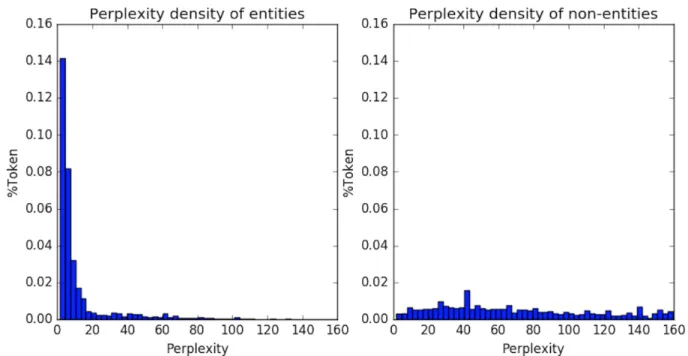
We conduct an experimental assessment of the discriminative power of CLMs for a range of languages: English, Amharic, Arabic, Bengali, Farsi, Hindi, Somali, and Tagalog. These languages use a variety of scripts and orthographic conventions (for example, only three use capitalization), come from different language families, and vary in their morphological complexity. We demonstrate the effectiveness of CLMs in distinguishing name tokens from non-name tokens, as illustrated by Figure 4.1, which shows perplexity histograms from a CLM trained on entity tokens. Our models use only individual tokens, but perform extremely well in spite of taking no account of word context.
4.2 METHODS
4.2.1 Character Language Models
We propose a very simple model in which we train an entity CLM on a list of entity tokens, and a non-entity CLM on a list of non-entity tokens. Both lists are unordered, with all entries treated independently. Each token is split into characters and treated as a “sentence” where the characters are the “words.” For example, “Obama” is an entity token,
Figure 4.1: Perplexity histogram of entity (left) and non-entity tokens (right) in CoNLL Train calculated by entity CLM for both sides. The graphs show the percentage of tokens (y
axis) with different levels of CLM perplexities (xaxis). The entity CLM gives a low average perplexity and small variance to entity tokens (left), while giving non-entity tokens much higher perplexity and higher variance (right).
and is split into “O b a m a”. From these examples we learn a score measuring how likely it is that a sequence of characters forms an entity. At test time, we also split each word into characters and determine perplexity using the entity and non-entity CLMs. We assign the label corresponding to the lower perplexity CLM.
We experiment with four different kinds of language model: N-gram model, Skip-gram model, Continuous Bag-of-Words model (CBOW), and Log-Bilinear model (LB). We demon-strate that the N-gram model is best suited for this task.
Following [6], we implement N-gram using SRILM [14] with order 6 and Witten-Bell discounting.2 For Skip-Gram and CBOW CLMs, we use the Gensim implementation [15] for training and inference, and we build the LB CLM using the OxLM toolkit [16].
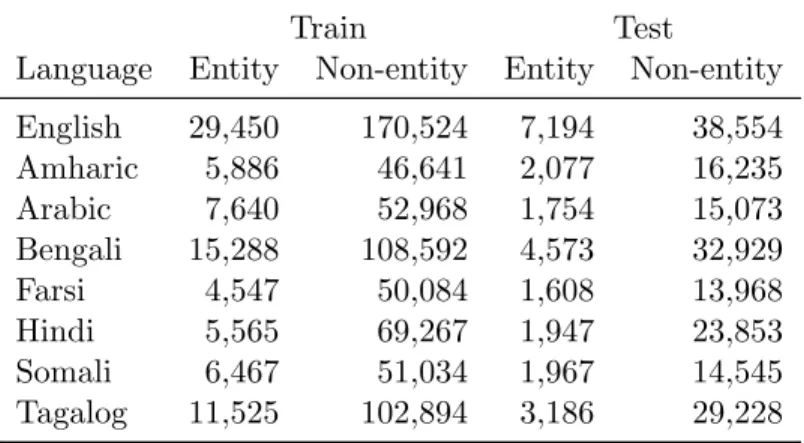
Train Test
Language Entity Non-entity Entity Non-entity
English 29,450 170,524 7,194 38,554 Amharic 5,886 46,641 2,077 16,235 Arabic 7,640 52,968 1,754 15,073 Bengali 15,288 108,592 4,573 32,929 Farsi 4,547 50,084 1,608 13,968 Hindi 5,565 69,267 1,947 23,853 Somali 6,467 51,034 1,967 14,545 Tagalog 11,525 102,894 3,186 29,228
Table 4.1: Data statistics for all languages, showing number of entity and non-entity tokens in Train and Test.
4.2.2 Multilingual Data
To determine whether name identifiability applies to languages other than English, we conduct experiments on a range of languages for which we had previously gathered resources (such as Brown clusters): English, Amharic, Arabic, Bengali, Farsi, Hindi, Somali, and Tagalog.
For English, we use the original splits from the ubiquitous CoNLL 2003 English dataset [3], which is a newswire dataset annotated with Person (PER), Organization (ORG), Location (LOC) and Miscellaneous (MISC). To collect the list of entities and non-entities as the train-ing data for the Entity and Non-Entity CLMs, we sample a large number of PER/ORG/LOC and non-entities from Wikipedia, using types derived from their corresponding FreeBase en-tities [17].
For all other languages, we use a subset of the corpora from the LORELEI project an-notated for the NER task [18]. We build our entity list using the tokens labeled as entities in the training data, and our non-entity list from the remaining tokens. These two lists are then used to train two CLMs, as described above.
Our datasets vary in size of entity and non-entity tokens, as shown in Table 4.1. The smallest, Farsi, has 4.5K entity and 50K non-entity tokens; the largest, English, has 29K entity and 170K non-entity tokens.
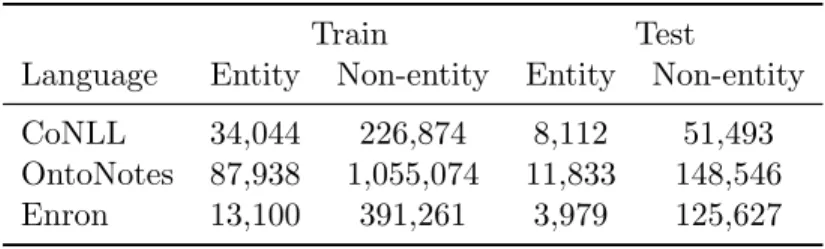
Train Test
Language Entity Non-entity Entity Non-entity
CoNLL 34,044 226,874 8,112 51,493
OntoNotes 87,938 1,055,074 11,833 148,546
Enron 13,100 391,261 3,979 125,627
Table 4.2: Data statistics for datasets from different domains, showing number of entity and non-entity tokens in Train and Test.
4.2.3 Cross-Domain Data
We use CoNLL 2003 English dateset [3] mentioned in section 4.2.2 as the source domain dataset, and use OntoNotes 5.0 [4] and Enron email dataset [5] as the target domain.
OntoNotes Label CoNLL Label
PERSON PER ORGANIZATION ORG FACILITY LOC GPE LOC LOCCATION LOC PRODUCT MISC EVENT MISC NORP MISC LANGUAGE MISC DATE O TIME O PERCENT O MONEY O QUANTITY O ORDINAL O CARDINAL O WORK OF ART O LAW O
Table 4.3: Label mapping from OntoNotes labels to CoNLL labels
OntoNotes 5.0 [4] includes data from newswire data, broadcast news, broadcast conversa-tions, P2.5 data and web data. Since most of the data is from newswire domain, we think
OntoNotes 5.0 [4] is a similar domain dataset as CoNLL03 [3]. OntoNotes 5.0 [4] is annotated with 18 labels: PERSON, ORGANIZATION, FACILITY, GPE, LOCATION, PRODUCT, EVENT, NORP, LANGUAGE, DATE, TIME, PERCENT, MONEY, QUANTITY, ORDI-NAL, CARDIORDI-NAL, WORK OF ART, LAW. To allow the model trained on CoNLL03 [3] to evaluate on OntoNotes 5.0 [4], we do the label mapping shown in Table 4.3 to make the annotation consistent.
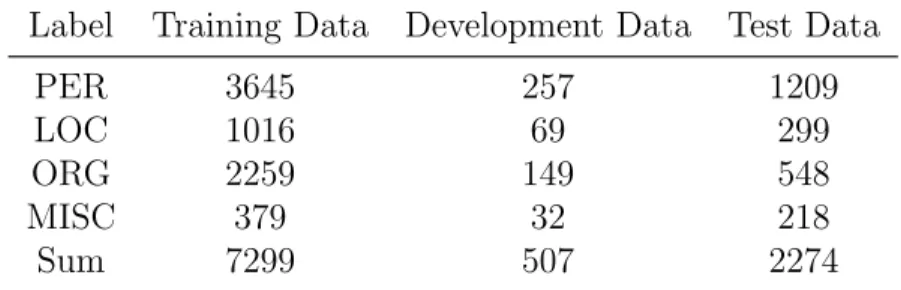
Enron email dataset [5] is a dataset of email domain, which is very different from the newswire domain. The language in emails is more like daily speaking English, which makes the context very different from the context of news written in formal English. We want to know how NER model performs when the context of target domain changes a lot. Since the Enron email dataset [5] has annotations for PER only, we have annotated the dataset, extending the label set from PER to PER, ORG, LOC and MISC. The annotation follows the same definition of CoNLL03 [3]. We split the dataset by 72.5% for training data, 5% for development data and 22.5% for test data. The percentages for each label are also similar in all the training data, development data and test data, PER around 50%, LOC around 14%, ORG around 30% and MISC around 6%. The size of the new Enron dataset is shown below.
Label Training Data Development Data Test Data
PER 3645 257 1209
LOC 1016 69 299
ORG 2259 149 548
MISC 379 32 218
Sum 7299 507 2274
Table 4.4: Number of entities in new Enron dataset
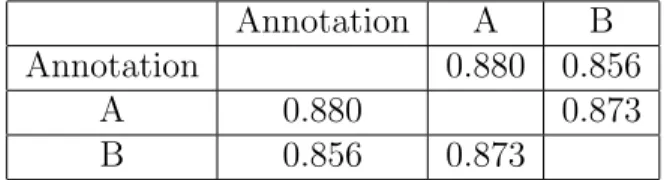
To evaluate the quality of the annotation, I have chosen 54 files that contain 1000 enti-ties randomly as the sample. The sample is divided into three parts. We asked two native speakers, A and B, to annotation two part of it. A annotated Part I and II, and B annotated Part II and III. We calculate Fleiss’ kappa between two annotation. Because most tokens in
kappa will make a large difference. Here we calculated the result of both conditions. From Table 3.5 and Table 3.6, we can see that if we take account of all the tokens including O tokens, there is a almost perfect agreement between three annotations, but if we only take account of entities, the result is still good, but can be further improved. More evaluation and improvement of the dataset will be done in the future.
Annotation A B
Annotation 0.880 0.856
A 0.880 0.873
B 0.856 0.873
Table 4.5: Fleiss’ kappa between two annotation of Enron. Including all the tokens.
Annotation A B
Annotation 0.758 0.704
A 0.758 0.737
B 0.704 0.737
Table 4.6: Fleiss’ kappa between two annotation of Enron. Including entity tokens only.
4.3 CLM FOR MULTILINGUAL NAMED ENTITY IDENTIFICATION
In this section, we first show the power of CLMs for distinguishing between entity and non-entity tokens in English, and then that this power is robust across a variety of languages. We refer to this task as Named Entity Identification (NEI), because we are concerned only with finding an entity span, not its label. We differentiate it from Named Entity Recognition (NER), in which both span and label are required. To avoid complicating this straightforward approach by requiring a separate mention detection step, we evaluate at the token-level, as opposed to the more common phrase-level evaluation. We also apply one heuristic: if a word has length 1, we automatically predict ‘O’ (or non-entity). This captures most punctuation and words like ‘I’ and ‘a’.
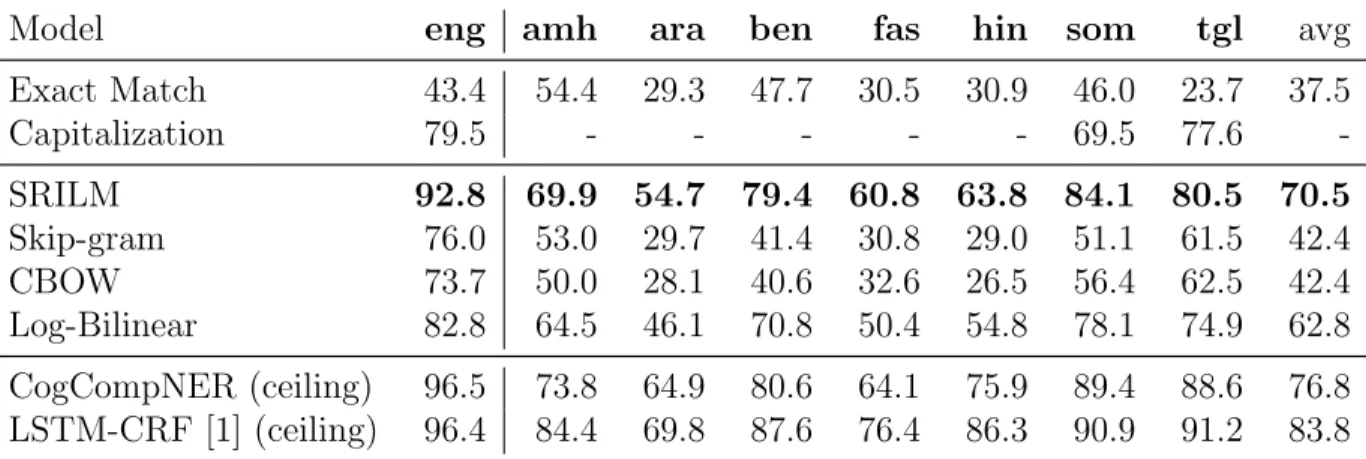
Model eng amh ara ben fas hin som tgl avg Exact Match 43.4 54.4 29.3 47.7 30.5 30.9 46.0 23.7 37.5 Capitalization 79.5 - - - 69.5 77.6 -SRILM 92.8 69.9 54.7 79.4 60.8 63.8 84.1 80.5 70.5 Skip-gram 76.0 53.0 29.7 41.4 30.8 29.0 51.1 61.5 42.4 CBOW 73.7 50.0 28.1 40.6 32.6 26.5 56.4 62.5 42.4 Log-Bilinear 82.8 64.5 46.1 70.8 50.4 54.8 78.1 74.9 62.8 CogCompNER (ceiling) 96.5 73.8 64.9 80.6 64.1 75.9 89.4 88.6 76.8 LSTM-CRF [1] (ceiling) 96.4 84.4 69.8 87.6 76.4 86.3 90.9 91.2 83.8 Table 4.7: Token level identification F1 scores. Averages are computed over all languages other than English. Two baselines are also compared here: Capitalization tags a token in test as entity if it is capitalized; and Exact Match keeps track of entities seen in training, tagging tokens in Test that exactly match some entity in Train. The bottom section shows state-of-the-art models which use complex features for names, including contextual informa-tion. Languages in order are: English, Amharic, Arabic, Bengali, Farsi, Hindi, Somali, and Tagalog. The rightmost column is the average of all columns excluding English.
Figure 1 shows that for the majority of entity tokens, the entity CLM computes a relatively low perplexity compared to non-entity tokens. Though there also exist some non-entities with low entity CLM perplexity, we can still reliably identify a large proportion of non-entity words by setting a threshold value for entity CLM perplexity. If a token perplexity lies above this threshold, we label it as a non-entity token. The threshold is tuned on development data.
Since we also build a CLM for non-entities, we can also compare the entity and non-entity perplexity scores for a token. For those tokens not excluded using the threshold as described above, we compare the perplexity scores of the two models and assign the label corresponding to the model yielding the lower score.
We compare SRILM against Skip-gram and CBOW, as implemented in Gensim, and the Log-Bilinear (LB) model. We trained both CBOW and Skip-gram with window size 3, and size 20. We tuned LB, and report results with embedding size 150, and learning rate 0.1. Despite tuning the neural models, the simple N-gram model outperforms them significantly, perhaps because of the relatively small amount of training data.3
We compare the CLM’s Entity Identification against two state-of-the-art NER systems: CogCompNER [19] and LSTM-CRF [1]. We train the NER systems as usual, but at test time we convert all predictions into binary token-level annotations to get the final score. As Table 4.7 shows, the result of N-gram CLM, which yields the highest performance, is remarkably close to the result of state-of-the-art NER systems (especially for English) given the simplicity of the model.
4.4 CLM FOR CROSS-DOMAIN NAMED ENTITY IDENTIFICATION
In the last section, we show that the result of N-gram CLM is remarkably close to the result of state-of-the-art NER systems. Since N-gram CLM is much better than other CLMs, in this section, we only focus on N-gram CLM, and evaluate its performance on different domain datesets in English. All the settings are same as Section 4.3.
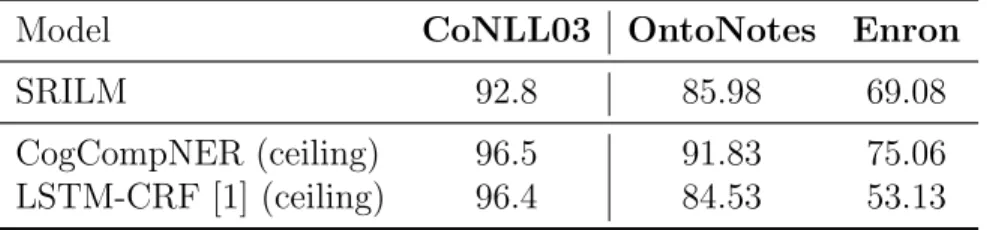
Model CoNLL03 OntoNotes Enron
SRILM 92.8 85.98 69.08
CogCompNER (ceiling) 96.5 91.83 75.06
LSTM-CRF [1] (ceiling) 96.4 84.53 53.13
Table 4.8: Token level identification F1 scores. The bottom section shows state-of-the-art models which use complex features for names, including contextual information.
As Table 4.8 shows, the result of N-gram CLM, is remarkably close to the result of Cog-CompNER, and even much better than the result of the previous state-of-the-art NER system. Though the performance of CLM still has a drop when evaluating on a different domain, without any help of context, it can beat full NER models with complex features, which shows its robustness, and also shows how weak the state-of-the-art NER system is.
4.5 SUMMARY
In this section, We propose a simple feature, which uses one entity CLM and non-entity CLM to make predictions, and show that CLMs are powerful for capturing the internal differences between names and non-names. N-gram CLM can identify named entity tokens
in a diverse set of languages at close to the performance of full NER systems. When eval-uating on different domains, though CLM will also suffer from a drop of performance, the performance is still close to the performance of full NER systems, and even better than one of the state-of-the-art NER systems.
CHAPTER 5: IMPROVING NAMED ENTITY RECOGNITION USING CLM
5.1 INTRODUCTION
In the last chapter, we show the discriminative power of CLMs to detect the named entity tokens taking no account of contexts. In this chapter, we assess the utility of directly adding simple features based on this CLM implementation to an existing NER system, and show that they have a significant positive impact on performance across many of the languages we tried. By adding very simple CLM-based features to the system, our scores approach those of a state-of-the-art NER system [1] across multiple languages, demonstrating both the unique importance and the broad utility of this approach.
5.2 FEATURES
We define three simple features that capture information provided by CLMs and which we expect to be useful for NER.
Entity Feature We define one “isEntity” feature based on the perplexities of the entity and non-entity CLMs. We compare the perplexity calculated by entity CLM and non-entity CLM described in Section 4.3, and return a Boolean value indicating whether the entity CLM score is lower.
Language Features We define two language-related features: “isArabic” and “isRus-sian”. We observe that there are many names in English text that originate from other languages, resulting in very different orthography than native English names. We therefore build two language-based CLMs for Arabic and Russian. We collect a list of Arabic names and a list of Russian names by scraping name-related websites, and train an Arabic CLM and a Russian CLM. For each token, when the perplexity of either the Arabic or the Russian CLM is lower than the perplexity of the Non-Entity CLM, we return True, indicating that this entity is likely to be a name from Arabic/Russian. Otherwise, we return False.
Model eng amh ara ben fas hin som tgl avg LSTM-CRF [1] Full 90.94 73.2 57.2 77.7 61.2 77.7 81.3 83.2 73.1 Unseen 86.11 51.9 30.2 57.9 41.4 62.2 66.5 72.8 54.7 CogCompNER Full 90.88 67.5 54.8 74.5 57.8 73.5 82.0 80.9 70.1 Unseen 84.40 42.7 25.0 51.9 31.5 53.9 67.2 68.3 48.6 CogCompNER+LM Full 91.21 71.3 59.1 75.5 59.0 74.2 82.1 78.5 71.4 Unseen 85.20 48.4 32.0 54.0 31.2 55.4 68.0 65.2 50.6 Table 5.1: NER results on 8 languages show that even a simplistic addition of CLM features to a standard NER model boosts performance. CogCompNER is run with standard features, including Brown clusters; Lample et al. [1] is run with default parameters and pre-trained embeddings. Unseen refers to performance on named entities in Test that were not seen in the training data. Full is performance on all entities in Test. Averages are computed over all languages other than English.
5.3 EXPERIMENTS
5.3.1 Multilingual Named Entity Recognition
We use CogCompNER [19] as our baseline NER system because it allows easy integration of new features, and evaluate on the same datasets as before. For English, we add all features described above. For other languages, due to the limited training data, we only use the “isEntity” feature. We compare with the state-of-the-art character-level neural NER system of [1], which inherently encodes comparable information to CLMs, as a way to investigate how much of that system’s performance can be attributed directly to name-internal structure. The results in Table 5.1 show that for six of the eight languages we studied, the baseline NER can be significantly improved by adding simple CLM features; for English and Arabic, it performs better even than the neural NER model of [1]. For Tagalog, however, adding CLM features actually impairs system performance.
In the same table, the rows marked “unseen” report systems’ performance on named entities in Test that were not seen in the training data. This setting more directly assesses the robustness of a system to identify named entities in new data. By this measure, Farsi NER is not improved by name-only CLM features and Tagalog is impaired. Benefits for English, Hindi, and Somali are limited, but are quite significant for Amharic, Arabic, and Bengali.
5.3.2 Cross-Domain Named Entity Recognition
We use the same model with simple CLM-based features designed in last section to evaluate on different domain datasets in English.
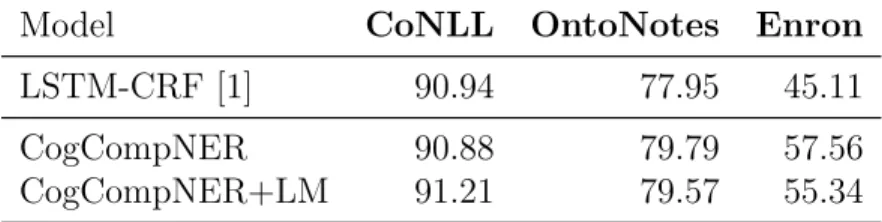
Model CoNLL OntoNotes Enron
LSTM-CRF [1] 90.94 77.95 45.11
CogCompNER 90.88 79.79 57.56
CogCompNER+LM 91.21 79.57 55.34
Table 5.2: NER results on datasets from 3 domains show that even a simplistic addition of CLM features to a standard NER model boosts performance. CogCompNER is run with standard features, including Brown clusters; Lample et al. [1] is run with default parameters and pre-trained embeddings.
The results in Table 5.2 show that for CoNLL, the baseline NER can be significantly im-proved by adding simple CLM features, but adding CLM features actually impairs system performance on other domains. The reason we guess may be that, to improve the cross-domain performance, we need to focus more on context because the main difference between domains is the style of language. Another reason could be that some of features used in CogCompNER dominate the prediction so that the adding of CLM features is not strong enough to change the prediction. These dominating features have too large weight, and because it works perfectly on the source domain, so before CLM features adjust the distri-bution of the feature weight, the model stops training. More future analysis is necessary here. CogCompNER should also be given more credits, since it is much better than [1] when evaluating on different domains.
5.4 SUMMARY
In last section, we provide a robust feature to detect entity tokens by using CLMs, so in this section, we show how we can use it. We design very simple and intuitive CLM-based features, and we can already significantly improve the performance of an off-the-shelf NER system for multiple languages. However, when evaluating on different domains, the system performance actually suffers from CLM-based features. More error analysis is needed here,
and we also need to claim that this is not the only way to embed CLM into a full NER system. We just design the simplest features, and show that it is effective. We leave more well-designed features and ideas to users and to future work.
CHAPTER 6: DISCUSSION
Our results demonstrate the power of CLMs for recognizing named entity tokens in a diverse range of languages, and that in many cases they can improve off-the-shelf NER system performance even when integrated in a simplistic way.
However, the results from Section 5.3 show that this is not true for all languages, especially when only considering unseen entities in Test: Tagalog and Farsi do not follow the trend for the other languages we assessed even though CLM performs well for Named Entity Identification.
When evaluating on different domains, though CLMs can still get a NEI performance that is remarkably close to a full NER system, and even much better than one of the NER system, adding CLM-based features actually impairs system performance. The reason may be that the design of the CLM-based features are not careful enough, but the result also tells us that, to improve cross-domain performance, we need to focus more on the change of context, since the main change between domains is the change of context.
While the end-to-end model developed by [1] clearly includes information comparable to that in the CLM, it requires a fully annotated NER corpus, takes significant time and computational resources to train, and is non-trivial to integrate into a new NER system. The CLM approach captures a very large fraction of the entity/non-entity distinction capacity of full NER systems, and can be rapidly trained using only entity and non-entity token lists – i.e., it is corpus-agnostic. For some languages it can be used directly to improve NER performance; for others (such as Tagalog), the strong NEI performance indicates that while it does not immediately boost performance, it can ultimately be used to improve NER there too. For different domains, though the performance of NER system is not good, the performance of NEI is even better than one of the full NER system, which shows that CLM is robust across domains. The only problem is how to better embed CLM into a full NER system. It may be too hard for a single feature to change all the other dominating features’ weight. A possible method might be adding CLM into inference. For example, we can use the perplexity of CLM as a constraint to NER system output. If the perplexity is lower than a threshold, which means CLM has high confidence that this token is an entity, then we
just force the NER models to predict it as an entity. Another method could be we somehow normalize the perplexity of CLM’s prediction, and we add the normalized number to the confidence scores of the NER predictions. We could use the updated scores to do inference again. There are many different ways to go. We just discover the value of CLM here, and leave the future possibility to readers.
CHAPTER 7: SUMMARY
We have shown, in a series of simple experiments, that in many languages names are iden-tifiable by character patterns alone, and that character level patterns have strong potential for building better NER systems.
While it was previously known that character-level features were useful for English NER, we have directly investigated the behavior of corpus-agnostic Character-level Language Mod-els for name and non-name tokens in English, and demonstrated that the intuition holds across a diverse set of languages.
In the future, we plan to make a more thorough analysis of reasons for the high variance in NER performance. In particular, we will study why it is possible, as with Tagalog, to have high Named Entity Identification results but lose points in NER.
REFERENCES
[1] G. Lample, M. Ballesteros, S. K. Subramanian, K. Kawakami, and C. Dyer, “Neural architectures for named entity recognition,” in HLT-NAACL, 2016.
[2] I. Augenstein, L. Derczynski, and K. Bontcheva, “Generalisation in named entity recog-nition: A quantitative analysis,”Computer Speech & Language, vol. 44, pp. 61–83, 2017. [3] E. F. T. K. Sang and F. D. Meulder, “Introduction to the conll-2003 shared task:
Language-independent named entity recognition,” in CoNLL, 2003.
[4] R. Weischedel, M. Palmer, M. Marcus, E. Hovy, S. Pradhan, L. Ramshaw, N. Xue, A. Taylor, J. Kaufman, M. Franchini et al., “Ontonotes release 5.0 ldc2013t19,” Lin-guistic Data Consortium, Philadelphia, PA, 2013.
[5] E. Minkov, R. C. Wang, and W. W. Cohen, “Extracting personal names from email: Applying named entity recognition to informal text,” in Proceedings of human lan-guage technology conference and conference on empirical methods in natural lanlan-guage processing, 2005.
[6] H. Peng and D. Roth, “Two discourse driven language models for semantics,” in Proc. of the Annual Meeting of the Association for Computational Linguistics (ACL), 2016. [Online]. Available: http://cogcomp.org/papers/PengRo16.pdf
[7] T. Mikolov, W.-t. Yih, and G. Zweig, “Linguistic regularities in continuous space word representations.” 2013.
[8] T. Mikolov, K. Chen, G. Corrado, and J. Dean, “Efficient estimation of word represen-tations in vector space,” in Proceedings of Workshop at ICLR, 2013.
[9] A. Mnih and G. Hinton, “Three new graphical models for statistical language mod-elling,” Z. Ghahramani, Ed., 2007.
[10] S. Cucerzan and D. Yarowsky, “Language independent named entity recognition com-bining morphological and contextual evidence,” in EMNLP, 1999.
[11] D. Klein, J. Smarr, H. Nguyen, and C. Manning, “Named entity recognition with character-level models,” in Proceedings of CoNLL-2003, W. Daelemans and M. Os-borne, Eds., 2003.
[12] J. Smarr and C. D. Manning, “Classifying unknown proper noun phrases without con-text,” 2002.
[13] L. Ratinov and D. Roth, “Design challenges and misconceptions in named entity recognition,” in Proc. of the Conference on Computational Natural Language Learning (CoNLL), 6 2009. [Online]. Available: http://cogcomp.org/papers/RatinovRo09.pdf
[14] A. Stolcke, “Srilm-an extensible language modeling toolkit,” in Seventh international conference on spoken language processing, 2002.
[15] R. Rehurek and P. Sojka, “Software framework for topic modelling with large corpora,” inIn Proceedings of the LREC 2010 Workshop on New Challenges for NLP Frameworks. Citeseer, 2010.
[16] P. Baltescu, P. Blunsom, and H. Hoang, “Oxlm: A neural language modelling framework for machine translation,” The Prague Bulletin of Mathematical Linguistics, vol. 102, no. 1, pp. 81–92, october 2014. [Online]. Available: https://ufal.mff.cuni.cz/pbml/102/art-baltescu-blunsom-hoang.pdf
[17] X. Ling and D. S. Weld, “Fine-grained entity recognition,” 2012. [Online]. Available: http://aiweb.cs.washington.edu/ai/pubs/ling-aaai12.pdf
[18] S. Strassel and J. Tracey, “Lorelei language packs: Data, tools, and resources for tech-nology development in low resource languages.” 2016.
[19] D. Khashabi, M. Sammons, B. Zhou, T. Redman, C. Christodoulopoulos, V. Srikumar, N. Rizzolo, L. Ratinov, G. Luo, Q. Do, C.-T. Tsai, S. Roy, S. Mayhew, Z. Feng, J. Wi-eting, X. Yu, Y. Song, S. Gupta, S. Upadhyay, N. Arivazhagan, Q. Ning, S. Ling, and D. Roth, “CogCompNLP: Your swiss army knife for nlp,” in 11th Language Resources and Evaluation Conference, 2018.