234
Organizational Climate
and the Human
Resources Function
CHAPTER 8
Learning Objectives
After reading this chapter, you will be able to
• Differentiate between organizational climate and organizational culture. • Delineate the importance of organizational climate in the improvement of
the HR function and the achievement of school goals.
• Discuss how the climate of a school or school system can be determined. • Understand more clearly the inevitable event of “conflict” in school settings
and how some conflict can serve to initiate positive change.
• Describe how fostering a positive school climate is related to positive student achievement and employee behavior.
• Describe how the climate of a school system can be improved.
H
uman resources administration is those processes that are planned and implemented in the organization to establish an effective system of human resources and to foster an organizational climate that enhances the accom-plishment of district goals. This definition emphasizes the responsibility of the human resources function to foster an environment in which relationships among personnel, students, and others lend support to the work of the human resources function and the achievement of stated objectives. The complex of personal and organizational relationships within the school is necessarily a concern of the human resources function. Human resources administrators throughout the school system must assume a major role in the development of a healthy school environment in which everyone works cooperatively to achieve desired ends.This chapter discusses organizational climate as it relates to the work of human resources administrators in education. First, a distinction is made between organi-zational culture and organiorgani-zational climate, and the importance of a positive cli-mate is discussed. Next, the research on school characteristics associated with a healthy school climate and the assessment of climate is reviewed. This is followed by a discussion of the impact of climate on student achievement, the behavior of school staff, organizational conflict, and organizational change and innovation. The final section discusses the improvement of school climate, with special attention given to the role of human resources administrators in this process.
What do school systems do to foster a healthy working environment for employ-ees? How can the school become a better place to work? What effect does organiza-tional climate have on employee performance? This chapter addresses the answers to these questions.
Organizational Culture
and Organizational Climate
Organizational climate, organizational culture, syntality, school atmosphere, schoolhealth, and others are among the terms found in the literature to describe human behavior in organizations. In some instances, these terms are used interchangeably. Yet, definitions of the term “culture” vary. For example, to Cunningham and Cordeiro (2000), culture is “a continuous process of creating meaning in social and material contexts” (p. 94). Kleiman (2000) defined culture as “a society’s set of assumptions, values, and rules about social interactions” (p. 412). Pai and Adler (2001) defined culture “as that pattern of knowledge, skills, behaviors, attitudes and beliefs, as well as material artifacts produced by human society and transmitted from one generation to another” (p. 21). Robbins (2001) stated that “organizational culture refers to a system of shared meaning held by members that distinguishes the organization from other organizations” (p. 510). “Culture is not interchangeable with ethnicity. It is dynamic and changing, dependent on place, time, and the influ-ence of other groups” (Decker, Decker, & Brown, 2007, p. 31). “Ethnicity refers not to race, but to selected cultural and sometimes physical characteristics used to clas-sify people into ethnic groups or categories” (Decker et al., 2007, p. 30). In this text,
culture is the set of important assumptions, beliefs, values, and attitudes that members of the school or school system share.
The human resources function benefits in several ways from knowing and understanding the culture. Deal and Peterson (1999) point out that the group’s cul-ture can serve to
1. Foster school effectiveness and productivity.
2. Improve collegial and collaborative activities that improve communication and problem-solving practices.
4. Build employee commitment and closer identification among staff, students, and administrators.
5. Amplify the energy, motivation, and vitality of a school staff.
6. Add the focus of daily behavior and attention on what is important and valued. (pp. 7–9)
As Norton (2005) noted, the organization’s primary goals, beliefs, and values are reflected in the cultural assumptions that support the important programs and daily work of staff personnel. The culture of the organization allows its members to commit themselves to meaningful purposes and superordinate goals above and beyond personal, vested interests.
Organizational climateis the collective personality of a school or school system. It is the school atmosphere as characterized by the social and professional interactions within it. The collective behavior of a school is the school’s personality or its syntality. The healthy organization gives due attention to meeting its required tasks and fulfilling its organizational and human needs by emphasizing continued growth and develop-ment. The school that is meeting its task needs has a clear goal focus—communication adequacy—and fosters a climate that enhances positive human relationships. Climate is a phenomenon that is influenced by both the internal and external environments of the school system. Although climate is relatively enduring, these internal and external influences can lead to changes in the climate of the school over time.
Table 8.1 illustrates differences between school culture and school climate, as well as the characteristics that serve to link the two. As depicted in Table 8.1, school climate is characterized by the social and professional interactions of people in the school community, whereas school culture extends beyond the interpersonal life that takes place in the school setting. Culture is more normative than climate in that it goes beyond interpersonal relationships.
The Importance of a Healthy School Climate
Why is school climate such an important consideration for the human resources function? Why does the environmental setting within a school system require the special attention of human resources administrators? How can school climate be instrumental in the improvement of the HR function in the school system? Several reasons can be identified:
1. Because schools, departments, and offices are staffed by people, school climate in a real sense is a human condition. The kind of climate in the school sets the tone for the human considerations of importance to human resources adminis-tration. An important part of the work of human resources administrators is to determine the facilitators and inhibitors of school effectiveness, those strengths and weaknesses that affect the climate of the school system. The determination of school climate is the forerunner of the determination of the strategies for school improve-ment generally and improveimprove-ment of conditions in the workplace specifically.
2. The school climate sets the opportunity for growth and renewal. Human resources administrators must work to promote a school environment that fosters positive personnel development in order to remain vital and alive. The healthy school serves to stimulate people’s best efforts by providing meaningful work, moti-vating challenges, and continuous opportunities for learning. Through an ongoing program of people development, the school system has the ability to innovate and change as needed within a changing society.
3. Effective communication requires a climate of trust, mutual respect, and clarity of function. Such communication is inhibited in schools where distrust and poor human relations exist. Effective communications is an important component of an open, positive climate; it serves to tie the school community together.
4. Climate conditions the school environment for creative efforts, innovation, and change. These behaviors serve as foundations for organizational goal achievement. A positive school environment encourages innovative practices that serve toward the achievement of new goals. Rather than attempting to initiate change and then real-izing subsequent failure, school leaders should examine the school climate first and, if it is less than favorable, take steps to improve it before attempting program innovation. 5. Positive school climate implies positive team building in that goal develop-ment and achievedevelop-ment are cooperative tasks that require mutual trust and respect among faculty personnel. Human resources administrators can foster a climate of trust by demonstrating trustworthy behavior in their leadership roles.
Table 8.1 Links Between School Culture and School Climate
School Culture
Cultureis the set of important beliefs and values that members of the school system share.
Cultureis more normative than climate in the sense that it is a reflection of the shared values, beliefs, and underlying assumptions of school members across an array of organizational dimensions that include but go beyond interpersonal relationships. Links • People • Socialization • Shared goals • Interpersonal relations • Environmental factors • Influenced behaviors • Attitudes • Individual needs • Artifacts • Traditions • Sanctions School Climate
Climateis the collective personality of a school or school system. It is the atmosphere that prevails as characterized by the social and professional interactions of people.
Climateis more
interpersonal in tone and substance than culture. It is manifested in the attitudes and behaviors of teachers, students, administrators, and community members.
Climateis concerned with the process and style of a school’s organizational life, rather than its content and substance.
Thus, school climate is important to school systems and to the human resources function because it affects all of the important reasons that schools exist. As a study of school climate by Wynn and Carboni (2006) reported, teachers are more likely to remain in the profession when they are satisfied with the school principal’s leadership and with the school climate.
Human resources leaders have an important role in determining what the school system is and what it might become. In order to have a positive influence, however, they must understand why organizational climate is important to school effective-ness as well as to the effectiveeffective-ness of the HR function, how it can be determined, and how to foster a positive environment within the system.
The Measurement of School Climate
In order to gain knowledge about the nature of school environments, the charac-teristics associated with different kinds of climate, and the impact various leadership styles have on personnel behaviors, school systems have administered numerous empirical climate assessment instruments.
Among the leaders in the study of organizational climate were Andrew W. Halpin and Don B. Croft, who developed the most widely used instrument for mea-suring climate in schools, the Organizational Climate Description Questionnaire (OCDQ), in 1962. Halpin and Croft focused primarily on school climate as the relationships held among group members and relationships between the school principal and the teaching staff.
The OCDQ comprises 64 Likert-type items to which teachers respond, describ-ing the climate of the school from their perspectives. It yields school mean scores that are averages of the scores for all teachers’ responses on eight subtests related to principal and teacher behavior. For example, two of the subtests are disengagement
and intimacy. Disengagement refers to the teacher’s tendency to “not be with it.” This dimension describes a group that is going through the motions but is not in gear with respect to the tasks at hand. Intimacy refers to the teachers’ enjoyment of friendly relationships with each other.
Halpin and Croft (1962) developed six prototypic profiles to describe climates on a continuum from open to closed using the profiles of 71 schools. An open cli-mate is one in which the staff enjoys extremely high morale, works well together, enjoys friendly relations but does not engage in a high degree of socialization, and possesses the incentive to work things out and to keep the school moving. Kreitner (2001) noted that open climates have four characteristics:
1. Interaction With the Environment. Open systems have permeable boundaries, whereas closed systems do not. Organizations depend on the environment for survival.
2. Synergy. An open system adds up to more than the sum of its parts. Only when all parts are in place and working in concert can the winning edge be achieved.
3. Dynamic Equilibrium. In open systems, dynamic equilibrium is the process of maintaining the internal balance necessary for survival by importing needed resources from the environment.
4. Equifinality. Open systems can achieve the same results by different means. (pp. 282–284)
In contrast to the open climate, a closed climate is characterized by low staff morale, limited and inadequate communication, and limited socialization. In addi-tion, closed systems are typified by impermeable boundaries and static equilibrium. A climate in which workers have excessive workloads, tight deadlines, unreasonable supervisors, unrealistic targets for productivity, and unattainable goals is often termed a toxic climate.
The work of Halpin and Croft (1962), and the wide use of their OCDQ in hun-dreds of empirical studies, contributed significantly to the foundational concepts of school climate and served to motivate other researchers to study the topic from a variety of perspectives, including the characteristics associated with positive cli-mates, the impact of climate on personnel, and the climate characteristics associ-ated with effective schools: innovation and change. Later sections of this chapter review selected research related to these considerations.
Other early assessment instruments addressed a variety of perspectives of orga-nizational climate. Among these instruments were the following:
The High School Characteristics Index (HSCI) (Stern, 1964). The HSCI was one of the first climate instruments developed at the Syracuse University Psychological Research Center as a standardized instrument to measure climate in schools. The HSCI’s 30 scales relate to seven factors of school climate, including group life, personal dignity, achievement standards, and so on. Such data can be invaluable in providing a school profile of existing conditions from the perspectives of the school’s most important clients, the students.
The Purdue Teacher Opinionaire (PTO) (Bentley & Rempel, 1980). The PTO is designed to provide a measure of teacher morale. The instrument includes 10 fac-tors related to the school environment. Data collected from teachers in one school result in norms that can be compared with those of the entire school system or with selected faculties in the system. The 10 climate factors include teacher rapport with the principal, satisfaction with teaching, teacher load, rapport among teachers, teacher status, community support of education, community pressures, and others. The instrument can be useful to school administrators, school staffs, and researchers who desire an objective and practical index of teacher morale. Comparisons can be made among teachers when grouped by schools, grade levels, subject areas, and tenure status. The reliability and validity of the PTO have been empirically tested and retested in hundreds of school settings since its first form was developed in 1961. The Purdue Research Foundation also developed the Purdue Evaluation Scale (PES), which is completed by students. The instrument provides evaluative information in six climate areas including ability to motivate students. The PTO
and the PES are available through the Office of Technology Commercialization at Purdue University in West Lafayette, Indiana.
The CFK Ltd. School Climate Profile. The Charles F. Kettering School Climate Profile (Phi Delta Kappa, 1973) can be completed by teachers, students, and parents. Although designed more than 30 years ago, the School Climate Profile remains among the most comprehensive climate survey instruments available today. It focuses on general, program, process, and material determinants of school climate. For example, the respondent uses a Likert-type scale in the general climate section to assess such factors as respect, trust, morale, school renewal, and caring.
The Harrison Instrument for Diagnosing Organizational Ideology. The Harrison Instrument for Diagnosing Organizational Ideology (Harrison, 1985) differs from the aforementioned instruments in that it helps staff personnel compare their orga-nization’s values and their own personal values with four different “cultures” or ide-ologies. The aim is to enable participants to clarify where their organization stands on a number of important value issues and to identify differences between the orga-nization’s ideology and their own. Organizational ideologies include (1) power ori-entation, (2) role oriori-entation, (3) task oriori-entation, and (4) self-orientation. Results enable the organization to identify potential problem areas and to take steps to resolve areas of conflict.
Organizational Health Inventory (OHI-S). The OHI-S (Hoy, Tarter, & Kottkamp, 1991) is administered to teachers and uses a Likert-type scale to assess seven climate areas: (1) institutional integrity, (2) principal influence, (3) consideration, (4) ini-tiating structure, (5) resource support, (6) morale, and (7) academic emphasis. Profiles of results for each of the seven climate areas can be determined and com-pared with other schools in the district. The OHI is a useful tool for measuring school climate because it measures key dimensions of organizational health and was specifically designed, developed, and tested in the schools.
Revised Versions of the OCDQ. Revised versions of Halpin and Croft’s OCDQ were completed by Hoy and Clover (1986), Kottkamp, Mulhern, and Hoy (1987), and Hoy and Tarter (1997). The updated OCDQ-RE was designed specifically for use in elementary school, the OCDQ-RS for secondary schools, and the OCDQ-RM for middle schools. OCDQ-RE uses four climate prototypes: (1) open, (2) engaged, (3) disengaged, and (4) closed. For example, a disengaged climate, which exempli-fies ineffective attempts by the principal to control faculty behavior, contrasts directly with behaviors of personnel in engaged climates. Each of the newer OCDQ climate instruments has been tested thoroughly for validity and reliability for use at their respective school levels.
The OCDQ-RS is a 34-item instrument designed to assess climate in secondary schools. It focuses on five dimensions of behavior including the supportive and directive behaviors of teacher personnel. Two of the dimensions describe the behav-iors exhibited by the principal and three center on teacher behavbehav-iors, specifically
teacher relationships with students, colleagues, and supervisors. Resulting data pro-vide descriptions of the openness and intimacy of the school climate. As we previ-ously defined it, intimacy refers to the level of satisfaction that teachers obtain from their friendly relationships with other teachers in the school.
The OCDQ-RM (Hoy & Tarter, 1997) represented an effort to create a climate instrument especially designed for use in middle schools. More information about the OCDQ-RM and the OCDQ-RE is available in the publication, Healthy Schools (Hoy & Tarter, 1997).
In addition to those described, a number of other climate assessment instru-ments has been developed and tested for use in schools. Among those still widely used are the School Discipline Climate Survey: Toward a Safe Orderly Learning Environment (Grossnickle, 1993); the School Climate and Context Inventory (Bobbett & French, 1992); the Tennessee School Climate Inventory (Butler & Albery, 1991), the Group Openness and Trust Scale (Bulach & Malone, 1993); and the Comprehensive Assessment of School Environments (National Association of Secondary School Principals, 1987).
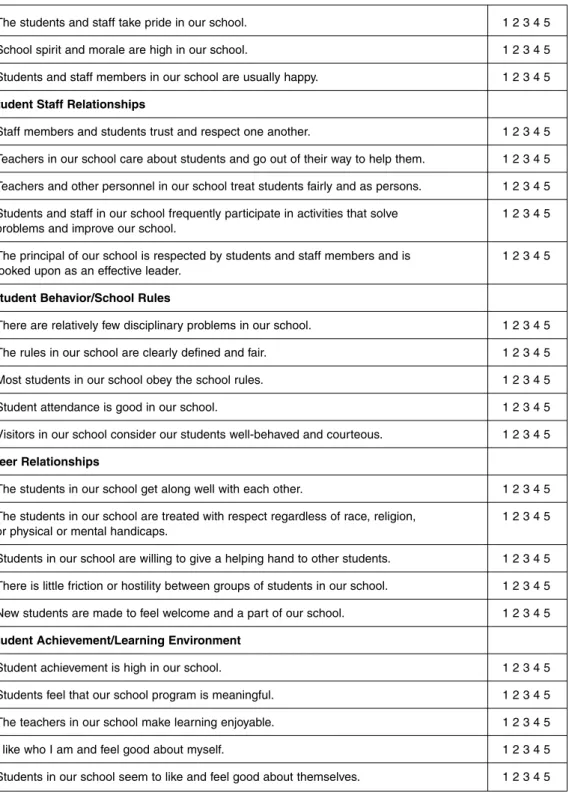
In many cases, school districts have found it convenient to design their own climate survey tools. Such instruments can be useful for gaining feedback from a variety of school stakeholders, but they have the disadvantage of lacking state or national norms for comparative purposes. Figure 8.1 illustrates a district-designed climate assessment instrument. Surveys designed by school personnel can be administered to teachers, students, and parents. They compare results in a variety of ways, including the perceptions of school climate by students in relation to the perceptions of the faculty.
Peoria School Improvement Climate Study
School ________________________ Grade ________________________ Directions:
Circle the number that best describes how you feel about your school. Do not circle more than one number for each statement.
Value of the number:
(1) Strongly disagree, (2) Disagree, (3) Don’t know, (4) Agree, (5) Strongly agree
(Continued) I. School Atmosphere
1. Our school has a friendly atmosphere. 1 2 3 4 5
2. Our school is a place where students want to be and a place where they can 1 2 3 4 5 learn in a pleasant environment.
Figure 8.1 Student School Climate Survey Instrument
3. The students and staff take pride in our school. 1 2 3 4 5
4. School spirit and morale are high in our school. 1 2 3 4 5
5. Students and staff members in our school are usually happy. 1 2 3 4 5 II. Student Staff Relationships
1 Staff members and students trust and respect one another. 1 2 3 4 5
2. Teachers in our school care about students and go out of their way to help them. 1 2 3 4 5 3. Teachers and other personnel in our school treat students fairly and as persons. 1 2 3 4 5 4. Students and staff in our school frequently participate in activities that solve 1 2 3 4 5
problems and improve our school.
5. The principal of our school is respected by students and staff members and is 1 2 3 4 5 looked upon as an effective leader.
III. Student Behavior/School Rules
1. There are relatively few disciplinary problems in our school. 1 2 3 4 5
2. The rules in our school are clearly defined and fair. 1 2 3 4 5
3. Most students in our school obey the school rules. 1 2 3 4 5
4. Student attendance is good in our school. 1 2 3 4 5
5. Visitors in our school consider our students well-behaved and courteous. 1 2 3 4 5 IV. Peer Relationships
1. The students in our school get along well with each other. 1 2 3 4 5 2. The students in our school are treated with respect regardless of race, religion, 1 2 3 4 5
or physical or mental handicaps.
3. Students in our school are willing to give a helping hand to other students. 1 2 3 4 5 4. There is little friction or hostility between groups of students in our school. 1 2 3 4 5 5. New students are made to feel welcome and a part of our school. 1 2 3 4 5 V. Student Achievement/Learning Environment
1. Student achievement is high in our school. 1 2 3 4 5
2. Students feel that our school program is meaningful. 1 2 3 4 5
3. The teachers in our school make learning enjoyable. 1 2 3 4 5
4. I like who I am and feel good about myself. 1 2 3 4 5
5. Students in our school seem to like and feel good about themselves. 1 2 3 4 5
There are other assessment strategies for gaining input from staff personnel that tie closely to one or more of the human resources processes and can result in find-ings that serve to improve current practices and ultimately lead to climate improve-ment. For example, valuable information can be gathered from employees who have decided to leave the system through the use of well-designed exit interviews. Information gained from an exit interview can help to determine why employees are leaving and what the school system might have done to retain them. Questions such as the following tend to serve such purposes:
1. What did you like best about working here? What did you like least? 2. What steps would you suggest to improve the workplace in this system? What
changes might you suggest?
3. To what extent were you able to realize your career goals while working here? 4. What opportunities did you have for discussing your career goals and
teach-ing interests with others in the school system?
Because much more of human resources administrators’ time is being spent on people management and efforts to make the school system a place where profes-sional personnel and other workers want to be, more attention necessarily will be directed to assessments of the workplace environment and its competitive ability to attract and retain quality personnel.
Research on School Climate
Mary Parker Follett and others questioned the emphasis placed on the technicalaspects of work for fostering productivity, as exemplified by Taylor’s task system in the scientific management era. Follett contended that the central problem of any enterprise is the building and maintaining of dynamic yet harmonious human relationships. Her concepts of coordination for refocusing methods of supervisory and personnel practices to achieve organizational harmony were revolutionary. She introduced the concept of integration for dealing with conflict and initiated foun-dations for contemporary practices such as participatory management, commit-ment to superordinate system goals versus personal vested interests, and integrative approaches to problem solving, including collective negotiations. Follett’s work spurred many subsequent investigations that sought a better understanding of the relationship between the human element and organizational health and productivity. Throughout the 1920s and during the next three decades, much attention was given to organizational concepts in the areas of democratic leadership. Informal group influences, the school as a social system, and other organizational character-istics were among the topics studied in relation to school climate. Much of the con-temporary thought relating to organizational climate had its beginning in the 1960s.
Since that time, numerous climate studies have centered on (1) the characteristics of schools with positive climates, (2) the impact of climate on student achievement, (3) the impact of climate on the behavior of personnel, and (4) the impact of school climate on school program innovation and change. The following sections discuss research studies related to each of these areas.
Characteristics of Schools With Positive Climates
Many of the studies of climate, completed during the late 1970s and 1980s, cen-tered on the effective school movement. Walberg and Genova (1982) found that the use of professional knowledge by teachers was significantly associated with such cli-mate characteristics as equality of staff treatment, integration of staff cooperation, goal direction, and learning orientation.
School climate is a key factor in the difference between effective and ineffective schools. These results were supported by Farrar and Flakus-Mosqueda (1986), who found that the one element all successful school improvement programs had in common was the development of a positive climate in which problems and issues could be identified and resolved. Short and Greer (1997) contended that, “In the healthy organization, challenges are addressed, solutions to problems are found, and new methods and innovations are initiated. . . . Thus, a healthy orga-nization not only has effective processes but also is likely to have a high trust culture” (p. 63).
Rutherford (1985) studied perceptions of effective and less effective principals relative to five characteristics. One characteristic was the establishment and main-tenance of a supportive school climate. He found that effective principals differed from less effective principals in their views of school climate. For example, less effective principals were much more concerned with maintaining a nonthreaten-ing, “keep clear of problems” environment. Taylor and Tashakkori (1994) collected data on the factors affecting climate from 9,987 teachers and 27,994 students. They found that the leadership of the school, the collegiality of the faculty, and student discipline were the major factors influencing school climate (Winter & Sweeney, 1994). Such support is exemplified in principals who recognize achievement, back up teachers, encourage teachers, care for teachers, and administer school rules fairly. Sweeney (1992) reported research results from a study of more than 600 schools nationally. The principal’s effectiveness in learning environment adminis-tration, instructional leadership, and human resources management correlated highly with a positive climate. In fact, human resources management was the prin-cipal behavior most highly correlated with a positive school climate.
These research findings describe many characteristics that promote positive cli-mates in schools and school systems, including such factors as the establishment of clear school goals; high expectations for human performance; a high level of inter-personal relations and cooperative work efforts founded on trust; contacts with the culture in which the school is embedded; a supportive, caring school leader; a problem-solving capacity within the school; and the existence of high esprit within the school community. The following sections discuss the research and practices relat-ing to organizational climate and student achievement.
The Impact of School Climate on Student Achievement
The definition of human resources used in this text emphasizes the fostering of organizational climate for the purpose of enhancing the accomplishment of school goals. Most everyone agrees that student achievement ranks high among the goals for schools. Over the past 30–40 years, numerous research studies have centered on the relationship between school climate and student achievement. Hopkins and Crain (1985) described efforts in a suburban high school to improve test scores through improvements in the school’s climate, including such strategies as student participa-tion in decision making. A 10-year high of ACT scores, improved student attendance, significant decrease in the dropout rate, and other positive student outcomes were attributed to the positive climate changes made by the school administrators.
Studies by Hoy and Appleberry (1970), Lunenburg (1983), and Deibert and Hoy (1977) support the general findings of Hopkins and Crain (1985). For example, Lunenburg’s research demonstrated that students’ perceptions of humanistic school climate related in a positive manner to their personal motivation, task ori-entation, problem solving, and attitude toward learning.
Paredes and Frazer (1992) examined school climate over a four-year period. They found that (1) high schools with positive climates had higher student achieve-ment and lower dropout rates, (2) student achieveachieve-ment was affected most directly by teacher expectations of student success and the instructional goals of teachers, and (3) school climate scores were better predictors of student dropout rates. Newman and Associates (1996) extended the foregoing findings in their report of a five-year study related to school success and school culture. Researchers found that commitment to high student expectations, support for staff innovation and creativity, an ongoing search for new ideas, and a climate of caring and collabora-tion among staff were among those condicollabora-tions directly related to school success.
Such factors as due process procedures for students and efforts to develop clearly written school rules and procedures, along with specific efforts to disseminate them, led to improved climates in nine schools in Kentucky and Tennessee (Bobbett & French, 1992). Bulach and Malone (1994) used three survey instruments to study the impact of the principal’s leadership style on school climate and student achieve-ment; they found a significant difference between leadership style and the subscale of school climate.
Many local school districts have reported increases in student achievement fol-lowing concerted efforts to improve the climate of the school. Winter and Sweeney (1994) summarized the results of the research on the relationship between climate and student achievement:
For more than a decade, studies have proven that climate makes a difference in secondary school. Climate affects student achievement and behavior inde-pendent of student’s intelligence or home environment. It is also reflected in the shared attitudes, beliefs, and values of the people of the school. (p. 66)
We submit that the foregoing research findings are of paramount importance for the work of school leaders. Practitioners who seek practical research results should
carefully examine the findings of organizational studies such as those reviewed in the foregoing sections. The research on climate is clear; what is needed is a serious implementation of the research findings.
The Impact of School Climate
on the Behavior of Personnel
Herzberg, Mausner, and Snyderman (1959) pointed out more than 40 years ago that interpersonal relationships with one’s superior and the technical aspects of supervision were organizational hygienes associated with job dissatisfaction. In 2000, the Gallup Organization gave this contention major support. Gallup inter-viewed 200,000 employees and concluded that the length of an employee’s stay with an organization is determined by the quality of the relationship with his or her immediate supervisor (Buckingham, 2000).
The impact of the workplace environment on employee satisfaction, commit-ment, and loyalty is no longer a matter of debate. Virtually every study of employee attitudes and behavior reaches the same conclusion: work conditions, in the long run, loom more important to job satisfaction and worker retention than do salary and other monetary incentives. “And, the organizational climate of the school often is disrupted when high turnover occurs because the efforts to develop positive interpersonal relationships and collaborative support networks in the school sys-tem and community for the purpose of delivering effective learning environments are thwarted” (Norton, 2001, p. 16).
It is clear that success in organizations today depends on a working environment that encourages input of the best ideas regardless of the sources of these ideas, and the collaboration of workers and team efforts to implement these ideas in the most optimal ways. Such working relationships are not possible in school systems with unhealthy school climates.
Organizational climate has been found to affect staff in a variety of ways. As we noted in the foregoing discussion, job satisfaction is directly related to conditions of work. Conditions of work include the nature of the supervision received, admin-istrative support, parental support, interpersonal relationships, participation in the system’s decision making, and consideration of one’s work and life needs. Patrick (1995) found that the principal’s administrative style had much influence on the job satisfaction of teaching personnel. In related studies, researchers have found that school climate factors, such as the principal’s leadership, the collegiality of the faculty, student discipline, and staff placements in school settings that provide the opportunity for them to use their personal and professional strengths and to do what they do best, were major determinants of staff job enjoyment and satisfaction. Previously, we discussed the OCDQ-RE climate assessment instrument. Hoy and Clover (1986) developed four prototypes of climate that result in various teacher behaviors. For example, the open climate features cooperation and respect within the faculty and between the faculty and the school principal. Teacher behavior fosters open and professional interactions among faculty members. The open climate pro-motes cooperative behavior among faculty members and meaningful engagement in
their work. In the engaged climate, teachers tend to ignore the principal’s attempts to control faculty behavior. Teachers respect each other’s professionalism and compe-tence. Attention to tasks is high, and the faculty members are professionally respon-sive despite the principal’s restrictive behaviors. In disengaged climates, relationship behaviors in the school are negative. Teachers are not engaged in the tasks, and teacher behaviors are exemplified by divisiveness, intolerance, and noncommitment. Teacher behaviors in closed climates are quite similar to those in disengaged situa-tions: task commitment is low, intimacy is low, and collegiality also is low.
Hoy and Miskel (2001) summarized the research on school climate and its impact on staff personnel as follows: “Recent research . . . shows that open school climates are characterized by higher levels of loyalty and trust, both faculty trust in the principal and in colleagues, than closed climates” (p. 150). They stated further that research clearly indicates that open schools generate higher levels of school commitment, and the openness of the climate is related to teacher participation in decision making as well as higher ratings of school effectiveness.
Dealing With Conflict
Conflict is an antagonistic state or action that is exemplified by divergent ideas and interests of individuals or groups. Hoy and Miskel (2001) point out that, “Administrators are faced with the classic confrontations between individual needs and organizational expectations; consequently, they spend a substantial amount of time attempting to mediate conflict” (p. 245). These authors also note additionally that power and politics are facts of organizational life, and, thus, conflict in organi-zations is inevitable. We discussed open and closed systems earlier in this chapter; both types of systems are subject to conflict, but open systems are much more pre-pared to deal with it.
Schools with unhealthy climates find it difficult to deal with conflict because per-sonnel do not work well together. In these climates, rules and regulations set the manner in which things are done, and the systems lacks a needed problem-solving capacity. Thus, problems are “resolved” through mandate as opposed to an integra-tion of ideas and alternatives, and conflict is often resolved in these environments by employee turnover. In an open school climate, disagreement and the expression of other points of view are not only expected, but are solicited. That is, the system purposely seeks input from all staff personnel through such means as suggestions systems, the use of “think tanks” for problem solving, and the use of shadow group techniques that place general staff personnel in role-play exercises to examine prob-lems that the system and its administrative personnel face. Healthy school systems realize that any attempt to discourage disagreement will most likely result in negative outcomes such as poor relationships and lack of confidence in the system’s leadership. In a healthy school climate, the consideration of controversial matters can be useful. Progress in terms of goal achievement and new understandings is often gen-erated through opportunities to reflect on problems and alternative solutions. Thus, the HR administrator can help make disagreements constructive in a number of ways. One need is for the HR administrator to broaden the base of stakeholder
understanding through purposeful assessment of criticism the school or school system receives. In this way, the HR administrator is in a much better position to limit unfair criticism, because assessment strategies serve to distinguish between constructive and destructive proposals.
Human resource administrators must implement viable methods for learning about the existence and specific concerns of criticism. The advantage of an open climate in this regard is that open channels of communication are most likely already in place; these channels serve as the system’s nervous system whereby school leaders are more able to discern conflict at an early stage and make an immediate, appropriate response to any attack, as well as keep such conflict more manageable. In those instances when criticism is unfair or based on irresponsible behavior, a planned strategy is necessary. The gathering of accurate information concerning the situation at hand, obtaining the participation of knowledgeable groups and individuals on the matter, and strategizing for appropriate counteraction are among the steps needed in such cases.
Public relations personnel have learned that attempts to cover up school prob-lems, or to use the tired phrase of “no comment” when working with the media and others, only tend to exacerbate the problem. Thus, the overall task of HR adminis-trators is to work to maintain integrity and stakeholder confidence in a climate where critics have the right to disagree and to access the school system’s open channels of communication. Conflict and controversy can be helpful in leading to preferred solutions. Schools that maintain a communications initiative such as sug-gested here are much more likely to deal effectively with the inevitable conflict they will encounter as a social institution.
School Life and Staff Commitment
The importance of gaining the commitment of staff personnel to the school sys-tem and its purposes is emphasized throughout this text. Although staff commitment is the result of various influences, research findings point out that worker loyalty is tied closely to how employees perceive that their supervisors are supporting inside and outside work life (Laabs, 1996). In fact, a workforce commitment study by Aon Consulting Worldwide (1998) found that the biggest driver of employee loyalty was having managers who recognize employees’ need to balance work with home life. This climate conditioner differs drastically with earlier views that the worker was never to let family or home life interfere with the job. Work-life matters have become ones of paramount importance to employees generally. It is certain that structured work schedules for teachers and other school staff members must be reevaluated in view of the changing attitudes of today’s employees toward work and life balances. New inno-vations in work schedules and instructional delivery in schools must be implemented. If not improved, job satisfaction will lessen and school climate will suffer. The impli-cations for work-life management by HR administrators include the following:
1. Studies reveal that both workplace and home life support by the organization increases employee loyalty. Thus, failure to recognize this fact will harm school climate and staff commitment to the school system.
2. Schools must give full attention to work-life benefits in school settings in order to attract and retain quality personnel. Recruiting, selection, and reten-tion processes must give high priority to “advertising” how the school system is giving attention to benefits in the area of work life. Policy decisions and HR strategies must recognize the inextricable relationship between the work and personal life of staff personnel. The HR processes of recruiting, selection, and retention necessarily must emphasize the needs of staff members, not only the needs of the school system.
3. HR administrators must realize that giving attention to school climate and to staff commitment by recognizing work-life balances is not just something they should do, but rather something they must do in order to keep the school system alive and vital.
The Impact of School Climate
on Organizational Change and Innovation
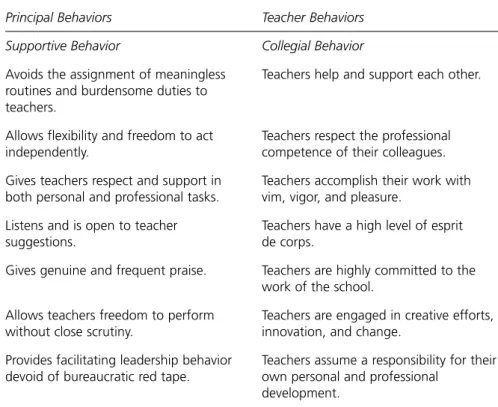
Several investigators have examined the relationship between types of school climate and the rate of innovations in schools. As early as 1966, Marcum studied innovative and noninnovative schools in a five-state area and found a significant difference between school climates of the most innovative and least innovative schools. School faculties judged innovative schools as having open climates. Bennett (1969) and Christian (1972) also studied innovation in relation to school climate. Bennett found a higher positive relationship in both number and types of innovations in the more open types of climate. Christian used Halpin and Croft’s OCDQ to study climate in elementary schools relative to the introduction and use of innovative educational practices. He found a significant positive relationship at the 0.01 level between openness and the rate of introduction and utilization of innovations in the school studied. The climate factors of disengagement and esprit were most closely related to the rate of use of innovations; the characteristics of aloofness and thrust, as related to positive principal behaviors, were most directly related to the degree of school innovativeness (see Table 8.2).
During the 1980s and 1990s, considerable climate research focused on school change as related to school reform. Bulach and Malone (1994) studied the relation-ship between several school climate characteristics (e.g., group openness and group trust) and the implementation of reform efforts in Kentucky. Thirteen schools and 292 teachers participated in the study. The researchers stated that, “the results of this study lead to the conclusion that school climate is a significant factor in suc-cessfully implementing school reform” (p. 7). The researchers cautioned that higher climate scores could have been the result of successfully implementing school reform. They were not certain which was cause and which was effect.
Those involved in school reform have also noted the importance of climate. For example, Akin (1993) expressed the opinion that administrators who expect to be successful in school site-based management projects must first understand their school’s climate and know how to change a negative climate to one that exemplifies the positive characteristics of healthy organizations. Similarly, Stevens (1990)
argued that giving attention to important climate considerations is a significant forerunner of school reform.
Hoy and Miskel (2001) stated that, “The principal of a healthy school provides dynamic leadership—leadership that is both task oriented and relations oriented. Such behavior is supportive of teachers and yet provides directions and maintains high standards of performance” (p. 200). Yet they were cautious in suggesting that the idea of changing organizational culture, or even bringing about real change, is simplistic. And, as other researchers have noted, “something that emerges as an abstract, unconscious, and complex expression of needs and beliefs, it is not a maneuverable or manageable entity” (Norton, Webb, Dlugosh, & Sybouts, 1996, p. 75). Nevertheless, certain empirical truths have been discovered in relation to cli-mate and organizational change: (1) change in organizations is much more readily realized and effective if personnel understand what the change is all about and why it is necessary, (2) successful implementation of change and innovation requires that attention be given to special training needs that serve to provide the necessary knowledge and skills to implement new goals and programs, and (3) strategies for recruiting, selecting, assigning, retaining, compensating, and developing personnel must focus on the changes and innovations in question.
Table 8.2 The Behavior of School Principals and Resulting Teacher Behavior
Principal Behaviors Supportive Behavior
Avoids the assignment of meaningless routines and burdensome duties to teachers.
Allows flexibility and freedom to act independently.
Gives teachers respect and support in both personal and professional tasks. Listens and is open to teacher suggestions.
Gives genuine and frequent praise.
Allows teachers freedom to perform without close scrutiny.
Provides facilitating leadership behavior devoid of bureaucratic red tape.
Teacher Behaviors Collegial Behavior
Teachers help and support each other.
Teachers respect the professional competence of their colleagues. Teachers accomplish their work with vim, vigor, and pleasure.
Teachers have a high level of esprit de corps.
Teachers are highly committed to the work of the school.
Teachers are engaged in creative efforts, innovation, and change.
Teachers assume a responsibility for their own personal and professional
development.
SOURCE: Adapted from Instructional Leadershipby Hoy, A. W., and Hoy, W. K. (2003), Boston, MA: Allyn & Bacon, pp. 286–287.
This chapter has focused on organizational climate, and research is clear that it can be assessed and improved. The following section discusses successful programs and practices for improving school climate and the responsibilities of HR adminis-trators in achieving this end.
Improvement of School Climate
The improvement of school climate is a responsibility of all school personnel.However, the school principal, as a human resources administrator, must assume a leadership role in assessing the climate and taking action for improvement based on the implications of assessment results. This contention is problematic in many ways: because the condition of school climate ties closely to the quality of the prin-cipal’s leadership and ability to work with the human element, principals in some instances might be reluctant to survey staff personnel on this matter.
As we saw in the previous discussion on measuring school climate, most climate instruments focus on the leadership and human skills of the principal in large part. The following section provides a review of the CFK Ltd. School Climate Profile, fol-lowed by a discussion of operational models that can be used to improve the cli-mate in school settings.
Program, Process, and Material
Determinants of School Climate
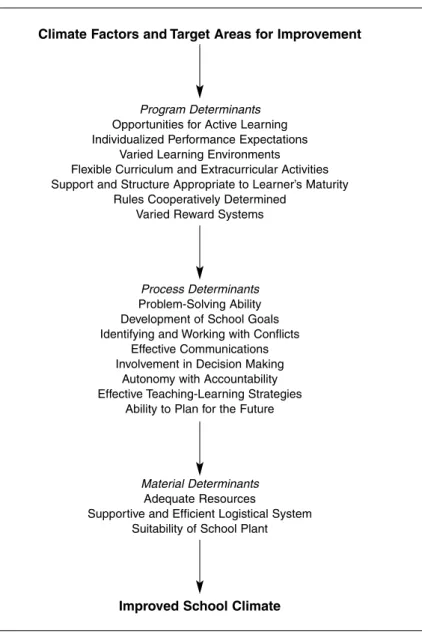
As we previously noted, one of the landmark publications in the area of school cli-mate improvement is Phi Delta Kappa’s publication, School Clicli-mate Improvement: A Challenge to the School Administrator (1973). Although the publication was first marketed nearly 30 years ago, its conceptual foundations remain applicable for practice in contemporary school settings. The publication, based on many of the climate concepts set forth in an earlier Charles F. Kettering Ltd. publication, sets forth school climate factors under three categories:program, process, and material determinants. Figure 8.2 presents each of the three climate dimensions and the provisions that accompany them. The CFK Ltd. instrument includes each of the cli-mate determinants set forth in Figure 8.2.
Climate improvement begins with assessing the school’s climate for the pur-poses of ascertaining areas targeted for improvement, determining a foundation for the purposes of ascertaining areas targeted for improvement, and determining a foundation for evaluating climate improvement changes resulting from specific program actions. Improvement procedures include the following action steps:
1. Human resources administrators must gain an understanding of school cli-mate and its determinants. They must also be knowledgeable of clicli-mate assessment procedures.
2. Human resources administrators must examine their leadership role in a program of climate improvement. Such an examination centers on leadership
responsibilities in assessing improvement needs, working to determine cooperative goals, determining actions strategies, implementing strategies, and monitoring progress and improvement results.
3. Human resources administrators must assume leadership in the implemen-tation of specific climate improvement projects. For each project, assessing improvement needs, setting objectives, implementing strategies, and control-ling the improvement process are required leadership actions. (Phi Delta Kappa, 1973)
Climate Factors and Target Areas for Improvement
Program Determinants Opportunities for Active Learning Individualized Performance Expectations
Varied Learning Environments Flexible Curriculum and Extracurricular Activities Support and Structure Appropriate to Learner’s Maturity
Rules Cooperatively Determined Varied Reward Systems
Process Determinants Problem-Solving Ability Development of School Goals Identifying and Working with Conflicts
Effective Communications Involvement in Decision Making
Autonomy with Accountability Effective Teaching-Learning Strategies
Ability to Plan for the Future
Material Determinants Adequate Resources
Supportive and Efficient Logistical System Suitability of School Plant
Improved School Climate
Figure 8.2 The School Climate Profile: Program, Process, and Material Determinants
SOURCE: Robert S. Fox et al. Phi Delta Kappa, School Climate Improvement: A Challenge to the School Administrator(1973). Reprinted by permission.
Thus, the route to school climate improvement depends largely on the extent to which program, process, and material determinants are being assessed, programmed, and monitored by school personnel. For example, the program determinant “individualized performance expectations” would be reflected in the attention given to the placement of students in appropriate learning environments scaled to their relative abilities, learning styles, and interests. Other considerations might include attention to teacher talents and interests in work assignments, the use of specially prepared teaching materials for individualizing instruction, and other program provisions that foster varied learning environments for students.
School Improvement Models and Strategies
Sweeney (1992) recommended several things that are needed for the improvement of climate in schools. He suggested that the first step in the process—awareness—is often the most difficult. “People need to understand what climate is, how it affects them and others, and what can be done to improve it” (p. 71). School personnel must identify the primary beliefs and values that should guide the school and what must be done to initiate a plan of action to implement these beliefs toward the goal of climate improvement.
Wilmore (1992) suggested three keys to the development of effective school cli-mate: (1) curriculum and instruction, (2) student affairs, and (3) parental support. She contended that curriculum should be student centered and that one of the best ways to promote positive school climate and an effective school is through a viable student affairs program. She also recognized that schools are not successful without a strong system of support from parents. Wilmore (1992) maintained that parental support stems largely from a sincere belief that school personnel truly care about the personal development of their child. Other studies, including the 1997 study by the National Center for Educational Statistics, have supported Wilmore’s con-tention that parental support is essential for positive school climates.
Human Resources Responsibilities
in the Improvement of School Climate
This text emphasizes that all school administrative personnel are humanresources administrators. As is true with every human resources process, the orga-nizational climate process is a shared responsibility among school leaders at all levels. Regardless of the position of the school administrator, we believe that the following primary responsibilities must be assumed. This belief is supported by the literature concerning successful programs and practices in the area of organi-zational climate.
1. The Development of a Set of Shared Goals. “Goals are those statements that set forth the purposes of the school system. Goals serve to clarify the aims of the school system; they provide a focus for the organization and give it a meaningful direction.
Goals express what is important to the school system overall and are undergirded by the beliefs, values, traditions, and culture of the school system’s community” (Norton et al., 1996, pp. 111–112). A primary process determinant of school climate is the development of a viable set of school goals. The significance of cooperative behavior as an important characteristic of school climate has been well established. In Barnard’s classic work, The Functions of the Executive (1938), he set forth the belief that cooperation is essential for individuals in an organization. Cooperation necessitates commitment to a set of group goals and, as Barnard emphasized, the formulation of organizational purposes and objectives is one of the three primary functions of all organizational leaders. Thus, human resources administrators must assume leadership roles in developing a set of shared goals that express the school or school system’s important and unique objectives. Once such goal statements are completed, a procedure for objectively examining these goals must be implemented. 2. Self-Image and High Expectations. We previously noted that effective schools, ones with healthy climates, hold high expectations for student and personnel perfor-mance. Levels of expectation should be such as to solicit the best performance that each teacher, student, or administrator has to offer. Viable goals provide a focus and give meaning to the people in the school. Such meaning is exemplified by the impor-tant work, personal motivations, and commitments of the school system’s human element. The meanings that are important to the system make up the system’s self-image. A positive self-image serves as a foundational component of an open, healthy school climate. Human resources leadership must work to develop a meaningful self-image for the organization, one that reflects the beliefs and values of importance to its stakeholders.
3. Opportunities for Personal Growth and Development. Healthy organizations understand that they will progress as people in the organization grow and develop. Schools with open, healthy climates tend to attract talented personnel who are motivated by opportunities to contribute and to be recognized for the important roles they play in the achievement of school purposes. Human resources adminis-trators help to develop the school system’s full potential by removing obstacles that inhibit growth opportunities, by assigning personnel in positions that allow human potential to be realized, and by establishing an environment that encourages cre-ative activity. Such an environment enables personnel in the school to be innova-tive, to develop different, more efficient, and more effective methods of achieving school goals and objectives. New and creative ideas must have a chance for imple-mentation, but without the freedom to fail under controlled conditions, such ideas will not likely be tested. Human resources leaders must work to provide opportu-nities for staff personnel to assume the major responsibility for their own personal growth. Such opportunities are more likely to exist in school systems that encour-age the use of individual strengths, and in which staff personnel believe that their thoughts and creations are welcome and respected.
4. Development of a Viable Set of Personnel Policies and Regulations. Many people believe that a school district’s personnel policies and regulations are a direct
reflection of how it values its human resources. Governance policies directly affect the work and life of school employees, and, therefore, human resources administra-tors must assume a leadership role in the development of such policies. School poli-cies and regulations affect the school climate in numerous ways. Polipoli-cies are an important means of implementing the established goals that direct programs and influence interpersonal relationships. Policies serve to release human potential by providing opportunities for discretionary action on the part of the professional staff. They serve an important communication role in helping all people under-stand the school system and its purposes, and, as we previously noted, a viable set of policies and regulations serves to release the strength and creativity of personnel and allows them to establish a basis for intelligent decision making within the sys-tem. In Chapter 9, we suggest that human resource administrators should be given the primary authority for developing viable personnel policy for the school district. Such a recommendation requires the HR director to be involved directly in all per-sonnel policy decisions of the school district. This responsibility provides HR leaders an opportunity to directly affect the climate of the school they serve.
5. Problem-Solving Capacity. Schools with healthy climates, like schools with less healthy ones, regularly face problems. A primary difference is that schools with positive climates have an identifiable problem-solving capacity. Climate char-acteristics that facilitate the availability to meet and resolve problems include open channels of communication, effective suggestion systems, a research posture, and recruitment and selection policies that encourage the hiring of a diversified staff. Human resources personnel must clearly identify ways to increase the effectiveness of communication, educate others about these channels, and facilitate their use. Effective problem solution and effective communication are inextricably related. Problem solving requires that the best ideas be heard and that they be considered on the basis of their merit as opposed to their origin. Open systems work diligently to increase the flow of ideas both vertically and horizontally within the system.
Human resources leadership necessitates the development of a research pos-ture within the school system. Problem solving often depends on the develop-ment of new knowledge. The effective human resources administrator is a consumer, facilitator, and disperser of good research, who realizes that creative solutions are often the outcome of research efforts that have objectively examined viable alternatives.
As we previously emphasized, a healthy school climate is not a product but a continuous process. Organizational climate is a people phenomenon, and people are the primary concern of human resources administration.
Summary
The human resources function by definition holds a primary responsibilityOrganizational climate is of paramount importance to the operation of schools and their personnel because it affects every process of the HR function. Early work in the area of organizational climate by Halpin, Croft, and others opened the field for numerous investigations on the topic. Their OCDQ spurred hun-dreds of empirical studies designed to ascertain the type of climate in various schools and led to major studies to determine the characteristics of various cli-mate types, the effects of clicli-mate on people behavior and student achievement, and the extent to which various types of climate influence innovation and change in organizations.
Various field studies have led to the development of frameworks that serve as models for improving climate in schools. Such models hold strong implica-tions for leadership by the school principal. Virtually every study in the area of school climate links the type of climate to the leadership behavior of the school principal.
The improvement of school climate is the responsibility of all school personnel. Nevertheless, human resources units and administrators have specific responsibili-ties in the administration of organizational climate, including developing a set of shared goals, fostering a positive self-image for the school system, providing oppor-tunities for personal growth and development, developing a viable set of personnel policies and procedures, and working to ensure a problem-solving capacity within the system.
Discussion Questions
1. Give thought to the climate of the school or school system that you know most about. What climate characteristics can you identify in each situation? After noting several climate characteristics for a particular school or system, attempt to label its climate type according to Halpin and Croft’s or Hoy and Tarter’s prototypes discussed in this chapter.
2. Discuss the approaches that today’s schools are using to change the environ-ments. Which factors tend to foster or inhibit positive climate in educational settings? Are these factors tied closely to monetary provisions or to factors more closely related to conditions of work, such as workload and administra-tive support?
3. This chapter suggests strongly that school principals have great influence on the school climate in their buildings. What changes might increase this influ-ence in the next several years? Are there changes that might serve to reduce this influence?
4. Reexamine the several characteristics of the program, process, and material determinants associated with the CFK Ltd. School Climate Profile. Which of these characteristics do you view as most important in conditioning school climate? Support your response with specific examples.
Case Studies
CASE 8.1M
AKING THEW
ORST OF AG
OODS
ITUATIONPrincipal William McChesney was the newly selected principal for Antonio High School. He was follow-ing in the footsteps of Art Lown, who had served for six years. Under the leadership of Principal Lown, Antonio High School had gained a reputation as one of the best schools in the southwest region. The teaching staff at Antonio was viewed as highly creative; three on the faculty had been named teacher of the year in the state. Turnover in the high school was quite low, and Principal Lown was viewed as an administrator who was highly supportive and easily approachable. Faculty and parents regretted his departure to California to head a developing program for at-risk students.
During the first week at Antonio High School, Principal McChesney sent a questionnaire to faculty members asking for their input on what improvements might be made in the school’s program and activities. The feedback from the faculty revealed their creativeness; many improvement ideas were presented. One member of the staff suggested that the principal’s control over curriculum be lessened and delegated largely to faculty personnel in the respective school departments. Another recom-mended a representative faculty advisory committee for the purpose of developing school policies and procedures in order to improve faculty involvement in participative management.
Principal McChesney did not act directly on any of the several recommendations received. At the sec-ond monthly meeting of the faculty, he commented, “I’ll take your ideas under advisement. I must say, however, that I was under the impression that I was entering a school with a happier family than is appar-ently the case.” One faculty member raised her hand to speak, but McChesney indicated that he would be following up on this matter soon. Within the next two weeks, he talked with faculty members indi-vidually about their suggestions. For the most part, he probed the matter about their apparent “unhap-piness” with the present school operation. The consensus of faculty responses implied that there were really no major problems at Antonio, but that any school had some room for improvements.
Over the next several weeks, directives from McChesney’s office centered on plans for focusing on performance evaluations, his desire to sit in on department meetings dealing with program and activi-ties within the school, and his intention to “flatten the organization” by eliminating the department heads by the end of the first semester. In addition, he sent a newly revised draft of recommended poli-cies and procedures for the faculty’s information.
By the close of the first semester, two department heads had asked to be relieved from the role, and three faculty members sent letters requesting transfers to other schools. For the first time in the school’s history, Antonio students held a “sit-in” in the school cafeteria; their protest focused on the lack of opportunity for input into the decision-making process. Both student and teacher absenteeism increased significantly as well.
As Principal McChesney sat in his office late one Friday afternoon, he contemplated the school situa-tion with some bewilderment. “How did this situasitua-tion change in so short a time?” he thought to him-self. “What should I do now?”
Questions
1. In view of the somewhat limited information in Case 8.1, present your thoughts about what seems to be happening at Antonio High School.
2. At this point, what positive steps might Principal McChesney take to reverse current climate trends? Do you believe that such a reversal is possible in this setting? Why or why not? 3. Discuss the situation in which a new school administrator moves into a school. Are there
rec-ommended procedures for entering such a new situation? Name two or more specific actions or behaviors that new administrators would be wise to consider on moving into a new leadership position.
References
CASE 8.2W
HAT’
SR
EALLYI
MPORTANTA
ROUNDH
ERE?
Virginia Royce was in her second year of teaching at College View High School. Her performance rat-ings for year one were “very good” in all categories. She had gained the reputation as one of the school’s most promising new teachers. At the close of school on a Friday in October, Mrs. Royce went to the principal’s office and asked if Mr. Henson, the principal, was available. The secretary answered in the positive and indicated that she was certain that he could visit with her.
“Come in, Mrs. Royce,” directed Principal Henson. “What’s on your mind on this late Friday after-noon?” “Something has been troubling me for several weeks,” answered Mrs. Royce. “So far this semester, six football players have been absent from my English class for the last period of the day on three occasions, and on two occasions they were absent for the full afternoon to play in out-of-town games, so they had to miss two other teachers’ classes as well on those days. Pep rallies generally are held the last class period of the day before games; it all adds up to the question of, ‘What’s really impor-tant around here?’”
Questions
1. Assume the role of Principal Henson in Case 8.2. How might you answer Mrs. Royce?
2. In your opinion, is it sufficient to respond that both subject-matter classes and extracurricular activities are important at College View High School? What other factors must you consider in this case?
3. Use the concepts of open climates, use of criticism, and open channels of communication for conflict resolution set forth in this chapter and apply them to Case 8.2. Write out your action plan that you would use to resolve the conflict described in the case. (Note: Class members couldbe assigned roles in Case 8.2 and role-play the situation using the conflict concepts in the chapter.)
Akin, J. (1993). The effects of site culture on reform. High School Magazine, 1(1), 29. Aon Consulting Worldwide, Inc. (1998). America @ work. Chicago: Author.
Barnard, C. I. (1938). The functions of the executive. Cambridge, MA: Harvard University Press. Bennett, R. E. (1969). An analysis of the relationships of organizational climate to innova-tions in selected schools of Pennsylvania and New York. Dissertation Abstracts, 30, 942A. Bentley, R. R., & Rempel, A. M. (1980). The Purdue teacher opinionaire. West Lafayette, IN:
Purdue University Office of Technology Commercialization.
Bobbett, G. C., & French, R. L. (1992). Evaluation of climate in “good” high schools in
Tennessee, Kentucky, and North Carolina. Paper presented at the annual meeting of the
Southern Regional Council on Educational Administration, Atlanta, GA. Buckingham, G. (2000, February). Same difference. People Management, 6(4), 45.
Bulach, C. R., & Malone, B. (1994). The relationship of school climate to the implementation of school reform. ERS Spectrum, 12(4), 3–8.
Butler, E. D., & Albery, M. J. (1991). Tennessee school climate inventory: A resource manual. Memphis, TN: Memphis State University, Center for Research in Educational Policy. Christian, C. F. (1972). Organizational climate of elementary schools and the introduction and
utilization of innovative educational practices. Unpublished doctoral dissertation,