Victor Eduardo Cabrita Ortuño
TIME PERSPECTIVE STABILITY:
STUDIES WITH A MULTIDIMENSIONAL MODEL
IN THE UNIVERSITY CONTEXT
Doctoral Dissertation in the scientific domain of Psychology, speciality Motivation and Personality, supervised by Sras. Professoras Doutoras Maria Paula Paixão and Isabel Nunes Janeiro and presented to the Faculty of Psychology and Educational Sciences of the University of Coimbra.
TIME PERSPECTIVE STABILITY:
STUDIES WITH A MULTIDIMENSIONAL MODEL
IN THE UNIVERSITY CONTEXT
Doctoral Dissertation
Title: Time Perspective Stability: Studies with an Multidimensional Model in the University Context
Author: Victor Eduardo Cabrita Ortuño
Scientific Supervision: Maria Paula Paixão | University of Coimbra Isabel Nunes Janeiro | University of Lisbon
Scientific Domain: Psychology | Motivation and Personality
Institution: Faculty of Psychology and Education Sciences | University of Coimbra
This work has been developed with a Doctoral Grant awarded by the Fundação para a Ciência a e Tecnologia do Ministerio da Ciência, Tecnologia e Ensino Súperior [SFRH/BD/33648/2009]
The future belongs to those
who believe in the beauty of their dreams.
Este trabalho é inteiramente dedicado
a todos aqueles que estiveram a todos aqueles que estão a todos aqueles que vão estar
mas por um mundo inteiro de razões especialmente a ti, C*
At certain time I was walking in downtown of Faro with a good friend of mine and she look at me at says something like "Victor, I don´t know how you do it but you are such a strong person", commentary which a reply stating (with a unusual kind of wisdom) that I´m not a strong person, is the people around me that give me strength. I was and I am still truly convinced of this. Is all these people around me that allow me to keep going, to push a little further and is to that all people that I owe my gratitude. I know that is not fair not to mention you all, but is truly impossible to me to achieve that.
As so, I´m going just to refer a few really amazing people that have been present in my life.
To both my supervisors, Maria Paula Paixão and Isabel Janeiro, thank you very much for enduring me in these last four years, I know I´m not the most easy person to deal with, but you always showed great patience and kindness for my good, my bad and specially my terrible ideas. Thanks a lot for sharing with me all your knowledge and helping me through this and other projects that we have
To Catarina Gomes, I guess I owe some prize or something like that, because you are just amazing and always there for me and I just can´t find enough words to express it.
To Willy Lens and Rachel Seginer, thanks for convincing me to write this work in English. I have to admit, now that is done it really feels like the right choice. Thanks a lot.
And to João Carlos Arruda, Jaime Martins, Alejandro Vásquez, Pedro Cordeiro and Victor Alfonso Ortuño, you´re simply the best friends a person can ask.
I have a lot more reasons to thank each one of you, but I just want to end saying to you all…
The individual’s subjective notions about time represent a vast and relevant topic with strong implications not only for the understanding of human behaviour but also because they function as the backbone for critical cognitive processes and permeate the objects perceptive process. Amongst these very unique and individual notions there is one that has gained tremendous prominence in recent decades and which is called Time Perspective. This construct has been considered for many years as a keystone in the motivational domain, more specifically in the school context and through its future frame or Future Time Perspective. Recent theoretical and empirical developments have also demonstrated the importance of Time Perspective in a wide array of behaviours and cognitions. Yet, although empirically validated by several authors, in different countries and with different methodologies, there is still a lack of information about which external influences affect the stability of Time Perspective as a cognitive process.
Transcendental Future (Boyd & Zimbardo, 1997) and the notion indirectly referred to by Lewin (1965) of Future Negative. This model’s predictive and conceptual validity is tested through a series of studies using Structural Equation Modelling in which Time Perspective appears as an important predictor of several well-known psychological traits such as Consideration of Future Consequences or Self-Esteem.
In the present study we also intended to shed light on the issue of Time Perspective stability, testing it through two studies which intend to clarify: i) what are the differences observed in the individuals’ Time Perspective when assessed in two different contexts and ii) what the differences observed in Time Perspective after a one-year time period. In other words we intend to explore Time Perspective’s contextual and temporal stability.
The obtained results suggest that context has little or no effect on Time Perspective, since no strong differences were found between the assessments in the college and the home context. Regarding the temporal stability of Time Perspective, the results allow us to consider that in a one-year period Time
Keywords: time perspective stability
As noções individuais e subjetivas acerca do tempo representam um vasto e importante tópico com fortes implicações no entendimento acerca do comportamento humano, e constituem um pilar para diversos processos cognitivos fundamentais, permeando ainda o todo o processo percetivo. De entre as diferentes noções acerca do tempo, há uma que tem conseguido um extraordinário destaque nas décadas recentes e que é denominada de Perspetiva Temporal. Este constructo tem sido considerado por muitos anos uma pedra angular no domínio motivacional, mais especificamente no contexto escolar, e principalmente através da sua dimensão de futuro ou Perspetiva Temporal de Futuro. Recentes desenvolvimentos tanto a nível teórico como empírico têm demostrado a importância da Perspetiva Temporal num amplo conjunto de comportamentos e cognições. No entanto, ainda que este conceito tenha sido validado empiricamente por diversos autores, em diversos países e com diferentes metodologias, continua a persisitir uma lacuna relativamente ao conhecimento dos fatores externos que afetam a estabilidade da Perspetiva Temporal como um processo cognitivo global.
Transcendental (Boyd & Zimbardo, 1997) e a noção indiretamente referida por Lewin (1965) de Futuro Negativo. A validade preditiva e concetual deste modelo foi testada através do método de Modelação de Equações Estruturais, tendo sido demostrado o importante poder preditivo da Perspetiva Temporal em traços psicológicos tais como a Consideração das Consequências Futuras ou a Autoestima.
Neste trabalho também foi a nossa intenção esclarecer a problemática relacionada com a estabilidade da Perspetiva Temporal, a qual foi verificada através de dois estudos nos quais se tentou responder às seguintes questões: i) quais são as diferenças na Perspetiva Temporal dos participantes quando medidas em dois contextos diferentes e ii) quais são as diferenças na Perspetiva Temporal dos participantes um ano depois da primeira avaliação. Por outras palavras, interessou-nos explorar a estabilidade temporal e contextual da Perspetiva Temporal.
Os resultados obtidos permitem-nos sugerir que o contexto presente tem pouco ou nenhum efeito na Perspetiva Temporal, já que não foram verificadas
relativamente estável, já que não foram encontradas diferenças estatisticamente significativas em nenhuma das suas dimensões.
Palavras-chave: perspetiva temporal estabilidade
Las nociones individuales y subjetivas acerca del tiempo representan un vasto e importante asunto con fuertes implicaciones en la comprensión relativa al ser humano pero también estas mismas sirven como pilar para variados procesos cognitivos que son fundamentales, así como también impregna todo el proceso cognitivo perceptual de objetos. Dentro de estas únicas e individuales nociones acerca del tiempo hay una que se ha destacado extraordinariamente de las otras, nos referimos a la Perspectiva Temporal. Este constructo ha sido considerado ya durante muchos años como una piedra de base en el dominio motivacional y más específicamente en el contexto escolar, principalmente a través de su dimensión de futuro o Perspectiva Temporal de Futuro. Recientes avances tanto a un nivel teórico como empírico han demostrado la importancia de la Perspectiva Temporal en un amplio conjunto de comportamientos y cogniciones. Sin embargo, aunque este concepto ha sido validado empíricamente por varios autores, en diferentes países y usando diferentes metodologías, aún persiste una falta de conocimiento relativamente a cuales los factores externos que afectan a la estabilidad de la Perspectiva Temporal como un proceso cognitivo.
Perspectiva Temporal a través del desarrollo de un modelo integrativo que combina el modelo de cinco dimensiones de Zimbardo & Boyd (1999), el Futuro Transcendental (Boyd & Zimbardo, 1997) y la noción indirectamente referida por Lewin (1965) de Futuro Negativo. La validad predictiva y conceptual de este modelo es puesta a prueba a través del método de Modelación de Ecuaciones Estructurales, por el cual es demostrado el importante poder predictivo de la Perspectiva Temporal en trazos psicológicos tales como la Consideración de las Consecuencias Futuras o la Autoestima.
En este estudio también fue nuestra intención aclarar la problemática relacionada con la estabilidad de la Perspectiva Temporal, la cual fue verificada a través de dos estudios en los cuales se intentó responder a las siguientes preguntas: i) cuales son las diferencias observadas en la Perspectiva Temporal de los participantes cuando medidas en dos contextos diferentes y ii) cuales son las diferencias en la Perspectiva Temporal de los participantes un año después de la primera evaluación. En otras palabras nos interesa explorar la estabilidad temporal y contextual de la Perspectiva Temporal.
escolar y el contexto hogar. Relativamente a la estabilidad temporal de la Perspectiva Temporal, los resultados nos permiten considerar la Perspectiva Temporal dentro de un periodo temporal de un año es un constructo relativamente estable, ya que no se verificaron diferencias estadísticamente significativas en ninguna de sus dimensiones.
Palabras clave: perspectiva temporal estabilidad
Contents Index
Acknowledgements ... 8 Abstract ... 10 Resumo ... 13 Resumen ... 16 Contents Index ... 1 Tables Index ... 5 Figures Index ... 7Abbreviations and Acronyms List ... 10
I n t r o d u c t i o n ... 11
P a r t I T i m e c o m p r e h e n s i v e t h e o r i e s ... 15
Chapter 1 Tempus regit actum ... 16
1.1 Tempo… What??? A comprehensive introduction to time in Psychology ... 18
1.2 A few subjective temporality-related concepts ... 24
1.3 Time Perspective: A core concept for human understanding ... 33
1.4 Properties of Time Perspective ... 47
1.5 Our approach to Time Perspective ... 59
1.6 Measurement techniques ... 66
1.7 Psychological Interventions on TP ... 72
1.8 Shortcomings in the study of Subjective Time... 77
Chapter 2 Time Perspective and… ... 92
2.2 Health and Well-Being Studies ... 98
2.3 Work and Organizational Themes ... 105
2.4 Pro-Environmental Behaviours... 109
2.5 Digital Life ... 111
Chapter 3 Time Perspective Stability ... 114
P a r t I I M e t h o d ... 119
Chapter 1 Participants ... 120
1.1 ZTPI Confirmatory Factor Analysis ... 120
1.2 TFTPS Exploratory & Confirmatory Factor Analysis ... 121
1.3 AISS Exploratory & Confirmatory Factor Analysis ... 122
1.4 TEIC Exploratory & Confirmatory Factor Analysis ... 123
1.5 A New Multidimensional Model of Time Perspective ... 123
1.6 The Relation Between Time Perspective and Temporal Extension ... 124
1.7 The Relation Between Time Perspective and Hope ... 124
1.8 The Relation Between Time Perspective and Consideration of the Future Consequences ... 125
1.9 The Relation Between Time Perspective and Sensation Seeking ... 126
1.10 The Relation Between Time Perspective and Self-Esteem ... 126
1.11 Temporal Changes in Time Perspective ... 127
1.12 Context Influence on Time Perspective... 127
Chapter 2 Instruments ... 129
2.1 Sociodemographic questionnaire ... 130
2.2 Zimbardo Time Perspective Inventory – ZTPI ... 130
2.3 Transcendental Future Time Perspective Scale – TFTPS ... 134
2.5 Temporal Extension Inventory of Coimbra – TEIC ... 142
2.6 Time Perspective Scale – TPS ... 144
2.7 Rosenberg Self-Esteem Scale – RSES ... 147
2.8 Adult Hope Scale – AHS ... 149
2.9 Consideration of the Future Consequences Scale – CFCS ... 151
Chapter 3 Procedures and Statistical Analyses ... 154
3.1 ZTPI Confirmatory Factor Analysis ... 155
3.2 TFTPS Exploratory & Confirmatory Factor Analysis ... 156
3.3 AISS Exploratory & Confirmatory Factor Analysis ... 157
3.4 TEIC Exploratory & Confirmatory Factor Analysis ... 158
3.5 A New Multidimensional Model of Time Perspective ... 158
3.6 The Relation Between Time Perspective and Temporal Extension ... 159
3.7 The Relation Between Time Perspective and Hope ... 160
3.8 The Relation Between Time Perspective and Consideration of the Future Consequences ... 161
3.9 The Relation Between Time Perspective and Sensation Seeking ... 161
3.10 The Relation Between Time Perspective and Self-Esteem ... 162
3.11 Temporal Changes in Time Perspective ... 163
3.12 Context Influence on Time Perspective ... 164
P a r t I I I R e s u l t s & D i s c u s s i o n ... 165
Chapter 1 Preliminary and preparatory statistical analyses ... 166
1.1 ZTPI Confirmatory Factor Analysis ... 167
1.2 TFTPS Exploratory & Confirmatory Factor Analysis ... 175
1.3 AISS Exploratory & Confirmatory Factor Analysis ... 191
Chapter 2 Time Perspective and its Association with other Temporal Variables ... 223 2.1 A New Multidimensional Model of Time Perspective ... 224 2.2 The relation between Time Perspective and Temporal Extension ... 231 2.3 The relation between Time Perspective and Hope ... 238 2.4 The relation between Time Perspective and Consideration of the Future Consequences ... 244 2.5 The relation between Time Perspective and Sensation Seeking ... 252 2.6 The relation between Time Perspective and Self-Esteem ... 258 Chapter 3 Time Perspective Stability ... 267 3.1 Temporal Changes in Time Perspective ... 267 3.2 Context Influence on Time Perspective ... 279 C o n c l u s i o n s ... 293 References List ... 304 A p p e n d i c e s ... 348 Appendix A ... 349 Appendix B ... 352 Appendix C ... 354 Appendix D ... 355 Appendix E ... 356
Tables Index
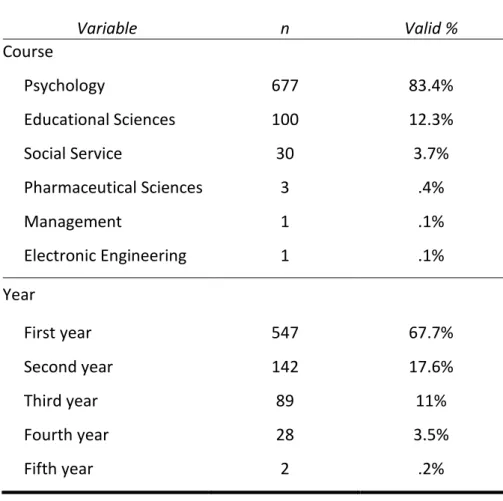
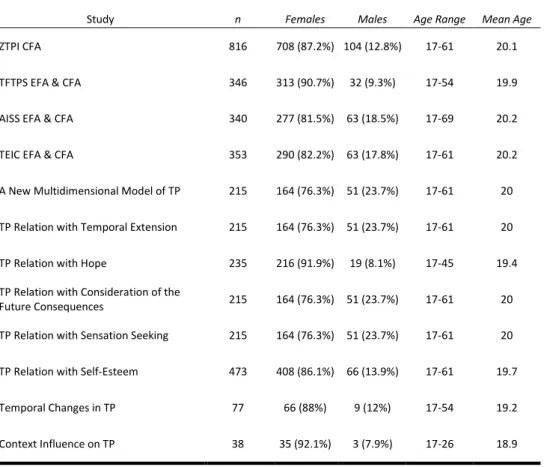
Table 1. Participants course and year (n = 811) ... 121 Table 2. Samples Summary ... 128
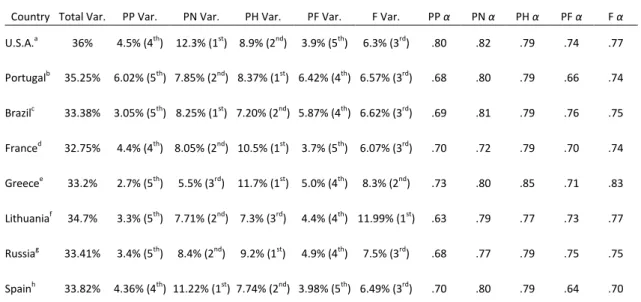
Table 3. ZTPI factor structure and internal consistency among several
international versions ... 132 Table 4. Portuguese AHS Model Adjustment Indices ... 151 Table 5. Little’s MCAR Test on ZTPI Subscales ... 156 Table 6. Portuguese ZTPI Fit Indices Comparison ... 172 Table 7. TFTPS Exploratory factor analysis (factor saturation, comunalities, mean, standard deviation and Cronbach´s alpha) ... 178 Table 8. TFTPS Exploratory factor analysis after item 5 removal (factor saturation, comunalities and Cronbach´s alpha) ... 180 Table 9. Correlations between TFTPS, ZTPI and TPS (only Negative Future) ... 182 Table 10. Portuguese TFTPS Fit Indices Comparison ... 190 Table 11. AISS Unrotated Component Matrix (20 items) ... 193 Table 12. AISS Rotated Component Matrix ... 195 Table 13. AISS Rotated Component Matrix, Communalities, Descriptive Statistics and Internal Consistency (12 items) ... 198 Table 14. AISS Fit indices and model comparison ... 202 Table 15. AISS International Versions Factor Structure Comparison ... 204 Table 16. AISS12 Correlations (ZTPI, TPS, TFTPS, CFCS, SWLS, RSES & EBDS) .... 206
Table 17. TEIC Component Correlation Matrix ... 211 Table 18. TEIC Factor Structure (Pattern Matrix) and Psychometric Characteristics ... 213 Table 19. TEIC Fit Indices and Model Comparison ... 219 Table 20. Correlations of Future and Past Temporal Extensions with seven Time Perspectives ... 232 Table 21. Summary of Regression Analysis of Time Perspective Predicting Temporal Extension ... 234 Table 22. Standardized Direct and Indirect Effects of the Consideration of Future Consequences Mediation Model ... 248 Table 23. Mediational Models of Consideration of Future Consequences Fit Indices and Model Comparison ... 249 Table 24. Fit indices and model comparison of the Regressional SS <- PT Models ... 255
Table 25. Means, Standard Deviations and Correlations of RSES, ZTPI, TFTPS and
TPS (n = 473) ... 259 Table 26. Fit Indices and Model Comparison ... 260 Table 27. Repeated Measures Descriptive Statistics, Within-Subjects Contrasts and Estimates ... 270 Table 28. DBTP Descriptive Statistics and Paired T-Test (n = 65) ... 275 Table 29. Differences in Time Perspective between Places (Repeated Measures Descriptive Statistics, Within-Subjects Contrasts and Estimates) (n= 38) ... 282
Figures Index
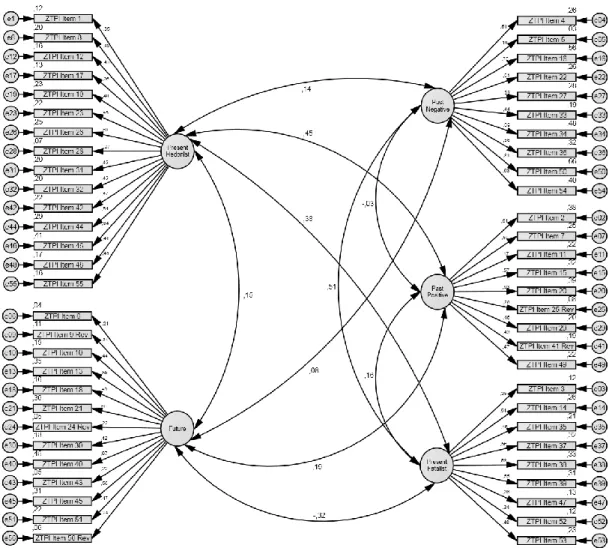
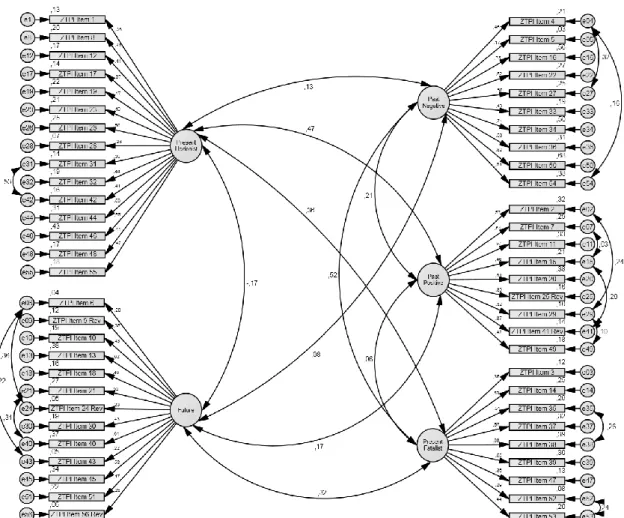
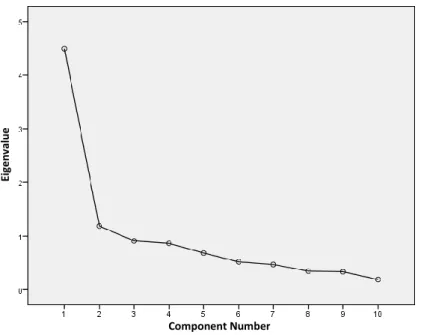
Figure 1. An illustrative model of Time Perspective ... 37 Figure 2. Three constituent aspects of Psychological Time according to Nuttin & Lens (1985) ... 49 Figure 3. ZTPI Confirmatory Factor Analysis Path Diagram (Model 1) ... 168 Figure 4. ZTPI Confirmatory Factor Analysis Path Diagram (with several residuals correlated, Model 2) ... 170 Figure 5. Brief ZTPI Confirmatory Factor Analysis Path Diagram (Model 3) ... 171 Figure 6. TFTPS Scree Plot (10 items) ... 177 Figure 7. TFTPS Scree Plot (after item 5 removal) ... 179 Figure 8. TFTPS Confirmatory Factor Analysis Path Diagram (Model 1) ... 187
Figure 9. TFTPS Confirmatory Factor Analysis Path Diagram After Item 5 Removal
(Model 2) ... 188 Figure 10. TFTPS Confirmatory Factor Analysis Final Path Diagram with 7 Items (Model 3) ... 189 Figure 11. AISS Scree Plot (20 items) ... 194 Figure 12. AISS Scree Plot (12 Items) ... 196 Figure 13. AISS Model Path Diagram of Model 3 (Standardized Estimates) ... 201 Figure 14. TEIC Scree Plot... 210 Figure 15. TEIC Model 1 Path Diagram (Standardized Estimates) ... 216 Figure 16. TEIC Model 2 Path Diagram (Standardized Estimates) ... 217
Figure 17. TEIC Model 3 Path Diagram (Standardized Estimates) ... 219 Figure 18. 7-Dimensions Time Perspective Model Path Diagram ... 226 Figure 19. Path Diagram of the Proposed Model of the Regressional Analysis of the Concept of Hope (Model 1) ... 239
Figure 20. Path Diagram of the Corrected Model of the Regressional Analysis of
the Concept of Hope (Model 2) ... 240 Figure 21. Path Diagram of the Proposed Model of the Regressional Analysis of the Concept of Consideration of Future Consequences (Model 1) ... 245 Figure 22. Path Diagram of the Model of the Regressional Analysis of the Concept of Consideration of Future Consequences (Model 2) ... 247
Figure 23. Path Diagram of the Proposed Model of the Regressional Anaylisis of
the Concept of Sensation Seeking (Model 1) ... 254
Figure 24. Path Diagram of the Corrected Model of the Regressional Analysis of
the Concept of Sensation Seeking (Model 2) ... 255 Figure 25. Model 2 Path Diagram (Standardized Estimates) ... 261 Figure 26. Model 3 Path Diagram (Standardized Estimates) ... 262 Figure 27. Past Positive Mean in First and Second Assessment Moment... 271 Figure 28. Past Negative Mean in First and Second Assessment Moment ... 271
Figure 29. Present Hedonist Mean in First and Second Assessment Moment ... 272
Figure 30. Present Fatalist Mean in First and Second Assessment Moment ... 272 Figure 31. Future Mean in First and Second Assessment Moment ... 273
Figure 33. Transcendental Future Mean in First and Second Assessment Moment ... 274 Figure 34. Past Positive Mean in First (College) and Second (Home) Assessment Moment ... 283
Figure 35. Past Negative Mean in First (College) and Second (Home) Assessment
Moment ... 283
Figure 36. Present Hedonist Mean in First (College) and Second (Home)
Assessment Moment ... 284
Figure 37. Present Fatalist Mean in First (College) and Second (Home)
Assessment Moment ... 284
Figure 38. Future Mean in First (College) and Second (Home) Assessment
Moment ... 285
Figure 39. Future Negative Mean in First (College) and Second (Home)
Assessment Moment ... 285 Figure 40. Transcendental Future Mean in First (College) and Second (Home) Assessment Moment ... 286
Figure 41. Future Temporal Extension mean in First (College) and Second (Home)
Assessment Moment ... 287 Figure 42. Past Temporal Extension Mean in First (College) and Second (Home) Assessment Moment ... 287
Abbreviations and Acronyms List
Concepts
BTP – Balanced Time Perspective
CFC – Consideration of Future Consequences DBTP – Deviation from a Balanced Time Perspective FO – Future Orientation
FTP – Future Time Perspective SS – Sensation Seeking
TFTP – Transcendental Future Time Perspective TP – Time Perspective
Instruments
AISS – Arnett Inventory of Sensation Seeking BTPS – Balanced Time Perspective Scale
CFCS – Consideration of Future Consequences Scale RSES – Rosenberg Self-Esteem Scale
SSS – Sensation Seeking Scale
TEIC – Temporal Extension Inventory of Coimbra TFTPS – Transcendental Future Time Perspective Scale TPS – Time Perspective Scales
ZTPI – Zimbardo Time Perspective Inventory
Statistical techniques
CFA – Confirmatory Factor Analysis EFA – Exploratory Factor Analysis KMO – Kaiser-Meyer-Olkin Index SEM – Structural Equation Modeling
The genesis of time as a psychological phenomenon can be understood by the constructivist point of view proposed by Piaget (1986). Within this model, the knowledge (in this specific case, temporal) does not come solely from the external objects of the individual (empiricism) nor from endogenous structures already present in him/her (innateness), but originates from the interaction of these two components (Piaget, 1986). Also, through Piaget’s (1977) experiments, we learned that time is critical in the intellectual development of children, but the opposite is also true: the intellectual development of children is crucial to understand temporal phenomena. In other words the subjective and unique individual’ notions about time develop through interaction with the external world (Santos, 1972), more specifically by socializing, modelling, education, cultural and other environmental factors (Seginer, 2003).
With this reasoning in mind, the main goal of this work is to explore the stability of a well-known temporal dimension, that of Time Perspective as conceptualized by Zimbardo & Boyd (1999). As secondary goals, we have defined the linguistic and cultural adaptation of several psychological assessment instruments related to subjective temporality, and also to explore the relation of the dimensions they assess with the concept of Time Perspective.
The present work will be organized into three parts. Part I encompasses a theoretical study about subjective time and we will discuss, among other issues, several temporal concepts putting an emphasis on the concept of Time Perspective (which is central to this work), namely its constituent dimensions (or properties), focusing on the operational model that we used in the several empirical studies that are included in this dissertation. Additionally, we reflect upon the main shortcomings that we have identified in the study of subjective time. Also, a brief exploration is made regarding the relation of Time Perspective with several cognitive and behavioural outcomes, and the issue of the stability of Time Perspective is addressed.
The second part is entirely dedicated to the methodology employed in the studies. Chapter 1 presents the samples of each study, Chapter 2 the instruments employed and Chapter 3 the several procedures and statistical analyses.
The third part of this work will serve to present the obtained results and respective discussion. In Chapter 1 we present the preliminary psychometrical analyses of the several assessment instruments used in the studies. Chapter 2 focuses on the exploration of the relations of an integrative model of Time Perspective with several temporal-related constructs (such as Hope and Consideration of the Future Consequences) and individual trait variables (such as
Sensation Seeking and Self-Esteem). Finally, in Chapter 3, we present the results concerning the stability of Time Perspective.
The last part of this thesis is dedicated to drawing the main conclusions regarding the obtained results.
Part I
Time comprehensive
theories
“What gets us into trouble is not what we don't know. It's what we know for sure that just ain't so”
Chapter 1
Tempus regit actum
1Our intention with this chapter is to provide an introduction to the vast topic which is time and more specifically the study of time in psychology. This chapter will be divided into sub-chapters of which the intent is to facilitate the understanding of the various topics being approached.
The first of these sub-chapters (see 1.1 Tempo… What??? A comprehensive introduction to time in Psychology) will consist of a historical summary about the idea of time, the interest of other sciences in it and more precisely which were the first approaches that Psychologists made in order to conceptualize and operationalize time.
The second sub-chapter (see 1.2 A few subjective temporality-related concepts) will evolve around a number of concepts that are deeply related to subjective temporality and that sometimes are mistakenly referred to as Time Perspective. The concepts analysed are Hope, Sensation Seeking and Consideration of Future Consequences.
1
In the following sub-chapter (see 1.3 Time Perspective: A core concept for human understanding) we will develop the conceptualization of the concept of Time Perspective, which is central to this research. We are going also to refer to a new approach to the study of Time Perspective which has been evolving in recent years, that is the two possible outcomes regarding the individual’s Time Perspective, or individual’s temporal profile, which are the Biased Time Perspective and the opposite, the Balanced Time Perspective.
The subsequent sub-chapter (see 1.4 Properties of Time Perspective) will serve as an introduction to the various dimensions of Time Perspective, for example: Extension, Density and Attitude among others. This has been one of the most controversial topics in the study of Time Perspective since different authors consider a different composition for Time Perspective construct.
Sub-chapter 1.5 Our approach to Time Perspective, will function as a presentation to the theoretical model of Time Perspective proposed by Zimbardo & Boyd (1999) but also to its latest development which is the inclusion of a sub-scale regarding the Transcendental Future. Nevertheless, in this sub-chapter we will also address another temporal dimension that we consider pivotal in the study of the individual’s temporal profile, which is the Future Negative.
In the next sub-chapter (see 1.6 Measurement techniques) we will summarize what we consider the most important instruments developed to measure Time Perspective and similar concepts such as Temporal Focus. In the
sub-chapter 1.7 Psychological Interventions on TP we will elaborate around the possible interventions aimed at changing or somehow modifying individuals’ Time Perspective. The last sub-chapter (see 1.8 Shortcomings in the study of Subjective Time), consist of a brief presentation of several of the shortcomings or deficiencies that we believe exist in the study of Time Perspective and subjective temporality.
1.1 Tempo… What??? A comprehensive introduction to time in
Psychology
Time is a concept or a construct that has been intimidating and fascinating humans since immemorial time, as it has an enormous potential for structuring all human experiences (Kant, 1781/1997). Mankind has tried to understand, capture and recreate time and its influence on our daily lives through literary and artistic work, but also through our "newly formed" sciences. Hence, "Time is one of the classic concepts whose study still holds a timeless relevance" (Dias, 2009, p. 42). Time, or more specifically the unique human ability of thinking about the future, has even been considered as a catalyst of our species’ success (Husman & Shell, 2008) and certainly can be considered as one of our biggest evolutionary advantage over other species.
Due its complexity, time can be addressed through a philosophical, biological, physiological, physical or psychological point of view (Dubois, 1954). As such, it has been studied over the years by several scientific disciplines, like Philosophy, Physics and Psychology among others (Ortuño & Gamboa, 2009). This fact can be considered both as a strength or as a weakness in the scientific study of time. For example, Lasane & O’Donnell (2005) consider that the study of time through a one-dimensional paradigm represents smaller predictive and explicative power of it.
In the specific case of Psychology, the study of time is as old as scientific psychology itself. Palpable proof of this is the work of the father of modern Psychology, Wilhelm Wundt, about the individual’s temporal perception of varied stimuli (Jesuino, 2002). However, Wundt’s approach to time was entirely quantitative, in which the most individual and subjective components of time were not taken into account. For him time is an instrument to measure space, but space itself also serves to measure time and both operate as mental magnitudes to be employed in the measurement of another type of magnitude, the individual’s sensations and thereby other psychological phenomena (Wundt, 1907).
Thus, William James, the father of Psychology in the United States of America, highlighted the relevance of time through an entire chapter of his book, Principles of Psychology.
Later, with Sigmund Freud and Psychoanalysis, attention is drawn to early personal experiences. The individual’s subjective past is now an important component defining individual personality and explaining human behaviour and psyche. To Freud (1911, as cited in Lavik, 1969) the most influential experiences in human life are those that occur in one’s very first years of existence, since psychosexual development depends on it. If an individual successfully completed the defined stages, he/she would present a healthy psyche, whilst if not, a fixation which is a persistent focus in an earlier psychosexual stage can occur, and these fixations can be behaviourally manifested through the effects of a repetition compulsion. Yet, Freud’s theory doesn’t consider any type of influence regarding the time yet to come, or future, on present behaviour.
Then, with the advent of Behaviourism, time was devoid of any importance in the psychological panorama, since the causal relation Stimulus-Response is the main area of study; within this paradigm there is no room or need for considering the various motivational processes (Lens, 1988), even those related to temporality.
Lewin (1965) presents a model of time analysis which broke with the dominant paradigm of psychology at the time: behaviourism. He considers that the analysis of the subjective temporal dimensions of past and future have a central importance in the explanation of human cognition and behaviour, as they are always active in the present moment. In this sense, Lewin (1965) postulates that TP is “the totality of the individual’s views of his psychological future and
psychological past existing at a given time” (pp. 75). This vision of Time is opposed to the objective or physical approach proposed by St. Augustine and scientifically implemented by several authors through the concepts of time use (Harvey & Pentland, 1999) or time budgets (Robinson, 1999). In fact, it represents a more subjective and individual perspective on time, one which is more related to the world’s relativistic view of I. Newton. In order to study this paradigm several concepts have been proposed throughout the years: time personality, time estimation, time intensity, time urgency, perceived time use, subjective duration of experience or time perception, time congruity, polychronicity and monochronicity and time structure. Time Perspective is one of the latest additions to this great array of concepts.
In the last years this specific dimension of the human temporal thinking has undergone a growing interest from the scientific community (Janeiro, 2012). In the last three decades a line of study of psychological time has developed, based on the assumptions presented by Lewin (1965), but which also considers the influence of time on the characterization and development of societies. So, it is considered that psychological time or Time Perspective - TP shapes not only individuals but also groups and societies. Following the same line, Zimbardo and Boyd (1999) defined TP as the non-conscious process through which personal and social experiences are placed in categories or temporal frames. This helps individuals to give order, coherence and meaning to these same experiences. According to Husman & Shell (2008), Future Time Perspective (but also, Past and
Present related Time Perspectives in our conceptualization of TP) approach to time is not related to the physical phenomenon we experience every day, but is rather conceived as a subjective psychological phenomenon. Time Perspective is a relatively stable personality trait, which can still be affected by social, economic, religious and cultural influences (Zimbardo & Boyd, 1999). Holman & Silver (2005) reported significant differences in individuals’ TP and its evolution 3 years after a terrorist attack when taking into account age, level of education, marital and socio-economic status.
Zimbardo & Boyd’s model has been quite prolific in the quantity and diversity of studies that have been produced in varied psychology fields. For example, there are various studies that show how Future Time Perspective is associated with adaptive and functional situations, such as: various types of pro-environmental behaviours (Corral-Verdugo, Fraijo-Sing & Pinheiro, 2006; Milfont & Gouveia, 2006), academic achievement (Bembenutty & Karabenick, 2004; Boniwell & Zimbardo, 2004) and vocational development (Janeiro, 2010; Janeiro, 2008; Paixão, 2004). Meanwhile, dimensions like the Fatalistic Present, Past Negative and Present Hedonist (with very high scores) are associated with behaviours that can undermine a healthy developmental trajectory like, for example, risk driving (Zimbardo, Keough & Boyd, 1997), smoking and alcohol consumption (Keough, Zimbardo & Boyd, 1999), cannabis consumption (Apostolidis, Fieulaine, Simonin & Rolland, 2006), procrastination (Ferrari &
Diaz-Morales, 2007) among others. More information about the breakthroughs of TP research in diverse topics of Psychology will be presented in Chapter 2.
Yet, having a quick look into the psychological research about time (objective or subjective), it will be found that there is an uneven distribution of the number of publications about each one of the three temporal frames (past, present and future). Mainly, studies are focused on Future Time Perspective; some are about Present Time Perspective and only a few studies focus on the Past Time Perspective. Regarding this phenomenon Shores & Scott (2007) argue that "the bulk of time perspective research has investigated the relationship of future and present time perspectives to other psychological constructs and behavioral outcomes. Less empirical attention has been given to past orientations.” (pp. 31).
Probably, one cause for this setting concerning future having much more attention that the other two temporal frames is the influence of well-known authors like Nuttin and Lens (1985), Gjesme (1979; 1983) and Nurmi (1991), who devoted much of their research efforts to studying the influence of Future Time Perspective on individuals’ motivation. The first author states that Future Time Perspective is the individual’s main motivational space.
This is especially valid when exploring cognitions and/or behaviours profoundly related to planning, anticipation and achievement. But, as demonstrated by Ortuño & Vasquez (2013), Past Time Perspective is an
important predictor of variables such as Self-Esteem (Seema, Sircova, Pork & Baltin, 2010, July). Also, Ortuño et al., (2013c) reported that Past Negative Time Perspective is a significant and moderate predictor of Satisfaction with Life, Interpersonal Relations and Psychological Well-Being. As such, we consider that when studying individuals’ Time Perspective it is important to verify the entire personal temporal horizon, since depending on the nature of what we are studying, the different temporal frames can give a different contribution.
1.2 A few subjective temporality-related concepts
It is crucial to consider that regarding the study of subjective temporality, similar designations do exist, sometimes differing only in which element of the temporal thinking they focus on (Aspinwall, 2011). In another scenario, they are concepts which by their own characteristics have a strong association with temporal dimensions. We decided to present some of the concepts that, without being specifically considered as temporal dimensions, have a strong link to time considerations, and are known by their psychological importance.
The concepts to be presented are Hope, Sensation Seeking, Consideration of Future Consequences and Future Anxiety.
1.2.1 Hope
Lopez, Snyder & Pedrotti (2003) encountered 23 theoretical models or definitions of Hope. This is a fairly well-known concept to the layman who usually relates it to an affective state regarding possible events (Snyder, Feldman, Shorey & Rand, 2002). In the scope of Psychology C. Snyder is one of the most relevant contemporary authors who has been studying and improving this concept in recent decades. Snyder et al. (1991) defined Hope as “a cognitive set that is based on a reciprocally derived sense of successful (a) agency
(goal-directed determination) and (b) pathways (planning of ways to meet goals)” (pp.
571). This approach differs from most psychological theories about Hope, in the way that those usually consider Hope as an expectation about the achievement of a desired goal (Averill, Catlin & Chon, 1990; McGeer, 2004, Stotland, 1969). Still, Lopez et al. (2003) consider that this emotion-cognition division is fading and future approaches to Hope will include both as different components of this concept.
The fundamental axis of this theory works around three main concepts (Snyder et al., 2002): 1) Goals, which are “anything that an individual desires to get, do, be, experience, or create” (pp. 299). 2) Pathways, consisting of the individual’s perceived skills to create cognitive ways of achieving its goals. And 3) Agency, related to the individual’s cognitions about their own abilities to begin and continue the necessary effort to achieve goals. Pathway and Agency thinking mutually interact in a cognitive process with the intent to pursue and achieve
diverse goals (Snyder et al., 2002). The concept has been employed to explain a wide array of behaviours and cognitions, presenting an important predictive value. Snyder et al. (2002) mention the importance of Hope concerning both physical and mental health.
Tong et al. (2010) comment about several criticisms that have arisen due to the Hope model proposed by Snyder; in our opinion the most interesting is that regarding the difference in the nature of the Hope concept. Most studies have focused on the way that people think about hope, asking participants directly “How hopeful do you feel now?” or “How hopeful did you feel in this event?” (Mauro, Sato & Tucker, 1992; Smith & Ellsworth, 1987) instead of using questions that reflect a different vision of Hope. This is deeply related to Bruininks & Malle (2005) and Roseman, Spindel & Jose’s (1990) studies, which suggest that people’s hope has little to do with goal, agency or pathways thinking. In other words, as mentioned by Tong et al. (2010), it appears that Snyder’s model of Hope, and Hope as usually experienced by people are not so equivalent.
Hope as referred to by Snyder et al. (2002) was considered for years as an affective state. The effort developed by Snyder and colleagues goes precisely in the sense of clarifying the cognitive basis of this concept, in order to work scientifically with it. Still, it was during this transition from the affective approach to the cognitive analysis that interest in temporality appeared. According to the Hope model presented by Snyder, in order for an individual to be motivated
he/she needs to determine which his/her goals are, establish the processes via which he/she can achieve these same goals and still possess the belief that it is possible to be successful in this process.
Concerning the relation of this concept with other temporal variables, Aspinwall (2011) states that Hope is related to the content of Future Orientation, but there is no reference to the extent of this relation. Phan (2009) through a SEM approach and using a reduced version of ZTPI composed only by the Future and Present dimensions discovered that Hope is mainly influenced by Present Time Perspective, while Future Time Perspective exhibits a small influence, but without statistical significance. Still more evidence is needed in order to fully understand the association between Hope and a more complete characterization of the individual’s temporal profile, since Snyder (1991) considers that Hope is related not only with the future, but also with the past and the present.
We would like also to make a couple of considerations about the two main components of Snyder’s Hope. Pathways is defined as an individual’s ability to produce means to achieve certain goals (Snyder et al., 2002). We believe this to be highly related to Future Time Perspective, due for example, to the association reported by De Volder & Lens (1982) of the subjective value assigned to long-term goals and the instrumental value of the activities related to those same goals with school motivation and academic results. In the case of Agency, Snyder et al. (2002) present it as an individual’s cognition regarding his/her
ability to successfully achieve his/her goals, structurally different from the concepts of optimism and self-efficacy. Still, we consider that Agency is more an affective component of Hope, so temporal affectivity would certainly be related to it. Likewise, since Self-Esteem is considered as the evaluative part of self-concept (Heatherton & Wyland, 2003) and it is negatively correlated with the more negative dimensions of Time Perspective (Past Negative and Future Negative), we believe that those dimensions of TP will be equally negatively associated with Agency which is a dimension that would require a certain sense of self-evaluation.
1.2.3 Sensation Seeking
Sensation seeking is described by Zuckerman (1994, p. 27), as a ‘‘trait defined by the seeking of varied, novel, complex and intense sensations and experiences, and the willingness to take physical, social, legal and financial risks for the sake of such experience’’. It is considered as one of the dimensions of the Alternative Five personality model (Zuckerman, Kuhlman, Joireman, Teta & Kraft, 1993) and is referred to as one of the most broadly used constructs in researches about the relations between personality and diverse types of activities, such as sports (Zarevski, Marusic, Zolotic, Bunjevac & Vukosav, 1998). According to
Zuckerman’s (2008) ideas, Sensation Seeking as a personality trait emerges from the interaction of innate biological characteristics with environmental influences. Its relevance as a psychological construct lies in the cognitive and behavioural differences among low and high sensation seekers; the latter usually underestimate risks of potentially dangerous situations and are also more predisposed to engage in risky activities (Zuckerman, 1979; Horvath & Zuckerman, 1993). Still, it’s important to consider that not all sensation seeking activities are risky (Zuckerman, 2008); different individuals’ socialization environments can guide or suppress a sensation seeking tendency regardless of the situation potential risk (Arnett, 1994).
The origin of this concept is deeply related to two notions proposed by Wundt (1907): the optimal level of stimulation and the optimal level of arousal. Both were integrated into Breuer & Freud’s (1955) theory as the constancy principle, which indicates the individual’s predisposition to search and preserve an optimal level of excitement or stimulation, anything above or below this optimal level will cause psychological discomfort. The first sensation seeking scale was an attempt to measure differences in the individual’s need for stimulation (Zuckerman, 2008).
The concept itself is considered to have a strong biological basis in Zuckerman’s conceptualization (Zuckerman, 1994). Yet, Arnett (1994) argues that sensation seeking is heavily influenced by socialization, even if it is partially
mediated by a biological basis. Another difference in Arnett’s conceptualization is that sensation seeking does not necessarily represent a willingness to take risks.
The reported empirical evidence points towards sensation seeking (and its sub-dimensions) evolving along the individual’s lifespan: it has low levels during childhood, reaches its peak during adolescence and then experiences a decline (Roth, Schumacher & Brahler, 2005; Zuckerman, 1979).
Several inventories have been developed in order to measure this dimension, the most referred to in the literature are: the Zuckerman-Kuhlman Personality Questionnaire subscale, Impulsive Sensation Seeking– ImpSS (Zuckerman, 1994), the Novelty-Seeking Scale (Cloninger, 1987), the Arnett Inventory of Sensation Seeking – AISS (Arnett, 1994) and by far the most employed instrument regarding this concept, the Sensation Seeking Scale – SSS in its varied forms (Zuckerman et al., 1978).
The Sensation Seeking concept has a high discriminatory power between groups, for example Zarevski et al. (1998) using both AISS and SSS inventories found important differences amongst athletes engaged in low or high risk sports in all the inventories’ subscales. Sensation seeking is also associated with sexual behaviours, such as the number of partners (Zuckerman, Tushup & Finner, 1976), and according to Hoyle, Fejfar & Miller (2000) sensation seeking is the personality trait most consistently related to risky sex. In the relational aspect,
sensation seeking also serves as an important discriminating factor between unmarried (Thornquist, Zuckerman & Exline, 1991) and married couples’ (Schroth, 1991) relationship satisfaction. Still, sensation seeking is not only correlated with risky behaviours; high sensation seekers compared to low sensation seekers prefer explicit sex in TV, movies and magazines (Brown, Ruder, Ruder & Young, 1974), more violence (Lawrence & Palmgreen, 1996; Zuckerman, 2006) and action in movies (Slater, 2003).
Sociodemographic variables do present a significant effect on the sensation seeking overall score, as do novelty and intensity sub-dimensions, yet this effect is small enough to be ignored (Roth et al., 2005).
Regarding its relation with Time Perspective, Zimbardo & Boyd (1999) suggest that Sensation Seeking is an overt construct through which the influence of Time Perspective can be manifest and it is mainly related to present-oriented functioning, as can be observed by its positive and significant correlations with Present Hedonist and Present Fatalist Time Perspectives (Keough et al., 1999; Zimbardo & Boyd, 1999; Zimbardo et al., 1997).
The capacity to foresee one’s personal future and mentally time travel is a shared and probably unique human feature. It has been suggested that it is a great adaptive advantage for our species (Suddendorf & Corballis, 2007). But this capacity also posits an internal conflict between immediate versus distant outcomes and rewards of our behaviour. For example, some people sacrifice an immediate pleasure or benefit for a distant, subjectively better outcome (e.g.: not eating desert now to be slimmer in the summer). To address scientifically how people respond differently to these dilemmas, the concept of consideration of future consequences was proposed. The study of individual differences in the consideration of future consequences was defined as “the extent to which people consider the potential distant outcomes of their current behaviors and the extent to which they are influenced by these potential outcomes” (Strathman et al., 1994, pp. 743). It was shown that the CFC is a reliable, stable, and valid construct, related to many other psychological and social phenomena.
According to Aspinwall (2011) the CFC concept is mostly related to the subjective value of future versus present outcomes. In Zimbardo & Boyd’s (1999) study, this concept, it was positively correlated only with the Future Time Perspective; the correlation with the other temporal dimensions (Past Negative, Present Fatalist and Present Hedonist) was negative and no correlation with Past Positive was found.
The Future Anxiety concept was proposed by Zaleski (1996), in which he defined it as “a state of apprehension, uncertainty, fear, worry and concern of unfavorable changes in a more remote personal future” (pp. 165). Zaleski, following previous conceptions of Anxiety (Bandura, 1988), defends that Future Anxiety is more a cognitive than an emotional concept. Holman & Silver (2005) understand Future Anxiety as a cognitive (and temporal in our opinion) bias towards the future. This concept has been associated with high levels of stress (Otrar, Eksi, Dilmac & Sikin, 2002). We further agree with Aspinwall (2011) who considers that the concept of Future Anxiety is deeply related to the content of Future Orientation.
1.3 Time Perspective: A core concept for human understanding
In our understanding, one of the most important concepts regarding the individual’s temporality is the concept of Time Perspective. First referred to by Frank (1939, as cited in Lewin, 1943), it is a concept related to the individual’s life-space and which is not limited by the present time: on the contrary, it includes also the individual’s remembered past and the imagined future. The importance of this concept for Psychology is underlined by Lewin (1942) when he states that “the behavior of an individual does not depend entirely on his present
situation. His mood is deeply affected by his hopes and wishes and by his views of his own past” (pp. 104).
These early approaches to Time Perspective stand out as transitory motivational states which affect the individual’s level of aspiration, mood, constructiveness and initiative at a given time (Lewin, 1943). Lens (1986) suggests that the operationalization of Future Time Perspective (and consequently of Time Perspective) over time has evolved from being considered as a motivational state to its conceptualization as a more stable personality trait.
The theoretical framework about Time Perspective proposed by Lewin encouraged an avalanche of studies regarding subjective time (Nuttin & Lens, 1985). Also, it served as the foundation for subsequent theoretical models about subjective time, such as Nuttin & Lens’ (1985) model of Time Perspective.
These authors conceive Time Perspective as a cognitive-spatial concept; cognitive because it is formed by motivational objects or events that exist on the cognitive level of behavioural functioning, spatial because these same motivational objects of events are cognitively located in a temporal continuum. Individuals perceive any of these motivational objects as being located either in the past, present or future even when in fact, physically, those same objects or events are being thought by the individual in the present moment.
In this model Nuttin & Lens (1985) consider that Time Perspective is characterized by its extension, density, degree of structuration and level of
realism but the topic of Time Perspective properties will be extensively discussed in the next sub-chapter.
One of the latest models of Time Perspective which follows Lewin’s and also Nuttin & Lens’s theory is proposed by Zimbardo & Boyd (1999). This new approach is characterized by a multi-dimensional approach of Time Perspective. While Nuttin & Lens (1985) acknowledge the existence of the past and future temporal frames (or Time Perspectives), they decide to focus mainly in the motivational impact of the Future Time Perspective on present behaviour2, whilst Zimbardo & Boyd’s (1999) proposal refers to an integrative view of all individual temporal frames, including the past, the present and the future and functioning as a cognitive-motivational process with large implications not only for motivation, but also for objects perceptions.
According to Zimbardo & Boyd (1999) Time Perspective is “the often nonconscious process whereby the continual flows of personal and social experiences are assigned to temporal categories, or time frames, that help to give order, coherence, and meaning to those events” (pp. 1271). The authors also refer to Time Perspective’s involvement in all the process of encoding, storing and retrieving of past events as well as in the development of expectations and goals. As such, Time Perspective has a strong impact at both a cognitive and a behavioural level.
2
We would like to stress two aspects of Time Perspective that define very well the extent and importance of its influence not only on behaviour, but also on several important cognitive processes. The first aspect is concerned with Time Perspective’s contribution to individuals in the cognitive process of retrieving memories from past events or from motivational objects located either in the past, present or future. That process is highly dependent on the individual’s temporal profile or, in other words, on which temporal frame the individual relies the most. This is because the same temporal frames serve as a cognitive-affective filter, which helps in the determination regarding which memories should be retrieved or which motivational objects should be accessed. All the information, events, memories or motivational objects that must be encoded, stored and retrieved are affected by configuration of the individual’s temporal profile.
The second aspect refers to Time Perspective’s flexibility, since Time Perspective is referred to by Zimbardo & Boyd (1999), as well by other authors as a relatively stable trait, but which is also affected by cultural, educational, religious, social and family variables and this effect is constant. Thus Time Perspective is a dynamic process constantly affected by other environmental forces, which in turn are also affected by Time Perspective, at least at a representational level and which bring us back to the former aspect.
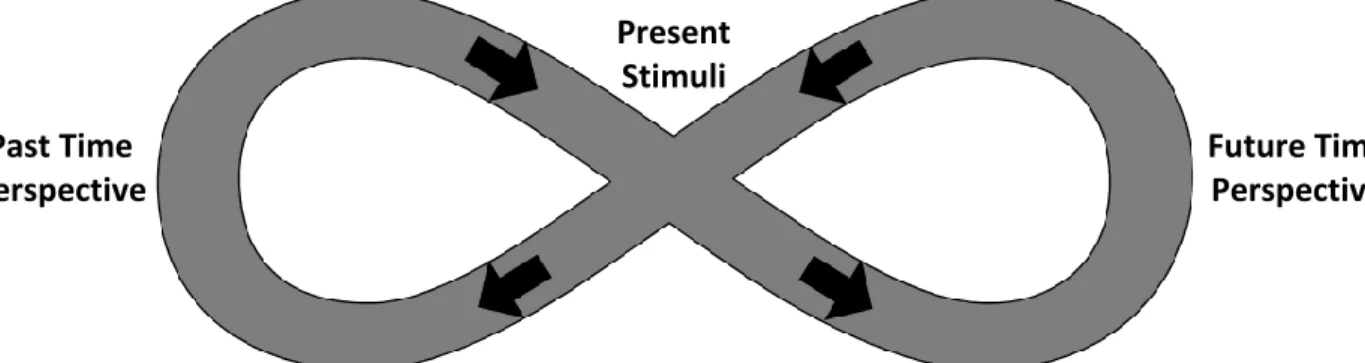
Considering those two aspects, it is our understanding that Time Perspective is a cognitive-affective-motivational process which is involved in the process of organizing most of the stimuli that our perceptive system receives, as well as the cognitive inputs-outputs that our cognitive system processes. It is also a process that modifies itself according to the environmental influences, but influences those same influences in return. We illustrate Time Perspective functioning as a fed-back process represented in Figure 1 as a infinite loop in which the present stimuli is both interpreted and affected by past memories and future goals and aspirations, while that same present stimuli has the ability to modify the information contained in the past and future temporal frames.
Figure 1.An illustrative model of Time Perspective
1.3.1 Biased Time Perspective
The notion of Biased Time Perspective is contrary to the notion of Balanced Time Perspective, which will be discussed in the next sub-chapter. In
Past Time Perspective Future Time Perspective Present Stimuli
order to understand the process by which an individual develops a bias in a certain temporal frame, we must consider that individuals use the various temporal frames or Time Perspectives as unique and differentiated cognitive styles, through which all the received information and stimuli are processed (Zimbardo et al., 1997) or as Zimbardo & Boyd (1999) state, the process that gives order, meaning and coherence to all internal (personal) and external (social) stimuli. This process is not static and individuals can, consciously or not, select any of the temporal frames (or cognitive styles) to deal with determined information. Still, individuals can develop a fixation regarding the over- or under-utilization of one of these temporal frames, influenced by family, educational, social, religious or/and cultural influences (Zimbardo & Boyd, 1999) and when this personal preference for one temporal frame overcomes the others and becomes chronic it can function as a stable personality trait (Zimbardo et al., 1997).
The result of this process as suggested by several authors (Boniwell & Zimbardo, 2004; Keough et al., 1999; Zimbardo & Boyd, 1999) is that specific temporal categories may be favoured or dominant and others may be used too little, leading people to become temporally “biased” and limiting optimal and healthy psychosocial functioning.
The usual conception regarding an optimal functioning of Time Perspective emphasizes the need for flexibility between the several temporal
frames (Zimbardo & Boyd, 1999), choosing one or another depending on the present environmental demands. For example, an individual biased in the Present Time Perspective is referred to as being mainly focused on a search for immediate pleasure, disregarding the possible future consequences of their present behaviour (Drake, Duncan, Sutherland, Abernethy & Henry, 2008). Contrariwise, individuals with a bias in the Future Time Perspective, are usually referred to as workaholic and unable to enjoy the pleasures of life, holidays and special occasions, since they are always focused on the oncoming projects and goals to be met (Zimbardo & Boyd, 1999).
1.3.2 Balanced Time Perspective
As defined in the last chapters, Time Perspective is a cognitive process composed by several temporal frames, which interrelate between themselves. Most research usually considers how each one of these temporal frames are related and influence several aspects of people’s life, but one of the conceptions introduced by Zimbardo & Boyd (1999) refers to “an idealized mental framework that allows individuals to flexibly switch temporal frames among past, future, and present depending on situational demands, resource assessment, or personal and social appraisals” (pp. 1272). According to the authors this cognitive background is referred to as Balanced Time Perspective – BTP is central to an
optimum psychological functioning and it is opposed to a dispositional bias towards any particular temporal frame (Drake et al., 2008; Boniwell & Zimbardo, 2003; 2004; Zimbardo & Boyd, 1999). BTP’s influence is even broader, since it also contributes to physical health and societal functioning (Sircova, Wiberg, Wiberg & Carelli, 2010, July). Among the factors that influence the development of a BTP, Stolarski, Bitner & Zimbardo (2011) point out coping strategy, emotional control and emotional application.
Since no TP is adaptive across all possible situations that individuals can find in their life, the authors highlight the added value of this broad analysis which consists of a combination of several Time Perspectives when analysing the relation of TP with other psychological concepts. In this case, the interpretation of individual scores is no longer fragmentary across the temporal frames; instead, it is necessary to analyse all the individual’s temporal frames as a whole. The junction of all these temporal frames would result in an individualized and unique Temporal Profile, which in our view is composed not only by the temporal orientation, but also by other temporal variables such as: Temporal Extension, Temporal Orientation, Density, Emotional Valence, Continuity and Balance, as proposed by Kazakina (in press; 1999). Yet we must stress the importance of Boniwell et al. (2010) and Kazakina (1999), who argue that there is a lack of measurement tools which consider Time Perspective in all its complexity.
At the behavioural level, individuals oriented by this metacognitive scheme should enforce a compromise between the knowledge of their own past
experiences, their present desires and needs and their future expectations and consequences (Zimbardo & Boyd, 1999). To Boniwell & Zimbardo (2004), the two main mechanisms of a BTP are the flexibility and the ability to change the focus on a determined TP to another more adaptive one, considering the contextual present situation. As such, BTP depends broadly on the present situation, and Epel, Bandura & Zimbardo (1999) refer that “The optimal time perspective depends upon the demands of the situation” (pp. 590).
Chronologically, the Balanced Time Perspective concept is addressed once again by Boniwell & Zimbardo in 2004. Here they complement the previous explanations defending that in order to achieve a Balanced Time Perspective, all the individual’s temporal frames should coexist or hold simultaneously without losing the ability to activate a determined temporal frame, taking into account its adaptive value in a given present situation. Complementarily, Boyd & Zimbardo (2005) proposed that a BTP would be characterized by five theoretical TP profiles: hedonistic (high in Present Hedonist and low in Future), fatalistic (high in Present Fatalist, low in Present Hedonist and in low Future), risk-taking (high in Present Hedonist and high in Present Fatalist), future-oriented (low in Present Hedonist and high in Future) and lastly, balanced (high in Present Hedonist and high in Future). Whilst this theorization seems logical and coherent, we still agree with Boniwell, Osin, Linley & Ivanchenko (2010), who state that this work’s empirical validity is still missing. Nevertheless, these same authors tried to find the psychological foundations of these five profiles, and partially encountered
evidence supporting the TP profile structure proposed by Boyd & Zimbardo (2005), and which were hedonistic, future, balanced, negative and risk taking.
Statistically, the Balanced Time Perspective is characterized by moderate values in Present Hedonist Time Perspective, moderate to high values in Past Positive and Future Time Perspectives, whilst presenting low values in Past Negative and Present Fatalist Time Perspectives (Kairys & Liniauskaite, 2010, July). Still this characterization of BTB is not absolute in terms of cultural and temporal contexts, since each culture values different aspects of behaviour, just as it does with the several temporal frames. For example Boniwell & Zimbardo (2004) denote differences in the cultural notion of BTB amongst populations of the United States of America and South Africa. Sircova et al. (2010, July) proposed a way to calculate BTP introducing the idea of Level of Balance; this level is the result of the number of “adequate or adaptive” results in the five Time Perspectives, and as such an individual can score between zero and five regarding their Level of Balance.
Still further, Boniwell et al. (2010) and Zhang, Howell & Stolarski (2013) are acknowledged as the first attempt to empirically operationalize the BTP concept following a proposal by Drake et al. (2008), in which they use cut-off criteria; individuals who score below the 33rd percentile in the Past Negative and Present Hedonist Time Perspectives and above this same percentile in the Past Positive, Present Hedonist and Future Time Perspectives would be considered as having a Balanced Time Perspective. Boniwell et al. (2010) criticized this