Ohio Intimate Partner Violence Collaborative:
Final Evaluation Report
of the
Safe and Together™
Training Program
Sheri Chaney Jones President & CEO Measurement Resources, Inc.
614.893.0773
Kenneth Steinman, PhD, MPH Principal
Galade Research & Project Management, LLC 614.599.4763
[email protected] March 18, 2014
2
For the past 4 years, the partners in the Ohio Intimate Partner Violence (IPV) Collaborative have engaged in a sustained, intensive effort to transform child welfare system practice in domestic violence cases where children are involved. Begun as pilot within the Alternative Response roll out, the Ohio IPV Collaborative has grown to become a statewide effort supported by ODJFS, and the Supreme Court of Ohio moved to encourage statewide practice change centered on the implementation of the nationally known Safe and Together model. With National Center for Adoption Law and Policy (NCALP) as the lead technical assistance agency, this effort has resulted in numerous achievements, including:
The formation of statewide IPV stakeholder planning group
The creation of an Ohio-based network of 12 Certified Safe and Together Model trainers
31 counties who have started or completed training in the Safe and Together model
Ohio Domestic Violence Network-provided needs assessments and technical assistance in numerous counties.
Since the widespread introduction of the Safe and Together model throughout Ohio is central to these transformation efforts, the HealthPath Foundation funded an independent evaluation to determine the impact of the training on child welfare system practice. NCALP conducted a competitive bid process and selected Sherri Chaney Jones and Kenneth Steinman, who brought expertise in both domestic violence and child welfare. Based on the goals of IPV Collaborative and the Safe and Together model training, Kenny and Sherri designed and implemented a multi-faceted evaluation model, which included interviews, surveys and case reviews.
The following is the final report on this evaluation, and we are very excited about the outcomes. While the Safe and Together model has been implemented in a number of states, Ohio stands out for its consistent and high level of collaboration between stakeholders and inclusion of Safe and Together as part of its Alternative Response roll out. Our efforts in Ohio are also unique because they include our first effort at creating a network of Certified Safe and Together model trainers drawn from the local ranks of child welfare and domestic violence professionals. The outcome results not only reflect the Safe and Together model and our training methods, but also the collaborative work of all the Ohio partners and their commitment to improve the safety, permanency and well-being of families.
We are pleased with the outcomes because they demonstrate important, clear and positive movement towards a more domestic violence-informed child welfare system. Consistent with the Safe and
Together model, there were changes in child welfare’s practice associated with the entire family (adult survivor, child survivor and perpetrator). The results not only demonstrate significant attitude changes (less victim blaming) towards adult domestic violence survivors, but strong changes in on-the-ground case practice. The desk reviews, interviews and surveys indicated that key child welfare practices such as screening and assessment for coercive control were improved. As a result of the training, child welfare became better at partnering with adult victims in order to assess victims’ protective capacities and efforts to keep children safe.
3
Because the movement toward a domestic violence informed child welfare system requires
enhancements in practice related to perpetrators, we were especially pleased with the changes related to case work with perpetrators. Social work staff reported that engagement and interviewing of perpetrators had become more valued. From a practice perspective, perhaps most importantly, the evaluation showed that the participants trained in Safe and Together were able to better assess and document the impact of perpetrators’ patterns of behavior on children.
The quantitative and qualitative results of this evaluation, along with the recommendations of the independent evaluators are very encouraging to us. Based on the fact that the positive results were consistent with the goals and expectations of the training and the negative results were in areas that were not targeted in the project, the evaluation appears to be well designed. These results are also consistent with data from other jurisdictions. For example, data from Florida correlates the introduction of the Safe and Together model with increased identification of domestic violence on the child welfare caseload, a halving of removals of children in cases involving domestic violence and no increase in repeat maltreatments. This data also points towards the potential of locally staffed, train-the-trainer version of the model. Certification, local technical assistance and on-going support from David Mandel & Associates, LLC have supported sustainable and cost-effective long-term implementation.
We’d like to thank Kenneth Steinman and Sheri Chaney Jones for their efforts in producing this Final Evaluation Report of the Ohio Intimate Partner Violence Collaborative (OIPVC). We’d also like to thank Jennifer Hartmann and Denise St. Clair from the National Center for Adoption Law and Policy for their guidance and support throughout both the evaluation process and the implementation of the OIPVC. We also want to acknowledge the Ohio Safe and Together certified trainers for their continued hard work in training Safe and Together throughout Ohio. And finally, we’d like to thank the Ohio Department of Jobs and Family Services, the Supreme Court of Ohio, the HealthPath Foundation of Ohio, Casey Family Services, Ohio Children’s Trust Fund, Capital University School of Law, SCO Family of Services and all of the child welfare staff throughout the state for working so diligently to implement the Safe and Together model into their practice.
We look forward to building upon these findings and strengthening our work based upon this evaluation.
Thank you,
4
EXECUTIVE SUMMARY ... 5
OVERVIEW ... 6
METHODS ... 6
RESULTS ... 8
(1) CPS staff assign less blame to victims for staying in a violent relationship. ... 8
(2) CPS staff increase their concern about, and documentation of the effects of children witnessing domestic violence ... 8
(3) CPS staff increase their understanding of coercive control. ... 8
(4) CPS staff enhance safety planning for victims and children. ... 9
(5) CPS staff increase perpetrators’ accountability. ... 10
(6) CPS agencies change written policies. ... 11
(7) Community stakeholders become more receptive to Safe and Together principles. ... 11
RECOMMENDATIONS ... 13
(1) OIPVC should be proud that the first-ever evaluation of the Safe and Together training program provided some strong evidence of the program’s effects. ... 13
(2) OIPVC should continue discussing whether missed outcomes indicate the need for further adaptation and expansion of the training program. ... 13
(3) Future evaluation efforts should build on this study by recognizing which outcomes can be documented by existing methods and which others may require new approaches. ... 13
ONLINE SURVEY ... 14 METHODS ... 14 RESULTS ... 19 DISCUSSION ... 26 SUPERVISOR INTERVIEWS ... 27 METHODS ... 27 RESULTS ... 29
How did Safe and Together training improve how CPS agencies work with families experiencing domestic violence? ... 30
After the training, what is needed to continue adapting the Safe and Together model?... 33
DISCUSSION ... 36
COMMUNITY STAKEHOLDER INTERVIEWS ... 38
METHODS ... 38
RESULTS ... 39
What helps a CPS agency collaborate effectively with other local agencies? ... 39
How has Safe and Together training changed your working relationship with your local CPS agency? 41 DESK REVIEWS... 43 METHODS ... 43 RESULTS ... 45 DISCUSSION ... 47 POLICY REVIEW ... 49 METHODS ... 49 RESULTS ... 49 DISCUSSION ... 51
APPENDIX A: Instrument for online survey of CPS professionals ... 52
APPENDIX B. Supervisor interview guide ... 58
APPENDIX C: Community interview guide ... 63
5
EXECUTIVE SUMMARY
BACKGROUND: During 2013, the Ohio Intimate Partner Violence Collaborative (OIPVC) enabled local child protective services (CPS) agencies in 13 Ohio counties to participate in the Safe and Together training program. The training aims to improve the ability of CPS agencies to work effectively with families that are experiencing domestic violence through skill building and values clarification. The training sought to provide participants with information and practice skills such as screening,
assessment, documentation, interviewing, partnering and engaging. Intensive training was provided to CPS staff; domestic violence advocates and other community partners received overview training of the Safe and Together model. We emphasize that this report focuses solely on Safe and Together and did not try to assess the impact of other efforts, such as technical assistance provided by the Ohio Domestic Violence Network. While the Safe and Together model is being used in many states, this report
represents the very first effort to evaluate how the training affected CPS practices, policies and collaboration with other local agencies.
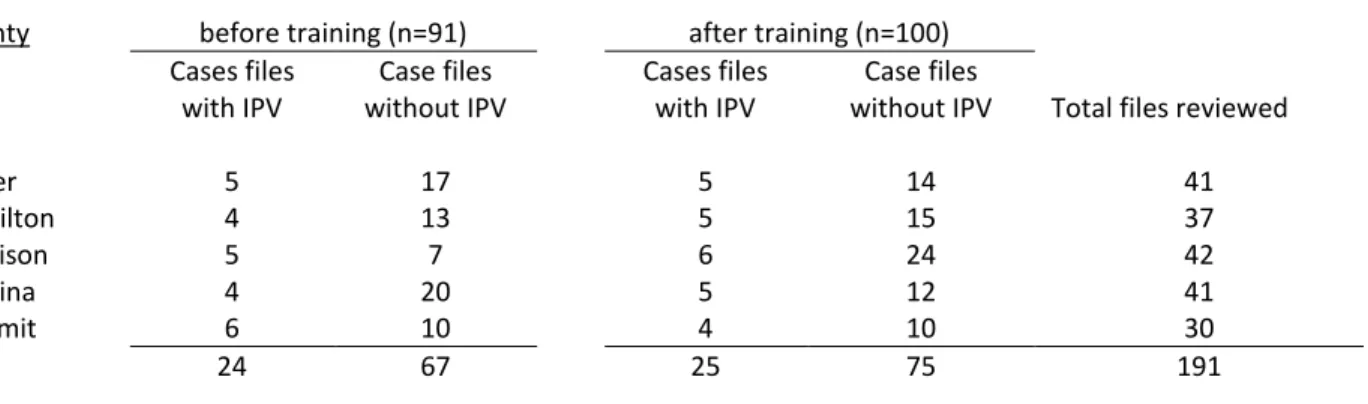
METHODS: We organized the evaluation around 5 data collection activities: (1) an online pre/posttest survey of 837 CPS caseworkers and supervisors; (2) semi-structured interviews with 16 supervisors; (3) semi-structured interviews with 8 community stakeholders; (4) desk reviews of 191 CPS case files; and (5) review of written policies from 15 counties that had completed Safe and Together training. Exhaustive descriptions of each of these methods are appended to this report.
RESULTS: The evaluation found strong evidence that Safe and Together training had two clear, positive effects and mixed or little evidence for other outcomes. These key findings are summarized below:
Regarding the effects of the Safe and Together training, the evaluation found… Strong evidence that: Mixed evidence that: Little evidence that: (1) CPS staff assign less blame to
victims for staying in a violent relationship;
(3) CPS staff increase their understanding of coercive control;
(6) CPS agencies change written policies; and
(4) CPS staff enhance safety planning for victims and children;
(7) Community stakeholders become more receptive to Safe and Together policies and principles.
(2) CPS staff increase their concern about, and documentation of the effects of children witnessing domestic violence.
(5) CPS staff increase perpetrators’ accountability.
RECOMMENDATIONS: Based on these findings, we offer the following recommendations:
OIPVC should be proud that the first-ever evaluation of the Safe and Together training program provided some strong evidence of the program’s effects.
OIPVC should continue discussing whether missed outcomes indicate the need for further adaptation and expansion of the training program.
Future evaluation efforts should build on this study by recognizing which outcomes can be documented by existing methods and which others may require new approaches.
6
OVERVIEW
During 2013, the Ohio Intimate Partner Violence Collaborative (OIPVC) enabled local child protective services (CPS) agencies in 13 Ohio counties to participate in the Safe and Together training program. The training aims to improve the ability of CPS agencies to work effectively with families that are experiencing domestic violence through skill building and values clarification. The training sought to provide participants with information and practice skills such as screening, assessment, documentation, interviewing, partnering and engaging. Intensive training was provided to CPS staff while domestic violence advocates and other community partners received overview training of the Safe and Together model. One of the challenges to evaluating the training was to distinguish its effects from the effects of other statewide efforts to strengthen CPS agencies. We emphasize that this report focuses solely on Safe and Together and did not try to assess the impact of other efforts, such as technical assistance provided by the Ohio Domestic Violence Network. While the Safe and Together model is being used in several states, this report represents the very first effort to evaluate how the training affected CPS practices, policies and collaboration with other local agencies.
The overview section of this report integrates results from multiple data collection methods that appear in subsequent sections. Whereas these results did not change, our interpretations of them sometimes did, based on feedback from OIPVC partners and David Mandel & Associates. We found these
exchanges to be very helpful and strengthened the validity and utility of this report’s conclusions.
METHODS
In order to participate in Safe and Together training, a county CPS agency must have already adapted an Alternative (i.e., Differential) Response (AR) pathway. As part of the evaluation, we collected data from 12 of the counties trained during 2013,1 as well as 12 Ohio counties that had participated in Safe and Together training during previous years, and 7 local CPS from AR counties that had not yet participated in the training.2
We organized the evaluation around 5 data collection activities: (1) an online pre/posttest survey of 837 CPS caseworkers and supervisors; (2) structured interviews with 16 supervisors; (3)
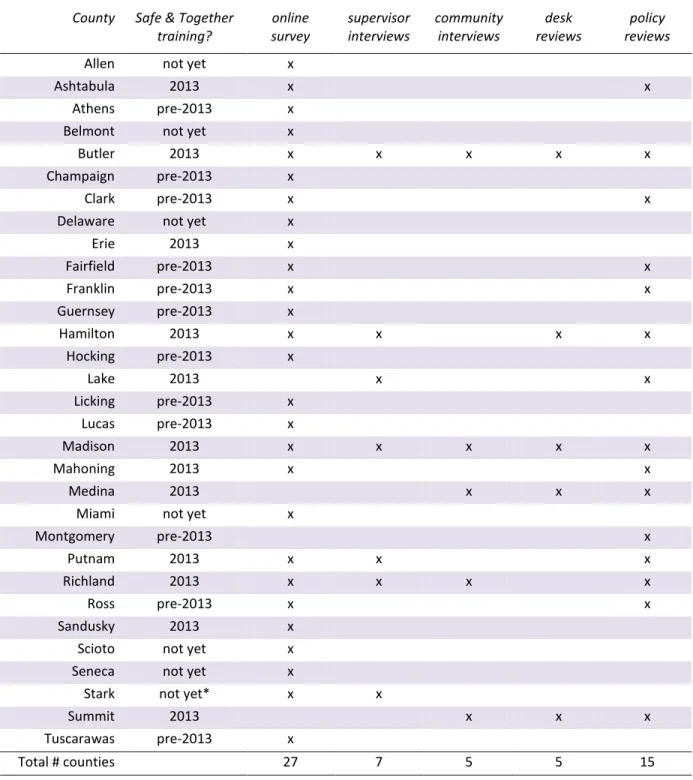
semi-structured interviews with 8 community stakeholders; (4) desk reviews of 191 CPS case files; and (5) review of written policies from 15 counties that had completed Safe and Together training. Exhaustive descriptions of each of these methods are appended to this report. Table 1 presents which counties participated in which activities.
Our presentation of key results is limited to those that we detected across multiple data collection activities. In some instances, a finding generated by one data collection activity was tested but not confirmed by another. We discuss the possible reasons for such inconsistencies and present them as tentative results.
1 Portage County agreed to participate in the training during the middle of year; too late for us to include them in the evaluation.
2
Stark County was originally slated to begin the training during 2013 but had to postpone it. Because they had already contributed data to the evaluation, we reclassified them as a “never-trained” county.
7
Table 1. Ohio counties in various data collection activities for the OIPVC evaluation County Safe & Together
training? online survey supervisor interviews community interviews desk reviews policy reviews
Allen not yet x
Ashtabula 2013 x x
Athens pre-2013 x
Belmont not yet x
Butler 2013 x x x x x
Champaign pre-2013 x
Clark pre-2013 x x
Delaware not yet x
Erie 2013 x Fairfield pre-2013 x x Franklin pre-2013 x x Guernsey pre-2013 x Hamilton 2013 x x x x Hocking pre-2013 x Lake 2013 x x Licking pre-2013 x Lucas pre-2013 x Madison 2013 x x x x x Mahoning 2013 x x Medina 2013 x x x
Miami not yet x
Montgomery pre-2013 x
Putnam 2013 x x x
Richland 2013 x x x x
Ross pre-2013 x x
Sandusky 2013 x
Scioto not yet x
Seneca not yet x
Stark not yet* x x
Summit 2013 x x x
Tuscarawas pre-2013 x
Total # counties 27 7 5 5 15
8
RESULTS
Safe and Together training had strong evidence for two positive effects on the attitudes and practices of CPS staff. Other anticipated changes had mixed evidence or little evidence to support them. These results on seven outcomes are summarized below and note the amount evidence supporting each one.
(1) CPS staff assign less blame to victims for staying in a violent relationship.
(STRONG EVIDENCE) On the online survey, we compared participants’ responses before versus after they participated in the training. Linear regression of change scores found that on average, trained staff reduced the degree to which they endorsed victim-blaming beliefs. In comparison, we found no such changes among people who had not received the training during the period. At pretest, we found that staff who had already completed training were less likely than untrained staff to endorse victim-blaming beliefs. In addition, interviewed supervisors often remarked how their trained caseworkers had begun working differently with staff. In the words of one supervisor, “Because of the Safe and Together training, the mindset of the worker is different. Before we would have put the blame on mom versus trying to partner with her and create a plan.” A domestic violence advocate illustrated a similar theme that we heard in several community interviews, “The conversations [with CPS staff are] shifting more toward understanding [the] dynamics of domestic violence; [they] look different than they used to, less victim blaming.”As indicated by these quotes, this attitude shift appears to have implications for intra agency case discussions, case practice with families and collaboration with community partners.
(2) CPS staff increase their concern about, and documentation of the effects of children
witnessing domestic violence
. (STRONG EVIDENCE) Essentially all CPS staff already know that
domestic violence harms children. On the pretest of the online survey, 95% of respondents agreed that “domestic violence hurts children – even when they do not see it happening.”3 It appears, however, that Safe and Together training heightened the sensitivity of CPS staff to this important issue, as well as their assessment and documentation of it. In our desk reviews of case files, the proportion of cases that documented the effect of domestic violence on children jumped from 50% during the period before training to 80% after the training had been completed (χ
(1)2=4.86, p=0.03, n=49). The community stakeholder interviews found a similar theme. One counselor who takes referrals from a recently-trained CPS agency offered the following observation: “Just by merely witnessing domestic violence situations it does great harm to the kids. I think there has absolutely been a greater understanding of that over the last 6 months.” In addition, several interviewed supervisors expressed great concern about children who witness domestic violence, although they bemoaned the lack of referral options.(3) CPS staff increase their understanding of coercive control.
(MIXED EVIDENCE)
One of the most common themes in the supervisor interviews was that the training helped CPS staff understand coercive control as an integral aspect of domestic violence. Such an understanding could translate into practice changes by altering how caseworkers ask about domestic violence and what they record in case files. One interviewee described this change as follows:
9
Our social workers were screening by just asking “Is there domestic violence in your home?” And I think one of the big changes that has come out of Safe and Together is really to ask different questions. More of what we’re looking for, about controlling behaviors or who is in charge of what in the household and how those decisions are made and different ways to get at domestic violence without asking about it directly.
Comparing pre/posttest data from the online survey, we found no change in the likelihood of caseworkers who “usually” or “almost always” documented a perpetrator’s pattern of abuse. Yet looking at pretest data, 73% of caseworkers who had completed the training in the past year reported doing so, versus 50% of those who had not had any training during the past year (
χ
(2)2=13.37, p<0.01, n=462).4The desk reviews found that cases handled after the training were nearly twice as likely to document coercive control compared to cases handled before the training (30% vs. 17%;
χ
(1)2=1.63, p=0.20, n=44). However, the sample size was far too small to rule out the likelihood that this difference was merely due to chance. Interestingly, reviewing posttest cases (both IPV and non-IPV) took much less time than reviewing pretest cases (7:53 vs. 11:20 minutes, t(62)=2.73, p<0.01). This improvement was not due to our field researchers’ working more quickly with greater experience, since they purposefully reviewed both pre and posttest cases out of chronological order. Rather they attributed the difference to the greater clarity with which caseworkers wrote about domestic violence after completing the training. While these results offer some evidence that the training made staff more sensitive to coercive control, other evidence led us to question this conclusion. We anticipated that greater sensitivity to coercive control would increase the number of cases that staff classified as having domestic violence. This, however, was not the case. The pre/posttest survey found no differences in staff estimates of the proportion of their cases where domestic violence was a concern. Similarly, desk reviews found no pre/posttest differences in the proportion of cases with any indication of domestic violence. 5 In sum, we conclude that there is mixed evidence supporting ability of the training to increase participants’ understanding of coercive control.(4) CPS staff enhance safety planning for victims and children.
(MIXED EVIDENCE) The online
pretest survey found that supervisors from counties trained before 2013 were more likely than those from untrained counties to “usually” or “almost always” ask about what safety plans were in place before a case was referred to CPS (76% vs. 42%;
χ
(3)2=10.83, p=0.01, n=154). Other models, however,4
These results classified supervisors’ exposure to Safe and Together training based on when the respondent had completed the training, regardless of whether their county had done so. Differences were not statistically significant when we classified training status based on the county.
5
On average at both pretest and posttest, caseworkers estimated that about 36% of their caseload had domestic violence as a concern; supervisors estimated about 25%. The desk reviews found that about 25% had some indication of domestic violence.
10
found no significant differences, neither at pretest nor for individual changes from pretest to posttest.6 Moreover, desk reviews found little documentation of safety planning either before or after the training. Supervisor and community interviews included few references to formal safety planning. They did, however, often describe how the training had changed their recognition of, and support for a victim’s efforts to protect herself and her children. Consider the following quote from a CPS supervisor.
After Safe and Together we are listening more and letting the family take the lead more and listening…To determine their (survivors’) own protective capacities – getting the kids to bed early and plans of safe care; or identifying when the right time to leave is.
In sum, the evaluation found mixed evidence to support this outcome. Future evaluations would benefit from greater clarity on how to better conceptualize and measure it.
(5) CPS staff increase perpetrators’ accountability.
(MIXED EVIDENCE) In comparing case files frombefore versus after the training, we found no differences in the proportion of domestic violence cases where the caseworker attempted to interview the perpetrator; nor was there any increase in the number of referrals for the perpetrator. Similarly, the online survey found no pre/posttest differences in the proportion of staff who reported “usually” or “almost always” creating a specific plan for a perpetrator of domestic violence. Yet the pretest survey found some marked differences between counties that had been trained prior to 2013 and those that had not yet been trained (i.e., never trained as well as those to be trained later in 2013). Just over half of supervisors from untrained counties surveyed reported “usually” or “almost always” creating a specific plan for a perpetrator of domestic violence, compared to 84% of those from counties trained in 2012 and 72% of those trained in earlier years (
χ
(3)2=9.71, p=0.02, n=154).7 Even at posttest, recently trained supervisors had similar scores as those who had never been trained, while supervisors trained prior to 2013 scored much higher. The supervisor interviews also frequently noted a growing awareness of the importance of engaging perpetrators. After the training one supervisor summarized her experience as follows:I think we know now how important it is to really talk to him [the perpetrator]. I think just getting our attention to him, just be able to do that initial interview with him and have a conversation with him, I think we’ve put a lot more value on now.
One explanation for these inconsistent findings is that the effect of Safe and Together training on increasing perpetrator accountability does not happen quickly. Given the limits of our evaluation, the data collection activities could often only follow counties 3-4 months after the training ended. As such, it is reasonable to conclude that the training may eventually produce result in such a change, but our evaluation was unable to make a confident conclusion.
6 For example, supervisors at pretest who reported individually participating in the training (regardless of whether their county agency had offered it) did not differ from non-participants in their likelihood of “usually” or “almost always” asking about safety plans (68% vs. 57%,
χ
(2)2=1.45, p=0.48, n=154).7
These results classified supervisors’ exposure to Safe and Together training based on when their county had completed the training, regardless of whether the individual respondent had done so. Differences were not statistically significant when we classified individuals’ training status based on their individual report.
11
(6) CPS agencies change written policies.
(LITTLE EVIDENCE) To assess this outcome, we solicited written policies from 15 county CPS agencies, including memoranda of understanding that they have with other agencies. Of these, only 1 agency had made changes to a policy that they sent to us. Several of the counties trained in 2013 reported that they planned to make changes, yet interestingly, not 1 of the 4 counties that completed the training before 2013 actually reported completing any changes. In addition, none of the community stakeholder interviews reported any policy changes or newmemoranda of understanding. This may suggest that trained agencies initially intend to make policy changes, but have trouble following through. As one supervisor stated in her interview, “No policy changes – not yet.”
Because the Safe and Together training does not explicitly target policy changes, this is not a surprising result. It may be that other factors (e.g., agencies merging; statewide directives) overwhelm whatever effect the Safe and Together training may have. In other words, many agencies may be adapting their internal practices (e.g., formalized work rules), but it is difficult to attribute these changes to Safe and Together training. Future evaluations should consider alternative approaches to distinguishing the effects of the training on this outcome.
(7) Community stakeholders become more receptive to Safe and Together principles.
(LITTLE EVIDENCE) The community stakeholders we interviewed tended to consist of either professionals who already espoused attitudes similar to Safe and Together principles (e.g., some domestic violence advocates) or those who did not (e.g., some law enforcement officials). The former group was largely supportive of the Safe and Together model because they felt CPS staff would finally adapt attitudes more akin to their own. As such, the training did not increase their receptivity because they were already receptive. In contrast, one law enforcement official we interviewed did not
participate in the training and reported no changes in his relationship with the local CPS agency. The other officer we interviewed did attend the training, but found it of questionable value. We also found little evidence of receptivity in the broader community. Among the supervisors we interviewed, for instance, several felt an ongoing need to educate the community after the training. Consider the following quotation:
Honestly, from a children’s services perspective whose job it is to make sure kids are safe, It is really scary to give up some of our control and give up some of our planning in order to let this mom keep her kids safe…And if something [bad] happens how do we defend: “We didn’t really do anything because we let mom do this…” So I think there is going to have to be a lot of education with the community about this concept. Because I don’t think the community is there.
Because community training was a minor portion of the Safe and Together program, and community receptivity was not a strong priority this result is not surprising. It is possible that the training may eventually lead to greater community receptivity, yet the absence of any promising evidence suggests the need to reconsider whether this outcome is achievable given the current training content and process. To the extent that this outcome is indeed key, future evaluations should consider alternative approaches to assessing it.
12
In addition to the above results, it is also important to acknowledge other outcomes that the original RFP initially asked the evaluation to assess, but for which we were unable to generate even tentative conclusions. In discussions with our OIPVC partners and David Mandel & Associates, we agreed that certain outcomes would need further conceptualization before we they could be included in an evaluation. Future evaluations that aim to assess these outcomes should first insure they are conceptually clear. It may also be necessary to consider different methods for assessing them.
Improved communication with other agencies. The community stakeholders often commented on their improved communication with CPS since the Safe and Together training began. As one domestic violence advocate stated, “People are less hesitant to pick up the phone and talk to each other.” Still, supervisors spoke little of improved communication. If anything, they continued to speak of the need to improve communication with other agencies, especially with law enforcement. Also, the absence of written policy changes such as new MOU’s, may signal the lack of change in this outcome. In sum, it is difficult to reconcile the findings from the community interviews with those from other data collection activities. As such, we remain uncertain whether and how the training may have improved
communication among CPS and other agencies.
Enhancing cultural competency. Aside from one unvalidated measure on the online survey, we lacked any formal approach to assessing whether Safe and Together training enhanced the cultural
competency of CPS workers and their partners. The survey measure yielded no differences in any analysis, and none of the interviews touched on their subject. We are unwilling, however, to conclude that the training did not affect this outcome. It is just as likely that our inability to detect any effects was due to incomplete conceptualization of the outcome and weak measures.
Model fidelity and implementation of S&T principles in all aspects of case management. The original RFP asked that the evaluation include an assessment of model fidelity – that is, how thoroughly and
consistently CPS staff were applying all aspects of the model. Yet once we learned that some aspects of the model were not being implemented widely, this outcome became irrelevant. Future efforts to assess model fidelity should focus on those agencies where OIPVC believes the model is
well-established. In addition, it would be helpful to create criteria for assessing model fidelity, rather than treating it as all or nothing.
Increasing appropriate referrals. Although not stated explicitly in the RFP, our meetings with OIPVC staff and David Mandel & Associates indicated that they hoped the training would change the number and type of referrals that caseworkers would make for families experiencing domestic violence. Whereas the training did increase CPS professionals’ interest in certain services (e.g., batterer intervention; support groups for child who witness domestic violence), we found very limited evidence that the staff actually increased such referrals. For instance, the desk reviews found few case files that recorded referrals. The reason for this disconnect is obvious – the absence of such local services and/or the resources to pay for them. In other words, CPS staff may have wanted to make more appropriate referrals, but they knew it was impractical to do so.
13
RECOMMENDATIONS
Based on the findings and our experience with the methods, we propose three recommendations.
(1) OIPVC should be proud that the first-ever evaluation of the Safe and Together training
program provided some strong evidence of the program’s effects.
Changing the attitudes andpractices of CPS workers is very difficult, yet OIPVC’s efforts have produced effects that could be detected by the first-ever evaluation of the program. These results illustrate the strength of the Safe and Together program and indicate that a modest, thoughtful evaluation can both detect these effects and provide useful suggestions for improvement.
(2) OIPVC should continue discussing whether missed outcomes indicate the need for further
adaptation and expansion of the training program.
The evaluation found little evidence thatparticipation in Safe and Together resulted in changes in written policies or increased community receptivity to the model’s principles. These findings may reflect the limited scope of the evaluation. In particular, the timeline limited our ability to detect changes that may occur more than 3 months after the end of the training. That said, these findings may also reflect reality, as OIPVC partner and David Mandel & Associates did not find them surprising. If these outcomes are important and realistic to achieve, OIPVC should consider whether supplementary efforts may be necessary to change policies and increase community receptivity. Technical assistance, such as that provided by Jo Simonsen and the Ohio Domestic Violence Network, may already be valuable in this regard, even though they were beyond the scope of the current evaluation.
(3) Future evaluation efforts should build on this study by recognizing which outcomes can be
documented by existing methods and which others may require new approaches.
Evaluation isan ongoing process and future efforts to document the effects of the Safe and Together program can benefit from our collaborative experience here. As a first-ever evaluation, OIPVC and David Mandel & Associates worked with us to determine which outcomes were reasonable to try and measure given our available time and resources. From there, we devised from scratch a variety of methods – from survey questions to desk review procedures – to try and measure these outcomes. Often these methods were successful; other times less so.
In the coming years, it will easier to evaluate Safe and Together because we now know which methods work (e.g., survey measures of victim blaming), which may require tweaking (e.g., interview questions related to safety planning) and which may require entirely new approaches (e.g., measuring community receptivity). Given sufficient time and resources, it will be possible to evaluate many more aspects of this promising program. We hope this report will help policy-makers towards this end.
14
ONLINE SURVEY
We conducted a two-wave survey of 837 child protective service (CPS) professionals from 27 Ohio counties. The purpose of the survey was to learn how participation in the Safe and Together training was associated with differences in staff attitudes and practices related to families experiencing domestic violence. Participation in the first wave of the survey was excellent, but in the second wave was poor, resulting in our only being able collect useful data from 204 matched individuals from both waves. Participation in the training was associated with a reduction in victim-blaming attitudes. Practices changed little between pretest and posttest, regardless of exposure to the training. At pretest, however, individuals and counties that had participated in the training were more likely to interview perpetrators and victims separately and to document a perpetrators pattern of abuse.
In the overall OIPVC evaluation, we expected certain data collection activities (e.g., supervisor interviews) to provide rich data from a limited number of people. Yet the because staff from 33
counties will have participated in Safe and Together training by the end of 2013, we felt it was important to gather data from a much broader range of individuals. A survey would also enable to compare a large number of CPS staff who participated in the training with a large number of their peers who did not. The purpose of the online survey was to identify how participation in Safe and Together training was associated with differences in CPS professionals’ attitudes and practices related to families experiencing domestic violence.
METHODS
The online survey was declared exempt by Institutional Review Board of Capital University Law School in February 2013 because the data were collected anonymously and involved assessment of government agencies intended to improve their performance.
Survey Instrument
We developed a survey instrument that would minimize the burden to participants, yet yield data that would be useful for the evaluation’s objectives. Towards these ends, the survey required only 5:06 minutes to complete (on average) and, whenever possible, employed items that had been used in earlier studies.8,9,10 Because CPS caseworkers and supervisors each have different practices that might change as a result of the training, we created skip patterns in the survey so the question wording and content would be relevant to their professional role. We pilot tested earlier versions of the instruments with members of our research team, OIPVC staff and partners, and selected CPS professionals from counties that would not be participating in the actual study. The final pretest version of the pretest instrument appears in the appendix. The posttest version was essentially identical, except that it omits
8
Weisz AN, Wiersma R. Does the Public Hold Abused Women Responsible for Protecting Children? Affilia, 2011; 26(4):419-430
9
Saunders DG, Faller KC, Tolman RM. Child Custody Evaluators’ Beliefs about Domestic Abuse Allegations: Their Relationship to Evaluator Demographics, Background, Domestic Violence Knowledge and Custody-Visitation Recommendations. Final Technical Report to the National Institute of Justice. Ann Arbor, MI: University of Michigan School of Social Work; 2011. Retrieved January 30, 2013 from:
https://www.ncjrs.gov/pdffiles1/nij/grants/238891.pdf 10
Fox KA, Cook CL. Is knowledge power? The effects of a victimology course on victim blaming. J Interpers Violence 2011; 26(17):3407-3427.
15
omitted a few questions that were unnecessary to collect a second time (e.g., for how long have you been working as a CPS professional?) and one that was found to be useless.
Recruitment and case selection
In order to participate in Safe and Together training, a county CPS agency must have already adapted an Alternative (i.e., Differential) Response (AR) pathway. We aimed to administer the survey to CPS staff in three types of counties: (1) Counties scheduled to complete the Safe and Together training during 2013 (n=13); (2) Counties that had completed Safe and Together training before 2013 (n=14); and (3) Counties with an AR pathway that had not yet completed the training (n=7).11 Summit and Medina counties trained in 2013 but did not participate because they started the training early in the year before we were able to administer the first wave (i.e., pretest) of the survey. Lake and Portage counties agreed to participate in the training during the middle of year; but we learned this after we had finished
administering the first wave of the survey and knew that they would finish too late for us to include them in the second wave of the survey. Stark County participated in the first wave of the survey but later decided to postpone the training, so we reclassified them as “not yet trained.” Montgomery, Trumbull and Washington counties trained before 2013 but declined to participate in the survey. For participating counties, Carla Carpenter, a senior official with the Ohio Department of Job and Family Services, helped us contact a senior administrator at each local CPS agency. We asked each local administrator to designate a single person in their agency who would be responsible for communicating with staff about the survey. Each contact person was then asked to forward an email message with the survey link to their appropriate CPS caseworkers and supervisors, forward email reminders and notify the research team about the total number (but not the names) of caseworkers and supervisors to whom they had sent the survey.12 For counties that had a separate unit devoted to adoption or foster care placement, CPS staff were not eligible to participate in the survey, since they had very little if any interaction with the birth family.
Survey administration
We administered the survey through a website hosted by Survey Monkey
http://s.zoomerang.com/s/oipvc_CPS_survey. We distributed a link to the survey to one contact person
in each agency (see above) who then forwarded it on to the appropriate staff. This had the advantage of protecting respondents’ anonymity and may have boosted participation since staff were more likely to respond if solicited by a colleague. The disadvantage, however, is that we were unable to track who had participated, so we sent 2-3 reminder emails to everyone initially invited, including those who had already participated or refused. We administered the first wave of the survey from February 19 to March 11, 2013, and the second wave from October 15 to November 14, 2013.
Based on the direction of OIPVC, we aimed to maintain participants’ anonymity when answering questions, although we also needed to match each individual’s pretest and posttest answers in order to properly model changes in attitudes and practices. To achieve both ends, we asked three questions that
11
Lake and Portage counties agreed to participate in the training during the middle of year; but we learned this after we had finished administering the first wave of the survey and knew that they would finish too late for us to include them in the second wave of the survey. Stark County participated in the first wave of the survey but later decided to postpone the training, so we reclassified them as “not yet trained.”
12
During the first wave of the survey, CPS staff in one large county were bothered by the reminder emails. In response, we agreed to administer the second wave using a unique link for each individual so we could tailor reminders.
16
be thought we easy to answer, would not change, would create a unique identifier and yet would be very difficult to use to identify an individual respondent. The questions were: (1) what year did you graduate high school? (2) What are the first four letters of the city where you were born? and (3) What are the first four letters of your mother’s middle name? Unfortunately, this approach resulted in many cases that were difficult or impossible to match. Of the 478 usable surveys at posttest, only 204 could be conclusively matched to a pretest code, whereas 278 could not. It is likely that some of these unmatchable cases were due to staff who took the survey at posttest but not pretest, but we also suspect some people made up new answers to avoid detection.
Survey Participation
The survey was administered to 1311 child protective professionals in 27 Ohio counties. Overall, 837 people responded to the survey (64.1%), 726 of whom provided mostly complete responses (86.7%). Of these 110 people indicated they were not eligible (e.g., had no direct contact with any client families), leaving us with usable data on 616 CPS professionals. Table 1 summarizes the types of responses to the survey invitation.
Table 1. Types of responses to the OIPVC online pretest survey.
# %
Invited 1305 --
Responded 837 64.1% of 1305 Incomplete responses 111 13.3% of 837 (Mostly) complete responses 726 86.7% of 837 Self-reported not-applicable 110 15.2% of 726 Valid complete cases for analysis 616 84.8% of 726
At pretest, county-specific response rates ranged from 25% to 100%, with a median of 78% and 17 of the 27 counties had a response rate ≥ 66%. At posttest, response rates ranged from 11% to 100%, with a median of 60% and 10 of the 26 counties had a response rate ≥ 66%.13 Participation rates by county appear in Table 2.
Classifying participation in Safe and Together training
Because both individuals as well as county agencies can opt to participate in the training, there were multiple options for classifying whether someone had been exposed to it. Each approach has its own advantages and disadvantages which are described below.
Individual report: This approach is based on whether an individual reports participating in Safe and Together training during the past 12 months, another type of domestic violence training, or no domestic violence training. This approach is the perhaps the most straightforward test of the effects of the Safe and Together training, because it simply compares individuals who had the training to those who did not. For untrained individuals, however, this approach assumes that there is no effect of working in an agency where others have been trained. Also, we suspect many participants forgot the name “Safe and
13
Because Hocking County had only one respondent at pretest, we omitted their data from analyses and did not solicit their participation in the posttest because we would be unable to calculate any county-specific statistics.
17
Together.” So we reclassified them as |”received the training” if they worked in a county that we know held the training, but the individual said they participated in a domestic violence training in the past year but could not remember the name.
County status: This approach classifies people based on the county where they work and whether/when their county completed the Safe and Together training. It assesses whether the training really has an effect on agencies in the real world, since most agencies are unable to train their entire staffs and regularly experience significant staff turnover. It may underestimate the effects of the training, however, especially in larger counties where only a few people participated in the training.
Combined individual report and county status: This approach compares individuals who report receiving the training and are working in counties that we know received the training, with individuals who report not receiving the training and are working in counties that we know did not received it. It may be the fairest approach to assess the training effects, but is not realistic. It also requires ignoring a large number of “inconsistent” cases (e.g., untrained individuals in trained counties), which results in much smaller sample sizes for analysis.
Data analysis
We organized analyses around two types of comparisons. First, we used the pretest data to examine differences among individuals and counties depending on their exposure to Safe and Together training. In such comparisons, counties to be trained in 2013 where classified in the same group as those who had never (i.e., not yet) trained. Estimates did not account for the clustering of errors within agencies. For the posttest, we focused on the 204 cases with data matched across both waves. Techniques included McNemar’s chi-squared tests and linear regressions with change scores between the wave 2 and wave 1 values serving as the dependent variable.14 To aid in the interpretation of data, we also present group-level differences, yet caution the reader that such figures can obscure changes.
18
Table 2. OIPVC online survey of CPS professionals: Response rate by county
Pretest Posttest county In vited respo n d ed co m p let ed respo n se
rate Invited respo
n d ed co m p let ed respo n se rate id's match ed Allen 32 29 27 90.6% 32 32 28 100.0% 7 Ashtabula 21 16 14 76.2% 21 16 15 76.2% 7 Athens 6 6 6 100.0% 5 3 3 60.0% 2 Belmont 14 13 11 92.9% 14 12 12 85.7% 7 Butler 94 39 24 41.5% 94 41 22 43.6% 4 Champaign 7 6 6 85.7% 6 6 6 100.0% 2 Clark 39 34 30 87.2% 38 24 19 63.2% 6 Delaware 20 18 15 90.0% 17 11 8 64.7% 7 Erie 16 16 15 100.0% 16 16 15 100.0% 8 Fairfield 40 31 28 77.5% 39 23 19 59.0% 11 Franklin 278 184 166 66.2% 238 123 109 51.7% 47 Guernsey 10 6 5 60.0% 9 5 4 55.6% 2 Hamilton 177 113 98 63.8% 177 19 16 10.7% 6 Hocking 4 1 1 25.0% -- -- -- -- 0 Licking 15 9 8 60.0% 15 7 6 46.7% 2 Lucas 250 89 64 35.6% 250 57 50 22.8% 21 Madison 10 9 9 90.0% 10 10 8 100.0% 3 Mahoning 42 38 33 90.5% 42 23 22 54.8% 10 Miami 21 17 16 81.0% 23 17 12 73.9% 5 Putnam 6 4 3 66.7% 3 3 3 100.0% 1 Richland 63 50 49 79.4% 67 28 24 41.8% 8 Ross 14 9 8 64.3% 10 5 4 50.0% 2 Sandusky 15 15 15 100.0% 14 12 12 85.7% 10 Scioto 10 6 6 60.0% 15 7 6 46.7% 3 Seneca 13 13 11 100.0% 12 10 10 83.3% 5 Stark 73 53 43 72.6% 75 45 38 60.0% 15 Tuscarawas 21 13 11 61.9% 10 7 7 70.0% 3 TOTAL 1311 837 722 63.8% 1252 562 478 45.1% 204 county median 76.8% county median 60.0%
19
RESULTS
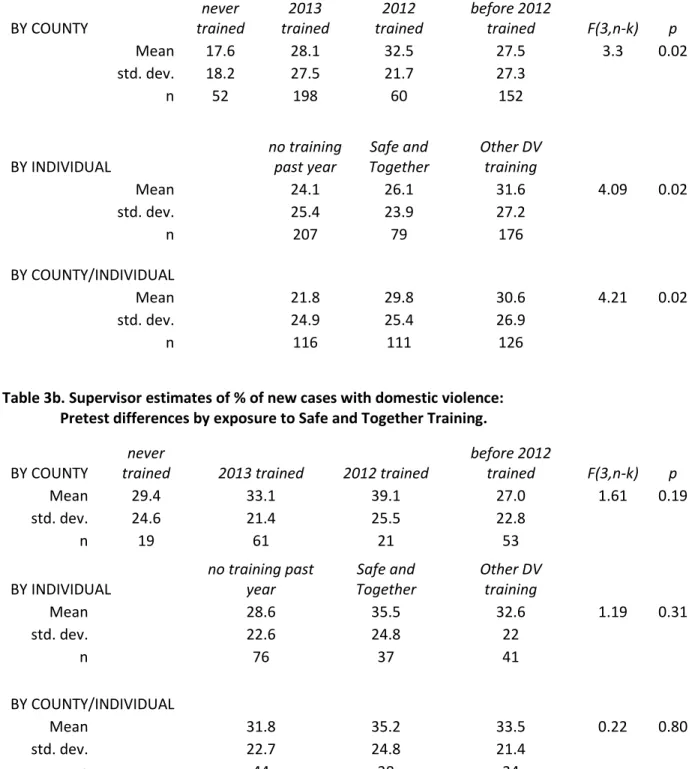
At pretest, caseworkers and counties who had been exposed to the Safe and Together training had higher estimates of the proportions of their cases where domestic violence was a concern. There were, however, no such differences for supervisors. Tables 3a and 3b present these results.
Table 3a. Caseworker estimates of % of new cases with domestic violence: Pretest differences by exposure to Safe and Together Training.
BY COUNTY never trained 2013 trained 2012 trained before 2012 trained F(3,n-k) p Mean 17.6 28.1 32.5 27.5 3.3 0.02 std. dev. 18.2 27.5 21.7 27.3 n 52 198 60 152 BY INDIVIDUAL no training past year Safe and Together Other DV training Mean 24.1 26.1 31.6 4.09 0.02 std. dev. 25.4 23.9 27.2 n 207 79 176 BY COUNTY/INDIVIDUAL Mean 21.8 29.8 30.6 4.21 0.02 std. dev. 24.9 25.4 26.9 n 116 111 126
Table 3b. Supervisor estimates of % of new cases with domestic violence: Pretest differences by exposure to Safe and Together Training. BY COUNTY
never
trained 2013 trained 2012 trained
before 2012 trained F(3,n-k) p Mean 29.4 33.1 39.1 27.0 1.61 0.19 std. dev. 24.6 21.4 25.5 22.8 n 19 61 21 53 BY INDIVIDUAL no training past year Safe and Together Other DV training Mean 28.6 35.5 32.6 1.19 0.31 std. dev. 22.6 24.8 22 n 76 37 41 BY COUNTY/INDIVIDUAL Mean 31.8 35.2 33.5 0.22 0.80 std. dev. 22.7 24.8 21.4 n 44 38 34
20
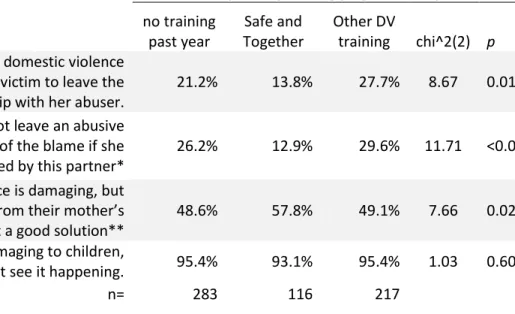
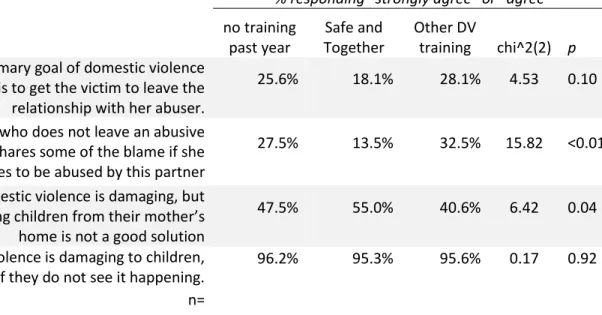
Training was also associated with differences in attitudes. Those with training were more likely to believe that removing children from a DV victim’s home is not a good solution, and were less likely to believe that the primary goal of DV prevention is to get the victim to leave her abuser. Also,
respondents were less likely to believe that a victim shares some of the blame for DV if she does not leave her abuser. Tables 4a through 4c present these results.
Table 4a. Differences in attitudes by county participation in Safe and Together training % responding "strongly agree" or "agree" never trained to be trained 2012 trained before 2012 trained chi^2(3) p The primary goal of domestic violence
prevention is to get the victim to leave the relationship with her abuser
18% 28% 21% 16% 11.56 <0.01
A woman who does not leave an abusive partner shares some of the blame if she continues to be abused by this partner
32% 29% 16% 20% 10.20 0.02
Domestic violence is damaging, but removing children from their mother’s home is not a good solution**
48% 43% 39% 57% 12.02 <0.01
Domestic violence is damaging to children, even if they do not see it happening.
93% 96% 96% 94% 1.47 0.69
n= 71 265 75 205
Table 4b. Differences in attitudes by individual participation in Safe and Together training
% responding "strongly agree" or "agree" no training past year Safe and Together Other DV training chi^2(2) p The primary goal of domestic violence
prevention is to get the victim to leave the relationship with her abuser.
21.2% 13.8% 27.7% 8.67 0.01
A woman who does not leave an abusive partner shares some of the blame if she continues to be abused by this partner*
26.2% 12.9% 29.6% 11.71 <0.01 Domestic violence is damaging, but
removing children from their mother’s home is not a good solution**
48.6% 57.8% 49.1% 7.66 0.02
Domestic violence is damaging to children,
even if they do not see it happening. 95.4% 93.1% 95.4% 1.03 0.60
21
Table 4c. Differences in attitudes by county and individual participation in Safe and Together training
% responding "strongly agree" or "agree" no training past year Safe and Together Other DV training chi^2(2) p The primary goal of domestic violence
prevention is to get the victim to leave the relationship with her abuser.
25.6% 18.1% 28.1% 4.53 0.10
A woman who does not leave an abusive partner shares some of the blame if she continues to be abused by this partner
27.5% 13.5% 32.5% 15.82 <0.01 Domestic violence is damaging, but
removing children from their mother’s home is not a good solution
47.5% 55.0% 40.6% 6.42 0.04
Domestic violence is damaging to children, even if they do not see it happening.
96.2% 95.3% 95.6% 0.17 0.92
n=
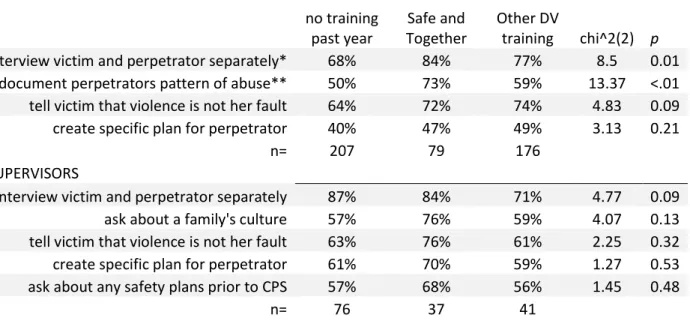
Using the data from the pretest, we also examined practices. Caseworkers and counties that participated in Safe and Together training were more likely to usually or almost always interview a victim and perpetrator separately and to document a perpetrator’s pattern of abuse. For example, 73% of caseworkers who reported participating in ST training during the past year said the usually or almost always documented the perpetrators pattern of abuse, compared to 50% of caseworkers who had not received any DV training and 59% of people who reported other types of DV training (or who couldn’t remember the name of the training). Training was not associated with difference proportions of caseworkers telling a victim that the violence was not her fault, or creating a specific plan for the perpetrator.
In trained counties, trained supervisors were more likely to direct their caseworkers to ask about a client’s safety plans prior to their involvement with CPS, and possibly to create a specific plan for the perpetrator. They were not more likely to direct their caseworkers to interview victim and perpetrator separately, to ask about a family’s culture or to tell a victim that the violence was not her fault. Our failure to detect statistically significant differences, however, was limited by the relatively small number of cases in each experimental condition. Tables 5a through 5c present these results.
22
Table 5a. Differences in practices by county participation in Safe and Together training
CASEWORKERS % "usually" or "almost always" employing practice
never trained to be trained 2012 trained before 2012 trained chi^2(3) p interview victim and perpetrator separately** 75% 69% 91% 75% 11.50 <.01
document perpetrators pattern of abuse 62% 51% 68% 60% 6.76 0.08 tell victim that violence is not her fault 75% 68% 79% 66% 4.15 0.25 create specific plan for perpetrator 42% 42% 57% 44% 4.35 0.23
n= 52 202 56 152
SUPERVISORS
interview victim and perpetrator separately 90% 75% 90% 85% 4.04 0.26 ask about a family's culture 63% 56% 63% 68% 1.91 0.59 tell victim that violence is not her fault 63% 62% 74% 68% 1.11 0.78 create specific plan for perpetrator* 50% 52% 84% 72% 9.71 0.02 ask about any safety plans prior to CPS** 42% 49% 63% 76% 10.83 0.01
n= 19 63 19 53
Table 5b. Differences in practices by individual participation in Safe and Together training
CASEWORKERS % "usually" or "almost always" employing practice no training past year Safe and Together Other DV training chi^2(2) p interview victim and perpetrator separately* 68% 84% 77% 8.5 0.01
document perpetrators pattern of abuse** 50% 73% 59% 13.37 <.01 tell victim that violence is not her fault 64% 72% 74% 4.83 0.09 create specific plan for perpetrator 40% 47% 49% 3.13 0.21
n= 207 79 176
SUPERVISORS
interview victim and perpetrator separately 87% 84% 71% 4.77 0.09
ask about a family's culture 57% 76% 59% 4.07 0.13
tell victim that violence is not her fault 63% 76% 61% 2.25 0.32 create specific plan for perpetrator 61% 70% 59% 1.27 0.53 ask about any safety plans prior to CPS 57% 68% 56% 1.45 0.48
23
Table 5c. Differences in practices by county and individual participation in Safe and Together training % "usually" or "almost always" employing practice CASEWORKERS no training past year Safe and Together Other DV training chi^2(2) p interview victim and perpetrator separately** 66% 85% 74% 11.02 <.01
document perpetrators pattern of abuse** 48% 71% 59% 11.96 <.01 tell victim that violence is not her fault 68% 76% 71% 1.93 0.38 create specific plan for perpetrator 36% 50% 48% 5.41 0.07
n= 116 111 126
SUPERVISORS
interview victim and perpetrator separately 84% 84% 74% 1.76 0.41 ask about a family's culture 57% 76% 59% 3.87 0.14 tell victim that violence is not her fault 66% 79% 59% 3.50 0.17 create specific plan for perpetrator 49% 74% 59% 5.22 0.07 ask about any safety plans prior to CPS* 43% 70% 56% 6.10 0.05
n= 44 38 34
Posttest results
For classifying exposure to Safe and Together training at posttest, we had to adjust our scheme to account for inconsistent and missing data across the two waves. Table 6a and 6b summarize how we used individual and county report to classify respondents. Given the relatively small number of cases we were able to match across waves, we were unable to account for clustering effects within agencies. Therefore the results must be interpreted with caution.
Table 6a. Using individual report and county status to classify posttest exposure to Safe and Together (ST) training County Status individual report never had ST training ST trained during 2013 ST trained before 2013 never trained 17 24 41 ST trained during 2013 0 43 12 55 already ST trained by pretest 2 6 36 44 other DV training or "don't remember" 15 23 26 64 34 72 98 204
Note: 11 "never trained" cases were reclassified as "other" for individuals who reported getting no DV training in 2013 although their counties had used Safe and Together training.
24
Table 6b. Frequency table classification of exposure to Safe and Together (ST) training never ST trained 41
ST trained during 2013 78 already ST trained by pretest 44 other DV training or "don't remember" 41
TOTAL 204
Note: colors correspond to cells in Table 3a
Between pretest and posttest, we found no differences in respondents’ estimates of what proportion of their cases involved domestic violence. Table 7 presents the mean group-level differences by individual training status. Linear regressions of individuals’ change scores from pre to posttest failed to find any significant differences in exposure to the training.
Table 7. Caseworkers and supervisors mean estimates of the percentages of their cases that involve domestic violence: Pre/Posttest differences by exposure to the Safe and Together training program.
Caseworkers Supervisors
pretest posttest pretest posttest
never trained 17.9% 29.6% 20.0% 36.6%
2013 trained 37.2% 36.2% 25.4% 25.8%
already trained 23.4% 35.0% 52.0% 55.4%
other DV training 25.2% 25.5% 35.1% 24.9%
We found some modest evidence that exposure to the training was associated with changes in certain beliefs, specifically about blaming the victim. Table8 summarizes group level difference, and Table 9, individual level differences.
Table 8. Mean pre/posttest scores of selected beliefs related to domestic violence (1=strongly disagree; 5=strongly agree).
A woman who does not leave an abusive partner shares
some of the blame if she continues to be abused by this
partner (reverse coded)
Domestic violence is damaging, but removing
children from their mother’s home is not a
good solution
The primary goal of domestic violence prevention is to get
the victim to leave the relationship with her abuser.
(reverse coded) pretest posttest pretest posttest pretest posttest
never trained 3.29 3.32 3.22 3.39 3.51 3.39
2013 trained 3.27 3.65 3.36 3.58 3.36 3.62
already trained 3.61 3.52 3.66 3.59 3.57 3.55
other DV training 3.48 3.38 3.42 3.38 3.00 3.16
25
Table 9. Coefficients for linear regression on pre/posttest change scores: Contrasts by exposure to Safe and Together (n=148)
A woman who does not leave an abusive partner
shares some of the blame if she continues to
be abused by this partner (reverse coded)
Domestic violence is damaging, but removing
children from their mother’s home is not a
good solution
The primary goal of domestic violence prevention is to get the
victim to leave the relationship with her abuser. (reverse coded) 2013 Trained vs… coefficient (s.e.) p coefficient (s.e.) p coefficient (s.e.) p …never trained -.406 (.247) 0.10 -.134 (.157) 0.40 -.217 (.180) 0.23 …already trained -.396 (.227) 0.08 -.109 (.155) 0.48 -.060 (.165) 0.72 …other DV training -.471 (.211) 0.03 -.214 (.140) 0.13 -.255 (.156) 0.10
Between pretest and posttest, we found few differences in practices regardless of exposure to Safe and Together training. As shown in Table 11, staff from counties trained prior to 2012 often were more likely to usually or almost always employ praiseworthy practices
Table 11. Proportion of caseworkers and supervisors “usually” or “almost always” engaging in specific practices at pre/posttest: Differences by exposure to the Safe and Together training program.
CASEWORKERS
individual training status
Interview perp and victim separately document perp's pattern of abuse tell DV victim it's not her
fault
develop plan specifically for
perp
pre post pre post pre post pre post
never trained 57.1% 50.0% 42.9% 46.4% 53.6% 53.6% 34.6% 42.9% 2013 trained 75.7% 81.1% 51.4% 54.1% 64.9% 64.9% 37.8% 45.9% already trained 89.4% 89.7% 71.1% 69.2% 78.9% 82.1% 39.5% 46.2% other DV training 69.2% 74.5% 48.1% 54.9% 66.7% 62.7% 29.4% 41.2% SUPERVISORS
individual training status
Interview perp and victim separately
tell DV victim it's not her
fault ask about family culture develop plan specifically for perp
pre post pre post pre post pre post
never trained 92.3% 76.9% 53.8% 69.2% 61.5% 61.5% 61.5% 69.2% 2013 trained 77.8% 83.3% 77.8% 55.6% 50.0% 50.0% 55.6% 66.7% already trained 54.7% 44.7% 66.7% 60.0% 66.7% 40.0% 83.3% 100.0% other DV training 58.3% 76.9% 41.7% 53.8% 58.3% 53.8% 45.4% 46.1%
26
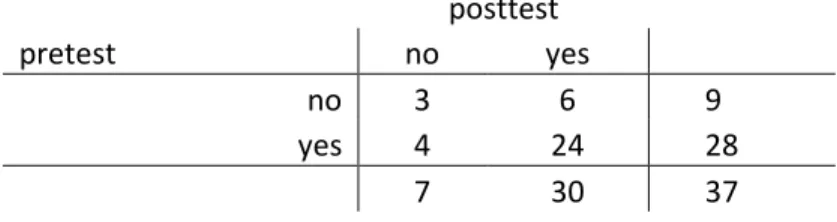
These group level differences may be misleading in that they obscure individual=level change. A series of McNemar chi-squared tests however failed to find any differences by practice. Table 12 illustrates how this test works: Of the 37 caseworker respondents who completed Safe & Together training in 2013, 24 reported at both pretest and posttest that they "usually" or "almost always" interviewed separately perpetrators and victims. Happily, 6 did not do so at pretest but did so at posttest, yet 4 did so at pretest, but no longer reported doing so at posttest. Colloquially, there is a 53% change that such changes are due to chance.
Table 12. Individual changes in “usually” or “almost always” interviewing perpetrators and victims separately. posttest pretest no yes no 3 6 9 McNemar χ(1)2=0.40 yes 4 24 28 p=0.53 7 30 37
DISCUSSION
These findings provide strong support that individuals and counties that participated in Safe and Together training before 2013 score better on measures of several attitudes and practices compared to individuals and counties that had not yet be so trained. Among the cohort of counties trained during 2013, we found no such differences, with the possible exception of attitudes related to victim-blaming. One explanation for these divergent findings is that the effects of the training program take time to develop. Perhaps it was simply unrealistic to expect changes in practices within 1-4 months of
completing the training. A competing explanation is that the training in 2013 was simply less effective than in previous years. Future evaluations should consider both possibilities.
27
SUPERVISOR INTERVIEWS
In spring 2013, we interviewed 16 child protective services (CPS) supervisors from 7 counties that were expected to complete Safe and Together training during the year. In the late fall we re-interviewed 8 of these supervisors after their counties had completed the training. The interviews helped us understand how their agencies work with families experiencing domestic violence and how the training may have affected staff practices. Following the training, supervisors noted that their trained staff had begun doing a better job documenting coercive control and were likely to honor the expertise of the domestic violence victim in knowing what is best for her family. They were also increasingly interested in
engaging perpetrators and finding services for children who witness domestic violence. To continue implementing the Safe and Together models, supervisors suggested that staff needed more time to practice the skills they had learned and also to provide broader training for staff who were unable to participate. In addition, they identified ongoing barriers to implementing the model, including pressure to close cases quickly, ineffective communication with other agencies, and the need to educate the community.
To help evaluate the effects of the Safe and Together training on child protective service (CPS) agencies, we conducted semi-structured interview with CPS supervisors from counties that were slated to
participate in the training. We were specifically interested in their perceptions of how they work with (i.e., investigate and intervene with) client families who are experiencing domestic violence. We also aimed to understand how the training was affecting their ability to work effectively with such families and what are the barriers to adapting the Safe and Together model. This document describes the methods we used to collect and analyze the data and presents key findings. It also discusses the meaning of these findings and presents recommendations for how to improve OIPVC and future efforts to evaluate it.
METHODS
For a complete description of the methods, please refer to “OIPVC Evaluation: Supervisor Interview Pilot Test Protocol.”
Initial interviews
As a “pretest,” we planned to speak with up to three supervisors in each of the following counties before they had initiated the Safe and Together training: Butler, Hamilton, Lake, Madison, Putnam, Richland and Stark. Doing so would offer a baseline assessment of their attitudes and practices against which we could compare changes in follow-up interviews later this year, once they had completed the training. Unfortunately, we were unable to begin the interviews until some counties had already begun the training. In addition, some counties had only one CPS supervisor to interview or had only one willing to participate. The table below summarizes our work. (We have omitted individuals’ names to protect their privacy.)