Appl. Sci. 2020, 10, 8948; doi:10.3390/app10248948 www.mdpi.com/journal/applsci
Article
Constructing a Reliable Health Indicator for Bearings
Using Convolutional Autoencoder and Continuous
Wavelet Transform
Mohammadreza Kaji 1, Jamshid Parvizian 1 and Hans Wernher van de Venn 2,*
1 Department of Mechanical Engineering, Isfahan University of Technology, Isfahan 84156‐83111, Iran;
[email protected] (M.K.); [email protected] (J.P.)
2 Institute of Mechatronic Systems, Zurich University of Applied Sciences, 8401 Winterthur, Switzerland
* Correspondence: [email protected]
Received:23 November 2020; Accepted: 11 December 2020; Published: 15 December 2020
Abstract: Estimating the remaining useful life (RUL) of components is a crucial task to enhance
reliability, safety, productivity, and to reduce maintenance cost. In general, predicting the RUL of a
component includes constructing a health indicator (𝐻𝐼) to infer the current condition of the
component, and modelling the degradation process in order to estimate the future behavior.
Although many signal processing and data‐driven methods have been proposed to construct the
𝐻𝐼, most of the existing methods are based on manual feature extraction techniques and require the
prior knowledge of experts, or rely on a large amount of failure data. Therefore, in this study, a new
data‐driven method based on the convolutional autoencoder (CAE) is presented to construct the
𝐻𝐼. For this purpose, the continuous wavelet transform (CWT) technique was used to convert the
raw acquired vibrational signals into a two‐dimensional image; then, the CAE model was trained
by the healthy operation dataset. Finally, the Mahalanobis distance (MD) between the healthy and
failure stages was measured as the 𝐻𝐼. The proposed method was tested on a benchmark bearing
dataset and compared with several other traditional 𝐻𝐼 construction models. Experimental results
indicate that the constructed 𝐻𝐼 exhibited a monotonically increasing degradation trend and had
good performance in terms of detecting incipient faults.
Keywords: health indicator; performance degradation assessment; deep learning; vibration
monitoring; bearing; remaining useful life; digital twin
1. Introduction
Performance degradation, which is almost inevitable for mechanical equipment, results in
machinery damage, severe financial losses due to replacement or repair work and machine
downtimes, or even personnel injury. Thus, prognostics and health management (PHM) has emerged
as an engineering discipline to improve availability, reliability, and safety of equipment. As a crucial
task in the lifecycle monitoring of complex equipment, PHM is used to monitor the equipment
condition and to design robust and accurate models in order to assess the health state of equipment,
as well as to define appropriate maintenance strategies [1]. In recent years, improving PHM methods
by the Industry 4.0 paradigm, such as digital twin and predictive maintenance, attracts the attention
of researchers [2–5].
In a digital twin, a virtual counterpart of the physical system during its whole life is created, with abilities such as analyzing, evaluating, optimizing, and predicting [6]. Jinjian et al. [5] presented
a digital twin model for rotating machinery to diagnose the unbalance faults, on the basis of the
approach for PHM, driven by digital twin for complex equipment. In this approach, a five‐
dimensional digital twin model is constructed to identify the health conditions of wind turbine
gearboxes. Dinardo et al. [7] proposed a prognostic approach to detect the incipient faults of rotating
machines by means of their vibrational status monitoring. Yan et al. [8] presented a two‐phase digital
twin to diagnose the fault using a deep transfer learning method. In this approach, the trained
knowledge of the deep neural network is transferred from the virtual space to the physical space for
real‐time monitoring and predictive maintenance.
Traditionally, a digital twin uses physical‐based simulation tools to describe the current
behavior of a system [3]. However, due to manufacturing tolerances and material variances,
describing a complex system in a simulation environment usually contains a strong deviation from
reality [9]. One solution is to obtain a digital representation of the expected behavior of the physical system directly from measured data [3]. For this purpose, the first step is to construct a (multi) digital
health indicator (𝐻𝐼) that describes different aspects of the physical component state during the whole
life of the component. This 𝐻𝐼 should represent the deviation between the initial conditions of the
component and its actual conditions during lifetime [1]. This 𝐻𝐼 can be further used for remaining
useful life (RUL) estimation by implementing statistical estimation techniques, such as exponential
degradation model [10], particle filter [11], or Kalman filter [12]. Therefore, defining an appropriate
and sensitive 𝐻𝐼 that reflects the deviation degree from normal health conditions is now a hot
research topic in the RUL estimation field.
In general, constructing a 𝐻𝐼 can be performed in three steps: (1) signal acquisition, (2) signal
processing, and (3) feature extraction [13]. Vibration measurement provides a very efficient way of
monitoring the dynamic conditions of a machine, such as unbalancedness, misalignment, mechanical
looseness, structural resonance, wear, and shaft bow. [14]. Developing each failure mode leads to
varying system dynamic behavior, resulting in significant deviation in vibration patterns [15].
Vibration signals generated by the faulty component can be analyzed in the time domain [16],
frequency domain [17], or time–frequency domain [18]. Using the time‐domain techniques for feature
extraction requires the recording of the time‐series vibrations over a long period of time to obtain
suitable parameters to reveal fault evolution. However, obtaining the necessary data for a complex
equipment may be expensive or even impossible. Using frequency‐domain techniques such as fast
Fourier transform (FFT) are powerful diagnostic tools in stationary conditions [18]. Since the FFT is
essentially an integral over time, it fails to do so for non‐stationary data, which could result from
intermittent defect or evolutionary faults [18]. To address the FFT limitation, time‐frequency signal‐
processing tools such as the short‐time Fourier transform (STFT) [19], Hilbert–Huang transform
(HHT) [20], Wigner–Ville distribution (WVD) [21], and wavelet transform [22] are introduced. The
wavelet transform is a relatively new and powerful tool, able to perform a local analysis of a signal and revealing some hidden aspects of the data that the other signal analysis fails to detect [23]. In this
work, the wavelet transform was selected for signal processing to detect changes in vibration
signatures that are caused by the faulty components.
Once the raw signal is acquired and processed, feature extraction techniques should be
employed to extract the representative features that are used for 𝐻𝐼 construction. Feature extraction
methods could be roughly classified into model‐based methods and data‐driven methods [24].
Rodney et al. [12] obtained a bearing 𝐻𝐼 by fusion of vibrational signal variance from the time
domain and Choi–Williams distribution from the time–frequency domain. Yaguo et al. [25] presented
a method to extract multiple features from the vibrational signal with multiple signal processing
techniques, and then these features are selected and weighted to form the new 𝐻𝐼. In [26], the authors
implemented the discrete wavelet packet transform to decompose the raw signal into different sub‐
bands, and the 𝐻𝐼 was extracted from each signal. Although model‐based methods do work and
achieve an extraction of an accurate 𝐻𝐼, they still have two deficiencies: (1) Feature selection is
heavily dependent on prior knowledge and diagnostic expertise. Moreover, it often focuses on a
specific fault type, and thus it may be unsuitable for other faults [27,28]. (2) In real industries, acquired
signal processing technologies need to be employed to filter the collected signals, which can result in a loss of information [27,29].
Data‐driven methods attempt to extract features from measured data using machine learning
techniques. In recent years, deep learning has emerged as a powerful tool to extract the representative
feature from the collected signals [30,31]. Different deep learning architecture, including
convolutional neural network (CNN) [29,32], recurrent neural network (RNN) [33], autoencoder [27],
and generative adversarial network (GAN) [34], are successfully used to extract features
automatically. The greatest advantage of deep learning is that it needs no prior expert knowledge
and represents more accurate features [35]. Until now, most studies employ deep learning methods
in a supervised setting to extract features for classification problems. For this purpose, performance
data of different degradation levels of a component are prerequisites to creating labeled healthy and
unhealthy datasets. However, gathering different degradation‐level data requires large failure data,
which is not available in practice, especially for high‐reliability component [36]. On the other hand, a
recent review on the state of deep learning on PHM [37] revealed that studies from a health‐
management point of view have been rather limited, largely due to the unavailability of fault data.
Moreover, many implementations of deep learning models in the literature are still constrained to
specific equipment or applications and are not reusable when the predefined conditions change. In
order to address the aforementioned restrictions, developing a single framework that can
systematically be extended to all aspects of system health management is necessary [3,36]. This
framework has to be able to be trained on‐line without requiring historical data, and must use only
healthy operational data for training [3]. In addition, it should be applicable to any equipment that
operates under stationary and non‐stationary conditions; it should also be extendable for different
components [3].
As a step toward the development of a single framework for system health management, this
paper proposes a method to construct an 𝐻𝐼 from the vibrational signal, on the basis of unsupervised
deep learning. This method establishes an online construction of 𝐻𝐼 in the sense that the input data
can be acquisitioned while the equipment is being exploited. The proposed method mainly includes
three steps: First, healthy raw vibrational signals of the equipment are processed with the continuous
wavelet transform (CWT) technique. These 2D images are considered as input of the deep learning
model. In the second step, a convolutional autoencoder (CAE) model is developed that is solely
trained by the healthy data. Lastly, during online monitoring, in each assessment interval, throughout
the entire lifetime of the equipment, the CWT image of the vibrational signal is fed to the trained CAE
model. Similar to the training data, the trained autoencoder can reconstruct images with small
reconstruction errors. The distance between the normal condition data and the failure stage is
measured by the MD formula and, thus, the 𝐻𝐼 is created.
In this study, to experimentally evaluate the effectiveness of the proposed methods, we chose
the ball bearing. Ball bearings are known as the most widely used rotating machine components,
playing an important role in successful and reliable operation of rotary machines. Health prognostic
of the ball bearing has great practical significance in reducing the failures of rotating machinery and
enhancing machine availability. Thus far, fault detection techniques exist for rolling bearing monitor
vibration, acoustic emission, motor current consumption, temperature, and oil debris. Among these
techniques, vibration monitoring has proved to be a reliable and effective technique for fault
detection in bearings [28]. Therefore, the vibrational analysis technique is selected in this work, and
the CAE model is used to extract features from the vibration data. Overall, this study proposes a
method to construct a 𝐻𝐼 on the basis of an unsupervised deep learning method that describes every
instant condition of the bearing and can be regarded as an indicator for a digital twin. In brief, the
main contributions of the current work are
(1) The CAE model is only trained by using healthy operation data at the beginning of an asset’s
life cycle. Therefore, unlike most methods to construct a 𝐻𝐼, this model can be trained online
without requiring historical failure data from similar assets or fleets. In addition, since the CAE
model is trained by the CWT image, it is applicable for equipment that operates under stationary
(2) The values of the bottleneck nodes of the CAE model are used as extracted features. Using these
values reduces any dependencies on the prior knowledge, and thus the 𝐻𝐼 is constructed
automatically.
The further course of the paper is organized as follows: Section 2 briefly introduces the
theoretical background of CWT and convolutional networks. Section 3 presents the proposed
methodology to construct the 𝐻𝐼 in detail. In Section 4, the results of the experimental evaluation are
presented and discussed. Section 5 provides the conclusions and future work guidelines.
2. Background Theory
2.1. Continuous Wavelet Transform
The purpose of CWT of the raw vibrational signal is to preprocess raw vibration in the time–
frequency domain and convert a 1D signal to a 2D image, as the input of the CAE model. The wavelet
transform is widely used to process non‐stationary signals over many different frequencies. The
wavelet transform can analyze a localized area of a large signal without losing the spectral
information contained therein. Therefore, the wavelet transform can reveal some hidden aspects of
the signal that other techniques fail to detect. This property can particularly be employed to identify
the damage (crack) or fault of a component that evolves during the time. There are two main trends
in how wavelet transforms are used, the CWT and the discrete wavelet transform. Both Fourier
transform and CWT use inner products to measure the similarity between a signal and an analytic
function. In the Fourier transform, the analytic function is complex exponentials (𝑒 ) and in the
CWT, the analytic function is a mother wavelet function, 𝜓 𝑡 . The mother wavelet, 𝜓 ∈ 𝐿 𝑅 , is a
function of finite length and zero average; 𝐿 𝑅 is the space of square‐integrable complex functions
[32]. The CWT compares the signal to shifted and compressed or stretched versions of the mother
wavelet function. Stretching or compressing a function is collectively referred to as dilation or scaling
and corresponds to the physical notion of scale. The family of time‐scale waveform is obtained by
shifting and scaling the mother wavelet, which can be expressed as
𝜓 , 𝑡 1 √𝑎 𝜓
𝑡 𝑏
𝑎 (1)
By comparing the signal with the mother wavelet function at various scales and positions, we
obtained two continuous variables, 𝑎 and 𝑏; 𝑎 is the dilation and 𝑏 is the translational parameter
variable. For the given signal, 𝑓 𝑡 , wavelet coefficient 𝜔 𝑎,𝑏 can be represented as
𝜔 𝑎,𝑏 𝑓 𝑡 1 √𝑎 𝜓
∗ 𝑡 𝑏
𝑎 𝑑𝑡 (2)
where 𝜓∗ denotes the complex conjunction of 𝜓.
Since selecting of a mother wavelet function is application‐dependent, the selection of the
appropriate function is the first and most important step in the wavelet analysis. As a rule of thumb,
the most appropriate mother wavelet is a function that has more similarity with the signal. Although
there is no standard or general method to select mother wavelet, the shape matching by visual
inspection is commonly used to select the appropriate mother wavelet function for the signal. For
this study, on the basis of the visual inspection and the result of the previous studies [32,38], we
selected Morlet wavelet in order to extract image features from the raw vibration signal. The Morlet
function is a Gaussian function modulated by complex exponential, defined as
𝜓 𝑡 𝑒 ⁄ 𝑒 (3)
where 𝜔 depends on the sampling frequency and usually is taken as 5 [39]. For wavelet transform
of a real signal, the real part of the Morlet function is employed as the mother wavelet:
𝜓 𝑡 𝑒 ⁄ cos 5𝑡 (4)
2.2. Convolutional Networks
Convolutional neural network (CNN) is a type of deep network that uses convolutional and
pooling operation to extract the topological features of the input data. CNN is primarily used to solve difficult image‐driven pattern recognition tasks, and if trained well, it will learn the features of the
image completely. Therefore, in recent years, CNN has been widely used in image pattern recognition
and image classification. CNN architectures come in several variations; however, a typical CNN
includes convolutional layers, pooling layers, and fully connected layers. In the convolutional layer,
a features map of the previous layer is convolved with multiple filters (also called Kernel) and is sent to the activation function to construct the output features map [29]:
𝑥 𝑓 𝑥
∈
∗ 𝑘 𝑏 (5)
where 𝑥 is the 𝑖th input feature map, ∗stands for the convolutional operator, 𝐾denotes a 𝑤 𝑤
convolutional filter, 𝑏 is an additive bias, 𝑀 is a set of input feature map, 𝑙 is the 𝑙th layer in the
network, and 𝑓 ∙ is a nonlinear activation function. The mathematical inverse of the convolutional
layer used in the decoder is known as the deconvolution layer. Different nonlinear functions such as
a rectified linear unit (ReLU), sigmoid function, and scaled exponential linear unit (SELU) function
can be used in convolutional layers. SELU is a variant of the ReLU activation function that, due to its
self‐normalizing properties, makes learning highly robust and allows training of networks which
have many layers. SELU, ReLU, and sigmoid activation functions are defined as
𝑆𝐸𝐿𝑈 𝑥 𝜆 𝛼𝑒 𝑥𝛼, , 𝑖𝑓𝑖𝑓 𝑥𝑥 00 (6)
𝑅𝑒𝐿𝑈 𝑥 max 0,𝑥 (7)
sigmoid x 1
1 e (8)
For standard scale inputs (zero mean and standard deviation), the selected values for the
parameters are 𝛼 1.6732 and λ 1.0507 [40].
The pooling layer usually follows the convolutional layer and is used to reduce the
computational load by reducing the size of the features map. Two common pooling methods are max
pooling and average pooling, which perform local max and average operations over the input
features, respectively. The calculation process of the pooling layer is given as [29]
𝑋 𝑓 𝛽 ∙ 𝑑𝑜𝑤𝑛 𝑋 𝑏 (9)
where 𝛽 is the weight of pooling and 𝑏 is the additive bias, and 𝑑𝑜𝑤𝑛 𝑥 denotes the down‐
sampling function, e.g., max pooling. In contrast to the pooling layer, an upsampling layer is a simple layer in the decoder with no weights that is used to increase the dimensions of input.
In a fully connected layer, the features maps are converted into a one‐dimensional feature vector,
and all neurons of both layers are connected, like a traditional multilayer neural network. The output
of the fully connected layer can be obtained as [29]
𝑂 𝑓 𝑥 𝛽 𝑏 (10)
where 𝑂 is the output value; 𝑥 is the 𝑗th neuron in the fully connected layer; 𝛽 and 𝑏 are the
weight and the additive biases corresponding to 𝑂 and 𝑥, respectively; and 𝑓 ∙ is an activation
function.
3. Methodology
In this work, a method is proposed to construct the 𝐻𝐼 automatically from the image of CWT
of the vibrational signal of the ball bearing by using a deep learning model. The method consists of
three main stages. The first stage involves acquiring and analyzing a healthy vibrational signal from
the ball bearing and establishing the training repository for deep learning model. In this stage, it is assumed that the bearing is in a healthy condition and it is free from the defects at the beginning of its life cycle. In the second stage, the deep learning model is trained by the established healthy dataset.
Finally, in the last stage, the 𝐻𝐼 is constructed to capture the bearing degradation throughout its
failure phase. For this purpose, the difference in values of the bottleneck nodes between the failure
stage and the normal stage is measured by using the MD formula for each assessment interval. The
proposed method is shown in Figure 1. More details on these three stages are given below.
Figure 1. Proposed methodology for the construction of a bearing health indicator (𝐻𝐼).
3.1. Data Acquisition and Analyzing
In the Industry 4.0 era, by emerging technologies such as data mining, internet of things, and
cloud computing, the online data acquisition and processing becomes more pervasive than ever. The
goals of data acquisition and data processing in this work are to create a dataset from the healthy
conditions and to construct the 𝐻𝐼 throughout the failure stage. In the absence of sudden and
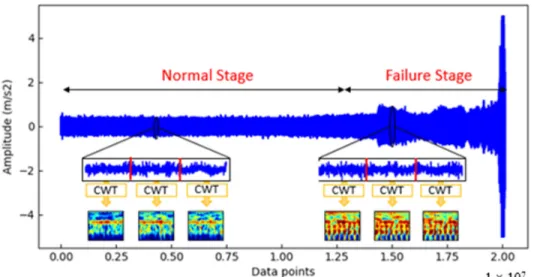
unexpected failures, the degradation process of the bearing generally includes two stages: the normal
operation stage and the failure stage, shown in Figure 2. In practical experiences, most of the bearing lifetime is passed in a stable and healthy stage; therefore, it is possible to acquire sufficient healthy
data to train the deep learning model. During a normal operation stage of the bearing, a sliding
window is used to capture the vibrational signal, and for each window, the power spectrum of the
CWT is used to convert a 1D vibrational signal into a 2D image. The transformed image contains both
time and frequency domain information and can represent the non‐stationary and transient evolution
Figure 2. The lifespan of a bearing is divided into the normal stage and failure stage, and the healthy dataset is established from the normal stage data.
In practical application, a component is evolved from the normal stage to the failure stage
gradually (excluding sudden and unexpected failures) through a series of degradation states. In
addition, there are high uncertainties about the ambient conditions and component properties.
Therefore, defining a fixed failure threshold that clearly separates the normal stage from the failure
stage is not feasible. To address this issue, in this paper, we introduced an adaptive failure threshold
approach, as depicted in Figure 3. According to the theory of statistical process control (SPC),
measured vibration signals under the normal operation follow a normal distribution (with the mean
μ and the variance σ) [41]. With the transfer from the normal operation to the failure operation, the
distribution pattern of the vibration signals might vary from normal distribution to unknown
distribution and, consequently, the mean and variance change.
Figure 3. The flowchart of defining a failure threshold and establishing a healthy dataset. The P variable is used to count the abnormal consecutive assessment intervals.
In this paper, the Pauta criterion [42] was employed to determine the failure threshold. If the
mean of the acquired vibrational signal amplitude for each assessment interval is within
the 𝜇 3𝜎,𝜇 3𝜎 range, the stage is recognized as a normal stage. Otherwise, the measured data
are recognized as abnormal. In order to obtain an adaptive failure threshold, we established a healthy
dataset 𝑋 𝑥̅ ,𝑥̅ , … ,𝑥̅ by collecting the mean amplitude of the vibrational data points in the
normal stage. Then, a reference range 𝜇 3𝜎,𝜇 3𝜎 is computed by using the 𝑛 data. When a
new datum 𝑥̅ is observed, the Pauta criterion is used to determine whether the new data belongs
to the healthy dataset. If the 𝑥̅ falls within the 𝜇 3𝜎,𝜇 3𝜎 range, it is added to the healthy
dataset, i.e.,𝑋 𝑥̅ ,𝑥̅ , … ,𝑥̅ ,𝑥̅ , and the reference range is updated. Otherwise, the datum is
recognized as an abnormal one and the original healthy dataset remains unchanged. If for more than,
e.g., 500 consecutive assessment intervals the means of the vibrational amplitudes are not in the
reference range, the failure threshold is recognized, and the collected healthy dataset is not changed
anymore.
3.2. Convolutional Autoencoder Model
The main purpose of using a deep learning model in this work is a dimensionality reduction
through the feature extraction, and thus the extracted features represent the conditions of every
moment of the ball bearing. Among the developed deep learning models, the CAE was selected in
this study. CAE is a type of autoencoder (AE) neural network that is used to extract hidden features
from unlabeled images. CAE is characterized by having identical input and output sizes and is
trained to predict the input in the output (ℎ , 𝑥 𝑥). One CAE algorithm consists of three layers:
the input layer, the hidden layer(s), and the output layer. The idea is that one or several hidden layers
have lower dimensions than the visible layers (input and output), and thus the input information is
reconstructed and compressed in the hidden layer(s). The hidden layer that contains the fewest nodes
is known as a bottleneck. The bottleneck layer represents the maximum point of compression of the
input data, which contains all necessary data to reconstruct the input data again. Therefore, the CAE
is constituted by two main parts: an encoder that maps the input into the code, and a decoder that maps the code to a reconstruction of the original input in the output layer.
In the encoding section, some convolutional layers and pooling layers are stacked on the input
image to extract hierarchical features. Then, all units in the last convolutional layer have been
flattened to form a vector followed by a fully connected layer(s). The bottleneck layer usually has 2
neurons. Accordingly, the input 2D image (for this study, the input image was 60 × 60 RGB pixels) is
transformed into a two‐dimensional vector space (ℝ → ℝ ). To train the CAE model in an
unsupervised manner, we used the mirror architecture of the encoder in the decoder section. Thus,
fully connected layer(s) followed by some deconvolutional and upsampling layers are used to
transform the embedded features back to the original image. The structure of the proposed CAE
model is shown in Figure 4. After setting up the CAE, it is essential to optimize weights and biases
by minimizing the reconstruction error, i.e., the loss function. Backpropagation algorithm [43] is used
to compute the gradient of the loss function with respect to any weight and bias in the network. To
make the output of the decoder as equivalent as possible to the input, the binary_crossentropy
function is employed as the standard CAE loss function, and the Adam optimizer is used to optimize
Figure 4. The overall convolutional autoencoder architecture used.
3.3. Construction of 𝐻𝐼
Once the CAE model is trained by the wavelet power spectrum images in normal operation, 𝐻𝐼
should be constructed for the failure stage automatically. The constructed 𝐻𝐼 is expected to exhibit
a monotonically increasing trend and should be robust to noise and stochastic fluctuations. The CAE
model learns to extract distribution characteristics of the normal data through its deep structure, and
to reproduce images similar to the training dataset with a small reconstruction error. Over the time
in the failure stage, damage evolution of bearing leads to a more turbulent vibration pattern.
Consequently, with the development of the degradation, high energies appear in the low‐frequency
bands and produce a different wavelet power spectrum image from the normal stage. When the
wavelet power spectrum image of the failure stage is input to the trained CAE model, the
dissimilarity between the extracted vector of features in normal stage images and the faulty sample
image is estimated to achieve the corresponding degradation indicator. In this regard, the mapped
features in the bottleneck layer are used to measure the distance between the normal stage and the
failure stage by the MD formula. This strategy is used to construct 𝐻𝐼 during the failure stage in this
work. Since the feature extraction and 𝐻𝐼 construction are performed automatically by the CAE
model, prior knowledge and diagnosis expertise are not required.
The 𝑀𝐷, which is an effective multivariate distance metric that measures the distance between
a vector and a distribution, still remains to be defined. An anomaly vector is an observation that has a different distribution from the rest of the data, and MD has an excellent ability to identify this deviation [44]. The MD is defined as
𝑀𝐷 𝐴 𝜇 𝑐 𝐴 𝜇 (11)
where A = (𝑎 ,𝑎 ,𝑎 , . . ,𝑎 gives the values of the bottleneck nodes in each assessment interval, 𝜇
𝑎 ,𝑎 ,𝑎 , … ,𝑎 is the mean values vector in healthy condition, and 𝑐 is the reverse covariance
matrix of the healthy condition.
4. Experimental Results
4.1. Dataset Description
To evaluate the effectiveness of the proposed method, we used the bearing dataset, generated
by the University of Cincinnati Center for Intelligent Maintenance Systems (IMS). The IMS bearing
test rig is illustrated in Figure 5. It consists of an AC motor coupled to the shaft via a rub belt and four
double row bearings installed on the shaft. The sampling rate of the record data was 20 kHz under
the radial load of 6000 lbs for each of the four bearings at the constant rotation speed of 2000 rpm.
Data acquisition was made every 10 minutes and for each assessment interval; a 1‐second vibrational
Figure 5. Intelligent maintenance systems (IMS) test rig [45].
The IMS bearing datasets contain three run‐to‐failure tests; both normal stage and failure stage
data exist in each test. For each test, data collection continued until any failure in inner race, outer race, or roller elements occurred at least for one bearing. At the end of the test, bearings 3 and 4 from the first dataset, bearing 2 from the second dataset, and bearing 3 from the third dataset showed signs
of failure. In the current work, the datasets for all three cases were considered. The time‐domain
vibrational signals for the four bearings are shown in Figure 6. For each bearing datum, the failure
threshold was identified by the adaptive failure threshold method, and healthy samples and faulty
samples were established. Details of IMS bearing datasets are described in Table 1. Since different
bearing defect frequencies are proportional to the revolutions per minute, all defects occurring in the
bearing are revealed in every revolution. Therefore, given the acquisition frequency of 20 kHz and
rotation speed of 2000 rpm, the vibrational signals were split into equal chunks of length 𝐿 600
points. For each chunk, the CWT was performed, and the power spectrum image was obtained.
(c) (d)
Figure 6. Original vibration signals of the IMS bearing dataset [45]: (a) subset 1 bearing 3, (b) subset 1 bearing 4, (c) subset 2 bearing 1, and (d) subset 3 bearing 3.
Table 1. Description of IMS bearing dataset [45]. The failure thresholds and the healthy and faulty samples were identified by the adaptive failure threshold.
Bearing Subset 1 Bearing 3 Subset 1 Bearing 4 Subset 2 Bearing 1 Subset 3 Bearing3 Load (lbs) 6000 6000 6000 6000 Speed (rpm) 2000 2000 2000 2000
Defect type Inner race Roller element Outer race Outer race
Endurance duration 34 days 12 h 34 days 12 h 6 days 20 h 45 days 9 h
Number of healthy
samples 61,069 43,381 19,146 200,474
Failure threshold 27 days 20 h 19 days 20 h 3 days 21 h 41 days 2 h
Number of faulty
samples 19,800 31,090 14,780 20,230
4.2. Analysis of Wavelet Power Spectrum Images
To demonstrate the advantage of the wavelet transform technique, we depicted the time‐domain
vibrational signals and their corresponding wavelet power spectrums for a normal and a failure stage
in Figure 7. While periodic vibrations with low amplitude are observed in the normal stage, more
severe vibrations appear in the failure stage. The wavelet power spectrum represents the variations
of the energy distribution of the vibration signal for different frequencies over time. As shown in
Figure 7, the wavelet transform can clearly distinguish between the normal stage and the failure stage
signals. For normal operations, most of the energy is concentrated in high frequencies, but for a
(a) (b)
(c) (d)
Figure 7. Comparison of time‐domain vibration signals and power spectrum images for healthy and damaged signals: (a) raw signal (normal stage) [45], (b) wavelet power spectrum (normal stage), (c) raw signal (failure stage) [45], and (d) wavelet power spectrum (failure stage).
4.3. Training the CAE Model
As mentioned above, power spectrum images of the normal health stage were used to train the
CAE model. Before training the CAE model, some parameters needed to be configured such as the
number of layers, number of nodes in each layer, activation function for each layer, iteration number,
and the learning rate. Regarding the number of layers and the number of nodes in hidden layers, the
parameters are related to the dimension of the input data. These parameters are usually obtained
experimentally and provide a good visual conformity. The convolutional autoencoder model starts
with propagating from the input layer to the convolution layer. The convolutional encoder consists
of three convolutional layers, each followed by a max pooling layer. The number of filters for the
three convolutional layers were (1,64,128), and the filter size for all layers was 3 3. Features map
from the convolutional encoder section were flattened and passed through the autoencoder layers.
The autoencoder section consisted of three fully connected layers with 64, 2, and 64 neurons in each
layer. Therefore, the input 2D RGB image was transformed into a two‐dimensional feature space in
the bottleneck layer that was used to construct the 𝐻𝐼. To transform the extracted features back to
the original image, we added three deconvolutional layers with three upsampling layers in between
to the autoencoder section. The number of filters for the three deconvolutional layers were [1,64,128],
with the filter size of 3 3.
To attain better visual conformity, after several trials, we chose the SELU as the activation
function for the convolutional and deconvolutional layers, ReLU for the autoencoder layers, and the
show the reconstruction error under various learning rates in. If the learning rate was too low, the
convergence was too slow or overfitting; if the learning rate was too high, it would hinder the
convergence. Therefore, the learning rate was set to 0.005 for this study. As illustrated in Figure 8, the
reconstruction error did not significantly decrease after 30 cycles; therefore, 30 iterations were
performed in this study. The experimental model was developed using the Python‐based Keras
library [46] with a TensorFlow backend [47].
Figure 8. The reconstruction error of deep learning model for different learning rates.
Since the CAE model is trained in an unsupervised manner, the successful trained CAE should
learn to extract meaningful features from the images of the normal operation, and to reconstruct a
closely similar image to the original image in the output. However, perfect reconstruction is usually
a sign of overfitting where it only learns to copy its input to the output without learning to extract
intelligent features and generalize to a new instance. Indeed, reasonably close reconstruction with a
small error demonstrates that the CAE learned the meaningful features of the training dataset and
had an acceptable generalization. Figure 9 represents the comparison of the original images with the
reconstructed images by the developed model. Although the CAE model was solely trained by the
normal operation dataset, it also reconstructed faulty images very well, indicating that the model
could extract subtle features from images.
Figure 9. Comparison of the original and reconstructed images of the wavelet power spectrum during the run‐to‐failure experiment of the subset 2 bearing 1.
4.4. Smoothing the 𝐻𝐼
The preliminary designed 𝐻𝐼 almost always exhibits local random fluctuations. To reveal an
𝐻𝐼 curve. In this study, an exponential function was used to remove any sharp changes in the 𝐻𝐼
curve and to improve the monotonicity of the designed 𝐻𝐼 [48]. This function was given by
𝑀𝐻𝐼 𝑒𝑥𝑝∑ / 1 𝑖 𝑁
(12)
where 𝐻𝐼 denotes the historical measured 𝐻𝐼, 𝑁 is the total number of 𝐻𝐼 values, and 𝑀𝐻𝐼
represents the modified value of the current𝐻𝐼. In Equation (12), the mean value of the historical
measurement from the first value 𝐻𝐼 to the current 𝑖th value 𝐻𝐼 is used to calculate the 𝑀𝐻𝐼.
Therefore, if the 𝐻𝐼 curve exhibits a significant oscillation at 𝐻𝐼 point, it will be weakened.
Furthermore, the exponential function is a monotonically increasing function and it can reveal a
monotonically increasing trend in the 𝐻𝐼 curve.
4.5. 𝐻𝐼 Results
Since the normal stage images are used to train the deep learning model, the 𝐻𝐼 is solely
constructed for the failure stage. The trained deep learning model was used to construct on‐line 𝐻𝐼
by applying the MD formula to measure the distance of the values of the bottleneck nodes between
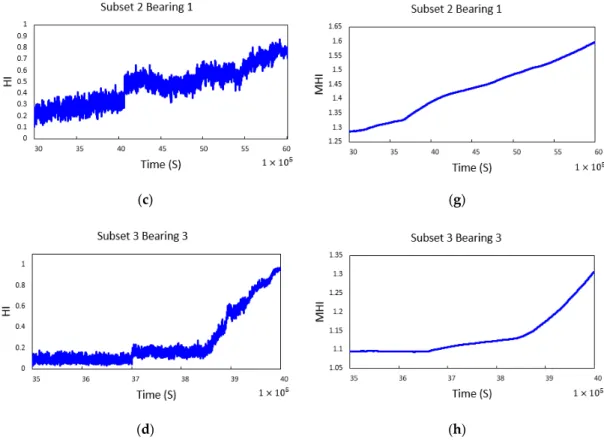
the normal stage and failure stage. The constructed 𝐻𝐼s for the four IMS bearings are shown in Figure
10a–d. Intuitively, it can be observed that 𝐻𝐼s evolved gradually at the beginning and dramatically
at the end; they revealed the true degradation in bearings. Although the initial 𝐻𝐼 curves represented
global monotonicity, there still were severe local spurious fluctuations that may have been the result
of highly inaccurate and unreliable data. Therefore, the smoothness and monotonicity of the
constructed 𝐻𝐼s were improved by using the exponential function defined in Equation (12); the
modified 𝐻𝐼s are shown in Figure 10e–h. The exponential function is an increasing function that uses
the mean from the starting time to the current time; thus, it can effectively eliminate oscillation and
enhance monotonicity. It can be seen by the naked eye that the modified 𝐻𝐼s were smoother, and
gradually increasing, while the degradation trends were effectively captured as well. The results
indicate that the proposed method has a good performance in detecting the early bearing defects and
abnormal bearing health conditions. Moreover, this method provides an 𝐻𝐼 that is well correlated
with progressively increasing bearing degradations, and it can lead to better RUL prediction.
(a) (e)
(c) (g)
(d) (h)
Figure 10. 𝐻𝐼 results for the four IMS bearings: (a–d) raw 𝐻𝐼, (e–h) modified 𝐻𝐼. 4.6. Comparison with Other Traditional Methods
To verify the effectiveness and superiority of the proposed method, we considered a comparison
among the proposed method and several traditional 𝐻𝐼 methods. These methods were categorized
in the two separate groups: five methods that are based on the time‐domain features and a method
that is based on the time‐frequency domain feature. To compare, the vibration signal of the “subset 2 bearing 1” was used to construct the 𝐻𝐼 in this section.
(1) In the first group, several commonly used features from the time domain were extracted to
construct the 𝐻𝐼. The selected features include:
Root mean square (RMS),
1 𝑁 𝑥 Variance, 1 𝑁 1 𝑥 𝑥̅ Kurtosis, 1 𝑁 𝑥 𝑥̅ 𝜎
Skewness,
1
𝑁
𝑥 𝑥̅
𝜎
𝑥 is the vibrational signal series; 𝑥̅ and 𝜎 are the mean value and the variance of the series,
respectively.
Approximate entropy (ApEn). ApEn expresses the regularity of fluctuations over time‐series
data. The detailed steps to construct an 𝐻𝐼 using the ApEn are introduced in [49].
During the failure stage, these equations were applied for each assessment interval to construct
𝐻𝐼. Figure 11a–e illustrates the extracted 𝐻𝐼 from these methods. The RMS and variance curves of
the 𝐻𝐼 are shown in Figure 11a,b, respectively. It can be noticed that these curves were insensitive
during the early stage degradation, making it difficult for RUL prediction. The ApEn and kurtosis
curves depicted in Figure 11c,d overcame the weakness of RMS and variance curves and recognized
the infant mortality period. However, in these curves, oscillations and sudden changes near the end
of the life of the bearing were obvious. This sudden change in the 𝐻𝐼 curve may cause problems in
predicting the RUL accurately. As can be seen from Figure 11e, the skewness curve contained severe
noises, and no up‐and‐down trend was visible, especially during the end of failure period.
(2) In the second group, the empirical mode decomposition (EMD) process was applied to
decompose the vibrational signal into a series of intrinsic mode functions (IMFs). Afterward, the
concept of singular value decomposition (SVD) was used to compute singular values (SVs) from the
first two IMFs, known as defect feature vectors. Finally, the extracted feature vectors were taken as
the input of the K‐medoids algorithm to clustering normal and abnormal conditions and constructing
the 𝐻𝐼. The details steps can be found in [50]. The 𝐻𝐼 constructed by the second method, EMS‐SVD‐
K‐medoids, is shown in Figure 11f. It is realized from Figure 11f that during the early stages, the 𝐻𝐼
curve had a smoothly increasing trend. However, after about 50 10 s, unpredictable stochastic
fluctuations were obvious.
Figure 11. Constructed 𝐻𝐼 in various methods: (a) root mean square (RMS), (b) variance, (c) approximate entropy (ApEn), (d) kurtosis, (e) skewness, and (f) EMS‐SVD‐K‐medoids.
To evaluate the performance of 𝐻𝐼 as defined in different methods, we employed three metrics,
namely, correlation (𝐶𝑜𝑟𝑟), monotonicity (𝑀𝑜𝑛), and robustness (𝑅𝑜𝑏) for different 𝐻𝐼s. It was
expected that a good 𝐻𝐼 would exhibit a monotonically increasing or decreasing trend, and that it
would be robust to noise and stochastic fluctuations. 𝑀𝑜𝑛 was used to assess consistently increasing
or decreasing trend of the 𝐻𝐼 curve. In 𝑀𝑜𝑛, the difference between the values of any two adjacent
is more than the total number of negative values and 𝑀𝑜𝑛 is close to 1. On the other hand, for the
turbulent and oscillation curves, the total number of positive values is close to the total number of
negative values and the 𝑀𝑜𝑛 value is close to 0. 𝑀𝑜𝑛 is calculated as follows:
𝑀𝑜𝑛 𝑁𝑜.𝑜𝑓𝑁 𝑑𝑓1 0 𝑁𝑜.𝑜𝑓𝑁 𝑑𝑓1 0 𝑑𝑓 𝐻𝐼 𝑖 𝐻𝐼 1 𝑖 𝑁 (13) where 𝑑𝑓is the difference in the values of any two adjacent points in 𝐻𝐼 curve and 𝑁 is the total
number of 𝐻𝐼 values.
𝑅𝑜𝑏 reflects the tolerance of the 𝐻𝐼 to random fluctuations, which may arise due to faulty
sensors, variations in operating conditions, or unexpected events. 𝑅𝑜𝑏 is defined as
𝑅𝑜𝑏 1 𝑁 𝑒𝑥𝑝
𝐻𝐼 𝐻𝐼
𝐻𝐼 (14)
where 𝐻𝐼 is the mean trend value of the 𝐻𝐼.
Similarly, 𝐶𝑜𝑟𝑟 measures the degree of linear correlation between the 𝐻𝐼 and time. It is
expected that a good 𝐻𝐼 gradually increases by time. In a strong positive correlation, the 𝐶𝑜𝑟𝑟 value
is close to 1 and vice versa. 𝐶𝑜𝑟𝑟 is defined as
𝐶𝑜𝑟𝑟 ∑ 𝐻𝐼 𝐻𝐼 𝑖 ∑ 𝑖 𝑁
∑ 𝐻𝐼 𝐻𝐼 ∑ 𝑖 ∑ 𝑖 𝑁
1 𝑖 𝑁 (15)
Here, 𝐻𝐼 is the mean value of all the 𝐻𝐼 values. Table 2 presents 𝑀𝑜𝑛, 𝑅𝑜𝑏, and 𝐶𝑜𝑟𝑟 values
for the proposed 𝐻𝐼 and the traditional health indicators mentioned earlier. The results in Table 2
show that all 𝑀𝑜𝑛, 𝑅𝑜𝑏, and 𝐶𝑜𝑟𝑟 of the current model are higher than those in other models. The
obtained results demonstrate that the proposed model is superior to other models, and it yields a
better 𝐻𝐼.
Table 2. Comparison of health indicators based on monotonicity (𝑀𝑜𝑛), correlation (𝐶𝑜𝑟𝑟), and robustness (𝑅𝑜𝑏) for subset 2 bearing 1.
Metrics Proposed
Method RMS Variance ApEn Kurtosis Skewness
EMD‐SVD‐ K‐ Medoids Mon 0.7587 0.0113 0.0140 0.0051 0.0063 0.0016 0.0229 Rob 0.9484 0.8411 0.7565 0.8790 0.8875 0.4427 0.6971 Corr 0.9969 0.6363 0.4480 −0.3814 0.3622 −0.4282 0.6358 5. Discussion
Constructing a reliable 𝐻𝐼 is the first and most important step in order to estimate the accurate
RUL for bearings; therefore, this has been the focus of many studies [24]. In general, these methods
are classified into three categories: mechanical signal processing‐based, model‐based, and machine
learning‐based. In mechanical signal processing‐based methods, after pre‐processing of the vibration
signal, statistical parameters are directly used to construct the 𝐻𝐼. Due to the flexibility and simplicity
of mechanical signal processing methods, these methods are widely used in industries. These
methods also have an acceptable performance to detect early bearing defects and abnormal bearing
health conditions. However, it has been experimentally shown that the indicator performance
decreases in the presence of transient conditions caused by bearing’s defects [1]. Compared to these
methods, the proposed method is sensitive to initial degradation, and is consistent with the
degradation process. Nevertheless, in this work, the data of the run to failure vibrations is divided
into two parts: the first part is used to train the CAE model and the second part is used to construct
the 𝐻𝐼. However, nothing ensures that a sudden degradation or failure does not happen during the
training phase. Therefore, the method proposed in this work is limited to those faults that cause
particular vibration patterns. In the case of any sudden failure or extremely slow degradation, this
In contrast to the time or frequency techniques, which only represent the information in time or
frequency domain, time–frequency techniques provide more information in both domains. In the
present work, the CWT technique was used to pre‐process the vibrational signals. The CWT method
is a joint time–frequency analysis method that can decompose a time series into time and frequency
spaces simultaneously. Therefore, the outputs of the CWT analysis are images that contain
information on both time and frequency domains. When a defect appears in the bearing, it generates
an impulsive force and excites resonances in the bearing and surrounding elements. With the
progress of the defect over time, the frequency spectrum changes drastically. Since the faulty signals
are non‐stationary and transient in nature, using the CWT for pre‐processing the vibration signals
has better performance than time or frequency techniques in constructing the 𝐻𝐼. Furthermore, in
the proposed method, the 𝐻𝐼 is constructed by comparing the images of normal and failure stages,
which are acquired for an identical bearing. Therefore, the perpetual background noise will not affect
the 𝐻𝐼 accuracy. In addition, in this work, a deep learning model is used in extracting features, as
well as for dimensionality reduction from the pre‐processed vibration signals. This provides a more
powerful capability of learning complex nonlinear relationships, which is able to extract the best‐
suited features automatically. Moreover, using the exponential function improves the smoothness
and monotonicity of the preliminary designed 𝐻𝐼, which leads to better RUL estimation.
6. Conclusions
A new data‐driven approach to construct the 𝐻𝐼 is presented. This 𝐻𝐼 represents every
moment conditions of the bearing and can be considered as a digital twin of the bearing during its
failure stage. Furthermore, this 𝐻𝐼 can be used for RUL estimation. First, the Pauta criterion was
employed to determine the failure threshold and a normal dataset. Since the CWT is suitable for
analyzing the non‐stationary signals, it was used to convert raw vibrational signals into two‐
dimensional feature images. The wavelet power spectrum image clearly revealed the degradation
process of the bearing and included information in both time and frequency domains. Subsequently,
the CAE model was used for dimensionality reduction through the feature extraction, and it was
trained by the normal operation dataset. The values of the bottleneck nodes of the trained CAE
represented the conditions of every moment of the ball bearing life; they were used to construct 𝐻𝐼.
Finally, the wavelet power spectrum image of the failure stage was fed to the trained CAE. The
distance between the values of bottleneck nodes in normal and failure stages was measured by MD
formula, and then the 𝐻𝐼 was constructed. To improve the 𝐻𝐼 curve monotonicity, we used an
exponential function to remove random fluctuations in the 𝐻𝐼 curve. Experiments were conducted
on the run‐to‐failure IMS dataset to verify the performance of the proposed method.
The results indicate that the constructed 𝐻𝐼 was capable of representing the health status of the
bearing and tracking the evolution of degradation over the whole lifetime of the bearing. Moreover,
constructing the 𝐻𝐼 with the proposed method required no prior knowledge or failure history data.
Therefore, it is suitable for industrial applications. Furthermore, to prove the effectiveness of the
proposed method, we compared this method with several other methods, such as RMS, EMD‐SVD‐
K‐medoids, skewness, kurtosis, and ApEn, showing a considerable superiority. The method, at the
current state, is limited to gradual degradation and excludes any sudden failure.
Future research directions are to use the proposed method for other mechanical components
such as ball screws, gears, and cutting tools.
Author Contributions: M.K. proposed the idea, set up the network, and conducted the calculation. J.P. and H.W.v.d.V. contributed to the supervision of the work, proposed some valuable suggestions, and performed the revisions. All authors have read and agreed to the published version of the manuscript.
Funding: This research was partially funded by Leading House South Asia and Iran seed money grant at ZHAW Zurich University of Applied Science.
Conflicts of Interest: The authors declare no conflict of interest.
References
1. Wang, D.; Tsui, K.‐L.; Miao, Q. Prognostics and Health Management: A Review of Vibration Based Bearing and Gear Health Indicators. IEEE Access 2018, 6, 665–676, doi:10.1109/access.2017.2774261.
2. Yan, J.; Meng, Y.; Lu, L.; Li, L. Industrial Big Data in an Industry 4.0 Environment: Challenges, Schemes, and Applications for Predictive Maintenance. IEEE Access 2017, 5, 23484–23491, doi:10.1109/access.2017.2765544.
3. Booyse, W.; Wilke, D.N.; Heyns, P.S. Deep digital twins for detection, diagnostics and prognostics. Mech. Syst. Signal Process. 2020, 140, 106612, doi:10.1016/j.ymssp.2019.106612.
4. Tao, F.; Zhang, M.; Liu, Y.; Nee, A.Y.C. Digital twin driven prognostics and health management for complex equipment. CIRP Ann. 2018, 67, 169–172, doi:10.1016/j.cirp.2018.04.055.
5. Wang, J.; Ye, L.; Gao, R.X.; Li, C.; Zhang, L. Digital Twin for rotating machinery fault diagnosis in smart manufacturing. Int. J. Prod. Res. 2019, 57, 3920–3934, doi:10.1080/00207543.2018.1552032.
6. Qi, Q.; Tao, F. Digital Twin and Big Data Towards Smart Manufacturing and Industry 4.0: 360 Degree Comparison. IEEE Access 2018, 6, 3585–3593, doi:10.1109/access.2018.2793265.
7. Dinardo, G.; Fabbiano, L.; Vacca, G. A smart and intuitive machine condition monitoring in the Industry 4.0 scenario. Measurement 2018, 126, 1–12, doi:10.1016/j.measurement.2018.05.041.
8. Wan, J.; Sun, Y.; Liu, X.; Zheng, Y. A Digital‐Twin‐Assisted Fault Diagnosis Using Deep Transfer Learning.
IEEE Access 2019, 7, 19990–19999, doi:10.1109/access.2018.2890566.
9. Tuegel, E. The Airframe Digital Twin: Some Challenges to Realization. In Proceedings of the 53rd AIAA/ASME/ASCE/AHS/ASC Structures, Structural Dynamics and Materials Conference, Honolulu, Hawaii, 23 April 2012–26 April 2012; pp. 1812–1820.
10. Li, N.; Lei, Y.; Lin, J.; Ding, S.X. An Improved Exponential Model for Predicting Remaining Useful Life of Rolling Element Bearings. IEEE Trans. Ind. Electron. 2015, 62, 7762–7773, doi:10.1109/tie.2015.2455055. 11. Deutsch, J.; He, M.; He, D. Remaining Useful Life Prediction of Hybrid Ceramic Bearings Using an
Integrated Deep Learning and Particle Filter Approach. Appl. Sci. 2017, 7, 649, doi:10.3390/app7070649. 12. Singleton, R.K.; Strangas, E.G.; Aviyente, S. Extended Kalman Filtering for Remaining‐Useful‐Life
Estimation of Bearings. IEEE Trans. Ind. Electron. 2015, 62, 1781–1790, doi:10.1109/tie.2014.2336616. 13. Guo, L.; Li, N.; Jia, F.; Lei, Y.; Lin, J. A recurrent neural network based health indicator for remaining useful
life prediction of bearings. Neurocomputing 2017, 240, 98–109, doi:10.1016/j.neucom.2017.02.045.
14. Liu, Z.; Zhang, L. A review of failure modes, condition monitoring and fault diagnosis methods for large‐ scale wind turbine bearings. Measurement 2020, 149, 107002, doi:10.1016/j.measurement.2019.107002. 15. Rai, A.; Upadhyay, S. A review on signal processing techniques utilized in the fault diagnosis of rolling
element bearings. Tribol. Int. 2016, 96, 289–306, doi:10.1016/j.triboint.2015.12.037.
16. Fu, S.; Liu, K.; Xu, Y.; Liu, Y. Rolling Bearing Diagnosing Method Based on Time Domain Analysis and Adaptive Fuzzy‐means clustering. Shock. Vib. 2015, 2016, 9412787.
17. Bustos, A.; Rubio, H.; Castejon, C.; Garciaprada, J.C. Condition monitoring of critical mechanical elements through Graphical Representation of State Configurations and Chromogram of Bands of Frequency.
Measurement 2019, 135, 71–82, doi:10.1016/j.measurement.2018.11.029.
18. Al‐Badour, F.; Sunar, M.; Cheded, L. Vibration analysis of rotating machinery using time–frequency analysis and wavelet techniques. Mech. Syst. Signal Process. 2011, 25, 2083–2101, doi:10.1016/j.ymssp.2011.01.017.
19. Gao, H.; Wan, X.; Chen, X.; Xu, G. Feature extraction and recognition for rolling element bearing fault utilizing short‐time Fourier transform and non‐negative matrix factorization. Chin. J. Mech. Eng. 2014, 28, 96–105, doi:10.3901/cjme.2014.1103.166.
20. Elbouchikhi, E.; Choqueuse, V.; Amirat, Y.; Benbouzid, M.E.H.; Turri, S. An Efficient Hilbert–Huang Transform‐Based Bearing Faults Detection in Induction Machines. IEEE Trans. Energy Convers. 2017, 32, 401–413, doi:10.1109/tec.2017.2661541.
21. Singru, P.; Krishnakumar, V.; Natarajan, D.; Raizada, A. Bearing failure prediction using Wigner‐Ville distribution, modified Poincare mapping and fast Fourier transform. J. Vibroeng. 2018, 20, 127–137, doi:10.21595/jve.2017.17768.
22. Li, L.; Liu, P.; Xing, Y.; Guo, H. Time‐frequency analysis of acoustic signals from a high‐lift configuration with two wavelet functions. Appl. Acoust. 2018, 129, 155–160, doi:10.1016/j.apacoust.2017.07.024.
23. Kankar, P.K.; Sharma, S.C.; Harsha, S.P. Fault diagnosis of ball bearings using continuous wavelet transform. Appl. Soft Comput. 2011, 11, 2300–2312, doi:10.1016/j.asoc.2010.08.011.