Ulrich Frank
ICB-Research Report No. 42
Research Group Core Research Topics
Prof. Dr. H. H. Adelsberger
Information Systems for Production and Operations Management
E-Learning, Knowledge Management, Skill-Management, Simulation, Artificial Intelligence
Prof. Dr. P. Chamoni
MIS and Management Science / Operations Research Information Systems and Operations Research, Business Intelligence, Data Warehousing Prof. Dr. F.-D. Dorloff
Procurement, Logistics and Information Management E-Business, E-Procurement, E-Government Prof. Dr. K. Echtle
Dependability of Computing Systems Dependability of Computing Systems Prof. Dr. S. Eicker
Information Systems and Software Engineering Process Models, Software-Architectures Prof. Dr. U. Frank
Information Systems and Enterprise Modelling Enterprise Modelling, Enterprise Application Integration,IT Management, Knowledge Management Prof. Dr. M. Goedicke
Specification of Software Systems Distributed Systems, Software Components, CSCW Prof. Dr. V. Gruhn
Software Engineering Design of Software Processes, Software Architecture, Usabi-lity, Mobile Applications, Component-based and Generative Software Development
Prof. Dr. T. Kollmann
E-Business and E-Entrepreneurship E-Business and Information Management, E-Entrepreneurship/E-Venture, Virtual Marketplaces and Mobile Commerce, Online-Marketing
Prof. Dr. B. Müller-Clostermann
Systems Modelling Performance Evaluation of Computer and CommunicationSystems, Modelling and Simulation Prof. Dr. K. Pohl
Software Systems Engineering Requirements Engineering, Software Quality Assurance,Software-Architectures, Evaluation of COTS/Open Source-Components
Prof. Dr.-Ing. E. Rathgeb
Computer Networking Technology Computer Networking Technology Prof. Dr. Enrico Rukzio
Mobile Mensch Computer Interaktion mit Software Services Novel Interaction Technologies, Personal Projectors, Pervasive User Interfaces, Ubiquitous Computing Prof. Dr. A. Schmidt
Pervasive Computing Pervasive Computing, Uniquitous Computing, Automotive User Interfaces, Novel Interaction Technologies, Context-Aware Computing
Prof. Dr. R. Unland
Data Management Systems and Knowledge Representation Data Management, Artificial Intelligence, Software Engineering, Internet Based Teaching Prof. Dr. S. Zelewski
Institute of Production and Industrial Information Management Industrial Business Processes, Innovation Management,Information Management, Economic Analyses
ISSN 1860-2770 (Print)
42
Outline of a Method for Designing
Domain-Specific Modelling Languages
Die Forschungsberichte des Instituts für Informatik und Wirtschaftsinfor-‐‑ matik dienen der Darstellung vorläu-‐‑ figer Ergebnisse, die i. d. R. noch für spätere Veröffentlichungen überarbei-‐‑ tet werden. Die Autoren sind deshalb für kritische Hinweise dankbar.
All rights reserved. No part of this report may be reproduced by any means, or translated.
Contact:
Institut für Informatik und Wirtschaftsinformatik (ICB) Universität Duisburg-‐‑Essen Universitätsstr. 9 45141 Essen Tel.: 0201-‐‑183-‐‑4041 Fax: 0201-‐‑183-‐‑4011 Email: icb@uni-‐‑duisburg-‐‑essen.de Author‘s Address: Ulrich Frank
Institut für Informatik und Wirtschaftsinformatik (ICB) Universität Duisburg-‐‑Essen Universitätsstr. 9 D-‐‑45141 Essen ulrich.frank@uni-‐‑due.de
The ICB Research Reports comprise preliminary results which will usually be revised for subsequent publica-‐‑ tions. Critical comments would be appreciated by the authors.
Alle Rechte vorbehalten. Insbesondere die der Übersetzung, des Nachdru-‐‑ ckes, des Vortrags, der Entnahme von Abbildungen und Tabellen – auch bei nur auszugsweiser Verwertung.
ISSN 1860-‐‑2770 (Print) ISSN 1866-‐‑5101 (Online)
ICB Research Reports
Edited by:
Prof. Dr. Heimo Adelsberger Prof. Dr. Peter Chamoni Prof. Dr. Frank Dorloff Prof. Dr. Klaus Echtle Prof. Dr. Stefan Eicker Prof. Dr. Ulrich Frank Prof. Dr. Michael Goedicke Prof. Dr. Volker Gruhn Prof. Dr. Tobias Kollmann
Prof. Dr. Bruno Müller-‐‑Clostermann Prof. Dr. Klaus Pohl
Prof. Dr. Erwin P. Rathgeb Prof. Dr. Enrico Rukzio Prof. Dr. Albrecht Schmidt Prof. Dr. Rainer Unland Prof. Dr. Stephan Zelewski
In recent years, the development of domain-‐‑specific modelling languages has gained re-‐‑ markable attention. This is for good reasons: A domain-‐‑specific modelling language incorpo-‐‑ rates concepts that represent domain-‐‑level knowledge. Hence, systems analysts are not forced to reconstruct these concepts from scratch. At the same time, domain-‐‑specific model-‐‑ ling languages contribute to model integrity, because they include already constraints that would otherwise have to be added manually. Even though there has been a considerable amount of research on developing and using domain-‐‑specific modelling languages, there is still lack of comprehensive methods to guide the design of these languages. With respect to the complexity and risk related to developing a domain-‐‑specific modelling language, this is a serious shortfall. This research report is aimed at a contribution to filling the gap. It presents the prolegomena of a method for developing domain-‐‑specific modelling languages, which is based on the experience gathered in several language specification projects. The method con-‐‑ sists of two main parts: a meta modelling language and a process model. The MEMO meta modelling language (MEMO MML) is specified in a further report. Therefore, its description is restricted to a brief overview. Instead, the main focus of this report is on the process mod-‐‑ el, which describes essential steps to be accounted for during the development of a domain-‐‑ specific modelling language. It includes heuristics to develop requirements and meta model-‐‑ ling guidelines that support frequent design decisions. The description of the method is complemented by examples which are mainly taken from the design of the MEMO Organisa-‐‑ tion Modelling Language.
1 INTRODUCTION ... 1
2 BACKGROUND ... 4
2.1 DOMAIN-‐‑SPECIFIC MODELLING LANGUAGES: BASIC ASSUMPTIONS AND PROSPECTS ... 4
2.2 DOMAIN-‐‑SPECIFIC PROGRAMMING LANGUAGES ... 7
2.3 MULTI-‐‑PERSPECTIVE ENTERPRISE MODELLING ... 8
3 GENERIC REQUIREMENTS FOR DSML ... 11
3.1 FORMAL REQUIREMENTS ... 12
3.2 USER-‐‑ORIENTED REQUIREMENTS ... 13
3.3 APPLICATION-‐‑ORIENTED REQUIREMENTS ... 14
4 SPECIFIC CHALLENGES: CONTINGENT TARGET ... 17
5 REQUIREMENTS FOR THE METHOD ... 20
6 ELEMENTS OF THE METHOD ... 23
6.1 META MODELLING LANGUAGE ... 23
6.2 PROCESS MODEL ... 25
6.2.1 The Role Model ... 26
6.2.2 The Macro Process ... 30
6.2.3 Clarification of Scope and Purpose ... 30
6.2.4 Analysis of Generic Requirements ... 32
6.2.5 Analysis of Specific Requirements ... 32
6.2.6 Business Process Association Diagram or Business Process Map ... 36
6.2.7 Language Specification ... 38
6.2.8 Design of Graphical Notation ... 49
6.2.9 Development of Modelling Tool ... 54
6.2.10 Evaluation and Revision ... 56
7 EVALUATION AND CONCLUSIONS ... 59
8 REFERENCES ... 61
FIGURE 1: ILLUSTRATION OF DSML IN COMPARISON TO GPML ... 2
FIGURE 2: LANGUAGE BARRIER BETWEEN APPLICATION DOMAIN AND INFORMATION TECHNOLOGY ... 5
FIGURE 3: COMMON CONCEPTS AS A FOUNDATION FOR MAPPING DOMAIN CONCEPTS TO IT CONCEPTS (EXAMPLES) ... 5
FIGURE 4: MAPPING BETWEEN BOTH DOMAINS THROUGH GENERIC CONCEPTS ... 6
FIGURE 5: ILLUSTRATION OF DSPL COMPARED TO GPPL ... 7
FIGURE 6: ILLUSTRATION OF MAPPING DSML TO DSPL ... 8
FIGURE 7: THE EFFECT OF SEMANTICS ON DSML BENEFITS ... 18
FIGURE 8: MEMO-‐‑MML: OVERVIEW OF CONCEPTS AND GRAPHICAL NOTATION ... 25
FIGURE 9: ILLUSTRATION OF MACRO PROCESS ... 30
FIGURE 10: MICRO PROCESS 'ʹCLARIFICATION OF SCOPE AND PURPOSE'ʹ ... 31
FIGURE 11: MICRO PROCESS ‘ANALYSIS OF GENERIC REQUIREMENTS‘ ... 32
FIGURE 12: MICRO PROCESS 'ʹANALYSIS OF SPECIFIC REQUIREMENTS'ʹ ... 33
FIGURE 13: MICRO PROCESS: 'ʹLANGUAGE SPECIFICATION'ʹ ... 38
FIGURE 15: EXCERPT OF A META MODEL SPECIFIED WITH THE MEMO MML ... 46
FIGURE 15: ILLUSTRATION OF ENFORCING A CRITICAL USE OF A DSML THROUGH RESPECTIVE ATTRIBUTES – ADAPTED FROM STRECKER ET AL. (2011) ... 46
FIGURE 16: ILLUSTRATION OF DIFFERENT SPECIFICATION STYLES ... 48
FIGURE 17: MICRO PROCESS 'ʹDESIGN OF GRAPHICAL NOTATION'ʹ ... 50
FIGURE 18: EXAMPLE FOR COMBINING SHAPE, COLOUR AND TEXT ... 52
FIGURE 19: EXAMPLE OF COMBINING NOTATION ELEMENTS FOR REPRESENTING DIFFERENTIATED CONCEPTS ... 52
FIGURE 20: EXAMPLE OF MERGING TWO IDENTICAL PATHS OF EXECUTION ... 53
FIGURE 21: MICRO PROCESS 'ʹDEVELOPMENT OF MODELLING TOOL'ʹ ... 55
FIGURE 22: MICRO PROCESS 'ʹEVALUATION AND REVISION'ʹ ... 57
TABLE 1: ROLE MODEL ... 29
TABLE 2: ILLUSTRATION OF GLOSSARY ... 39
TABLE 3: STRUCTURE FOR CHECKING SUITABILITY OF POTENTIAL LANGUAGE CONCEPT ... 40
TABLE 4: EXEMPLARY REPRESENTATION OF CONCEPT IN CONCEPT DICTIONARY ... 44
TABLE 5: OVERVIEW OF EVALUATING THE METHOD AGAINST REQUIREMENTS ... 60
1
Introduction
Designing conceptual models of high quality is a demanding task. It is a widespread as-‐‑ sumption that most users would be overburdened with developing and using elaborate con-‐‑ ceptual models without further support. A plethora of modelling methods is addressing the corresponding demand. At first, these methods made mainly use of general purpose model-‐‑ ling languages (GPML), such as the ERM or the UML. In recent years, the idea of using mod-‐‑ elling languages that were designed for more specific purposes – so called domain-‐‑specific modelling languages (DSML) – has gained increasing popularity. This is for convincing rea-‐‑ sons: It is certainly more appealing to describe large models with domain-‐‑level concepts than to construct them from generic concepts such as ‘entity type’, ‘attribute’ etc. Imagine one would need to write technical specifications – not to speak of other types of documents – with a vocabulary that is restricted to a handful of basic terms only. Instead, a DSML pro-‐‑ vides concepts that correspond to the technical language used in the targeted domain. Hence, they promise to promote convenience and productivity of modelling, since users do not have to reconstruct technical terms on their own. At the same time, they contribute to model quality, since the concepts that are provided by a DSML should be the result of an especially thorough development process. The integrity of models, as a specific aspect of their quality, is promoted, too, since the syntax and semantics of a DSML allow for prevent-‐‑ ing nonsensical models to a certain degree. In addition to that, a DSML will often feature a special graphical notation (concrete syntax) that helps to improve clearness and comprehen-‐‑ sibility of models. Figure 1 illustrates the advantages of a DSML – in this case for modelling IT infrastructures – over a GPML. The model designed with a GPML uses the same graphical symbols for any concept in the wide range of its possible applications, which prevents them from being self-‐‑expressive. Also, it allows for assertions that are perfectly valid – with re-‐‑ spect to the syntax and semantics of the language – but are wrong with respect to an obvious interpretation in the targeted domain.
SAP/R3 DBMS-‐Server name: String os: String version: String Server name: String version: String ERP name: String Attribute name: String isAbstract: Boolean Class os: String version: String DBMS-‐Server os: String version: String SAP-‐R3 specified by t 1,1 0,* u part of 0,* 1,1 runs on t 0,* 0,* u runs on 0,* 0,* M2 M1 runs on
r
DSML GPML Figure 1: Illustration of DSML in comparison to GPMLA core motivation for developing domain-‐‑specific modelling languages (DSML) is the as-‐‑ sumption that domain-‐‑specific concepts support users more effectively with structuring a domain for a certain purpose than a general purpose modelling language. However, design-‐‑ ing a DSML is not a trivial task. Against this background, it is remarkable that there is hardly any method for guiding the development of modelling languages in general, the design of DSML in particular. Work on the evaluation of modelling languages, e.g. Goldstein and Storey (1990), Opdahl and Henderson-‐‑Sellers (1999), Frank (1998), provides language de-‐‑ signers with criteria they should account for. However, they are restricted to a few aspects only – and do not focus on guidelines for how to satisfy the suggested language features. Formal quality criteria – see for instance: Süttenbach and Ebert (1997) – are more concrete, but not sufficient for guiding the design of a language because they fade out the relationship of a language to the targeted domain and to the prospective users. In recent years, method engineering, i.e. a methodical support for developing modelling methods, has gained re-‐‑ markable attention. Since a modelling method consists of at least one modelling language and a corresponding process model, one would assume that work on method engineering includes support for the development of modelling languages. However, this is not the case. While there is a plethora of approaches on method engineering (for an overview see Henderson-‐‑Sellers and Ralyté, 2010), they all focus on the design of process models and take the modelling language as given. In a comprehensive book on domain-‐‑specific modelling, Kelly and Tolvanen (2008) describe the development and use of DSML. While they provide valuable advice that is based on a number of corresponding projects, their focus is mainly on technical aspects, especially on meta modelling and on code generation. Also, their notion of domain and DSML is different from the one that is advocated in this report (see chapter 4). The current lack of support may be attributed to the fact that those who develop modelling languages are usually highly specialized experts. However, that does not mean that they are
not in need for support, since the design of modelling languages can be an extremely de-‐‑ manding task. For several years, an essential part of our research has been directed towards the development of DSML and corresponding modelling methods. During this time we have faced numerous challenges that are related to certain recurring design decisions and to pecu-‐‑ liarities of the development process. Many discussions with various designers of modelling languages have shown that we share this experience with others. This may be regarded as a deluxe problem that is relevant for a few only. However, the lack of substantiated guidance increases the risk of poorly designed modelling languages, which will eventually affect all prospective language users. With the increasing popularity of DSML and corresponding model-‐‑based approaches to software development, this problem becomes even more crucial. While a number of tools support the specification of DSML and the realization of corre-‐‑ sponding model editors, prospective users can expect only little guidance with designing a language that fits its purpose.
This report is aimed at presenting prolegomena of a method for designing modelling lan-‐‑ guages. It is focused on language specification through meta models. This is mainly for the reason that meta modelling is the approach of choice not only for the specification of lan-‐‑ guages for enterprise modelling, but also for most domain-‐‑specific languages that are used for model-‐‑driven software development. In order to illustrate the method, examples will be shown occasionally. For this purpose, the MEMO-‐‑Meta Modelling Language (MML) (Frank, 2011a), which is also part of the presented method, will be used. Note, however, that the use of the process model is not restricted to the MEMO-‐‑MML. It can also be applied using other meta modelling languages, which, however, may require some adaptations. The primary focus of the method is on languages for enterprise modelling, e.g. for modelling business processes, resources, IT infrastructure, strategies etc. It is, however, not necessarily restricted to this focus.
2
Background
DSML have not been a research subject for long yet. As a consequence, there is no unified terminology. Even a term like ‘domain’, which has been used for many years in conceptual modelling is not used consistently. Often it is not defined explicitly. This may be contributed to the fact that it is not trivial to define such a basic term – and that most people in our field can be assumed to have a sufficient understanding of it. In this report, we will also go with this assumption. Instead, we will restrict our consideration on discussing basic assumptions, prospects and specific challenges of DSML compared to GPML. Finally, we will briefly char-‐‑ acterize enterprise modelling as the intended scope of the presented method. An upcoming report will provide a comprehensive discussion of foundational terms in the field of enter-‐‑ prise modelling including ‘domain’ and ‘domain of discourse’ (Frank, 2011b).
2.1
Domain-‐‑Specific Modelling Languages: Basic Assumptions and
Prospects
The conception of DSML is based on distinguishing them from GPML. Like GPML, DSML are languages for conceptual modelling. The following definitions express characteristic dif-‐‑ ferences.
A GPML is a modelling language that is thought to be independent from a particular domain of discourse. Instead, it should be suited to cover a wide range of domains. It consists of generic modelling concepts that do not include any specific aspects of a par-‐‑ ticular domain of discourse.
A DSML is a modelling language that is intended to be used in a certain domain of discourse. It enriches generic modelling concepts with concepts that were reconstruct-‐‑ ed from technical terms used in the respective domain of discourse. A DSML serves to create conceptual models of the domain, it is related to.
The above definitions of DSML and GPML focus on characteristic features. They do not, however, provide a detailed conception of a DSML in comparison to a GPML. In particular, they do not allow for clearly deciding whether a specific modelling language qualifies as a DSML or as a GPML. Instead, they rather emphasize the principle idea. Gaining a better un-‐‑ derstanding of specific benefits and challenges related to the design of DSML recommends taking a close look at underlying assumptions and prospects in comparison to GPML. A piv-‐‑ otal objective of conceptual models is bridging the gap between two languages: The lan-‐‑ guage that is used in the targeted domain of discourse (the intended application area) and the technical language used to implement corresponding information systems, i.e. the do-‐‑ main of discourse characteristic for IT experts (see Figure 2).
Domain of Discourse IT Concepts Domain (Action System) Information System (programs, data structures …) Ab st ra ct io n Ab st ra ct io n Language Barrier
Figure 2: Language Barrier between Application Domain and Information Technology
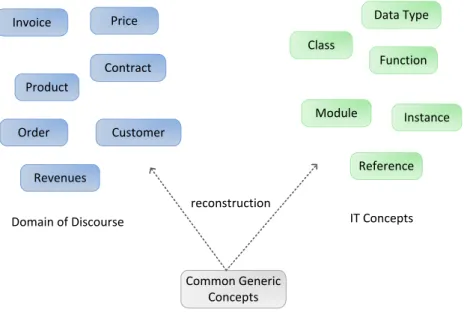
With respect to productivity and integrity, it would be worthwhile to define a mapping be-‐‑ tween the two languages. A mapping would require common generic concepts that allow for reconstructing both, the concepts of the domain of discourse and the IT concepts (see Figure 3).
Invoice Data Type
Product Customer Contract Revenues Price Order Function Class Module Reference Instance Common Generic Concepts
Domain of Discourse IT Concepts
reconstruction
Figure 3: Common Concepts as a Foundation for Mapping Domain Concepts to IT Concepts (Examples) With respect to information systems, generic concepts are abstractions of the underlying ma-‐‑ chine. They include concepts such as data type, class, attribute, state, state transition etc. With respect to the domains to be represented, the search for generic language concepts has been subject of Philosophy, but also of Linguistics and Cultural Anthropology for long. In Philosophy, it was motivated by an ontological question: What are generic categories of be-‐‑ ing? While the objectives of Ontology are not undisputed in Philosophy, it is nevertheless worthwhile looking at proposals for basic ontological categories. Aristotle suggested catego-‐‑
ries such as “substance”, “quantity”, “quality”, “state”, and “affection”. Apparently, catego-‐‑ ries like “quality” or “affection” do not allow for a clear mapping to basic concepts of infor-‐‑ mation systems. This is different with categories suggested by philosophers who aim at more precisely defined concepts. Grossmann, while building on Aristotle, is drawing on modern logics and suggests categories such as “individuals”, “properties”, “relations”, “classes”, “quantifiers” (Grossmann, 1983). Bunge, who suggests regarding the world in terms of sys-‐‑ tems (Bunge, 1979) in order to gain more precise conceptions, proposes ontological catego-‐‑ ries he refers to as the “furniture of the world” (Bunge, 1977). They include “things”, “prop-‐‑ erties of things”, “attributes of things”, “classes of things”, “coupling of things”, “laws and lawful states”. Apparently, Grossmann’s and Bunge’s proposals correspond almost directly to elementary concepts used in systems analysis and design. This is remarkable, since there is no evidence that the specification of the ERM or the UML was inspired by philosophical Ontology. Nevertheless, this correspondence provides the foundation for mapping concepts of a domain of discourse to concepts used for constructing information systems. Figure 4 illustrates this mapping and the respective abstractions. Note that the common generic con-‐‑ cepts correspond to concepts typically offered by GPML.
Information System Domain OrderItem Order Datatype Class Attribute class Customer { String firstname; String lastname; String phone; String email; Float revenues; } ... Conceptual Model Domain of Discourse
Common elementary concepts (Modelling Language) Programming Language Abstrac tion Customer firstName: String lastName: String phone: String email: String revenues: Real
„We need to knowlast Name, first Name
andRevenuesof a Customer…“ „An Order includesOrder Items. …“ corresponds Product Figure 4: Mapping between both Domains through Generic Concepts
GPML are certainly helpful with bridging the gap between application domains and corre-‐‑ sponding information systems. However, creating conceptual models from generic concepts such as ‘class’, ‘attribute’ etc. implies a tremendous effort and is a threat to model quality, too. Imagine one would have to write a business report in a language with primitive generic
concepts only! Providing modellers with a DSML that includes reconstructions of domain-‐‑ specific concepts they are familiar with is certainly much more attractive.
2.2
Domain-‐‑Specific Programming Languages
There are two ways to map the concepts of a DSML to implementation languages. First, they can be mapped to the generic concepts of general purpose programming languages (GPPL). Unfortunately, this will result in a loss of semantics. Take, for instance, a concept like ‘Posi-‐‑ tion’ of a DSML for modelling organisations. It can be instantiated in a type like ‘Sales_Assistant’. In a programming language, ‘Sales_Assistant’ would be represented e.g. as a class. Hence, the information that it is an instance of the meta type ‘Position’ would be lost. Second, the implementation language could also be domain-‐‑specific. Languages for specify-‐‑ ing workflow schemas are a prominent example. Their concepts correspond to those of DSML for business process modelling. In recent years, domain-‐‑specific programming lan-‐‑ guages have been an emerging field of research (see, e.g. Bettin and Clark, 2010, Ducasse and Gîrba, 2006). Usually, they are referred to as DSL. However, since this acronym is sometimes also used for domain-‐‑specific modelling languages, we rather use DSPL instead. Different from specifying a domain-‐‑specific concept with generic concepts, DSPL allow for making domain-‐‑specific concepts part of the programming language. For this purpose, they feature a distinct meta layer. As a consequence, they offer similar advantages to programming as DSML to modelling. Figure 5 illustrates the use of a fictitious DSPL in contrast to the use of a fictitious GPPL referring to the example used to compare DSML against GPML (see Figure 1). While a GPPL allows for defining classes with arbitrary features, the concepts provided by a DSPL allow for predefined instantiations only. In the example, these could be instances of a meta type such as ‘Platform’ or ‘Server’ – depending on the intended abstraction.
class ERP_System superclass: Object; name: String; os: String; runsOn: Invoice; name return name name: aString name := aString runsOn return runsOn runsOn: anInvoice runsOn := anInvoice Software ERP_System; name: String; os: String; runsOn: Invoice; ... compile time error! predefined GPPL DSPL Figure 5: Illustration of DSPL compared to GPPL
Using DSML and corresponding DSPL allows for bridging the gap between application do-‐‑ mains and information systems on a higher level of semantics, thus contributing to increased productivity and integrity (see section 2.1). At the same time, it creates an additional chal-‐‑ lenge: It would not be enough developing a DSML alone. Instead, every DSML development would require developing a corresponding DSPL as well as the related tools.
While generating code from models can substantially contribute to productivity and code quality, it will usually create the problem to synchronize model and code consistently. There-‐‑ fore, it would be more appealing to aim at a common representation of models and code (for a detailed discussion of this prospect see Frank and Strecker, 2007, p. 20 f.) – in other words: to develop domain-‐‑specific languages that serve as a foundation for both conceptual model-‐‑ ling and implementation.
Service Business Process Organisational Unit <wsdl:operation name=„check_availability"> <wsdl:portType name=“StockInfo"> ... Conceptual Model Common domain-specific concepts (DSML) Implementation Language (DSL) A b st ra ct io n „Sales departmentis in charge of theorder management process
…“
„A stock information serviceshould offer …“
corresponds
Information System Domain
Domain of Discourse
Figure 6: Illustration of Mapping DSML to DSPL
2.3
Multi-‐‑Perspective Enterprise Modelling
The method presented in this report is designed for DSML in the realm of enterprise model-‐‑ ling, which is our main field of research. Languages to be used for enterprise modelling cov-‐‑ er a remarkable range. They have one characteristic in common that does not have to apply for DSML in other areas. It is implied by the conception of an enterprise model:
An enterprise model serves the purpose to support analysis, design and management
of information systems together with corresponding action systems. It comprises con-‐‑ ceptual models of software systems, e.g. object or component models, and conceptual models of the surrounding action systems, e.g. business process models or strategy
models. The models that constitute an enterprise model are integrated through the use of common concepts.
Note that action system and information system are not limited by the boundaries of a par-‐‑ ticular organisation. Instead, an enterprise model may represent inter-‐‑organisational action systems, too. Integrating the various models that are part of an enterprise model does not only foster the integrity of an enterprise model, it also provides a medium for users with different professional backgrounds to communicate more effectively: While everybody should have a good chance to find an abstraction that corresponds to his personal perception (and conception), he is also supported in realizing how the models he prefers are related to those of other stakeholders.
Hence, DSML for enterprise modelling will usually address at least two diverse groups of potential users: people with an IT background on the one hand, and actors that are business-‐‑ oriented on the other hand. To further emphasize this fact, we use the notion of multi-‐‑ perspective enterprise model:
A multi-‐‑perspective enterprise model is an enterprise model that emphasizes account-‐‑
ing for perspectives. The term ‘multi-‐‑perspective’ is purposefully overloaded. On the one hand, it represents different conceptions of perspective. On the other hand, it refers to differentiating specific perspectives related to one conception of perspective. The first conception is a psychological one: In this conception, a perspective represents a specific professional background that corresponds to cognitive dispositions, technical languages, specific goals and capabilities of prospective users. The second conception refers to the representation of perspectives within an enterprise model. In this sense it relates directly to the respective DSML that are expected to provide concepts that cor-‐‑ respond to those characteristic for certain (psychological) perspectives. The third con-‐‑ ception goes beyond the factual content of an enterprise model and stresses critical me-‐‑ ta perspectives. It recommends supplementing – and confronting – an enterprise model with the relevant context, i.e. with aspects that are required for a reflective interpreta-‐‑ tion of an enterprise model but that bulk against formalisation.
At first sight it may seem that the development of a DSML for enterprise modelling will mainly focus on the second aspect – the specification of modelling concepts. However, with-‐‑ out an idea of relevant psychological perspectives, it will be impossible to develop appropri-‐‑ ate language concepts. At the same time, it suggests to account for the problem that a psy-‐‑ chological perspective cannot be completely represented in a DSML or a corresponding model. Perspective as a psychological concept serves to express that the way an individual perceives and understands the world, i.e. his ‘Weltanschauung’, is characterized by a cogni-‐‑ tive disposition that is shaped by socialisation, experiences, language games, etc. It consti-‐‑ tutes sense and is a framework for understanding our surroundings. Experiences relate to patterns of interaction, to the appreciation of other actor’s attitudes and expectations. We cannot expect to adequately represent all aspects of this psychological concept with a DSML. This limitation of DSML is a specific problem in those cases where relevant aspects of a con-‐‑ cept can be represented only through simplifications. For instance: If a DSML for modelling
organisations includes a concept like ‘competence’ to describe a particular position type, it may cause the problem that prospective users account for these explicit aspects only, neglect-‐‑ ing other aspects that bulk against formalisation, such as, e.g. commitment or persistence. The third meaning of the term ‘multi-‐‑perspective enterprise model’ in the above definition relates to this possible problem. It is aimed at the reflective assessment and use of enterprise models and suggests an additional, critical perspective that accounts for aspects not repre-‐‑ sented explicitly in a model. It also stresses that a mere engineering approach to designing and using enterprise models is not sufficient.
Reflecting upon the term ‘perspective’ has two major consequences for the development of a DSML. First, it creates a specific challenge for requirements analysis, because it demands to focus on specific cognitive styles, attitudes etc. that will often not be directly accessible. Therefore, it is especially important to intensively communicate with prospective users aim-‐‑ ing at gaining a deeper understanding of their perspective. Second, it demands for supple-‐‑ menting language concepts with explicit remarks that they are based on simplifications that may cause dysfunctional effects in case they are used without critical distance.
The method is intended to support everybody who develops DSML in the area of enterprise modelling, i.e. academics as well as practitioners. However, it is not conceptualized as a re-‐‑ search method. Nevertheless, some peculiarities of developing a DSML as part of a research project will be accounted for in the process model (for an elaborate study on corresponding research methods see Frank, 2006b). Note that the focus on enterprise modelling does not exclude that the method is suited for developing other DSML, too.
3
Generic Requirements for DSML
The previous definition of DSML gives an impression of core ideas. However, it does not include a differentiated consideration of purposes and quality criteria. To develop a more elaborate conception of DSML, we will look at generic requirements any DSML should fulfil. Publications on requirements for modelling languages can be differentiated into three cate-‐‑ gories. Approaches that focus on formal requirements, usually originating in Computer Sci-‐‑ ence, emphasize aspects such as correctness and completeness. Typically, they do not ac-‐‑ count for characteristics of the targeted domain or for specific use cases. Therefore, they are not sufficient for covering all relevant requirements. Approaches that stress pragmatic aspects focus the question what prospective users demand from an artefact. For this purpose they emphasize an empirical approach by analysing requirements through interviewing users and analysing the patterns of action and/or decision making that should be supported. Fol-‐‑ lowing such an approach faces the challenge that most users will lack sufficient knowledge of DSML to answer questions directly related to generic requirements.
Other approaches are aimed at developing a foundation of modelling languages by referring to the field of Ontology in Philosophy (for a more comprehensive overview see Frank, 2006a). In order to develop a theoretical foundation of conceptual modelling, Weber suggests refer-‐‑ ring to the ontology introduced by Bunge (1977) mentioned already above. Based on Bunge’s work, he proposes “ontological completeness” and “ontological clarity” as a core require-‐‑ ment (Weber 1997, pp. 92) modelling languages should satisfy. The demand for ontological completeness is satisfied, if a modelling language covers all basic concepts proposed by the reference ontology, which was adapted from Bunge’s work (Wand and Weber, 1995). It in-‐‑ cludes basic concepts to describe static, (e.g. “things”, “properties of things”) and dynamic (e.g. “events”, “states”) abstractions. Ontological clarity demands for avoiding concept over-‐‑ load, redundancy or excess. A concept of a modelling language is overloaded, if it maps to more than one concept of the ontology. It is redundant, if there is already another language concept that maps to the same concept of the ontology. It is excessive, if it maps to none, it is regarded as excessive. While Weber’s approach was adopted by others – e.g. Opdahl and Henderson-‐‑Sellers (1999), Fettke and Loos (2003), it suffers from a severe misconception, which makes it especially useless for DSML. Usually, a modelling language is focusing on a particular abstraction, e.g. static, functional or dynamic. Hence, it is not ontological complete on purpose – and for a good reason. Concepts offered by a DSML may be overloaded on pur-‐‑ pose, too. Take, for instance, the concept ‘process’ that may be part of a DSML for modelling business processes. It will usually combine static features (e.g. average costs) and dynamic features.
Due to the lack of adequate guidance, we will not build on ontologies to analyse require-‐‑ ments for DSML. Instead, we apply and refine the framework presented in Frank and Laak (2003). It accounts for formal and pragmatic requirements where the latter are differentiated
into user-‐‑oriented and application-‐‑oriented aspects. Note that these are not orthogonal di-‐‑ mensions.
Formal requirements are of special relevance, if formal procedures (that allow for automation)
are required for analysing or transforming models.
User-oriented requirements refer to the prospective modellers’ perception of language concepts
and their visualisation.
Application-oriented requirements are related to the intended modelling domains and generic
modelling purposes.
3.1
Formal Requirements
While the formalisation of a modelling language is not an end in itself, it can be very useful with respect to analysing and transforming models. In computer science, it is common to demand for a correct and complete specification of modelling languages. A specification is correct and complete, if it allows for the clear identification of all models, which include syn-‐‑ tactic or semantic errors. At the same time, a correct and complete specification allows for generating the set of all models that are syntactically and semantically correct. In other words, a correct and complete specification refers to the formalisation of both, the syntax and the semantics of a language. Formalisation requires the use of a formal (meta) language. For our purpose, the quest for formalizing a modelling language seems too rigid. While it makes sense to formalize the syntax in order to foster formal analysis and the construction of mod-‐‑ elling tools, formalizing the semantics is hardly feasible. That is for two reasons. First, the domain of interest may include concepts that balk at formalisation, e.g. ‘competence’ or ‘cus-‐‑ tomer satisfaction’. In this case, the only option is ‘pseudo’ formalisation. It occurs in two variants, which may be combined. First, a concept can be reduced to a formal specification that represents only certain aspects. Describing a resource type’s value by referring to an ordinal scale would be an example of this kind of formalisation. The second variant features representations with no formal semantics that depend on human interpretations, e.g. a string that represents a natural language term or statement. In both cases, one can hardly speak of formal semantics, since it is not possible to formally decide whether a particular description is appropriate or not. Nevertheless, ‘pseudo’ formalisation can be helpful for documenting and analysing organisational models.
Against this background, we shall relax the demand for formalisation:
Requirement F1: The specification of a modelling language should include a precise
and complete specification of its syntax. In an ideal case, this will be a formal specifica-‐‑ tion. In any case, the syntax specification should allow a human to clearly decide whether a specific model is syntactically correct or not. Rationale: Syntactical correct-‐‑ ness is a prerequisite for model analysis and for keeping models in a consistent state.
Requirement F2: The concepts used to specify a DSML should correspond to concepts of languages used for software design. Rationale: A clear correspondence will promote a straightforward implementation of respective modelling tools. Note, however, that this requirement may be in conflict with other requirements.
Within the specification of a language, there is no clear distinction between syntax and se-‐‑ mantics. Syntactical rules can be used to exclude models that make no sense. The semantics can be specified by formal and informal rules.
Requirement F3: The rules defining the semantics of a modelling language should be
suited to clearly guide prospective users with the construction of appropriate models and their adequate interpretation. These rules should be formalized, if this does not compromise the intended meaning. Rationale: Only if the semantics of modelling con-‐‑ cepts is precisely defined, conceptual models can be unambiguous, which in turn is a prerequisite for (automated) analysis.
The convenient and safe development and maintenance of models recommends concepts that allow for a high level of abstraction. A high level of abstraction fosters reuse (e.g. through generalisation/specialisation) and integrity.
Requirement F4: The modelling language should feature concepts on a high level of
semantics to support model integrity and reuse. Rationale: The more (domain-‐‑specific) semantics a modelling concepts includes, the better it is suited to prevent users from accidental errors (see Figure 1). Note, however, that this requirement may be in conflict with requirement A1.
3.2
User-‐‑Oriented Requirements
The prospective users of a DSML include domain experts, systems analysts, and software developers. While it is likely that these groups will emphasize different specific require-‐‑ ments, there are three generic requirements that make sense for all users: simplicity, com-‐‑ prehensibility and convenience of use. Note that these requirements are not necessarily com-‐‑ patible.
The simpler a language, the more likely it is that users are not overcharged. As a conse-‐‑ quence, one can expect that a simple language will foster the construction of error-‐‑free mod-‐‑ els. While there is no clear definition of simplicity, we can assume that a language is the more simple, the less the number of its concepts and the number of the rules to define its syntax and semantics. The comprehensibility of a language may be fostered by its simplicity. But it seems that it is more important that the concepts it provides correspond to the termi-‐‑ nology prospective users are familiar with.
Requirement U1: The concepts of a modelling language should correspond to concepts
prospective users are familiar with. That recommends reconstructing existing termi-‐‑ nology. Furthermore, it recommends using graphical symbols that are suited to illus-‐‑ trate the corresponding concepts’ meaning. Rationale: The more users are familiar with
the concepts of a DSML and their representation, the easier it will be for them to un-‐‑ derstand and use them properly.
Note, however, that satisfying this requirement may be aggravated by the diversity of do-‐‑ mains – and corresponding terminologies – a modelling language is supposed to cover. Con-‐‑ venience of use refers to the effort that is required to build a model. This requirement is con-‐‑ trasting the demand for simplicity. If a language provides domain specific concepts, it sup-‐‑ ports those users’ productivity that develop models for this domain, since they do not need to construct these concepts on their own. However, the more specialized concepts a model-‐‑ ling language includes, the higher will be the effort to learn it.
Requirement U2: A DSML should provide a manageable set of basic concepts that are
sufficient for creating simple models. Rationale: Often, there will be users that do not need to develop elaborate models. For them, it would be an unnecessary burden, if they could use the language only after they had learned more elaborate concepts, too. In other words: If possible, a DSML should include a subset that represents a light-‐‑ weight version.
Note that this requirement makes especially sense with more complex DSML. In these cases, it will be beneficial for occasional users, if they do not have to learn the entire language to develop a model that fits their needs.
The following requirement relates to the previous one and also to requirement A3:
Requirement U3: The modelling language should allow for building models on vari-‐‑
ous levels of detail and abstraction. A modeller should not be forced to specify details he does not need. Rationale: Usually, different groups of users have different demands for the level of abstraction and detail provided by a model. Some will be bothered by too much detail, while others focus problems that require a higher degree of detail.
3.3
Application-‐‑Oriented Requirements
Incorporating domain-‐‑specific concepts into a language is only one option to foster produc-‐‑ tivity. Only if the semantics of a concept is invariant across the entire class of intended mod-‐‑ els, it is suited to be incorporated into the language. Otherwise, it would limit the usability of the language. In addition to that, to not compromise the quest for simplicity too much, only those concepts should be included in the language that are needed on a regular base. Includ-‐‑ ing a concept in the language has one major advantage over representing it in an accompa-‐‑ nying reference model: Its adequate use can be enforced through the language specification.
Requirement A1: A modelling language should provide domain specific concepts as
long as their semantics is invariant within the scope of the language’s application. Ra-‐‑ tionale: Only if the semantics of a modelling concept is invariant within the range of its intended use, it is possible to satisfy all prospective users
Note that this requirement may lead to exclude concepts that are not invariant from a DSML or to limit the scope of the DSML’s application. The concepts a modelling language should
include depend on the purpose the corresponding models should fulfil, hence, on its intend-‐‑ ed application. In general, the concepts of a language should be adequate with respect to the set of intended applications. On the one hand, that implies that a language should not be overloaded with concepts that are not required. On the other hand, it means that the lan-‐‑ guage concepts should allow for descriptions on a level of detail that is implied by the appli-‐‑ cation purposes. This recommends carefully analysing possible applications. However, one cannot show that a certain set of applications is sufficient for all times. Therefore, a language should allow for application-‐‑specific extensions.
Requirement A2: The concepts of a language should allow for modelling at a level of
detail that is sufficient for all foreseeable applications. To cover further possible appli-‐‑ cations, it should provide extension mechanisms. Rationale: A DSML is intended to cover a certain domain only. At the time of its specification, there needs to be a clear idea of this domain and related applications. However, it cannot be excluded that fur-‐‑ ther aspects of the domain will be discovered that should be represented by the DSML. Extensions mechanisms provide support for dealing with this change. Note, however, that they will usually offer a compromise only. If the extensions are relevant enough, a modification of the language itself may be the better option.
Conceptual models are focusing the type level: The concepts of a model do not represent particular instances, but types. However, sometimes the elaborate design of conceptual models requires further levels of abstraction. Consider for instance the feature that every business process starts at a certain point in time and terminates at a certain point in time. While this feature applies to all instances of a type, it is not a direct feature of the type. The type may have been created at a certain point in time. But that represents clearly a different meaning.
Requirement A3: A modelling language should provide concepts that allow for clearly
distinguishing different levels of abstraction within a model. Rationale: Conceptual models may represent different levels of abstraction, e.g. types and – in rare cases – in-‐‑ stances. Overloading a model with different levels of abstraction compromises an ap-‐‑ propriate interpretation of a model.
Often, conceptual models are transformed into other representations, e.g. into implementa-‐‑ tion level documents. These transformations should not be biased by ambiguity.
Requirement A4: There should be a clear mapping of the language concepts to the concepts
of relevant target representations. In an ideal case, all information required by the target rep-‐‑ resentations can be extracted from the model. That requires that the concepts of the language allow for expressing all concepts of relevant target representations. Rationale: The most im-‐‑ portant – but not the only – case for the requirement is software development. The semantics of programming languages is characterized by a few subtle peculiarities. They concern e.g. the notion of class or specialisation/generalisation. A DSML can either adopt the semantics of implementation languages or it can provide a clear mapping to these.
Due to our conception of multi-‐‑perspective enterprise models, the development of a DSML should be accompanied by a critical evaluation.
Requirement A5: In case a concept of a DSML is based on a problematic reduc-‐‑
tion/simplification, this should be clearly stated with the language documentation. Ra-‐‑ tionale: If a credulous user applies respective concepts and eventually beliefs in them, his judgement may get compromised. In other words: The concept would not promote a differentiated problem analysis, but rather hamper it.
4
Specific Challenges: Contingent Target
The rationale for developing a DSML seems to be convincing. Compared to a GPML, a DSML promises to improve both, productivity and quality. As a consequence, prospective users should be eager to get such a powerful tool. And of course, those who are in charge of approving the required investment should be supportive. Unfortunately, deciding for the development of a DSML will usually be not that easy. This is for various reasons:
Lack of support by users: Today, a DSML is still an artefact most prospective users are not fa-‐‑ miliar with. At the beginning, they do not know sufficiently what they may expect. Often, there will be no similar DSML available that could be used as a demonstrator. The lack of knowledge about the targeted artefact will most likely not promote the prospective users’ enthusiasm. But even those who understand the basic idea do not have to appreciate it: The introduction of a new language does not only imply the effort of learning it, it will also re-‐‑ quire giving up the use of GPML users are familiar with. Hence, it comes with the threat of challenging existing competence and reputation.
Amorphous requirements: As long as users lack a clear imagination of the instrument they may expect, it will be difficult to get them involved in the process of gathering and shaping re-‐‑ quirements. On the other hand, language designers will often be not sufficiently familiar with the targeted domain to define requirements on their own. This problem will be the more serious the less experience designers of a DSML have gained in similar projects.
Economics hard to judge: Usually, an economic justification will be most effective. That would require showing that the investment into a DSML produces a satisfactory return. However, calculating the economics of a DSML in advance is facing serious obstacles. On the one hand, the economic benefit to be expected from using a DSML is hard to predict – especially when it comes to quantifying it. While there is good reason to assume that it will foster quality and productivity, it may well happen that an insufficiently designed DSML and corresponding tools do not keep up to their promises. Due to relative little experience, the investment into developing and using a DSML leaves significant risks. As a consequence, it will be challeng-‐‑ ing to convince managers who decide about respective budgets.
Kelly and Tolvanen emphasize the quest for an economic justification of DSML, too. They respond to it with an optimistic advice: "ʺDomain-‐‑specific approaches should generally be used whenever possible. They normally produce better results than general-‐‑purpose ap-‐‑ proaches."ʺ (Kelly and Tolvanen, 2008, p. 34). While we sympathize with this advice, it will often be regarded as not sufficient to justify a major investment.
Little incentives for pioneers: The costs of using a DSML depend on the range of its use. The higher the level of (re-‐‑) use, the more attractive are the economies of scale. If a DSML and corresponding tools can be obtained at little cost, it is likely that more and more prospective users will try it. Hence, as long as a critical mass has not been reached, there is need for pio-‐‑
neers who are willing to invest into the development and establishment of a DSML. To justi-‐‑ fy such an investment, a company will usually want to know the potential of the respective market and the share it may expect to get. Predicting these numbers is risky. Also, for pro-‐‑ spective customers standardisation becomes more and more important. Defining a standard is not only beyond the capabilities of most potential vendors, it will also take an unpredicta-‐‑ ble long time. As a consequence, the incentives for investing into DSML and related technol-‐‑ ogies may often be regarded as not convincing. This conflict between the obvious – though not exactly quantifiable benefit – of an artefact and the risk that is related to the initial devel-‐‑ opment costs is well-‐‑known. It is the case, too, for reference models and for sophisticated application systems. One approach to overcome this conflict is the establishment of open communities of developers and prospective users following the model of open source soft-‐‑ ware. A corresponding initiative for conceptual models and modelling languages is outlined in Frank and Strecker (2007).
The difficulties in analysing the economics of DSML in advance are also related to a general design conflict. To take advantage of economies of scale, a DSML should be reusable in a wide range of application scenarios. Hence, the language concepts should not comprise too much domain-‐‑specific semantics. At the same time, however, a DSML should be a tool that provides effective support. The more domain-‐‑specific semantics a DSML includes the better its contribution to productivity – in those cases it fits. Figure 7 illustrates these considerations – and at the same time that trying to determine an optimal level of semantics would be a hopeless undertaking: Not only that measuring the level of semantics provided by a DSML on a metric scale is hardly possible, the benefits of additional semantics will be hard to judge in a single case – not to speak of numerous cases with considerable variance.
Figure 7: The Effect of Semantics on DSML Benefits
While it does not seem to be a promising idea to pursue an approach to calculate the optimal level of semantics a DSML should feature, it is nevertheless required to make corresponding decisions, namely to determine whether or not to develop a DSML for a certain domain – and how specific it should be. In their approach to developing and using DSML Kelly and
Tolvanen avoid the problem of determining an economic scale of reuse in advance by re-‐‑ stricting the application of a DSML to one particular organisation: "ʺA domain here is general-‐‑ ly a highly focused problem domain, typically worked on by 5 – 500 developers in the same organisation."ʺ (Kelly and Tolvanen, 2008, p. xiii). Apart from the fact that the definition is circular, the authors do not explain why they limit the number of prospective users to 500. It is hard to see why one should not go for a higher number of users. The authors give one rea-‐‑ son why to restrict the use of a DSML to one organisation: If it is regarded as an asset that generates competitive advantage, it makes sense not to make it available to competitors. However, this is only one aspect of using a DSML across a range of organisations. It is con-‐‑ ceivable that various organisations that are not competitors use a common DSML, which would result in lower costs. Kelly and Tolvanen suggest that investments into DSML will pay off anyway – independe