Chapter 2
: Machines, Machine
Languages, and Digital Logic
Topics
2.1 Classification of Computers and Their Instructions 2.2 Computer Instruction Sets
2.3 Informal Description of the Simple RISC Computer, SRC
2.4 Formal Description of SRC Using Register Transfer Notation, RTN
2.5 Describing Addressing Modes with RTN
2.6 Register Transfers and Logic Circuits: From Behavior to Hardware
What Are the Components of an ISA?
• Sometimes known as The Programmer’s Model of the machine
• Storage cells
• General and special purpose registers in the CPU
• Many general purpose cells of same size in memory
• Storage associated with I/O devices
• The machine instruction set
• The instruction set is the entire repertoire of machine operations
• Makes use of storage cells, formats, and results of the fetch/ execute cycle
• i.e., register transfers
• The instruction format
• Size and meaning of fields within the instruction
• The nature of the fetch-execute cycle
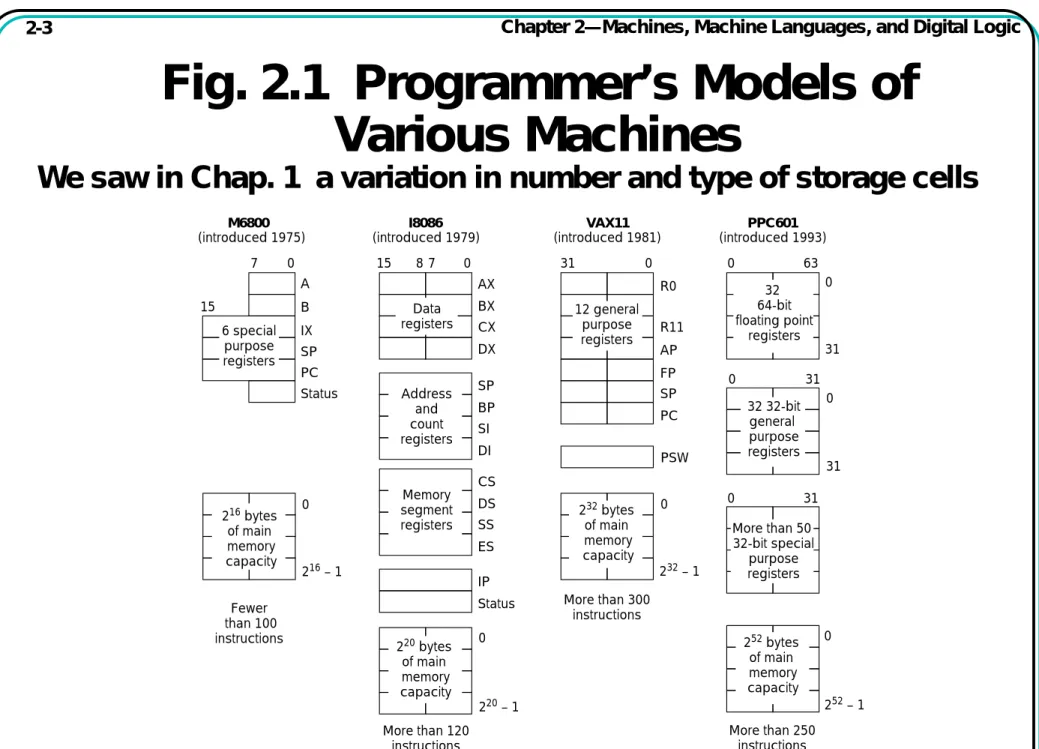
Fig. 2.1 Programmer’s Models of
Various Machines
We saw in Chap. 1 a variation in number and type of storage cells
216 bytes of main memory capacity Fewer than 100 instructions 7 15 A 216 – 1 B IX SP PC 0 12 general purpose registers More than 300 instructions More than 250 instructions More than 120 instructions 232 – 1 252 – 1 0 PSW Status R0 PC R11 AP FP SP 0 31 0 32 64-bit floating point registers (introduced 1993) (introduced 1981) (introduced 1975) (introduced 1979) 0 31 0 63 32 32-bit general purpose registers 0 31 0 31 More than 50 32-bit special purpose registers 0 31 252 bytes of main memory capacity 0 M6800 VAX11 PPC601 220 – 1 AX BX CX DX SP BP SI DI 15 87 0 IP Status Address and count registers CS DS SS ES Memory segment registers 220 bytes of main memory capacity 0 I8086 232 bytes of main memory capacity Data registers 6 special purpose registers
• Which operation to perform add r0, r1, r3
• Ans: Op code: add, load, branch, etc.
• Where to find the operand or operands add r0, r1, r3
• In CPU registers, memory cells, I/O locations, or part of instruction
• Place to store result add r0, r1, r3
• Again CPU register or memory cell
• Location of next instruction add r0, r1, r3
br endloop
• Almost always memory cell pointed to by program counter—PC
• Sometimes there is no operand, or no result, or no next instruction.
Can you think of examples?
What Must an Instruction Specify?
Instructions Can Be Divided into
3 Classes
• Data movement instructions
• Move data from a memory location or register to another memory location or register without changing its form
• Load—source is memory and destination is register
• Store—source is register and destination is memory
• Arithmetic and logic (ALU) instructions
• Change the form of one or more operands to produce a result stored in another location
• Add, Sub, Shift, etc.
• Branch instructions (control flow instructions)
• Alter the normal flow of control from executing the next instruction in sequence
Tbl 2.1 Examples of Data Movement
Instructions
• Lots of variation, even with one instruction type
Instruction Meaning Machine
MOV A, B Move 16 bits from memory location A to VAX11
Location B
LDA A, Addr Load accumulator A with the byte at memory M6800
location Addr
lwz R3, A Move 32-bit data from memory location A to PPC601
register R3
li $3, 455 Load the 32-bit integer 455 into register $3 MIPS R3000
mov R4, dout Move 16-bit data from R4 to output port dout DEC PDP11
IN, AL, KBD Load a byte from in port KBD to accumulator Intel Pentium
Tbl 2.2 Examples of ALU
Instructions
Instruction Meaning Machine
MULF A, B, C multiply the 32-bit floating point values at VAX11 mem loc’ns. A and B, store at C
nabs r3, r1 Store abs value of r1 in r3 PPC601
ori $2, $1, 255 Store logical OR of reg $ 1 with 255 into reg $2 MIPS R3000
DEC R2 Decrement the 16-bit value stored in reg R2 DEC PDP11
SHL AX, 4 Shift the 16-bit value in reg AX left by 4 bit pos’ns. Intel 8086
Tbl 2.3 Examples of Branch
Instructions
Instruction Meaning Machine
BLSS A, Tgt Branch to address Tgt if the least significant VAX11 bit of mem loc’n. A is set (i.e. = 1)
bun r2 Branch to location in R2 if result of previous PPC601 floating point computation was Not a Number (NAN)
beq $2, $1, 32 Branch to location (PC + 4 + 32) if contents MIPS R3000 of $1 and $2 are equal
SOB R4, Loop Decrement R4 and branch to Loop if R4 ≠ 0 DEC PDP11
CPU Registers Associated with Flow of
Control—Branch Instructions
• Program counter usually locates next instruction
• Condition codes may control branch
• Branch targets may be separate registers
Processor State C N V Z Program Counter Branch Targets Condition Codes • • •
HLL Conditionals Implemented by
Control Flow Change
• Conditions are computed by arithmetic instructions
• Program counter is changed to execute only instructions associated with true conditions
C language
Assembly language
if NUM==5 then SET=7
CMP.W #5, NUM
BNE L1
MOV.W #7, SET
L1 ...
;the comparison ;conditional branch ;action if true ;action if falseCPU Registers May Have a
“Personality”
• Architecture classes are often based on how where the
operands and result are located and how they are specified by the instruction.
• They can be in CPU registers or main memory:
Top Second
Stack Arithmetic
Registers AddressRegisters General PurposeRegisters Push Pop • • • • • • • • • • • •
Stack Machine Accumulat or Machine General Regist er Machine
3-, 2-, 1-, & 0-Address ISAs
• The classification is based on arithmetic instructions that have two operands and one result
• The key issue is “how many of these are specified by memory addresses, as opposed to being specified implicitly”
• A 3-address instruction specifies memory addresses for both operands and the result R ← Op1 op Op2
• A 2-address instruction overwrites one operand in memory with the result Op2 ← Op1 op Op2
• A 1-address instruction has a processor, called the accumulator register, to hold one operand & the result (no addr. needed)
Acc ← Acc op Op1
• A 0-address + uses a CPU register stack to hold both operands and the result TOS ← TOS op SOS (where TOS is Top Of Stack, SOS is Second On Stack)
• The 4-address instruction, hardly ever seen, also allows the address of the next instruction to specified explicitly
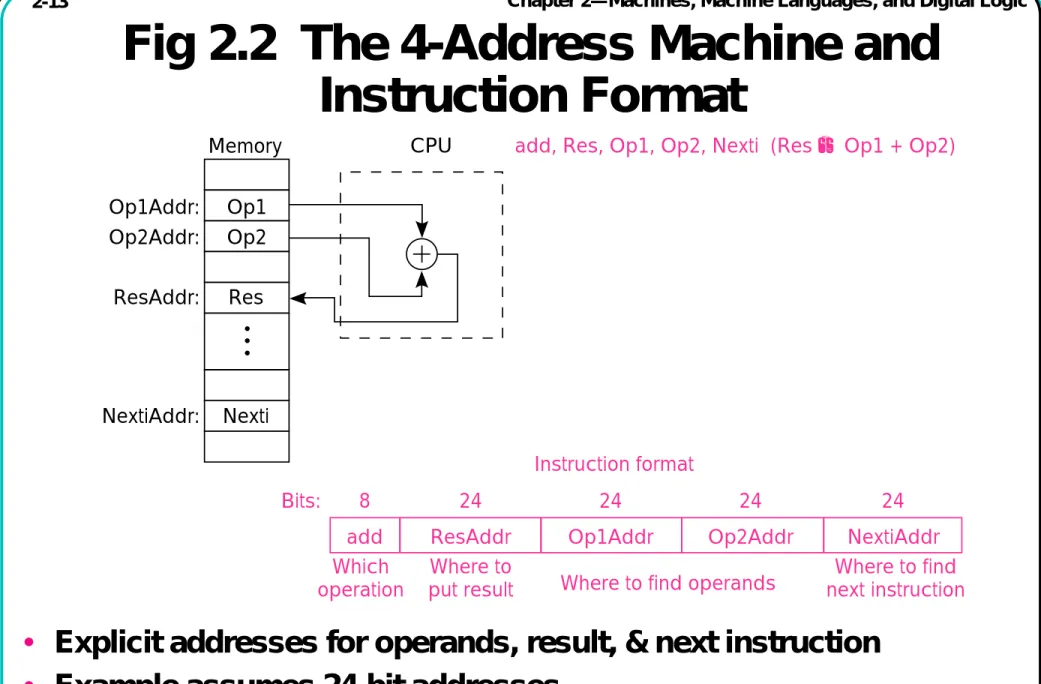
Fig 2.2 The 4-Address Machine and
Instruction Format
• Explicit addresses for operands, result, & next instruction
• Example assumes 24-bit addresses
• Discuss: size of instruction in bytes
Memory Op1Addr: Op2Addr: Op1 Op2 ResAddr: NextiAddr: Bits: 8 24 24 Instruction format 24 24 Res Nexti
CPU add, Res, Op1, Op2, Nexti (Res ← Op1 + Op2)
add ResAddr Op1Addr Op2Addr NextiAddr
Which operation
Where to
put result Where to find operands
Where to find next instruction
Instruction Format
• Address of next instruction kept in processor state register— the PC (except for explicit branches/jumps)
• Rest of addresses in instruction
Memory Op1Addr: Op2Addr: Op1 Program counter Op2 ResAddr: NextiAddr: Bits: 8 24 24 Instruction format 24 Res Nexti CPU Where to find next instruction 24
add, Res, Op1, Op2 (Res ← Op2 + Op1)
add ResAddr Op1Addr Op2Addr
Which operation
Where to
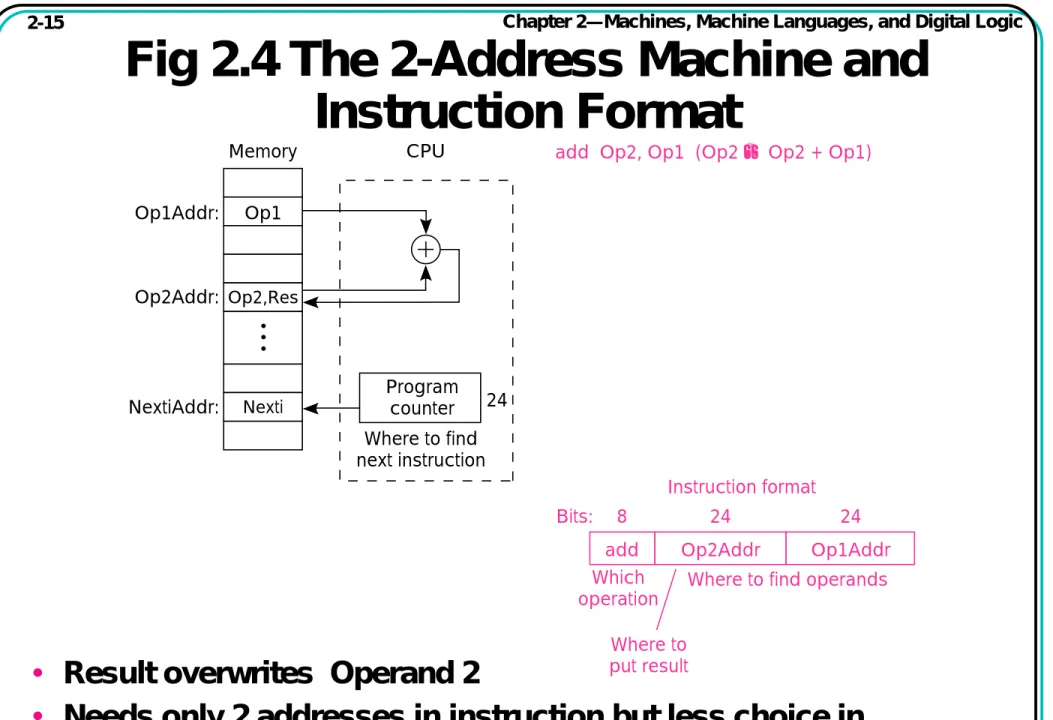
Fig 2.4 The 2-Address Machine and
Instruction Format
• Result overwrites Operand 2
• Needs only 2 addresses in instruction but less choice in placing data Memory Op1Addr: Op2Addr: Op1 Program counter Op2,Res Nexti NextiAddr: Bits: 8 24 24 Instruction format CPU Where to find next instruction 24
add Op2, Op1 (Op2 ← Op2 + Op1)
add Op2Addr Op1Addr Which
operation Where to put result
Instruction Format
• Special CPU register, the accumulator, supplies 1 operand and stores result
Need instructions to load and store operands:
LDA OpAddr STA OpAddr
Memory
Op1Addr: Op1
Nexti Programcounter Accumulator NextiAddr: Bits: 8 24 Instruction format CPU Where to find next instruction 24
add Op1 (Acc ← Acc + Op1)
add Op1Addr Which operation Where to find operand1 Where to find operand2, and where to put result
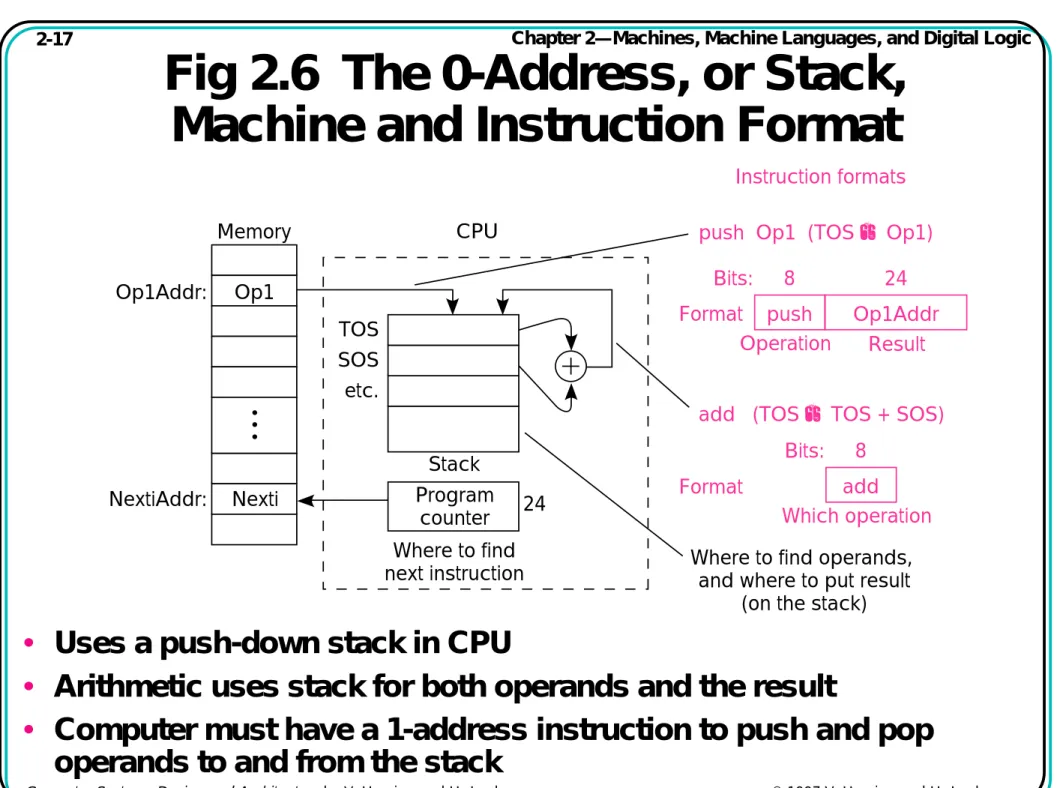
Fig 2.6 The 0-Address, or Stack,
Machine and Instruction Format
• Uses a push-down stack in CPU
• Arithmetic uses stack for both operands and the result
• Computer must have a 1-address instruction to push and pop operands to and from the stack
Memory Op1Addr: TOS SOS etc. Op1 Program counter NextiAddr: Nexti Bits: Format Format 8 24 CPU Where to find next instruction Stack 24
push Op1 (TOS ← Op1) Instruction formats
add (TOS ← TOS + SOS) push Op1Addr Operation Bits: 8 add Which operation Result
Where to find operands, and where to put result
Example 2.1 Expression Evaluation for
3-, 2-, 1-, and 0-Address Machines
• Number of instructions & number of addresses both vary
• Discuss as examples: size of code in each case
3 - a d d r e s s
2 - a d d r e s s
1 - a d d r e s s
S t a c k
add a, b, c
mpy a, a, d
sub a, a, e
load a, b
add a, c
mpy a, d
sub a, e
load b
add c
mpy d
sub e
store a
push b
push c
add
push d
mpy
push e
sub
pop a
Evaluat e a = (b+c)*d - e
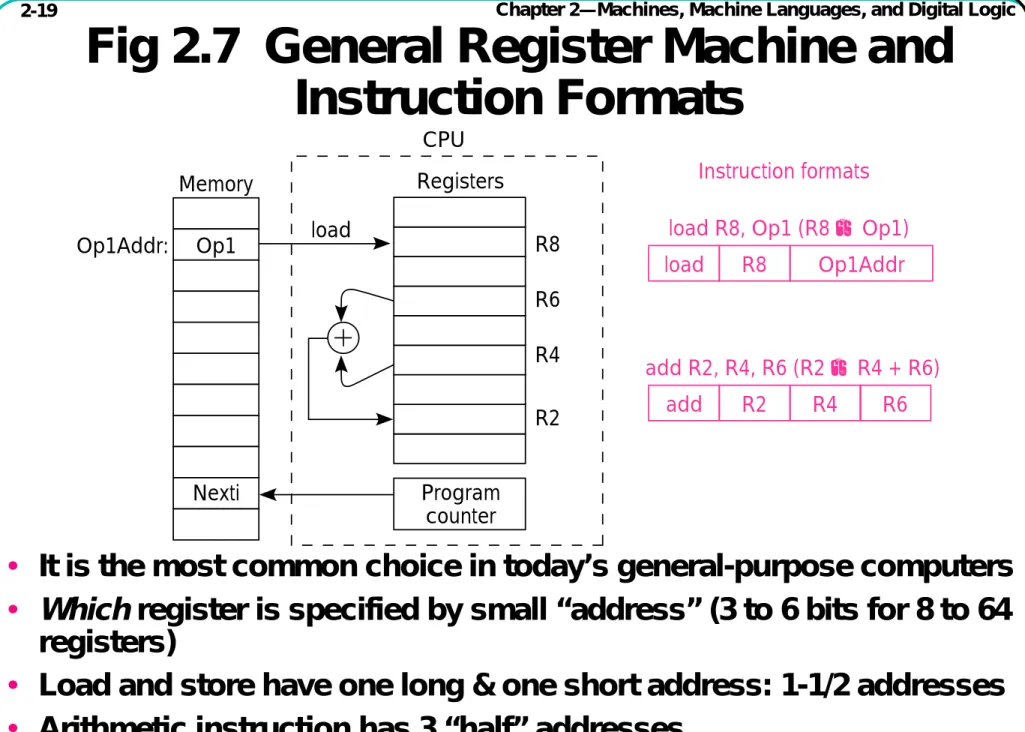
Fig 2.7 General Register Machine and
Instruction Formats
• It is the most common choice in today’s general-purpose computers
• Which register is specified by small “address” (3 to 6 bits for 8 to 64
registers)
• Load and store have one long & one short address: 1-1/2 addresses
• Arithmetic instruction has 3 “half” addresses
Memory
Op1Addr: Op1 load
Nexti Program
counter
load R8, Op1 (R8 ← Op1)
CPU Registers R8 R6 R4 R2 Instruction formats R8 load Op1Addr add R2, R4, R6 (R2 ← R4 + R6) R2 add R4 R6
Real Machines Are Not So Simple
• Most real machines have a mixture of 3, 2, 1, 0, and 1-1/2 address instructions
• A distinction can be made on whether arithmetic instructions use data from memory
• If ALU instructions only use registers for operands and result, machine type is load-store
• Only load and store instructions reference memory
• Other machines have a mix of register-memory and memory-memory instructions
Addressing Modes
• An addressing mode is hardware support for a useful way of determining a memory address
• Different addressing modes solve different HLL problems
• Some addresses may be known at compile time, e.g., global variables
• Others may not be known until run time, e.g., pointers
• Addresses may have to be computed. Examples include:
• Record (struct) components:
• variable base (full address) + constant (small)
• Array components:
• constant base (full address) + index variable (small)
• Possible to store constant values w/o using another memory cell by storing them with or adjacent to the instruction itself
HLL Examples of Structured Addresses
• C language: rec → count
• rec is a pointer to a record: full address variable
• count is a field name: fixed byte offset, say 24
• C language: v[i]
• v is fixed base address of array: full address constant
• i is name of variable index: no larger than array size
• Variables must be contained in registers or memory cells
• Small constants can be contained in the instruction
• Result: need for “address arithmetic.”
• E.g., Address of Rec → Count is address of Rec + offset of count.
Rec →
Count
V →
Fig 2.8 Common Addressing Modes
3 Op'n Instr LOAD #3, .... a) Immediate Addressing(Instruction contains the operand.)
Addr of A Operand Memory Op'n Instr b) Direct Addressing (Instruction contains address of operand) LOAD A, ... Address of address of A Operand Addr Memory Op'n Instr c) Indirect Addressing (Instruction contains address of address of operand) LOAD (A), ... Operand Operand Memory Op'n Instr
d) Register Indirect Addressing
(register contains address of operand)
LOAD [R2], ... R2 . . . R2 Operand Addr. Operand Memory Op'n Instr
e) Displacement (Based) (Indexed) Addressing
(address of operand = register +constant)
LOAD 4[R2], ... R2 4 Operand Addr. + R2 PC Operand Memory Op'n f) Relative Addressing
(Address of operand = PC+constant)
LOADRel 4[PC], ... 4
Operand Addr. +
Example: Computer, SRC
Simple RISC Computer
• 32 general purpose registers of 32 bits
• 32-bit program counter, PC, and instruction register, IR
• 232 bytes of memory address space
R0
R31 PC IR
The SRC CPU Main memory
31 0 7 0 0 R[7] means contents of register 7 M[32] means contents of memory location 32 232 – 1 32 32-bit general purpose registers 232 bytes of main memory
SRC Characteristics
• Load-store design: only way to access memory is through load and store instructions
• Only a few addressing modes are supported
• ALU instructions are 3-register type
• Branch instructions can branch unconditionally or
conditionally on whether the value in a specified register is = 0, <> 0, >= 0, or < 0
• Branch and link instructions are similar, but leave the value of current PC in any register, useful for subroutine return
SRC Basic Instruction Formats
• There are three basic instruction format types
• The number of register specifier fields and length of the constant field vary
• Other formats result from unused fields or parts
• Details of formats on next slide
31 27 26 22 21 0 31 27 27 26 26 22 22 21 21 31 17 16 17 16 12 11 0 0 op r a r b r c r b r a r a op op c1 c2 c3 Type 1 Type 2 Type 3
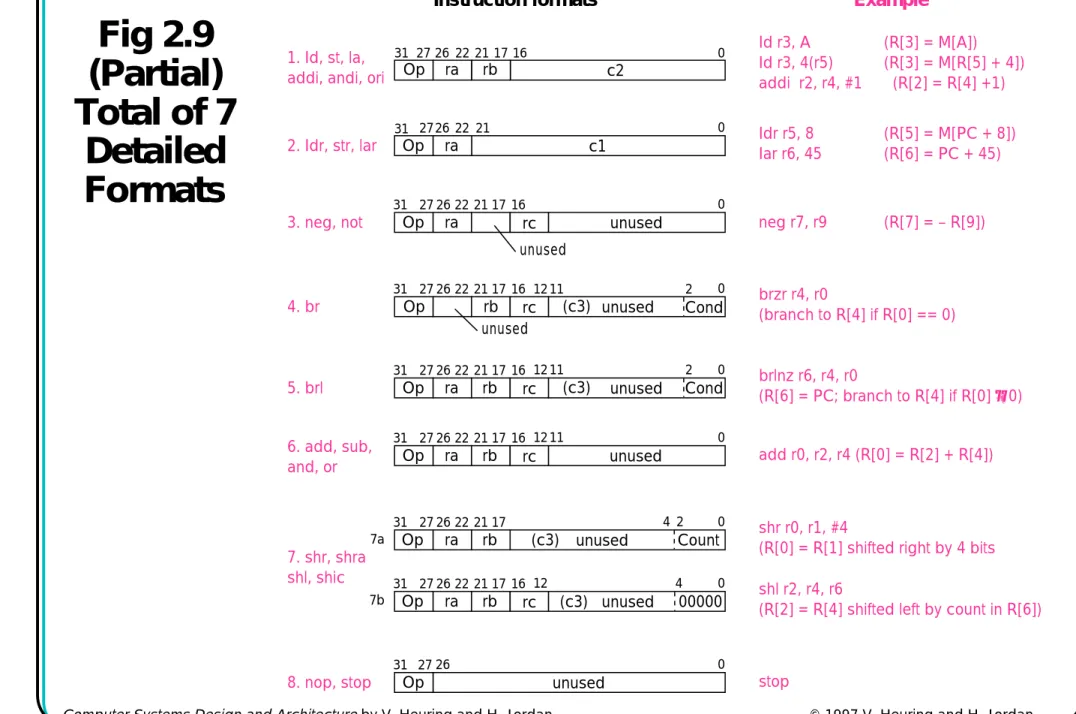
Fig 2.9
(Partial)
Total of 7
Detailed
Formats
Op 1. Id, st, la,addi, andi, ori rb c2
Instruction formats Example
31 27 26 22 21 17 16 0 Id r3, A Id r3, 4(r5) addi r2, r4, #1 (R[3] = M[A]) (R[3] = M[R[5] + 4]) (R[2] = R[4] +1) ra Op 2. Idr, str, lar c1 31 2726 22 21 0 Idr r5, 8 Iar r6, 45 (R[5] = M[PC + 8]) (R[6] = PC + 45) ra Op
3. neg, not unused
31 27 26 22 21 17 16 0 neg r7, r9 (R[7] = – R[9]) ra unused rc Op 4. br unused 31 27 26 22 21 1716 1211 2 0 brzr r4, r0 (branch to R[4] if R[0] == 0) rb rc (c3) Cond Op 5. brl unused 31 27 26 22 21 17 16 0 brlnz r6, r4, r0 (R[6] = PC; branch to R[4] if R[0] ≠ 0) ra rb rc 12 11 2 Cond (c3) Op unused 31 27 26 22 21 17 16 0 shl r2, r4, r6
(R[2] = R[4] shifted left by count in R[6])
ra rb rc 12 4 4 00000 (c3) Op 7. shr, shra shl, shic unused 31 27 26 22 7a 7b 21 17 0 shr r0, r1, #4
(R[0] = R[1] shifted right by 4 bits
ra rb 2 Count Op 6. add, sub, and, or unused 31 27 26 22 21 17 16 0 add r0, r2, r4 (R[0] = R[2] + R[4]) ra rb rc 12 11 Op
8. nop, stop unused
31 27 0 stop 26 unused (c3) (c3) (c3)
Tbl 2.4 Example SRC Load and Store
Instructions
• Address can be constant, constant + register, or constant + PC
• Memory contents or address itself can be loaded
(note use of la to load a constant)
Instruction op ra rb c1 Meaning Addressing Mode ld r1, 32 1 1 0 32 R[1] ← M[32] Direct ld r22, 24(r4) 1 22 4 24 R[22] ← M[24+R[4]] Displacement st r4, 0(r9) 3 4 9 0 M[R[9]] ← R[4] Register indirect la r7, 32 5 7 0 32 R[7] ← 32 Immediate ldr r12, -48 2 12 – -48 R[12] ← M[PC -48] Relative lar r3, 0 6 3 – 0 R[3] ← PC Register (!)
Assembly Language Forms of
Arithmetic and Logic Instructions
• Immediate subtract not needed since constant in addi may be negative
Format Example Meaning
neg ra, rc neg r1, r2 ;Negate (r1 = -r2) not ra, rc not r2, r3 ;Not (r2 = r3´ )
add ra, rb, rc add r2, r3, r4 ;2’s complement addition
sub ra, rb, rc ;2’s complement subtraction
and ra, rb, rc ;Logical and
or ra, rb, rc ;Logical or
addi ra, rb, c2 addi r1, r3, #1 ;Immediate 2’s complement add
andi ra, rb, c2 ;Immediate logical and
Branch Instruction Format
There are actually only two branch instructions:
br rb, rc, c3<2..0> ; branch to R[rb] if R[rc] meets ; the condition defined by c3<2..0>
brl ra, rb, rc, c3<2..0> ; R[ra] ← PC; branch as above
lsbs condition Assy language form Example
000 never brlnv brlnv r6 001 always br, brl br r5, brl r5 010 if rc = 0 brzr, brlzr brzr r2, r4, r5 011 if rc ≠ 0 brnz, brlnz 100 if rc ≥ 0 brpl, brlpl 101 if rc < 0 brmi, brlmi
• It is c3<2..0>, the 3 lsbs of c3, that governs what the branch condition is:
• Note that branch target address is always in register R[rb].
Tbl 2.6 Forms and Formats of the
br
and
brl
Instructions
Ass’y lang.
Example instr. Meaning op ra rb rc c3
〈2..0〉 Branch Cond’n. brlnv brlnv r6 R[6] ← PC 9 6 — — 000 never br br r4 PC ← R[4] 8 — 4 — 001 always brl brl r6,r4 R[6] ← PC; PC ← R[4] 9 6 4 — 001 always brzr brzr r5,r1 if (R[1]=0) PC ← R[5] 8 — 5 1 010 zero brlzr brlzr r7,r5,r1 R[7] ← PC; 9 7 5 1 010 zero brnz brnz r1, r0 if (R[0]≠0) PC← R[1] 8 — 1 0 011 nonzero brlnz brlnz r2,r1,r0 R[2] ← PC; if (R[0]≠0) PC← R[1] 9 2 1 0 011 nonzero brpl brpl r3, r2 if (R[2]≥0) PC← R[3] 8 — 3 2 100 plus brlpl brlpl r4,r3,r2 R[4] ← PC; if (R[2]≥0) PC← R[3] 9 4 3 2 plus
brmi brmi r0, r1 if (R[1]<0) PC← R[0] 8 — 0 1 101 minus
brlmi brlmi r3,r0,r1 R[3] ← PC;
if (r1<0) PC← R[0]
Branch Instructions—Example
C: goto Label3 SRC:
lar r0, Label3 ; put branch target address into tgt reg.
br r0 ; and branch
• • •
Example of Conditional Branch
in C: #define Cost 125 if (X<0) then X = -X; in SRC:
Cost .equ 125 ;define symbolic constant
.org 1000 ;next word will be loaded at address 100010
X: .dw 1 ;reserve 1 word for variable X
.org 5000 ;program will be loaded at location 500010
lar r0, Over ;load address of “false” jump location ld r1, X ;load value of X into r1
brpl r0, r1 ;branch to Else if r1≥0 neg r1, r1 ;negate value
RTN (Register Transfer Notation)
• Provides a formal means of describing machine structure and function
• Is at the “just right” level for machine descriptions
• Does not replace hardware description languages
• Can be used to describe what a machine does (an
abstract RTN) without describing how the machine
does it
• Can also be used to describe a particular hardware implementation (a concrete RTN)
RTN (cont’d.)
• At first you may find this “meta description” confusing, because it is a language that is used to describe a
language
• You will find that developing a familiarity with RTN will aid greatly in your understanding of new machine
design concepts
Some RTN Features—
Using RTN to Describe a Machine’s
Static Properties
Static Properties
• Specifying registers
• IR〈31..0〉 specifies a register named “IR” having 32 bits numbered 31 to 0
• “Naming” using the := naming operator:
• op〈4..0〉 := IR〈31..27〉 specifies that the 5 msbs of IR be called op, with bits 4..0
• Notice that this does not create a new register, it just
generates another name, or “alias,” for an already existing register or part of a register
Using RTN to Describe
Dynamic Properties
Dynamic Properties
• Conditional expressions:
(op=12) → R[ra] ← R[rb] + R[rc]: ; defines the add instruction
“if” condition “then” RTN Assignment Operator
This fragment of RTN describes the SRC add instruction. It says, “when the op field of IR = 12, then store in the register specified by the ra field, the result of adding the register specified by the rb field to the register specified by the rc field.”
Using RTN to Describe the SRC (Static)
Processor State
Processor state
PC
〈
31..0
〉
: program
counter
(memory addr. of next inst.)
IR
〈
31..0
〉
:
instruction register
Run:
one bit run/halt indicator
Strt:
start signal
RTN Register Declarations
• General register specifications shows some features of the notation
• Describes a set of 32 32-bit registers with names R[0] to R[31]
R[0..31]
〈
31..0
〉
:
Name of registers Register # in square brackets .. specifies a range of indices msb # lsb# Bit # in angle brackets Colon separates statements with no orderingMemory Declaration:
RTN Naming Operator
• Defining names with formal parameters is a powerful formatting tool
• Used here to define word memory (big-endian)
Main memory state
Mem[0..2
32- 1]
〈
7..0
〉
:
2
32addressable bytes of memory
M[x]
〈
31..0
〉
:= Mem[x]#Mem[x+1]#Mem[x+2]#Mem[x+3]:
Dummy parameter Naming operator Concatenation operator All bits in register if no bit index givenRTN Instruction Formatting Uses
Renaming of IR Bits
Instruction formats
op
〈
4..0
〉
:= IR
〈
31..27
〉
: operation code field
ra
〈
4..0
〉
:= IR
〈
26..22
〉
:
target register field
rb
〈
4..0
〉
:= IR
〈
21..17
〉
:
operand, address index, or
branch target register
rc
〈
4..0
〉
:= IR
〈
16..12
〉
:
second operand, conditional
test, or shift count register
c1
〈
21..0
〉
:= IR
〈
21..0
〉
: long displacement field
c2
〈
16..0
〉
:= IR
〈
16..0
〉
: short displacement or
immediate field
c3
〈
11..0
〉
:= IR
〈
11..0
〉
: count or modifier field
Specifying Dynamic Properties of SRC:
RTN Gives Specifics of Address
Calculation
• Renaming defines displacement and relative addresses
• New RTN notation is used
• condition → expression means if condition then expression
• modifiers in { } describe type of arithmetic or how short numbers are extended to longer ones
• arithmetic operators (+ - * / etc.) can be used in expressions Register R[0] cannot be added to a displacement
Effective address calculations (occur at runtime):
disp〈31..0〉 := ((rb=0) → c2〈16..0〉 {sign extend}: displacement (rb≠0) → R[rb] + c2〈16..0〉 {sign extend, 2’s comp.} ): address rel〈31..0〉 := PC〈31..0〉 + c1〈21..0〉 {sign extend, 2’s comp.}: relative
Detailed Questions Answered by the
RTN for Addresses
• What set of memory cells can be addressed by direct addressing (displacement with rb=0)
• If c2〈16〉=0 (positive displacement) absolute
addresses range from 00000000H to 0000FFFFH
• If c2〈16〉=1 (negative displacement) absolute
addresses range from FFFF0000H to FFFFFFFFH
• What range of memory addresses can be specified by a relative address
• The largest positive value of C1〈21..0〉 is 221-1 and
its most negative value is -221, so addresses up to
221-1 forward and 221 backward from the current PC
value can be specified
Instruction Interpretation: RTN
Description of Fetch-Execute
• Need to describe actions (not just declarations)
• Some new notation
instruction_interpretation := (
¬
Run
∧
Strt
→
Run
←
1:
Run
→
(IR
←
M[PC]: PC
←
PC + 4; instruction_execution) );
Logical NOT
Logical AND
Register transfer Separates statements
RTN Sequence and Clocking
• In general, RTN statements separated by : take place during the same clock pulse
• Statements separated by ; take place on successive clock pulses
• This is not entirely accurate since some things written with one RTN statement can take several clocks to
perform
• More precise difference between : and ;
• The order of execution of statements separated by : does not matter
• If statements are separated by ; the one on the left must be complete before the one on the right starts
More About Instruction Interpretation
RTN
• In the expression IR ← M[PC]: PC ← PC + 4; which value of PC applies to M[PC] ?
• The rule in RTN is that all right hand sides of “:” -
separated RTs are evaluated before any LHS is changed
• In logic design, this corresponds to “master-slave” operation of flip-flops
• We see what happens when Run is true and when Run is false but Strt is true. What about the case of Run and Strt both false?
• Since no action is specified for this case, the RTN implicitly says that no action occurs in this case
Individual Instructions
• instruction_interpretation contained a forward reference to instruction_execution
• instruction_execution is a long list of conditional operations
• The condition is that the op code specifies a given instruction
• The operation describes what that instruction does
• Note that the operations of the instruction are done after (;) the instruction is put into IR and the PC has been advanced to the next instruction
RTN Instruction Execution for Load and
Store Instructions
• The in-line definition (:= op=1) saves writing a separate definition ld := op=1 for the ld mnemonic
• The previous definitions of disp and rel are needed to understand all the details
instruction_execution := (
ld (:= op= 1) → R[ra] ← M[disp]: load register
ldr (:= op= 2) → R[ra] ← M[rel]: load register relative st (:= op= 3) → M[disp] ← R[ra]: store register
str (:= op= 4) → M[rel] ← R[ra]: store register relative
la (:= op= 5 ) → R[ra] ← disp: load displacement address lar (:= op= 6) → R[ra] ← rel: load relative address
SRC RTN—The Main Loop
ii := ( ¬Run∧Strt → Run ← 1: Run → (IR ← M[PC]: PC ← PC + 4; ie) );ii := instruction_interpretation:
ie := instruction_execution :
ie := (ld (:= op= 1) → R[ra] ← M[disp]: Big switch ldr (:= op= 2) → R[ra] ← M[rel]: statement
. . . on the opcode
stop (:= op= 31) → Run ← 0: ); ii
Use of RTN Definitions:
Text Substitution Semantics
• An example:
• If IR = 00001 00101 00011 00000000000001011
• then ld → R[5] ← M[ R[3] + 11 ]: ld (:= op= 1) → R[ra] ← M[disp]:
disp〈31..0〉 := ((rb=0) → c2〈16..0〉 {sign extend}:
(rb≠0) → R[rb] + c2〈16..0〉 {sign extend, 2’s comp.} ):
ld (:= op= 1) → R[ra] ← M[
((rb=0) → c2〈16..0〉 {sign extend}:
(rb≠0) → R[rb] + c2〈16..0〉 {sign extend, 2’s comp.} ): ]:
RTN Descriptions of SRC Branch
Instructions
• Branch condition determined by 3 lsbs of instruction
• Link register (R[ra]) set to point to next instruction cond := ( c3〈2..0〉=0 → 0: never c3〈2..0〉=1 → 1: always c3〈2..0〉=2 → R[rc]=0: if register is zero c3〈2..0〉=3 → R[rc]≠0: if register is nonzero c3〈2..0〉=4 → R[rc]〈31〉=0: if positive or zero c3〈2..0〉=5 → R[rc]〈31〉=1 ): if negative
br (:= op= 8) → (cond → PC ← R[rb]): conditional branch brl (:= op= 9) → (R[ra] ← PC:
RTN for Arithmetic and Logic
• Logical operators: and ∧ or ∨ and not ¬
add (:= op=12)
→
R[ra]
←
R[rb] + R[rc]:
addi (:= op=13)
→
R[ra]
←
R[rb] + c2
〈
16..0
〉
{2's comp. sign
ext.}:
sub (:= op=14)
→
R[ra]
←
R[rb] - R[rc]:
neg (:= op=15)
→
R[ra]
←
-R[rc]:
and (:= op=20)
→
R[ra]
←
R[rb]
∧
R[rc]:
andi (:= op=21)
→
R[ra]
←
R[rb]
∧
c2
〈
16..0
〉
{sign extend}:
or (:= op=22)
→
R[ra]
←
R[rb]
∨
R[rc]:
ori (:= op=23)
→
R[ra]
←
R[rb]
∨
c2
〈
16..0
〉
{sign extend}:
not (:= op=24)
→
R[ra]
←
¬
R[rc]:
RTN for Shift Instructions
• Count may be 5 lsbs of a register or the instruction
• Notation: @ - replication, # - concatenation
n := ( (c3〈4..0〉=0) → R[rc]〈4..0〉: (c3〈4..0〉≠0) → c3〈4..0〉 ):
shr (:= op=26) → R[ra]〈31..0〉← (n @ 0) # R[rb]〈31..n〉:
shra (:= op=27) → R[ra]〈31..0〉← (n @ R[rb]〈31〉) # R[rb]〈31..n〉: shl (:= op=28) → R[ra]〈31..0〉← R[rb]〈31-n..0〉 # (n @ 0):
Example of Replication and
Concatenation in Shift
• Arithmetic shift right by 13 concatenates 13 copies of the sign bit with the upper 19 bits of the operand
shra r1, r2, 13
1001 0111 1110 1010 1110 1100 0001 011013@R[2]
〈
31
〉
R[2]
〈
31..13
〉
100 1011 1111 0101 0111R[2]=
#
1111 1111 1111 1R[1]=
Assembly Language for Shift
• Form of assembly language instruction tells whether to set c3=0
shr ra, rb, rc ;Shift rb right into ra by 5 lsbs of rc shr ra, rb, count ;Shift rb right into ra by 5 lsbs of inst shra ra, rb, rc ;AShift rb right into ra by 5 lsbs of rc shra ra, rb, count ;AShift rb right into ra by 5 lsbs of inst shl ra, rb, rc ;Shift rb left into ra by 5 lsbs of rc
shl ra, rb, count ;Shift rb left into ra by 5 lsbs of inst shc ra, rb, rc ;Shift rb circ. into ra by 5 lsbs of rc shc ra, rb, count ;Shift rb circ. into ra by 5 lsbs of inst
End of RTN Definition of
instruction_execution
• We will find special use for nop in pipelining
• The machine waits for Strt after executing stop
• The long conditional statement defining
instruction_execution ends with a direction to go repeat instruction_interpretation, which will fetch and execute the next instruction (if Run still =1)
nop (:= op= 0) → : No operation
stop (:= op= 31) → Run ← 0: Stop instruction
); End of instruction_execution
Confused about RTN and SRC?
• SRC is a Machine Language
• It can be interpreted by either hardware or software simulator.
• RTN is a Specification Language
• Specification languages are languages that are used to specify other languages or systems—a
metalanguage.
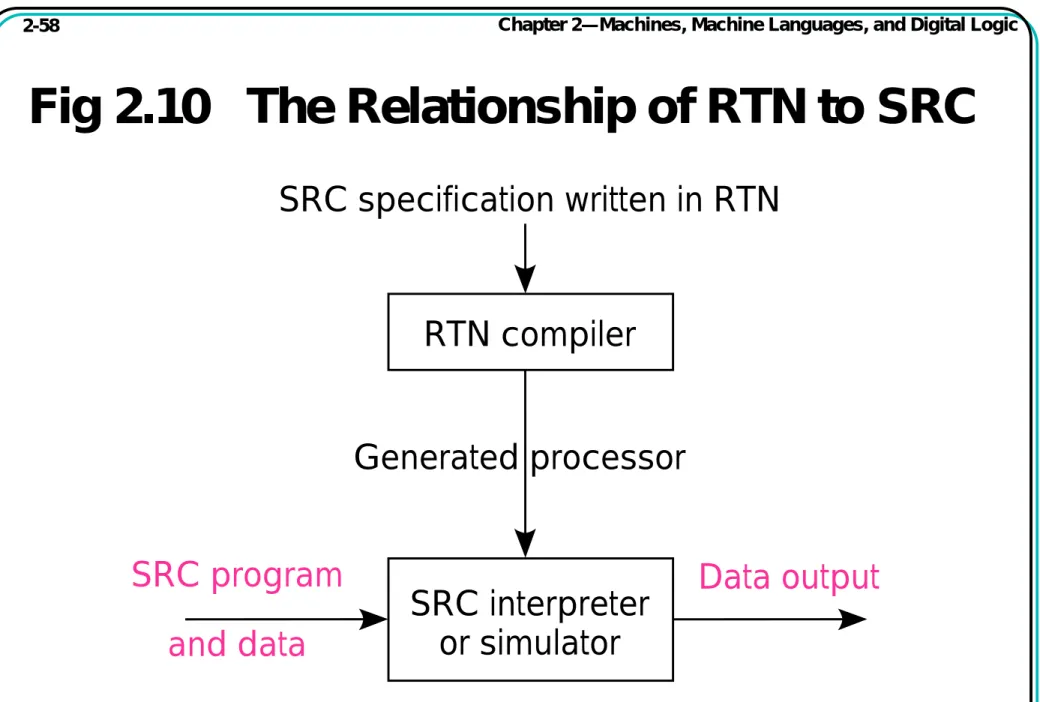
• Other examples: LEX, YACC, VHDL, Verilog Figure 2.10 may help clear this up...
Fig 2.10 The Relationship of RTN to SRC
SRC specification written in RTN
RTN compiler
Generated processor
SRC program
and data
Data output
SRC interpreter
or simulator
A Note About Specification Languages
• They allow the description of what without having to specify how.
• They allow precise and unambiguous specifications, unlike natural language.
• They reduce errors:
• Errors due to misinterpretation of imprecise specifications written in natural language.
• Errors due to confusion in design and implementation—“human error.”
• Now the designer must debug the specification!
• Specifications can be automatically checked and processed by tools.
• An RTN specification could be input to a simulator generator that would produce a simulator for the specified machine.
• An RTN specification could be input to a compiler generator that would generate a compiler for the language, whose output could be run on the simulator.
Addressing Modes Described in RTN
(Not SRC)
Mode name Assembler RTN meaning Use
Syntax
Register Ra R[t] ← R[a] Tmp. Var.
Register indirect (Ra) R[t] ← M[R[a]] Pointer
Immediate #X R[t] ← X Constant
Direct, absolute X R[t] ← M[X] Global Var.
Indirect (X) R[t] ← M[ M[X] ] Pointer Var.
Indexed, based, X(Ra) R[t] ← M[X + R[a]] Arrays, structs
or displacement
Relative X(PC) R[t] ← M[X + PC] Vals stored w pgm
Autoincrement (Ra)+ R[t] ← M[R[a]]; R[a] ← R[a] + 1 Sequential
Autodecrement - (Ra) R[a] ← R[a] - 1; R[t] ← M[R[a]] access.
Fig 2.11 Register Transfers Hardware
and Timing for a Single-Bit Register
Transfer: A
←
B
• Implementing the RTN statement A ← B
Strobe
(a) Hardware
(b) Timing
Strobe
B
A
1
0
1
0
1
0
D
B
Q
Q
D
A
Q
Q
Fig 2.12 Multiple Bit Register Transfer:
A
〈
m..1
〉
←
B
〈
m..1
〉
Strobe D 1 Q Q D 1 Q Q Strobe D B〈m..1〉 Q Q D A〈m..1〉 Q Q D 2 Q D 2 Q D m Q D m B A Q Q Q Q Q mFig 2.13 Data Transmission View of
Logic Gates
• Logic gates can be used to control the transmission of data:
Data gate Controlled complement Data merge data gate data control gate→data gate→0 control→data control→data data 1 data1(2), provided data2(1) is zero data 2 data 1 data 2
Fig 2.14 Two-Way Gated Merge, or
Multiplexer
• Data from multiple sources can be selected for transmission x y y x Gx y Gy m x m m m Time
Fig 2.15 Basic Multiplexer and Symbol
Abbreviation
• Multiplexer gate signals Gi may be produced by a
binary to one-out-of-n decoder
D0 D1 G0 Gn–1 Dn–1 m
An n-way gated merge An n-way multiplexer with decoder
(a) Multiplexer in terms of gates (b) Symbol abbreviation
m m m D0 D1 m m m Dn–1 m k Select G1 m m m
Fig 2.16 Separating Merged Data
• Merged data can be separated by gating at the right time
• It can also be strobed into a flip-flop when valid
x
y
G
xm
x
m
0
Time
Fig 2.17 Multiplexed Register
Transfers Using Gates and Strobes
• Selected gate and strobe determine which RT
• A←C and B←C can occur together, but not A←C and B←D
GC SA SB GC Hold time Propagation time SB m m D C Q Q GD Gates Strobes m m m m D D Q Q D A Q Q D B Q Q m
Fig 2.18 Open-Collector NAND Gate
Output Circuit
+V +V Out +V Inputs Output 0v 0v +V +V 0v +V 0v +V Open Open Open Closed (Out = +V) (Out = +V) (Out = +V) (Out = 0v)(a) Open-collector NAND truth table
(b) Open-collector NAND (c) Symbol
Fig 2.19 Wired AND Connection of
Open-Collector Gates
+V a Out b a b Wired AND output Switch Closed(0) Closed(0) Open (1) Open (1) Closed(0) Open (1) Closed(0) Open (1) 0v (0) 0v (0) 0v (0) +V (1)(a) Wired AND connection (b) With symbols
(c) Truth table
+V
Fig 2.20 Open-Collector Wired OR Bus
• DeMorgan’s OR by not of AND of NOTS
• Pull-up resistor removed from each gate - open collector
• One pull-up resistor for whole bus
• Forms an OR distributed over the connection
+V Dn–1 Gn–1 D1 G1 D0
Fig 2.21 Tri-State Gate Internal
Structure and Symbol
Data
Enable
(a) Tri-state gate structure (b) Tri-state gate symbol
(c) Tri-state gate truth table
Data
Enable
Out Tri- Out
state +V
Enable Data Output
0 0 1 1 0 1 0 1 Hi-Z Hi-Z 0 1
Fig 2.22 Registers Connected by a
Tri-State Bus
• Can make any register transfer R[i]←R[j]
• Can’t have Gi = Gj = 1 for i≠j
• Violating this constraint gives low resistance path from power supply to ground—with predictable results!
m S0 m m G0 R[0] Tri-state bus m S1 m m m G1 D R[1] Q Q m Sn–1 m m Gn–1 D R[n – 1] Q Q D Q Q
Fig 2.23 Registers and Arithmetic Units
Connected by One Bus
Combinational logic—no memory Example: Abstract RTN R[3] ← R[1]+R[2]; Concrete RTN Y ← R[2]; Z ← R[1]+Y; R[3] ← Z; Control Sequence R[2]out, Yin; R[1]out, Zin; Zout, R[3]in;
Notice that what could be described in one step in the abstract RTN took three steps on this particular hardware R[0]in Yin R[0]out m m m m m m R[0] Incrementer Adder D Q R[1]in R[1]out m D Q R[n – 1]in R[n – 1]out m D Q Q Q Q Win Wout m Zout W D Q Q Zin Z D Q Q R[1] R[n – 1] D Q Q Y
RTs Possible with the One-Bus
Structure
• R[i] or Y can get the contents of anything but Y
• Since result different from operand, it cannot go on the bus that is carrying the operand
• Arithmetic units thus have result registers
• Only one of two operands can be on the bus at a time, so adder has register for one operand
• R[i] ← R[j] + R[k] is performed in 3 steps: Y←R[k]; Z←R[j] + Y; R[i]←Z;
• R[i] ← R[j] + R[k] is high level RTN description
• Y←R[k]; Z←R[j] + Y; R[i]←Z; is concrete RTN
From Abstract RTN to Concrete RTN to
Control Sequences
• The ability to begin with an abstract description, then describe a hardware design and resulting concrete RTN and control sequence is powerful.
• We shall use this method in Chapter 4 to develop various hardware designs for SRC.
Chapter 2 Summary
• Classes of computer ISAs
• Memory addressing modes
• SRC: a complete example ISA
• RTN as a description method for ISAs
• RTN description of addressing modes
• Implementation of RTN operations with digital logic circuits