SOFTWARE
Interoperable chemical structure search
service
Miroslav Kratochvíl
1,2, Jiří Vondrášek
1and Jakub Galgonek
1*Abstract
Motivation: The existing connections between large databases of chemicals, proteins, metabolites and assays offer valuable resources for research in fields ranging from drug design to metabolomics. Transparent search across multiple databases provides a way to efficiently utilize these resources. To simplify such searches, many databases have adopted semantic technologies that allow interoperable querying of the datasets using SPARQL query language. However, the interoperable interfaces of the chemical databases still lack the functionality of structure-driven chemi-cal search, which is a fundamental method of data discovery in the chemichemi-cal search space.
Results: We present a SPARQL service that augments existing semantic services by making interoperable substruc-ture and similarity searches in small-molecule databases possible. The service thus offers new possibilities for query-ing interoperable databases, and simplifies writquery-ing of heterogeneous queries that include chemical-structure search terms.
Availability: The service is freely available and accessible using a standard SPARQL endpoint interface. The service documentation and user-oriented demonstration interfaces that allow quick explorative querying of datasets are available at https ://idsm.elixi r-czech .cz.
Keywords: Substructure search, Small molecule databases, Interoperability, Linked data
© The Author(s) 2019. This article is distributed under the terms of the Creative Commons Attribution 4.0 International License (http://creat iveco mmons .org/licen ses/by/4.0/), which permits unrestricted use, distribution, and reproduction in any medium, provided you give appropriate credit to the original author(s) and the source, provide a link to the Creative Commons license, and indicate if changes were made. The Creative Commons Public Domain Dedication waiver (http://creat iveco mmons .org/ publi cdoma in/zero/1.0/) applies to the data made available in this article, unless otherwise stated.
Introduction
The vast availability of research-related data sources on the Internet has created a need for tools that can efficiently search through these data and automati-cally collect and associate information from multiple interoperable sources. In the chemistry field, chemical structure search is an extremely useful tool provided by many small-molecule databases as a free, on-line service. However, such services typically offer a simple, human-oriented user interface, which makes them unsuitable for automated use (e. g. by other services) or use in arbitrary combinations with other interoperable data sources. Here, we introduce a service that uses a standard-compli-ant interoperable interface to address these deficiencies
and provide high-performance chemical structure search across many available chemical databases.
To promote interoperability among the diverse data sources accessible on the Internet, the World Wide Web Consortium (W3C) introduced semantic web technolo-gies [1, 2]. The properties of semantic technologies make them ideal for interoperable publishing of datasets, the use of which has been consistently increasing over the past decade. Semantic data structured according to the Resource Description Framework (RDF) [3] are now rou-tinely published by many well-established databases, including those from EBI, EMBL, UniProt, neXtProt, and KEGG. Interoperability of datasets provides the ability to automatically answer complex heterogeneous queries that cannot be answered by individual databases separately. However, the ability to pose chemical struc-ture-driven queries over interoperable databases is cur-rently limited. Consequently, comprehensive information about structural relations is largely absent in chemistry-oriented RDF datasets. This also limits opportunities to
Open Access
*Correspondence: [email protected]
1 Institute of Organic Chemistry and Biochemistry of the CAS, Flemingovo náměstí 2, 166 10 Prague 6, Czech Republic
observe relationships with other linked information, such as proteins and metabolic pathways that are connected by chemically similar ligands or metabolites. To address this issue, we developed a publicly available service that augments the interoperable chemical search space by providing chemical similarity and substructure relations. This creates new ways to query and obtain more precise, meaningful data from currently available data sources.
Database interoperability is made possible by wide-spread standardization of data models and interfaces, and RDF is the key standardized semantic technology for interoperable representation of datasets [4]. Individ-ual entities in RDF-formatted datasets are identified by Internationalized Resource Identifiers (IRI), which guar-antee single global identification of each entity and avoid potential collisions of identifiers across datasets. RDF vocabularies are published to globally standardize iden-tifiers for particular use cases [5, 6] to make data more discoverable and prevent ambiguity in interpretation. Query services for published RDF datasets typically sup-port the SPARQL query language [7], which can be used to query datasets online, without the need to download them. Each SPARQL-supporting service is identified by a unique IRI, called a SPARQL endpoint [8].
Importantly, many SPARQL services support the Fed-erated Query Extension [9]. With this extension, the user may instruct a service to execute specified parts of the query on other services and combine the collected data in one federated result [10]. This virtually removes the boundaries between different data sources, which greatly simplifies heterogeneous querying of the available data and promotes interoperability.
RDF specifies that datasets be modeled as sets of RDF triples [4], which provides sufficient expressive power to describe any data that can be modeled as graphs, includ-ing similarity and substructure relations between mol-ecules. Current implementations of RDF databases, on the other hand, are typically only able to handle finite amounts of statically stored RDF entries, which leads to technical problems when handling data that may poten-tially match large numbers of RDF triplets. Chemical similarity and substructure relations are common exam-ples of such data. Storing a predicate like hasSimilar-ity for each pair of molecules in a database is not only impractical, but technically impossible if the predicate should match structures not present in the databases (e. g. arbitrary structures defined by SMILES).
In classical SQL-based relational databases, this issue can be easily solved, for example, by implementing a stored procedure that dynamically creates the rela-tions for the given parameters. Unfortunately, there is no similar concept standardized for RDF and SPARQL. We address this issue for the specific case of chemical
search—the presented service is a publicly available SPARQL server that provides similarity and substruc-ture relations generated on demand. Additionally, the procedure calls do not require extension of the SPARQL syntax, as they are triggered by simple data patterns in queries. Thus, the extension is transparent to ser-vices that are not aware of the involved procedure calls, which ensures compatibility with existing interoperable services.
A running instance of the chemical structure search ser-vice is available for free use at https ://idsm.elixi r-czech .cz/, as a part of the larger Integrated Database of Small Mol-ecules (IDSM) project.
Implementation
Overall, the service implementation can be viewed as an interoperable wrap of the structure search interface of the Sachem cartridge [11].
Sachem is an open-source chemical cartridge that we previously designed to provide chemical search capa-bilities in small-molecule databases, with performance sufficient for online services. Sachem exposes its search functionality using SQL stored procedures provided in a special PostgreSQL extension, which handles the neces-sary low-level, high-performance chemical indexing and search. Using the available SQL functions, Sachem users may create indexes of large searchable datasets and run substructure and similarity searches on them.
The main improvement offered by the new service is the ability to make the search interfaces of a running Sachem installation publicly available and interoper-able, thus allowing anyone to quickly search through the indexed datasets. This functionality is provided by a generic SPARQL-to-SQL translator, which is the main part of the IDSM SPARQL engine.
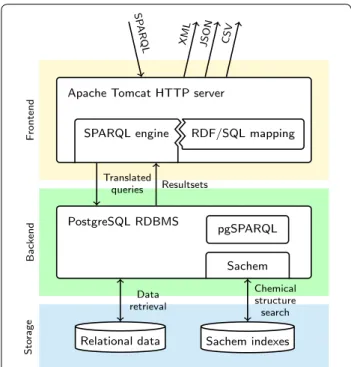
All components of the service are displayed in the over-view in Fig. 1.
IDSM SPARQL engine
Through our implementation of a SPARQL engine, we aimed to address several shortcomings of other RDF triple stores and SPARQL engines. Our implementa-tion bridges the gap between triplet-based handling of interoperable RDF data and dynamically generated data required for work with chemical databases. This is achieved by completely translating the incoming SPARQL queries into SQL queries enriched with stored procedure calls, which are then executed by a high-per-formance relational database.
To represent the relational data in a given dataset as RDF, we created an RDF/SQL mapping that describes conversion of individual rows of tables in the relational schema into equivalent sets of RDF triples. This map-ping is used to translate the incoming SPARQL queries into SQL queries that generate SPARQL-compatible query results. This mapping method is generally similar to the Linked Data Views in OpenLink Virtuoso [12].
Major differences between SPARQL and SQL func-tions and data types are addressed by using the cus-tom PostgreSQL extension pgSPARQL (placed in the backend section in Fig. 1), which re-implements the SPARQL-specific behavior and functions in PostgreSQL.
The SPARQL engine is written in Java as a standard web application for Apache Tomcat. The frontend supports SPARQL 1.1 protocol for query submission. After the SPARQL query is translated into SQL and executed by PostgreSQL, the results are repacked to a user-selected
standard query result format (XML, JSON, CSV or TSV [13–15]) and sent back to the client.
Procedure call extension
Currently, there is no standardized way to represent a procedure call in SPARQL. Although a straight-forward syntactic extension for procedure calls could be imple-mented, it would make the service non-interoperable with existing standard-compliant services. Thus, we chose to adopt an approach from our earlier work [16]. We encode the procedure calls as SPARQL patterns that do not differ syntactically from regular query patterns, but are recognized by the SPARQL service upon process-ing and handled in a special way.
The procedure call pattern is a standard triple pattern with subject, predicate and object. The engine uses the predicate part of the pattern to identify the stored pro-cedure to be called—a special IRI contained in the predi-cate triggers translation of the entire pattern into the corresponding SQL procedure call. Procedure call argu-ments are represented by a blank node contained in the pattern as an object; individual properties of the blank node represent individual named arguments of the pro-cedure. This allows the user to specify parameters in any order, or omit them and use the default parameter values. Results of the procedure call are bound to the RDF node specified in the pattern as a subject, either directly if the returned result is not structured or as blank nodes with properties if the result is structured.
Structure search using SPARQL
We mapped the high-performance substructure and similarity search SQL procedures from Sachem to cor-responding SPARQL procedure calls. These are identified
by the predicates sachem:substructureSearch
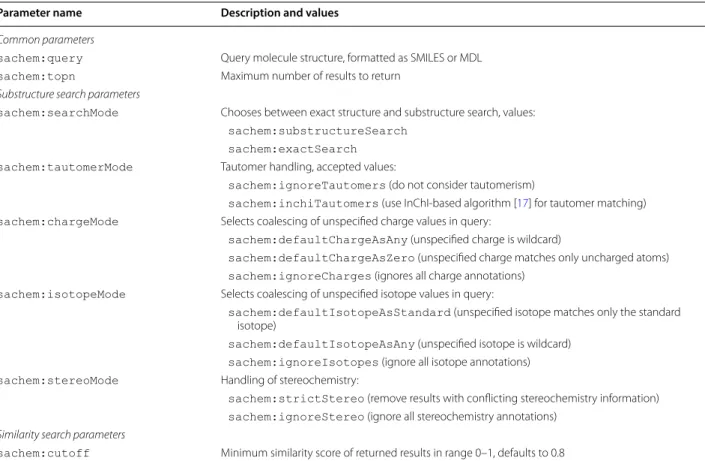
and sachem:similaritySearch, respectively. The procedure calls take several arguments. The main argument is sachem:query, which specifies either SMILES or MDL description of the queried molecule structure. A comprehensive list of other search argu-ments is provided in Table 1.
Using this framework, an example procedure call that finds all compounds that contain any tautomeric form of adenine as a substructure can be encoded to pattern as follows:
?COMPOUND sachem:substructureSearch [ sachem:query ’Nc1ncnc2c1ncn2’; sachem:tautomerMode true ].
When included in a query that queries the ChEMBL dataset, the pattern will bind the variable COMPOUND to IRIs of the matching compounds (the result in CSV for-mat is shortened for brevity):
COMPOUND
http://rdf.ebi.ac.uk/.../CHEMBL121339 http://rdf.ebi.ac.uk/.../CHEMBL122511 http://rdf.ebi.ac.uk/.../CHEMBL122512 ...
The results of the similarity search are structured val-ues, encoded as blank RDF nodes with the properties sachem:compound and sachem:score, which rep-resent the identifier of the retrieved compound and its similarity score, respectively. An example pattern that executes a search for compounds similar to adenine can be encoded as follows:
[ sachem:compound ?COMPOUND; sachem:score ?SCORE ]
sachem:similaritySearch [
sachem:query ’Nc1ncnc2c1ncn2’ ].
If included in the query, the similarity search results will be mapped to the two corresponding variables:
The returned similarity score is based on Jaccard simi-larity [18] of Morgan-style connectivity fingerprints [19] with a radius of up to 5.
IDSM service dataset support
The service can provide chemical search functionality across datasets that have been indexed by the internal Sachem cartridge. IDSM currently includes the well-established public databases DrugBank [20], ChEBI [21], ChEMBL [22] and PubChem [23], thus providing fast search in more than 100 million total compounds.
Maintenance of the search indexes is crucial for the service to provide a lasting, reliable source of accurate
E R O C S ,
D N U O P M O C
http://rdf.ebi.ac.uk/.../CHEMBL226345, 1.0 http://rdf.ebi.ac.uk/.../CHEMBL1738843, 0.62222224 http://rdf.ebi.ac.uk/.../CHEMBL394752, 0.62222224 ...
Table 1 Parameters of the chemical structure query executed via the SPARQL procedure call
Parameter name Description and values
Common parameters
sachem:query Query molecule structure, formatted as SMILES or MDL
sachem:topn Maximum number of results to return
Substructure search parameters
sachem:searchMode Chooses between exact structure and substructure search, values:
sachem:substructureSearch sachem:exactSearch sachem:tautomerMode Tautomer handling, accepted values:
sachem:ignoreTautomers (do not consider tautomerism)
sachem:inchiTautomers (use InChI-based algorithm [17] for tautomer matching)
sachem:chargeMode Selects coalescing of unspecified charge values in query:
sachem:defaultChargeAsAny (unspecified charge is wildcard)
sachem:defaultChargeAsZero (unspecified charge matches only uncharged atoms)
sachem:ignoreCharges (ignores all charge annotations)
sachem:isotopeMode Selects coalescing of unspecified isotope values in query:
sachem:defaultIsotopeAsStandard (unspecified isotope matches only the standard isotope)
sachem:defaultIsotopeAsAny (unspecified isotope is wildcard)
sachem:ignoreIsotopes (ignore all isotope annotations)
sachem:stereoMode Handling of stereochemistry:
sachem:strictStereo (remove results with conflicting stereochemistry information)
sachem:ignoreStereo (ignore all stereochemistry annotations) Similarity search parameters
search results. The IDSM service therefore aims to pro-vide indexed data that is as up-to-date as possible. This is currently ensured by running automated nightly checks and updates of all datasets.
Results
A running instance of the interoperable structure search service is accessible at the SPARQL endpoint https://idsm.elixir-czech.cz/sparql/ endpoint/<database>, where <database>
com-prises pubchem, drugbank, chebi and chembl. We present two use cases: (1) a single-purpose chemi-cal structure search application chemi-called ‘Sachem GUI,’ which serves as an example of using an interoperable chemical search in a web application, and (2) the general application ‘SPARQL GUI,’ which serves as a tool for con-structing and running heterogeneous, federated queries that employ the service.
Use case: chemical search in web applications
The possibility to obtain JSON-formatted output from the SPARQL interface makes the interoperable search functionality readily available for use in web applications. Public availability of this chemical information may be beneficial for construction of various domain-specific search tools and database access utilities atop the IDSM service.
We demonstrate this functionality in the online search tool ‘Sachem GUI,’ available at https ://idsm.elixi r-czech .cz/sache m. Sachem GUI represents the simplest possible JavaScript wrapper over the Sachem search functionality. It provides a user-friendly molecule-drawing interface for input of chemical structure queries (the JavaScript imple-mentation of the drawing interface is based on the EPAM Ketcher tool1). After users draw a query, they may choose several other search parameters and hit the search but-ton. Queries are then evaluated online by the IDSM ser-vice, and results are displayed as molecule images with metadata.
The source code of this application is intended as a starting point for development of more complicated search applications. For example, it could be easily adapted to allow the user to set additional search param-eters and display the results of more complicated search queries, such as interactions with proteins (as shown in Sect. 3.3).
Use case: heterogeneous chemical search
Examples of the various functionalities of federated que-ries across interoperable databases are presented in an
interactive, modifiable form in the SPARQL GUI inter-face, available at https ://idsm.elixi r-czech .cz/sparq l.
Technically, SPARQL GUI is a universal SPARQL inter-face enriched with IDSM-specific functionalities, which mainly comprise improved display of chemical results, available examples, and search API documentation. The JavaScript implementation of SPARQL GUI is based on YASGUI, which is a stand-alone SPARQL frontend.2 Queries tested in SPARQL GUI can be easily transferred to other software (e. g. web applications based on the first use case) or used to gather data programmatically.
Heterogeneous query example
Of the examples available in SPARQL GUI, we selected protein–small molecule interactions to demonstrate the intended usage of the service.
It is generally straightforward to search for proteins that have a known interaction or measured activity with a small molecule—protein databases are already referenced by chemical databases that contain measured activities. This is also true for ChEMBL [22], which links chemi-cal information to UniProt [24] references via a chain of activities, assays, targets and target components that ends in chembl:UniprotRef.
A related and potentially desirable search would be to query the activities of proteins with compounds that con-tain a cercon-tain molecular core bearing arbitrary additional ligands. For example, the user might be interested in pro-tein activities with any existing derivatives of morphine. Such a query is, however, not directly executable using current database interfaces. To run it, the user would first have to employ a simple substructure search tool (either the ChEMBL online search or a self-hosted substructure search) to extract a potentially long list of morphine-con-taining ChEMBL IDs [22], which could then be used to construct a large query to obtain the protein information from UniProt.
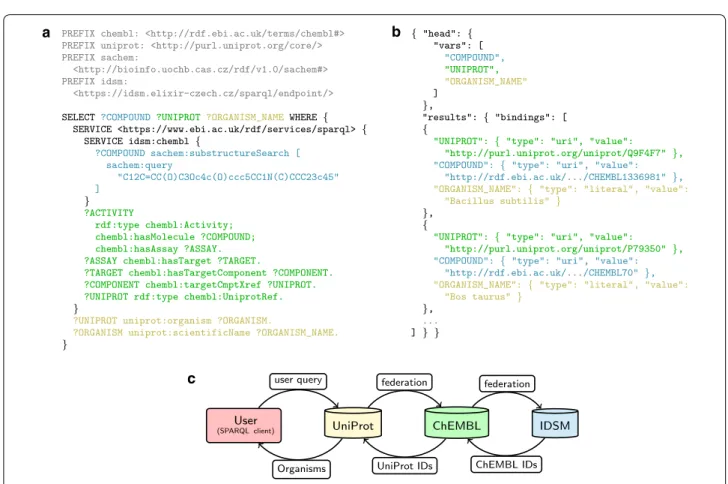
With our interoperable chemical search service, this query can be run without any client-side overhead. Instead of listing the ChEMBL identifiers manually in the query, the user can employ a federated query that trans-parently retrieves the list of desired compound identifiers from the IDSM SPARQL endpoint. An example imple-mentation of such a query is illustrated in Fig. 2, along with a schema of its distributed processing. To complete the example, the displayed query code connects the mor-phine derivatives with additional UniProt content to obtain more metadata, including the names of the corre-sponding organisms.
Discussion
Representation of chemistry-related structure search results in the context of semantic search creates a new source of data linkages. The ability to query for struc-tural similarity or sub- and super-structures of molecules enables retrieval of precisely specified chemical relations between identifiers of molecules, which can be transpar-ently and transitively extended to any molecule-referenc-ing data.
The new links can be used to alleviate some archetypal sources of trouble in chemical search, including the prob-lems of annotation granularity and canonization.
Metadata about chemical compounds (e. g. assay results) are typically present only for a single variant of a molecule in a database, but may be valid for multiple different tautomeric structures or even some derivatives. If the user searches for a connection between two anno-tations (e. g. assay results and vendor availability) using only the exact molecule identifiers, this connection may be missed if the annotations were unintentionally placed with related (in this case, chemically identical) but differ-ently identified molecules. The presented service allows
users to enrich the search by including annotations from small similarity- or structure-defined ‘neighborhoods’ of molecules, thus effectively avoiding this problem in a wide variety of search scenarios.
This approach can be viewed as complementary to the more common canonization policies that are enforced in chemical databases [25, 26]. From a search perspective, both approaches help reduce the rate of false negatives by connecting larger amounts of available information. At the same time, they can potentially increase the rate of false positives. Manual annotation of canonized structure adds bias and maintenance problems derived from the human factor. Automatically produced links, on the other hand, may not have a chemically relevant interpretation and are biased by factors such as the similarity indexing method used.
Conclusion
We have described a new service that delivers chemical structure search capabilities to searches in interoperable RDF databases. This innovation can be used to extend the rich heterogeneous search possibilities of current RDF
a b
c
Fig. 2 a An example of a federated SPARQL query that connects assay results of morphine derivatives to corresponding organism names. b
databases by including automatically provided substruc-ture and similarity relations between chemical identifiers in the search. We have demonstrated that this extension enables facile discovery of new, meaningful connec-tions in data from multiple databases, and alleviates the impact of common canonization and curation problems in chemical databases.
The SPARQL engine is the main innovative component of the service. Although it is currently used only to pro-vide an interoperable interface for Sachem, it is designed as a generic tool. Using the SPARQL engine, the same approach of improving dataset interoperability also can be applied to other areas of cheminformatics and bio-informatics, providing searches of metabolic pathways, biopolymer sequences, full-text metadata, etc.
The presented service is free, publicly available at https ://idsm.elixi r-czech .cz and accessible through a SPARQL-compatible machine interface. The service includes two demonstration user interfaces that can be used to manu-ally test the service viability and as a basis for implement-ing the provided chemical search in new applications. Acknowlegements
Computational resources were provided by CESNET LM2015042 and CERIT Scientific Cloud LM2015085, provided under the programme “Projects of Large Research, Development, and Innovations Infrastructures”.
Authors’ contributions
JG and JV designed the software and study. JG and MK implemented the Sachem cartridge and the web interfaces. JG implemented the SPARQL engine. MK wrote the manuscript. All authors participated in preparing the manuscript. All authors read and approved the final manuscript.
Funding
This project was supported by ELIXIR CZ (MEYS), Grant No. LM2015047. Funding for open access publication was provided by the Institute of Organic Chemistry and Biochemistry of the CAS (RVO), Project No. 61388963.
Availability of data and materials
All datasets used are publicly accessible the respective databases. The service is public and freely available.
Competing interests
The authors declare that they have no competing interests.
Author details
1 Institute of Organic Chemistry and Biochemistry of the CAS, Flemingovo náměstí 2, 166 10 Prague 6, Czech Republic. 2 Department of Software Engi-neering, Faculty of Mathematics and Physics, Charles University, Malostranské náměstí 25, 118 00 Prague 1, Czech Republic.
Received: 26 February 2019 Accepted: 21 June 2019
References
1. Berners-Lee T, Hendler J, Lassila O (2001) The semantic web. Sci Am 284(5):34–43
2. Jacob EK (2003) Ontologies and the semantic web. Bull Am Soc Inf Sci Technol 29(4):19–22
3. World Wide Web Consortium et al (2014) RDF 1.1 Primer. World Wide Web Consortium
4. World Wide Web Consortium et al (2014) RDF 1.1 concepts and abstract syntax. World Wide Web Consortium
5. McBride B (2004) The resource description framework (RDF) and its vocabulary description language RDFS. In: Staab S, Studer R (eds) Hand-book on ontologies. Springer, Berlin, pp 51–65
6. Allemang D, Hendler J (2011) Semantic web for the working ontologist: effective modeling in RDFS and OWL. Elsevier, Amsterdam
7. World Wide Web Consortium et al (2013) SPARQL 1.1 Query language: W3C recommendation. World Wide Web Consortium
8. World Wide Web Consortium et al (2013) SPARQL 1.1 protocol: W3C recommendation. World Wide Web Consortium
9. World Wide Web Consortium et al (2013) SPARQL 1.1 federated query: W3C recommendation. World Wide Web Consortium
10. Buil-Aranda C, Arenas M, Corcho O (2011) Semantics and optimization of the SPARQL 1.1 federation extension. In: Extended semantic web confer-ence. Springer, pp 1–15
11. Kratochvíl M, Vondrášek J, Galgonek J (2018) Sachem: a chemical car-tridge for high-performance substructure search. J Cheminform 10(1):27 12. Mapping SQL Data to Linked Data Views; 2016. Online. http://vos.openl
inksw .com/owiki /wiki/VOS/VOSSQ L2RDF . Accessed 2019-05-01 13. World Wide Web Consortium et al (2013) SPARQL 1.1 query results JSON
format: W3C recommendation. World Wide Web Consortium 14. World Wide Web Consortium et al (2013) SPARQL 1.1 query results XML
format, 2nd edn. W3C recommendation. World Wide Web Consortium 15. World Wide Web Consortium et al (2013) SPARQL 1.1 query results CSV
and TSV formats: W3C recommendation. World Wide Web Consortium 16. Galgonek J, Hurt T, Michlíková V, Onderka P, Schwarz J, Vondrášek J (2016)
Advanced SPARQL querying in small molecule databases. J Cheminform 8(1):31
17. Thalheim T, Vollmer A, Ebert RU, Kühne R, Schüürmann G (2010) Tautomer identification and tautomer structure generation based on the InChI code. J Chem Inf Model 50(7):1223–1232
18. Choi SS, Cha SH, Tappert CC (2010) A survey of binary similarity and distance measures. J Syst Cybern Inform 8(1):43–48
19. Rogers D, Hahn M (2010) Extended-connectivity fingerprints. J Chem Inf Model 50(5):742–754
20. Law V, Knox C, Djoumbou Y, Jewison T, Guo AC, Liu Y et al (2013) Drug-Bank 4.0: shedding new light on drug metabolism. Nucleic Acids Res 42(D1):D1091–D1097
21. Hastings J, Owen G, Dekker A, Ennis M, Kale N, Muthukrishnan V et al (2015) ChEBI in 2016: improved services and an expanding collection of metabolites. Nucleic Acids Res 44(D1):D1214–D1219
22. Gaulton A, Bellis LJ, Bento AP, Chambers J, Davies M, Hersey A et al (2011) ChEMBL: a large-scale bioactivity database for drug discovery. Nucleic Acids Res 40(D1):D1100–D1107
23. Kim S, Thiessen PA, Bolton EE, Chen J, Fu G, Gindulyte A et al (2015) PubChem substance and compound databases. Nucleic Acids Res 44(D1):D1202–D1213
24. Apweiler R, Bairoch A, Wu CH, Barker WC, Boeckmann B, Ferro S et al (2004) UniProt: the universal protein knowledgebase. Nucleic Acids Res 32(Suppl 1):D115–D119
25. Fourches D, Muratov E, Tropsha A (2010) Trust, but verify: on the impor-tance of chemical structure curation in cheminformatics and QSAR modeling research. J Chem Inf Model 50(7):1189–1204
26. Warr WA (2010) Tautomerism in chemical information management systems. J Comput Aided Mol Des 24(6–7):497–520
Publisher’s Note