AUSTRALIAN JOURNAL OF BASIC AND
Open Access Journal
Published BY AENSI Publication
© 2016 AENSI Publisher All rights reserved This work is licensed under the Creative http://creativecommons.org/licenses/by/4.0/
Performance Improvement Of A Grid Connected Wind Energy Conversion
System Fed By A Matrix Converter
1D.Rajalakshmi, 2Dr.K.Geetha, 3R.Shalini
1,3Electrical and Electronics Engineering, Kumaraguru 2Electrical and Electronics Engineering, Karpagam
Address For Correspondence:
R.Shalini, Electrical and Electronics Engineering, Kumaraguru College of Technology, India. E-mail: [email protected], phone: 9487979941
A R T I C L E I N F O
Article history:
Received 12 February 2016 Accepted 12 March 2016 Available online 20 March 2016
Keywords:
Induction Generator (IG), Matrix Converter (MC), Model Reference Adaptive System (MRAS), Space Vector Modulation (SVM), Wind Energy Conversion System (WECS).
A matrix converters provides direct ac
conventional two-stage ac-dc-ac converter topology.
sinusoidal input/output currents and controllable input power factor al., 2002). Due to the absence of components with significant, capacitors the matrix converters can potentia
matrix converter, when compared to a conventional back three (Podlesak, T.F., et al., 2005).
can be embedded in the machine itself.
the modulation technique, it can be provide zero displacement machines for wind energy applications are documented in P.W., et al., 2005). When induction machines ar
response, and accurate torque control i
applications are documented in (Lopes, L.A. and R.G. Almeida, 2006 speed wind energy conversion system (WECS) based on a grid converter is proposed which is shown in Fig
for induction generator(IG). A space vector modulation (SVM) control the matrix converter by regulating the torque
voltage and input current control of states, it is divided into three groups
vectors and third group consist of 3 space vectors which is also known as zero vectors. generates the three phase sinusoidal
AUSTRALIAN JOURNAL OF BASIC AND
APPLIED SCIENCES
ISSN:1991-8178 EISSN: 2309-8414 Journal home page: www.ajbasweb.com
© 2016 AENSI Publisher All rights reserved
This work is licensed under the Creative Commons Attribution International License (CC BY). http://creativecommons.org/licenses/by/4.0/
Improvement Of A Grid Connected Wind Energy Conversion
System Fed By A Matrix Converter
Kumaraguru College of Technology, India. , Karpagam Institute of Technology, India.
R.Shalini, Electrical and Electronics Engineering, Kumaraguru College of Technology, India. [email protected], phone: 9487979941
A B S T R A C T
This paper describes the control of a grid-connected wind energy conversion system based on an induction machine fed by a matrix converter. The matrix converter is controlled using a space vector modulation algorithm with zero displacement factor at the input. A model reference adaptive system observer, for sensorless control of the proposed wind energy conversion system is implemented and the output performance of a proposed system is discussed. The model reference adaptive system observer is implemented using the output voltage demand instead of measuring the machine voltage by voltage transducers .The complete control system has been developed and validated by simulation.
INTRODUCTION
A matrix converters provides direct ac-ac conversion and is consider an emerging alternative to the ac converter topology. Matrix converters provide bidirectional power flow
and controllable input power factor (Wheeler, P.W., et al Due to the absence of components with significant, wear out characteristics
the matrix converters can potentially be very robust and reliable. The amount of space
matrix converter, when compared to a conventional back-to-back converter, has been estimated as a factor of . Therefore, due to its small size in some applications, the m
the machine itself. The matrix converter draws sinusoidal input current and depen it can be provide zero displacement factor. The advantages
machines for wind energy applications are documented in (Lopes, L.A. and R.G. Almeida, 2006
When induction machines are operated using vector control techniques, fast dynamic response, and accurate torque control is obtained. The advantages of cage induction machines for wind energy
Lopes, L.A. and R.G. Almeida, 2006; Wheeler, P.W., et al speed wind energy conversion system (WECS) based on a grid-connected induction generator
which is shown in Figure 1.A rotor flux oriented sensorless vector control A space vector modulation (SVM) algorithm (Casadei, D.,
control the matrix converter by regulating the torque and the magnetizing current in the generator of matrix converter the SVM technique can be used.
groups. First group consist of 6 space vectors, second group third group consist of 3 space vectors which is also known as zero vectors.
generates the three phase sinusoidal output voltage by proper selection of switching states of a matrix converter
Improvement Of A Grid Connected Wind Energy Conversion
connected wind energy conversion system based on an induction machine fed by a matrix converter. The matrix converter is led using a space vector modulation algorithm with zero displacement factor at the input. A model reference adaptive system observer, for sensorless control of the proposed wind energy conversion system is implemented and the output performance ed system is discussed. The model reference adaptive system observer is implemented using the output voltage demand instead of measuring the machine voltage by voltage transducers .The complete control system has been developed and
and to calculate the corresponding ON time duration. In the matrix converter, a second-order input filter is required in order to reduce the input voltage distortion and to improve the input current waveform. MRAS observer is used in the proposed WECS. The methodology necessary to implement this observer is using the commanded voltages instead of measured values (Cardenas, R., et al., 2005; Comanescu, M. and L. Xu, 2006;
Schauder, C., 1992; Cárdenas, R., et al., 2009; Saranya, U. and S.Allirani, 2015). The modeling of MRAS
observer is explained in (Jeong, I.W., et al., 2004). The performance of a grid connected wind energy conversion system with MRAS observer and without MRAS observer is analyzed and the improvement of a wind energy conversion system with MRAS observer is presented.
Fig. 1: Block diagram for WECS
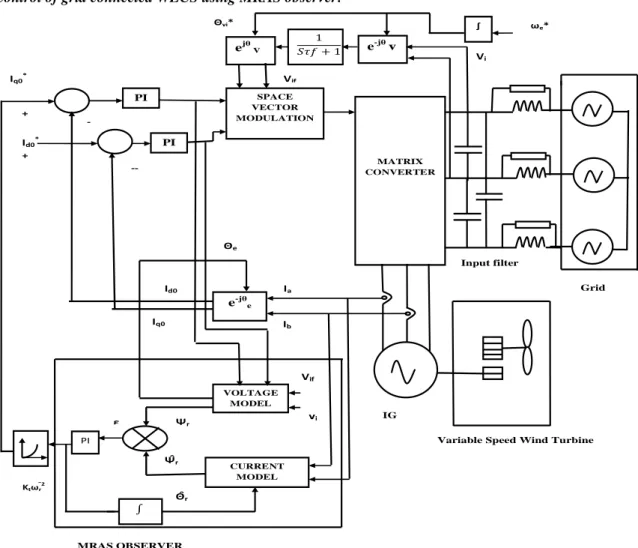
II. Control of grid connected WECS using MRAS observer:
Fig. 2: Proposed control system
Figure 2 shows the proposed control system. A variable speed wind turbine drives the IG. The MC is controlled using the space vector modulation algorithm. In figure 2 MRAS Observer is used to estimate the
rotational speed ωr and the rotor position θr. The electrical angle θe is obtained from the α–β components of the
rotor flux ψr. The angle θiv is used to obtain the d–q components of the input voltage vector in a synchronous
ωe*
Θvi* ∫
Iq0* +++ + Id0* + -- - Ψr Ψr Θr Vif
vi IG
MRAS OBSERVER
Variable Speed Wind Turbine Input filter Grid Vif Vi Θe Ia Ib Id0 Iq0 PI PI SPACE VECTOR MODULATION MATRIX CONVERTER ejθ
V e
-jθ v 1
+ 1
e-jθ e VOLTAGE MODEL CURRENT MODEL ∫ PI
Ktωr ҄2
ε
Variable Speed Wind Turbine MATRIX CONVERTER MODULATION ALGORITHM MRAS OBSERVER F I L T E R
IM MC
rotating frame. Two rotating axes are required for the analysis. On the input side, a synchronous frame rotating
at grid electrical frequency ωe is used. This frame is orientated along the input voltage vector. A conventional
vector control system, for cage machine is required for the output side (Cárdenas, R. and R. Pena, 2004). In this
case, the induction machine is controlled using a direct vector control system oriented along ψr (Cárdenas, R.
and R. Pena, 2004; Cardenas, R., et al., 2005). The demand ido* is constant for the whole operating range
because the wind energy conversion system is not required to operate at nominal flux.
It can be demonstrated that in steady state, when the wind turbine is operating at the maximum aerodynamic
efficiency, the captured power Pm, and the induction machine rotational speed are related by
Pm= Koptωr3 (1)
Where, Kopt depends on the blade aerodynamics, gear box ratio, and wind turbine parameters (Cárdenas, R.
and R. Pena, 2004). From the above equation (1) and neglecting the losses, the WECS operates at the optimal
aerodynamic efficiency point when Te is controlled to
Te = Koptωr2 (2)
Using the state equations of a cage induction machine orientated along the rotor flux (Cárdenas, R. and R.
Pena, 2004), it can be shown that for optimal power capture, the torque current demand iq0* is obtained from
(2) as follows
iqo* = ∗ (3)
Where, P is the pole number, Lr rotor inductance. Considering that sensorless operation is used in the
proposed WECS shown in Figure 2, the rotational speed estimated by the MRAS observer is used to regulate iq0*
which is analogous to torque Te
III. Modeling of MRAS Observer:
In this paper, an MRAS observer is used to estimate the rotational speed of the induction machine. The
speed is estimated by the MRAS observer which consists of two models, namely reference model and
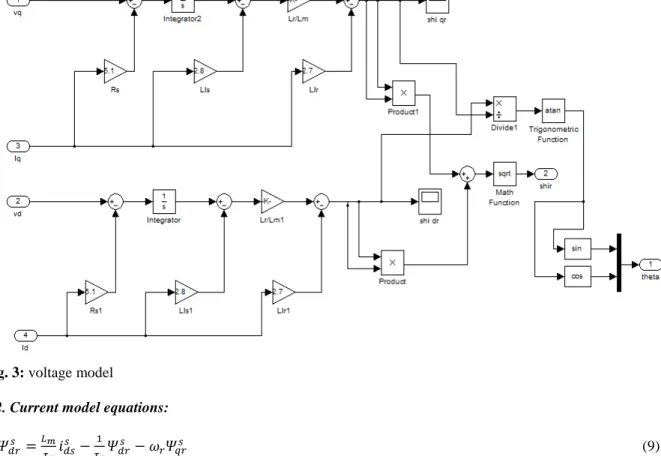
adaptive model where the output of the reference model compared with the output of the adjustable model until the errors between the two models vanish to zero. Voltage model is known as a reference model. Current model is known as an adaptive model. Voltage model use the stator voltage equation to calculate rotor flux linkage.
Current model calculates the flux linkage from the input stator current and speed signal .For low speed
operation current model is useful but for high speed operation voltage model is preferred. The combination of voltage model and current model provide good performance for wide speed range.
3.1. Voltage model equations:
= ∫ − !"# (4)
$ = ∫% $ − $ &"# (5)
' =
( − )*+ ! (6)
$' = ( $ − )*+ $ ! (7)
=, ' + $'! (8)
Where,
d s-qs Stationary reference frame direct and quadrature axis
, $ d-axis and q-axis stator voltages
, $ d-axis and q-axis stator current
, $ d-axis and q-axis stator flux linkage
' , $' d-axis and q-axis rotor flux linkage
Fig. 3: voltage model
3.2. Current model equations:
. '= 0(1 −
2
0 '− ' $' (9)
. $'= 0(1$ −
2
0 $'− ' ' (10)
=, ' + $'! (11)
3.2.1. Simulink model for current model:
Fig. 4: Current model
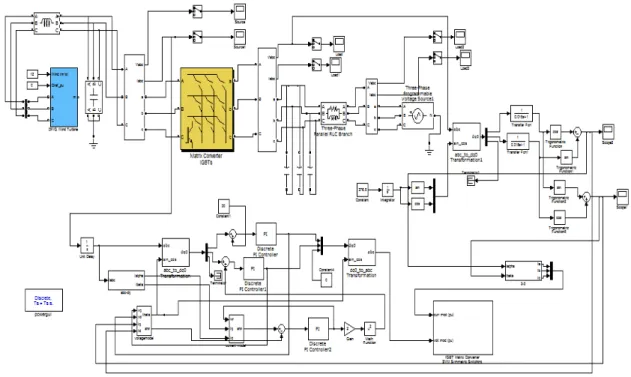
IV. Simulation Diagram and Results:
input modulating signal is from the grid reference voltage and the other input modulating signal is from the
torque components id0*which is controlled by MRAS Observer. Three phase to two phase transformation is done
at the output current of the induction generator which is given as a feedback for PI controller.
Fig. 5: Simulation diagram with MRAS Observer
4.2 Simulation Result:
The simulation results for grid connected WECS through matrix converter with and without MRAS observer is shown in figure 6&7.Input current and output voltage waveform is improved in WECS with MRAS observer compared to WECS without MRAS observer
Fig. 6: Input current and output voltage with MRAS observer
Fig. 7: Input current and output voltage without MRAS Observer
4.3. Harmonics analysis of input current and output voltage with and without MRAS observer:
Table 1: Comparison of grid connected WECS with and without MRAS observer Parameters
With MRAS Without MRAS
Input current Output voltage Input current Output voltage
THD 6.76% 4.80% 19.29% 17.43%
h5 0.52% 0.50% 1.43% 0.93%
h7 0.77% 0.31% 0.33% 0.62%
h11 0.36% 0.20% 1.59% 0.41%
h13 0.17% 0.17% 0.92% 0.33%
h17 0.18% 0.13% 0.89% 0.25%
Conclusion:
The performance of the grid connected WECS fed by a matrix converter has been implemented. Therefore
it is concluded that the grid connected WECS fed by a matrix converter with MRAS Observer has less Total
harmonics distortion (THD), selective harmonic content and better input current waveform compared togrid
connected WECS fed by a matrix converter without MRAS observer.
REFERENCES
Cárdenas, R. and R. Pena, 2004. Sensorless vector control of induction machines for variable-speed wind energy applications. Energy Conversion, IEEE Transactions on, 19(1): 196-205.
Cardenas, R., R. Pena, J. Proboste, G. Asher and J. Clare, 2005. MRAS observer for sensorless control of standalone doubly fed induction generators. Energy Conversion, IEEE Transactions on, 20(4): 710-718.
Cárdenas, R., R. Peňa, P. Wheeler, J. Clare and G. Asher, 2009. Control of the reactive power supplied by a
WECS based on an induction generator fed by a matrix converter. Industrial Electronics, IEEE Transactions on, 56(2): 429-438.
Casadei, D., G. Serra, A. Tani and L. Zarri, 2002. Matrix converter modulation strategies: a new general approach based on space-vector representation of the switch state. Industrial Electronics, IEEE Transactions on, 49(2): 370-381.
Chen, W.L. and Y.Y. Hsu, 2006. Controller design for an induction generator driven by a variable-speed wind turbine. Energy Conversion, IEEE Transactions on, 21(3): 625-635.
Comanescu, M. and L. Xu, 2006. Sliding-mode MRAS speed estimators for sensorless vector control of induction machine. Industrial Electronics, IEEE Transactions on, 53(1): 146-153.
Jeong, I.W., W.S. Choi and K.H. Park, 2014. Sensorless Vector Control of Induction Motors for Wind Energy Applications Using MRAS and ASO. Journal of Electrical Engineering & Technology, 9(3): 873-881.
Lopes, L.A. and R.G. Almeida, 2006. Wind-driven self-excited induction generator with voltage and frequency regulated by a reduced-rating voltage source inverter. Energy Conversion, IEEE Transactions on, 21(2): 297-304.
Mosskull, H., J. Galić and B. Wahlberg, 2007. Stabilization of induction motor drives with poorly damped
input filters. Industrial Electronics, IEEE Transactions on, 54(5): 2724-2734.
Podlesak, T.F., D.C. Katsis, P. Wheeler, J.C. Clare, L. Empringham and M. Bland, 2005. A 150-kVA vector-controlled matrix converter induction motor drive. Industry Applications, IEEE Transactions on, 41(3): 841-847.
Saranya, U. and S. Allirani, 2015. Model Reference Adaptive System based Speed Sensorless Control of Induction Motor using Fuzzy-PI Controller. International Journal of Computer Applications, 110(5): 23-28.
Schauder, C., 1992. Adaptive speed identification for vector control of induction motors without rotational transducers. Industry applications, IEEE Transactions on, 28(5): 1054-1061.
Wheeler, P.W., J. Rodriguez, J.C. Clare, L. Empringham and A. Weinstein, 2002. Matrix converters: a technology review. Industrial Electronics, IEEE Transactions on, 49(2): 276-288.