Australian Journal of Basic and Applied Sciences
AUSTRALIAN JOURNAL OF BASIC AND
Open Access Journal
Published BY AENSI Publication
© 2016 AENSI Publisher All rights reserved
This work is licensed under the Creative Commons Attribution International License (CC BY).
http://creativecommons.org/licenses/by/4.0/
To Cite This Article: G.S. Mahalakshmi, Betina Antony J, Akshaya Kumar, Bagawathi Recognition using Naive Bayes Classification
Domain Based Named Entity Recognition using Naive Bayes Classification
G.S. Mahalakshmi, Betina Antony J, Akshaya Kumar, Bagawathi Roshini S 1Department of Computer Science & Engineerin
Address For Correspondence:
Betina Antony J, Department of Computer Science & Engineering., College of Engineering Guindy, Anna University, Chennai 60002 Tamilnadu, India.
E-mail: [email protected]
A R T I C L E I N F O Article history:
Received 04 December 2015 Accepted 22 January 2016 Available online 14 February 2016
Keywords:
Named Entity Recognition
Syntactic parsing Temple domain Naïve Bayes
Tamil Nadu is well known for the very famous and ancient temples which attracts
world to pay a visit. The information about these temples however is not in available in a concise format. Also the temples are located at different parts of Tamil Nadu and each having their own specialties. This notion motivated us to perform the very popular subtask of information extraction, Named entity recognition so that, relevant details can be grouped together. Named entity recognition is the task of identifying proper names of people, organizations, locations, or other enti
existing work, it came to our notice that temples in Tamil Nadu is an untouched field and that too the task in hand is based on Indian language Tamil. Named entity recognition in Tamil, is vastly
English. Existing work to get a fairly good idea about the working of the framework.
G.S. Mahalakshmi, 2014), presents the construction Absence of capitalization, partial free word style, heavy lemmatization and conjugation and most importantly the case marking makes the NER task very challenging.
Named entity recognition can be done in a generic manner and also domain specifically where a predefined tag set is needed to describe the named entities in a domai
explored for a long time in the Biodomain for identification of protein names, gene names, DNA names etc. We have proposed a domain specific tag set pertaining to Temples where prominence is given to the
location, god and goddess name, operating hours and history.
Therefore, our proposed system takes input text in Tamil (in the UTF_8 format) about temples, analyze the text by preprocessing, parsing and identify the named entity tags in temple
Bayes algorithm such that, the trained set of data is used to find the most appropriate tag. The final result will the text tagged with the most appropriate name entities.
Australian Journal of Basic and Applied Sciences, 10(2) Special 2016, Pages: 234-2
AUSTRALIAN JOURNAL OF BASIC AND
APPLIED SCIENCES
ISSN:1991-8178 EISSN: 2309-8414 Journal home page: www.ajbasweb.com
Publisher All rights reserved
This work is licensed under the Creative Commons Attribution International License (CC BY).
http://creativecommons.org/licenses/by/4.0/
G.S. Mahalakshmi, Betina Antony J, Akshaya Kumar, Bagawathi Roshini S, Domain Based Named Entity Recognition using Naive Bayes Classification. Aust. J. Basic & Appl. Sci., 10(2): 234-239, 2016
Domain Based Named Entity Recognition using Naive Bayes Classification
G.S. Mahalakshmi, Betina Antony J, Akshaya Kumar, Bagawathi Roshini S
ineering, College of Engineering Guindy, Anna University, Chennai 600025
Betina Antony J, Department of Computer Science & Engineering., College of Engineering Guindy, Anna University, Chennai 60002
A B S T R A C T
In this paper we propose a methodology to perform named entity recognition on Tamil text which speaks about various temples in Tamil Nadu. The approach is to preprocess the text by tokenizing, parse the text to find the parts of speech and to perform named entity recognition as a classification problem with the help of Traditional Naïve Bayes algorithm. The statistical processing framework makes use of the dictionary created from the training data which belongs to predefined labels of named entities. Our research primarily focused on the domain specific named entities (Temple name, location swami name), temporal entities (date and time) and numbers. Our experiments on the presented system provided us with desirable results.
INTRODUCTION
Tamil Nadu is well known for the very famous and ancient temples which attracts people from all over the world to pay a visit. The information about these temples however is not in available in a concise format. Also the temples are located at different parts of Tamil Nadu and each having their own specialties. This notion s to perform the very popular subtask of information extraction, Named entity recognition so that, relevant details can be grouped together. Named entity recognition is the task of identifying proper names of people, organizations, locations, or other entities. Extensive research on the kinds of domains explored by existing work, it came to our notice that temples in Tamil Nadu is an untouched field and that too the task in hand is based on Indian language Tamil. Named entity recognition in Tamil, is vastly
English. Existing work to get a fairly good idea about the working of the framework. (
, presents the construction Absence of capitalization, partial free word style, heavy and conjugation and most importantly the case marking makes the NER task very challenging. Named entity recognition can be done in a generic manner and also domain specifically where a predefined tag set is needed to describe the named entities in a domain. Domain specific Named entity recognition has been explored for a long time in the Biodomain for identification of protein names, gene names, DNA names etc. We have proposed a domain specific tag set pertaining to Temples where prominence is given to the
location, god and goddess name, operating hours and history.
Therefore, our proposed system takes input text in Tamil (in the UTF_8 format) about temples, analyze the text by preprocessing, parsing and identify the named entity tags in temple domain by the application of Naïve Bayes algorithm such that, the trained set of data is used to find the most appropriate tag. The final result will the text tagged with the most appropriate name entities.
239
Domain Based Named Entity
Domain Based Named Entity Recognition using Naive Bayes Classification
College of Engineering Guindy, Anna University, Chennai 600025, Tamilnadu, India.
Betina Antony J, Department of Computer Science & Engineering., College of Engineering Guindy, Anna University, Chennai 600025,
this paper we propose a methodology to perform named entity recognition on Tamil text which speaks about various temples in Tamil Nadu. The approach is to preprocess the text by tokenizing, parse the text to find the parts of speech and to perform named tity recognition as a classification problem with the help of Traditional Naïve Bayes algorithm. The statistical processing framework makes use of the dictionary created from the training data which belongs to predefined labels of named entities. Our rch primarily focused on the domain specific named entities (Temple name, location swami name), temporal entities (date and time) and numbers. Our experiments
people from all over the world to pay a visit. The information about these temples however is not in available in a concise format. Also the temples are located at different parts of Tamil Nadu and each having their own specialties. This notion s to perform the very popular subtask of information extraction, Named entity recognition so that, relevant details can be grouped together. Named entity recognition is the task of identifying proper names of ties. Extensive research on the kinds of domains explored by existing work, it came to our notice that temples in Tamil Nadu is an untouched field and that too the task in different compared to (Betina Antony, J. and , presents the construction Absence of capitalization, partial free word style, heavy and conjugation and most importantly the case marking makes the NER task very challenging. Named entity recognition can be done in a generic manner and also domain specifically where a predefined
n. Domain specific Named entity recognition has been explored for a long time in the Biodomain for identification of protein names, gene names, DNA names etc. We have proposed a domain specific tag set pertaining to Temples where prominence is given to the Temple name,
Section II gives a brief summary of the related
system, followed by section IV which gives an overview of the Experiments and the Results. Finally section V concludes the proposed work discussion.
Related Works:
In order to learn about preliminary work in the area of named entity recognition in Tamil, we looked upon of a hybrid, three stage named entity recognizer for Tamil. The approach
Named entity recognition by an inplace t
parsing, shallow semantic parsing and statistical processing. It uses Expectation maximization in the statistical processing phase, with initial probabilities obtained from the shallow p
EM algorithm deals with inputs from the shallow semantic parsing phase. Recent work in Name entity recognition is heavily based on domain specific since it gives accurate results compared to generic method. Vijayakrishna et al (2008) have developed a domain specific hierarchical tag set consisting of 106
tourism domain. Conditional Random Fields, which is a machine learning approach, is used as the sequence labeling task for performing Named entity recog
recognition by using SVM classifiers. The method is to extract unique features such as such as case markers, bigrams frequency, and substring clues and construct a NER identification module usi
dictionary is created, containing list of named entities and their corresponding categories, and the dictionary also has unigrams and bigrams.
System Overview:
The NER system accepts a raw Tamil document as input and outputs a tag
entities in text are tagged according to the entity type. Fig 1 gives the outline of the NER system. The various processes and components of the system include the following: The proposed system comprises of two phases namely, analysis phase and synthesis phase.
Fig .1: High level block diagram
Analysis Phase:
Analysis phase comprises of three modules namely, preprocessing, morphological analysis and two stage parsing. Each module is described in the following sections.
1) Preprocessing:
The initial preprocessing is performed on the Tamil text for converting it into suitable format for machine learning. The Tamil text in standard UTF8 format is converted into English with the inclusion of clit markers for differentiating between the variations in phonetics.
Section II gives a brief summary of the related work. Section III discusses the overview of the proposed system, followed by section IV which gives an overview of the Experiments and the Results. Finally section V concludes the proposed work discussion.
In order to learn about preliminary work in the area of named entity recognition in Tamil, we looked upon of a hybrid, three stage named entity recognizer for Tamil. The approach Pandian S
Named entity recognition by an inplace tagging task for a given Tamil document in three phases namely shallow parsing, shallow semantic parsing and statistical processing. It uses Expectation maximization in the statistical processing phase, with initial probabilities obtained from the shallow parsing phase, and a modification to the EM algorithm deals with inputs from the shallow semantic parsing phase. Recent work in Name entity recognition is heavily based on domain specific since it gives accurate results compared to generic method.
have developed a domain specific hierarchical tag set consisting of 106
tourism domain. Conditional Random Fields, which is a machine learning approach, is used as the sequence labeling task for performing Named entity recognition. Betina Antony J et al (2014) perform
recognition by using SVM classifiers. The method is to extract unique features such as such as case markers, bigrams frequency, and substring clues and construct a NER identification module using SVM classifier. An NE dictionary is created, containing list of named entities and their corresponding categories, and the dictionary also
The NER system accepts a raw Tamil document as input and outputs a tagged document wherein named entities in text are tagged according to the entity type. Fig 1 gives the outline of the NER system. The various processes and components of the system include the following: The proposed system comprises of two phases
alysis phase and synthesis phase.
Analysis phase comprises of three modules namely, preprocessing, morphological analysis and two stage module is described in the following sections.
The initial preprocessing is performed on the Tamil text for converting it into suitable format for machine learning. The Tamil text in standard UTF8 format is converted into English with the inclusion of clit markers for
ions in phonetics.
work. Section III discusses the overview of the proposed system, followed by section IV which gives an overview of the Experiments and the Results. Finally section V
In order to learn about preliminary work in the area of named entity recognition in Tamil, we looked upon Pandian S et al (2008) performs agging task for a given Tamil document in three phases namely shallow parsing, shallow semantic parsing and statistical processing. It uses Expectation maximization in the statistical arsing phase, and a modification to the EM algorithm deals with inputs from the shallow semantic parsing phase. Recent work in Name entity recognition is heavily based on domain specific since it gives accurate results compared to generic method. have developed a domain specific hierarchical tag set consisting of 106 tags for tourism domain. Conditional Random Fields, which is a machine learning approach, is used as the sequence (2014) perform Named Entity recognition by using SVM classifiers. The method is to extract unique features such as such as case markers, ng SVM classifier. An NE dictionary is created, containing list of named entities and their corresponding categories, and the dictionary also
ged document wherein named entities in text are tagged according to the entity type. Fig 1 gives the outline of the NER system. The various processes and components of the system include the following: The proposed system comprises of two phases
Analysis phase comprises of three modules namely, preprocessing, morphological analysis and two stage
236 G. S. Mahalakshmi et al, 2016
Australian Journal of Basic and Applied Sciences, 10(2) Special 2016, Pages: 234-239
2) Morphological Analysis:
Given a word, the morphological analysis finds out the root and the grammatical features of the word. We have employed a dictionary of root words and used an analysis to split the word form into its root and grammatical suffixes. Paradigm based approaches have given good success rates Tamil. The words are then analyzed with respect to its structure and are tagged with appropriate parts of speech tags.
Example: 1 SrI NNC
2 pArwwacArawi NNP 3 latcArccanYE NN 4 SYM
5 pipravari NN
3) Parsing:
Parsing is executed on two different stages. First being the shallow parsing and then semantic parsing for picking out words for dictionary creation in next phase. The shallow parser gives the analysis of a sentence at various levels. The analysis begins at the morphological level and accumulates at results of POS tagging and chunking the text. Next with the help of words that will pertain to certain category, we identify nouns, verbs and postpositions that are used to identify the type of subjects/ objects in a sentence. These words are then used in the dictionary to help identify and accurately classify the entities. The parsed entries are represented in a standard format (Shakthi Standard Format)(Bharati A et al., 2007).
4) Dictionary:
The dictionary contains an exhaustive list of temple names, Swami names, dates, and locations. The dictionary is part of the dataset used to train the Naive Bayes Classifier.
5) Tag set:
The tag set comprises of seven tags namely temple name,location, Swami name(including god and goddess),number,date,time and history. The given text is categorized to match the above mentioned tags at the required places.
Synthesis Phase:
1) Naive Bayes Trainer:
In this module, 80% of the documents and the entire dictionary is trained, including the temple names, God names, and location names. The entity could be a single word, or phrase.
2) Naive Bayes Classifier:
This module classifies the rest of the 20% of documents. Classification is done up to trigram, to include up to three word phrases. In cases like bigrams or trigrams, there's a high probability of classifying too much
information into an entity. For example, if there is a sentence A B C D E, and only B C D is a temple name;
(A,B,C),(B,C,D),(C,D,E) will be the corresponding trigram. In this case, all three will result in max probability, since in the first case, B and C adds weightage to temple tag, and C, will add weightage in (C,D,E). But the maximum probability will exist for (B,C,D) only. To resolve this issue, wherever there are multiple same tag for a set of trigrams, retain the one with maximum probability, like in (B,C,D).
Example:
1.1 SrI NNC <fs af='SrI,unk,,,,,,' poslcat="NM">
1.2 pArwwacArawi NNP <fs
af='pArwwacArawi,unk,,,,,,' poslcat="NM"
name="pArwwacArawi"> Example:
As you can see, the actual temple name would be ‘rulymiku cevpparye natarajar wirukkoyil’. Hence maximum probability of the three N-Grams must be chosen to tag the text.
3) Name Entity Generator:
This module tags the entities to their corresponding names with their angular brackets. Final output will be the converted text with the appropriate tags from the predefined tag set at the relevant places.
Experiments And Discussion:
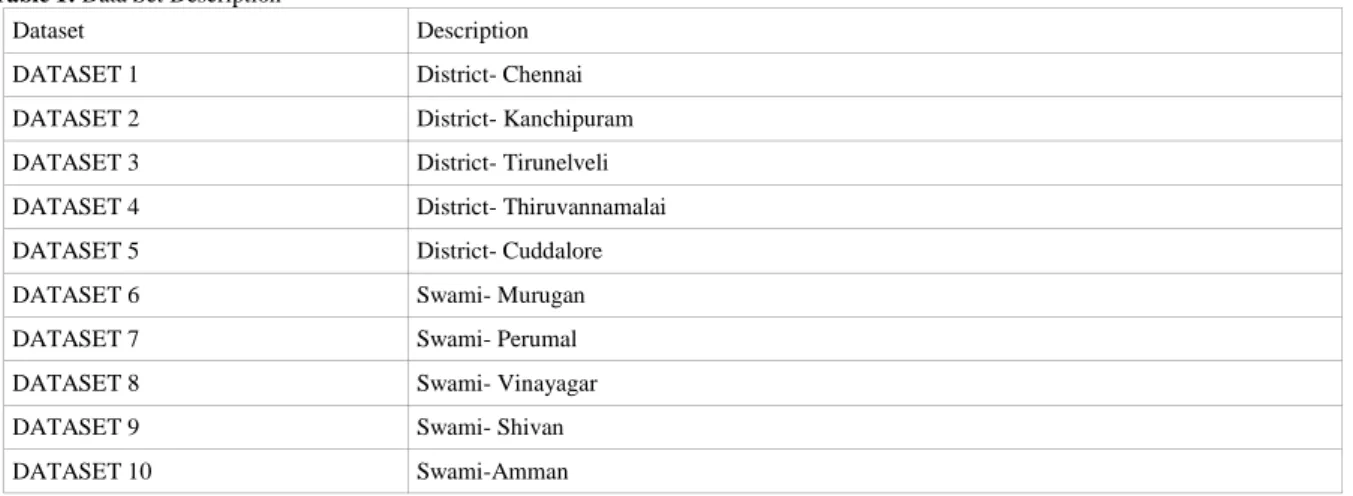
5000 documents were crawled from 'www.temples.dinamalar.com'. It is an exclusive website that provides with details on temples. The information was classified according to district, God names, and their specialty. The corpus was split into 10 datasets each consisting of 500 documents. The indexing information is presented on Table 1. The documents were preprocessed by removing symbols other than “?,!,.”. MUC evaluation system is based on two criteria. i) The ability to find the correct type and ii) The ability to find the exact text. When an entity is assigned the correct type, it is credited as a correct 'type', while an entity matched currently within boundaries is credited as correct 'text'. The modules tested were POS tagger, and Parser.
Table 1: Data Set Description
Dataset Description
DATASET 1 District- Chennai
DATASET 2 District- Kanchipuram
DATASET 3 District- Tirunelveli
DATASET 4 District- Thiruvannamalai
DATASET 5 District- Cuddalore
DATASET 6 Swami- Murugan
DATASET 7 Swami- Perumal
DATASET 8 Swami- Vinayagar
DATASET 9 Swami- Shivan
DATASET 10 Swami-Amman
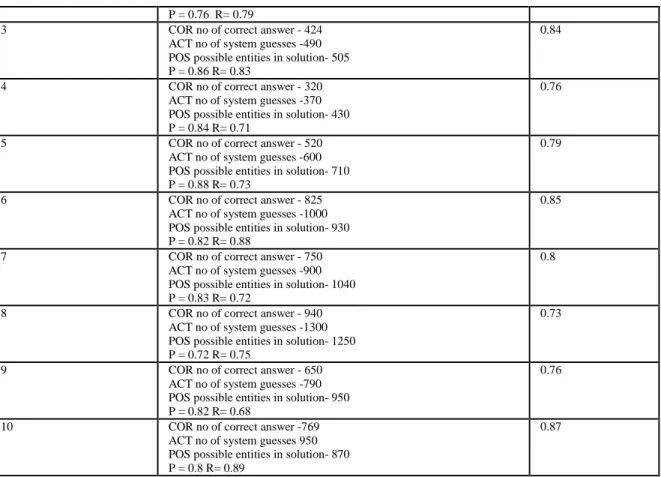
The results are shown in Table 2. The formula used for MUC evaluation is given by (1).
MUC=2*(Precision*Recall)/(Precision+Recall) (1)
where, Precision =COR / ACT, Recall =COR / POS. COR- correctly tagged words, ACT- actual tagged words, POS- possible entities.
Table 2: MUC Evaluation
DATASET PRECISION AND RECALL MUC SCORE
1 COR no of correct answer - 640
ACT no of system guesses -712 POS possible entities in solution- 750 P = 0.89 R= 0.85
0.86
2 COR no of correct answer - 369
ACT no of system guesses -484 POS possible entities in solution- 490
0.75 Unigram:
<TEMPLE>arulymiku</TEMPLE> <LOCATION>cevpparye</LOCATION> <TEMPLE>natarajar</TEMPLE> <TEMPLE>wirukkoyil</TEMPLE>
Bigram:
arulymiku cevpparye <TEMPLE>natarajar wirukkoyil </TEMPLE> mulavar
Trigram:
238 G. S. Mahalakshmi et al, 2016
Australian Journal of Basic and Applied Sciences, 10(2) Special 2016, Pages: 234-239
P = 0.76 R= 0.79
3 COR no of correct answer - 424
ACT no of system guesses -490 POS possible entities in solution- 505 P = 0.86 R= 0.83
0.84
4 COR no of correct answer - 320
ACT no of system guesses -370 POS possible entities in solution- 430 P = 0.84 R= 0.71
0.76
5 COR no of correct answer - 520
ACT no of system guesses -600 POS possible entities in solution- 710 P = 0.88 R= 0.73
0.79
6 COR no of correct answer - 825
ACT no of system guesses -1000 POS possible entities in solution- 930 P = 0.82 R= 0.88
0.85
7 COR no of correct answer - 750
ACT no of system guesses -900 POS possible entities in solution- 1040 P = 0.83 R= 0.72
0.8
8 COR no of correct answer - 940
ACT no of system guesses -1300 POS possible entities in solution- 1250 P = 0.72 R= 0.75
0.73
9 COR no of correct answer - 650
ACT no of system guesses -790 POS possible entities in solution- 950 P = 0.82 R= 0.68
0.76
10 COR no of correct answer -769
ACT no of system guesses 950 POS possible entities in solution- 870 P = 0.8 R= 0.89
0.87
Macro Averaged F-measure is the harmonic mean of precision and recall values. For each of the ten datasets, which had 500 documents each, precision and recall values were calculated. The average of all the precision values and recall values were separately calculated and the harmonic mean of these two values was then computed. This is described in Table III. The formula used to compute Macro-averaged-f measure is given by (2).
Macro-averaged-f measure = Harmonic mean[(p1+p2…+pn)/n,(r1+r2…+rn)/n] (2)
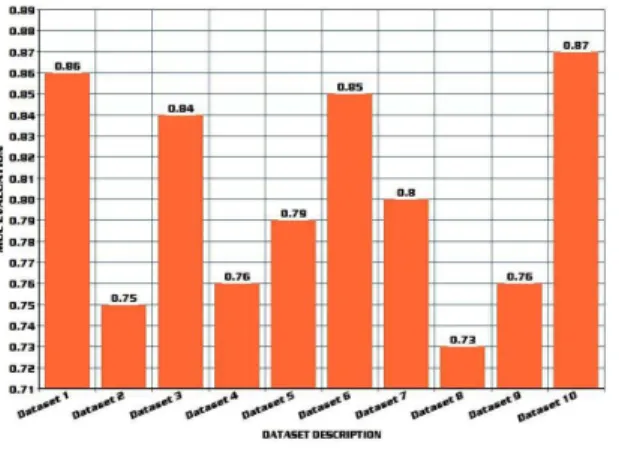
Table 3 depicts the result of our methodology on the different dataset and the corresponding MUC values calculated. Fig 2 shows the graphical representation of the same. The results are best when the Naive Bayes classifier is trained with more and more number of words from training data set pertaining to each type of tag from the tag set.
Table 3: Macro Averaged F-Measure
PRECISIÓN RECALL F-MEASURE
P1=0.89 P2=0.76 P3=0.86 P4=0.84 P5=0.88 P6=0.82 P7=0.83 P8=0.72 P9=0.82 P10=0.8
R1=0.85 R2=0.79 R3=0.83 R4=0.71 R5=0.73 R6=0.88 R7=0.72 R8=0.75 R9=0.68 R10=0.89
P average= 0.82 R average=0.76 Macro averaged F-measure=0.79
Fig. 2: MUC Evaluation Graph
Conclusion:
Based on the experiments and the results it is evident that our approach is successful in determining the named entities with the relevant text with accuracy of 79%. It is seen that the best outcome is due to extensive training of Naive Bayes classifier and regular updation of the dictionary. Identifying history of temples in text poses a challenge since many words in the text will contain other named entities. Also, for named entities for phrases with more than three words pose a challenge since N-gram must be done.
REFRENCES
Betina Antony, J. and G.S. Mahalakshmi, 2014. March. Named entity recognition for tamil biomedical documents. In Circuit, Power and Computing Technologies (ICCPCT), 2014 International Conference:1571-1577.
Bharati, A., R. Sangal and D.M. Sharma, 2007. Ssf: Shakti standard format guide. Language Technologies Research Centre, International Institute of Information Technology, Hyderabad, India, pp: 1-25.
Pandian, S., K.A. Pavithra and T. Geetha, 2008. Hybrid three-stage named entity recognizer for tamil. INFOS.