© 2019 by the Serbian Biological Society How to cite this article: Rajčević N, Nikolić B, Marin PD. Different responses to 629 environmental factors in terpene composition of Pinus heldreichii and P. peuce:
Ecological and chemotaxonomic considerations. Arch Biol Sci. 2019;71(4):629-37.
Different responses to environmental factors in terpene composition of Pinus heldreichii
and P. peuce: ecological and chemotaxonomic considerations
Nemanja Rajčević1,*, Biljana Nikolić2 and Petar D. Marin1
1Faculty of Biology, University of Belgrade, Studentski trg 12, 11000 Belgrade, Serbia 2Institute of Forestry, Kneza Višeslava 3, 11000 Belgrade, Serbia
*Corresponding author: [email protected]
Received: July 5, 2019; Revised: July 18, 2019; Accepted: July 24, 2019; Published online: August 1, 2019
Abstract: Many studies show the influence of the environment on terpene composition, but not many of them deal with the terpene composition variability in correlation with environmental factors in Pinus. We chose two endemic species – P. heldreichii Christ. (Bosnian pine) and P. peuce Griseb. (Macedonian pine) – two relict and (sub)endemic species of the Balkan peninsula. They mainly form pure stands but can appear in mixed populations, most commonly with each other. These species belong to different subgenera and thus differ greatly, especially in needle anatomy. α-pinene, limonene and germacrene D predominated in Bosnian pine leaf oleoresins, while Macedonian pine oleoresin contained high amounts of
α-pinene. Furthermore, there were three chemotypes present in Bosnian, and only one in Macedonian pine. Oleoresins of Bosnian pine did not show correlation with climate, however, its composition changed in response to geological substrate type. Macedonian pine oleoresin showed a high correlation with the climate but changed only a little in response to geo-logical substrate type. The oleoresin profiles showed strong species-dependent composition and variability. However, since each species expressed different responses to tested environmental conditions, it is important to take into consideration these variables when analyzing natural populations of the species.
Keywords: Bosnian pine; Macedonian pine; essential oil; environmental factors; chemotaxonomy
INTRODUCTION
Plants produce a myriad of compounds in order to adapt as best as they can to the environment. Essential oils or plant volatiles are complex mixtures consisting mainly of terpenes (mono-, sesquiterpenes and some diterpenes), but also different aliphatic and aromatic hydrocarbons. Essential oils play a significant role in plant-environment interactions, including both bio-tic (microorganisms, animals, plants, and fungi) and abiotic (climate and geological substrate) factors [1-3]. Terpenes are synthesized in two different cellular com-partments: monoterpenes and diterpenes in plastids (MEP biosynthetic pathway) and sesquiterpenes in the cytosol (MVA) [3]. Their synthesis is regulated by terpene synthases that can produce anywhere from only one compound to up to 52 different compounds [4-10]. The multi-product synthesis of terpene syntha-ses and a very fast rate of evolution of their genes is in high correlation with the ecological significance of the
terpenes and the cost of their production [7,10-12]. Hence, terpenes are most useful at lower taxonomic levels. In conifers, essential oils are usually mixed with higher terpenes, and thus are referred to as oleoresins. They have been used as environmental and chemo-taxonomic markers in many conifer species, with the latter ranging from family to infra-specific level [13-20]. Unlike some members of the Cupressaceae family,
oleoresins in Pinus are stored in resin ducts located in
leaves and branches, where they are used as protection against predatory insects [21].
There are many studies showing the influence of environmental factors on terpene composition [22-25]. Even though there are quite a few studies of the
composition of the Pinus oleoresins, not many of
the composition of needle oleoresins of several Bal-kan pines.
For this study, we chose two endemic species –
Pinus heldreichii Christ. (whitebark pine or Bosnian
pine) and P. peuce Griseb. (Macedonian pine). Both
species are relict and endemic or subendemic (P.
hel-dreichii) on the Balkan peninsula. They can be found in high mountains of Serbia, Montenegro, Albania, Macedonia, Bulgaria and Greece, while Bosnian pine can also be found in southern Italy and Bosnia and Herzegovina [29]. These species usually form pure stands, but can also appear in mixed population, most commonly with each other. Furthermore, these two species belong to different subgenera within the genus.
Bosnian pine belongs to the subgenus Pinus, while the
Macedonian pine belongs to Strobus, differing greatly,
especially in the anatomy of needles. Initial research on the distribution of these two species in their na-tural range suggested that they have a preference for different substrata, but consequent studies showed that they grow on both geological substrates [30,31]. This, along with their other characteristics, makes them perfect for this study.
The aims of this study were to assess the overall variability of oleoresin composition of two endemic pines from central Balkans in relation to their diffe-rent geographic distribution and bioclimatic parame-ters, geological substrate and exposition.
MATERIALS AND METHODS
Plant material
Two-year-old twigs with needles were collected in late summer from 2003 and 2012. Plant material was collected from the lowest third of the tree crown, from 30 individuals in most populations, except Ošljak and Galičica, where there were small populations and therefore fewer samples were taken. Geographic and geological details of the studied localities and a map with the geographic distribution of the analyzed populations are given in the supplementary material (Supplementary Fig. S1; Supplementary Table S1). The collected twigs were stored in a freezer (-21°C) until oleoresin extraction and analysis.
Oleoresin isolation
Two-year-old needles were cut into 2-3-mm pieces
and extracted with GC grade n-pentane (1 g of needles
per mL of solvent). The extracts were kept at 4°C for 24 h, then filtered and stored in chromatography vials with solid caps in a refrigerator until GC/MS analyses.
GC/MS and GC/FID analyses
The GC/MS analyses were performed with a Hewlett Packard G1800C-GCD apparatus equipped with a split/splitless injector, an automatic liquid sampler (ALS), a mass-selective detector and an HP-5 MS fu-sed silica capillary column (30 m x 0.25 mm i.d., film thickness 0.25 mm). The chromatographic conditions were the same as described (cf. GC-FID Analysis), except for the carrier gas, which was He. Electron-im-pact mass spectra (EI-MS; 70 eV) were acquired over the m/z range 40-450 amu.
The GC-FID analyses were carried out with an Agilent Technologies 7890A apparatus equipped with a split/ splitless injector, an ALS, a flame ionization detector (FID) and an HP-5 fused-silica capillary column. The oven temperature was programmed linearly to rise from 40 to 280° at 4/min; injector temperature was 250°C; detector temperature was 280°C; carrier gas, H2 (1 mL/min). Samples (1 mL) were injected in splitless mode (1:15) using the ALS.
Bioclimatic parameters
Bioclimatic characteristics of the nine studied locali-ties were extracted from the WorldClim set of global climate layers [32] using DIVA-GIS 7.5 software (ava-ilable at: http://www.Diva-Gis.Org). The list of used abbreviations for bioclimatic parameters (BIO1-19) is given in Supplementary Table S4.
Statistical methods
RESULTS
Pinus heldreichii
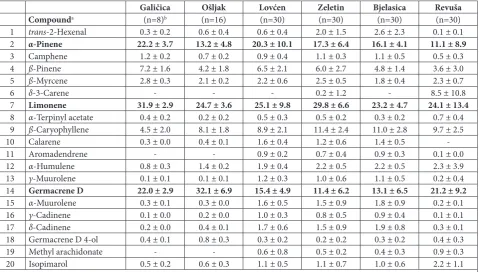
In total, 138 compounds were detected. The detailed oleoresin composition of the studied individuals can be found in our previous investigations [34,35]. Twen-ty components that did not show correlation and were present at 0.5% on average in the whole dataset were used for further statistical analyses (Table 1). These twenty compounds represented on average 90.2±4.3% of the total oil content. Even though essential oil com-position varied between individual samples, three components were always high in abundance in all of
them, namely, α-pinene, limonene and germacrene D.
Limonene was the most abundant compound in most of the individual samples in all individuals from the population Galičica, and most individuals from the populations Lovćen, Zeletin, Bjelasica and Revuša, and a single individual from the population Ošljak. On the other hand, germacrene D was the dominant component of almost all individuals from Ošljak and several other populations excluding Galičica. Only 10
individuals (out of 144) from Lovćen, Zeletin,
Bjela-sica and Revuša had α-pinene as a dominant
com-pound.
DA based on these components with populations as groups showed the formation of three clusters.
Ba-sed on the high abundance of δ-3-carene and low
abu-ndance of α-pinene, the population Revuša separated
on one side. On the other side, the populations Ošljak and Galičica parted based on the high abundance of germacrene D, while all other populations overlapped based on the lower abundance of germacrene D and
δ-3-carene, and the relatively high abundance of α
-pi-nene and ß-caryophyllene (Fig. 1a). These results were
further confirmed by cluster analysis (Fig. 1b). A linear correlation test was used to assess the po-tential correlation between essential oil composition and bioclimatic characteristics, altitude and surface inclination. The linear correlation test showed a weak correlation between several essential oil components and several bioclimatic parameters, mainly those related to precipitation (Supplementary Table S2). However, there was no correlation between terrain
Table 1. Relative abundance of twenty compounds of Pinus heldreichii essential oil used in statistical analyses.
Galičica Ošljak Lovćen Zeletin Bjelasica Revuša
Compounda (n=8)b (n=16) (n=30) (n=30) (n=30) (n=30)
1 trans-2-Hexenal 0.3 ± 0.2 0.6 ± 0.4 0.6 ± 0.4 2.0 ± 1.5 2.6 ± 2.3 0.1 ± 0.1
2 α-Pinene 22.2 ± 3.7 13.2 ± 4.8 20.3 ± 10.1 17.3 ± 6.4 16.1 ± 4.1 11.1 ± 8.9
3 Camphene 1.2 ± 0.2 0.7 ± 0.2 0.9 ± 0.4 1.1 ± 0.3 1.1 ± 0.5 0.5 ± 0.3
4 ß-Pinene 7.2 ± 1.6 4.2 ± 1.8 6.5 ± 2.1 6.0 ± 2.7 4.8 ± 1.4 3.6 ± 3.0
5 ß-Myrcene 2.8 ± 0.3 2.1 ± 0.2 2.2 ± 0.6 2.5 ± 0.5 1.8 ± 0.4 2.3 ± 0.7
6 δ-3-Carene - - - 0.2 ± 1.2 - 8.5 ± 10.8
7 Limonene 31.9 ± 2.9 24.7 ± 3.6 25.1 ± 9.8 29.8 ± 6.6 23.2 ± 4.7 24.1 ± 13.4
8 α-Terpinyl acetate 0.4 ± 0.2 0.2 ± 0.2 0.5 ± 0.3 0.5 ± 0.2 0.3 ± 0.2 0.7 ± 0.4
9 ß-Caryophyllene 4.5 ± 2.0 8.1 ± 1.8 8.9 ± 2.1 11.4 ± 2.4 11.0 ± 2.8 9.7 ± 2.5
10 Calarene 0.3 ± 0.0 0.4 ± 0.1 1.6 ± 0.4 1.2 ± 0.6 1.4 ± 0.5
-11 Aromadendrene - - 0.9 ± 0.2 0.7 ± 0.4 0.9 ± 0.3 0.1 ± 0.0
12 α-Humulene 0.8 ± 0.3 1.4 ± 0.2 1.9 ± 0.4 2.2 ± 0.5 2.2 ± 0.5 2.3 ± 3.9
13 γ-Muurolene 0.1 ± 0.1 0.1 ± 0.1 1.2 ± 0.3 1.0 ± 0.6 1.1 ± 0.5 0.2 ± 0.4
14 Germacrene D 22.0 ± 2.9 32.1 ± 6.9 15.4 ± 4.9 11.4 ± 6.2 13.1 ± 6.5 21.2 ± 9.2
15 α-Muurolene 0.3 ± 0.1 0.3 ± 0.0 1.6 ± 0.5 1.5 ± 0.9 1.8 ± 0.9 0.2 ± 0.1
16 γ-Cadinene 0.1 ± 0.0 0.2 ± 0.0 1.0 ± 0.3 0.8 ± 0.5 0.9 ± 0.4 0.1 ± 0.1
17 δ-Cadinene 0.2 ± 0.0 0.4 ± 0.1 1.7 ± 0.6 1.5 ± 0.9 1.9 ± 0.8 0.3 ± 0.1
18 Germacrene D 4-ol 0.4 ± 0.1 0.8 ± 0.3 0.3 ± 0.2 0.2 ± 0.2 0.3 ± 0.2 0.4 ± 0.3
19 Methyl arachidonate - - 0.6 ± 0.8 0.5 ± 0.2 0.4 ± 0.3 0.9 ± 0.3
20 Isopimarol 0.5 ± 0.2 0.6 ± 0.3 1.1 ± 0.5 1.1 ± 0.7 1.0 ± 0.6 2.2 ± 1.1
inclination or altitude with any of the twenty essential
oil compounds. Calarene, aromadendrene, γ
-muuro-lene, δ-cadinene and γ-cadinene showed a moderate
positive correlation with several bioclimatic parame-ters related to precipitation, although this could be due to the very low abundance of these compounds. None of the dominant essential oil components showed correlation with any of the used bioclimatic parame-ters. The Mantel and partial Mantel tests showed no correlation between the essential oil profile and bi-oclimatic parameters, not even after the removal of the geographic region. To further assess the possible
influence of climate, exposition and substratum, DA was deployed. Gro-ups for DA were constructed using bioclimatic parameters, exposition and geological substrate, respective-ly, to assess whether the populations growing in different conditions sepa-rate significantly based on essential oil components.
Based on the bioclimatic chara-cteristics of the localities, four gro-ups could be distinguished (Fig. 1c). Bjelasica, Galičica, and Ošljak formed
one group (a), while all other
popula-tions belonged to different groups (
b-d). These bioclimatic groups differ in
minimum winter temperatures, with
group d having the coldest winters,
followed by groups c, a and b. Group
c (Revuša) also had quite a different
climate, with the highest temperatures during the wettest quarter and lowest during the driest. However, the DA scatterplot shows a high separation of
only Revuša (bioclimatic group c)
ba-sed on the high abundance of δ
-3-ca-rene and complete overlap of all other bioclimatic groups.
DA was performed with groups according to geological substrate type and exposition. Individuals growing on Neogene sediments separated from individuals growing on limestone-ba-sed substrates (Fig. 1e). Schist and li-mestone substrate populations separa-ted based on the higher abundance of
α-pinene and limonene, while dolomite populations
separated based on β-caryophyllene. Interestingly,
individuals from a population that grew on a serpen-tinite substrate were positioned between populations growing on limestone and dolomite substrates. The DA scatterplot with individuals growing at different expositions showed complete overlap of individuals growing on N and E expositions (Figure 1f). These
individuals had a higher abundance of δ-3-carene and
a lower presence of α-pinene. On the other hand, the
population growing with a NE exposition had a higher
abundance of germacrene D and was clearly separated from all other populations. The population with a SW
exposition had the highest abundance of α-pinene and
low abundance of both δ-3-carene and limonene.
Pinus peuce
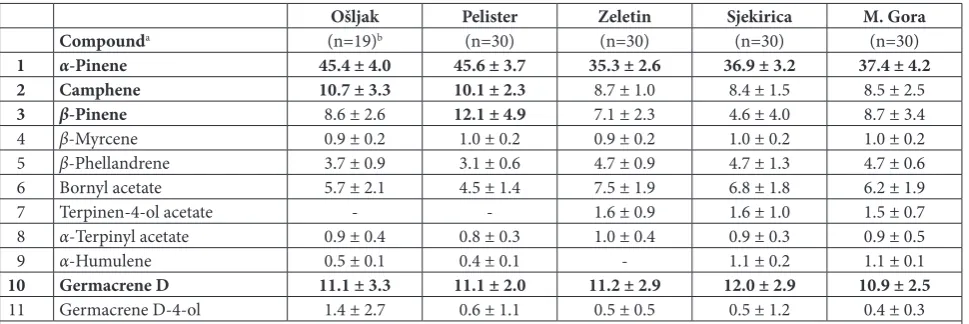
In total, 135 compounds were detected. The detai-led oleoresin composition of the studied individuals can be found in our previous investigations [36,37]. Eleven that did not exhibit correlation and were pre-sent at 0.5% on average in the whole data set were used for further statistical analyses (Table 2). These eleven compounds represent on average 84.1±5.0% of the total oil content. Even though the essential oil composition varied between individual samples,
α-pinene was dominant in all samples (29.3-55.5%).
Several other compounds showed high abundance,
i.e. camphene, β-pinene, bornyl acetate, germacrene
D. One individual from Ošljak also had germacrene D-4-ol in relatively high abundance.
DA based on these components with populations as groups showed the formation of three clusters. All individuals separated primarily on the abundance of
the two most abundant compounds (α-pinene and
β-pinene), however, they separated clearly based on
several other compounds on the first discriminant axis. The population Zeletin separated from all others
based on the absence of α-humulene. On the other
hand, populations Ošljak and Pelister did not have terpinen-4-ol acetate and had quite a low
abundan-ce of α-humulene (<1%). The populations Sjekirica
and Zeletin contained both α-humulene and
terpi-nen-4-ol acetate at a somewhat higher abundance (Fig. 2a). These results were further confirmed by cluster analysis (Fig. 2b).
A linear correlation test was used to assess the po-tential correlation between essential oil composition on one side and bioclimatic characteristics as well as altitude and inclination of the surface (Supplementary Table S3). A strong significant correlation was found
of α-pinene and terpinen-4-ol acetate with
bioclima-tic parameters and altitude. There was no correlation between terrain inclination with any of the analyzed
essential oil components. α-Pinene showed a medium
to strong positive correlation with bioclimatic para-meters related to temperature (BIO1-BIO11), and a strong negative correlation with bioclimatic parameters related to precipitation and altitude, with the excepti-on of precipitatiexcepti-on seasexcepti-onality (BIO15). The opposite holds true for terpinen-4-ol acetate. This compound displayed a medium negative correlation with bioc-limatic parameters related to temperature and preci-pitation seasonality, and a positive correlation with the precipitation parameters. The Mantel and partial Mantel tests showed a high statistically significant correlation between the essential oil profile and
bi-oclimatic parameters (r=0.95 p=0.01), even after the
removal of the geographic region (r=0.91, p=0.03),
which also strongly correlated with the essential oil
profile (r=0.72, p=0.02). To further assess the possible
influence of the climate, exposition and substratum,
Table 2. The relative abundance of eleven compounds of Pinus peuce essential oil used in statistical analyses.
Ošljak Pelister Zeletin Sjekirica M. Gora
Compounda (n=19)b (n=30) (n=30) (n=30) (n=30)
1 α-Pinene 45.4 ± 4.0 45.6 ± 3.7 35.3 ± 2.6 36.9 ± 3.2 37.4 ± 4.2
2 Camphene 10.7 ± 3.3 10.1 ± 2.3 8.7 ± 1.0 8.4 ± 1.5 8.5 ± 2.5
3 β-Pinene 8.6 ± 2.6 12.1 ± 4.9 7.1 ± 2.3 4.6 ± 4.0 8.7 ± 3.4
4 β-Myrcene 0.9 ± 0.2 1.0 ± 0.2 0.9 ± 0.2 1.0 ± 0.2 1.0 ± 0.2
5 β-Phellandrene 3.7 ± 0.9 3.1 ± 0.6 4.7 ± 0.9 4.7 ± 1.3 4.7 ± 0.6
6 Bornyl acetate 5.7 ± 2.1 4.5 ± 1.4 7.5 ± 1.9 6.8 ± 1.8 6.2 ± 1.9
7 Terpinen-4-ol acetate - - 1.6 ± 0.9 1.6 ± 1.0 1.5 ± 0.7
8 α-Terpinyl acetate 0.9 ± 0.4 0.8 ± 0.3 1.0 ± 0.4 0.9 ± 0.3 0.9 ± 0.5
9 α-Humulene 0.5 ± 0.1 0.4 ± 0.1 - 1.1 ± 0.2 1.1 ± 0.1
10 Germacrene D 11.1 ± 3.3 11.1 ± 2.0 11.2 ± 2.9 12.0 ± 2.9 10.9 ± 2.5
11 Germacrene D-4-ol 1.4 ± 2.7 0.6 ± 1.1 0.5 ± 0.5 0.5 ± 1.2 0.4 ± 0.3
and to identify components most affected, DA was per-formed. Groups for DA were constructed using biocli-matic parameters, exposition and geological substrate. Based on the bioclimatic characteristics of the localities, three groups could be distinguished (Fig. 2d). Most distinct of all was Mokra Gora that was
in a group of its own (c). Four other localities have
much more similar climates, so they clustered close to each other, forming two clades: clade a (Zeletin and Sjekirica) and clade b (Ošljak and Pelister). However, the DA scatterplot shows a high separation of only
Ošljak and Pelister (bioclimatic
gro-up b) based on the high abundance of
α-pinene and almost complete overlap
of all other bioclimatic groups. Mokra
Gora (bioclimatic group c) separated
from most of the individuals
belon-ging to bioclimatic group a, based on
the presence of α-humulene and
hig-her abundance of β-pinene.
DA was also performed with gro-ups according to geological substrate type and exposition. Even though the-re is overlap between substrate types, there is an evident gradient of both
α-pinene and β-pinene along the pH
gradient, from an ultra-alkaline ser-pentinite substrate to a less alkaline silicate (Fig. 2e). The DA scatter plot with groups based on locality exposi-tion showed the formaexposi-tion of two se-parate clusters. One cluster was with individuals growing on NE and SE slo-pes, while the other one included tho-se growing on S and E exposition. The NE-SE group separated based on the
higher amounts of α-humulene,
ger-macrene D-4-ol and camphene, while the S-E group had a higher abundance
of bornyl acetate, β-phellandrene,
ger-macrene D and terpinen-4-ol acetate (Fig. 2f). Interestingly, S and NE po-pulations had similarly high amounts
of α-pinene, while the E and SE
popu-lations had β-pinene.
DISCUSSION
Bosnian and Macedonian pine, which belong to diffe-rent subgenera, show remarkably diffediffe-rent responses to environmental factors. The evident differences in essential oil profiles between the two pine species, even when growing in the same locality (Ošljak and Zeletin) under the influence of the same environmental factors, can only be explained by strong genetic control. This is in agreement with previous investigations on the usability of oleoresin/essential oil as chemotaxonomic markers in conifers (18,38-45). However, within the
investigated species, there is a species-specific com-position response to the environment.
There was no simple correlation between environ-mental factors and the composition of the essential oil in Bosnian pine. There are several chemotypes present in each of the populations, and the distribution of these chemotypes appears to be random. Based on the essential oil profile, three groups could be distinguis-hed that correspond to geographic regions. However, the essential oil profile showed no correlation with bioclimatic parameters in any of the tests. Since 50-year averages were used for bioclimatic parameters, these results suggest that there was no shift in the essential oil profile that would correspond to the cli-mate of the area; however, considering the lifespan of these individuals, this only confirms a strong genetic control, independent of fluctuating climate. More de-tailed experiments measuring real-time bioclimatic parameters and essential oil composition are needed to confirm this hypothesis.
On the other hand, population Revuša separated from all other populations based on the geological substrate type (Neogene sediments vs. limestone-ba-sed substrates). The exposition also showed some influence on the essential oil profile in Bosnian pine, separating individuals growing on the NE exposition, and a partial overlap of individuals from N, E and SW expositions.
Unlike the Bosnian pine, the Macedonian pine essential oil profile showed a high correlation with bioclimatic parameters, both in univariate and mul-tivariate tests. DA showed the separation of bioclima-tic groups with partial overlap of bioclimabioclima-tic groups
a and c, which would indicate that the influence of
bioclimatic factors is not as simple as the test sugge-sts. Considering the type of data used (50-year ave-rage), this indicates that either the individuals with better-suited oleoresin profiles were selected or that climate modulated more strongly the essential oil composition in this species. Geological substrate type also showed separation with some overlap of groups growing on different substrate types, from ultra-alka-line to less alkaultra-alka-line, but unlike Bosnian pine, there is no simple (e.g. linear) influence of exposition since the populations with similar exposition grouped opposite to one another.
The different responses of these two pines could be due to their different anatomy and physiology. Bo-snian pine needles are significantly more robust and thicker than those of Macedonian pine. Furthermore, the epidermis of Bosnian pine needles and the cuti-cular layer are significantly thicker, providing both the photosynthetic tissue and vascular bundle with much better protection from drying-out or freezing. The resin ducts in which essential oil is produced and stored are much closer to the outer leaf surface in Ma-cedonian pine than in Bosnian pine [46,47], so their oleoresins could play much more significant roles in leaf physiology and ecology than in Bosnian pine. Furthermore, the essential oil profile of Macedonian pine is much simpler than that of Bosnian pine, es-pecially when we take into account that there is only
one chemotype present in P. peuce.
This varying response is congruent with the scarce literature data available on the correlation of diffe-rent abiotic factors and essential oil composition. For
example, in an evergreen shrub Rosmarinus officinalis
L., bioclimatic parameters related to the temperatu-re wetemperatu-re the dominant abiotic factors that led to the chemical differentiation of studied populations [22]. Marčetić et al. [23] showed that climate also had a high impact on the composition of the essential oils of different plant parts (roots, aerial parts, and fruits)
of the perennial angiosperm, Seseli rigidum Waldst. &
Kit., but the response of each plant part was different. Interestingly, the influence of the substrate was less pronounced. On the other hand, in another conifer
species, Juniperus communis L., two studies present
somewhat conflicting results [24,25]. One showed that the substrate characteristics and insolation did
not influence the amount of α-pinene (a dominant
component in J. communis leaf and berry essential oil)
and its enantiomeric composition. The other study showed no influence of climate on the amount of the
dominant component (α-pinene), but also revealed
CONCLUSIONS
The essential oil profiles of Bosnian and Macedonian pine show species-dependent variability. Even when growing at the same locality under the influence of the same environmental factors, both species displayed very different essential oil profiles. However, the in-fluence of environmental factors cannot be completely ruled out. In the more robust Bosnian pine needles, the essential oil composition was only mildly influen-ced by terrain exposition and geological substrate type, but did not show any correlation with differing climate conditions at the localities. On the other hand,
in the more litheneedles of Macedonian pine, the oil
profile was highly influenced by climate, but only mi-ldly by substrate type. Therefore, while the essential oil profile in pines is genetically determined, one must take into account the geological substrate type, the climate and even the exposition when analyzing na-tural populations and chemophenetics of the species.
Funding: This work was supported by the Ministry of Science, Education, and Development of the Republic of Serbia, Grant No 173029.
Author contributions: NR, PM drafted the manuscript; BN and PM collected the plant material; BN conducted essential oil iso-lation and analyses; NR performed the statistical analyses; PM supervised the research and critically reviewed the manuscript. All authors read and approved the final manuscript.
Conflict of interest disclosure: The authors declare no conflict of interest.
REFERENCES
1. Adorjan B, Buchbauer G. Biological properties of essential oils: an updated review. Flavour Fragr J. 2010;25(6):407-26. 2. Baser KHC, Buchbauer G. Handbook of essential oils: science,
technology, and applications. Boca Raton, FL: CRC Press; 2009
3. Cseke LJ, Kirakosyan A, Kaufman PB, Warber S, Duke JA, Brielmann HL. Natural products from plants. Boca Raton, FL: CRC Press; 2006.
4. Banthorpe DV, Le Patourel GN. The biosynthesis of (+)-alpha -pinene in Pinus species. Biochem J. 1972;130:1055-61. 5. Bohlmann J, Steele CL, Croteau R. Monoterpene Synthases
from Grand Fir (Abies grandis) cDNA isolation, characteriza-tion, and functional expression of myrcene synthase,(−)-(4s)-limonene synthase, and (−)-(1s, 5s)-pinene synthase. J Biol Chem. 1997;272(35):21784-92.
6. Buchanan BB, Gruissem W, Jones RL. Natural Products (Sec-ondary Metabolites). In: Biochemistry & Molecular Biology
of Plants. Maryland: American Society of Plant Physiologists; 2009. p. 1251-68.
7. Langenheim JH. Higher plant terpenoids: a phytocen-tric overview of their ecological roles. J Chem Ecol. 1994;20(6):1223-80.
8. McKay SAB. Insect Attack and Wounding Induce Traumatic Resin Duct Development and Gene Expression of (--)-Pinene Synthase in Sitka Spruce. PLANT Physiol. 2003;133(1):368-78. 9. Phillips MA, Savage TJ, Croteau R. Monoterpene Synthases
of Loblolly Pine (Pinus taeda) Produce Pinene Isomers and Enantiomers. Arch Biochem Biophys. 1999;372(1):197-204. 10. Phillips MA, Croteau RB. Resin-based defenses in conifers.
Trends Plant Sci. 1999;4(5):184-90.
11. Bohlmann J, Meyer-Gauen G, Croteau R. Plant terpenoid synthases: molecular biology and phylogenetic analysis. Proc Natl Acad Sci. 1998;95(8):4126-33.
12. Martin DM. Functional Characterization of Nine Norway Spruce TPS Genes and Evolution of Gymnosperm Ter-pene Synthases of the TPS-d Subfamily. PLANT Physiol. 2004;135(4):1908-27.
13. Adams RP. Systematics of the one seeded Juniperus of the eastern hemisphere based on leaf essential oils and random amplified polymorphic DNAs (RAPDs). Biochem Syst Ecol. 2000;28(6):529-543.
14. Adams RP. The serrate leaf margined Juniperus (Section Sabina) of the western hemisphere: systematics and evolution based on leaf essential oils and Random Amplified Polymor-phic DNAs (RAPDs). Biochem Syst Ecol. 2000;28(10):975-89. 15. Iloff PM, Mirov NT. Composition of gum turpentines of
pines XXV. A report on two white pines: Pinus
koraien-sis from Korea and P. peuce from Macedonia. J Pharm Sci. 1956;45(2):77-81.
16. Rudloff E von. Chemosystematic Studies in the Genus Picea (Pinaceae): I. Introduction. Can J Bot. 1967;45(6):891-901. 17. Rudloff E von. Chemosystematic studies in the genus Picea
(Pinaceae): II. The leaf oil of Picea glauca and P. mariana. Can J Bot. 1967;45(9):1703-14.
18. Von Rudloff E. Volatile leaf oil analysis in chemosystematic studies of North American conifers. Biochem Syst Ecol. 1975;2(3):131-67.
19. Yatagai M, Sato T. Terpenes of leaf oils from conifers. Bio-chem Syst Ecol. 1986;14(5):469-78.
20. Zavarin E, Snajberk K, Reichert T, Tsien E. On the geographic variability of the monoterpenes from the cortical blister oleo-resin of Abies lasiocarpa. Phytochemistry. 1970;9(2):377-95. 21. Cates RG. The role of mixtures and variation in the produc-tion of terpenoids in conifer-insect-pathogen interacproduc-tions. In: Romeo JT, Saunders JA, Barbosa P, editors. Phytochemical diversity and redundancy in ecological interactions. Springer; 1996. p. 179-216.
24. Ložienė K, Labokas J. Effects of abiotic environmental condi-tions on amount and enantiomeric composition of α-pinene in Juniperus communis L. Biochem Syst Ecol. 2012;44:36-43. 25. Kallio H, Junger-Mannermaa K. Maritime influence on the
volatile terpenes in the berries of different ecotypes of juni-per (Juniperus communis L.) in Finland. J Agric Food Chem. 1989;37(4):1013-16.
26. Djerrad Z, Kadik L, Djouahri A. Chemical variability and antioxidant activities among Pinus halepensis Mill. essential oils provenances, depending on geographic variation and environmental conditions. Ind Crops Prod. 2015;74:440-9. 27. Jud A. Characteristics of essential oil composition in the
nee-dles of young stand of Scots pine (Pinus sylvestris L.) growing along aerial ammonia gradient. Chemija. 2006;17(4):67-73. 28. Kupcinskiene E, Stikliene A, Judzentiene A. The essential oil
qualitative and quantitative composition in the needles of Pinus sylvestris L. growing along industrial transects. Environ Pollut. 2008;155(3):481-91.
29. Farjon A, Filer D. An Atlas of the World’s Conifers: An Analy-sis of Their Distribution, Biogeography, Diversity and Con-servation Status. Leiden ; Boston: Brill; 2013.
30. Diklić N, Janković M. Šume munike. In: Sarić M, editor. Veg-etacija Srbije II. Belgrade: Serbian Academy of Sciences and Arts; 1997. p. 155-65.
31. Veljković V, Radulović S. Prirodno podmlađivanje molike u raznim uslovima stanita i sastojinskih prilika u SR Srbiji. In: Pejoski B, editor. Zbornik na simpoziumot za molikata. Bitola: Pelister; 1969:351-362
32. Hijmans RJ, Cameron SE, Parra JL, Jones PG, Jarvis A. Very high resolution interpolated climate surfaces for global land areas. Int J Climatol. 2005;25(15):1965-78.
33. Hammer Ø, Harper DAT, Ryan PD. PAST: paleontological statistics software package for education and data analysis. Palaeontol Electron. 2001;4(1):1-9.
34. Nikolić B, Ristić M, Bojović S, Marin PD. Variability of the needle essential oils of Pinus heldreichii from different populations in Montenegro and Serbia. Chem Biodivers. 2007;4(5):905-16.
35. Nikolić B, Ristić M, Bojović S, Krivošej Z, Matevski V, Marin PD. Population Variability of Essential Oils of Pinus
held-reichii from the Scardo‐Pindic Mountains Ošljak and
Gali-čica. Chem Biodivers. 2015;12(2):295-308.
36. Nikolic B, Ristic M, Bojovic S, Marin PD. Variability of the needle essential oils of Pinus peuce from different Populations in Montenegro and Serbia. Chem Biodivers. 2008;5(7):1377-88.
37. Nikolic B, Ristic M, Bojovic S, Matevski V, Krivosej Z, Marin PD. Essential-oil composition of the needles collected from natural populations of Macedonian Pine (Pinus peuce GRISEB.) from the Scardo-Pindic Mountain System. Chem Biodivers. 2014;11(6):934-48.
38. Mitić ZS, Jovanović SČ, Zlatković BK, Nikolić BM, Stojanović GS, Marin PD. Needle terpenes as chemotaxonomic markers in Pinus: subsections Pinus and Pinaster. Chem Biodivers. 2017;14(5): e1600453.
39. Šarac Z, Bojović S, Nikolić B, Tešević V, Ðorđević I, Marin PD. Chemotaxonomic significance of the terpene composi-tion in natural populacomposi-tions of Pinus nigra JF Arnold from Serbia. Chem Biodivers. 2013;10(8):1507-20.
40. Nikolić B, Ristić M, Tešević V, Marin PD, Bojović S. Terpene Chemodiversity of Relict Conifers Picea omorika, Pinus held-reichii, and Pinus peuce, Endemic to Balkan. Chem Biodivers. 2011;8(12):2247-60.
41. Kaundun SS, Lebreton P. Taxonomy and systematics of the genus Pinus based on morphological, biogeographical and biochemical characters. Plant Syst Evol. 2010;284(1-2):1-15. 42. Otto A, Wilde V. Sesqui-, di-, and triterpenoids as chemo-systematic markers in extant conifers—A review. Bot Rev. 2001;67(2):141-238.
43. Adams RP. The leaf essential oils and chemotaxonomy of Juni-perus sect. Juniperus. Biochem Syst Ecol. 1998;26(6):637-45. 44. Hanover JW. Applications of terpene analysis in forest genet-ics. In: Adams WT, Strauss SH, Copes DL, Griffin AL, editors. Population Genetics of Forest Trees. Springer; 1992. p. 159-78. 45. Adams RP. Chemosystematics-Analyses of populational
dif-ferentiation and variability of ancestral and recent populations of Juniperus ashei. Ann Mo Bot Gard. 1977;64(2):184-209. 46. Nikolić B, Bojović S, Marin P. Morpho-anatomical
proper-ties of Pinus heldreichii needles from natural populations in Montenegro and Serbia. Plant Biosyst. 2016;150(2):254-63. 47. Nikolić B, Bojović S, Marin PD. Morpho-anatomical traits of
Pinus peuce needles from natural populations in Montenegro
and Serbia. Plant Biosyst. 2015;150(5):1038-45.
Supplementary Material