RESEARCH ARTICLE
Normalization and validation of Auditory Processing Domain
Questionnaire in normal 8-12 year-old children
Zohreh Ahmadi1, Farnoush Jarollahi1*, Mohsen Ahadi1, Agha Fatemeh Hosseini2
1- Department of Audiology, School of Rehabilitation Sciences, Iran University of Medical Sciences, Tehran, Iran 2
- Department of Biostatistics, School of Public Health, Iran University of Medical Sciences, Tehran, Iran
Received: 5 Dec 2016, Revised: 15 Jan 2017, Accepted: 27 Jan 2017, Published: 15 Apr 2017
Abstract
Background and Aim: Auditory processing disorder (APD) weakens recognition and under-standing auditory data and adversely affects children's language and learning if remains und-etected and untreated. Since early diagnosis of APD can obviate its adverse effects, screening is hugely important in identifying suspected cases. Auditory Processing Domain Questionnaire (APDQ) is a reliable tool among APD screening methods. The present study aimed to translate and to determine the validity and reliability of APDQ.
Methods: The first phase included translation of APDQ into Persian according to international quality of life assessment (IQOLA) method inc-luding forward translation, assessment of trans-lation, and backward translation. The second phase involved establishing face and content validities and reliability of the Persian version of APDQ.
Results: All the items had appropriate quality in terms of translation difficulty following review of 5 items and had appropriate translation quality after review of 21 items. In terms of face validity, more than 80% of the participants gave a score of 4 or higher to the items. In content
validity, content validity ratio exceeded 63% in all the items. In determining reliability, Cronbach's alpha in subscales of 1-3 was found to be 0.88, 0.80, and 0.86, respectively. Int-raclass correlation coefficient for each of the three subscales was higher than 0.92.
Conclusion: The Persian version of APDQ has favorable translation quality, validity, and relia-bility. The Persian version of APDQ can be used for screening of auditory processing skills in 8 to 12-year-old children.
Keywords: Auditory processing disorder ques-tionnaire; screening; validity; reliability
Introduction
Auditory processing involves mechanisms and processes responsible for behavioral skills, inc-luding sound localization, distinguish of audi-tory, auditory pattern recognition, understanding the characteristics of sound (temporal reso-lution, temporal masking, temporal integration, and temporal ordering), hearing performance in the presence of competitive auditory signal, and hearing function in receiving reduced auditory signal. According to this definition, emergence of one or few disorders in the mentioned areas strongly suggests auditory processing disorder (APD) [1]. According to the second anno-uncement of the American Speech-Language-Hearing Association (ASHA), APD is a defect in neural processing of auditory stimuli, which
* Corresponding author: Department of Audiology,
might be associated with, and not as a result of, defects in other senses [1,2].
According to the literature, prevalence of APD in school-age children was reported to be 2-7% [2,3]. Based on the results obtained by Ebadi et al., auditory processing ability of first- and second-grade primary school students had an impact on the quality of education. In addition, the prevalence of APD in Iran was reported to be 5% [4]. Given the fact that learning and education significantly affect more than 60% of time of teaching language skills, reading, and writing [5-8], APD can lead to lack of ability to distinguish, recognize, and understand infor-mation. This might adversely affect the learning and language of children and cause difficulties in their education process [3,6,7]. Therefore, timely detection and diagnosis of the mentioned disorder can significantly lower the adverse effects of this disease on education and learning of children [5]. As mentioned, some disorders during childhood, such as attention deficit, hyp-eractivity, and learning disorders, might have similar manifestations in children with APD [9,10]. Management and treatment of these children requires accurate detection of defects in children. Due to the possibility of APD in these children, defects related to this condition should be also detected [6,11]. With regard to severity and complexity of the detection process, scree-ning is required to refer these patients for dia-gnostic tests [5]. Screening phase is mainly per-formed through questionnaire, behavioral tests, and combination of questionnaire and beha-vioral tests [12]. Screening of APD must be conducted using low-cost tools and can be easily performed on a wide range of individuals [12]. Therefore, APD screening through questi-onnaire can be cost-effective and time-saving. In addition, questionnaires can provide specific and applicable information about everyday pro-blems of individuals. Use of questionnaire is the first step in this regard and is more preferable, compared to behavioral tests [5,12]. Currently, several questionnaires are used for APD scree-ning such as Fisher's Auditory Problem Check-list, Children's Auditory Processing Performa-nce Scale (CHAAPS), Evaluation of Classroom
Listening Behavior (ECLB), Scale of Auditory Behaviors (SAB), Buffalo Model Questionnaire (BMQ-R) and Auditory Processing Domain Questionnaire (APDQ) [1,5]. Since APD sym-ptoms can overlap with those of other disorders (e.g. attention deficit/hyperactivity and learning disability), APD screening without considering the attention, cognition, and language factors would not be accurate and might lead to ina-ppropriate referrals for children [6]. Therefore, from the mentioned questionnaires, solely the APDQ has been standardized for children other than those with APD. Moreover, items of this questionnaire evaluate the factors of language and attention.
APDQ is a standard questionnaire, first desi-gned by Brain O’Hara in 2006 [5,6]. In addition to auditory skill, other skills, such as language, and their aspects are assessed by this ques-tionnaire. This is a 52-item parent response que-stionnaire, which must be filled out by parents or instructors of children. Items of the que-stionnaire were designed by reviewing previous studies and consulting with experts, such as Chermak and Musiek [6]. This questionnaire assesses auditory skills, hearing problems, lan-guage skills, and some aspects of attention in individuals aged 7-17 years, and it paves the way for more accurate referral of the children. Moreover, the questionnaire is unique and inc-ludes three subscales of attention, auditory pro-cessing, and language [7].
Given the importance of APD screening ques-tionnaire, the standard questionnaire was desi-gned for Iranian population in order to assess children suspicious of having APD. With this background in mind, this study aimed to inte-rpret and determine the reliability and validity of the Persian version of APDQ in normal chil-dren aged 8 to 12.
Methods
52-item questionnaire contains 31 52-items on audi-tory processing, 10 items on attention, and 11 about language skills of individuals aged 7-17 years. The items were rated using a 4-point Likert scale including always 4, often 3, some-times 2, and never 1. The maximum scores of this questionnaire are 124, 40, and 44 in the auditory processing, attention, and language subscales, respectively. On the other hand, the minimum possible scores are 31, 10, and 11 for the mentioned subscales, respectively. Accor-ding to the original study conducted on indi-viduals aged 7-17 years old, scores lower than 68, 55, and 80 for three subscales in children aged 7-10 years are suspicious and the child is failed. For the participants aged 10-17 years, scores lower than 78, 65, and 85 are suspicious and subjects are referred for diagnostic tests [5,6].
The questionnaire was translated using interna-tional quality of life assessment (IQOLA) met-hod. In the first stage of translation, forward translation of the questionnaire (from English to Persian) was performed by two translators (1 and 2), who had mastery of Persian language and had previous experience in this regard. At the end of the translation, the translators were required to determine the level of difficulty of their translation from 0-100. At this stage, mean difficulty scores of less than 25 were regarded as easy, whereas mean scores of 25-30 and higher than 35 were considered as relatively easy and difficult, respectively. Afterwards, one translation with acceptable level of difficulty was selected. Then, two bilingual translators (3 and 4), who were native and had adequate knowledge of Persian, were opted to translate the Persian version of APDQ into its original language. At first, the translators were asked to estimate the primary quality of the translation as follow 1) clarity, 2) use of the same language, and 3) similarity in meaning within the range of 0-100 (unfavorable-favorable). Items scored 90 or above were favorable, whereas those within the range of 80-90 and lower than 80 were regarded as relatively favorable and unfavorable, respectively [13]. After obtaining the acceptable Persian version of APDQ, the 3
and 4 translators were asked to retranslate the primary translations to the original language (English). Translation of each item was sepa-rately discussed by the researchers and modify-cations were applied if necessary. The original developer of the questionnaire was asked about the translation of APDQ in order to obtain his approval. Thereafter, the Persian version of APDQ, which had an acceptable translation, was evaluated to determine its reliability and validity.
To determine validity, the Persian version of the questionnaire was assessed to confirm its clarity and comprehensiveness by distributing the ques-tionnaire among 11 parents of children aged 8-12 years and 10 audiologists. For this purpose, a 6-point grading scale (1 very low, 2 low, 3 medium, 4 high, 5 very high, and 6 excellent) was used. Validity of the questionnaire was con-firmed if more than 80% of the individuals assi-gned scores four or higher to each item.
Content validity ratio (CVR) was also estimated based on a three-item scale (1 it is essential, 2 beneficial, but not essential, and 3 not essential) by asking for opinions of 11 audiologists. Acce-ptable ratio in the formula depends on the num-ber of experts and must be higher than 59% for 11 content validity ratio (CVR) experts based on Lawsh method [13]. In the next phase and considering the fact that this questionnaire was answered by parents, it was performed on 263 (97 males [36.9%] and 166 females [63.1%]) parents with normal children aged 8-12 years with the mean age and standard deviation of 10.2±0.48 years. The questionnaire was filled out by parents at public primary schools of Dis-tricts 1-6 of Tehran, Iran. The schools were selected through convenience sampling, wher-eas the parents were chosen by randomized sampling technique. All the parents, the majo-rity of whom were females, were presented to the schools on one day to complete the ques-tionnaire.
level of high school diploma or above. The exc-lusion criteria were lack of full completion of the questionnaire and lack of ability to identify the performance of their children.
The original version was translated using IQOLA method, which included translation, panel of translators and researcher, selection of the final Persian version, backward translation to English, and its comparison with the original version. In addition, CVR was applied to deter-mine content validity. Furthermore, to establish face validity, a questionnaire was applied and the number of scores higher than four was cal-culated.
Reliability of the APDQ was determined throu-gh assessing the internal consistency and test-retest reliability. It should be mentioned that internal consistency was obtained by evaluating the Cronbach's alpha. Test-retest reliability was calculated using Pearson’s correlation coeffi-cient between the two phases of administering the questionnaire and using intraclass corre-lation coefficient (ICC) for each subscale of the questionnaire. After seven days, 30 parents were asked to fill out the questionnaire one more time.
Results
In order to develop the Persian version of the questionnaire, level of difficulty of all the items was evaluated, indicating that 17% of the items had mean score of higher than 30 (difficult). The mentioned items were reevaluated and que-stions of 39 and 31 obtained lower scores (rela-tively easy), and the other items were easy. In the next stage, mean of the allocated scores by
the translators (3 and 4) demonstrated that 40% of the items had relatively favorable quality (80-90) and the remaining items had favorable quality. After the reevaluation meeting between translators and researchers, all the items obtai-ned scores higher than 90. Eventually, the acce-ptable Persian version with favorable translation was achieved.
Validity of the Persian version of APDQ was estimated higher than 63% for all the items. However, since the content of questions did not change after translation, content validity was not necessary. Nevertheless, content validity of the questionnaire was assessed due to translation to another language. To determine content validity of the questionnaire, at first 80% of the experts assigned the score of four or higher to all the items. After applying modifications based on the opinions of audiologists, 100% of the exp-erts allocated the score of four or above to all of the items and confirmed face validity of the questionnaire.
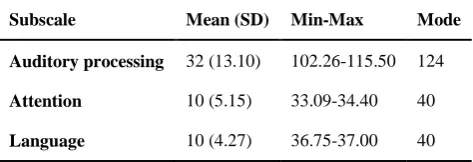
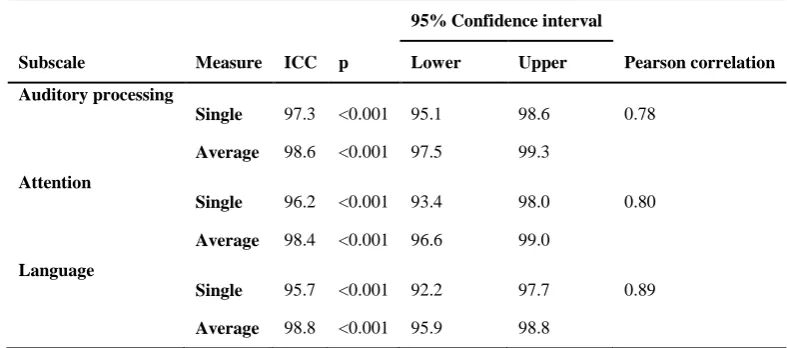
The present study was conducted on 263 parents (97 male and 166 female) of normal children aged 8-12 years (mean age: 10.2 years). Mean and standard deviations obtained after the test are provided in Table 1. Internal consistency of the questionnaire was estimated at Cronbach’s alpha of 0.92, 0.86, and 0.88 for subscales of 1-3 (auditory processing, attention, and language), respectively. Results of Pearson’s correlation coefficient between the two phases are presen-ted in Table 2, according to which the corre-lation coefficient of all the subscales was higher than 0.7. In addition, results of ICC evaluation are provided in Table 2, which indicated ICC
Table 1. Mean (standard deviation) scores of Auditory Processing Domain Questionnaire in parents with normal chidren (n=263)
Subscale Mean (SD) Min-Max Mode
Auditory processing 32 (13.10) 102.26-115.50 124
Attention 10 (5.15) 33.09-34.40 40
was high for all the three subscales.
Discussion
In the current study, the standard APDQ was translated into Persian and its reliability and validity were confirmed. In the translation pha-se, the questionnaire was at an easy level and had favorable translation quality. Face validity of the questionnaire was confirmed in two pha-ses, all the items were allocated a score of four or higher, face validity of all the items was estimated at 100%. Moreover, in content vali-dity all the items received favorable CVR coe-fficient, which demonstrated the appropriate content validity of the questionnaire in the dom-ain of auditory processing. Reliability of the Persian version consisted of three subscales, similar to the original version of the question-naire. The first subscale included items about auditory processing skills, whereas the second and third subscales were related to attention and language, respectively. Cronbach’s alpha was estimated for each study group separately to det-ermine the internal consistency of the question-nnaire. Internal consistency of the first-third subscales was estimated using Cronbach’s alpha at 0.92, 0.86, and 0.88, respectively. In other words, all the subscales of the questionnaire had acceptable internal consistency.
In a study by Brain O’Hara, who is the original
developer of APDQ, Cronbach’s alpha was applied to determine the internal consistency and reliability of the questionnaire. According to the results, Cronbach’s alpha for the sub-scales of auditory processing and language was 0.95, whereas it was 0.88 for the attention subscale, which is in line with the present study [6]. In addition, a method similar to the one applied in the current study was used to obtain the external reliability of the questionnaire. Pearson’s correlation coefficient after repeated completion of the questionnaire with a three-week interval was estimated at 0.88, which indicated the acceptable external reliability of the original version of APDQ. Our findings are in congruence with the results obtained by the original designer of the questionnaire [6].
The original version of this questionnaire was designed and standardized by Brian O’Hara. This questionnaire can be applied to determine auditory processing disorders and screen APD children aged 7-17 years in different settings. Moreover, given the fact that this questionnaire can assess the aspects of language and attention, as well, it is more preferred than other question-nnaires in this field. This was the first study on translation of APDQ into another language. This questionnaire has never been translated into another language. Given the fact that this ques-tionnaire was designed a few years ago and that
Table 2. Intraclass correlation coefficient (ICC) for Auditory Processing Domain Questionnaire test-retest with 3-7 days interval (n=30)
95% Confidence interval
Subscale Measure ICC p Lower Upper Pearson correlation
Auditory processing
Single 97.3 <0.001 95.1 98.6 0.78
Average 98.6 <0.001 97.5 99.3
Attention
Single 96.2 <0.001 93.4 98.0 0.80
Average 98.4 <0.001 96.6 99.0
Language
Single 95.7 <0.001 92.2 97.7 0.89
no other study has evaluated the translation, reliability, and validity of the questionnaire, we could not compare the final results. Moreover, this study was conducted on age group of 8-12 years and its results are only related to this age group. Therefore, further studies are required on other age groups.
Conclusion
According to the results of the present study, the Persian version of APDQ had high quality trans-lation. In addition, reliability, face validity, and content validity of the questionnaire were con-firmed. Internal consistency and reliability of the Persian version of the questionnaire were acceptable in all the performed tests.
Acknowledgements
This paper is extracted from Z. Ahmadi’s MSc. thesis in Audiology submitted in Iran University of Medical Sciences, Tehran, Iran and is con-firmed by Ethic code No. IR.IUMS.REC.1394. 9211301206. We would like to thank all the families and the developer of the original ques-tionnaire, Prof. Brian O’Hara, for their coope-ration with this study.
REFERENCES
1. Diefendorf AO. Assessment of hearing loss in children. In: Katz J, Medwetsky L, Burkard R, Hood L, editors. Handbook of clinical audiology. 6th ed. Baltimore: Lippincott Williams & Wilkins; 2009. p. 545-63. 2. American Speech-Language-Hearing Association.
(cen-tral) auditory processing disorders [Technical Report]. 2005. Available from www.asha.org/policy.
3. Bamiou DE, Musiek FE, Luxon LM. Aetiology and clinical presentations of auditory processing disorders--a review. Arch Dis Child. 2001;85(5):361-5.
4. Ebadi E, Jarollahi F, Tahaei AA, Ahadi M, Hosseini AF. Development and evaluation of the Persian version of the multiple auditory processing assessment. Aud Vest Res. 2016;25(2):75-81.
5. Wilson WJ. Screening for central auditory processing disorder. In: Musiek FE, Chermak GD, editors. Handbook of central auditory processing disorder, Volume I: auditory neuroscience and diagnosis. 2nd ed. San Diego: Plural Publishing Inc; 2014. p. 265-90. 6. Atcherson SR, Richburg CM, Zraick RI, George CM.
Readability of questionnaires assessing listening diffi-culties associated with (central) auditory processing dis-orders. Lang Speech Hear Serv Sch. 2013;44(1):48-60. 7. Yalçinkaya F, Muluk NB, Sahin S. Effects of listening
ability on speaking, writing and reading skills of chil-dren who were suspected of auditory processing diffi-culty. Int J Pediatr Otorhinolaryngol. 2009;73(8):1137-42.
8. Cacace AT, McFarland DJ. Central auditory processing disorder in school-aged children: a critical review. J Speech Lang Hear Res. 1998;41(2):355-73.
9. Martin MJ, Billiet CR, Bellis TJ. Audiologic assessment of (C)APD. In: Geffner D, Ross-Swain D, editors. Aud-itory processing disorders: assessment, management and treatment. 1st ed. San Diego: Plural Publishing; 2007. p. 479-81.
10. Dawes P, Bishop DV. Psychometric profile of children with auditory processing disorder and children with dyslexia. Arch Dis Child. 2010;95(6):432-6.
11. Iliadou V, Bamiou DE, Kaprinis S, Kandylis D, Kaprinis G. Auditory processing disorders in children suspected of learning disabilities--a need for screening? Int J Pediatr Otorhinolaryngol. 2009;73(7):1029-34.
12. Jerger J, Musiek F. Report of the consensus conference on the diagnosis of auditory processing disorders in school-aged children. J Am Acad Audiol. 2000;11(9): 467-74.