Geschke Center
Master's Theses Theses, Dissertations, Capstones and Projects
Winter 12-20-2015
Authoritarian Member States in International
Organizations
Matt Barg
University of San Francisco, [email protected]
Follow this and additional works at:https://repository.usfca.edu/thes
Part of theComparative and Foreign Law Commons,Comparative Politics Commons,Courts
Commons,Eastern European Studies Commons,International Law Commons,International
Relations Commons,Political Theory Commons, and theSoviet and Post-Soviet Studies Commons
This Thesis is brought to you for free and open access by the Theses, Dissertations, Capstones and Projects at USF Scholarship: a digital repository @ Gleeson Library | Geschke Center. It has been accepted for inclusion in Master's Theses by an authorized administrator of USF Scholarship: a digital repository @ Gleeson Library | Geschke Center. For more information, please [email protected].
Recommended Citation
International Organizations
Hungary and Romania in the European Union
Matt Barg
ABSTRACT
TABLE OF CONTENTS
INTRODUCTION ... 3
LITERATURE REVIEW ... 10
STEALTH AUTHORITARIANISM ... 10
DEMOCRATIZATION:INTERNATIONAL ORGANIZATIONS AND THE DOMESTIC STATE ... 16
INTERNALIZATION AND COMPLIANCE WITH INTERNATIONAL LAW ... 21
METHODOLOGY ... 25
AUTHORITARIAN REVERSALS IN INTERNATIONAL ORGANIZATIONS ... 27
CASE STUDY:THE FIDESZ GOVERNMENT IN HUNGARY ... 28
CASE STUDY:ROMANIA ... 61
ENFORCEMENT MECHANISMS ... 81
MEMBER STATE INTERNALIZATION OF INTERNATIONAL LAW ... 93
CONCLUSIONS ... 105
Table of Figures FIGURE 1:THE STRUCTURE OF HUNGARY’S GOVERNMENTAL BRANCHES ... 29
FIGURE 2:THE STRUCTURE OF ROMANIA’S GOVERNMENTAL BRANCHES ... 62
Table of Tables TABLE 1:STEALTH AUTHORITARIAN INDICATORS IN HUNGARY ... 32
Introduction
Hungary was the first Soviet-occupied state to slash a hole in the Iron Curtain when it opened its border with Austria in 1989. Consequently, Hungary became a bastion of
democratic hope in Central and Eastern Europe following the collapse of the Soviet Union. Since the Fidesz government gained its supermajority in Hungary’s Parliament in 2010, however, the progress made toward establishing a democracy has been dismantled. Hungary’s decline toward authoritarianism has illuminated weaknesses in the European Union’s (EU) ability to enforce its fundamental values and ensure democracy in its Member States.1
Prime Minister Orbán and the Fidesz government have maintained the illusion of democracy Hungary; all the while, they have essentially reinstated a single-party system. The Fidesz government drafted a new Constitution with almost no input from oppositional parties and the public. The new Constitution, known as the Fundamental Law, was passed without any votes from oppositional parties in Hungary’s Parliament, and the Fidesz government found a way to circumvent the constitutionally required public debate process for the Fundamental Law’s adoption. The Fidesez government has passed legislation without oppositional party influence or debate, removed political checks and balances, and redefined rule of law to suit its aspirations. This government has restructured the judiciary and
bureaucratic institutions, provided Fidesz party members with tremendous electoral advantages, and established a means of entrenching itself into institutional frameworks for the unforeseeable future.2 The media is under attack and forced to self-censor. Civil society
1 The Fidesz party lost its supermajority by one seat in February 2015 when a special election was
held in Veszprem to replace Tibor Navracsics, who became an EU commissioner.
2 Rule of law is defined as “The importance of the rule of law applies to all peoples, whether of a
offices and the homes of non-governmental organization (NGO) employees have been raided. It appears that the Fidesz government has halted Hungary’s transition to democracy for authoritarianism.
Democracy and rule of law in Romania, which borders Hungary to the east and is also a former Soviet-occupied country, have also been in jeopardy in recent years. Democratic hopes have remained far lower in Romania, in comparison to Hungary’s peaceful transition after the Soviet Union lost control over the region in the late 1980s. Romania’s transition to democracy has been tumultuous and began with the execution of its communist president, Nicolae Ceausescu. Romania’s democratic transition has been plagued by institutional corruption and political turmoil. In 2012, the political instability reached its pinnacle as Prime Minister Victor Ponta attempted to impeach his chief political opponent, President Traian Basecu. Prime Minister Ponta enacted emergency ordinances, even though there was no legitimate emergency in Romania, to remove the Constitutional Court’s review powers. Prime Minister Ponta also intended to remove key checks against his office and his majority coalition’s power in Parliament. This attempt to consolidate power through extralegal means was ultimately unsuccessful, primarily because of pressures from European Union actors. The EU has consistently had greater influence over governance in Romania when compared to Union’s role in Hungary. This is greatly due to the EU’s implementation of a
post-accession monitoring instrument in Romania—the Certification and Verification Mechanism (CVM)—that observes the Member State’s progress to correct major democratic
deficiencies. These major democratic deficiencies in Romania include corruption of public officials and the independence of the judiciary. The CVM has only been applied to the 2007
a state, so does it govern the behavior of states within the international system.” Zartner, Dana.
EU accession class, which included Romania and Bulgaria, and there is no monitoring tool for Hungary or any other EU Member States.
The central question of this thesis is under which conditions does an authoritarian Member State exist in an international organization (IO) that requires democratic governance in its treaty law? Specifically, this thesis aims to examine the discourse surrounding
international organizations and their Member States, the effectiveness of IO enforcement mechanisms, democratization, authoritarian reversals and Member State internalization of IO norms. Further, the following will analyze the consequences when Member State violates the EU’s fundamental values of democracy and rule of law, which are found Article 2 of Treaty of the European Union, as well as the EU’s ability to prevent authoritarian reversals.
Hungary and Romania will be used as case studies. Hungary and Romania’s accession into the EU required a certain level of democratic proficiency before the states could join the Union. However, each country teetered on an authoritarian reversal this decade.
society has adopted these norms and require public institutions to respect these norms as the appropriate standards of behavior. The primary objective of this thesis is not to simply point out incidents of democracy and rule of law violations but to also recognize when a Member State is systematically creating an authoritarian government. In addition, this thesis aims to determine the extent that an IO becomes involved and pressures a Member State to improve its democratic performance.
Analysis should first scrutinize domestic governance practices and key democratic institutions to determine which conditions an authoritarian Member State exists in an IO. The first hypothesis uses stealth authoritarian theory to appraise possible authoritarian Member States.3 Authoritarian reversals occur nearly exclusively in transitioning states that formerly
had authoritarian regimes. A transitioning state’s authoritarian reversal requires governments to work through and undermine the democratic institutions and practices that were crafted during its transition. Therefore, comprehensive understanding of this phenomenon requires observation of how transitioning IO Member States undermine democracy and rule of law to establish an authoritarian foothold. Stealth authoritarianism is a means of protecting and entrenching power when transparent authoritarian practices are not a viable option, which would be the case for Member States that do not wish to draw attention or hope to conceal their violations of IO treaty law requiring democratic governance.4 There are six indicators of
stealth authoritarian governance: (1) the executive branch uses constitutional order to dominate and partially control judicial and legislative branches; (2) those in power rewrite laws or uses constitutional loopholes to consolidate power into the executive branch; (3) those in power build strong formal as well as informal institutions that are filled with
party loyalists; (4) there is strong control over mass media; (5) ruling-party turnover is obstructed by election and campaign laws that provide incumbents with unfair electoral advantages over challengers; and, (6), there is a weak civil society.5 These sub-hypothesis,
however, are not independent. Rather, they are interactive and certain components of stealth authoritarianism cannot be achieved until others have been completed. Despite different means, the outcome of stealth authoritarian practices is simply authoritarianism.
The second hypothesis evaluates the role that IOs have in Member State
democratization and the effectiveness of their enforcement mechanisms. This hypothesis estimates that IOs may be able to support transitions to democracy, but they cannot prevent reversals to authoritarianism in transitioning Member States for the following reasons. First, IOs direct enforcement mechanisms found in treaty law are weak and cannot force a Member State to comply with IO rules. Also, most IOs do not have mechanisms that allow them to intervene with military force when Member States do not comply with IO law. Second, indirect enforcement mechanisms (economic and political pressures) from IOs do not promote long-term democratic consolidation and do not prevent authoritarian reversals. Finally, IOs with limited monitoring and evaluating mechanisms can fail to prevent an authoritarian reversal. In some cases, IOs are unable to initially recognize authoritarian reversals because monitoring and evaluating are either ineffective or do not exist.
The final hypothesis examines compliance and internalization of international law. An authoritarian Member States exists in an international organization when the IO’s norms have not been internalized into domestic society. Signing and ratifying treaties is only the first step to compliance with international law. It is necessary that Member States
domestically internalize international law for it to become binding.6 Yet, accession into an IO
only requires surface-level internalization of international law, and the internalization process is slow moving. This process can be disrupted or terminated in times of crisis, especially economic crises. Political leaders often have the ability derail the internalization and
acceptance of IO norm process during these crises. As a result, democratic transitions are far more likely to fail if the public does not believe democratic governance is the appropriate standard of behavior from its leaders. Both the Hungarian and Romanian citizens’ faith in democratic political leadership and democratic principles have faltered over the past decade.
The EU was created in response to World War II to promote international peace, cooperation and economic stability in the region. In 1951, six states signed the Treaty Establishing the European Coal and Steel Community. 7 The main goal of this treaty was to
create interdependence on coal and steel so that no country could mobilize its armed forces without others knowing.8 The Union progressed throughout the 20th century to create the
European Economic Community,9 established a consolidated European Commission and
Council,10 and continued to add Member States. The word ‘democracy’ was not mentioned in
any of the Union’s treaties until 1992 when the European Union was formally created.11
Article 2 of the Treaty on European Union (TEU) established democracy, rule of law, and respect for human rights and fundamental freedoms as the Union’s core values. 12 These
6 Zartner, Dana. “Internalization of International Law.” International Studies Compendium Project
(2015).
7 Belgium, France, West Germany, Italy, Luxembourg, and the Netherlands 8 http://europa.eu/eu-law/decision-making/treaties/index_en.htm
9 Treaties of Rome: EEC and EUROTOM Treaties (1957)
10 Merger Treaty (1965), also known as the Brussels Treaty, and the Single European Act (1986) 11 Koen Lenaerts, “The Principle of Democracy in the Case Law of the European Court of Justice,”
International and Comparative Law Quarterly 62:2 (2013).
12 Article 2 of the 1992 Treaty of the European Union (TEU) states “[t]he Union is founded on the
values, or norms, have unofficially been part of the Union since its beginning, but the collapse of the Soviet Union (1989-1991) likely caused the Union’s shift in focus to
democracy in the 1992 TEU and its amendment with the Treaty of Lisbon in 2007. Both of these treaties aimed to continue the advancement of democracy and rule of law in the EU.13
The fifth enlargement of the EU took place in 2004 when the Union added ten Central and Eastern Europe (CEE) states, eight of which were former Soviet satellites that operated under authoritarianism.14 Accession was offered to these newly democratic states primarily to
prevent democratic ‘backsliding’ into their former authoritarian way of governance.15
Despite membership requirements of democracy, economic stability, and human rights protections, several of these CEE Member States have democratically regressed over the past two decades. Some of these Member States have adopted undemocratic governance practices that draw similarities to authoritarianism of their communist pasts.
Given the EU backdrop, the scope of this thesis is not to define democratic
governance or the foundational freedoms listed in Article 2 of the TEU. This thesis intends analyze global governance, international law and international organization membership from within the context of certain Member States, in particular Hungary and Romania. Investigation of the current situations in both Member States is essential, but it is also necessary to examine the historic influence from the Soviet occupation and communist dictatorship (1946-1989) in order to fully understand the current state of democracy in Hungary and Romania. These case studies will offer insight into democratic transitions from
law, principles which are common to the Member States.” These principles are also found in the 5th
Recital of the TEU’s Preamble, as well as the 2007 Treaty of Lisbon, which amended the 1992 TEU.
13 http://europa.eu/eu-law/decision-making/treaties/index_en.htm.
14 Czech Republic, Estonia, Cyprus, Latvia, Lithuania, Hungary, Malta, Poland, Slovakia and
Slovenia.
15 Attila Ágh, “The Triple Crisis in Hungary: The ‘Backsliding’ of Hungarian Democracy after
communism in Central and Eastern Europe, the possibility of authoritarian reversals, EU accession process and its enforcement mechanisms, and democratic norm internalization into domestic cultures.
Literature Review
To answer the central thesis question, this thesis employs a theoretical approach that utilizes multiple perspectives to explain the conditions in which an authoritarian Member State exists in an IO that legally requires democracy from its members. The first theoretical approach used is stealth authoritarian, and it considers how a Member State constructs an authoritarian regime despite democratic requirements from the IO it belongs to. The second theoretical approach comes from the viewpoint of the IO and its enforcement mechanisms to prevent Member States from building authoritarian regimes. The final theoretical approach examines the role of the Member State’s domestic society and culture in order to evaluate what to degree the public has internalized the IO’s democratic norms and laws. These different vantage points aim to collectivity explain the conditions in which authoritarian Member States exist in IOs.
Stealth Authoritarianism and Authoritarian Governance
Following the Cold War, democracy clauses have been placed in international agreements and treaties to establish democracy as a fundamental norm for certain IOs. The democracy clauses in IO treaties also sanction regimes that abuse their authority through extra-legal means. Democracy clauses included into treaties can be found in the EU, the Organization of American States (OAS), the Council of Europe, and the African Union (AU).
16 For instance, Chapter II Article 3 of the OAS Charter states, “The solidarity of the
American States and the high aims which are sought through it require the political
organization of those States on the basis of the effective exercise of representative
democracy.”17 Also, the African Union created the African Charter on Democracy, Elections
and Governance in the early 2000s to provide specific guidelines for democratic governance. Establishing these norms within IOs has led to the elimination of many transparent authoritarian regimes.18 The decline of transparent authoritarianism, however, has resulted in
a new authoritarian practices. The growth of civil society around the globe has been a key contributor for leaders to reconsideration their means of authoritarianism, since civil society groups aims to expose undemocratic practices and human rights violations. In addition, IO treaty law that requires democratic governance has caused some Member State leaders with authoritarian objectives to employ more discrete tactics to achieve their authoritarian goals. “Stealth authoritarianism serves as a way to protect and entrench power when direct
repression is not a viable option,” which is the case for Member States that adopt
authoritarian governance practices in international organizations that require democracy.19
Some authoritarian leaders have since transformed their governance practices to play by the same rules as democratic governments.20 Stealth authoritarian regimes use democratic
institutions and practices to create an illusion of legitimacy that masks authoritarianism. These practices include rewriting constitutions, constitutional amendments, revising court structures and review powers, appointing judges without oppositional party input, providing bureaucratic or state institutions with increased powers or duties that formerly belonged to judicial or legislative branches, and empowering the executive branch to dominate legislative
17 Charter of the Organization of American States.
18 Varol, Ozan. “Stealth Authoritarianism.” Iowa Law Review 100 (2015). 19 Ibid, 1678.
20 “Stealth Authoritarianism”; Hahn, Gordon M. "Managed democracy? Building stealth
and judicial branches to rewrite or influence law.21 Stealth authoritarianism makes it
increasingly difficult for outside observers to identify and eradicate governance in
comparison to transparent authoritarian regimes, like those of Adolf Hitler, Joseph Stalin or Saddam Hussein.22 Stealth authoritarianism regimes are those that use legal mechanisms in
generally accepted democratic states for anti-democratic ends, such as elections,
constitutional amendment procedures, and judicial review powers.23 These claims have been
made in Russia, Turkey, Hungary, Azerbaijan, Algeria, Ethiopia and Romania.
This thesis tests the components of stealth authoritarianism in its case studies to evaluate the state of democracy in Hungary and Romania and to determine whether these governments are authoritarian. Stealth authoritarianism has six interrelated and interactive components: (1) constitutional order provides the executive branch the power to dominate and partially control judicial and legislative branches; (2) weak formal institutions and rule of law; (3) strong informal institutions and networks, which are filled with ruling party loyalists, that use their power to threaten and persuade opponents; (4) weak civil society; (5) subtle constitutional violations and maximum usage of loopholes in the constitutional order; (6) and, control over the mass media.24 Often, international organizations struggle to properly
diagnose stealth authoritarian governance. This is primarily because these organizations consider these components individually and independently as democratic violations rather than comprehensively appraising the interaction of these components, which produces something far worse than the violation of a single IO law. International organizations also
21 “Ibid. (BOTH Stealths above) 22 “Stealth Authoritarianism.” 23 Ibid.
24 “Stealth Authoritarianism.” Hahn, Gordon M. "Managed democracy? Building stealth
generally combat these components individually and independently. This approach often leads to IOs failure to prevent authoritarianism, because the matter is not addressed systematically.
The toolbox of stealth authoritarian regimes includes using judicial review not as a check on the political branches of government, but as a tool to consolidate power into the executive branch and remove accountability for politicians. Stealth authoritarian leaders often use libel and defamation lawsuits against dissidents, which creates self-censorship in the media. Legislators in the authoritarian faction adopt electoral laws to disenfranchise oppositional parties as well as increase the difficulty to remove incumbents. The toolbox also includes prosecuting political dissidents and opponents with non-political crimes, like tax evasion or embezzlement, using internationally-supported surveillance laws and institutions to blackmail or discredit political opponents. In addition, these leaders often enact democratic reforms and rule of law rhetoric to sculpt public perceptions and deflect attention from
undemocratic practices.25
It is necessary to define the traditional form of authoritarianism to not only
demonstrate the similarities between the two forms but to also highlight the differences. The forms of authoritarianism utilize different means; however, the undemocratic ends are
incredibly similar. Authoritarianism is traditionally defined as a “legal order in which there is little or no political pluralism and the incumbent party acts ‘via legal or extralegal means, to suppress political opposition.’”26 Corruption and abuse of state resources are widespread. It is
incredibly difficult to remove the incumbent party through elections, and regime change is
25 Ibid.
typically only possible by a transition, revolution, coupd’état, or foreign intervention.27
Traditional, or transparent, authoritarian regimes generally have a set of common mechanisms. These mechanisms include overtly defying or disregarding laws and constitutions,28 imposing emergency laws or martial law, silencing dissidents with
harassment and violence,29 closure of media outlets and banning publications,30 vote count
manipulation through vote buying, intimidation, and electoral fraud,31 packing courts and
replacing constitutions to remove checks and balances on the authoritarian government’s power.32 Traditional authoritarian governance is far more blatant and easily detected by
international organizations and the international community when compared to the subtle, more covert mechanisms utilized in stealth authoritarian regimes. Nevertheless, stealth authoritarian uses variations of these tactics with for the same authoritarian ends.
The law is a crucial tool for stealth authoritarian regimes. These regimes use law to entrench the status quo, protect their incumbents from democratic challenges, and create a dominate-party or single-party state.33 The single-party state still has oppositional parties, but
oppositional parties have almost no input in governance. These governments are able to grasp great amounts of power through legal maneuvering and often enact ‘constitutional coups,’
which “through a series of perfectly legal moves the constitutionally devious leaders can
27 Ibid.
28 Jan-Erik Lane, Constitutions and Political Theory (1996), 9-10; Miguel González Marcos,
“Comparative Law at the Service of Democracy: A Reading of Arosemena’s Constitutional Studies of the Latin American Governments,” Boston University International Law Journal 21, 259-278 (2003).
29 Steven Levitsky & Lucan A. Way, Competitive Authoritarianism: Hybrid Regimes After the Cold
War (2010).
30 Gordon Silverstein, “Singapore: The Exception That Proves the Rule” in Rule by Law: The Politics
of Courts in Authoritarian Regimes, Tom Ginsburg and Tamir Moustafa eds. (2008).
31 Andreas Schedler, The Politics of Uncertainty: Sustaining and Subverting Electoral
Authoritarianism (2013).
achieve a substantively anti-constitutional result.”34 A constitutional coup is constitutional
because there is no break in legality—the government doesn’t violate any laws to achieve its goals. It is a coup because the prior constitutional order is turned on its head without a legitimating process for the changes made.35 In worst-case scenarios, constitutional coups
transform a state from a constitutional democracy to an authoritarian regime while appearing to respect the constitution through the process.36
One of the clearest indications that a state is becoming authoritarian, regardless of whether it’s stealth or traditional authoritarianism, is the leadership’s manipulation of the electoral environment so that electoral outcomes almost always have a predetermined conclusion.37 Electoral turnover, or partisan alternation, is a core component of democracy
and allows the electoral system to respond to electoral preferences. Electoral turnover proves that incumbents can be “dethroned.”38Election and media laws give authoritarian incumbents
advantages that are supplemented by the selective application of the laws against challengers in the election. This combination provides incumbents with nearly insurmountable
advantages.39
A democratizing state’s reversal to authoritarianism requires the government to work through and undermine the democratic institutions and practices that were crafted during the democratic transition. Assessment of stealth authoritarian components can help determine whether a Member State is systematically creating a stealth authoritarian government or just
34Scheppele, Kim Lane. "Constitutional Coups and Judicial Review: How Transnational Institutions can Strengthen Peak Courts at Times of Crisis (With Special Reference to Hungary)." Transnat'l L. & Contemp. Probs. 23 (2014): 51.
35 Ibid. 36 Ibid.
37Hahn, Gordon M. "Managed democracy? Building stealth authoritarianism in St. Petersburg." DEMOKRATIZATSIYA-WASHINGTON- 12, no. 2 (2004): 195-232. 38 Ibid.
violating democracy and rule of law principles in an isolated fashion without an authoritarian objective; moreover, a government is simply violating a democratic principle but not with the intention of building an authoritarian government. At times, democratic governments violate democratic principles, like restricting freedoms and imposing laws through the executive branch without following legislative protocol after a terrorist attack. Nevertheless, this does not necessarily mean that this government is attempting to create an authoritarian regime.
Application of stealth authoritarian theory to the following case studies will help make the distinction of whether a transitioning Member State is in the process an
authoritarian reversal, or whether the Member State suffers from democratic deficiencies but is ultimately headed toward democratic consolidation. Because EU Member States are required to have a certain level of democratic progress prior to accession, this theory will provide insight to the state of democracy and authoritarianism in these Member States. This is a relatively novel theory and has not been academically critiqued. Employing this theory in the context of international organizations should provide further insights into stealth
authoritarian theory.
Democratization: International Organizations and the Domestic State
Samuel Huntington argued that democratization in the developing world is “an important—perhaps the most important—global political development of the late twentieth century.”40 Democratization has been widely studied. Much of the democratization
scholarship examines the transition from authoritarianism to democracy as one that is confined to internal national forces. The growing presence of international organizations in global and national politics has recently led scholars to consider the role of external
40 Huntington, Samuel. The Third Wave: Democratization in the Late Twentieth Century. Norman,
democratization factors, in this case international organizations. Some scholars have claimed that international actors are essential for a successful regime transformation.41 Existing
democratic countries, like the U.S. and Western European states, have made democracy promotion a foreign policy goal. International organizations have been a significant tool for achieving these ends.42 For example, the IO-democracy relationship has helped justify the
growth of the North Atlantic Treaty Organization (NATO), the EU, Council of Europe, and North American Free Trade Association (NAFTA), in which these organizations have promoted democracy by adding Member States that are transitioning to democracy from authoritarian regimes.43
Scholarly consideration of the relationship between international and domestic politics first began with the “second image reversed” theory, which observes how
international factors affect domestic structures.44 This theory surveys various international
factors, including international economic trends, military intervention, and the anarchic structure of the international system and how IOs affect domestic political structures. The factors that affect domestic political structures include electoral outcomes, regime type, domestic coalitions, and trade policies. The second image reversed theory recognizes that despite the fact that international factors may potentially have a powerful external influence over domestic regimes, the extent of these international factors influence requires some link
41 Ekiert, Grzegorz et al. “Democracy in the Post-Communist World: An Unending Quest?” Eastern
European Politics and Societies 21:7 (2007).
42 Christopher, Warren. “America’s Leadership, America’s Opportunity.” Foreign Policy 98 (1995). 43 Pevehouse, Jon C. “Democracy from the Outside-In? International Organizations and Democracy.”
International Organization 56:3 (2002).
44 The “second image reversed” theory was first introduced by Peter Gourevitch. “The Second Image
to the domestic political process.45 In response to this original theory, academic scholarship
of how international organizations affect Member States’ domestic democratization has primarily fallen into two groups: ‘democratization from above’ and the transitional-consolidation theorists.
First, democratization from above theory contends that IOs can support the
democratization of formerly undemocratic Member States.46 Jon Pevehouse argues that there
are three potential causal mechanisms that explain the effects that IOs can have on regime change. First, authoritarian regimes can be compelled to liberalize by economic and
diplomatic pressures from IOs when these pressures are paired with internal pressures, such as protests and social movements. Economic pressures from an IO can create fiscal hardships on the regime through trade suspensions and seizure of financial benefits. 47 Diplomatic
pressures can result in international isolation that further de-legitimizes the regime
domestically, and during times of crisis a regime’s international standing may be particularly important. Public and elite perception of the regime can be weakened if allies and
institutional partners treat the state as an outcast. 48 Second, IO membership can lead certain
elite groups to accept liberalization because membership lowers the risks that these groups face during democratization. There will inherently be groups of elites that will attempt to stop the liberalization process. IO membership obstructs these groups by making credible guarantees to key groups that reduce their fears of democratization. Finally, acceptance of
45 Peter Gourevitch. “The Second Image Reversed: The International Sources of Domestic Politics.”
International Organization 32:4 (1978).
46 Pevehouse, Jon C. “Democracy from the Outside-In? International Organizations and Democracy.”
International Organization 56:3 (2002).
47 Ibid.
48 Whitehead, Laurence. “Democracy by Convergence and Southern Europe: A Comparative Politics
liberalization can occur through either a hand-tying process or through the socialization of domestic elites. The socialization process involved in accession into an IO helps persuade elites to be less resistant to the liberalization process by changing their belief systems. This is done when IOs act as an external guarantor of their interests, rights and preferences, or by adjusting preferences during the socialization process.49
In opposition to democratization from above theory, the transitional-consolidation camp argues that IOs may be able to promote democracy through the means described above, but ultimately IOs cannot prevent or stop authoritarian reversals. Transitional-consolidation theorists argue that ‘democratization from above’ arguments fail to distinguish between the effects that IOs have on the temporary survival of a transitional democracy and the effects that ensure long-term democratic consolidation. Milan Svolik argues that scholarship must distinguish between ‘transitional’ and ‘consolidated’ democracies, because each one has different challenges to prevent regression to authoritarianism.50 The threat of an authoritarian
reversal is constant in transitional democracies, but authoritarian reversals are rare in consolidated democracies.51 Therefore, democratic consolidation suggests a qualitative
change has taken place that nearly eliminates the possibility of authoritarian reversion rather than mere democratic survival.52 However, it is difficult to measure whether or not a state has
49 Pevehouse, Jon C. “Democracy from the Outside-In? International Organizations and Democracy.”
International Organization 56:3 (2002).
50 Svolik, Milan. “Authoritarian Reversals and Democratic Consolidation.” American Political
Science Review 102:2 (2008).
51 Huntington, Samuel. The Third Wave: Democratization in the Late Twentieth Century. Norman,
Okla.: University of Oklahoma Press, xiii (1991); Przeworski, Adam. Democracy and the Market: Political and Economic Reform in Eastern Europe and Latin America. New York: Cambridge University Press (1991); Przeworski, Adam. “Democracy as an Equilibrium.” Public Choice 123:3-4 (2005); Svolik, Milan. “Authoritarian Reversals and Democratic Consolidation.” American Political Science Review 102:2 (2008).
52 Poast, Paul & Urpelainen, Johannes. “How International Organizations Support Democratization:
achieved democratic consolidation.53 A transitional democracy may resist an authoritarian
reversal for a sustained period of time when conditions are favorable, but it still may be at risk. The factors that enable democratic consolidation and avert authoritarian reversal include economic performance, wealth, previous military rule, political structures and a combination of these factors.54
The transitional-consolidation theory suggests that by not addressing this distinction between transitioning and consolidation that ‘democratization from above’ theorists falsely suggest that international organizations can promote consolidation as well as prevent reversals to authoritarianism.55 IOs can foster consolidation in transitional democracies by
building capacity and providing technical expertise, coordinating between public and private actors, and enhancing transparency.56 The transitional-consolidation argument claims that
IOs cannot stop authoritarian reversals in transitioning democracies, despite their ability promote democratic consolidation. This is because IOs do not have enforcement mechanisms strong enough to prevent a reversal.57 There are very few IOs have mechanisms to enforce
their policies with forceful military intervention. The economic sanctions, political pressures and internal enforcement mechanisms used against noncompliant Member States don’t carry enough weight to prevent these reversals.
53 Svolik, Milan. “Authoritarian Reversals and Democratic Consolidation.” American Political
Science Review 102:2 (2008).
54 Poast, Paul & Urpelainen, Johannes. “How International Organizations Support Democratization:
Preventing Authoritarian Reversals or Promoting Consolidation.” World Politics 67:1 (2014). 55Poast, Paul & Urpelainen, Johannes. “How International Organizations Support Democratization: Preventing Authoritarian Reversals or Promoting Consolidation.” World Politics 67:1 (2014).
56 Chayes, Abram & Chayes, Antonia Handler. The New Sovereignty: Compliance with International
Regulatory Agreements. Cambridge, Mass.: Harvard University Press (1995).
This thesis uses the second-image reversed perspective to observe the role that IOs play in national democratization process of their Member States. The ‘democratization from above’ theory provides insights to promoting democratic consolidation for Member States and the strategies utilize in the hopes of preventing authoritarian reversals. However, this thesis contends that the transitional-consolidation theory is appropriate in the case of the EU, because the EU does not have enforcement mechanisms strong enough to prevent a reversal. While it is necessary to observe the role that IOs have on Member State democratization, analysis of internalization and compliance of international law is the next step to
comprehensively study why a transitioning Member States reverts to an authoritarian regime and violates IO law.
Internalization and Compliance with International Law
Internalization of international law is defined as “the process by which nations incorporate international law concepts into domestic practice.”58 Ratification of international
treaties or acceptance of a customary international law principle technically binds a state to follow the rule, but there is widespread agreement that international law is not fully
implemented until it has been internalized domestically.59 Transitioning Member States that
have not internalized an IO’s treaty law requirements for democratic governance into their domestic institutions, or a if Member State’s domestic society has not deemed democracy and rule of law as the appropriate behavior for governance, are far less likely to reach democratic consolidation. Therefore, these Member States are more vulnerable for
58 Cleveland, Sarah. “Norm Internalization and U.S. Economic Sanctions.” Yale Journal of
International Law 26 (2001).
59 Koh, Harold. “Why Do Nations Obey International Law.” Yale Law Journal,106 (1997); Cohen,
authoritarian reversals. The “logic of appropriateness” declares that actors, both elites working in government and individual citizens, are required to have a binding sense of obligation to law before it becomes accepted as the appropriate standard of behavior.60 The
logic of appropriateness leads to the creation of international norms, which is defined as “a standard of appropriate behavior for actors with a given identity.” 61 International relations
scholarship defines international norms as, “shared understandings of standards of
behavior,”62 which “guide human behavior,”63 that “indicate how a state should behave.”64
The most widely accepted theory of norm development and emergence in international legal studies scholarship is the emergence through a norm entrepreneur.65
When a new concept becomes an international norm, it typically starts with a norm entrepreneur, which is a person, group of people, institution or a state that has strong notions about the appropriate or desirable behavior in their community.66 After the norm emerges and
is advocated by the entrepreneur, decision-makers increasingly recognize the norm until it reaches a tipping point where the norm attains recognition. Next, there is a torrent of recognition and acceptance of the norm by the general population. Ultimately, the norm becomes widely accepted and ingrained into a society to the point where it becomes the
60 March, James & Olsen, Johan. “The Institutional Dynamics of International Political Orders.”
International Organization 52:4 (1998).
61 Finnemore, Martha & Sikkink, Kathryn. “International Norm Dynamics and Political Change.”
International Organization 52, 891 (1998).
62 Klotz, Audie, J. Norms in International Relations: The Struggle Against Apartheid. Ithaca: Cornell
University, 14 (1995)
63 Jensen, Lloyd. and Miller, Lynn, H. Global Challenge: Change and Continuity in World Politics.
Fort Worth: Harcourt Brace, 96 (1997).
64 Barnett, Michael. “The United Nations and Global Security: The Norm is Mightier than the
Sword.” Ethics and International Affairs 9, 38 (1995)
65 Finnemore, Martha and Sikkink, Kathryn. “International Norm Dynamics and Political Change.”
International Organization 52 (1998).
standard of appropriate behavior.67 However, the sociological perspective of international
norms provides a more encompassing definition in which international norms are established through institutions; that is, international norms are “a relatively stable collection of practices and rules defining appropriate behavior for specific groups of actors in specific situations.”68
Regardless, international law and international norms are so tightly linked that the two terms can be used interchangeably.69 Since the sociological prospective advances the international
relations definition, this thesis combines these two terms for its definition of international norms.
Understanding how states internalize international law is essential to understanding the role of international law within a specific state. In order to fill the void for weak or
nonexistent enforcement capabilities, international law needs to be internalized into the fabric of domestic law to make the international legal rules punishable by domestic legal
mechanisms.70 Domestic populations cannot perceive international laws as appropriate, and
therefore binding, until the international laws have been embedded and accepted into the domestic legal culture and institutions, which comprise a state’s legal tradition. 71 Cultural
attributes of legal tradition include purpose of law, origins of law, and concern about reputation as a law abider. Institutional attributes include separation of powers and strength
67 Ibid.
68 March, James & Olsen, Johan. “The Institutional Dynamics of International Political Orders.”
International Organization 52:4, 948 (1998).
69 Keohane, Robert. After Hegemony: Cooperation and Discord in the World Political Economy.
Princeton: Princeton University Press (1984).
70 Zartner, Dana. Courts, Codes, and Custom: Legal Tradition and State Policy Toward International
of the judiciary, hierarchy of law, and monist versus dualist position.72 A state’s legal
tradition can provide great insight to compliance with international law and internalization of IO norms.
A democratizing state’s legal tradition has often changed dramatically as the state transitions between regime-types. Democratizing states typically have to completely rebuild their legal institutions and governance structures in the process, which includes transforming their institutional attributes mentioned above. The cultural attributes need to follow these institutional modifications in order for democratic and rule of law principles to be
comprehensively internalized. Crises can impede internalization of democratic norms institutionally and culturally. Commonly, economic crises obstruct internalization of democratic norms, but even accession into an IO can create a crisis capable of blocking internalization.
This thesis uses internalization, norm adoption and legal tradition theory in its case studies to explain why a Member State violates EU laws, norms, and potentially implements authoritarian practices. Hungary and Romania had to completely reconfigure their legal tradition not only during the democratization process but to also align with EU norms. In addition, this theoretical approach considers the effects the 2008 global economic crisis had on the internalization process. Both of these countries had only just become Member States prior to the global economic crisis in 2008. Their legal traditions had not fully adopted democracy and EU norms. The economic crisis partially influenced each country’s domestic society to lose of faith in democracy and the EU as effective governance structures.
72 Organization of Cultural and Institutional Attributes are taken from Zartner, Dana. Courts, Codes,
Therefore, domestic societies did not require their leaders to fully comply with democratic principles.
Methodology
This thesis takes a comparative legal studies approach. The principal research methodology employed below is content analysis of primary and secondary sources. The primary sources used in this research are European Union treaties, the Hungarian
Fundamental Law and legislation, the Romanian Fundamental Law and legislation,
Constitutional Court decisions in both countries, civil society reports, studies and research projects conducted at Central European University’s Center for Media, Data and Society, and reports by European institutions.
The primary research relied greatly on the Council of Europe’s European
Commission for Democracy Through Law (Venice Commission). Even though the Venice Commission is not an EU institution, this Commission provides comprehensive legal opinions examining laws and institutional structures for potential violations of democratic principles and European norms. The Organization for Security and Co-operation in Europe (OSCE) and the studies conducted by its Office for Democratic Institutions and Human Rights provided data and analysis for electoral fairness and national relevant electoral laws. Reports prepared by Amnesty International provided information regarding civil society and NGOs. Secondary sources include scholarly journal articles and books that examine
Curiosity into governance in Hungary initially began after a proposed Internet tax failed to be enacted after thousands of protesters gathered in its opposition in Budapest. I intended to research the Fidesz government’s policies for Internet governance but quickly realized that Hungary had a much larger, systemic issue with its government. I spent the summer of 2015 in Budapest at Central European University’s Center for Media, Data and Society as an intern and a research fellow. General assessment and assumptions about the state of Hungary and the region’s national governments have been formulated through my work with Central-Eastern European scholars, lawyers at the Hungarian Civil Liberties Union, and observations through personal experiences during my time spent in Hungary. I also led discussion groups at CEU’s summer course in Advanced Topics of Internet Governance, Civil Society and Policy Advocacy with regional freedom of expression and media experts to learn about global attitudes towards Hungary’s governance and media policies.
This thesis then researched Romania to provide context for the Hungarian
Member State Authoritarian Reversals
International organizations that value democracy as a key tenet of the organization typically require that Member States meet minimum standards of democracy before
accession. IO membership is often one of the reasons that prompt a former authoritarian state to democratize. A democratizing state’s reversal to authoritarian requires the government and its actors in the reversal to work through and undermine the democratic institutions and practices that were crafted during the democratic transition. In order to assess whether a Member State is systematically and overtly creating an authoritarian government or just violating democracy and rule of law principles without an authoritarian objective, this section uses stealth authoritarian theory to make this determination through case studies. To measure stealth authoritarianism, case studies analyze its six components. Democratizing Member States are more likely to move toward authoritarianism when the following forces are present: (1) the executive branch uses constitutional order to dominate and partially control judicial and legislative branches; (2) the regime rewrites law or uses constitutional loopholes to consolidate power into the executive branch; (3) the regime builds strong formal as well as informal institutions that are filled with ruling-party loyalists; (4) the regime has strong control over mass media; (5) ruling-party turnover is obstructed by election and campaign laws that provide incumbents with unfair electoral advantages over challengers; and, (6), there is a weak civil society. These sub-hypothesis, however, are not independent. Rather, they are interactive and certain components cannot be achieved if others are not present.
This section employs these six stealth authoritarian hypotheses on both the current situations in Hungary and Romania to determine whether they have engaged stealth
analyze the EU’s enforcement mechanisms and response to undemocratic practices in these case studies. Finally, the internalization of international law section will explore why these case studies have not complied with the EU’s democratic norms and laws in certain scenarios and the effect that crises have had on the democratization and the norm internalization
process.
Case Study: The Fidesz Government in Hungary
In Hungary’s 2010 election, the Fidesz party and its coalition with the Christian Democratic People’s Party (KDNP) won more than two-thirds of seats in Parliament, after they won nearly 53 percent of the popular vote.73 Despite the authoritarian practices of the
Fidesz government after winning its supermajority, this was a free and fair election. Due to disproportionate electoral laws, 53 percent of the popular vote translated into 68 percent of Parliamentary seats. 74 In a proportionate electoral system the percentage of votes won for a
particular party equals the percentage of seats won in Parliament. However, Hungary’s disproportionate electoral system is weighted and provides extra seats, which is how 53 percent of the popular vote translated into 68 percent of the seats in Parliament. The
disproportionate election system was created as Hungary was transitioning into democracy in 1989. Leaders in the transition created this disproportionate electoral system in order to promote pluralism in Parliament, prevent the communists from regaining control, and to provide smaller parties with more seats. In 2010, this system backfired for proponents of democracy. The Fidesz party has been able to grab a tremendous amount of power and pass legislation without debate or votes from other parties in Parliament.
73 KNDP is officially a coalition partner with Fidesz, however, the party has been unable to get into
Parliament on its own and break the election threshold of 5 percent since it barely did so in 1994. KDNP has nearly no influence over the Fidesz agenda, and the coalition was primarily created so the Fidez government could win enough votes to win a supermajority.
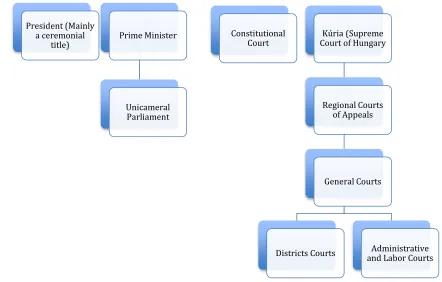
The Fidesz party was able to quickly grab power partially because of Hungary’s weak separations between its branches of government. As portrayed in Figure 1 below, Hungary has a unicameral Parliament. There are limited checks built in the Hungary’s government structure. There is no real separation between legislative branch and the Prime Minister, because the majority party in Parliament selects the Prime Minister. Also, the majority party selects the President. There are incredibly weak separations between legislative and
executive branches. Therefore, a strong and independent Constitutional Court in Hungary is an essential check against other political branches. The Constitutional Court is the only formal check against the legislative and executive branch. The leaders of the democratic transition understood this and knew the importance adding checks to its democratizing government.
Figure 1: The Structure of Hungary’s Governmental Branches
President (Mainly a ceremonial
title) Prime Minister
Unicameral Parliament
Constitutional
Court Court of HungaryKúria (Supreme
Regional Courts of Appeals
General Courts
Hungary held its first free and fair elections for the first time in over four decades in 1990. As Hungary was transitioning into democracy in 1989, the leaders of the transition heavily amended the 1949 Stalinist-era constitution (Act XX of 1949) at roundtable
meetings. 75 The amendments to Act XX of 1949 created a constitution that met the standards
of a modern, democratic constitution that protected human rights and fundamental
freedoms.76 The roundtable meetings, which were comprised of oppositional parties and the
communists who had just lost their 40-year grip in the country, were concerned with two hazards to Hungary’s transition to a multiparty democracy: a fractured parliament where small parties were unable to form stable coalitions, which was addressed by the
disproportionate electoral system, and a deeply entrenched constitution that would be too difficult to change once the new democratic leaders gauged how they wanted to design their political institutions.77 The amendments, also known as the 1989 Constitution due to such
vast changes to the previous Constitution, established an amendment process that required a two-thirds majority vote to amend the Constitution. This created an amendment threshold that was attainable and not excessively demanding that the Constitution could not be amended as democratic leaders began to recognize what Hungary needed to democratize. 78
The leaders of the transitions also made structural adjustments to bolster democratic governance.
75 At the time the country was known as the Republic of Hungary, which was later changed to
Hungary by the Fundamental Law that was enacted in Jan. 1, 2012.
76 Kis, János. “From the 1989 Constitution to the 2011 Fundamental Law.” Constitution for a
Disunited Nation: on Hungary’s 2011 Fundamental Law” ed. Tóth, Gábor A. Budapest-New York: Central European University Press (2012).
77 Bánkuti, Miklós et al. “Disabling the Constitution.” Journal of Democracy 23:3 (2012).
78 There was no break in legality from Act XX of 1949, and “the 1989 Constitution” is the amended
The 1989 Constitution established a judicial check against the other branches when it created the Constitutional Court. The Constitutional Court was constructed to be independent and have wide powers of judicial review to check the powers of the executive and legislative branches. The 1989 Constitution established actio popularis to bring matters before the Constitutional Court. Actio popularis allows anyone to bring a case before the Court, not just those affected by the law, to review laws for constitutionality. As a result, nearly every important law was challenged before for the Court. Indeed, the Constitutional Court became the highest respected political institution in Hungary in the early stages of the transition.79
In addition to the Constitutional Court, the 1989 Constitution made additional checks against Hungary’s unicameral parliamentary system. It established the public consultation process, which changed Parliamentary procedure to require extensive consultation with civil society and opposition parties before bills can be put to a vote. Four ombudsmen were also added to monitor Parliament and ensure that human rights were protected. Further, the amendments created politically independent bureaucratic institutions: the central bank, state audit office, prosecutor general’s office, national election commission and the media board. Up until the Fidesz government’s victory in 2010, Hungary’s transition to democracy had been relatively successful in comparison to other democratizing states in Eastern Europe. Scholarship prior to 2010 generally applauded Hungary’s democratic advancements and found the country to be a beacon of democratic hope for the former Soviet-controlled states.
Despite these democratic advancements, nearly all of these checks have been
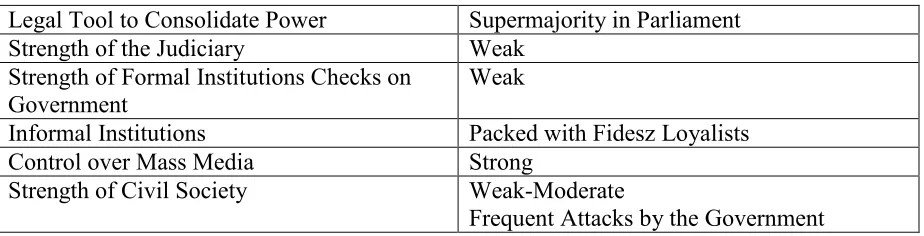
eliminated once the Fidesz Party took power in 2010. Table 1 summarizes the components of stealth authoritarian in Hungary and the current state of these components. Hungary’s
79 See generally Örkény, Antal & Scheppele, Kim Lane. “Rules of Law: The Complexity of Legality
Parliament has become a political tool of Prime Minister Orbán’s office. There is essentially no separation between Parliament and the executive branch because of the majority party’s power to choose the Prime Minister and the primarily ceremonial President of Hungary. Due to limited institutional separation and coordination between the Prime Minister’s Office, Parliament and the Presidency, reference of these institutions will be consolidated into ‘the government’ throughout this thesis. The government’s leader is Prime Minister Victor Orbán. This case study investigates each of the components of stealth authoritarian on the Fidesz government since it gained power in 2010.
Table 1: Stealth Authoritarian Indicators in Hungary
Legal Tool to Consolidate Power Supermajority in Parliament Strength of the Judiciary Weak
Strength of Formal Institutions Checks on Government
Weak
Informal Institutions Packed with Fidesz Loyalists Control over Mass Media Strong
Strength of Civil Society Weak-Moderate
Frequent Attacks by the Government
Use of Law and Constitutional Loopholes for Executive Branch Consolidation
amendment required oppositional party input and cooperation in the drafting process. The new rule essentially required a “super” supermajority for writing a new constitution.80
After the Fidesz government easily amended the four-fifths rule with its
supermajority, it began to write a new Constitution. The drafting process took place from October 2010 to April 2011 and consisted of two disconnected stages: an inconsequential public stage (stage 1) and a consequential secret stage (stage 2).81 In October 2011, a
constitutional commission, called the Salamon Commission after its chair László Salamon and comprised of members of Parliament (MPs), was given the task of to create a list of principles for the new Constitution.82 The meetings were open and civil society groups were
able to provide their opinions. The list of principles, however, did not reflect any of the opinions or proposals made by civil society or the ‘democratic opposition’ parties in Parliament—the Socialist MszP party and the new Green LMP party.83 The democratic
opposition parties left the Salamon Commission when none of their proposals were accepted. Nevertheless, the Fidesz bloc approved the Commission’s constitutional principles on March 7, 2011, with a Parliamentary resolution.84
In stage 2, which also began on March 7, 2011, the approved resolution stated that members of Parliament (MPs) had one week to propose a complete draft of the new
80 Scheppele, Kim Lane. “Constitutional Coups and Judicial Review: How Transnational Institutions
Can Strengthen Peak Courts at Times of Crisis (with Special Reference to Hungary.” Transnational Law & Contemporary Problems 23 (2014).
81 Scheppele, Kim Lane. “Constitutional Coups and Judicial Review: How Transnational Institutions
Can Strengthen Peak Courts at Times of Crisis (with Special Reference to Hungary.” Transnational Law & Contemporary Problems 23 (2014).
82 László Salamon would later be elected as a judge to the Constitutional Court.
83 In 2010, MszP was the largest opposition (15 percent of seats) party to Fidesz and LMP was the
third and smallest opposition party (4 percent of seats). The second opposition party was Jobbik (12 percent of seats). Since MszP and LMP do not wish to be associated with the far-right Jobbik party, they call themselves the “democratic opposition.” The number of seats mandated to each party changed after the 2014 election.
constitution due to the national holiday commemorating the 1848 Revolution that takes place on March 15th each year. The resolution also stated that the proposed Constitution could be
written with or without taking the draft principles into account. The first stage of the drafting process was disconnected from the second, and the drafts were written in secrecy. It is rumored that the Constitution’s lead author, József Szájer, wrote much of it on his iPad.85
Szájer at the time was not even a member of Hungarian Parliament. Nevertheless, Szájer is a member of the party’s inner circle and a Fidesz member to the European Parliament. There is no official record of who was involved in the drafting process, consultation, opinions
engaged, or how the final draft was created, despite many Fidesz MPs claiming credit for being part of the process.
The draft of the Constitution came out on March 14, 2011, and was introduced into Parliament as a private member’s bill by Péter Ágh from the Fidesz party and András Andradszki from the Christian Democratic party. A private member’s bill in Hungarian Parliament bypasses steps normally required by government bills. Government bills typically require impact assessment as well as consultation from relevant agencies that must enforce the law and civil society groups that would be affected by the law. Because the impact assessment and consultation were not required, they were of course not performed by Parliament. Regardless, the Fidesz bloc insists that the public was involved in the
consultation process since they sent out questionnaires to registered voters in late February and early March 2011. However, the questionnaire did not address any substantive questions about constitutional design and were sent out right before the constitutional draft appeared, which meant that the questionnaires could not be collected and assessed in time to affect the
85 Zoltan, Simon. “Hungary First to Write a Constitution on IPad, Lawmaker Says.” Bloomberg. Mar.
draft. On April 18, 2011, the Fidesz bloc in Parliament passed the new Constitution (the Fundamental Law) without a single vote from opposition parties. The Socialist MszP and new Green LMP parties abstained from voting as a form of protest, but votes from these parties would have been inconsequential due to the Fidesz supermajority. During the drafting process and prior to adoption, thousands of protesters demonstrated in Budapest to voice their disapproval and hope to persuade the government not to adopt the new Constitution. Protesters were concerned with the government overextending its power, limitations on freedoms, and forcing Christian ideology onto citizens. Nevertheless, the voices of those who opposed the Fundamental Law were not powerless to prevent its adoption.
The Fidesz government has successfully achieved a key element of stealth
authoritarianism. The government first used its supermajority to amend the rules for drafting a new Constitution. Several procedural rules were bypassed, like public consultation and impact assessment. Next, the Fidesz government was able to write the Fundamental Law without any input in drafting the document from oppositional parties, without a legitimate debate Parliament, and without a single vote from opposing parties. Now that the Fidesz government has created its constitutional order, the government begins to dismantle formal checks against its centralized power.
Dismantling the Judiciary and Formal Checks Against the Executive Branch
The leaders of the 1989 democratic transition recognized that the unicameral
Constitutional Court’s strength and independence would essentially eliminate all the formal checks against the Fidesz government. It is necessary to examine a series of legal battles between the Constitutional Court and the Fidesz government—along with uncontested legislation—to realize certain interactive components of stealth authoritarianism: consolidation of power for executive branch through constitutional order, weak formal institutions and rule of law, and subtle constitutional violations and maximum usage of constitutional loopholes.
The initial step to weaken the strength and independence of the Constitutional Courts was packing the Court with judges selected by the Fidesz government. First, the procedure for electing Constitutional Court judges was amended so that a single two-thirds
Parliamentary vote can place a judge in the Court. Prior to the amendment, multiparty
agreement was necessary for nominating a judge to the Court.86 Next, the Fidesz government
increased the number of judges on the Court from 11 to 15, which allowed the government to pack the Court with judges of its choice. The Parliament also gave itself the authority to elect the Constitution Court’s president. This was previously the task of the Court’s judges to elect its president. These three acts occurred in the Fidesz government’s first year in power. Each placement of the new judges into the Court was done so without any opposition party influence. The Fidesz government selected nine out the fifteen judges in its first three years. Currently, only three sitting judges were appointed to the Court prior to 2010. As expected, the new judges in the Court have voted in unison with the Fidesz government’s position in
86 The original amendment was to the 1989 Constitution, but this rule also became a part of the
each case heard by the Court, with only a few exceptions.87 Only Justice István Stumpf has
gone against party lines more than once even though he is a member of the Fidesz party. He has been ridiculed as a disloyal and traitorous party member.88
As the Court was in the process of being packed with Fidesz loyalists, it fought back against the government on a number of occasions. The first battle between the Fidesz government and the Constitutional Court was over a 98 percent retroactive tax against the severance payments paid to all state officials who left their posts after Jan. 1, 2010. It is likely that this tax was aimed at the officials from the previous government who were leaving office to make room for the new Fidesz appointees. The Court found this law to be
unconstitutional on the grounds that it violated the Constitution’s prohibition of ex post facto
laws and the size of the tax was confiscatory.89 In retaliation, the government passed two
constitutional amendments. The first amendment restricted the jurisdiction of the Court so it could generally no longer review any law that impacts fiscal or tax policy.90 The second
reenacted the retroactive tax, extending the tax back five years. After the new retroactive severance tax went into effect, it was challenged before the Court again. The Court heard the case, despite the constitutional amendment that restricted its jurisdiction, and struck down the tax again.91 The Court bypassed its constitutional jurisdiction by claiming the tax violated
87 Scheppele, Kim Lane. “Constitutional Coups and Judicial Review: How Transnational Institutions
Can Strengthen Peak Courts at Times of Crisis (with Special Reference to Hungary.” Transnational Law & Contemporary Problems 23 (2014).
88 See Hajnalka, Joó. “Aki a Fidesz árulója let” (Fidesz who became a traitor), Origo.hu, Mar. 26,
2013 http://www.origo.hu/itthon/20130325-stumpf-istvan-alkotmanybiro-es-a-fidesz-viszonya-portre.html.
89 See Alkotmánybíróság (AB) [Constitutional Court] Oct. 28, 2010, MK.184/2010 (Hung.). 90 The Constitutional amendment allowed the Court to only review fiscal or tax policy cases that
infringe on the right to life and human dignity, the right to the protection of personal data, freedom of thought, conscience and religion, and Hungarian citizenship rights. However, it is unlikely that tax and fiscal policy will affect any of these rights listed.