81
Copyright © 2018. IJEMR. All Rights Reserved.
Volume-8, Issue-4, August 2018
International Journal of Engineering and Management Research
Page Number: 81-86
DOI:
doi.org/10.31033/ijemr.8.4.10
Role of Public Distribution System in Andhra Pradesh an Analysis
Vanguru. Naga Satyanarayana1 and Dr. M. Rajasekhara Babu2
1Research Scholar, Department of Economics, Acharya Nagarjuna University, Guntur, INDIA
2Retired Principal, VTJM & IVTR Degree College, Mangalagiri, INDIA
1
Corresponding Author: [email protected]
ABSTRACT
Public Distribution System in India has been one of the most crucial elements in food policy and food security system in the country. Public Distribution System in has close links with food security for the vulnerable segment of population. It is so because Public Distribution System is considered as a principal instrument in the hands of the government for providing safety net to the poor and the downtrodden. Public Distribution System is the largest distribution network of its kind in the world. It emerged out as rationing measure in the backdrop of Bengal famine as well as a war-time measure during Second World War.
The Government of India in an effort to ensure fair supply of food items to all citizens of India instituted Fair Price Shops (FPS) under Public Distribution System (PDS). Essential commodities such as Rice, Wheat, Sugar, Kerosene, etc., are supplied to the targeted underprivileged sections as per the eligibility and at fixed by the Government of India. In spite of the best efforts by Government officials at various levels, there are a few bottlenecks and inconveniences to the targeted citizens in availing the services provided. Over the years, Public Distribution System has expanded enormously as poverty alleviation and food security measure to become a permanent feature of Indian Economy.
The Andhra Pradesh state incorporated various modifications from time to time to make its implementation more relevant for the masses and to increase its effectiveness. This paper analyzes that whether Public Distribution System is able to achieve its objective of providing food security to the people. The present paper discusses a brief review of welfare schemes and also makes a study of existing Public Distribution System in Andhra Pradesh. An attempt has been made in this study to ascertain the problems prevailing in Public Distribution System and to recommend suggestions to make Public Distribution System is more effective.
Keywords--- Food Security, Fair Price Shops (FPS), Public Distribution System (PDS), Rationing
I.
INTRODUCTION
Andhra Pradesh is one of the states pursuing a vigorous Public Distribution policy. Among the states, Public Distribution Systems that have tried Public Distribution Systems to cover rural areas are Kerala, Tamil Nadu and Andhra Pradesh. Of these states, Kerala is always deficit, while Tamil Nadu is marginally deficit in years due a bad rainfall. While Andhra Pradesh on the other hand, is a surplus state, encompassing large surplus as well as deficit tracts within its area. It is the government's primary duty to look that all its people should live with maximum quality. The Public Distribution System initially visualizes in terms of checking inflation and protecting vulnerable section from the vagaries of the market mechanism. PDS is an organizational asset of considerable significance improving the nutritional status of poorer groups touching the one of the antipoverty programmes, PDS has a direct bearing on their success. The concept of minimum needs coupled with enlarging scope of PDS, serves to underline its dynamic character: As we move from the regions of primary poverty to a happier position, the system can be used to concretize the quest for "quality of life" as it may be defined from time to time in politico-administrative terms.
II.
REVIEW OF LITERATURE
1
Dr. K.K. Tripathy and K.C. Mishra (2011)
estimated that though India is one of the largest producers of the food in the world, yet nearly 300 million people struggle for meeting two square meals a day and 21 percent of the national population (230 million) are malnourished. This indicates the issues of accessibility to adequate and nutritive food to the poor.
2According to Dev. (2007) poverty declined
82
Copyright © 2018. IJEMR. All Rights Reserved.
distribution system function, while that of growth rate of staple food grain prices remain low and inflation is also low. These are the things attributed to reduction of poverty in Andhra Pradesh. On one hand some policy measures to improve agriculture growth, macro policy on industrial and rural non-farm sectors in the post period had adverse impact on poverty reduction. On the other hand, it is believed that, it is due to social welfare programmes, such as focus on providing food and nutritional security, PDS and ICDS which helped in poverty reduction.
3Sharma (2007) observed that the lower quality of
PDS wheat is evidenced of inefficiencies in the operation of the public sector. The appearance of quality differential at the retail outlet is due to inefficiencies in the marketing chain, such as bad purchase decision, lack of care in storage and handling and indifferent service at the ration shops. Another disturbing feature of PDS in India is the ground reality that a large portion of the subsidized food grains and other essential commodities meant for distribution do not reach the beneficiaries and find their way to the market. The difference between the open market price and subsidized prices of these commodities under PDS determine the attraction of the leakages. If calculation is made between the figures of stocks lifted and actually sold to the consumers, there shall be a discrepancy, which could be said to be equal to leakages in the system. It is estimated that a little over one-third of the food grains, supplied to PDS do not reach the actual users of the PDS- it leaks out of the programme. While some part of these may be genuine losses incurred in storage and transport, a major part is diverted to open market.
4
Yesudian (2007) suggested to improve the quality of PDS products are proper grading and standardization of ration commodities must be ensured so that quality services can be provided to consumers, minimize the presence of sand and pebbles in flour and rice, packed and labeled products should be provided to consumers, dealer must be provided with sufficient infrastructure facilities so that they can provide better quality services to consumers, periodical inspection of records maintained by FPS dealers must be conducted by the competent authorities and those who violate rules and regulations must be penalized and debarred from continuing as a FPS dealers.
III.
OBJECTIVES
The following objectives for study are given below.
1. To make a study of existing Public Distribution System in Andhra Pradesh.
2. To observe the role of Public Distribution System for ensuring food security in AP.
3. To examine the brief review of welfare programmes introduced in Andhra Pradesh.
4. To find out the drawbacks in the system and make suggestions to PDS more effective.
IV.
METHODOLOGY
This study has been conducted on the basis of secondary data. The secondary data has been compiled from the Planning Commission, various journals, books, internet sources and other published papers etc.
V.
PUBLIC DISTRIBUTION SYSTEM
IN ANDHRA PRADESH
India’s public distribution system (PDS) is
perhaps the largest of its kind anywhere in the World. The Public distribution system is among the most important food security programmes of government of India. In fact, the PDS in the country to facilitates the supply of food grains to the poor at a subsidized price. The targeted public distribution system was introduced in the state of Andhra Pradesh and elsewhere in the country in 1997 with a view to eliminate hunger. The PDS supplies essential commodities like rice, kerosene, sugar, palmolein oil, wheat to the poor at subsidized prices. The Telugu Desam was introduced cheap rice at Rs.2 per Kg in the state. The fair price shops are the major outlets under public distribution system. The number of fair price shops are functioning in the state are shown in table-1.
Table: 1 Fair Price Shops in AP as on 1st August 2017 Sr.
No. District Name
No. of FPS
Total No. of FPS Dealers
1 Srikakulam 2079 2000
2 Vijayanagaram 1400 1283
3 Visakhapatnam
Rural
1612 1572
4 Visakhapatnam
Urban
493 487
5 East Godavari 2698 2507
6 West Godavari 22002 2141
7 Krishna 2212 2112
8 Guntur 2725 2514
9 Prakasam 2141 1661
10 Nellore 1896 1792
11 Chittoor 2852 2550
12 Cuddapah 1737 1330
13 Anantapur 2970 2787
14 Kurnool 2414 2208
Total 29431 26950
83
Copyright © 2018. IJEMR. All Rights Reserved.
Table -1 show that district wise number of total fair price shops and fair price shops dealers. Table -1 reveals the fact that total number of fair price shops and fair price shops dealers has been increasing in few districts. The total number of fair price shops and fair price shops dealers in AP are 29,431 and 26,950 respectively in 2017. Among the districts, West Godavari having highest number of fair price shops which accounts for 22,002, Anantapur with 2,970 followed by Chittoor with 2,852 fair price shops. Lowest number of fair price shops found in Visakhapatnam Urban with 493, Vijayanagaram with 1400 followed by Visakhapatnam Rural with 1,612.
Among the districts Anantapur, Guntur and East Godavari districts stood in first three places with regard to fair price shop dealers with 2,787, 2,514 and 2,507 respectively. Visakhapatnam Urban, Vijayanagaram and Cuddapah having lowest number of fair price shop dealers with 487, 1,283 and 1,330 respectively in 2017.
VI.
RATIONALIZATION FAIR PRICE
SHOPS
Rationalization of existing F.P. Shops has been
done to ensure effective functioning of PDS, and enable card holders have easy access to fair price shops without having to travellong distances.
Rural areas: 400 to 450 BPL and 50 Pink ration
cards are attached to eachF.P. shop in rural area.
Urban Areas: 500 to 550 BPL and 250 Pink
ration cards are attached to each F.P. shop in urban areas.
Municipal Corporations: 600 to 650 BPL and
250 Pink ration cards are attached to each F.P. shop in Municipal Corporations.
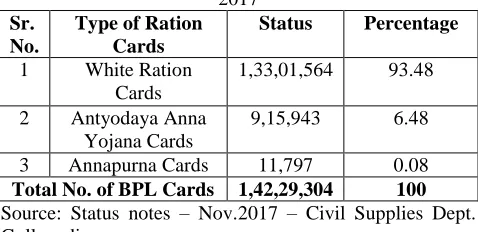
The following are the number of category wise ration cards for which allotment issued in November, 2017 are shown in table -2
Table :2 Category wise Ration Cards as on November 2017
Sr. No.
Type of Ration Cards
Status Percentage
1 White Ration
Cards
1,33,01,564 93.48
2 Antyodaya Anna
Yojana Cards
9,15,943 6.48
3 Annapurna Cards 11,797 0.08
Total No. of BPL Cards 1,42,29,304 100
Source: Status notes – Nov.2017 – Civil Supplies Dept. Gollapudi
Table-2 show that category wise ration cards as on November 2017. The total number of BPL cards in AP was 1, 42, 29,304. Out of which 1, 33, 01,564 are white
ration cards which is nearly 93.48 percent. Antyodaya Anna Yojana cards are 9, 15,943 which accounts for 6.43 percent and 11,797 are Annapurna cards which is 0.08 percent of the total number of BPL cards.
VII.
ROLE OF PUBLIC DISTRIBUTION
SYSTEM AND FOOD SECURITY
It is now well recognized fact that the availability
of food grains is not a sufficient condition to ensure food security to the poor but the necessary condition is that the poor should have sufficient means to purchase food. Hence, PDS subsidized food grain supply to poor, is very important in providing food security. In this context, we want to see how far functioning of PDS is effective, in providing food security to poor household.
Through PDS, food grains such as rice and wheat are supplied at a subsidized price; on an average each household will be receiving 25 kgs of rice. Present section analyses access to PDS in the state of Andhra Pradesh, which is one of the main interventions of state to ensure food security with subsidized lending to poor sections of the society.
The center allocates food grains to states on the basis of the identified BPL population, the availability of food grains stocks, and the quantity of food grains lifted by states for distribution under TPDS. Table -3 indicates the statement showing procurement of paddy, allotment and distribution of rice under public distribution system.
Table-3 Statement showing Procurement of Paddy, Allotment and Distribution of Rice under PDS
Year Procurement
of Paddy (in MTs)
Allotment (in MTs)
Total quantity of
Rice Distributed
(in MTs)
2012 -13 68,87,998 39,50,734 39,22,274
2013 -14 76,90,267 40,58,447 39,41,548
2014 -15
94,78,969
10,20,068 10,12,901
(Up to June 2014)
17,52,818 16,35,221
(From July, 2014 onwards)
2015 -16 64,71,447 25,50,857 23,67,419
2016 -17 55,57,778 26,55,183 22,69,426
Source: Civil Supplies Dept. AP – Gollapudi
84
Copyright © 2018. IJEMR. All Rights Reserved.
much higher due to larger production and sharp increase in the procurement prices. During 2016 -17 the procurement of paddy was decreased by 55, 57,778 MT as against 64, 71,447 MT in 2015 -16.
The allotment and distribution of rice under different schemes – BPL, AAY, Annapurna in all the three schemes the total allotment was quite less from 2012 -13 to 2014 -15 since the distribution was meant for all 23 districts of combined AP. The total quantity of rice distributed among all the 23 districts of combined AP are more or less same from 2012 -13 to 2014 -15 with minor variations. Similarly, from 2014 -17 the allotment of rice was higher than the distribution in 13 districts of AP. From the above analysis we can say that the PDS in AP not that effective with regard to distribution to ensure distributional equity.
VIII.
WELFARE SCHEMES IN AP
Andhra Pradesh state is one among the states
advanced in the PDS and as introduced a number of innovative novel schemes towards achieving efficiency efficacy of PDS.
Subsidy Rice Scheme: Government of Andhra Pradesh has given top most priority to supply of rice at subsidized rate to below poverty line families through Targeted Public Distribution System line (TPDS). Since 1-11-2011, rice is being supplied at Rs. 1 per Kg. to all white cardholders and AAY cardholders. It is an important constituent of the strategy for the up-liftment of below poverty line (BPL) population. The endeavor of the Government is to implement TPDS effectively, efficiently and transparently for the best advantage of beneficiaries.
Amma Hastam Scheme: Government of Andhra Pradesh launched a scheme called “Amma Hastam” from 11- 04 -2013. Under this scheme nine Essential Commodities Viz. 1-liter Palmolive Oil 1 Kg Red gram dhal, ½ Kg Sugar, 1 Kg Wheat, 1 Kg whole meal Atta, Chilly 250 Grams Powder, ½ Kg Tamarind, 100 Grams Turmeric Powder and 1 Kg iodized Salt are being supplied in packed form at Rs. 185/- The main objective of the scheme is to provide relief to BPL families from price rise and to ensure supply of unadulterated quality and correctly weighed commodities in a packed form. The cardholders can get benefit of Rs. 107/- per month against the present open market price of Rs. 292/ for the essential commodities. In fact, it is a boon to the poor families who afford at concessional rates.
Social Welfare Institutions (SWI) and Social Welfare Hostels (SWH):Central issue price of rice under SWI/SWH is Rs. 565/- per quintal. i.e. at BPL rate. The rice is being released to meet the requirement of all Hostels, Ashram Schools, and Residential Junior Colleges of ST, SC and BC categories and other institutions under the control of social welfare department. And also, to homes, hostels for Physically Handicapped, Residential
Schools for deaf and blind for boys and Girls, Handicapped children, State Home, Service Home, Children Home, Collegiate girls Hostels, Creech centers (to the children of Agriculture labour women) Balwadies, Regional Training Centers, Women Welfare Branches, Mobile Creches, Women and Child Welfare Centre and Vocational Training Centers, which are under control of Women Development and Child Welfare Departments. Rice is supplied at Rs. 400/- per Quintal, to the above institutions. The normal monthly allocation made by Government of India was 5772.260 MTs for Social Welfare Institutions as against the state requirement of 17474.992 MTs. of rice.
Mid-Day Meal Scheme: Government of India allotted a quantity of 1, 38,232 MTs, of rice under the MGNREG scheme at free of cost for primary and upper primary classes, to meet the requirements under cooked meal programme for the year 2012-13. Rice is being released to DWCRA women and Self-help groups and through Fair Price Shops as allotted by the district collectors. In respect of Hyderabad and Visakhapatnam Metropolitan Cities, rice is being released to Nandi Foundation, an NGO, directly, for supply of cooked meal to the schools. It has been decided by the Government, to release the rice stocks from MLS point to school point to Schools points avoiding F.P. shops point, to ensure proper quality and weighment. In respect of IX and X classes the state Government meets the expenditure of cost and transport and handling charges.
Antyodaya Anna Yojana Scheme (AAY): This scheme was launched in Andhra Pradesh February, 2001 for the poorest of the poor families in order to make TPDS more focused and targeted towards this category of people. AAY identified one crore poorest of the poor families from amongst the BPL families covered under TPDS and providing them food grains at a highly subsidized rate of Rs.2/ per Kg. for Wheat and Rs. 3/ per Kg for Rice. The scale of issue which was initially fixed at 25 Kg per family per month has been increased to 35 Kg per family per month with effect from April, 2002. This scheme was expanded in 2003-04 by adding another 50 lakh BPL households headed by widows, terminally ill persons, disabled persons or persons aged 60 years or more with no assured means of subsistence or societal support. At present 9.75 lakh AAY families are being supplied 35 Kg rice at Rs. 1 per Kg per family as against the target of 9.08 lakh AAY families. A quantity of 34,217 MTs of rice is being supplied under AAY scheme at Rs. 1 per Kg against the allotment of 31,798 MTs per month.
85
Copyright © 2018. IJEMR. All Rights Reserved.
for old age pension under the National Old Age Pension Scheme (NOAPS), but are not receiving it. The Gram Panchayat would identify, prepare and display a list of such persons after giving wide publicity to the scheme.
Wheat Based Nutrition Programme: The scheme is operated by the Women Development and Child Welfare (WD & CW) Department in all districts except Guntur, Prakasam, Kurnool, Anantapur, Hyderabad and Adilabad and popularly known as Integrated Child Development Scheme (ICDS) / Anganwadi Centers (AWCs).
IX.
PROBLEMS OF PDS
The Public Distribution System of Andhra Pradesh is considered one of the successful systems. However, it has some of the drawbacks which call for corrective measures of the system is to be more purposeful. First, there is a strong care for making the system target group oriented. Originally, it was meant to cater to poorer people in the urban as well as the rural areas in fact the poor slum dwellers and the immigrants remain largely out-side the preview of the P.D.S. Secondly, the FPS are concentrated in urban areas, Thirdly, what the vulnerable groups prefer to consume E.g. Coarse grains are not supplied at the FPS. There are over 5 lakhs villages in the country, in addition to small and other towns where nearly 20-40 percent population is poor. Now three lakhs of FPS would mean that nearly half of the villages have no F.P.S.
It is evident that this is still an unfulfilled promise for a long time that there would be one FPS for every 2,000-rural population in a radius of 3 kms. The food grain supplies through P.D.S. are not even catering to 50 percent of the food needs of the poor.
Irregular supply of ration items.
Sometimes the ration items are sold in black market by the dealers in collusion with and authorities.
Corruption at various levels of civil supplies department is rampant.
Sometimes the dealers are not in a position to pay
the money and lift the stocks due to inadequate credit facility.
Transportation losses.
Short of storage facility
Demand of tips to godown keeper and
transporters
Short supply.
Improper allotment of ration cards. It was found that some of the people who belong to creamy layer also have ration cards while on the other hand some people who actually deserved do not have the ration cards.
Poor quality of goods.
There were long queues.
The shops were open at the discretion of the Dealer and the timings were also not properly maintained.
Uncertainty of stock arrival at FPS.
X.
SUGGESTIONS
Suggestions for the improvement of the public distribution system relating to the policy and operation are:
Allotment of quota should be made on practical basis.
The item covered by PDS should be increased.
Cards should be issued to all needy people and stringent action should be taken against those people who own the cards even though they are well off.
Good quality commodities should be supplied.
Necessary measures should be taken that the
F.P.S. should be open all round the month and the timings should be specified and implemented strictly.
Credit facility should be provided to all poor dealers.
Quantity should be more and timely distribution must be there.
Storage facility at gram panchayat level should be
provided.
Steps should be taken to bring the gaps in
structural and management dimension of
functions of fair price shops.
Necessary steps should be taken to create
awareness among consumer about the working and organization of P.D.S.
Stringent action should be taken against the
officers and Dealers indulge in malpractice.
XI.
CONCLUSION
86
Copyright © 2018. IJEMR. All Rights Reserved.
of white ration cards during 2013-14. A new study based on NSSO data, has estimated that 46.7 per cent or 25.9 million metric tonnes of the grain (rice and wheat released through the PDS, did not reach the intended beneficiaries in 2011-12. The study further reveals that Andhra Pradesh and Tamil Nadu are among the better performers with 11.1 percent and 12.2 percent leakages respectively. The Shanta Kumar Committee recommendations are completely against the implementation of TPDS and Food Security Act. It wants to reduce the coverage to 40 percent of the population as against 67 percent. The TPDS is no doubt an instrument which reduces poverty and ensures the food security to the millions of helpless poor.
REFRENCES
[1] Dr. K. K. Tripathy & K.C. Mishra. (2011, March). Food security in India, policy issues and challenges.
Kurukshetra, 59(5), 14-20. Available at:
http://yojana.gov.in/cms/(S(e1hdgm45zs5trp55bkv4bc45)) /pdf/Kurukshetra/English/2011/March.pdf
[2] Mahendra Dev S. (2007). Inclusive growth in Andhra Pradesh: Challenges in agriculture, poverty, social sector and regional disparities. Centre For Economic and Social
Studies, 71, 1-47.
[3] Sharma, J.K. (2007). Business Statistics. (2nd Edition). New Delhi: Pearson Education.
[4] Yesudian, C.A.K. (2007). Poverty alleviation programmes in India: A social audit. Tata Institute of
Social Sciences, Mumbai, 126, 364-373.
[5] Venugopal, K.R. (1992). Deliverance from hunger:
The public distribution system in India. New Delhi: Sage
Publications.
[6] Rahim. C.A. (1997). Management of public distribution system in Andhra Pradesh: Administrative
arrangements in delivery system. Journal of Rural
Development, 16(1), 135-150.
[7] Nikhilesh Dholakia & Rakesh Khurana. (1979). Public
distribution system; Evolution, Evaluation and prospects.
New Delhi: Oxford and IBII, p.3.
[8]C.H. Hanumantha Rao. (1995). Attack on poverty and
Deprivation: Role of structural Change and structural Adjustment. The Indian Journal of Labour Economics, 38(1), 19.
[9] Hanumantha Rao, C. H. (1994). Agricultural growth,
Rural poverty and environmental degradation in India.
New Delhi: Oxford University Press.
[10] Raj Krishna. (1967). Government operations in foodgrains. Economic and Political Weekly, 11(37), 1695-1706.
[11] Galab, S et al. (1997). District poverty initiatives
project: Anantapur. Mimeo, Centre for Economic and
Social Studies, Hyderabad.
[12] Ghumaan, G.K. & Dhiman, P.K. (2013). Role and effectiveness of public distribution system in providing
food security in India. Indian Journal of Research, 3(5), 1-4.
[13] Indian Food Banking Network. A food security
foundation India initiative. Available at:
https://www.indiafoodbanking.org/ hunger.
[14] Reetika Khera. (2011). Revival of the Public
Distribution system: Evidence and explanations. Economic
& Political Weekly, 46(44-45). Available at:
https://www.epw.in/journal/2011/44-45/special- articles/revival-public-distribution-system-evidence-and-explanations
[15] GOI: Tenth five year plan 2002-07. (2001). Planning
Commission, New Delhi. Available at:
http://unpan1.un.org/intradoc/groups/public/documents/ap city/unpan010153.pdf
[16] Bhaskar Dutta & Bharat Ramaswami. (2001). Targeting and efficiency in the public distribution system: Case of Andhra Pradesh and Maharashtra. Economic and
Political Weekly, 18, 1524-1532. Available at:
https://www.isid.ac.in/~bharat/Research/epw_dutta.pdf [17] Abusaleh Shariff & Ananta C Mallick. (1999). Dynamics of food intake and nutrition by expenditure class in India. Economic and Political Weekly, 34(27), 1790-1800.
[18] Alessandro Tarozzi. (2005). The Indian public distribution system as provider of food security: Evidence
from children nutrition in Andhra Pradesh. Elsevier
European Economics Review, 49, 1305-1330.
[19] Vide G.O.MS. No.22 CA, F&CS (CS.III) Department, Government of Andhra Pradesh Dt. 6-6-2008. [20] Vide Information on PDS – given under right to information Act – 2005, by the Office of the commissioner of Civil Supplies, Hyderabad to Sri D. Gopal Reddy dt. 7-10-2009.
[21] Towards a Hunger Free India. Available at: www.rediff.com
[22] B. Siddapa. (1991). Report on public distribution