Copyright © 2013 IJECCE, All right reserved
Restoration of Blurred Image Using Biogeography Based
Optimization
Nitika Jearth, Rekha Rani, Bharti Jyoti, Raju sharma
Abstract – An Image is a representation of a two-dimensional image using ones and zeros. Image processing modifies pictures to improve them by extracting information. The common problems in an image are blur and noise due to out of focused capturing by camera. Blur can be removed by technique called image restoration technique. Blur can also be removed by applying Discrete Cosine Transform (DCT), Discrete Fourier Transformation (DFT), Fast Fourier Transform (FFT) for restoration of image. To improve quality of restored image particle swarm optimization, ant colony optimization, genetic algorithm and biogeography based optimization techniques are used. In this paper the technique of biogeography based optimization is applied for restoration of out of focused image. In this paper the result of biogeography based optimization (BBO) is compared with genetic algorithm. Applying Biogeography based optimization technique for restoration improves the quality of images and give better results than genetic algorithm for human viewing. The obtained result image will get better visual perceptibility.
Keywords – Image Restoration, Genetic Algorithm, Biogeography Based Optimization (BBO), Degradation Function, Suitability Index Variables (SIV).
I. I
NTRODUCTIONImage restoration improves the clarity of images for human viewing. Removing blurring and noise, increasing contrast, and revealing details are examples of restoration operations. For example, an image might be taken of an endothelial cell, which might be of low contrast and somewhat blurred. Reducing the noise and blurring and increasing the contrast range could restore the image [2][3]. The original image might have areas of very high and very low intensity, which mask details. An adaptive restoration algorithm reveals these details. Adaptive algorithms adjust their operation based on the image pixels being processed [8]. In this case the mean intensity, contrast, and amount of blur removal could be adjusted based on the pixel intensity statistics in various areas of the image .To improved clarity we use biogeography based optimization technique for restoration of image. Biogeography is the study of the geographical distribution of biological organisms. By applying biogeography to optimization problems technique called biogeography based optimization is introduced. This technique describes how species migrate from one island to another [7]. By using this technique noise and blurring is removed to greater extent and we get better visual quality of image. It gives better results than genetic algorithm for restoration of blurred image. To remove blurring simple technique can be used. Replace the corrupted pixel by better quality pixel so resultant image gives clear view of image. In this paper biogeography based optimization technique is used which remove the blur and give better results than other
techniques. De-blurring is equivalent to enhancing high frequency components of the image [2]. High Pass filters are used to get the high frequency components and added back to the original image. Image restoration attempts to reconstruct or recover the image that has been corrupted by applying restoration techniques in order to recover the original image[1].The degradations may have many causes but the two types of degradations that are often dominant are noise and blurring. In the algorithm mentioned the degradation introduced due to blurring. This blurring can be caused by the movement of camera or object which generates out of focus images [4]. Due to blurring information contained in the original scene is lost or hidden.
II. R
ESTORATION BYU
SINGG
ENETICA
LGORITHMCopyright © 2013 IJECCE, All right reserved population is evaluated, multiple individuals are
stochastically selected from the current population (based on their fitness), and modified (recombined and possibly randomly mutated) to form a new population. The new population is then used in the next iteration of the algorithm. Commonly, the algorithm terminates when either a maximum number of generations has been produced, or a satisfactory fitness level has been reached for the population. If the algorithm has terminated due to a maximum number of generations, a satisfactory solution may or may not have been reached.
III. B
IOGEOGRAPHYB
ASEDO
PTIMIZATIONBiogeography based optimization (BBO) is type of evolutionary algorithm which involves the process of modifying a system in order to make some aspect of it
work more efficiently. The term “island” is an island is
any habitat that is geographically isolated from other habitats. The quality of island is measured by suitability index Variable (SIV).Geographical areas that are well suited as residences for biological species are said to have a high habitat suitability index (HSI). Features that correlate with high habitat suitability index include such factors as rainfall, vegetation, land area, and temperature [7]. The areas that are less compatible as residences for biological species are said to have a low habitat suitability index (LSI). Poor solutions accept more useful information from good solution, which improve the exploitation ability of algorithm [9][10].
A. Migration
Migration in BBO is an adaptive process as it is used to modify existing islands. BBO migration is used to change existing solutions. Migration stage arises when LSI occurs. When spices are less compatible with their habitat then they migrate. We use the emigration and immigration rates of each solution to probabilistically share information between habitats [7][9]. It works on principle of immigration and emigrations of species to achieve information sharing [9][10].
Fig.1. Immigration and emigration
Fig.1 illustrates emigration and immigration of species [7]. The process of species leaving the habitat is called emigration. The process of entering the species in particular habitat is called immigration [9][10].
Fig.2. Solution having identical migration curve
Habitat with few species having low HSI or poor
solution has low μ and high λ, while habitat with more species with high HSI or good solution high μ and low λ..The equilibrium number of species is So at which point
the immigration and emigration rates are equal. With probability, we modify each solution based on other solutions [9][10]. If a given solution is selected to be modified, then we use its immigration rate to probabilistically decide whether or not to modify each suitability index variable (SIV) in that solution [7]. Each
individual has its own λ and μ and are expressed by
equation (1).
λ =1 –μ (1)
λ = the probability that the immigrating individual’s
solution feature is replaced.
μ = the probability that an emigrating individual’s solution
feature migrates to the immigrating individual
In BBO, problem solutions are represented as islands, and the sharing of features between solutions is represented as migration. BBO is based on the idea of probabilistically sharing features between solutions based
on the solutions’ fitness values. The probability that a given solution shares its features is proportional to its fitness, and the probability that a given solution receives features from the rest of the population is inversely proportional to its fitness. We base migration probabilities on a curve like that shown in Fig. 2. For the sake of simplicity we assume that all solutions have identical migration curves. Fig. 2 illustrates two solutions in BBO. S1 represents a poor solution and S2 represents a good
solution. The immigration probability for S1will therefore
be higher than the immigration probability for S2. The
emigration probability for S1 will be lower than the
emigration probability for S2.
B. Mutation:
In which a new region are create by hybrid others region. The implemented mutation mechanism is problem dependent. In which a new region are created by hybrid
others region. A habitat’s HSI can, therefore, change
suddenly due to apparently random events. Very high HSI solutions and very low HSI solutions are equally improbable. Medium HSI solutions are relatively probable. If a given solution has a low probability, then it is surprising that it exists as a solution. It is, therefore, likely to mutate to some other solution. Conversely, a solution with a high probability is less likely to mutate to a where is a user-defined parameter. This mutation approach makes low HSI solutions likely to mutate, which gives them a chance of improving. It also makes high HSI solutions likely to mutate, which gives them a chance of improving even than they already have. So, we use mutation on both poor solutions and good solutions. Those solutions that are average are hopefully improving already, and so we avoid mutating them.
Copyright © 2013 IJECCE, All right reserved so they are less likely to get stuck in a local extreme.
While Biogeography based optimization can find global extreme. Genetic algorithm is slower than Biogeography based optimization [5][6]. The Population size field in Population options determines the size of the population at each generation. Increasing the population size enables the genetic algorithm to search more points and thereby obtain a better result. However, the larger the population size, the longer the genetic algorithm takes to compute each generation. You should set Population size to be at least the value of Number of variables, so that the individuals in each population span the space being searched [5][6]. You can experiment with different settings for Population size that return good results without taking a prohibitive amount of time to run. A BBO algorithm consists of a single population with N islands/solutions, each having different solution features. One of the most important factors that determine the performance of the genetic algorithm performs is the diversity of the population [5]. If the average distance between individuals is large, the diversity is high; if the average distance is small, the diversity is low. Getting the right amount of diversity is a matter of trial and error. If the diversity is too high or too low, the genetic algorithm might not perform well. BBO is concerned with more population so we take small mutation step size for search. Smaller the step size higher the probability of mutation. So In BBO we can vary value of mutation probability. For best fit value we take low value of mutation probability i.e 0.01%. Solution feature is represented as an allele in a GA and as a species in BBO. Note that in BBO, islands are representative of problem solutions. This is much different than island GAs [9], in which islands are representative of populations of solutions.
V. A
PPLICATIONSImage processing technology is used by planetary scientists to remove noise from the images of Mars, Venus, or other planets [3]. Doctors use this technology to manipulate Computer Aided Tomography (CAT) scans and Magnetic Resonance Images (MRI). Image processing in the laboratory can motivate students and make science relevant to student learning. Image processing is an excellent topic for classroom application of science research techniques. Image restoration is used to improve the quality of an image so that users can better interpret it [3][4]. These include- astronomy, military, medicines to name a few. Photo processing labs may also find restoration techniques a valuable tool in touching up special photographs.
VI. I
MPLEMENTATIONThe Image Restoration using BBO algorithm can be informally described with the following algorithm. 1. Take the out of focused image or blurred image [2]. 2. Choose parameters mutation probability pm, number
of iterations, cardinality of search set n.
3. Initialize the BBO parameters. Randomly generate
SIV of each island that form island.
4. Identify the island having best fitness value.
5. Compute λ and μ, for each solution. Modify habitats migration based on λ, μ based on probability.
6. Perform mutation probabilistically on those SIV based on pmto get optimal solution.
7. Go to step (4) for the next iteration. This loop can be terminated after a predefined number of generations or after an acceptable problem solution has been found. The flowchart is shown in Fig.3.
Fig.3. Flowchart of restoring image using BBO
VII. R
ESULTSIn this paper a Gray level image of 298 × 260 size with 256 Gray levels is considered. The software used are Windows XP or Windows Server 2010, MATLAB version 7.10.0 and Image Processing Toolbox. This work is carried out in MATLAB 7.10.0 RAM and the original image is classical 298 × 260 image coded with 8 bits per pixel. The number of bits required to store a 298 X 260 image with 256 gray levels.
256 gray levels = 28bits 298 * 260=size of image 298 * 260 * 8 619840 bits.
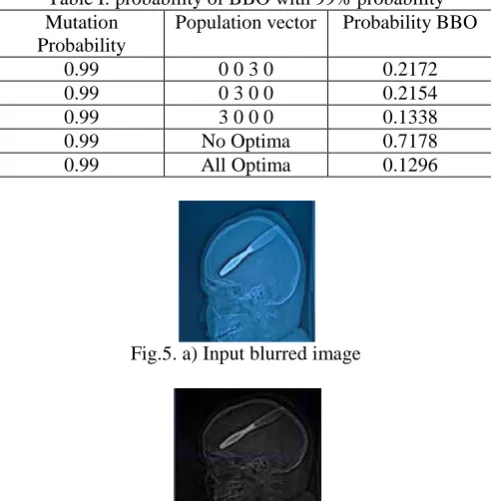
Copyright © 2013 IJECCE, All right reserved The input blurred image is taken. After 100 iteration and
considering the following parameters the results of genetic algorithm and BBO are shown in Fig.5 b) and 5c). From Fig.5 b) and 5c), it is clear that visual quality of image is much better with BBO as compared to genetic algorithm.
Table I: probability of BBO with 99% probability Mutation
Probability
Population vector Probability BBO
0.99 0 0 3 0 0.2172
0.99 0 3 0 0 0.2154
0.99 3 0 0 0 0.1338
0.99 No Optima 0.7178
0.99 All Optima 0.1296
Fig.5. a) Input blurred image
Fig.5. b) Output of genetic algorithm with 99% probability
Fig.5. c) Output of BBO with 99% probability Let cardinality of search set n=4
Population size N=3 Number of peers=2
Fig.5. d) Output of BBO with 0.01% probability The best fitness value is obtained with 0.01%mutation probability shown in Fig.5 d).
VIII. C
ONCLUSIONImage restoration processes consist of a collection of techniques. That seek to improve the visual appearance of an image or to convert the images to a form better suited for analysis by a human or machine. The presented restoration techniques are effective in restoring natural images. Various optimization techniques are Particle swarm optimization, Genetic algorithm and biogeography based optimization. From these three techniques,
Biogeography based optimization technique gives best result. The results of Biogeography based optimization technique is compared with Genetic algorithm technique. It is clear BBO is more reliable and better optimizer as compared to genetic algorithm [9][11]. So In thesis BBO technique is applied for the restoration of image. Biogeography based optimization technique play an important role in enhancing the quality and contrast of natural images[11].BBO gives better resultant as compared to Genetic Algorithm .So Genetic algorithm is replaced by technique called BBO for the restoration of image. The extracted resultant of restored image by BBO technique gives accuracy level of 99%.The extracted resultants are better with tolerance of 0.001%. BBO technique is used especially in the case of Restoration, Enhancement and Segmentation of image. Biogeography based optimization technique gives best result and hopefully could give extra information. As a result, natural images that have been applied with this technique appear to be clearer and hopefully would ease further analysis by viewers.
F
UTURES
COPEIn future this proposed algorithm can be applied to all these techniques for processing an image so that result is more suitable than original image for specific application. This method can also be applied on Image Compression, Image Smoothing and Sharpening, Video Compression, Image Recognition, Image Steganography and Image Watermarking. Image is processed for visual interpretation, the viewer is ultimate judge of how this method work. Visual evaluation of image quality is highly subjective process thus making the definition of good image an elusive standard by which to compare algorithm performance.
A
CKNOWLEDGEMENTCopyright © 2013 IJECCE, All right reserved
R
EFERENCES[1] R. Gonzalez and R. Woods, Digital Image Processing, 3nd ed., Prentice Hall, 2007.
[2] D. Donoho, “De-Noising by Soft -Thresholding ,” IEEE Trans. Information Theory, vol. 41, pp 613-627, May1995.
[3] R.L.Lagendijk, J. Biemond and D.E. Boekee,“Identification and Restoration of Noisy Blurred Images Using the Expectation Maximization Algorithm”, IEEE Trans. on Acoustics, Speech and Signal Processing, vol. 38, pp.1180-1191, 1990.
[4] Y.L. You and M. Kaveh, “A Regularization Approach to Joint Blur Identification and Image Restoration”, IEEETrans. on Image Processing, vol. 5, pp. 416-428, 1996.
[5] T. Davis and J. Principe. , 1993. “A Markov chain framework for the simple genetic algorithm”, Evolutionary Computation, vol. 1, pp. 269-288.
[6] C. Reeves and J. Rowe., 2003. “Genetic Algorithms: Principles and Perspectives”,Norwell, MA: Kluwer..
[7] C. Darwin, The Origin of Species, Gramercy, 1995.
[9] L. Tseng and S. Liang, “A hybrid metaheuristicfor the quadratic assignment problem,” Computational Optimization and Applications, Vol. 34, No. 1, pp. 85–113, 2006.
[9] D. Simon, “A Probabilistic Analysis of a Simplified Biogeography-Based Optimization Algorithm,” IEEE, pp. 1604 -1616, 2009.
[10] J. Kennedy, “The particle swarm: social adaptation of knowledge”, inProc. of the IEEE international conference on evolutionary
[11] D. Simon,“Biogeography-BasedOptimization,”IEEE Trans. On Evol. Comput. vol. 12, no. 6, pp 712-713, Dec. 2008.
[12] A. Nix and M. Vose., 1992. “Modeling genetic algorithms with Markov chains”,Annals of Mathematics and Artificial Intelligence, vol. 5, pp. 79-88.
[13] Thornton, Catherine L. (15 October 1976). "Triangular covariance factorizations for Kalman Filtering"(PhD thesis).
A
UTHOR’
SP
ROFILENitika Jearth
Research Scholar,from Nangal pursuing M.Tech. in Baba Banda Singh Bahadur College, Fatehgarh Sahib in Electronics and communication Engineering .She graduated from Rayat Institute of Engineering and information Technology, Railmajra in Electronics and communication trade in 2008.She has presented two journals in international conferences and five paper in national conference. Research interest are in Matlab based Image Steganography, Restoration and Enhancement techniques.
Rekha Rani
Research Scholar, from Nangal pursuing M.Tech. in IITT College of Engineering, Pojewal in computers and science Engineering. She graduated from Butta college of Engineering and Technology, Ludhiana in computers and science Engineering trade in 2010.She has presented four journals in international conferences and three paper in national conference. Research interest are IK software reuse, gold plating and Biogeography based image segmentation.
Bharti Chowdry
Assistant Professor, from Nangal.She has completed M.Tech from Rayat Institute of engineering and information technology in computers and science Engineering .She graduated from Rayat Institute of engineering and information technology in computers and science Engineering in computers and science Engineering trade in 2009.She has presented Six journals in international conferences and five paper in national conference. Research interest are Exploiting the l*a*b characterstics using palette based steganography, Image steganography and Image segmentation.