Performance of the Wavelet Transform-Neural Network Based
Receiver for DPIM in Diffuse Indoor Optical Wireless Links in
Presence of Artificial Light Interference
S. Rajbhandari*, Z. Ghassemlooy* and M. Angelova**
Abstract: Artificial neural network (ANN) has application in communication engineering
in diverse areas such as channel equalization, channel modeling, error control code because of its capability of nonlinear processing, adaptability, and parallel processing. On the other hand, wavelet transform (WT) with both the time and the frequency resolution provides the exact representation of signal in both domains. Applying these signal processing tools for channel compensation and noise reduction can provide an enhanced performance compared to the traditional tools. In this paper, the slot error rate (SER) performance of digital pulse interval modulation (DPIM) in diffuse indoor optical wireless (OW) links subjected to the artificial light interference (ALI) is reported with new receiver structure based on the discrete WT (DWT) and ANN. Simulation results show that the DWT-ANN based receiver is very effective in reducing the effect of multipath induced inter-symbol interference (ISI) and ALI.
Keywords: Optical wireless communication, discrete wavelet transform, artificial neural
network, artificial light interference, multipath propagation.
1 Introduction 1
The increasing popularity of files and video sharing and the possibility of digital radio and TV broadcast over the internet have already put a huge bandwidth demand on the personal communication systems [1, 2]. On the other hand, the fourth generation communications promise to support multiple applications and a higher bandwidth per user (more than 100 Mbps) for both indoor and outdoor applications [3]. This will place an enormous challenge on already congested microwave and radio frequency (RF) spectrum with limited capacities. However, the solution to the bandwidth congestion and the ‘last mile access’ bottleneck, would be to employ optical communications technologies. Though OW communication is not a new technology, the recent profuse demand in bandwidth makes it a real
Iranian Journal of Electrical & Electronic Engineering, 2009. Paper first received 23 Mar. 2009and in revised form 6 May 2009. * The Authors are with Optical communications research group, School of CEIS, Northumbria University.Address: Ellison Building, Ellison Place, Newcastle upon Tyne, NE1 8ST, UK.
E-mails: [email protected], [email protected]. ** The Authors are with the Intelligent Modeling Lab, School of CEIS, Northumbria University, Address: Pandon Building, Camden Street, Newcastle upon Tyne, NE2 1XE, UK.
E-mails: [email protected]
contender for the primary medium in personal communications for the future applications [4, 5]. The combination of fibre optics and indoor and outdoor OW links can readily overcome the problem of last mile access for a foreseeable future at certain specific applications. In fact, the largest installed short-range wireless communication links are optical rather than RF [6], which can readily be connected to the fibre optical communications backbone. In outdoor applications we are seeing a growing range of OW systems covering rages up to 5-6 km at speed in access of 10 Gbps achieved by adopting wavelength division multiplexing [7]. In indoor environment, we are seeing a growing research activities and availability of commercially available device and systems for targeted application such HDTV, high-speed download station at airports, railway station and other public places, to name a few [8, 9]. However, for indoor non-line-of-sight (NLOS) systems mobility and to a certain extend cost are important issues when compared to RF links.
The basic system model for in-house OW communication was first developed in 1979 by Gfeller and Bapst [10], but the extensive study of the channel capacity, channel modelling as well as modulation techniques were carried mostly in the late 1990’s [11-15]. Over the last two decades a number of modulation
schemes (old and new) have been proposed for OW systems. The most basic and widely studied bandwidth efficient scheme is the On-off keying (OOK) with a high average optical power requirement and having DC and low frequency components. On the other hand the most power efficient and bandwidth efficient scheme is the pulse position modulation (PPM) offering the best performance but is susceptible to the multipath induced ISI in NLOS links as well as requiring both the slot and symbol synchronization. Anisochronous modulation scheme including differential PPM (DPPM) [16], DPIM [17] and dual-header pulse interval modulation (DH-PIM) [18] with built-in symbol synchronization offer improved throughputs and bandwidth efficiency at the cost of marginally lower power efficiency compared to the PPM. For indoor NLOS applications these schemes also offer a degree of immunity to the ISI by adding guard slots to the symbols. However, in highly dispersive channels, the unequalized error performances of PPM, DPPM, DH-PIM and DPIM are rather inferior compared to the OOK.
A number of equalization techniques have been investigated for these modulation schemes [9, 12, 16, 17]. Though the maximum likelihood sequence detector (MLSD) is the optimum solution, it is not suitable for the variable symbol length modulation schemes of DPPM, DH-PIM and DPIM for practical reasons [17]. Hence sub-optimum solutions like the decision feedback equalizer would be the preferred option [16, 17]. But equalization based on the finite impulse response (FIR) filter suffers from severe performance degradation in the time varying and non-linear channels [19]. In [20, 21] the equalization is defined as a pattern classification problem, thus opening opening-up the possibility of utilizing the ANN. In [22] it has been reported that ANN with both adaptability and nonlinear processing capability is a perfect tool for signal detection for the non-Gaussian, nonlinear and time-varying channels. The concept of equalization as a classification problem is considered here with the ANN as a classifying tool.
The link performance of an indoor OW link is severely degraded by the intense ambient light source both from the artificial and nature lights. For diffuse links and in the presence of intense ambient light the optical power penalty for the matched filter based receiver with an equalizer will be very high. Hence, some kind of filtering is needed to ensure that the link performance is acceptable as there is spectral overlap between ALI and the baseband region of the data signal. Fluorescent lamps (FLs) driven by the electronic ballasts are potentially the most degrading as the interfering signal is periodic with harmonics extending up to several MHz. The most widespread technique used to mitigate the effect of ALI is to employ an electrical high-pass lter (HPF). Although electrical
HPF is effective in attenuating the interference signal, it introduces a form of ISI known as the baseline wander (BLW), which is more severe for baseband modulation techniques with a considerable amount of power at its DC and low-frequency regions [23, 24]. In this paper, we investigate an alternative scheme based on the DWT for combating the effect of ALI for the LOS and diffuse DPIM. The DWT is a multiresolutional analysis in which the signal is decomposed into two equal bands at each level of decomposition. Each band of the signal can be manipulated independently providing flexibility in the analysis. DWT is realized by using a filter bank with repetitive structure which reduces the design complexity. The goal of using DWT in this work is to remove the ALI that has spectral components mainly at a low frequency region. The received noisy signal is decomposed into a number of bands using DWT until signal and inference are effectively separated in frequency bands and the DWT coefficients corresponding to interference are removed from the reconstructed signal. Though theoretically it may sound perfect, in practical situation it is not possible to completely remove the interference from the signal as there is a spectral overlap. Hence, there is need for optimization to ensure that the loss of information is kept to a minimum.
In this paper the performance of a diffuse DPIM link employing the DWT (for denoising) and the ANN (equalization) is studied and results are presented and compared with a LOS link. The paper is organised as follows: the system description of DPIM along with the ALI model and a diffuse channel model is presented in Section 2. The proposed DWT-ANN based equalizer is described in Section 3 and the error performance of the proposed system is reported in Section 4 for different data rates. Finally, the concluding remarks are given in Section 5.
2 Indoor OW Channel Model and Unequalized
Performance
2.1 DPIM System Description
DPIM is an anisochronous modulation technique, in which each block of M (= log2L) input data bits {di, i = 1, 2, ...M } is mapped to one of L possible symbols {s(n) , 0 < n ≤ L } of different length. A symbol is composed of a pulse of one slot duration followed by a series of empty slots, the number of which is dependent on the decimal value of the M-bit data stream being encoded. The L-DPIM symbol set s (t) , 0 < n ≤ L can be represented as:
s (t) = P0 T t ≤ T< t ≤ nT (1)
where P is the peak power and T is the slot duration. The peak power P is related to the average transmitted power P and the average symbol length L as:
P = P L (2)
In order to avoid symbols with a zero time slot between the adjacent pulses, an additional guard band (GB) of one or more time slots may be added to each symbol immediately following the pulse. Adding one or more guard slots also provide immunity to the multipath induced ISI for moderately dispersive channel [25]. For highly dispersive channel, equalization schemes must be incorporated to achieve a reasonable BER.
Assuming independent and identically-distributed (iid) random data, the average symbol length Lavg and the slot duration Ts are given by:
L = ( )+ NGB (3)
T =
(4)
where Tb is the bit duration of di(t) and NGB is the number of guard GBs.
DPIM can be used to achieve either higher bandwidth efficiency or power efficiency compared to PPM by varying the value of L. For a fixed average bit rate and fixed available bandwidth, improved average power efficiency can be achieved when using higher bit resolution (i.e. higher M) compared to PPM [17]. Unlike PPM schemes where both slot and symbol synchronisations are the requirement, DPIM also offers a built-in symbol synchronisation capability.
The complete schematic system block diagram of the DPIM is given in Fig. 1. In a dispersive channel with ALI, both HPF and equalizing filter are incorporated at the receiver to reduce the effect of the interference due to artificial light and multipath respectively. For an ideal channel (with no multipath distortion and ALI) and with the additive white Gaussian noise (AWGN), the optimum detection strategies would be to use a matched filter (without an equalizer and a HPF). The impulse response of the unit energy matched filter r(t) is matched to the transmitted pulse shape p(t). The filter output y(t) is sampled at the end of each slot period and a binary ‘0’ or ‘1’ is assigned to the output of the sampler depending on whether the sample is above or below the threshold α. Unlike the OOK scheme, the optimum threshold α does not lies at the middle of the maximum and minimum
amplitude of the received signal. It is calculated that the optimum values of α varies from 0.49Es to 0.54Es for L = 2 to 32 [17] , where Es is the energy of a pulse. Though suboptimal, the value of α is taken as 0.5Es in this study. The slot error probability Pse for a matched filter based receiver with a threshold level of 0.5Es can be approximated as [26]:
P = Q L M η (4)
where η is the double-sided noise power spectral density, R is the photodetector responsivity, Rb is the bit rate and Q(φ) is the Q-function defined as Q(φ) =
√ π∫ e
ω⁄
∞
φ dω. For the system with one or more
GBs, the error probability needs to be modified to take account for different detection errors and a more complex mathematical analysis is required (for details refer to [17]).
2.2 Artificial Light Interference Model
The unavoidable background radiation from the artificial and natural light sources has potential to severely degrade the performance of IR receivers. The signal independent background radiation induced shot noise is white and Gaussian; whereas interferences from the artificial sources are periodic. Of all the artificial sources of ambient light, FLs driven by the electronic ballasts are potentially the most degrading with harmonics of the switching frequency extending into the MHz [27]. In [27] a model is proposed to accurately describe the fluorescent light interference (FLI) driven by a electronic ballast. The FLI signal mfl(t) composed of the low frequency and high frequency components mlow(t) and mhigh(t) respectively is given by:
m (t) = m (t) + m (t) (5) where
m (t) = (6)
I
A [Φ cos (2π(1ooi − 50)t + φ) + ψ cos (2π(100i)t
+ ϕ)]
m (t) = ∑ Γ cos 2πf jt + θ (7)
where Φi and Ψi are the amplitudes of the odd and even
harmonics of 50 Hz mains signal, respectively, Γj and θj
are the amplitude and phase of the harmonics, fhigh is the electronic ballast switching frequency, and A2 is the constant relating the interference amplitude to IB. For
Fig. 1. The block diagram of DPIM system with equalizer and HPF at the receiver front
DPIM encoder
Transmitter filter
p(t)
Matched filter
r(t)
LavgPavg shot
noise n(t)
Output slots Input
bits
sample
mfl(t)
(sometimes omitted)
HPF g(t) (sometimes
omitted) Multipath
channel h(t)
x(t) v(t)
Responsivity R
z(t) y(t)
Equalizer di s(n) sn(t)
n sˆ
y(n) ν( )t
detail description and all parameter values readers are referred to [27].
The link performance in the presence of the ALI can be studied by calculating error probability using the matched filter based receiver. In the absence of the HPF, the output of the matched filter due to the FLI signal, sampled at the end of each slot period, is given as:
m = m (t)⨂r(t)| (8) where the symbol ⨂ denotes convolution. By considering every slot over a 20 ms interval (i.e. one complete cycle of m (t) and averaging, the probability of slot error is given by:
P = ∑ Q ⁄ +
Q
⁄ (9) where N is the total number of slots under consideration. For detail study of power penalty and baseline wander associated with the FLI and HPF respectively, see [17, 24].
2.3 Dispersive Channel
Though the LOS links provides the least path loss, the requirement of the unobstructed path between the transmitter and receiver makes its usability to limited applications. In indoor environments, where there is a high possibility of blocking, the diffuse and non-directed LOS links are the preferred options. In both the diffuse and the non-directed LOS IR link configurations, the transmitted optical signal undergoes multiple reflections before arriving at the photodetector, giving rise to a high path loss and pulse spreading. The latter leads to ISI, which is more significant for bit rates above 10 Mbit/s [9].
The indoor OW multipath channel can completely be characterized by its impulse response h(t). Using practical channel measurements, Carruthers and Kahn [11] has developed a ceiling bounce channel model, which is given by:
h(t) =( . ( . )) u(t) (10)
where the Drms is the RMS delay spread and u(t) is the unit step function.
The performance of an equalized and unequalized DPIM link in a dispersive environment in the absence of ALI is given in [17]. For the unequalized DPIM scheme, the optical power plenty exponentially increased with increasing Drms and for Drms > 0.1 the power requirement to achieve a desirable error performance becomes impractical. Since symbol boundaries are not known prior to detection, practical implementation of MLSD for DPIM is not feasible. Hence the suboptimal decision feedback equalization scheme is the preferred option.
3 DWT and ANN Based Receiver
The schematic block diagram of the receiver with the proposed DWT and ANN modules is shown in Fig. 2. The architecture of the traditional HPF equalizer receiver (Fig. 1) and DWT-ANN (Fig.2) are similar. The DWT reduces the effect of ALI whereas the ANN acts as an equalizer. For the case where there is no ALI, DWT is not required and whereas for LOS links, the ANN could be removed without any effect on the link performance.
The noise and signal are separated into different bands using the DWT and the signal band that corresponds to the noise in the reconstructed signal is removed. In contrast to the DWT based denoising [28], here DWT is employed to reduce the low frequency ALI, and only the approximation coefficients are manipulated. The DWT decomposing and denoising processes can be better understood by the multiresolutional analysis (MRA) tree depicted in Fig. 3. The signal is divided into half-frequency bands at each level of the decomposition. At the first stage of the decomposition, the signal x(n) is divided into lowpass y and highpass y bands using low pass h(n) and high pass g(n) filters and followed by down-sampling by 2 to provide approximation and detail coefficients, respectively. The outputs at the first stage of the decomposition are given by [29]:
y (k) = ∑ x(n). g(2k − n) (11)
y (k) = ∑ x(n). h(2k − n) (12)
The second stage divides y further to the lowpass y and bandpass y , which results in a logarithmic set of bandwidths. Further decompositions of y is possible. It is to be noted here that the decomposition filters h(n) and g(n) remain the same for all level of decompositions.
For reducing the effect of ALI, the decomposition is carried out until the signal and interference can effectively be separated. There is a problem in reducing the effect of ALI without affecting the loss of information content. This is because there is a spectral overlap at and near the DC component between the signal and ALI interference. Thus, the challenge is how to carry out denoising without any loss of information. Having separated the signal and the interference in the wavelet domain, the DWT coefficients corresponding to the interference is made equal to zero. i.e.
y = 0 (13) where ynl is the nth level DWT approximation coefficients.
n sˆ
( )n
x' ν( )t
Fig. 2. DWT-ANN based receiver
Fig. 3. Multiresolutional analysis tree
Fig. 4. The architecture of MLP equalizer
The order of decomposition level n depends upon the data rate and interference bandwidth. Signal is reconstructed with y = 0, and if n is selected appropriately, the reconstructed signal can be partially/completely free from interference. The reconstruction process involves the inverse of the decomposition process, i.e. the DWT coefficients at each level are up-sampled by two, passed through the synthesis filters g′(n) and h′(n) (high pass and low pass, respectively), and then added. However, the analysis and synthesis filters are the same, hence the reconstruction at each level is given by [30]:
x ( )= y
(k). g(2k − n) +
y (n). h(2k − n) (14)
The reconstructed signal x′(n) is sliced to generate a binary sequence in LOS links. However, x′(n) is further processed using the ANN for the diffuse channel to compensate for multipath propagation. Adaptive equalization using ANN is carried out in a supervised manner using a feedforward backpropagation multilayer perceptrons (MLP). The equalizing structure of the MLP with input, hidden and output layers is illustrated
in Fig. 4. The DWT output x′(n) is passed though a number of tap delay lines as in the traditional equalizers. The number of tap delay lines can be varied according to the delay spread of the channel. The number of neurons in the input layer is in par with the number of tap delay lines. Six neurons and one neuron are used in the hidden layer and the output layer, respectively and the transfer functions utilized are the log-sigmoid and linear, respectively. The MLP is trained in supervised manner, meaning input and target sets are provided to the ANN for the estimation of the channel, and hence adjusting the ANN parameters (weight and bias). The target of the learning process is to reduce the error signal (i.e. the difference of the actual output from ANN and the target output). There are a number of different ANN training algorithms. Readers can refer to the standard texts on ANN [31] for details. The output of the ANN is sliced forcing the output to the binary values. The output of the slicer (Fig. 4) is compared to the original DPIM sequence to determine the SER.
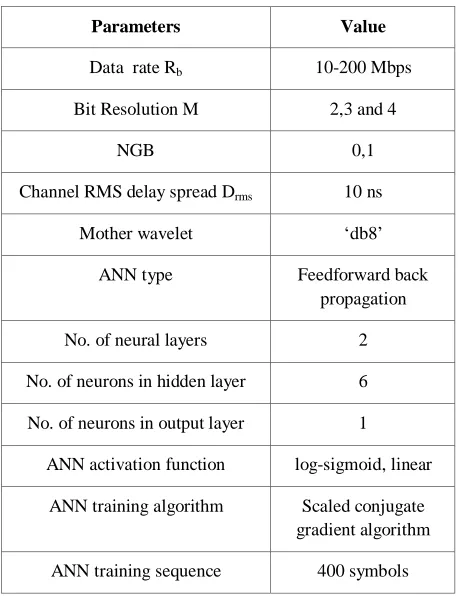
Table 1. Simulation Parameters
Parameters Value
Data rate Rb 10-200 Mbps
Bit Resolution M 2,3 and 4
NGB 0,1
Channel RMS delay spread Drms 10 ns
Mother wavelet ‘db8’
ANN type Feedforward back
propagation
No. of neural layers 2
No. of neurons in hidden layer 6 No. of neurons in output layer 1
ANN activation function log-sigmoid, linear ANN training algorithm Scaled conjugate
gradient algorithm ANN training sequence 400 symbols
4 Results and Discussions
The computer simulation of the proposed receiver structure is carried out using MatlabM . All the key simulation parameters are listed in Table 1. Most of the simulation is carried out for 8-DPIM as it is a good compromise for bandwidth and power efficiencies. In all simulations, it is assumed that background
Z-1 ... Z-1
Input Layer
Hidden Layer
Output Layer
Slicer ( )n
x'
( )n x'
( )1
'n−
x x'( )n−L
( )
tν
n sˆ
interference with an average photocurrent IB of 200 µA is present with an additional 2 µA of photocurrent in presence of the FLI. The channel impulse response is normalized to 1 so that total energy of the system is conserved.
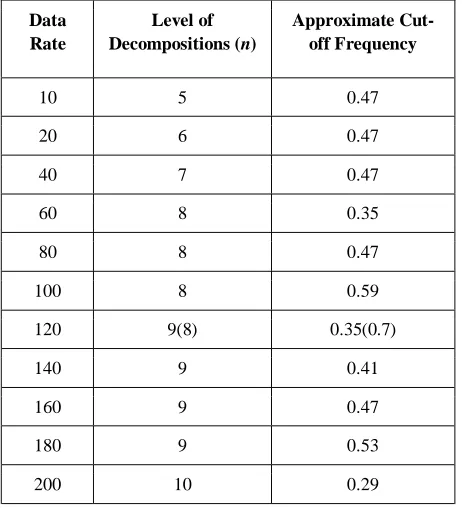
The DWT block is the key element of the proposed receiver design as the denoising capacity of the block will eventually dictate the performance of the system; provided ANN is trained properly. The simulation carried out showed that a family of Daubechies wavelet (db8) gives the optimum performance; hence it is adopted in all simulations. As explained previously, the decomposition level should be selected with proper care. The simulations show that the performance is optimal if the low-band of the signal (signal that corresponds to the last level of approximation) is made within the frequency range of 0-0.5 MHz. The decomposition levels and approximate cut-off frequencies for DWT at data rate of 10-200 Mbps are listed in the Table 2.
Table 2. Decompositions levels and approximate cut-off
frequency for different data rates.
Data Rate
Level of
Decompositions (n)
Approximate Cut-off Frequency
10 5 0.47
20 6 0.47
40 7 0.47
60 8 0.35
80 8 0.47
100 8 0.59
120 9(8) 0.35(0.7)
140 9 0.41
160 9 0.47
180 9 0.53
200 10 0.29
4.1 Performance for the LOS Link
The normalized optical power penalty for 8-DPIM(0GB) with a matched filter receiver and DWT denoising at a data rate of 10-200 Mbps under the constraint of FLI is given in Fig. 5. The performance of 8-DPIM (0GB) in an ideal AWGN (i.e. no FLI) is also shown for comparison. Since the channel is LOS,
therefore the ANN equalization is not incorporated in any of simulation instead the denoised signal is converted to the binary values by a slicer. The optical power penalty is normalized to that of the 8-DPIM (0GB) with a data rate of 10 Mbps in an ideal channel. The curves shown in Fig. 5 reveal that the optical power penalty associated with the FLI is relatively high (~8-10 dB) depending upon the data rates. On the other hand, DWT is very effective in removing the FLI and displaying performance comparable to the matched filter in an ideal channel with < 0.5 dB of optical power penalty for all data rates. The optical power gain due to application of the DWT is ~7 dB at 10 Mbps and decrease proportionally with increase data rate reducing to ~ 2.7 dB at 200 Mbps.
Fig. 5. The normalised optical power penalty versus the data
rate for 8-DPIM (0 GB) with and without FLI and with DWT for a LOS OW link at a SER of 10-6
4.2 Performance for Diffuse Links
The performance of DWT-ANN architectures in a diffuse channel with delay spread of 10 ns in presence of FLI for data rate of 10–200 Mbps is shown in Fig. 6. The performance of 8-DPIM with the ideal channel and a diffuse link (without FLI) with and without an equalizer are also shown for comparison. Since the performance of the linear equalizer closely matches that of the ANN equalizer, it is not reported here. As expected, a link with no equalization shows the worst performance for the data rate >25 Mbps. The optical power penalty associated with the DWT-ANN receiver in a diffuse link in presence of FLI is comparable to the equalized system in absence of the FLI, thus demonstrating the effectiveness of the proposed receiver in a highly diffuse channel. For DWT-ANN case, the power penalty increases from ~ 0.5 dB at 10 Mbps to ~ 13 dB at 200 Mbps.
0 50 100 150 200
0 2 4 6 8 10
Data rate ( Mbps)
N
o
rm
a
li
z
e
d
o
p
ti
c
a
l
p
o
w
e
r
p
e
n
a
lt
y
(
d
B
)
LOS (without FLI) LOS ( with FLI)
LOS (with FLI , DWT denoising)
Fig. 6. The normalised optical power penalty at a SER of 10-6 versus the data rate for 8-DPIM (0 GB) for unequalized and equalized matched filter receiver for diffuse link with a delay spread of 10 ns
4.3 Performance with Different Bit Resolutions with/without Guard Slots
Inclusions of one or more guard slots can provide certain immunity to the ISI in a diffuse channel. In case of the one guard slot, if a slot is detected, the next slot is assigned to be an empty slot as there should not to be any consecutive pulses. However, including additional slots will make the average slot duration smaller, which in turn increases the normalized delay spread. Hence, additional guard slot will be beneficial provided that the gain is larger than the power penalty due to the increased delay spread. For receivers employing an equalizer there is very little to be gained by including guard slots. To verify the hypothesis, simulations are carried out with and without guard slots for 8-DPIM. It is observed that symbols with one guard slot offer very little gain with power difference of <0.5 dB.
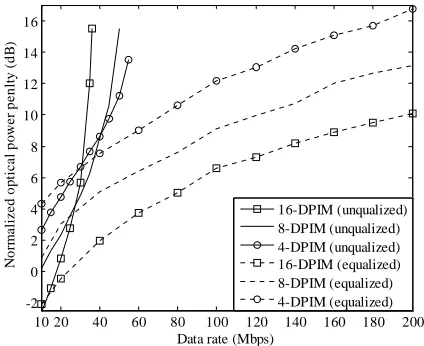
Increasing bit resolution M provides the power efficiency in LOS. However, in diffuse channel due to the decrease in pulse duration with increasing M, power penalty increase exponentially and the power penalty of 32-DPIM will be maximum for normalized delay spread greater than 0.1 [17]. With an application of the equalizer, the power efficiency associated with increasing M is expected to restore and simulation is carried out for verification. The performance of 4, 8 and 16-DPIM in a diffuse channel with a delay spread of 10 ns with and without equalizer is shown in Fig. 7. The unequalized system is simulated in absence of ALI. This is because ALI induced power penalty is very high and therefore making it impossible to carry out a comparative study. As expected unequalized 16-DPIM shows the worst performance (i.e. higher power penalty) compared to all other cases. At low data rates, the performance of the unequalized system is marginally better than the equalized systems, this is because of the ALI being the dominant source of the interference. However, equalized systems display lower power penalties at higher data rates, this is because FLI can
effectively be removed using DWT and the dominant source of the interference is the ISI. It is to be noted here that data rates at which power penalties for the unequalized and the equalized systems are equal increases with decreasing values of M. This can be explained by considering the slot duration Ts and the first zero crossing frequency 1/Ts of DPIM signal. For the same date rates, Ts decreases with increasing M, (i.e. increased normalized delay spread). Hence, at lower data rates and higher values of M the dominance source of interference is the multipath induced ISI not the ALI. The power penalty curves for the equalized systems are almost parallel to each other for all the data rates, thus indicating the effectiveness of the DWT-ANN in removing both the FLI and ISI irrespective of the value of M. The average power penalties for 4-DPIM and 16-DPIM compared to the 8-16-DPIM for the same data rate are ~2.5 and -2.6 dB, respectively.
Fig. 7. Performance of 4, 8 and 16-DPIM in a diffuse channel
with a delay spread of 10 ns for a receiver with and without DWT-ANN
5 Conclusion
A new receiver based on the discrete wavelet transform and artificial neural network is proposed and studied for the DPIM system in diffuse indoor optical wireless channel subjected to artificial light interference. The computer simulation of the DWT-ANN receiver is carried out and its performance is investigated under different channel conditions. The results provide enough evidence that DWT can be a very effective tool for reducing the ALI in OW links. On the other hand, the ANN can be trained to reduce the effect of multipath induced ISI. For LOS links, the DWT can significantly reduce the FLI induced power penalty to within 0.5 dB of the ideal channel. Though such performance cannot be achieved in diffuse channels, the DWT-ANN receiver provides significant improvement compared to the unequalized system.
0 50 100 150 200
0 2 4 6 8 10 12 14 16
Data rate ( Mbps)
N o rm a li z ed o p ti c a l p o w e r p e n a lt y ( d B ) Unqualized DWT-ANN (FLI) ANN (without FLI) Ideal channel
20 40 60 80 100 120 140 160 180 200 10 -2 0 2 4 6 8 10 12 14 16
Data rate (Mbps)
N o rm a li z e d o p ti c a l p o w e r p e n lt y ( d B ) 16-DPIM (unqualized) 8-DPIM (unqualized) 4-DPIM (unqualized) 16-DPIM (equalized) 8-DPIM (equalized) 4-DPIM (equalized)
Acknowledgment
This work is supported by School of CEIS, Northumbria University, Newcastle upon Tyne, UK.
References
[1]
Ramirez-Iniguez R., Idrus S. M. and Sun Z.,“Optical wireless communications: IR for wireless connectivity” NW: Auerbach Publications, 2008. [2] Smitha K., Sivabalan A. and John J., "Estimation of
channel impulse response using modified ceiling bounce model in non-directed indoor optical wireless systems," Wireless Personal Communications, Vol. 45, No. 1, pp. 1-10, 2008. [3] Miki T., Ohya T., Yoshino H. and Umeda N., "The
overview of the 4th generation mobile communication system," in ICICS'05, Singapore, 2005, pp. 1551-1555.
[4] O'Brien D., Parry G. and Stavrinou P., "Optical hotspots speed up wireless communication,"
Nature Photonics, Vol. 1, No. 5, pp. 245-247, 2007.
[5] Green R. J., Joshi H., Higgins M. D. and Leeson M. S., "Recent developments in indoor optical wireless systems," IET Communications, Vol. 2, No. 1, pp. 3-10, 2008.
[6] O’Brien D. C., Katz M., Wang P., Kalliojarvi K., Arnon S., Matsumoto M., Green R. and S. Jivkova, "Short-range optical wireless communications," Wireless world research forum, pp. 1-22.
[7] Cvijetic N., Qian D. and Wang T., "10Gb/s Free-Space Optical Transmission using OFDM," in
Conference on Optical Fiber
communication/National Fiber Optic Engineers Conference, San Diego, CA, 2008, pp. 1-3.
[8] Street A. M., Stavrinou P. N., Obrien D. C. and Edwards D. J., "Indoor optical wireless systems - A review," Optical and Quantum Electronics, Vol. 29, No. 3, pp. 349-378, 1997.
[9] Kahn J. M. and Barry J. R., "Wireless infrared communications," Proceedings of IEEE, Vol. 85, No. 2, pp. 265-298, 1997.
[10] . Gfeller F. R and Bapst U., "Wireless in-house data communication via diffuse infrared radiation,"
Proceedings of the IEEE, vol. 67, No. 11, pp. 1474- 1486, 1979.
[11] Kahn J. M., Krause W. J. and Carruthers J. B., "Experimental characterization of non-directed indoor infrared channels," IEEE Transactions on Communications, Vol. 43, No. 234, pp. 1613-1623, 1995.
[12] Barry J. R., "Sequence detection and equalization for pulse-position modulation," in International Conference on Communication, New Orleans, LA, 1994, pp. 1561-1565.
[13] Wisely R. D., "A 1 Gbit/s optical wireless tracked architecture for ATM delivery," in IEE Colloquium on Optical Free Space Communication Links, London, UK, 1996, pp. 14/1-14/7.
[14] Lomba C. R., Valadas R. T. and Duarte A. M., "Efficient simulation of the impulse response of the indoor wireless optical channel," International Journal of Communication Systems, Vol. 13, No. 7-8, pp. 537-549, 2000.
[15] Aldibbiat N. M., "Optical wireless communication systems employing dual header pulse interval modulation (DH-PIM)" PhD thesis, Sheffield Hallam University, UK, 2001.
[16] Shiu D. and Kahn J. M., "Differential pulse position modulation for power-efficient optical communication," IEEE Transaction on Communication, Vol. 47, No. 8, pp. 1201-1210, 1999.
[17] Hayes A. R., "Digital pulse interval modulation for indoor optical wireless communication systems"
,PhD thesis, Sheffield Hallam University, UK, 2002.
[18] Aldibbiat N. M., Ghassemlooy Z. and McLaughlin R., "Indoor optical wireless systems employing dual header pulse interval modulation (DH-PIM),"
International Journal of Communication Systems,
Vol. 18, No. 3, pp. 285-305, 2005.
[19] Hussain A., Soraghan J. J. and Durrani T. S., "A new adaptive functional-link neural-network-based DFE for overcoming co-channel interference,"
IEEE Transactions on Communications, Vol. 45, No. 11, pp. 1358-1362, 1997.
[20] Haykin S., Nie J. and Currie B., "Neural network-based receiver for wireless communications," IEE Electronics Letter, Vol. 35, No. 3, pp. 203-204, 1999.
[21] Choi J., Bouchard M. and Yeap T. H., "Decision feedback recurrent neural equalization with fast convergence rate," IEEE Transactions on Neural Networks, Vol. 16, No. 3, pp. 699-708, 2005. [22] Haykin S. and Thomson D. J., "Signal detection in
a nonstationary environment reformulated as an adaptive pattern classification problem,"
Proceedings of the IEEE, Vol. 86, No. 11, pp. 2325-2344, 1998.
[23] Narasimhan R., Audeh M. D., and Kahn J. M., "Effect of electronic-ballast fluorescent lighting on wireless infrared links," IEE Proceedings - Optoelectronics, Vol. 143, No. 6, pp. 347-354, 1996.
[24] Ghassemlooy Z., "Investigation of the baseline wander effect on indoor optical wireless system employing digital pulse interval modulation," IET Communications, Vol. 2, No. 1, pp. 53-60, 2008. [25] Ghassemlooy Z., Hayes A. R. and Wilson B.,
"Reducing the effects of intersymbol interference in diffuse DPIM optical wireless communications,"
IEE Proceedings Optoelectronics, Vol. 150, No. 6, pp. 445 - 452, 2003.
[26] Ghassemlooy Z., Popoola W. O., Rajbhandari S., Amiri M., and Hashemi S., "A synopsis of modulation techniques for wireless infrared
communication," in ICTON-MW' 2007 Tunisia, 2007.
[27] Moreira A. J. C., Valadas R. T. and Duarte A. M. d. O., "Optical interference produced by artificial light," Wireless Networks, Vol. 3, No. 2, pp. 131-140, 1997.
[28] Donoho D. L., Johnstone I. M., Kerkyacharian G., and Picard D., "Wavelet shrinkage: Asymptopia?,"
Journal of the Royal Statistics Society, Vol. 57, No. 2, pp. 301-337, 1995.
[29] Burrus C. S., Gopinath R. A., and Guo H.,
“Introduction to wavelets and wavelet transforms: A primer “, New Jersey, USA: Prentice Hall, 1998. [30] Dickenson R. J., "Wavelet analysis and artificial
intelligence for diffuse indoor optical wireless communication," PhD thesis, Northumbria University, UK, 2007.
[31] Haykin S., “Neural networks: A comprehensive foundation” 2nd ed. New Jersey, USA: Prentice Hall, 1998.
Sujan Rajbhandari is originally
from Nepal where he obtained his bachelor’s degree in Electronics and Communication Engineering from Institute of Engineering, Pulchowk Campus (Tribhuvan University), in 2004. He then joined Northumbria University, Newcastle upon Tyne, U.K. in 2005 where he did his M.Sc. degree in Optoelectronics and Communication systems graduation with a distinction. He is currently pursuing a Doctorate degree in Optical Wireless Communications in the School of Computing, Engineering and Information Sciences at Northumbria University for which he was awarded a University Ph.D. studentship. His research interests lie in the area of optical communications and, more specically, the application of articial intelligence and wavelet transform for signal detection in optical wireless communication links.
Zabih Ghassemlooy CEng,
Fellow of IET, Senior Member of IEEE: Received his BSc (Hons) degree in Electrical and Electronics Engineering from the
Manchester Metropolitan
University in 1981, and his MSc
and PhD in Optical
Communications from the
University of Manchester Institute of Science and Technology (UMIST), in 1984 and 1987, respectively with Scholarships from the Engineering and Physical Science Research Council, UK. From 1986-87 he worked as a Demonstrator at UMIST and from 1987 to
1988 he was a Post-doctoral Research Fellow at the City University, London. In 1988 he joined Sheffield Hallam University as a Lecturer, becoming a Reader in 1995 and a Professor in Optical Communications in 1997. He was the Group Leader for Communication Engineering and Digital Signal Processing Subject Division, and also head of Optical Communications Research Group until 2004. In 2004 he moved to the University of Northumbria at Newcastle as an Associate Dean for Research in the School of Computing, Engineering and Information Sciences. He also heads
the Northumbria Communications Research
Laboratories within the School. He was the coordinator for the successful RAE 2008 submission in the General Engineering with more than 50% of the work submitted rated as 4* and 3*. In 2001 he was a recipient of the Tan Chin Tuan Fellowship in Engineering from the Nanyang Technological University in Singapore to work on the photonic technology. In 2006, he was awarded one of the best PhD research supervisors at Northumbria University. He was a visiting professor at the Ankara University, Turkey and Hong-Kong Polytechnic University, and is currently a visiting Professor at the Technological University of Malaysia. He is the Editor-in-Chief of The Mediterranean Journals of Computers and Networks, and Electronics and Communications. He serves on the Editorial Committees of International Journal of Communication Systems, and the EURASIP Journal of Wireless Communications and Networking, Contemporary Engineering Sciences, Research Letter in Signal Processing, and also has served on the Publication Committee of the IEEE Transactions on Consumer Electronics, the editorial board of the Inter and the Sensor Letters. He is the founder and the Chairman of the International Symposium on Communication Systems, Network and Digital Signal Processing, a committee member of The International Institute of Informatics and Systemics, and is a member of technical committee of a number of international conferences. He is a College Member of the Engineering, and Physical Science Research Council, UK (2003-2009), and has served on a number international Research and Advisory Committees. His research interests are in the areas of photonic networks, modulation techniques, high-speed optical systems, optical wireless communications as well as optical fibre sensors. He has received a number of research grants from UK Research Councils, European Union, Industry and UK Government. He has supervised a large number of PhD students and has published over 310 papers. He is a co-editor of an IET book on “Analogue Optical Fibre Communications”, the proceedings of the CSNDSP ‘08’, ’06, CSDSP’98, and the 1st Intern. Workshop on Materials for Optoelectronics 1995, UK. He is the co-guest editor of a number of special issues: the IET Proceeding Circuit, Devices and Systems, August 2006, Vol. 2, No. 1, 2008, the Mediterranean J.
of Electronics and Communications on “Free Space Optics –RF”, July 2006, the IET Proceeding J. 1994, and 2000, and Inter. J. Communications Systems 2000.
From 2004-06 he was the IEEE UK/IR
Communications Chapter Secretary and the Vice-Chairman and currently is the Vice-Chairman.
Maia Angelova is Professor of
Mathematical Physics and Head of the Intelligent Modelling research group at the University of Northumbria. She has a BSc (Hons) in Physics, MSc in Theoretical Physics and PhD in Mathematical and Theoretical Physics from Sofia University. She was a visiting research fellow at the University of Kent at Canterbury from 1989-1991, a Lecturer in physics at Somerville College and member of Theoretical Physics at Oxford University from 1991-1996. She joined Northumbria University in 1997 as a Senior Lecturer, became a Reader in 2002 and Professor in 2004. She has research interests in the development and applications of group-theoretical and algebraic methods in condensed matter, dynamical systems in biology, bioinformatics and mathematical models of communication networks. She has received funding from UK Research Councils, European Union and a number of charities. She is a member of the IoP and LMS, reviewer and panel member for the European FP5, FP6 and FP7 and member of Editorial Board of Bioinformatics and Biology Insights.