Quality Function Deployment-based Expert System for
Materials Selection
Kanika Prasad
1, Saikat Ranjan Maity
2, Shankar Chakraborty
1*1 Department of Production Engineering, Jadavpur University, Kolkata - 700 032, India 2 Production Engineering Department, Haldia Institute of Technology, Haldia – 721657, India
* Corresponding author. email: [email protected] Manuscript submitted January 29, 2016; accepted May 8, 2016.
Abstract: An appropriate material for a particular product determines the range of function, durability, cost,
user’s feedback and experience about the product. Failure arising from improper material selection may often lead to loss of both revenue and reputation of the concerned manufacturing organization. Hence, selection of a proper material for a product is very important from engineering design perspective. In the field of manufacturing engineering, selection of material is a tedious task because there are numerous factors to be carefully evaluated before making the final decision. The main requirements may be different for varying applications, but depending on the working environment, several other interrelated factors may also need to be considered, thus making the selection process more complex and time consuming. The past researchers have already developed different expert systems for solving material selection problems. Those expert systems were often problem specific, used to estimate criteria weights using subjective perception of the designers and fail to incorporate customers’ requirements into the final products. This paper presents a quality function deployment-based methodology for materials selection that can provide due importance to the voice of customers. An expert system in Visual BASIC 6.0 is also developed to automate the entire material selection procedure. The applicability of the developed expert system is demonstrated while selecting materials for an end milling cutter and a centrifugal compressor impeller.
Key words: Centrifugal compressor impeller, expert system, material selection, milling cutter, quality
function deployment.
1.
Introduction
about all of them to optimize their choice. Thus, in order to assist the designers to select the best material alternative from an assortment of existing choices, there is a need for development of a methodical and rational approach. Expert systems that run in computers aid in systematizing and restoring information with a view to accomplish the desired goals of a manufacturing enterprise with better exactness within the restricted available budget and time while exterminating the enormous calculations involved. They help the designers in the manufacturing organizations with their decision making procedure, characteristically resulting in ranking, categorizing or selecting from the existing alternatives. Hence, an expert system integrating quality function deployment (QFD) technique is presented in this paper to facilitate selection of materials for an end milling cutter and a centrifugal compressor impeller. The QFD technique is adopted here to take into account the voice of customers for the considered products along with their desired technical requirements and derive the priority weights for those technical requirements. This expert system is supported by a database where the data pertaining to various material properties are stored to make material selection easier. The development of this expert system would automate the process of material selection while eliminating the use of handbooks and tedious mathematical calculations.
2.
Literature Review
Kumar and Singh [2] presented an intelligent system for selection of materials for progressive die components. Ho et al. [3] employed case-based reasoning, rule-based reasoning and k-means clustering methods to generate a hierarchical hybrid recommendation list for cross validation, which would assist in formulation of a web-based expert system for steel welding material selection. Lan et al. [4] presented a web-based computer-aided material selection system for aircraft design and demonstrated its effectiveness with two aircraft design material selection problems. Sapuan et al. [5] developed a prototype expert system for selection of natural fibre composites which were utilized for manufacturing automotive dashboard. Zarandi et al. [6] developed a new methodology to support preliminary filtering of material alternatives from environmental viewpoint while employing the knowledge of the experts in the domain of eco-design. Butilă and Gîrbacia [7] presented an intelligent integrated system for selecting suitable material for gears while taking into account various operational constraints. Rahman et al. [8] designed a knowledge-based decision support system to facilitate selection of the optimal materials for different roof elements. Fairuz et al. [9] applied simple if…then logic for the optimal selection for polymeric-based composite material for boat components. İpek et al. [10] solved the material selection problems in the manufacturing domain using an expert system approach. Prasad and Chakraborty [11] applied a QFD-based approach for solving four material selection problems while integrating the voice of customers with the technical requirements for the considered products. Mayyas et al. [12] provided a framework for developing a knowledge-based system designed for selecting materials while taking various sustainability factors into consideration. Sanyang and Sapuan [13] developed an expert system using Exsys Corvid software to select suitable bio-based polymer materials for packaging products. Urrea et al. [14] developed an expert system for selection of materials to be used in construction of the main structure of a transfer crane. Zhang et al. [15] presented a novel ontology-based knowledge framework to provide valuable guidance for material selection.
developing a real time expert system that can overcome the limitations of the previously designed expert systems. In this paper, a QFD-based expert system is designed and developed in Visual BASIC 6.0 that can solve all the real time material selection problems. Its database containing an exhaustive set of material properties is created in MS ACCESS.
3.
Development of QFD-based Expert System for Materials Selection
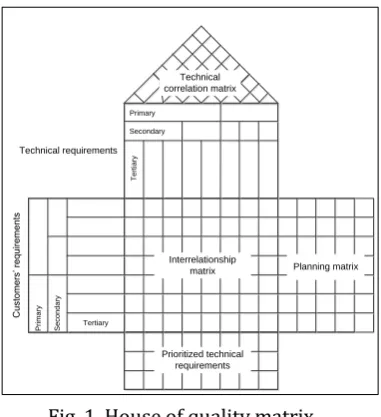
QFD methodology is the visual interpretation of a structured engineering process, and a set of interlinked engineering and management tools, which can establish priority of the customers using their voice, and transform it to design characteristics during development of the product. It simply prioritizes and links the product development process to ensure quality of the product as defined by the customers. Yoji Akao, who is regarded as the father of QFD, defined it as “a method for developing a design quality aimed at satisfying the consumer and then translating the consumer’s demands into design targets and major quality assurance points to be used throughout the production phase” [16]. QFD is also known as ‘customer-driven engineering’ and ‘matrix product planning’. Its whole concept is based on a sequence of operations to translate the voice of customers into the final product/service [17]. It is oriented towards concerning a team of people representing various functional departments that are involved in product development, like marketing, design, quality assurance, manufacturing/sales, testing, finance, product support etc. The main advantage of QFD methodology over the other approaches is that it can be applied for processing both qualitative and quantitative data, and can serve as a flexible framework which can be simplified, extended and combined with other quality design and improvement techniques. The QFD methodology can be best explained graphically through a set of matrices that captures a number of issues vital to the planning process. These matrices fit together to form a house-shaped diagram and hence, is also referred to as house of quality (HOQ). The HOQ matrix, as shown in Fig. 1, is the engine that drives the entire QFD process and provides means for interrelating customers’ requirements with technical requirements. The six building blocks of HOQ matrix are described as below:
a) Customers’ requirements - These are the ‘whats’ the customers want from the product to be developed and are also known as ‘voice of the customers’. They contain customers’ wishes, expectations and requirements from the product.
b) Technical requirements - These are the engineers’ understanding in technical terms that are to be built into a product with the intention to satisfy the customers’ requirements. They are sometimes referred to as ‘hows’ as they answer how can the customers’ requirements be addressed or satisfied.
c) Interrelationship matrix - The interior of the house describes the relationship between the customers’ requirements and design characteristics. In other words, this matrix relates ‘whats’ against ‘hows’.
d) Technical correlation matrix - The roof of the house contains the correlation or interrelationship between the design characteristics. The correlation matrix is used to identify which ‘hows’ items support one another and which are in conflict.
e) Planning matrix - It contains the quantified customers’ requirements and ranks them in order of their importance. The performance measurement of an organization with respect to the benchmarked organizations is described in this matrix.
Cu
st
omers’ requ
irem
ents
Technical requirements
Primary
Secondary
Tertiary
Second
ary
Tertiary
Primary
Interrelationship matrix
Prioritized technical requirements
Planning matrix Technical
correlation matrix
Fig. 1. House of quality matrix
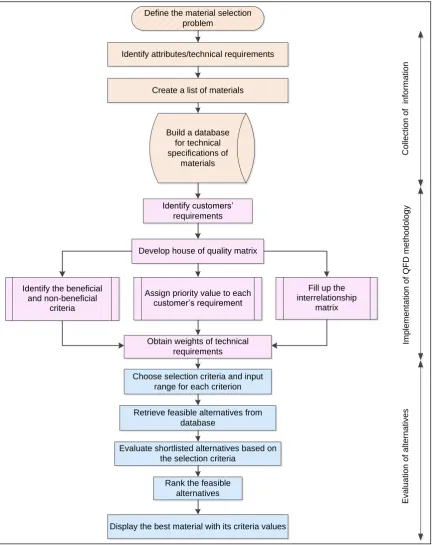
Depending on the type of problem, the HOQ matrix can take different forms. In this paper, a simplified HOQ is implemented after eliminating the planning and technical correlation matrices. The basic framework for development of this QFD-based expert system for materials selection is demonstrated in Fig. 2. It follows three basic steps, i.e. accumulation of the pertinent data for the considered material selection problem, implementation of QFD methodology and evaluation of the feasible alternatives to select the best material for a given product.
The first step for development of this expert system belongs to collection of appropriate data for creating the related materials’ properties database. For this, the technical requirements for various products are shortlisted after a detailed literature review and based on the opinions of the experts in material selection domain. After analyzing all the relevant material properties, the following 11 technical requirements are finally shortlisted for evaluation of the material alternatives.
a) Chemical resistance (in R scale) - measures the ability of a material to withstand corrosive actions. b) Density (in g/cc) - measures mass of a material per unit volume.
c) Hardness (in Vickers) - denotes material’s ability to withstand surface indentation.
d) Melting point (in °C) - is the temperature at which a material changes its state from solid to liquid at atmospheric pressure.
e) Price (in $/kg) - represents the cost of a material.
f) Thermal conductivity (in W/m-K) - measures the amount of heat transmitted through unit thickness of a material in a direction normal to a surface of unit area.
g) Coefficient of thermal expansion (in µm/m-°C) - shows the change in length of a material in response to change in temperature.
h) Toughness index (in MPa-m1/2) - relates the ability of a material to deform plastically and absorb
energy before fracture.
i) Ultimate tensile strength (in MPa) - denotes the maximum load in tension that a material can withstand prior to fracture.
j) Wear resistance (in R scale) - represents the resistance against frictional wear and tear. k) Young’s modulus (in GPa) - measures the stiffness of an elastic material.
Define the material selection problem
Identify attributes/technical requirements
Create a list of materials
Build a database for technical specifications of
materials
Identify customers’ requirements
Develop house of quality matrix
Assign priority value to each customer’s requirement Identify the beneficial
and non-beneficial criteria
Fill up the interrelationship
matrix
Obtain weights of technical requirements
Choose selection criteria and input range for each criterion
Retrieve feasible alternatives from database
Evaluate shortlisted alternatives based on the selection criteria
Rank the feasible alternatives
Display the best material with its criteria values
Co
llection
of
in
fo
rmation
Implem
entation
o
f QFD method
olog
y
Eval
uation of al
te
rnatives
Fig. 2. Framework for QFD-based expert system for materials selection.
is indicated by the corresponding value of the improvement driver (+1 for beneficial criteria and –1 for non-beneficial criteria). For beneficial criteria, higher values are preferred and for non-beneficial criteria, lower values are always recommended.
In this HOQ matrix, the relative importance of customers’ requirements is evaluated using a fuzzy triangular membership function having scale values set as 1 - not important, 2 - important, 3 - much more important, 4 - very important and 5 - most important. For filling up the interrelationship matrix showing the association between customers’ requirements and technical requirements, another fuzzy priority scale is proposed as 1 - very very weak relation, 2 - very weak relation, 3 - weaker relation, 4 - weak relation, 5 - moderate relation, 6 - strong relation, 7 - stronger relation, 8 - very strong relation and 9 - very very strong relation. These fuzzy numbers for providing the relative importance to customers’ requirements and technical requirements are later defuzzified using centroid method. Once the HOQ matrix is filled up with all the necessary data, the priority weights of all the technical requirements are derived using the following equation:
wj =
n
i 1
Pri ×IDi × Correlation index (1)
where wj is the weight for jthtechnical requirement, n is the number of customers’ requirements, IDi is the value of improvement driver for ith customer requirement, Pri is the priority assigned to ith customer requirement and correlation index is the relative importance of jth technical requirement with respect to ith customer requirement. These weights are subsequently employed to calculate the performance scores of the feasible material alternatives for a given product.
Now, all the feasible materials in the database are evaluated to arrive at the final material selection decision. For this, the end user needs to provide a set of criteria with their ranges of values to derive a list of the feasible material alternatives. After retrieving the final set of materials satisfying the criteria values, the related decision matrix for the given problem is generated. The decision matrix is then normalized and the performance score for each material alternative is computed applying the following expression:
PSi =
n
j j
w
1
× (Normalized value)ij (i = 1,2,…,m; j = 1,2,…,n) (2)
where wj is the weight for jthtechnical requirement, m is the number of alternatives and n is the number of technical requirements. The weights for the technical requirements are retrieved from the corresponding HOQ matrix. Based on these performance scores, the alternative materials are then ranked and the most appropriate material for the given product is finally identified along with its all important properties.
4.
Illustrative Examples
4.1.
Example 1
considered, but essentially the designer has to choose such a milling cutter material that should machine the work material to its desired shape and specifications with the minimum possible cost. A typical end milling cutter is shown in Fig. 3.
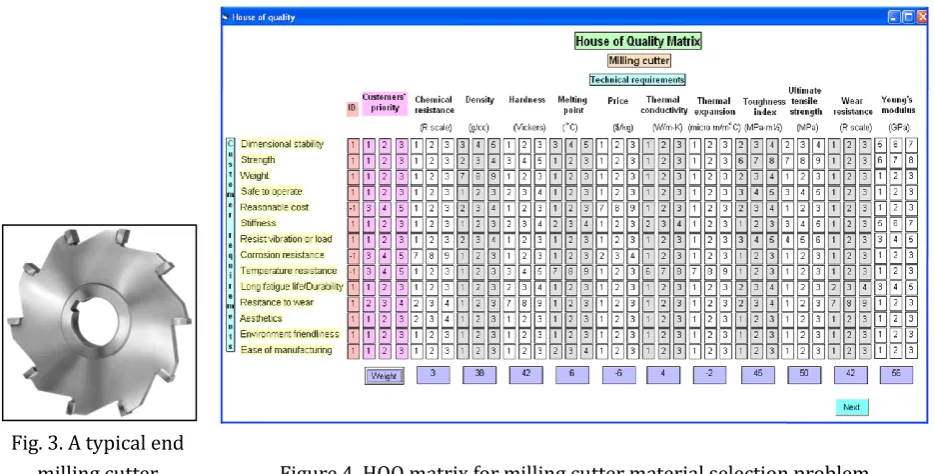
The developed QFD-based expert system is now employed to solve this milling cutter material selection problem. The related HOQ matrix for this problem, as exhibited in Figure 4, is filled up with the necessary data and the priority weights for the considered technical requirements of the milling cutter materials are computed on pressing ‘Weight’ functional key. Negative priority weights for price and coefficient of thermal expansion identify them as non-beneficial attributes. On the other hand, values of negative improvement drivers indicate that reasonable price, corrosion resistance and temperature resistance are non-beneficial customers’ requirements.
Fig. 3. A typical end
milling cutter Figure 4. HOQ matrix for milling cutter material selection problem
Milling cutter material should possess reasonable hardness and must be made of a material harder than the material to be milled. Hardness of a milling cutter material is the measure of how resistant the material is to various localized deformations when a force is externally applied. Young’s modulus of a milling cutter material is defined as the slope of its stress-strain curve in the elastic deformation region, i.e. ratio of tensile stress to tensile strain. Ultimate tensile strength is the maximum stress that a milling cutter material can withstand while being stretched or pulled before failing or breaking. Thermal conductivity is the property of a milling cutter material that indicates its capability to conduct heat. The higher the value of thermal conductivity, the better the material is in conducting heat.
higher values. Pressing of ‘Suitable alternatives’ functional key then identifies those candidate materials which satisfy all the preset ranges of criteria values. Among those material alternatives, ten materials, i.e. Alumina, Cubic boron nitride (CBN), high speed steel (HSS), Silicon carbide, Silicon nitride, synthetic polycrystal diamond, Tantalum carbide, Titanium nitride, Tungsten carbide and Zirconia are ultimately identified for further analysis to choose the most appropriate material for an end milling cutter. The physical characteristics of those ten materials along with their applications are detailed out here-in-under.
The desired properties of all HSS grades include high working hardness, high wear resistance, excellent toughness and compressive strength, high red hardness and strength to prevent breakage on the cutting edge. These properties make them suitable for manufacturing of tools, such as drills, taps, hobs and broaching tools, while ensuring high tool life with low maintenance cost. Silicon carbide (SiC) composed of tetrahedral atoms of carbon and silicon with strong bonds in the crystal lattice produces a very hard and strong material which is not attacked by acids, alkalis or molten salts up to 800°C temperature. Its basic characteristics include low density, high strength, low thermal expansion, high thermal conductivity, high hardness, high elastic modulus, excellent thermal shock resistance and superior chemical inertness. It is an excellent abrasive material, and has been widely used to manufacture grinding wheels and other abrasive products over the years. Silicon nitride (Si3N4) offers high strength over a wide temperature range, high
toughness index, high hardness, outstanding wear resistance, good thermal shock resistance and excellent chemical resistance. Its typical applications include manufacturing of rotating balls and roller bearings, cutting tools, turbine blades, vanes, buckets, precision shafts and axles in high wear environments. Cubic boron nitride (CBN) is a combination of boron and nitrogen. Super-hard milling cutter materials primarily consist of diamond and CBN. The crystal structures of both are the same with all unit cells in diamond crystal composed of carbon atoms, and CBN crystal being composed of boron atoms alternating equally with nitrogen atoms. Zirconia (Zr2O) adopts a monoclinic crystal structure at room temperature, with
transitions to tetragonal and cubic structures at higher temperatures. It is primarily used in the production of ceramics, with the other application as a refractory material in insulators and abrasives. The most common form of crystalline alumina (Al2O3) is known as corundum. The oxygen ions nearly form a
hexagonal close-packed structure with aluminium ions filling two-thirds of the octahedral interstices. It is also widely used as cutting tools. Titanium nitride (TiN) is a tremendously hard abrasive ceramic material, being available in the form of black powder with NaCl-type face centered cubic crystal structure. It has high hot hardness, high strength, good toughness and excellent wear resistance properties, which make it suitable for cutting tools, forming dies, grinding abrasives and other wear-resistant applications. The tungsten metal powder can be converted to tungsten carbide (WC) through reaction with pure carbon powder. This compound has very good resistance to chemical attack and high hot hardness. As the most important tungsten compound, it is used to make wear-resistant abrasive materials for grinding wheels, circular saws, and milling and turning tools used in metalworking, woodworking, mining, petroleum and construction industries. Tantalum carbide (TaC) is an extremely hard, refractory ceramic material possessing electrical conductivity. It is a non-porous material having excellent resistance to wear and corrosion, high dimensional stability and average resistance to thermal shock. The synthetic polycrystal diamonds are produced by powerful explosion, which transforms graphite into diamond. This process yields polycrystal diamonds, each consisting of thousands of micro-crystallites bonded together. Synthetic polycrystal diamonds have high wear resistance, high shock resistance, good thermal stability and homogeneous structure. The polycrystal diamonds are the only type of diamonds having self-sharpening properties through which new sharp edge opens up every time following release of an outer layer of dull micro-crystallites.
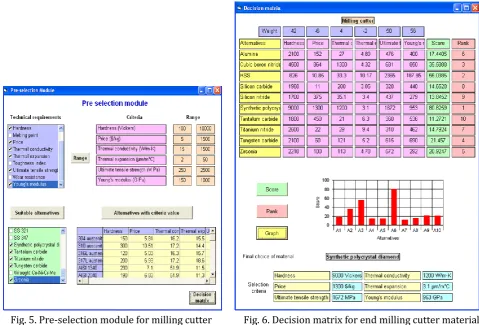
the corresponding decision matrix, as shown in Fig. 6. It is a filled up evaluation matrix containing criteria values of the considered material alternatives. From this decision matrix, the material performance scores are calculated using Eqn. (2) when ‘Score’ key is pressed. Pressing of ‘Rank’ and ‘Graph’ functional keys respectively provides a complete ranking order of the milling cutter materials based on their performance scores and pictorically identifies the best performing material. For this end milling operation, synthetic polycrystal diamond is identified as the most suitable choice.
Fig. 5. Pre-selection module for milling cutter material selection problem.
Fig. 6. Decision matrix for end milling cutter material selection problem.
The superiority of synthetic polycrystal diamond over the other materials is due to its very high hardness, thermal conductivity and ultimate tensile strength, which are the most desirable properties for an end milling cutter. But, the practical use of synthetic polycrystal diamond as a milling cutting material is often restricted due to its high cost and graphitization problem at elevated temperatures. This stimulates the designers to opt HSS as the milling cutter material and it also occupies the second best position in the ranking list. It has the least possible cost and highest ultimate tensile strength among the other materials, while its performance with respect to the remaining criteria is also satisfactory. Thus, it becomes the most preferred material for end milling cutters. Tantalum carbide evolves out as the worst chosen material.
4.2.
Example 2
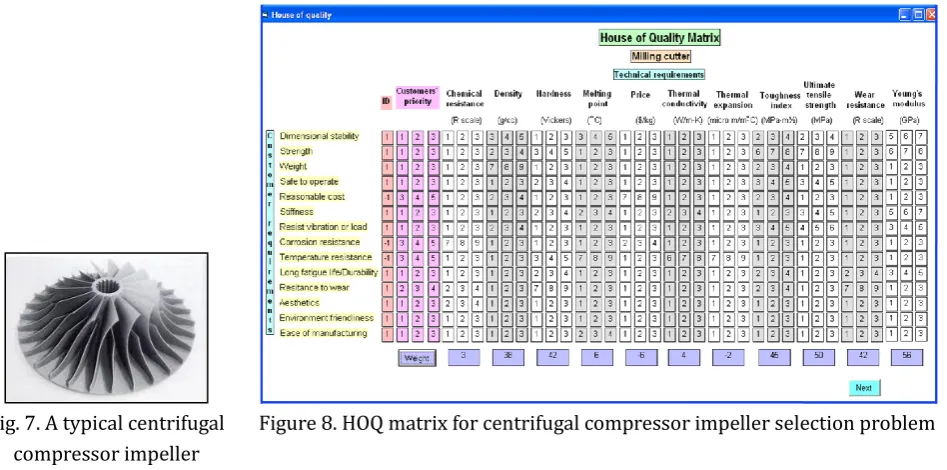
compressed in the proceeding diaphragm, while the shaft provides support and rotation to the impellers. Considering the importance of impellers, utmost attention needs to be provided for their design and manufacture. Generally, centrifugal compressor impellers are fully shrouded, consisting of a solid hub and cover separated by equally spaced radial blades. The blades of the impeller hub are usually attached to the cover by welding, integral casting, brazing, riveting, integral machining of the hub with the cover or a combination of these methods. Today, for most of the impellers, the blades are integrally machined to the impeller hub or cover and then welded to the non-machined blade hub or cover. The choice of materials for a centrifugal compressor impeller requires consideration of a number of design, operating and environmental factors. A typical centrifugal compressor impeller is shown in Fig. 7.
The developed QFD-based expert system is now implemented for this centrifugal compressor impeller material selection problem. The HOQ matrix of Fig. 8 is filled up with the necessary fuzzy scale values and the priority weights for 11 technical requirements are then obtained.
Fig. 7. A typical centrifugal compressor impeller
Figure 8. HOQ matrix for centrifugal compressor impeller selection problem
Alloy steel (AISI 304) has very good corrosion resistance, high ductility, and excellent drawing, forming and spinning properties. It is essentially non-magnetic and becomes slightly magnetic when cold worked. Its low carbon content causes less carbide precipitation in the heat-affected zone during welding and provides less susceptibility to intergranular corrosion. Alloy steel (AISI 4140) possesses high fatigue strength, abrasion and impact resistance, toughness and torsional strength, making it a suitable material for manufacturing of break dies, bending dies, support tooling, die holders, gears, flanges, collets, arbors, spindles and axles, clutch parts, forming rolls, compressor impellers, wrenches and various machine tool components. Alloy steel (AISI 4340) has high toughness and strength in the heat-treated condition. AISI 4340 alloy steel is mainly used in power transmission gears and shafts, aircraft landing gears and other structural parts. Aluminium alloy (Al 2025 T6) has copper as the key alloying element. When the alloys from this series are heat-treated, the mechanical properties become better than those of medium steel. Al 2025 T6 is a heat-treatable wrought alloy, chiefly used in aircraft structures and propellers, centrifugal compressor impellers, automotive bodies and screw fittings. Aluminium alloy (Al 7050 T73) is the premier choice for aerospace and impeller blade applications which require the best combination of strength, stress corrosion cracking resistance and toughness. It exhibits better toughness and corrosion resistance characteristics than other aluminium alloys. Since, it is less quench sensitive than most of the aerospace aluminum alloys, it retains its strength properties in thicker sections while maintaining good stress corrosion cracking resistance and fracture toughness. Aluminium alloy (Al C355) is mainly used in sand casting, permanent mold casting and manufacturing of compressor impeller blades. Low density precipitation hardnable nickel base alloy (USN 7716) is chemically resistant, which allows its application in wet chlorine gas environments. USN 7716 has been successfully applied in aggressive coal gasification applications. For temperatures down to -195.56˚C, this alloy has widely been accepted for impellers in compressors for boil-off gas from liquid methane due to its high toughness index at low temperatures. Monel K500 is a nickel-copper alloy which has excellent corrosion resistance with the added advantages of higher strength and hardness. The typical applications of Monel K500 are chains and cables, fasteners and springs for marine service, pump and valve components for chemical processing, impeller blades and scrapers for pulp processing in paper production, oil well drill collars and instruments, pump shafts and impellers, non-magnetic housings, safety lifts and valves for oil and gas production. Titanium is a light transition metal with a white-silvery-metallic color. It is strong, lustrous and corrosion resistant. Pure titanium is not soluble in water but is soluble in concentrated acids. It forms a passive but protective oxide coating (leading to corrosion resistance) when exposed to elevated temperatures in air, but at room temperatures, it resists tarnishing. Titanium alloy (Ti6Al4V) has good machinability and excellent mechanical properties. It offers the best all round performance for a variety of weight reduction applications in aerospace, automotive and marine equipments.
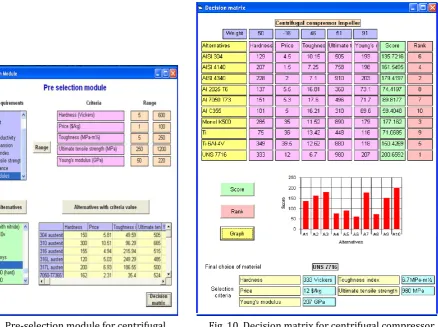
After retrieving the list of alternative materials, the relevant filled up decision matrix is automatically generated in Figure 10. The performance score and rank for each material is then obtained by pressing the ‘Score’ and ‘Rank’ functional keys respectively. When ‘Graph’ key is pressed, a graphical representation showing the positions of the materials in the ranking list is displayed. Finally, the best suited material along with its physical properties is identified for the centrifugal compressor impeller.
Fig. 9. Pre-selection module for centrifugal compressor impeller material selection problem.
Fig. 10. Decision matrix for centrifugal compressor impeller material selection problem.
5.
Conclusions
Manufacturing requirements are on rise with varying customers’ wants and near about daily introduction of new-fangled product varieties. Decision makers of those enterprises must emphasize on reducing costs, improving quality and customization for long term sustainability. In this paper, a real time expert system is designed and developed based on QFD methodology for selecting the most appropriate materials for varying engineering components. It relates the dynamic requirements of customers with technical specifications of the materials and identifies the most suitable material for a particular product. This expert system relieves the designers to have any in-depth technical knowledge regarding various physical characteristics of the considered materials. It also eases out and automates the entire material selection procedure while eliminating the rigorous mathematical calculations involved in decision making. The graphical user interface built in Visual BASIC 6.0 facilitates an immaculate interaction of the expert system with the end user. Adoption of triangular fuzzy numbers for assigning priorities to customers’ requirements, and exploring the interrelationship between customers’ requirements and technical requirements also facilitates its application in a group decision making environment. It can be successfully employed for solving any type of material selection problem. The database of this expert system can be updated from time to time to make it more dynamic and exhaustive. The derived benefits from the implementation of this expert system would be minimized overall cost of production, reduced instances of design failure, superior utilization of knowledge and improved employee productivity.
References
[2] Kumar, S. & Singh, R. (2007). A short note on an intelligent system for selection of materials for progressive die components. Journal of Materials Processing Technology, 182(1-3), 456–461.
[3] Ho, Y. H., Chen, Huang, C. H. &, C-L. (2010). A hierarchical hybrid expert system for steel welding materials selection system. Proceedings of 3rd International Symposium on Knowledge Acquisition and
Modeling, China, 171–174.
[4] Lan, Y., Guan, Z., Jiao, Q. & Xu, G. (2010). A web-based computer-aided material-selection system for aircraft design. Proceedings of WASE International Conference on Information Engineering, China, 109–
113.
[5] Sapuan, S. M., Mun, N. K., Hambali, A., Lok, H. Y., Fairuz, A. M. & Ishak, M. R. (2011). Prototype expert system for material selection of polymeric composite automotive dashboard. International Journal of the Physical Sciences, 6(25), 5988-5995.
[6] Zarandi, M. H. F., Mansour, S., Hosseinijou, S. A. & Avazbeigi, M. (2011). A material selection methodology and expert system for sustainable product design. International Journal of Advanced Manufacturing Technology, 57(9-12), 885–903.
[7] Butilă, E.V. & Gîrbacia, F. (2011). Expert system for chose material used gears. World Academy of Science, Engineering and Technology, 55(2), 157–159.
[8] Rahman, S., Odeyinka, H., Perera, S. & Bi, Y. (2012). Product-cost modelling approach for the development of a decision support system for optimal roofing material selection. Expert Systems with Applications, 39(8), 6857–6871.
[9] Fairuz, A. M., Sapuan, S. M. & Zainudin, E. S. (2012). Prototype expert system for material selection of polymeric-based composites for fishing boat components, Food, Agriculture and Environment, 10(3-4), 1543–1549.
[10]İpek, M., Selvi, İ. H., Findik, F., Torkul, O. & Cedimoğlu, I. H. (2013). An expert system based material selection approach to manufacturing. Materials & Design, 47, 331–340.
[11]Prasad, K. & Chakraborty, S. (2013). A quality function deployment-based model for materials selection.
Materials & Design, 49, 525–535.
[12]Mayyas, A., Omar, M. A., Mayyas, A. R., Qattawi, A. & Shen, Q. (2014). Knowledge-based system, equipped with cluster analysis for eco-material selection: An automobile structure case study.
International Journal of Sustainable Engineering, 7(3), 200-213.
[13]Sanyang, M. L. & Sapuan, S. M. (2015). Development of expert system for biobased polymer material selection: Food packaging application. Journal of Food Science and Technology, 52(10), 6445-6454. [14]Urrea, C., Henríquez, G. & Jamett, M. (2015). Development of an expert system to select materials for
the main structure of a transfer crane designed for disabled people. Expert systems with Applications, 42(1), 691-697.
[15]Zhang, Y., Luo, X., Zhao, Y. & Zhang, H. C. (2015). An ontology-based knowledge framework for engineering material selection. Advanced Engineering Informatics, 29(4), 985-1000.
[16]Akao, Y. (1990). Quality Function Deployment. Cambridge, MA: Productivity Press.
Kanika Prasad is working as a DST research fellow in Production Engineering Department, Jadavpur University, Kolkata. She graduated in Mechanical Engineering from Sikkim Manipal Institute of Technology, Sikkim in 2010. She completed her Master of Engineering in Production Engineering from Jadavpur University, Kolkata in 2013. She has worked with Sikkim Manipal Institute of Technology as an Assistant Professor for almost a year and taught various undergraduate subjects, like Operation Research, Theory of Machines, Manufacturing Process etc. At present, her research interests include applications of quality function-based method for manufacturing decision-making.
Shankar Chakraborty is a Professor in Production Engineering Department of