Please cite this article as: S. P. Challagulla, C. Parimi, S. C. Mohan, E. Noroozinejad Farsangi, Seismic Response of Building Structures with Sliding Non-structural Elements, International Journal of Engineering (IJE), IJE TRANSACTIONS B: Applications Vol. 33, No. 2, (February 2020) 205-212
International Journal of Engineering
J o u r n a l H o m e p a g e : w w w . i j e . i rSeismic Response of Building Structures with Sliding Non-structural Elements
S. P. Challagullaa, C. Parimia, S. C. Mohana, E. Noroozinejad Farsangi*b
a Department of Civil Engineering, BITS-Pilani, Hyderabad, India
b Faculty of Civil and Surveying Engineering, Graduate University of Advanced Technology, Kerman, Iran
P A P E R I N F O
Paper history:
Received 13 December 2019
Received in revised form 01 January 2020 Accepted 17 January 2020
Keywords: Primary Structure Secondary Bodies Coulomb Friction Sliding Effect Seismic Hazard Level
A B S T R A C T
Interaction between a structure under base excitation and heavy non-structural elements that it supports is significant in the seismic analysis and design of the structure. Heavy non-structural elements may slide/rock under base excitation, and this dynamic action affects the seismic behavior of the supporting structure. Hence, in this study, a numerical model was presented to describe the seismic behavior of a primary structure (PS) supporting non-structural elements referred to as secondary bodies (SBs). The governing equations of motion for PS and SBs were developed considering Coulomb's friction model. Seismic hazard levels corresponding to Indian seismic zone III (medium hazard level) and V (highest hazard level) were considered. A parameter called displacement ratio (DR) was defined to quantify the sliding effect of SBs on the displacement response of the PS. A parametric study has been conducted to understand the variation in the DR due to varied time period of the structure, live loads to structure mass ratios and coefficients of friction between PS and SBs. From the analysis of results, it was concluded that the DR varies significantly with the time period, mass ratios, and coefficient of friction values. It can also be found from the study that the energy dissipation due to sliding of SBs was more in the highest hazard level than medium hazard level. Finally, the conditions for which the full mass of sliding secondary bodies should be considered in the seismic design of the structure are also presented.
doi: 10.5829/ije.2020.33.02b.04
NOMENCLATURE
PS Primary structure 𝑇𝑝 Structural period (s)
SBs Secondary bodies k Lateral stiffness of the Primary structure (N/m) DR Displacement Ratio c Damping coefficient (N-s/m)
𝑚𝑝 Mass of the Primary structure (kg) Greek Symbols
𝑚𝑏𝑖 Mass of the ith secondary body (kg) 𝜇𝑠𝑖 Static coefficient of friction between PS and ith SB 𝑢𝑔 Ground displacement (m) 𝜇𝑘𝑖 Kinematic coefficient of friction between PS and ith SB 𝑢𝑝 Displacement of the Primary structure (m) 𝛼𝑖 Mass ratio of the ith secondary body
𝑢𝑏𝑖 Displacement of the ith Secondary body (m)
1. INTRODUCTION1
Damage to non-structural elements (NSEs) can occur even at low levels of ground shaking [1]. Non-structural elements whose anchorage mechanism is not proper or with no anchorages are more vulnerable to earthquakes [2, 3]. Sliding of such NSEs can result in economic loss and injury. The literature on these types of NSEs ranges from the closed-form and numerical solutions describing the sliding displacement of NSEs under base excitations
*Corresponding Author Email: [email protected] (E. Noroozinejad Farsangi)
friction. Although the sliding of these elements is not commonly considered in structural design, consideration of sliding may reduce the portion of the live load that should be considered [11]. However, the above studies derived conclusions based on single sliding live loads on the supporting structure for a given seismic hazard level. But in reality, there exist multiple sliding live loads on the supporting structure. The dynamic behavior of a structure will be very different with multiple sliding bodies on it. Containers used for storage in pile-supported structures, heavy leads blankets draped on scaffolding structure in the nuclear industry, critical and sensitive laboratory equipment, spent nuclear fuel storage casks, etc., are few examples of such objects. Therefore, it is important to study multiple loads sliding on the seismic response of the supporting structure.
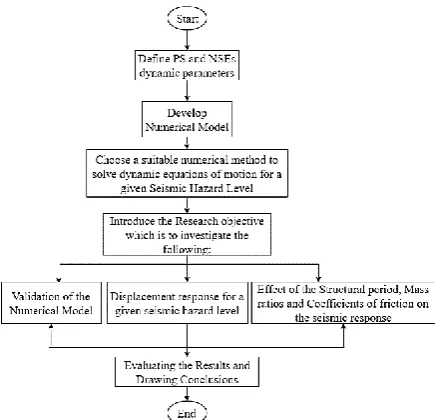
In response to the previous research limited to a single sliding rigid block, this paper presents the theoretical background and numerical model to depict the dynamic interaction between a multiple sliding rigid blocks and its supporting single-degree of freedom (SDOF) primary structure. The seismic response of the structure is obtained by varying the structural period, mass ratios, and coefficient of friction values for a given seismic hazard level. An overview of the steps of the research methodology is illustraed in Figure 1.
The organization of the paper is as follows: Section 2 describes the problem statement. Section 3 presents the numerical model and the governing equations of motion. Sections 4 and 5 present the details of the earthquakes and results for validating the present study with the existing study, respectively. Sections 6 and 7 present the analysis and parametric study results. Concise conclusions are drawn in the last section (i.e., Section 8).
Figure 1. Flow chart of Research Methodology
2. PROBLEM STATEMENT
In this study, the seismic behavior of an SDOF primary structure with multiple sliding live load objects is investigated under real earthquake excitations. Spectrum compatible ground motions are used in the analysis of the SDOF structure with SBs. The equations governing the motion of primary and secondary masses are developed considering Coulomb's friction model [12]. The equations were solved by the 4th order Runge-Kutta method. The following are the assumptions made in this study:
• The single-degree primary structure is linearly elastic.
• Static and kinematic coefficients of friction are equal in magnitude.
• Live load objects are sufficiently squat as to slide but not rock.
•
Live load objects are far enough from each other and other obstructions as to not cause impact collision between them.3. NUMERICAL MODEL
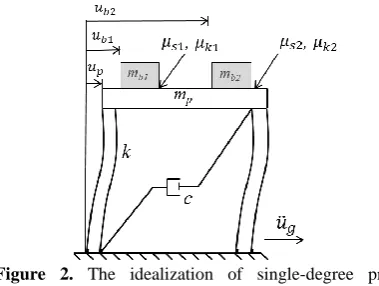
A single-degree primary structure (PS) with mass 𝑚𝑝, lateral stiffness k and viscous damping c with multiple secondary bodies is considered. Figure 2 shows the structure with secondary bodies. Let 𝜇𝑠𝑖 and 𝜇𝑘𝑖 be the static and kinematic coefficients of friction between the structure (𝑚𝑝) and the 𝑖𝑡ℎ secondary body (𝑚𝑏𝑖). Static and kinematic coefficients of friction are assumed as equal in this study (𝜇𝑠𝑖 = 𝜇𝑘𝑖, say 𝜇𝑖). The displacements of the primary structure, 𝑖𝑡ℎ secondary body and the ground are defined as 𝑢𝑝, 𝑢𝑏𝑖and 𝑢𝑔 respectively. The dynamic equations of motion for the system can be written as follows:
A function stick is defined as shown in Equation (1) to check the stick/slip behavior between the bodies.
stick(𝑢𝑔,𝑢𝑝, 𝑢𝑏,𝜇𝑠) = (|𝑢̈𝑝+ 𝑢̈𝑔| < 𝜇𝑠𝑔) & (𝑢̇𝑝=
𝑢̇𝑏 )
(1)
If stick = 1 (True), then the secondary body sticks to the primary structure.
= 0 (False), the body slides (𝜇𝑘 is active)
Note that 𝒔𝒕𝒊𝒄𝒌′is the slip condition. Let n be the number of secondary bodies placed on the primary structure. The dynamic equations of motion are derived as follows:
For the primary structure
[{𝑚𝑝+ ∑𝑛𝑗=1𝑚𝑏𝑗 𝑠𝑡𝑖𝑐𝑘(𝑢𝑔,𝑢𝑝, 𝑢𝑏𝑗,𝜇𝑠𝑗)}(𝑢̈𝑝+
𝑢̈𝑔)] + 𝑐𝑢̇𝑝+ 𝑘𝑢𝑝=
∑ 𝑠𝑡𝑖𝑐𝑘
′(𝑢
𝑔,𝑢𝑝, 𝑢𝑏𝑖,𝜇𝑠𝑖)𝜇𝑘𝑖𝑚𝑏𝑖𝑔
. 𝑠𝑖𝑔𝑛(𝑢̇𝑏𝑖 − 𝑢̇𝑝)
𝑛
𝑖=1
𝑠𝑖𝑔𝑛 is the mathematical signum function, which equals to +1 if the relative velocity (𝑢̇𝑏𝑖 − 𝑢̇𝑝) is positive, -1 if the relative velocity (𝑢̇𝑏𝑖 − 𝑢̇𝑝) is negative, or zero if relative velocity (𝑢̇𝑏𝑖 − 𝑢̇𝑝) = 0.
For all the sliding secondary bodies (only when 𝒔𝒕𝒊𝒄𝒌(𝑢𝑔, 𝑢𝑝, 𝑢𝑏𝑖, 𝜇 𝑠𝑖) = 0
𝑚𝑏𝑖(𝑢̈𝑏𝑖+ 𝑢̈𝑔) + 𝜇𝑘𝑖𝑚𝑏𝑖𝑔. 𝑠𝑖𝑔𝑛(𝑢̇𝑏𝑖 − 𝑢̇𝑝) (3)
It should be noted that if I bodies are sliding, the total number of equations to be solved are I+1 (Equations (2) and (3)). The above governing dynamic equations of motion of PS and SBs in stick and slip mode are solved by the 4th order Runge-Kutta method. In subsequent discussions, the mass ratio (𝛼𝑖) and original structural period (𝑇𝑝) are introduced and defined as shown in Equations (4) and (5):
𝛼𝑖=
𝑚𝑏𝑖 𝑚𝑝
, ∀ 𝑖 = 1 𝑡𝑜 𝑛 (4)
𝑇𝑝= 2𝜋√
𝑚𝑝
𝑘 (5)
4. SELECTION OF STRONG GROUND MOTIONS
In order to capture the effect of sliding bodies on the dynamic behavior of a structure, 11 earthquake excitations were selected from the PEER NGA WEST2 ground motion database [13] which is the minimum required number of ground motions as per ASCE 7-16 [14]. The moment magnitude (Mw) of the selected excitations is greater than 6. Excitations are made compatible with the design spectrum associated with seismic zones III and V, hard soil with 5% damping by the spectral matching method in the time domain. The details of the excitations are shown in Table 1. Figure 3 shows the IS 1893:2016 [15] design spectra as a target spectrum associated with 5% damping.
Figure 4 shows the 5%-damping mean response spectrum of the 11 earthquake excitations. The average
Figure 2. The idealization of single-degree primary structure with two SBs
spectrum or mean spectrum does not fall below 90% of the target spectrum in the entire period range as per ASCE 7-16.
5. VALIDATION OF THE STUDY
It is necessary to verify the numerical model before conducting further studies.
The validation of the numerical model in this study is done by comparing the velocity responses of the PS and rigid block obtained in this study with the velocity responses of the supporting structure and rigid block obtained by the Nigam-Jennings method based on the
TABLE 1. Specifications of strong ground motions used in the current study
No. Event Year Station PGA (g)
Magnitude (Mw)
1 Kern
County 1952
Taft Lincoln
School 0.18 7.36
2 Loma Prieta 1989
Fremont-Mission San
Jose
0.12 6.93
3 Landers 1992 Barstow 0.13 7.28
4
Duzce-Turkey 1999 Lamont 1059 0.15 7.14
5 Chi-Chi 1999 TCU075 0.22 6.21
6 Chi-Chi 1999 CHY028 0.20 6.20
7 Chi-Chi 1999 CHY046 0.12 6.22
8 San
Simeon 2003
San Luis
Obispo 0.16 6.52
9 Parkfield 1966
Cholame-Shandon Array #12
0.06 6.19
10 Iwate 2008 Semine
Kurihara city 0.16 6.91
11 Parkfield 1966 Temblor pre-1969 0.35 6.19
Figure 4. Target and mean acceleration spectra for 5% damping
exact solutions reported in literature [16]. Hence, the primary structure (𝑚𝑝) with a single sliding rigid block (𝑚𝑏1) is considered. The velocity responses of the structure and rigid block are plotted for stick, stick-slip, and slip-slip conditions. For validating the numerical model, the slip-slip condition is arbitrarily chosen. The dynamic structural properties, rigid block parameters, and forcing function parameters used for the slip-slip mode in the literature [16].are given as input parameters to the numerical model in this study. Figure 5 shows an acceptable correspondence between this study and the velocity responses reported in literature [16].for slip-slip mode.
6. DISPLACEMENT RESPONSE
Previous research studies confirm the effect of a single sliding rigid block on the seismic response of the supporting structure. This study tries to investigate the
(a)
(b)
Figure5. Velocity responses (a) primary structure (b) rigid block
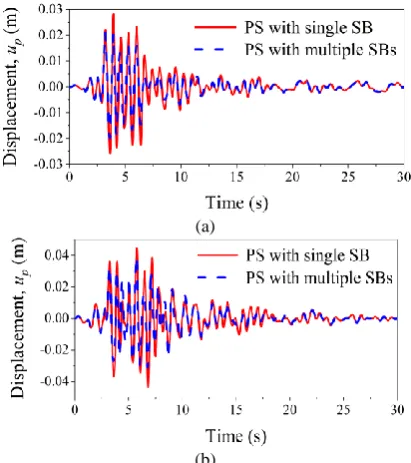
The structural period of the PS is chosen as 0.5 s. In the case of PS with multiple SBs, the mass ratios (𝛼1 and 𝛼2) are 0.5 and 0.5. The coefficients of friction (𝜇1 and 𝜇2) are 0.3 and 0.1. The mass ratio and coefficient of friction in the case of PS with single SB are 1 and 0.3, respectively. Earthquake excitation-#11 from Table I is applied to the base of the PS with single and two SBs.
Figure 6 shows the displacement time histories of the PS with single and multiple SBs. Since the maximum displacement of the PS is of great concern for the design of the structures, maximum displacements of PS with single and two SBs for a given excitation corresponds to seismic zone III are 0.028 m and 0.021 m, respectively. For seismic zone V, those values are 0.044 m and 0.039 m. The maximum displacement of the PS with two SBs is reduced by 25% in zone III, and 11.36 % in zone V compared to PS with single SB, respectively.
Hence seismic behavior of the PS with multiple sliding rigid blocks is different from the structure with a single sliding rigid block. Similarly, Figure 7 shows the displacement time history of the PS with single and multiple SBs with the same coefficients of friction (𝜇1= 𝜇2 = 0.1) between the structure-SBs interfaces. From Figure 7, it can be concluded that PS with two SBs is dynamically similar to the PS with single SB when the coefficients of friction are the same.
This conclusion leads to a further discussion on the response of the PS with multiple sliding rigid blocks. In order to verify the effect of seismic hazard level on the response of the PS with multiple SBs, the effect of two rigid sliding blocks (𝑚𝑏1 and 𝑚𝑏2) on the displacement response of the primary structure in two seismic zones
(a)
(b)
III and V are studied. One ground motion from each seismic hazard level is applied to the PS with SBs. The structural period of the PS is arbitrarily chosen as 0.8 s. Mass ratios (𝛼1 and 𝛼2) are chosen as 0.5. Coefficients of friction (𝜇1 and 𝜇2) are chosen as 0.2 and 0.1 between the blocks and structure interface.
The displacement response of the structure with sliding loads ((𝑢𝑝)𝑠𝑙𝑖𝑑𝑖𝑛𝑔) is compared against the response of the same structure with rigidly fixed SBs ((𝑢𝑝)𝑟𝑖𝑔𝑖𝑑). From Figure 8, it can be deduced that sliding live loads can mitigate the seismic response of the primary structure when compared to PS with rigidly
(a)
(b)
Figure 7. Displacement of PS for same coefficients of friction (a) Zone III (b) Zone V
(a)
(b)
Figure8. Displacement of primary structure (a) Zone III (b) Zone V
attached SBs. The reduction in displacement is more in zone V (31.4%) compared to zone III (17.3%). This is because acceleration experienced by the structure is more in zone V, which overcome the static friction between block-structure interface, and hence sliding of the SBs is higher. Due to the higher sliding of SBs, more energy is dissipated in the highest seismic hazard level when compared to the medium seismic hazard level.
7. PARAMETRIC STUDY
The numerical model was used to evaluate the seismic response of the single-story primary structure. A parametric study has been conducted by changing the parameters: (1) structural period, (2) the blocks-to-structure mass ratio, (3) the coefficient of friction at the interface of the blocks and structure. Viscous damping ratio was taken as 5% of the critical damping of the primary structure. In this study, a parameter called displacement ratio (DR) is introduced as shown in Equation (6) to quantify the effect of sliding live loads on the seismic response of the primary structure since drift is the widely accepted parameter due to its accepted correlation with structural and non-structural damage [10, 17]. It is calculated as follows:
𝐷𝑅 = (𝑢𝑝)𝑠𝑙𝑖𝑑𝑖𝑛𝑔−(𝑢𝑝)𝑓𝑟𝑒𝑒
(𝑢𝑝)𝑟𝑖𝑔𝑖𝑑−(𝑢𝑝)𝑓𝑟𝑒𝑒 (6)
(a)
(b)
Figure9. Displacement Ratio (DR) for zone III, 𝜇1= 0.1
(𝑢𝑝)𝑠𝑙𝑖𝑑𝑖𝑛𝑔 is the displacement of the PS with sliding live
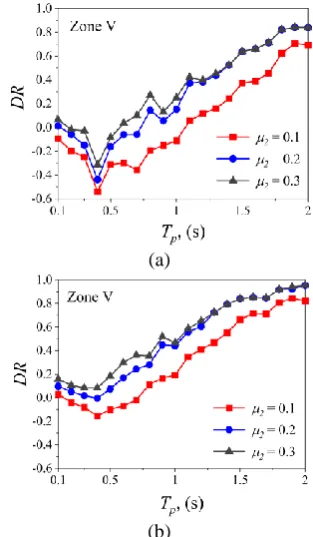
loads. (𝑢𝑝)𝑟𝑖𝑔𝑖𝑑 and (𝑢𝑝)𝑓𝑟𝑒𝑒 are the displacements of the same structure with rigidly fixed SBs and with no SBs respectively. In every case, displacement was defined as the mean value of the maximum displacements obtained for an array of eleven scaled ground motions corresponding to each seismic hazard level. A DR equal to one indicates that SBs behave as rigidly attached bodies to the PS. The effect of sliding live loads on the seismic response of the structure is negligible when DR is close to zero. The rigid sliding blocks mitigate the response of the primary structure if DR is negative. If DR varies between 0 and 1, only some portion of the mass of SBs has to be considered in the seismic analysis of the PS.
Figure 9 summarizes the results for the displacement ratio (DR) for medium seismic hazard level (zone III). It can be observed that DR varies significantly with the structural period, coefficient of friction, and mass ratios. This behavior agrees with the conclusion reported in literature [18]. A practical implication that can be drawn from Figure 9 is that sliding rigid blocks on structures with 𝑇𝑝> 1.3 s could behave as rigidly attached to the PS since DR = 1 regardless of the blocks-to-structure mass ratios. As observed from Figure 9a, DR decreases for structures with periods less than or equal to 0.4 s. This is because ground acceleration increases with the structural period up to 0.4 s as observed from the given spectra (Figure 3), and hence they overcome the static friction, and sliding of SBs takes place. For structures with 𝑇𝑝>
0.4 s, DR increases significantly with coefficients of friction since ground acceleration decreases with 𝑇𝑝. For higher mass ratios, the decreases in DR is very minimal and increases significantly with structural period and coefficient of friction values (Figure 9b). For a given seismic hazard level, an increase in mass ratio results in an increase in limiting static frictional force between the interfaces of the PS and SBs. Due to this, an effective period of the structure-SBs system increases, which results in the lower accelerations that are insufficient to overcome the friction between the SBs and PS. Hence, higher mass ratios are significant on the seismic response of the PS. DR is positive for higher mass ratios even for the small coefficient of friction and hence some portion of SBs participates in the inertia of the PS as shown in Figure 9b. This behavior is observed in the literature [19]. Figure 10 presents the results for the displacement ratio (DR) for the highest seismic hazard level (zone V). Figure 10 shows that also for the highest seismic hazard zone, the DR significantly decreases for structures with periods less than or equal to 0.4 s for lower mass ratios. For higher mass ratios, DR increases significantly with structural period and coefficients of friction values. From Figures 9 and 10, it can be observed that DR values in zone V are less than the values in the zone III for the given input parameters.
(a)
(b)
Figure10. Displacement Ratio (DR) for zone V, 𝜇1= 0.1
(a) 𝛼1 = 𝛼2 = 0.5; (b) 𝛼1 = 𝛼2 = 1
This is because, zone V is the highest seismic hazard zone, the accelerations experienced by the structure are more which in turn increases the sliding of the SBs. The full mass of the rigid sliding blocks cannot be considered for any structure under highest seismic hazard level since DR is not equal to one.
8. CONCLUSIONS
periods less than or equal to 0.4 s, the response of the structure decreases with structural period. The seismic response of the structure increases significantly with structural period and coefficients of friction for higher mass ratios under both medium and highest seismic hazard levels. For medium seismic hazard level, sliding bodies behave as a rigidly attached bodies to the primary structure with 𝑇𝑝>1.3 s for a given set of mass ratios and coefficient of friction values. Hence the full mass of the sliding bodies has to be considered in the seismic analysis of PS. For a given mass ratios and coefficient of friction values, only some portion of the mass of sliding bodies has to be considered for any structure under the highest seismic hazard level.
9. REFERENCES
1. Perrone, D., Calvi, P.M., Nascimbene, R., Fischer, E.C. and Magliulo, G., "Seismic performance of non-structural elements during the 2016 central italy earthquake", Bulletin of Earthquake
Engineering, Vol. 17, No. 10, (2019), 5655-5677.
2. Nateghi, F., "Earthquake evaluation of the non structural elements in a thermal power plant", International Journal of Engineering,
Transactions A: Basics, Vol. 29, No. 1, (2016), 8-13.
3. Majdalaweyh, S., Pang, W., Safiey, A., Ziaei, E., Rokneddin, K., Javanbarg, M. and Prabhu, S., "Seismic vulnerability assessment of anchored block type contents due to sliding and overturning", Canadian Conference of Earthquake Engineering, (2019). 4. Younis, C.J. and Tadjbakhsh, I.G., "Response of sliding rigid
structure to base excitation", Journal of Engineering Mechanics, Vol. 110, No. 3, (1984), 417-432.
5. Nikfar, F. and Konstantinidis, D., "Effect of the stick-slip phenomenon on the sliding response of objects subjected to pulse excitation", Journal of Engineering Mechanics, Vol. 143, No. 4, (2017), 04016122.
6. Lin, S.-L., MacRae, G.A., Dhakal, R.P. and Yeow, T.Z., "Building contents sliding demands in elastically responding structures", Engineering Structures, Vol. 86, (2015), 182-191.
7. Lin, S.L., MacRae, G.A., Dhakal, R.P. and Yeow, T.Z., "Building contents sliding during earthquakes. NZSEE Conf erence, (2013).
8. Hutchinson, T.C. and Chaudhuri, S.R., "Simplified expression for seismic fragility estimation of sliding-dominated equipment and contents", Earthquake Spectra, Vol. 22, No. 3, (2006), 709-732. 9. Smith-Pardo, J.P., Reyes, J.C., Giraldo, O.A., Ardila-Bothia, L. and Villamizar-Gonzalez, J.N., "Dynamic effect of sliding rigid blocks on the seismic response of structures". Second
European Conference on Earthquake Engineering and Seismology, Istanbul (2014).
10. Smith-Pardo, J.P., Reyes, J.C., Ardila-Bothia, L., Villamizar-Gonzalez, J.N. and Ardila-Giraldo, O.A., "Effect of live load on the seismic design of single-story storage structures under unidirectional horizontal ground motions", Engineering
Structures, Vol. 93, (2015), 50-60.
11. Reyes, J.C., Ardila-Bothia, L., Smith-Pardo, J.P., Villamizar-Gonzalez, J.N. and Ardila-Giraldo, O.A., "Evaluation of the effect of containers on the seismic response of pile-supported storage structures", Engineering Structures, Vol. 122, (2016), 267-278.
12. Drucker, D.C., Coulomb friction, plasticity, and limit loads. 1953, Brown Univ Providence Ri Div of Applied Mathematics. 13. Peer, Peer ground motion database. 2014, University of
California Berkeley, CA.
14. American Society of Civil, E., Minimum design loads and associated criteria for buildings and other structures, asce/sei 7-16. 2017, American Society of Civil Engineers (ASCE) Reston, VA.
15. Indian Standard, "Criteria for earthquake resistant design of structures", Bureau of Indian Standards, Part 1, (2016).
16. Matsui, K., Iura, M., Sasaki, T. and Kosaka, I., "Periodic response of a rigid block resting on a footing subjected to harmonic excitation", Earthquake Engineering & Structural Dynamics, Vol. 20, No. 7, (1991), 683-697.
17. Rastegarian, S. and Sharifi, A., "An investigation on the correlation of inter-story drift and performance objectives in conventional rc frames", Emerging Science Journal, Vol. 2, No. 3, (2018), 140-147.
18. Okada, T. and Takanashi, K., "The resonance responses of steel structure with sliding floor loads. Vol. 3, 4419-4422.
Seismic Response of Building Structures with Sliding Non-structural Elements
S. P. Challagullaa, C. Parimia, S. C. Mohana, E. Noroozinejad Farsangib
a Department of Civil Engineering, BITS-Pilani, Hyderabad, India
b Faculty of Civil and Surveying Engineering, Graduate University of Advanced Technology, Kerman, Iran
P A P E R I N F O
Paper history:
Received 13 December 2019
Received in revised form 01 January 2020 Accepted 17 January 2020
Keywords: Primary Structure Secondary Bodies Coulomb Friction Sliding Effect Seismic Hazard Level
کچ ی هد ی ک ی لحت رد راذگرثا دراوم زا ی ل حارط و ی ا هزرل ی م شنکردنا اه هزاس ی نا رحت ی ک اپ ی ه ازجا و ی گنس ی ن نامتخاس رد دوجوم
م ی ا .دشاب ی ن لدم هئارا هب هعلاطم ی
صوت روظنم هب ی
ف ا هزرل راتفر ی ی ک لصا هزاس ی اب هک ی تس ی اهناملا نزو ی عرف ی لباق اب ی ت
امن لمحت ار شزغل ی د م ی اعم .دزادرپ تلاد د ی مان ی ک ی لصا هزاس هب طوبرم تکرح ی
عرف و ی کاکطصا لدم طسوت ی
بملک
سررب دروم رطخ حوطس .دنا هدش هداد هعسوت ی ا رد ی ن انبمرب هعلاطم ی رطخ حوطس 3 و 4 آ رد یی ن حارط همان ی ا هزرل ی دنه م ی رتماراپ .دشاب ی دج ی د اجباج تبسن ناونع تحت یی ققحم طسوت ی ن رعت ی ف درگ ی هد ملا رثا ات نا عرف ی خساپ رب ار هدنزغل
اجباج یی س ی متس امن هبساحم ی د . ی ک لحت ی ل رتماراپ ی ک زرا روظنم هب ی
با ی اجباج تبسن تاناسون یی
،هزاس بوانت هرود رثا رد
اهراب ی رض و هدنز ی ب ب کاکطصا ی ن لصا هزاس ی عرف ناملا و ی ن ی ز ذپ تروص ی هتفر انبمرب .تسا ی اتن ی ج لحت ی ل ساسح ی ،ت ققحم ی ن ا هب ی ن عمج دنب ی سر ی دند اجباج تبسن صخاش هک یی
رعت ی ف ا رد هدش ی ن هجوت لباق روط هب هعلاطم ی
هرود اب
ارض و مرج هب هدنز راب تبسن ،هزاس بوانت ی ب ازفا کاکطصا ی ش م ی ی دبا اهن رد . ی ت ارش ی ط ی م هک ی رثا زا اهنآ تحت ناوت
ب شزغل ی ن حارط رد هزاس ود ی
ا هزرل ی شوپ مشچ ی درگ هئارا درک ی
هد ا تس .