warwick.ac.uk/lib-publications
A Thesis Submitted for the Degree of PhD at the University of Warwick
Permanent WRAP URL:
http://wrap.warwick.ac.uk/80317 Copyright and reuse:
This thesis is made available online and is protected by original copyright. Please scroll down to view the document itself.
Please refer to the repository record for this item for information to help you to cite it. Our policy information is available from the repository home page.
Materials Selection
Using
Knowledge-Based Techniques
Darbara Jay Bal
Doctor of PhiIosphy (PhD)
University of Warwick
Department of Engineering
CONTENTS
PageList of Figures ... .1
List of Tables ... III List of Screens ... IV Acknowledgement and Declaration ... V Summary ... VI Chapter 1 Introduction ... 1
1.1 The Importance of design ... 1
1.2 The Importance of Materials Selection ... 2
1.3 Criteria for Material Selection ... 3
1.4 Plastic Material Selection ... 6
1.5 Objectives ... 8
1.6 Thesis structure ... 9
Chapter 2 The Material Selection Process ... 11
2.1 Material Selection Approaches ... 11
2.2.1 The Non-Systematic Approach to Material Selection ... 11
2.2 The systematic approach to materials selection ... 12
2.3 Evaluation Methods for Material Selection ... 18
2.3.1 Cost Vs. Performance Indices ... 18
2.3.2 Value Analysis ... 19
2.3.3 Failure Analysis ... 23
2.3.4 Benefit-Cost Analysis ... 23
2.3.5 Weighted Property Index ... 24
2.4 Discussion on material selection approaches ... 25
2.5 Computerised Material Selection ... 27
2.5.1 Types of Materials Oata ... 28
2.6 Ordering of Oat a ... 29
2.6.1 Direct Comparison Approach ... 29
2.6.2 Combined Weightings Approach ... 29
2.6.3 Geometrical Approach ... 30
2.6.4 Algebraic Approach ... 31
2.6.5 Application ... 32
2.7 Searching Methods ... 32
2.8 Present Applications ... 33
2.9 Recent Developments and the Future ... 34
2.9.1 The Broader Concept of Materials Selection ... 34
2.9.2 Systems Management ... 36
2.9.3 Linking of Packages ... 36
2.9.4 Advances in Computer technology ... 37
Chapter 3 Computerised Plastic Information Systems ... 39
3.1 Bibliographic, Full-Text, Factual and Numerical Oatabases ... 39
3.2 EPOS (Engineering Plastics On Screen ) ... 43
3.2.1 Discussion of the system ... 44
3.2.1.1 Main and sub-selection criteria ... 46
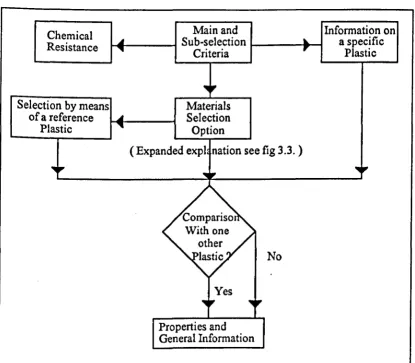
3.2.1.2 The Materials Selection Option ... 47
3.2.l.4 Presentation of Selected Material Data ... .49
3.2.l.5 Material Selection Example ... 49
3.3 CAMPUS ~omputer Aided Material :ere-selection by llniform S,tandards) ... 52
3.4 PLASCAMS (l'LAStics :~omputer Aided Materials S,elector) ... 5S 3.4.1 Materials Selection module ... 57
3.4.2 Materials Data module ... 58
3.4.3 Discussion Of The System ... 60
3.4.4 Materials Selection Problem ... 62
3.5 Comparison Of The Material Selection Packages ... 65
3.6 Knowledge-based Systems and Hypertext/Hypermedia systems ... 68
3.7 Knowledge-based Systems ... 69
Chapter 4 Knowledge-Based Systems ... 71
4.1 The Origins of Knowledge-based Systems ... 71
4.2 Characteristics of Knowledge-based Systems ... 73
4.2.1 Single purpose in a specific area of knowledge ... 73
4.2.2 Contains rules ... 73
4.2.3 Knowledge and inference are separate ... 73
4.2.4 Knowledge is extendible ... 74
4.2.5 Capable of handling uncertainty ... 74
4.2.6 Provides advice ... 74
4.3 Advantages and Limitations of using Knowledge-based Systems ... 75
4.2.4 Knowledge is extendible ... 75
4.4 Applications of Knowledge-based Systems ... 77
4.5 Knowledge-based System Structure ... 78
4.5.1 Knowledge base ... 79
4.5.1.1 Production rules ... 79
4.5.1.2 Semantic nets ... 79
4.5.1.3 Frames ... 81
4.5.1.4 Logic ... 82
4.5.2 Knowledge Acquisition ... 82
4.5.3 Inference Engine ... 82
4.5.3.1 Forward chaining ... 83
4.5.3.2 Backward chaining ... 83
4.5.4 User Interface ... 84
4.6 Knowledge-based Systems for Plastic Materials Selection ... 8S 4.7 Knowledge-based System Development Tools ... 87
4.7.1 Computer languages ... 87
4.7.2 Toolkits or Environments ... 87
4.7.3 Shells ... 88
4.8 Knowledge-based Materials Selection Systems ... 89
4.9 WAILON ... 91
4.9.1 Consultation ... 93
4.9.2 Material Description ... 94
4.9.3 Process-Material Match ... 94
4.9.4 Material Data Sheet ... 94
4.9.5 Tackling New Application with Combined Weighting option ... 95
4.10 PLASMA ... 95
4.10.1 Materials Selection ... 97
4.10.2 Design Consultation ... 99
4.10.3 Plastic Material Database Maintenance Module ... 102
4.11 PMSES ... 102
4.11.1 Simple Selection Module ... 104
4.11.2 Multiple Property Search Module ... 106
4.1l.3 Single Property Search Module ... 106
4.11.5 Display Materials List. ... 108
4.11.6 Display Materials Information ... 108
4.11.7 Update Material Database Module ... 108
4.12 Discussion ... 108
4.12.1 Selection Methodology ... 109
4.12.2 System Features ... 111
4.12.3 System Knowledge ... 111
4.12.4 System Development ... 112
4.13 Prototype Conclusions ... 112
Chapter 5 System Requirements ... 114
5.1 The system should be mM PC ( or compatible) based ... 115
5.2 The system should use knowledge based techniques ... 115
5.3 The system must be easy to use ... 115
5.4 The system must be capable of being networked ... 116
5.5 The system should be capable of customisation by the company and individuals ... 116
5.6 The system should be capable of linking with other systems ... 117
5.7 A variety of selection techniques should be provided ... 117
5.8 The system should allow facilities for easily retrieving materials texts, data sheets and process-material matches ... 117
5.9 The expertise within the system should be separated from the materials data ... 118
5.10 The selection process should consider property interaction ... 120
5.11 The system should help identify suitable manufacturing processes for the component. ... 120
5.12 It is desirable to have graphical representation of the component geometry within the system ... 120
5.13 The system should help identify the likely material property requirements ... 120
5.14 The system should enable consideration of'green' issues ... 121
5.15 The system should be able to cope with uncertain or incomplete infonnation ... l21 5.16 The system should allow a full evaluation of "cost considerations" ... 121
5.17 The system should allow easy 'what-if analysis ... 121
5.18 Explanation Facility should be provided ... 122
5.19 The system should be modular in structure ... 122
5.20 System Development ... 122
Chapter 6 System Development ... 128
6.1 System Functionality ... 128
6.2 Environment Selection ... 129
6.2.1 The Crystal 3 Expert System Shell ... 131
6.3 Data Quality ... 132
6.4 The Plascams Data Module ... 134
6.5 The Campus Data Module ... 135
6.5.1 Conversion of C.A}.1PUS ASCII data ... 136
6.5.1.1 Structure ofC.A}.1PUS ASCII data ... 137
6.5.1.2 A structured ASCII fonnat for the databases ... 138
6.5.1.3 File Conversion ... 139
6.5.1.4 Reasons for writing the conversion programs in Turbo Pascal ... 141
6.5.1.5 The CAM2PLAS and C.A}.1PINFO conversion programs ... 141
6.6 System Interfaces ... 142
6.7 Selection Procedures ... 143
6.7.1 Consult Expert Material Selection ... 144
6.7.2 Manufacturing Process Selection ... 145
6.7.2.1 STAGE A Dialogue with user to identify manufacturing process requirements ... 145
6.7.2.3 STAGE C
Evaluate qualified process with respect to specific requirements ... 155
6.7.2.4 STAGE D Sort shortlist based on scores ...•... 160
6.8 Consult Expert - Materials Property Assessment ... 162
6.9 Consult Expert - Material Properties ...•... 164
6.10 Consult Expert - Customised Properties ... 165
6.11 Consult Expert - Environment, Energy and Post Processing ... 166
6.12 C~US Data Search Routines ... 167
6.12.1 Ranking of the materials properties ... 168
6.12.2 Search on Specific Values Module ... 168
6.12.3 Knowledge-base Driven Search Module ... 169
6.12.4 Keyword Search Module ... 170
6.13 End-Use Requirements Checklist Module ... 171
6.14 User Chooses Module ... 173
6.15 Materials Information Modules ... 174
6.16 Manufacturing Process Information Module ... 175
6.17 Example Applications Module ... 176
6.18 Customised Material Properties Module ... 176
6.18.1 PART 1 - Create Customised Material Properties ... 177
6.18.l.1 Stage One The user must enter the property of interest and the search approach ... 177
6.lS.l.2 Stage Two Input numerical values or the value judgements for the material property ... 181
6.18.2 PART 11 - Select Materials By Customised Material Properties ... lS2 6.18.3 PART III - Modified Material Databases for Customised Properties ... 184
6.1S.3.1 Modify Databases ... 184
6.18.4 Application Library ... 184
6.19 Cost Analysis Module ... 186
6.19.1 Module Structure ... 187
6.20 Environmental, Energy And Post-Processing Module ... 188
6.21 Discussion ... 189
Chapter 7 System Evaluation ... 192
7.1 Design Quality ... 192
7.1.1 Efficiency ... 192
7.1.2 Integrity ... 194
7.1.3 Reliability ... 194
7.1.4 Survivability ... 194
7.1.5 Usability ... 195
7.1.6 Correctness ... 195
7.1.7 Maintainability ... 195
7.1.S Verifiability ... 196
7.1.9 Expandability ... 196
7.1.10 Flexibility ... 196
7.1.11 Interoperability ... 196
7.1.12 Portability ... 197
7.1.13 Reusability ... 197
7.2 Usability Study ... 198
7.2.1 Questionnaire ... 199
7.2.2 Usability Tests ... 199
7.3 Knowledge Evaluation ... 203
7.4 Washing Machine Outer Stationary Drum ... 205
7.4.1 Manufacturing Processes for Washing Machine Outer Drum ... 206
7.4.2 Materials for washing machine outer drum ... 206
7.5 Windsurfer Board ... 209
7.5.1 Manufacturing processes for windsurfcr board ... 209
7.5.2 Materials for windsurfer board ... 210
7.5.3 Comparison with PlasseI90 ...•... 211
7.6 Computer Housing ... 212
7.6.1 Manufacturing Processes for computer housing ... 212
7.6.2 Materials for computer housings ... 212
7.7 Expert Comments ... 213
7.8 Discussion ... 217
Chapter 8 Discussion ... 219
8.1 Interaction in Selection Parameters ... 219
8.1.1 Interaction Between Materials And Manufacturing Processes ... 221
8.1.2 Manufacturing Processes Selcction ... 221
8.2 Conversion of functional requirements ... 222
8.3 Data Management ... 223
8.4 Customisation ... 225
8.5 Application of Multimedia ... 226
8.6 Reliability of the System and Product Liability Considerations ... 227
8.7 Applicability to other materials ... 229
8.8 Accurate Weighting ... 230
8.9 Separated Databases ... 231
8.9 Data Quality ... 231
8.10 Component Shape Analysis ... 232
8.11 Integrate Computer Aidcd Design and Computcr Aided Manufacturing System ... 233
8.12 Customised End Use Requirements Checklist ... 234
8.13 Cost ... 234
8.14 Learning Systems ... 236
8.15 Execution Time ... 236
8.16 Knowledge Acquisition ... 237
8.17 System Evaluation ... 237
Chapter 9 Conclusions and Recommendations ... 239
References ... 241
Bibliography ... 246
Appendix A ... 247
Appendix B ... 249
Appendix C ... 258
List of Figures
Page
Figure 1.0: Important Sources of Infonnation on New Materials
and Manufacturing Technologies ---5
Figure 2.0: The Material Selection Process--- 13
Figure 2.1: Materials Selection Chart--- 16
Figure 3.0: Summary of Databases --- 41
Figure 3.1: Summary of Data bases --- 42
Figure 3.2: EPOS Selection strategy --- 44
Figure 3.3: Material Selection option procedure --- 45
Figure 3.4: EPOS Main Selection Criteria --- 46
Figure 3.5: EPOS Sub - Selection Criteria --- 47
Figure 3.6: EPOS suitable materials --- 51
Figure 3.7: EPOS reduced list of suitable materials --- 52
Figure 3.8: Comparison of the mechanical properties of PP and PS --- 52
Figure 3.9: Max-Min selection --- 56
Figure 3.10: Selected materials --- 56
Figure 3.11 : Material text --- 56
Figure 3.12 : Data Plot--- 56
Figure 3.13 : Searchable Qualities--- 59
Figure 3.14 : Plascams fmal shortlist --- 64
Figure 3.15 : Plascams text and data sheets for PS--- 64
Figure 4.0: Knowledge-based system structure --- 78
Figure 4.1: Structured description--- 80
Figure 4.2: Schema for Fig. 4.1 --- 80
Figure 4.3: Frame structure --- 81
Figure 4.4: Frame representation --- 81
List of Figures
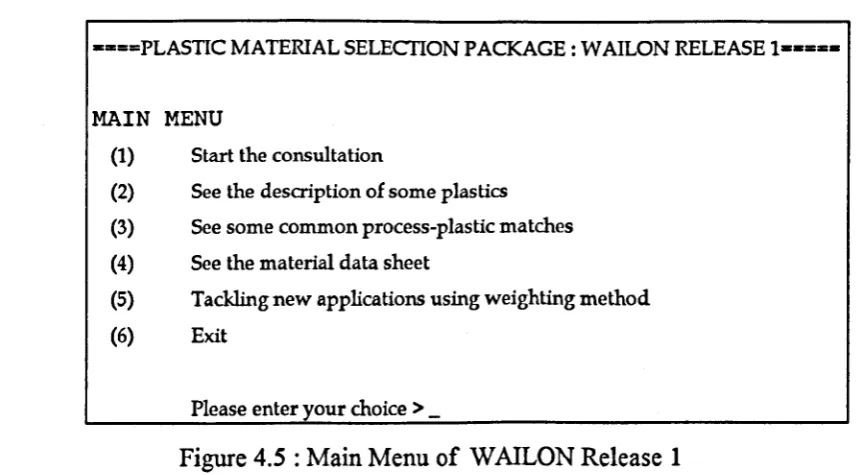
Figure 4.5: Main Menu of W AILON Release 1--- 92
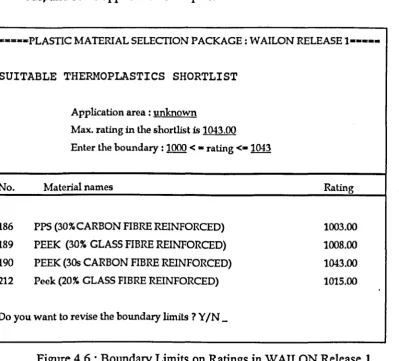
Figure 4.6: Boundary Limits on Ratings in WAILON --- 94
Figure 4.7: Program Structure ofPLASMA--- 96
Figure 4.8: PLASMA Overall Selection Procedure.--- 98
Figure 4.9: Advice screen in Plasma ---100
Figure 4.10: Design for Manufacture ---101
Figure 4.11 : Design for stiffness ---101
Figure 4.12 : Structure of PMSES ---103
Figure 4.13 : A 'Simple selection' output screen---1 05 Figure 4.14 : Items under 'Coating Materials' categOIy---107
Figure 5.0: Incremental Prototyping Design Methodology for ES's---124
Figure 6.0: Plassel93 module structure ---130
Figure 6.1: CAMPUS.ASC file extract. ---137
Figure 6.2: The three stages in the material selection process. ---144
Figure 6.3 : Material Selection Process ---146
Figure 6.4: Manufacturing Process selection ---147
Figure 6.5 : Menu for" Search on Specific Values" ---174
Figure 6.6: Structure ofEEP.KB---190
Figure 7.0: Software Quality Factors---193
List of Tables
Page
Table 3.0 : Epos properties --- 50
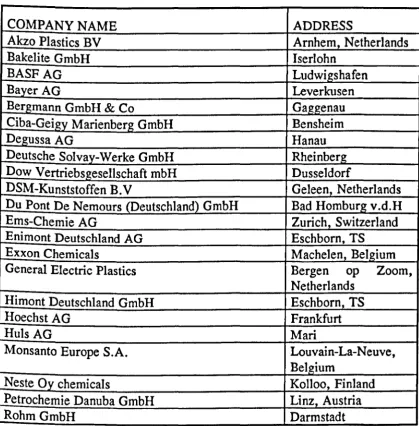
Table 3.1 : Alphabetical list of CAMPUS Plastics Data Bank Licensees-- 54
Table 3.2 : Generic sub grouping for polyamide 6/6 --- 59
Table 4.0: Conventional vs. Knowledge-based Programs --- 74
Table 4.1 : KES : Attributes and corresponding questions. --- 90
Table 4.2 : Decision criteria utilised in Plasma--- 99
Table 4.3 : In:fl uential design factors ---1 0 1 Table 6.0 : Rating of importance of selection factors---157
Table 7.1 : Response Matrices ---199
Table 7.2 : Time Estimates ---200
Table 7.3 : Actual Times Taken ---200
Table 7.4 : Mode Raw Scores for each System---201
Table 7.5 : Proces sed score--- 20 1 Table 7.6 : Responses to the questions asked for the component. ---205
Table 7.7 : Process shortlist (1)---206
Table 7.8 : Material shortlist (93-1)---207
Table 7.9 : Material shortlist (93-2)---207
Table 7.10 : Material shortlist (PlasseI90)---208
Table 7.11 : Windsurfer Board Process shortlist (High Volume)---209
Table 7.12 : Windsurfer board Process shortlist (Low volume )---21 0 Table 7.13: Injection shortlist (3 )--- 21 0 Table 7.14: Foam Shortlist (4) ---210
Table 7.15 : Low Volume Shortlist (93-5) ---211
Table 7.16 : Plassel Shortlist (90-2) ---211
Table 7.17: Computer Housing Process shortlist 4 ---212
Table 7.18: Material shortlist 93 -6 --- 213
Table 7.19: Plassel shortlist 90-3 --- 213
List of Screens
Page
Screen 1: Graphical representation of Class 4 ---148
Screen 2 : Production Rate Options ---149
Screen 3 : Elicit component size---150
Screen 4 : Elicit required surface fInish ---151
Screen 5 : Elicit required dimensional tolerance ---152
Screen 6 : Elicit the required production volume---153
Screen 7 : Summary input manufacturing process screen---161
Screen 8 : Campus Module Menu Options---167
Screen 9 : Ask for component category---172
Screen 10 : Ask for property category ---172
Screen 11: The recorded mechanical requirements for category B ---173
Screen 12 : Materials information ---175
Screen 13 : Rotational Moulding information ---175
Screen 14: Ask for number of weighting factors---178
Screen 15 : Text descriptions for the weighting factors ---179
Screen 16 : Numerical assignments against subjective judgements---180
Screen 17 : Input of customisation data onto custom datafile ---182
Screen 18 : Component level Information---185
Screen 19 : Component details---186
Screen 20 : Environmental, Energy and Post Processsing Summary ---191
Acknowledgements
A piece of work such as this requires the help and support of many people, I would like to thank all my colleagues in the Warwick Manufacturing Group; my materials experts Dr Gordon Smith and Mr David Wimpenny; and Professor S. K. Bhattacharyya for supporting the work.
Declaration
All contributions to this work are acknowledged in the text of the thesis and referenced.
SUMMARY
A successful design is one of the most important elements for the commercial success of a product and the selection of appropriate materials is a key step within the product design process. The task is not easy; a large number of interacting factors, both technical and economic, need to be taken into consideration and a vast amount of data investigated.
Product designers can benefit from using computer systems which can emulate the reasoning processes of an expert in selecting materials and provide ready access to appropriate materials data. The knowledge based system developed, Plassel fulfils the key requirements identified for such a system. It can:
1. Emulate the reasoning processes of a plastics expert. 2. Allow a customised data search to be undertaken
3. Access a range of data sources covering both embodiment and detail data. 4. Convert component functional requirements into property requirements. 5. Allow knowledge and experience to be stored in the system
6. Allow cost to be fully considered
Professor Ashby in 1993 [1] stated ''A full expert system for materials
selection is decades away. Success has been achieved in speCialised highly
CHAPTER ONE
INTRODUCTION
Good design is crucial to commercial success, and a key design problem
is in choosing the best material to utilise. It is estimated that there are between 40,000 and 80,000 [1] materials to choose from. The need to adequately survey
the large number of possible material choices during the design process, places
a premium on materials knowledge and experience. "Material selection is the
final, practical decision in the engineering design process and can determine
that design's ultimate success or failure" (James Shackelford [5]).
Computerisation can help by providing easy access to a vast amount of
data and the information required to make good selection decisions. The
proliferation of computerised materials data banks and selectors demonstrates
this. Plastic materials selection is particularly difficult due to rapid
development of new plastics, poor definition of their properties and the use of
plastics as substitutes for more traditional materials in many industries.
1.1 The Importance of design
What is design? According to the Oxford English dictionary, " Design
is an outline from which something may be made." There are other deftnitions
which add some 'flesh' to this, for example that by Crane & Charles [2]; "Design is a complex process which sets out to specify everything that needs to
be known in order that something may be made. "
and by Dieter [3];
" To design is to pull together something new or arrange existing things in a
new way to satisfy the needs of society. "
Introduction
research laboratories [4] found that only about 5,400 out of 27,000 new
products introduced in a given year by American companies proved successful. Dr. John Bjorksten concluded that the principle reason for failure of
new products was a lack of technical expertise related to the product. Major
reductions in product cost can be achieved by decreasing the cost of product supply, this includes the costs of design , material , labour, machinety,
overheads, etc.. .... and most often the decisions taken at design dominate the
supply cost. According to Whitney [6], at General Motors, " 70% of the cost of
manufacturing truck transmissions is determined at the design stage" , and at
Rolls Royce " design determines 80% of the final production cost of 2000
components" .
1.2 The importance of Materials Selection
A major element within the design activity is the selection of appropriate
materials for the proposed product. Crane and Charles [2], state:
"Materials selection should contribute to every part of the whole design
process. This is because it is hardly possible to proceed very far with a
genuinely innovative design without taking into account all the materials and
manufacturing methods that are available for use".
The type of material data required at the different stages of the design
process varies in breadth and precision. In the conceptual stage all materials (and options) may be considered though at low levels of data precision.
Material requirements are then gradually defmed in more detail and subsets of materials are selected and greater data precision is required. Each level of data
requires its own data management scheme. Ashby [1] recognises "the
Introduction
same time embrace the complex interaction between the material, its shape, the
process by which it is given that shape, and the function it is required to
perform. "
1.3 Criteria for Material Selection
Materials selection may be initiated when [2]
:-(1) A new product or component is to be producedfor theftrst time by the
organisation.
(2) A desire to improve the existing product due to economic reasons or a
desire to improve its performance.
(3) It is necessary to change material use owing to failure of the component
in meeting customer specification, failure of material suppliers, etc.
Material selection is a complex problem. The fmal decision is based
upon a trade-off between technical and economic factors with full
consideration of the interactions of materials, manufacturing processes and
component geometry. In essence, the job of the designer is to visualise and understand the operation, use and function of the product in its environment, to
translate this to product performance requirements and thence into the
combination of materials properties and geometty that would satisfy such
requirements. He must also take into account the influence of manufacturing
process and shape on those properties and apply appropriate economic
constraints. The product designer must understand how these factors fit
together, what interactions are possible and what sort of trade-offs can and/or
must be made. It is usually impossible for one individual to be thoroughly conversant with all of them. He must collaborate closely with specialists on
different aspects of the overall problem. It is also difficult for the designer to handle and analyse such highly unstructured and scattered knowledge. The
Introduction
decision process relies very much on the designer's experience and knowledge.
Past experience or heuristic rules of thumb are usually critical in the decision
making process.
There are systematic methodologies proposed to ease this process, such
as that by Kusy [7], but it is undoubtedly true that persons with knowledge and
experience will usually arrive at a good solution more efficiently than those
without, even with a methodology. However, previous experience of a similar
application is by itself insufficient in the majority of applications. One of the
biggest stumbling blocks in conducting a large-scale evaluation of materials and processes is the sheer amount of data that has to be processed. To ensure
that all possibilities are considered, it is frequently necessary to evaluate a
considerable number of materials and quite often a wide range of engineering
properties. The task then, is to assemble all the data, analyse and classify it into
useful terms.
Generally information about engineering materials can be divided into
two broad categories; data, and knowledge. Data can be defmed as the results
of property measurements, knowledge represents the connections between
items of data and is gained by instruction and experience. A range of sources
for materials data and design advice have emerged to aid the designer in the
process of evaluation and selection of materials. These range from the
ubiquitous large and heavy data books, advisory departments of suppliers,
salesmen, independent consultants, trade shows to conferences and not
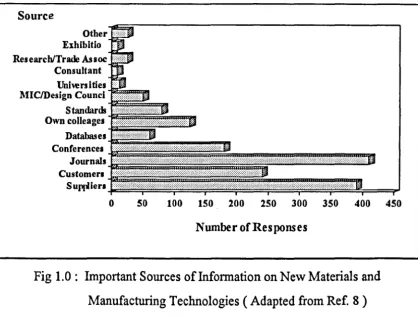
forgetting trade magazines. A survey by P.A Consulting [8] revealed the
following usage rates of these sources among designers (figure 1.0).
To help alleviate some of these problems, a range of commercial
computerised materials databases and selection packages have been made
Introduction
Source
Other Exhibitio Research/Trade Assoc
Consultant
Uniwrsities i1""~' ~1'I!'lJ MIClDesign Counci ""'::'::::':::'::;:;:::'
Standanls "":',,:::::':::':i::::::::'::::::::':::::':"
Own colleages .,:"":":,:::,:,:",:::::::""",:,,'::,',,,::::,::::,,:,,,:""",:,,,,': .
Databas es':':::::':':~':::::':))}: ~~~ _ _ ""'1"""n
Conferences "",,:::}},:}::,;:;:,;;:;,;:;}},,:;;;;;::;;:,;,:,:,:,;::,::,:,,:,:,}}::,,:,::::::;;',;,::;,
J ournaJs ,,':,':::::;:;.:., .. :::::':::::::::':': .... :,:,.,:,.':':':'::'::"'O"':':'::}:::":':::" "':"""':""':"',':',':":':;::::::}";,':':',"';::;:;;:,;,:":",:,:,:"",:,,, """",::" ;'::':'."";';:;:;:::::;:::::'::"'::::;:;::::':::::' . Customer. . .. ,.,.,.,.:, .... :.,.:.,.,.,.,.,.,.,.,.,.,., ':'",',""""':::',::':',::':::::,::,'::,::::':',::::,:.::::::;";;:;:::::::::::::::::,::::,,;;::::::
Sup(iier •. ':';:::::::':::::::;:;::';:":::;:::/:, ... : ... : ... :".: ... : ... : ... : .... :.:.: ... :.: ... :.:.:.: ... :.: ... , .. : ':'.' , .. : ... : ':. :.' .. :'.":,,,:: .. ,:.: '::'" :::.",:
o
50 100 150 200 250 300 350 400 450Number of Responses
Fig 1.0: Important Sources of Infonnation on New Materials and
Manufacturing Technologies (Adapted from Ref. 8)
With the vast number of available materials, it is likely that designers do not
have adequate knowledge or time to evaluate them all in order to select the
most appropriate material for their specific applications. Even when sufficient
data is available from materials handbooks, materials suppliers or reports, it
would be too time consuming to research all the literature for every new
application. The problem of applying it still remains intractable unless the
designers have assistance. This assistance needs to be "on-line", that is,
constantly available.
On-line assistance could be interpreted as telephone support, but it is usually taken to mean computerised support. The storage of materials data in computers has two major theoretical advantages compared with printed matter:
• A greater quantity of data can be stored electronically, and
• Data can be retrieved more readily and transferred to other systems.
[image:18.551.76.494.57.372.2]Introduction
In addition, although a book may be revised in a new edition, an electronic data store can be brought up to date almost instantaneously. The increasing access to computers by designers has enabled a tremendous growth in the availability of computerised support. There are currently over one hundred and seventy [9] materials data and selection systems available. They range from simple personal computer based systems detailing the wares of a single supplier, to huge international on-line systems. There is a hierarchy among the systems. Some systems focus on selecting a generic material from the three basic groups, ceramics, metals and polymers, of materials options. Others focus on selection within these basic groups and also within the subsequent generic groups. Of all material classes, plastics (taken in this report to include both polymers and polymer-composites) is the one that has the greatest number of information systems.
1.4 Plastic Material Selection
The volume usage of plastics now comfortably exceeds that of other materials and engineering plastics demand has been continuously increasing for many years. Plastics are very open-ended in potential development, and new ones are being introduced at a rate of 750 per year [9]. The problems of materials selection are particularly acute in the area of plastics. Some of the reasons for this are:
(1) The rate of introduction for new plastics is higher than for other materials [10].
-- ---- - -
--~---Introduction
(3) Plastic properties can be extensively modified by processing and the
addition of fillers, and often a custom 'mix' can be created. This however is
difficult to cater for when providing reference property data.
(4) Plastics are being applied in traditionally 'metallic' applications, such as
vehicle inlet manifolds, and there is a lack of knowledge and experience
about plastics in some of these industries.
Edward and Endean [10] provide a good practical example. It illustrates
some of the benefits that can be gained by a change of material. The product, a
digital multimeter, was made from sections of aluminium sheet formed into
simple shapes and held together with aluminium extruded profiles, nuts and
bolts, and other mechanical fasteners. The reason for the designers wanting to
change was that a polymer would be easier to manufacture and assemble, and
be more resistant to damage in use. Through a process of design analysis, the
product was changed in order to provide the optimum utilisation of the new material. The resulting design has a reduced number of components and a
shortened lead time. As a consequence, the cost of manufacturing of the 'new'
product was about 15% of the aluminium version.
These properties and others such as ;
• low density,
• high strength to weight ratio,
• low elastic modulus,
• low thermal and electrical conductivity,
• high chemical and corrosion resistance,
• self lubrication,
• inherent colour,
• high coefficient of thermal expansion,
• low melting point,
• ease of manufacture into complex shapes.
Introduction
have led to plastics becoming one of the most commonly used materials in our
daily life, even though according to Fish [11], " designing with plastics is often
a more complex task than designing with metals. Engineering plastics, which
are visco-elastic, do not respond to mechanical stress in the linear, elastic
manner for which most designers have developed an intuitive feel. In many
applications, engineering plastics exhibits a more complex property mix than
do metals".
Already there are many computerised polymer databases and material
selection systems available for designers such as PLASCAMS 220 [12],
CAMPUS [13] and EPOS [14] which have been designed to help engineers
with the problem of plastic material selection.
1.5 Objectives
The difficulty m materials selection has been illustrated and the
importance of knowledge and experience in the selection process introduced.
Computerisation is of benefit in the design process to enable designers to
access and manipulate the vast amounts data and infonnation they need.
Selection of polymer materials causes particular problems. If a system can be
designed to cope with polymer material selection, it may be of even greater
value for other types of materials. An effective system needs to combine knowledge about how to select plastics with easy access to data about the
materials. Many knowledge-based and database systems exist, none, however,
tackle the general problem of material selection. Existing systems either tackle
aspects of material perfonnance such as Corrosion [15] and provide design guidance, or use simple procedures to search materials data banks. The
Introduction
1. Define the requirements for an ideal system for plastic material selection.
2. Describe the development of a knowledge-based system to satisfy them.
The definition of what is an ideal system is vel)' closely linked with identifying
and analysing likely users needs and their environment. A system can only be
truly 'ideal' for a single (or a few) user(s) since each requirement is unique.
This partly explains, why in the past, companies have often developed their
own systems. The concept of an ideal system is in contradiction with the
authors desire to build a general system, applicable in a wide range of
situations and useful for a range of people. It may be better to use the term
'full', rather than 'ideal', though it again could be argued that a 'full' system,
rather like an 'ideal' system is impossible to provide for all types of users and
applications.
1.6 Thesis structure
In chapter one , some of the problems of material selection have been introduced. The issues raised are particularly relevant to the selection of
polymer materials in manufacturing industry. The automobile industry is a
good example, a wide range of polymer materials and technologies are being
investigated and employed to meet increasing consumer and legislative
demands. In chapter two, methods of selecting materials are described and discussed and the types of materials data analysed. Different commercial and
experimental materials selection systems are investigated and assessed in
chapter three. Knowledge as well as data is critical to good selection and
Knowledge based systems techniques are introduced in chapter four with a
view towards examining the application. of them to the selection of materials.
In chapter five, polymer materials selection requirements are examined to
identify the requirements for a material selection system. In chapter six the
- -
.-.--.-~----.---Introduction
development of a system to meet the requirements identified, combining
knowledge-based and database techniques is described. The system designed is
CHAPTER TWO
TIlE MATERIALS SELECTION PROCESS
The thorough evaluation and selection of materials for a specific
application is a very difficult task. A number of approaches have been
suggested to ease the task, the philosophy and details of which vary
tremendously. The materials data available to support selection is also subject
to a number of limitations. It is often incomplete, inconsistent or inappropriate.
2.1 Material Selection Approaches
There are two fundamental approaches to the selection of materials,
non-systematic and systematic.
2.2.1 The Non-Systematic Approach to Material Selection
The non-systematic approach is based on past knowledge and
experience. Although there are many tens of thousands of different materials
available [1], the designer if possible, wants to reduce the risk of failure by
using materials with whose properties he is thoroughly familiar. He also gets
the benefit that heuristic selection can reduce the need for lengthy and detailed
analysis, resulting in a shorter time to market. This is the predominant method
in industry : "Much material selection is based upon past experience. What
worked before is obviously a solution, but not necessarily the optimum
solution." ( Dieter [2]). Obviously the quality of decisions based upon
heuristic experience and knowledge is purely dependent upon the quality of
that knowledge. Material selection on a historical basis may be unsatisfactory
with the current trends and speed of development of newer and better materials
The Materials Selection Process
past have been replaced, frequently by newer, improved ones resulting in better
perfonnance and/or lower cost. To provide a fully optirnised choice, the
designer must also consider new or improved materials. For instance, in the
automotive field, the drive to increase energy efficiency through weight
reduction is revolutionising material selection [4]. Cooling fans, distributor
caps, bumpers and many others are now made of plastic rather than metal.
According to the British Plastics federation; " out of 2730 parts from which a
car is assembled, 771 are plastics'~ Apart from the motivation for an optimum
solution, pressure has also arisen from our entering an era of possible materials
shortages and this often makes the selection of materials on a historical basis
not viable because the desired materials may no longer be available.
Consequently, there is a greater need than ever for material selection on a
rational basis.
2.2 The systematic approach to materials selection.
Material selection, like any other aspect of engineering design, is a
problem solving process. There is not any absolute procedure for material
selection. According to Dieter [5] "The selection of material on a purely
rational basis is far from easy. The problem is not only often made diffiCUlt by
insufficient or inaccurate property data but is typically one of decision making
in the face of multiple constraints without a clear-cut objective function. "
Different companies may have their own approaches to selecting appropriate
The Materials Selection Process
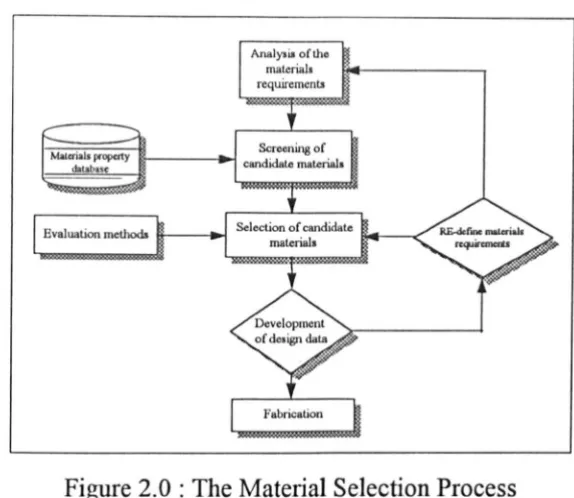
Figure 2.0 : The Material Selection Process
Step 1: Analysis oftlte materials requirements for tlte application
A crucial first step in rational material selection is preparing a complete
performance specification, which delineates the basic functional requirements
of the product and sets out the basic parameters from which the design can be
developed [6]. Failure to do so can lead to costly errors. Based on the market
needs, the designer is required to determine the demands the part will have to
satisfy, with respect to for example, operating condition, appearance,
fabrication (e.g.: weldability or machinability), safety aspects, environmental
impact (storage and disposal), packaging requirements, ease of maintenance
and regulatory requirements, etc.
Once the materials requirements have been fully specified, they can be
translated into critical material properties. Usually, the functional requirements
or performance of a material are expressed in terms of physical, mechanical,
thermal, electrical, chemical, or fabrication properties. However, according to
Crane & Charles [7], the material requirements fall into four major areas:
*
Functionality*
Appearance*
Manufacturing Method*
CostThe Materials Selection Process
In practice converting the performance specification into engineering terms is not always a straightforward task. For instance;
"if the component is required to pass UL 7J (5 ft
*
lbf) impact tests at OOC,then, what is the requirement into terms normally used for evaluating
impact strength of plastics, such as Izod impact strength. Since there is no
well-defmed correlation existing to relate these different impact tests, the
designer must rely on engineering experience and intuition." (F. Fish [8])
Step 2: Screening of candidate materials (Preliminary Material Selection)
Subsequent to identification of the required material properties, a
screening process is always required in order to narrow the field of choice from
the huge number of available materials to a relative few which look promising
for the application. This screening process can be done either by accessing
computerised data bases, or by searching in material data books. In this stage, all the potential materials that can meet the performance specifications are
identified on the basis of screening properties. A screening property is any
material property for which an absolute lower (or upper) limit can be
established for the application. No trade-off beyond that limit is tolerable. The
aim of the screening process is to eliminate some obviously, unsatisfactory
materials in order to speed up the selection process. Consequently it is often
helpful to perform a first screening using the most restrictive design constraints
The Materials Selection Process
resistance design constraints are often very restrictive, they are usually used to
narrow the list of candidate materials rapidly. Of course this mainly depends on
the nature of the product. For instance,
"if a flame class of UL 94 5V is required for the application, the list of
candidate materials can then be rapidly narrowed down to the few materials
with this very high flame class rating." (F.A. Fish [8])
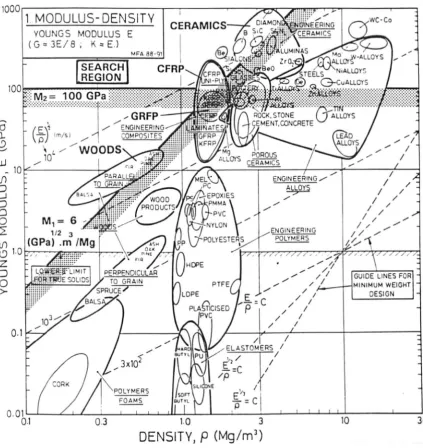
A Material Selection Chart is a very useful tool in preliminary material selection. On the materials selection chart, as shown in Figure 2.1 [9], primary constraints correspond to a horizontal or vertical line on the diagrams. All
materials to one side can be rejected. This can narrow the choice to the
materials with the most ?esirable perfonnance properties which will maximise
the perfonnance of the component. Selection can be carried out quickly and
simply by frrstly specifying the requirements of both strength and temperature
on the chart, then viewing the chart to fmd which balloon is specific for your
requirements. However this method can only help the designer to select some
appropriate subgroup or generic groups of materials ( e.g. Metal, Wood, Plastic,
HDPE, PVC, etc.), it cannot find exactly the most appropriate material for your
requirements. Consequently, this method is nearly always used only for
conceptual design or preliminary materials selection to identify a few candidate
materials for the detailed design or optimal materials selection described later.
The qualified materials in the screening process will become the
candidate materials for evaluation in the following step.
Step 3: Optimal selection of candidate materials
In this stage, the candidate materials in the shortlist are further evaluated
The Materials Selection Process
and tested against a broader and more discriminating set of properties including
the trade-off between perfonnance, cost, fabricability, and availability in order
to select the most appropriate materials for the specific application.
1000r---~~---~--~~--~~~~---~~
,,-..
a
CL <.9 ...,
1. MODULUS-DENSITY
YOUNGS MODULUS E (G::3E/ 8 ; K::E.l
CERAMICS
[image:29.548.79.502.173.620.2]I
Figure 2.1 Materials Selection Chart (Source: [ID
It is necessary at this point to select a processmg method for
The Materials Selection Process
economics. There are several evaluation methods, listed below, commonly used
in this stage. All of them are discussed in section 2.3.
*
Cost Vs Performance Indices*
Value Analysis*
Failure Analysis*
Benefit-Cost Analysis• Weighted Property Indices
Step 4: Prototyping and Verification Tests
Finally and most importantly, before fmalising any material selection,
testing the component under real or simulated in-service conditions is required.
Due to the possible influence of manufacturing processes on critical design
properties or inappropriate selection, testing is required in order to verify that
the component (with selected material) works properly under specific
conditions. Consequently the key material properties for the selected material
are determined experimentally through prototypes in order to obtain statistically
reliable measures of the material performance under the specific operating
conditions. Prototypes can be prepared by a number of different methods. A
major goal is to obtain prototypes for testing that are as similar as possible to
production parts. The basic trade-off is prototype cost versus the reliability of
the data obtained during part testing. Oberholtzer [10] said that "usually, more
expensive prototypes provide less-reliable test data. " If the component cannot
fulfil the specific requirements and fails the verification tests, it indicates that
the material selection and/or design was faulty. The designer is required to
re-consider the materials requirements and repeat the selection process again. Fish
[8] concludes;
The Materials Selection Process
"The expense of plastics tooling and the uncertainties inherent in plastic
part design contribute to the extensive use of pro to typing and testing sequences
while developing plastics application. Engineering tests are performed on a
sufficient number of prototypes to qualify the design. "
2.3 Evaluation Methods for Material Selection
The possible complexity of comparisons and trade-offs means
that there is no one method that is suitable for all circumstances. According to
George Dieter [11] ,"there is not a well-developed methodology for materials
selection. Partly, that is due to the complexity of the comparisons and
trade-olft that must be made. Often the properties we are comparing cannot be
placed on comparable terms so a clear decision can be made. Partly it is due
to the fact that little research and scholarly effort have been devoted to the
problem. "
A range of evaluation methods have evolved. In this section some important evaluation methods for material selection are described. They are: Cost Vs
Perfonnance Indices, Value Analysis, Failure Analysis, Benefit-Cost Analysis
and Weighted Property Indices.
2.3.1 Cost Vs. Performance Indices
It is logical and reasonable to consider cost at the outset of the material selection process. A cost-perfonnance index is used to detennine the relative
weight (cost) of each material for equal property perfonnance (e.g. equal
stiffness or equal strength). This index can be a useful parameter for optimising
the material' selection but it is not easy to construct meaningful indices of
perfonnance for the complex situations found in many designs. Often, the
The Materials Selection Process
detennination of cost vs. performance (per property) relationships becomes a question of detennining the structural equivalency of different materials. For , example suppose polyethylene costs 0.6 £/kg and polyester costs 2 £/kg, what is the cost of a unit strength of these materials to support a load, of lets say IlkN in a bar of IOOmm thickness. In developing the cost-performance index for this problem, a mathematical expression is needed to determine the relationship between strength, material cost, and weight. After the cost vs. performance index has been calculated it can be used for optimising the selection of materials.
According to Dieter [3], cost is the most important criterion in materials selection, and is used as a factor in the initial screening process. This seems a limiting view to the author, often the designer is interested in satisfying the performance requirements first, and then cost can be used as a selection criterion among the materials satisfying the performance criterion. Hence it can be important in the fmal screening process, not the first as suggested by Dieter.
The idea of using indices, not necessarily versus cost, is an important concept in selecting materials and is utilised in several systems such as Ashby's [1] balloon charts ( figure 2.1 ) and as provided by the graph plotting facility in CAMPUS.
2.3.2 Value Analysis
Value analysis applies a rational approach to identifying and reducing unnecessary costs and hence maximising 'value'.
"Value analysis is an organised system of techniques for identifying and
removing unnecessary costs without compromising the quality and reliability of
the design. The field this technique is usually applied to is much broader than
just material selection, but its framework applies admirably to the problem of
The Materials Selection Process
material selection. " (Dieter [3])
The analysis process can be divided into four main stages:
(1) Defining the functions of the design. (2) To assess the value of each function
value of function
=
importance of function cost of providing function(3) Compare value of each function
(4) Identify the unsatisfactOlY functions and make corrections.
For example, suppose a value analysis is conducted on a electric toaster design. The fIrst step is to defme the functions of the product, such as:
(A) Convert electricity to heat (B) connect to electricity supply
(C) disconnect from supply if element overheats (D) switch off when the toast is done
In order to assess the value of each function, the following steps need to be
perfonned;
Step 1 - Pair the functions; and make comparisons.
i.e. AB BC CD AC BD AD
Step 2 - Underline the most important member of each pair.
The Materials Selection Process
Step 3 - Count the underlined functions and use this as an 'importance' score.
funti c on Impo rt ance score
A 2
B 3
C 0
D 1
Step 4 - Construct a table of function against component cost.
Component Function Function Function Function
A B C D
Electronics 85p_ 15Qp
Element 15p 5J!
Connector 20p
Lead 5QQ
Wiring lOp 20p_ 70~
Fasteners lO~ 2p 5p
Cost of function l5p 95p lO7Q 225~
% of total cost 3 22 24 51
Score 1 2 2 4
The score that is given is based on a scale from one for the lowest cost up to a maximum score equal to the number of functions.
The Materials Selection Process
Step 5 - Use value function expression to obtain value score.
Value of function = importance of function cost of providing function
Function Importance Cost Score
score
A 2 1
B 3 2
C 0 2
D I 4
Value score
2 1..5
0
0.2.5
Having followed the steps, a comparison is made between these functions.
Attention is required when the function value score is low
The previous example only illustrates how a value analysis is perfonned
in the design domain. Although this technique can help the designer to decide whether the product made from the selected material is worthwhile or at the
lowest cost, it mainly focuses on economic factors and has insufficient
consideration on the engineering aspects. In addition considerable skill, knowledge and judgement are required to determine worth in tenns of money.
One way to detennine the worth of a function is to ask yourself "what would be
a reasonable amount to pay for the function". The decision-making process is
very subjective. Birley, Heath, and Scott [17] state value analysis is usually not
incorporated into a systematic approach to materials selection. It is used rather subjectively and employs a decision making technique to defme the required
functions of a product, especially when a design review on a new product is
The Materials Selection Process
2.3.3 Failure Analysis
This method is based on predicting and determining the ways in which
the product may fail in service, so that materials that are unlikely to fail are
selected. Failure analysis is a rational way for selecting materials by identifying
the causes of the failure. It determines all of the ways in which the products, or parts similar to a new design, fail in service. Then, with respect to that
knowledge, appropriate materials that are unlikely to fail can be selected.
Failure analysis commonly requires the combined detective work of various
experts who must systematically consider each alternative and any other
plausible cause of the failure. It may be very time consuming. In addition, this technique is a systematic approach to the measurement, control and
improvement of reliability. So, it is especially useful if reliability is the most important goal of the product, such as in aerospace applications. However, for
most general engineering applications, economic factors cannot be overlooked
and, so, other methods may be more suitable for material evaluation.
2.3.4 Benefit-Cost Analysis
The process of benefit-cost analysis is based on the following expression
[3]
Benefit/cost ratio (BeR)
=
Benefits - Disadvantages ( to owner) CostsProfit is usually the primary goal of an organisation. In the selection of
alternative materials for specific applications, although the performance of the
component can be improved by using other materials, the profit may be
reduced due to increased material costs. In order to deal with this problem,
benefit/cost ratio's can be used to help the designer to consider profit in
material selection. The ratio relates the capital investment required to produce
The Materials Selection Process
the desired benefit.
Generally, only the alternatives for which BCR > 1 are acceptable. First, the alternatives are ranked with respect to cost, and the lowest-cost situation is
taken as the initial reference. The mechanism of this technique is to compare
the reference with the next higher cost alternative by the incremental benefit
and the incremental cost. If B/C < 1 for the second, costs will not be covered, and the first alternative is the superior one. This is then compared with
alternative three. This evaluation continues until all the alternatives have been
considered. The fmal superior alternative is the best one, though it may not
have the largest overall benefit/cost ratio.
2.3.5 Weighted Property Index
In most applications, a selected material is required to satisfy more than
one perfonnance requirement. Perfonnance requirements may adversely
interact, e.g. cost v stiffness. This means that compromises among different
properties are inevitable in materials selection [3]. The designer is required to
detennine the overall perfonnance of the materials with respect to the various
requirements.
The Weighted Property Index (WPI) is a useful systematic method of
evaluating the overall combined performance of materials [3,17]. Each material
property is assigned a certain weight depending on its importance to the
required service performance. WPlj for the property j is determined by multiplying the scaled property value, Sj (or rating, Rj) by the corresponding
weighting factor, Wj- Since different properties have widely different numerical
The Materials Selection Process
Evaluation of material by WPI (Equation 1):
n
(Equation 1)
where WPli = Weighted Property Index for material i Wj = weighting factor for property j
n = number of material characteristics specified Sj = Scaled property
=
(value ofproperty/max. value in list)*scaleif a high value for the property is desirable or
=
(min. value in list/value ofproperty)*scaleif a low value for the property is desirable
For properties that are not readily expressed in numerical values, e.g., weldability, Sj can be replaced by some kind of subjective ratings,
Rj-The higher the material perfonnance index, the more appropriate may be the material for the specific requirements. This weighted property technique is the best tool for choosing between the competing property requirements in a general engineering situation [3]. It can also consider the trade-off of perfonnance and economic factor by considering cost as one of the properties, usually with a high weighting factor. This systematic method of evaluating materials in the selection process is used in one of the best computerised materials database selection systems ( Plascams [12] ).
2.4 Discussion on material selection approaches
There is no blueprint for correct materials selection. No correct complete set of procedures can be followed. Different situations may require different approaches in selecting materials for specific applications. The approach may
The Materials Selection Process
depend on market needs, the nature of the product and the nature of the
company. However, there are some general points that can be summarised.
• The material selected must fulfil the performance specification of the
product.
• Although cost must be a prime adjunct to the technical considerations in
selecting materials, materials selection must not be based solely on cost.
Quality and reliability are always very important factors.
• For the safety reasons, the effects of changes in operating conditions outside
the normal limits due to uncertainty should be taken into account.
• To select an appropriate material, first screening for a list of possible
materials by the most restrictive design constraints and then evaluating the
qualified materials by making the trade-offs with cost and processing methods,
etc. is common. Finally, several tests or failure analysis are performed to verify
the selection.
• The correlation between the performance requirements and the material
properties must be accurate.
• The availability of materials must be considered
The different evaluation methods for materials selection have their own
advantages and disadvantages. They evaluate materials by focusing on different
The Materials Selection Process
requirements in Weighted Property Index, etc .. Different situations may require
particular methods for optimum effectiveness. For instance, failure analysis is
very useful to material selection when a design is modified. Material selection
also depends on the overall objectives of the designer or the nature of the
product, e.g. cost-oriented or perfonnance-oriented. However, for general
engineering situations, overall perfonnance of materials is always of interest
and is considered. The weighted property technique is a systematic and
appropriate tool for choosing between the competing property requirements. It can take both technical and economic factors into account successfully and
directly. In addition, due to its simplicity, this systematic method of evaluating
materials in the selection process is very appropriate for computerisation.
Obviously the quality and applicability of data used within a selection approach
and particularly with computerised materials selection is of critical importance.
2.5 Computerised l\faterial Selection
Computers greatly enhance man's ability to organise and present data.
They can have a large storage capacity, and software database systems can
provide easy access to available relevant material data. Even so, there is often
far too much infonnation for an individual or group of individuals to assimilate.
Computers can also assist the assimilation of data. They achieve this by
requesting data for a material selection problem, such as the material
specification and processing requirements. This data is then processed in
relation to corresponding data bank values, either by comparison or calculation,
and the user may be presented with an optimal or near optimal solution. If the
problem has been clearly defined by the answers to computerised questions ,
the infonnation received by the user will be 'most' relevant to the problem, and
the volume greatly reduced.
The Materials Selection Process
2.5.1 Types of Materials Data
A report by the National Materials Advisory board [16] classifies the
information in a materials property database according to three categories :
(1) Test Data
A materials suppliers specification data sheet lists the properties of new
and enhanced materials determined in standard tests. The processing and
interpretation of data is often complicated by the absence of sufficient
information to properly characterise materials and the lack of standard format
in the presentation. There are a number of testing bodies ( ASTM, BSI, DIN
etc.)! specifying different standards which require test results to be expressed in
a variety of units and this further complicates direct numerical comparison
between material properties. The validation of data is not straightforward. Due
to experimental variability, any quoted datum will probably be a mean value.
For a number of different samples taken from a population, a judgement must
be made on the statistical significance of any difference in sample parameters.
(2) Variable Data
This data relates to specification requirements, material costs,
fabrication costs, maintenance procedures, etc. It may be expressed in numerical form but, since it is not invariant, it must frequently be up-dated as
economic conditions, available materials, production processes, etc. change.
(3) Instructive Data
This is data that cannot be reduced to numerical form, such as the
conclusions derived from laboratory tests and performance feedback regarding
The Materials Selection Process
precautions to be taken in the production, fabrication or application of a given material.
2.6 Ordering of Data
The most simple fonn of data organisation is an infonnation library providing access to material property data. To further exploit computer capabilities this basic fonn has progressed to allow the comparison of relevant data and accept or reject materials for presentation to the user. Various 'optimisation' methodologies have been suggested for dealing with the large amount of test and variable quantitative data:
2.6.1 Direct Comparison Approach
This methodology requires a data input of selected ideal material properties, either as single values or a range of acceptable values, for anyone property. These are then compared with corresponding databank values for materials known to the computer, and if the databank values are found to match a material is accepted, or if they differ a material is rejected.
Problems arise when the set of material property data for anyone material is incomplete, which is frequently the case. Some programs overcome this by including a candidate material only if data supporting its inclusion is available. Others will include a material even if data is unknown.
2.6.2 Combined Weightings Approach
This methodology makes use of 'value judgements'. A value judgement
IS a number, usually between 0 and 9, corresponding to a quantitative or qualitative material property. As examples : weldability can be a qualitative property, and very poor weldability may be represented by value judgement 1 ; operating temperature is a quantitative property and a high operating
The Materials Selection Process
temperature of, for example, 290°C may be represented by value judgement 9.
A data input of selected ideal material properties as a single value
judgement for each property is required. For each material, ideal value
judgements are multiplied by corresponding databank value judgements and the
results are added together to give a total value. Total values are ranked in
decreasing order, and the materials corresponding to totals near the top of the
list are most suitable for the application.
2.6.3 Geometrical Approach
An ideal material for a specific application may be geometrically represented in the fonn of a regular polygon with various properties plotted
along radials from the polygon centre to each vertex. Values for each property
are defmed as Yl,Y2, ... Yn, which are represented as equal distance radials. A
candidate material for the application may then be considered with its
respective properties, designated Xl,X2, ...
Xn,
plotted along each radial. The suitability of a candidate material is rated according to three factors :(a) The size of the polygon and its closeness to the ideal.
A 'Mean Weighted Characteristic' ( MWC ) may be defmed as,
f
Equation 2
i=l
where n is the number of properties and ai is a weighting coefficient arbitrarily
chosen from 0 to 1 according to the relative importance of a particular property,
zero being unimportant and unity being a critical property.
The computer can rapidly calculate a MWC for all materials supplied to
its databank. The closer the MWC is to one, the closer the overall properties
![Figure 3.0 Summary of Databases (Source [27])](https://thumb-us.123doks.com/thumbv2/123dok_us/9857548.486936/54.552.54.526.56.650/figure-summary-of-databases-source.webp)
![Figure 3.1 Summary of Databases (Source [27])](https://thumb-us.123doks.com/thumbv2/123dok_us/9857548.486936/55.557.44.514.184.599/figure-summary-of-databases-source.webp)