warwick.ac.uk/lib-publications
A Thesis Submitted for the Degree of PhD at the University of Warwick
Permanent WRAP URL:
http://wrap.warwick.ac.uk/109619
Copyright and reuse:
This thesis is made available online and is protected by original copyright.
Please scroll down to view the document itself.
Please refer to the repository record for this item for information to help you to cite it.
Our policy information is available from the repository home page.
DENSITY ESTIMATION
by
Christopher B . Stride, B.Sc.
This thesis is submitted for the degree of Doctor of Philosophy at the University of Warwick
Departm ent of Statistics University o f W arw ick
Coventry
Contents i
P lots iv
Acknowledgem ents and Declaration viii
S um m ary ix
N o tation x
1 Introduction and Literature Survey 1
1.1 Setting the s c e n e ... 1
1.2 Local likelihood and regression... 2
1.3 Density estimation through local-likelihood... 7
1.4 Kernel density estimation and related m eth o d s... 16
1.5 How this thesis aims to improve upon these m e th o d s...21
2 T h e superiority o f sem i-parametric estim ation when h is large 28 2.1 Introdu ction ... 28
2.2 Some approximations for large h ... 32
2.3 Comparing semi-parametric and parametric estimation for large h ... 36
2.3.1 Using the loss function L \ ... 36
2.3.2 Using the Kullback-Leibler Distance...46
2.3.3 Using the mean integrated squared e r r o r ... 49
2.4 Discussion... 55
2.5 Case S tudies... 57
2.5.1 Example 1 ... 59
2.5.2 Example 2 ... 63
2.5.3 Example 3 ... 65
3.1 The motivation for a variable bandwidth... 67
3.2 Incorporating the local kernel function into semi-parametric estim a tio n ... 71
3.2.1 Determining a pilot e s t im a t e ... 77
3.3 Limiting properties of ht,a ... 80
3.4 Quantifying the improvement offered by a d a p tion ... 83
3.4.1 Some approximations when h,%a is l a r g e ... 84
3.4.2 Examining the effect of a small amount o f adaption ...86
3.4.3 Considering ht<a on a restricted range ... 97
3.4.4 The effect o f a when h is s m a ll... 100
3.5 C o m m e n t ... 103
4 A n autom atic m ethod for choosing overall bandw idth h 104 4.1 In trodu ction... 104
4.2 Choice of h ... 104
4.2.1 Constructing the selection m e th o d ...106
4.2.2 Finding a preliminary estimate of true distribution g ...114
4.2.3 An automatic formula for ‘ best’ h ...123
4.3 When more than one boundary point e x is t s ... 125
5 S everal autom atic methods o f choosing a 129 5.1 Defining a region of in te rest...129
5.2 Four automatic selections of a ... 131
5.2.1 Method (i): Appoximating to a local kernel e s tim a te ...132
5.2.2 Method (ii): Least Squares Cross-Validation... 137
5.2.3 Method (iii): Using a direct small ht,a approximation to the MSE of the adaptive semi-parametric m e t h o d ...141
5.2.4 Method (iv): Minimising the difference from hliOI to the opti mal local bandwidth at t ...144
5.3 Some examples of these methods in a c tio n ...157
5.3.1 Example 1 ...158
5.3.2 Example 2 ...161
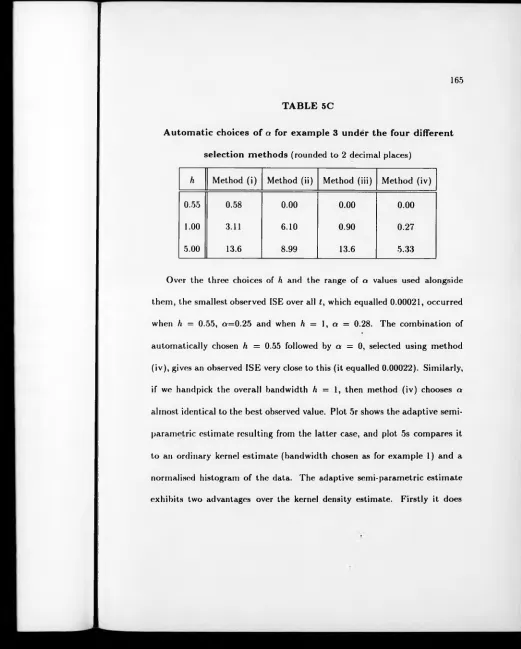
5.3.3 Example 3 ... 162
5.4 Selecting h and a - a su m m a ry ... 182
6.1 In trodu ction ... 185
6.2 A method for incorporating prior b e l i e f ... 187
6.3 The motivation for and formulation of p ... 189
6.4 An estimate o f « ... 193
6.4.1 An E x a m p le ... 202
6.5 Tw o possible improvements for special cases... 203
6.5.1 A tail-weighted method o f choosing k ...206
6.5.2 An E x a m p le ... 208
6.5.3 A boundary point-weighted method of choosing « ...211
6.5.4 An E x a m p le... 214
6.6 Choosing k using a continuous analogy to Z ’ ... 218
6.7 C o m m e n t ...225
7 R eal D a ta Set exam ples and Conclusions 226 7.1 Birth prediction error d a t a ... 226
7.2 A small data set exam ple...231
7.3 Problems and avenues for further research... 236
7.3.1 Introducing adaption into other semi-parametric methods . .236 7.3.2 The formulation of ht in the local kernel fu n c tio n ...237
7.3.3 Varying a with respect to lo c a t io n ...238
7.3.4 A plug-in selection method for h and a ... 240
7.3.5 Dealing with awkwardly shaped distrib u tio n s... 240
References 242
C h a p te r 1
P L O T la: Scalterplot Smoother based on age/log(income) data . . 5 P L O T lb: Histogram of deer line transect d a t a ... '2 3 P L O T lc: Normalised histogram, parametric and kernel density
estimates of deer line transect d a t a ... 25
C h a p te r 2
P L O T 2a: Comparing parametric and semi-parametric density es timates when the shapes o f g ( t ) and f ( I . O ) differ substantially 44 P L O T 2b: Comparing parametric and semi parametric density es
timates when the shapes o f g ( l ) and f ( t . O ) are very similar . . 45 P L O T 2c: Comparing M ISE’s o f parametric and semi-parametric
density estimates when g ~ (lamina, / ~ N o r m a l ...53 P L O T 2d: Comparing parametric and semi parametric density es
timates under three different loss fu n ction s...54 P LO T 2e: Comparing parametric and semi parametric density os
l i mates as li decreases, with g ~ Camilla, / ~ Normal . . . . (j| P L O T 2f: The difference between squanxl errors of parametric' and
semi parametric density estimates where <1 ~ Camilla, f ~
N o rm a l...(¡2 P L O T 2g: Normalised histogram, parametric and semi parametric
density estimates of doer line transect d a t a ...(>4 P L O T 2h: Comparing parametric and semi parametric density es
( ¡mate's under three different loss fu n ction s...(¡0
C h a p te r 3
P L O T 3a: Normalised histogram and semi parametric density osti mates of door line transect data with differing bandwidths . . 7b P L O T 3b: Comparing adaptive and non adaptive semi parametric
density estimates of doer line transect d a t a ... N’3 P L O T 3c: Adaption vs the gain in accuracy of adaptive semi
parametric density estimation over parametric estimation for large h ...-11
large h ... ?M> P L O T •{<■: Behaviour of vs o as It va ries... 102
C h a p te r 4
P L O T 4a: Selecting parameter O ' ... |p>
C h a p te r 5
PLO 'I' 5a: Choosing optimal o by minimising distance over I ) ' between hopt ( l ) and htyl, (overall h s m a ll)... P L O T 5b: Choosing optimal a by minimising distance over I ) '
between kopt ( l ) and htt„ (overall h medium) ... P L O T 5c: Choosing optimal o by minimising distance over I ) ’
f>etween h„,,t(l) and ht,„ (overall It largo, tio restriction on /i(>„ ) P L O T 5d: Choosing optimal nr by minimising distance over /)*
between h„pi ( t) and ftij(i (overall It large, restriction on lit,a) . . | PLO 'I' 5e: Observed ISP of semi parametric method vs o. where
g ~ bimodal and J ~ Normal (/t ~ 0 . 5 ) ...|^y
PLO P 5f: Observed ISP, of semi parametric method vs n, where
g ~ bimodal and f ~ Normal (/i = I ) ...|cu
PLO 'I' 5g: Observed IS I! ol send parametric method vs n, where
g ~ bimodal and / ~ Normal (ft — 5 ) ...|gg
PLO 'I' 5b: Comparing parametric and semi parametric density es timates; semi-parametric uses optimal h and o ... |yg PLO 'I' 5i: Comparing a semi parametric density estimate using op
timal It and o with a normalised histogram of the data and a kernel e s t im a t e ...171 PLO 'I' 5j: Observed ISP of send parametric method vs or, where
g ~ Gamma and / ~ Normal (h ~ 0 . 5 ) ...172
PLO T' 5k: Observed ISP of semi parametric method vs or, where
g ~ Gamma and f ~ Normal (/i = 1) ...175 P L O T 51: Observed ISP of send parametric method vs or, where
g ~ Gamma and f ~ Normal (h = 5 ) ...174
optimal h and a with a normalised histogram ...176 P L O T 5o: Observed ISE o f semi parametric method vs « , where
true distribution is mixture o f Gammas, / ~ Weibull (h ~ 0.5) 177 P L O T 5p: Observed ISIO o f semi parametric method vs a, where
true distribution is mixture o f Gammas, f ~ Weibull (h = 1) . 178 P L O T 5q: Observed ISP of semi parametric method vs « , where
true distribution is mixture o f Gammas, / ~ Weibull (h = 5) . 17!) P L O T 5r: Comparing parametric and semi-parametric density es
timates; semi-parametric uses optimal h and « ...180 P L O T 5s: Comparing a semi-parametric density estimate using
optimal h and ft with a normalised histogram and a kernel e s t im a t e ... 181
C h a p te r 6
P L O T 6a: k vs / ' (n = 1000) ...|<)<) P L O T 6b: |/c| vs Z ' (n = 1 0 0 0 )... 200 P L O T 6c: Adaptive semi-parametric estimate' of deer line transect
data with no ‘ prior belief’ in corp o ra ted ...20) P L O T fid: Adaptive semi parametric estimate of deer line transect
data using index of ‘ prior belief’ ... 205 P L O T fie: Adaptive semi parametric estimate without, the incorpo
I n i. i o n o l ' pi lol l i c l i e i ... 20!)
P L O T (if: Adaptive semi parametric estimate with ‘ tail weighted prior belief’ ...210 P L O T fig: Normalised histogram of brightness component data in
dieating the reflectance from cornfields measured by satellite . 215 P L O T fih: Adaptive semi parametric density estimate of cornfield
reflectance data with no incorporation of prior b elie f... 217 P L O T fii: Adaptive semi parametric density estimate oi cornfield
reflec tance data with boundary point, weighted prior belief . . 21!)
C h a p te r 7
PLO T 7a: Histogram of birth date predic tion e r r o r ...'i 'l l PLO T 7b: Normalised histogram of prediction error and a para
metric density estim a te...22!)
density e s tim a te s ...230 P L O T 7d: Normalised histogram of prediction error with an adap
tive semi-parametric density e s tim a te ... 232 P L O T 7e: Histogram of ball bearing fatigue d a t a ...233 P L O T 7f: Normalised histogram of fatigue data with parametric,
ordinary kernel and adaptive semi parametric density estimates 235
Firstly I would like to thank my supervisor, Professor John Copies, for all his advice and encouragement over the past three years. Thanks also to all stair and students at Warwick University Statistics Department who have- made the past six years ve-ry enjoyable, especially l.ita anel Liz (sexre-tarial), Orlando, Nick and Crispin (for much needed computing help), Neil (rounds of golf) and Luis (rnexican cooking)!
Finally to my parents and EPSRC whose financial support has enabled me to complete this weak, and to (¡erel for giving me the ability to do it.
D E C L A R A T IO N
The local likelihood method o f ('opas (1995a) allows for the incorporation into our parametric model of influence from data local to the point t at which we are estimating the true density function g(t) . This is is achieved through an analogy with censored data; we define the probability of a data point being considered observed, given that it has taken value x,, as
where K is a scaled kernel function with smoothing parameter h. This leads to a likelihood function which gives more weight to observations close to I, hence the term ‘ local likelihood’ .
After constructing this local likelihood function and maximising it at I, the resulting density estimate can be described as semi-parametric in terms o f its limits with respect to li. As h oo, it approximates a standard parametric' fit f ( I . O ) where as when li decreases towards 0, it approximate's
the non - parametric kernel density estimate!.
My thesis develops this idea, initially proving its asymptotic superiority over the standard parametric estimate under certain conditions.
We then consider the improvements possible by making smoothing pa rameter h a function of /, enabling our semi parametric estimate to vary from
believe the true density to be low. Our improvement in accuracy is demon st rated in both simulated and real data examples, and the limits with respect
li and ft are given and evaluated, along with a procedure for incorporating
prior belief about the true form of the density into these choices.
Kurt her piaci ¡cal examples illusi rate the effectiveness of I liese ideas when applied to a wide range of data sets.
approximating y( l ) in regions of high density to f ( t , 0 ) in regions where we
to li and the new adaption parameter n are examined. Methods for choosing
I'Ik- following notation appears regularly throughout this thesis. This guide is neither exhaustive or essential, hut may save the reader the trouble of referring back to preceding chapters when working through equations.
g The true distribution whose density function we are attempting to esti mate.
X = x\,...,xn A random sample of n observations from distribution g.
I Target point I at which we are estimating the density function of the true distribution.
g ( t ) The probability density function defining true distribution g.
n The size o f our sample o f random observations.
W , 0 ) 1 hobability density function defining the parametric family / which we b e lie v e to be the distribution which produced data set .V.
0 Maximum Likelihood Kstimate (M L K ) of parameter 0.
0t Maximum Ixical Likelihood Kstirnate (M L L L ) of parameter 0 at t.
I\ ( ti) Scaled kernel function performing the weighting in our local like lihood function.
h band width or smoothing parameter list'd in the kernel function, constant with respect to /. ‘ Overall bandwidth1 in adaptive semi parametric method.
hi Loeal band width; locally variable' version of h.
n Adaption parameter which determines how much our local bandwidth varies from the overall bandwidth //.
The following notation appears regularly throughout this thesis. This guide is neither exhaustive or essential, but may save the reader the trouble of referring back to preceding chapters when working through equations.
g The true distribution whose density function we are attempting to esti mate.
X = x\,...,xn A random sample o f n observations from distribution g.
I Target point I. at which we are estimating the density function of the true distribution.
g ( t ) The probability density function defining true distribution g.
n The size of our sample of random observations.
f ( l , 0 ) Probability density function defining the parametric family / which w e b elie ve to be the distribution which produced data set ,V.
0 Maximum Likelihood Estimate (M L E ) of parameter 0.
0t Maximum local Likelihood Estimate (M L L K ) of parameter if at t.
K (u) Scaled kernel function performing the weighting in our local like lihood function.
h llandwidl h or suioot hing parameter used in the kernel function, constant with respec t to /. ‘ Overall bandwidth’ in adaptive semi parametric method.
h, local bandwidth; locally variable version o f h.
o Adaption parameter which determines how much our local bandwidth varies from the overall bandwidth h.
function uses a local bandwidth /t( „ instead of h.
MSE Mean squared error.
M ISE Mean integrated squared error.
ISE Integrated squared error.
1
Introduction and Literature Survey
1.1 Setting the scene
How exactly one should estimate the probability density function defining
the true distribution g of a random quantity Z is a fundamental question
in statistics. The various methods used for density estimation can be split
into two groups. Parametric estimation assumes that the observed data
X = x\, . . . , xn are from a member of a standard parametric fam ily o f dis
tributions /, with density function f ( t , 0 ) at our target point t at which we
are attempting to estimate true density function g(t). The p-dimensional
parameter 0 = ( 0i,...,0p) is then estimated, for example by maximum likeli
hood, and an estimate 0 = (0\,...,0V) is obtained. We now have a paramet
ric estimate f ( t , 0 ) . Non-parametric estimation differs from this in that no
constraints are imposed as regards to the data coming from any particular
parametric family. Instead the data are allowed to speak for themselves, the
only assumption being that the distribution of the data has a ‘ true’ probabil
ity density function g ( t ) , our non-parametric estimate of this being defined
as g(t ) .
aspects of parametric and non-parametric estimation, and eliminating their
respective weaknesses as far as possible. Various methods have been proposed
in the past which are semi-parametric in that they attempt to provide a
link between g( t ) and f ( t , 0 ) . My work concentrates on the development,
improvement and theoretical justification of a particular technique built on
the concept of local likelihood. This method was first applied in a density
estimation setting by Copas (1995a), though local weighting of observations
has been established in the field of regression analysis for some time.
1.2
Local likelihood and regression
Local fitting is a standard procedure in estimating the dependence of a re
sponse variable Y on a predictive variable X . Assume we have a sample
(X i, V j), ..., ( X n, Yn). We are searching for a regression function
m (X ) = E ( Y \ X ) ,
the best mean squared error predictor o f Y given X , and our response shall
then be modelled as
Yi = m (X ,) +
Cleveland (1979) and Chambers (1983) both give examples of Scatterplot
Smoothers. For a scatterplot (X ), V)), i = l,...,n , the fitted value at x is the
value of a polynomial fit to the data using weighted least squares. The weight
o f a particular point is dependent upon the distance between the X variables
only, such that it will be large for ( X t, Vi) if X ; is close to x, and small if not.
A common choice of weight function is
u>(*,Xit A ) « f f ( ^ j p i ) (1)
where A '(u ) is a scaled non-negative kernel function which satisfies the fol
lowing conditions:
(i) It is symmetrical about 0.
(ii) It is a decreasing function of |u|.
(iii) It has a maximum o f 1 at u = 0.
For example, if we are estimating response y at predictor value x = xo,
we fit a straight line
y = ¿o -f box
where a0 and bo are the values of coefficients a and b which minimise
at x = x 0. Smoothing parameter h, often called the bandwidth, controls
the degree of local weighting; when it is large this method approximates
ordinary least squares. Our regression estimate at x0 is simply the height o f
the fitted line (2) at x0. At a different point xi we repeat the procedure, but
with the weighting now dependent on the distances of the A ) ’s from xj. Plot
la, adapted from Wand and Jones (1995), Fig 1.2, illustrates this method
clearly.
The result is a non-linear fit to the data, with the extent of the departure
from linearity depending on the size of h. This method is also known as the
locally weighted running lines smoother or LOWESS. Cleveland (1979) gives
a more robust iterative fitting method.
Scatterplot smoothing can be seen as semi-parametric in that we are
assuming a model for Y given X at every point. In general the literature
describes this as non-parametric regression.
Tibshirani and Hastie (1987) make the extension to likelihood based re
gression models. Likelihood based methods assume that m (A ,) = m ( X { , 0 )
and then attempt to estimate parameter 0. For example in the quadratic
model
T h e s o lid cu rv e is th e e s ti m a te T h e d o tte d cur ves a re th e k e rn e l w e ig h ts a n d s tra ig h t lin e fit s a t po in ts x „ a n d x ,
log (income)
12
13
14
15
with
t i ~ N ( 0,<r2),
we estimate 0 = ( 0 o , 0 i , 0 j ) by 0 = (0O, fa, fa), the maximum likelihood
estimate found by maximising log-likelihood function L ( 0 , X i , Y { ) summed
over the data. Our parametric estimate of response y given any predictor
value x, found via likelihood, would thus be the curve
y = 0o + fax + fax2 + et.
Tibshirani and Hastie replace the function m o f predictor value and pa
rameter 0 in (3) by an unspecified smooth function s(x). They then use
‘ local likelihood’ to estimate s (x ) from the data. In this process the data is
weighted with respect to x, the weight of an observed pair (A",-, Yi) decreasing
the further A , is from x. We then find parameters f a = (fa,x, 0 liX, fa,x) which
maximise the ‘ local likelihood function’
¿u»(*,A .-,A )L (A ,A 4,lf5)
1=1
at predictor value x, where w(x, A<, h) controls the weighting. Our estimate
of s( x ) is then defined as
In the Gaussian case, this local likelihood regression technique is equiva
lent to LOWESS, since maximising the local likelihood is equivalent to least
squares minimisation. This procedure has a range of applications, such as in
the proportional hazards model of Cox (1972). Hastie and Tibshirani (1990)
discuss several drawbacks o f this method, such as the difficulties of incorpo
rating different smoothing methods and the cost of the estimation procedure.
However they suggest that the method is worthy of further study.
Other work of interest in this field has been produced by Jianqing Fan,
in particular Fan and Gibjels (1992) which explores the use of a variable
bandwidth hx. Explicit formulae for the optimal choice of this parameter are
given.
1.3
Density estimation through local likelihood
In the words of Copas (1995a), there is a “crucial distinction” between the
use of locally weighted likelihood methods in regression and in density esti
mation. In the former, the weight o f an observation is a function o f time or of
the covariates which are fixed (i.e. we are interested in estimating response
fixed. In the density estimation scenario, the weight needs to depend on the
distance between the observed data X and the target point t at which we
are estimating the true density. Because the weight function is a function of
X and hence a random variable, we have to allow for the random nature of
the weights in our likelihood function.
Copas uses an analogy with censored data to motivate a local likelihood
function. As in parametric estimation we assume the data to be from a para
metric family /. However, we consider a proportion of the data to have been
observed and the rest to have been censored. Given that we are estimating
at any target point t, the probability that any particular observation is taken
as being observed, conditional on the value that it takes arriving from the
experiment, is given by a weight function
w ( n , t , h ) = K
In other words, the weighting on each observation, which is dependent on
its distance from t, is performed by a scaled kernel function A '(u ) defined in
equation (1). Smoothing parameter h controls the overall degree of censoring;
given a fixed target point t, then if h is large with respect to maxIt |ar, —1|, the
decreases, only the observations local to t are likely to be considered observed.
Considering our sample X to have been thinned by this artificial censoring
process, we now construct our local likelihood function. The probability that
an observation is observed and takes the value x, is
p ( i t h data point considered observed|ith data point takes value X j ) p ( a data point takes value X ,')
= w(Xi, t, h) f( X{ , 6).
Likewise the probability that a data point is censored and takes a value in
the range of / can be written as
B( 6) —
J
(1 — w(x, t, h ) ) f ( x , 0)dx = 1 —J
w( x, t, h ) f ( x , 0) d x .W ith /, as the indicator random variable for the censoring status o f obser
vation x, having been observed, then our standard log-likelihood is of the
form
l ( xi , 0) - /¿log/(x,,0) -I- 7; log ui(x,, t, h) + (1 - I i ) l o g B ( O ) . (4)
W e can omit the second term since it is constant with respect to model
parameter 0. Then taking the expectation over the 7,’s to get the ‘average’
log-likelihood obtained under our weighting mechanism, using the fact that
and summing over the data, we have the local likelihood function at t,
n
L w( X , t , 0 , h ) = ^ 2 w ( x i , t , h ) \ o g f ( x i , 0 ) + (1 - w ( i i , t, h) ) log B( 0) . (5) 1=1
For any target point t , we evaluate our maximum local likelihood es
timate (M L L E ) 0t which maximises (5). Our density estimate is
Copas (1995a) gives further technical details, demonstrating that although
the variance of the M LLE 6t is greater than that of the standard maximum
likelihood estimate (M L E ) 0, 0t is a consistent estimate o f 0 for all h.
This method is semi-parametric in terms of its limits with respect to h.
Assuming n fixed, as h —> oo our local likelihood function converges towards
the standard log-likelihood L ( X , 0 ) , which is maximised by M LE 0, and so
our density estimate will approximate the standard parametric estimate.
It is important to note that this convergence is not always uniform for
all t. That is to say, however large our value of h is, if the domain of / is
unbounded then
t —* oo => w ( i i , t , h ) —* 0 Vxj,
and L w( X , t , 0 , h) will not approximate the log-likelihood. For practical use
o f this semi-parametric method this is not a problem, since we will either be
which contains the data. In these cases |x,- — <| will be bounded, and as
h —* oo the aforementioned convergence is uniform. So if we want our local
likelihood to approximate the log-likelihood for all t we just choose h to be
very large with respect to |x, — t\ for all the observations x,.
However, later in this thesis I use this large h approximation to the lo
cal likelihood in a theoretical context, which involves integrating our semi-
parametric estimate with respect to t over an unbounded interval. Despite
the lack of uniform convergence of L w( X , t , 0 , h ) to L ( X , 0 ) as h —> oo, it
is possible to split the integrals concerned into three parts and demonstrate
that the unbounded end sections converge to 0 as the probability of them
containing observed data decreases. We can then use the bounded middle
section integral as an approximation to the whole integral. This is explained
in greater depth in section 2.3. Obviously if the domain of / is bounded
anyway, then convergence is uniform and we do not have a problem.
Copas also demonstrates that as h —► 0, then f ( t , 6 t ) converges to the
ordinary non-parametric kernel estimate g ( t ) in the sense that as h —►0,
then
/Mi)
g ( t )where
<6)
In equation (6), which is our definition of g( t ) for the remainder of this thesis,
we have
as the normalising constant for kernel function K , X\, ..x„ as our sample and
h as the smoothing parameter or bandwidth.
In the semi-parametric method, bandwidth h controls the relative influ
ence of the imposed parametric model compared to that of the data. As
it spans the continuum between 0 and oo, so f ( t , 0 t) spans the continuum
between g ( t ) and f ( t , 0 ) , though it should be noted that the non-parametric
end of this is a ’moving target’ , since g( t ) is itself dependent on h.
One drawback with this method is that f ( t , O t) does not necessarily in
tegrate to 1. Obviously this condition is satisfied at the limits of h, and for
the Normal distribution with large h it was proved by Copas (1995a) that
¡ f ( t , 0 t)dt = l + O( h ~4).
When the semi-parametric method has been used with a two-parameter fam
has been very close to one, whereas it has been noticeably less for a one
parameter family such as the exponential. As Copas suggests, this may be
because of the greater flexibility of the two parameter case in matching all
values of g. In all the exam ples in this thesis, the density estimate
f ( t , 9 t) has not been normalised unless otherwise stated.
T w o further papers have been concerned with demonstrating the superi
ority o f this semi-parametric method, using small and large h approximations
to f ( t , 9 t) respectively. Copas (1995b) produces a small h approximation to
the mean squared error o f f ( t , 9 t) and demonstrates a gain in accuracy over
the ordinary kernel estimate if / is modestly misspecified. Meanwhile, taking
h to be large, Copas and Stride (1995) give a proof of the semi-parametric
method’s asymptotic improvement in accuracy over parametric estimation
under certain restrictions on the form of /. This is contained in chapter 2 of
this thesis.
There exist other so-called semi-parametric density estimators which have
similar properties to the method described above. Olkin and Spiegelman
(1987) build the bridge between f ( t , 9 ) and g( t ) in a simpler if somewhat ad-
a density estimate of
+ (1 - 7T)$(<),
a weighted sum of parametric and non-parametric estimates. This method
also requires selection of a further parameter 7r € [0, 1], possibly by cross-
validation.
The semi-parametric method of Hjort and Jones (1994) bears a closer
resemblance to that of Copas. At t they suggest choosing a value of 0 to
maximise their local likelihood function
L n(t, 0) = n ~ ' ± K ( ^ ) log / (* ,, 0 ) ~ l K ( ^ ) f ( x , 0)dx (7)
which is simpler than that of Copas (1995a), but lacking the direct motivation
through weighted censoring of observations depending on their distance from
our target point. The function defined in (7) has a useful property in that the
parameter 0( t) which maximises its large n approximation at t also minimises
a locally weighted version o f the Kullback-Leibler distance between the true
and the approximating parametric density at t. As h —> oo, (7) converges to
the standard log-likelihood minus 1, which is maximised by M LE 0. Equally
when h decreases to moderate and small values so reducing the influence of
the same variance as g ( t ) but a smaller bias term, resulting in a smaller mean
squared error with respect to true distribution g(t). Using the notation from
(5), equation (7) can be rewritten as
n
L n( t , 0) = n~l w(xi, t, h) log /(*,-, 0) - 1 -f- B( 0) . i=i
Some rewarding conversations about this work with Dr Shinto Eguchi
(Institute of Statistical Mathematics, Tokyo) led to his suggestion of the
following local likelihood function, where we choose 6 = 6 j to maximise
M M )
= n ~ xlog/(*.-, 0) -
h)log(l -
B{ 0) ) .1=1
(In the special case where we are using a rectangular “ neighbourhood-type”
weight function, this method is equivalent to ‘ truncating’ rather than cen
soring. The weight function determines the size of the interval around target
point t containing the observations which we shall consider. We ignore all
observations outside this region, thus truncating the data.)
This method gives its strongest results when h is large. As for the method
of Copas, we can show that under certain distance measures the resulting
semi-parametric estimate offers an improvement in accuracy over
parametric estimation (see chapter 2). However the result is stronger since
method loses out when h is decreased to a small value, since unlike the
procedures of Copas or Hjort and Jones it does not possess the equivalence
to, or the asymptotic improvement over non-parametric kernel estimation. If
we believe the departure of g( t ) from f ( t , 6) to be very slight, making a large
value of h suitable, then this method could be effective, but it will perform
poorly if h is small.
From now on in this thesis, the terms semi-parametric estimation and
local likelihood will refer exclusively to f ( t , 6 , ) and (5 ) respectively unless
otherwise stated. It should also be assumed that in all practical ex
am ples and simulations in which I have evaluated sem i-param etric
density estimates via maxim ising the local likelihood, I have taken
the weighting function A '(u ) to be the scaled G aussian kernel func
tion exp( — y ) . It has convenient continuity properties and makes it possible
to find B ( 0) analytically for many choices of /. Unless clearly stated other
1.4
Kernel density estimation and related methods
A t the lower limit of smoothing parameter h, our semi-parametric method
approximates to a non-parametric ordinary kernel density estimate g ( t ) with
bandwidth h (6), first suggested by Parzen (1962). This itself has been sub
ject to a large amount of research, much of which becomes relevant in the
later chapters o f this thesis. Silverman (1986) gives a good introduction to
the subject as well as going into finer detail on several facets o f it. Wand
and Jones (1995) performs a similar role, with special attention given to the
choice of the bandwidth h. As in the histogram, o f which the kernel is simply
a smoothed version, the choice of h will significantly effect the appearance of
our density estimate. Parzen (1962) developed a plug-in formula for h based
on minimising a small h approximation to the mean squared error of the es
timate. This performs well when the true density is close to that of a Normal
distribution, but otherwise tends to oversmooth, especially when estimating
multimodal densities. Hall et al (1990) suggest an improvement involving
a higher order asymptotic representation of the optimal bandwidth. Least
Squares Cross-Validation, first applied in this context by Rudemo (1982),
as possible methods of selecting h. For a comparison o f these methods see
Sheather (1992), which demonstrates that there is no single best method for
all samples.
Just as Fan suggests a variable h when using the kernel as a weight func
tion in regression analysis, so the concept o f kernel estimation with a variable
h has also been explored. The principle of using a non-constant bandwidth
is particularly appealing when true distribution g appears to be long-tailed.
In these circumstances it makes sense to use a large bandwidth in areas of
low density, smudging the few observations over a wide area and reducing
the risk o f noise around the datapoints. In the smaller regions of high den
sity a smaller value o f h would be more suitable to avoid oversmoothing and
subsequent underestimation o f the density around the mode.
T w o methods have arisen, both of which can be described as ‘adaptive’ or
‘ variable’ kernel methods. I shall use the definitions from the review paper of
Jones (1990). This defines a varying kernel density estimate at t given data
X = i t , ...,x„ as
dif-ferent bandwidth is employed for each data point. Varying kernels were
introduced by Briemen, Meisel and Purcell (1977), who suggested that the
bandwidth would vary through a choice of hXl = hg ( xi)~1 with h a constant
of proportionality. Abramson (1982) proved that a choice of hXt = hg( x, ) ~ 2
reduced bias, while Silverman generalised the choice o f bandwidth to
g (* .)
exP(£*,(logff(xi)))
with new adaption parameter a chosen between 0 and 1. Notable further
work in this area with respect to bias minimisation has been written by
Hall and Marron (1988) and Hall (1990). Hall (1992) considers choosing our
variable bandwidth with respect to minimising a weighted version o f the in
tegrated squared error of the resulting density estimate, and demonstrates
the optimality of selection by weighted squared error cross-validation. Note
that the formula for varying bandwidth hx, given above requires the estima
tion o f a pilot estimate of the true density for further use. Brieman et al,
Abramson and Silverman all indicate that the quality o f our density estimate
will be insensitive to the fine detail of the pilot estimate, for which Silverman
suggests the use of ordinary kernel density estimation.
target point t, our density estimate is
This is equivalent to the ordinary kernel estimate at t with h = ht. But
unlike the varying kernel, which provides a global density estimate once we
have placed the kernels of varying bandwidth over the n points, the local
kernel estimate at t, which places kernels of identical bandwidth ht over the
data points, is not applicable at any other point than t. In fact our local
kernel estimate over the range of t is made up of a continuum of individual
ordinary kernel estimates with different bandwidths for each t. This means
that does not necessarily integrate to 1, and is not a probability density
function itself, unlike g( t ) and gv( t) . The optimal choice of ht will be the
same as for the ordinary kernel estimate when considering estimation at a
single point; we can use the same small h approximation to the MSE at t
which tells us that our best choice is
l
See Jones (1990) for further details. Over the range o f t this will run into
(1989) attempts to sidestep this problem but his solution involves the awk
ward proposition of estimating the fourth and sixth derivatives of g ( t ) . For
these reasons the varying kernel has a greater chance of being adopted as a
regular method of density estimation; indeed Silverman (1986) demonstrates
its worth in several examples. However Chapter 3 of this thesis involves local
kernels in the weighting of the local likelihood function; a situation in which
their lack o f integrability to 1 is less important. A new method of bandwidth
selection is proposed avoiding awkward derivative estimation, using a form
similar to that for the varying kernel.
1.5
How this thesis aims to improve upon these meth
ods
Very few distributions are perfectly modelled by any single parametric family.
One answer is not to impose any parametric family on the data, and let
it speak for itself by using non-parametric methods. Yet methods such as
histograms are hardly practical for precise estimation of a density and even
non-parametric kernel estimation is far from ideal in'some situations. As well
as lacking the convenient structure of parametric estimation, the problem of
roughness is allowed in the tails to enable a good estimate to be achieved in
regions of high density.
A motivation for semi-parametric methods of the sort reviewed in this
chapter comes from cases where the true distribution is thought to resem
ble a parametric family but differs in shape and size in a few small areas.
The following data set will be considered throughout this thesis since it is a
good illustration of how both parametric and non-parametric methods can
simultaneously fail.
The data set consists of line transect measurements of deer (Buckland
(1992)). The unit of measurement of perpendicular distance from the line
is metres. Line transect surveys are a technique used to measure ‘species
abundance’ , defined as the average number o f specimens of the species per
unit area. A straight line is drawn between two points and an observer walks
along it, recording the perpendicular distances from the line o f individual
sightings of the relevant species. If L is the length of the line, then abundance
can be estimated by
J _ rcg(O) 2 L
LO
T
1
b
:
His
to
g
ra
m
o
f d
e
e
r
lin
e
tr
a
n
s
e
c
t d
a
the observed distances, which itself must be estimated first. See section 2 of
Copéis (1995b) for a more detailed inspection of the formula for abundance.
Initially we consider producing a parametric estimate of g( t ) . A his
togram of the distances of the deer data (plot lb ) suggests an exponential fit
is sensible, but overestimates in the region around t = 0. However, the alter
native, a non-parametric kernel estimate, will struggle especially in this case,
as much because o f the shape and bounded nature of the distribution éis the
usual problem o f choosing h to balance oversmoothing and undersmoothing.
Thus the retention of the structure of a parametric family which is defined
on a limited range is convenient here; our density estimate cannot logically
take any value other than 0 for t < 0 when we are considering distances from
a line. Plot lc illustrates just how poor our parametric and non-parametric
estimates are around t = 0, the non-parametric method being an ordinary
Gaussian kernel density estimate with bandwidth h handpicked to avoid noise
in the tails yet minimise oversmoothing in regions o f higher density. For
a similar motivating example for semi-parametric methods see the remand
times example from Copas (1995a), section 3. Further information on line
transect sampling can be found in Burnham et al (1980).
but gives us flexibility to deal with local departures from the model. In par
ticular the semi-parametric method derived from the local likelihood function
(5) of Copas has the advantages of a clearly motivated structure, convergence
to non-parametric and parametric estimates at the lower and upper limits of
A, and asymptotic proof of its superiority over kernel estimation when f ( t , 0)
does not differ too much from g(t). The first aim of this thesis is to demon
strate its superiority over parametric estimation under certain conditions (see
chapter 2).
However the problem of choosing a suitable smoothing parameter A trans
lates to semi-parametric estimation too, since we are using a kernel function
for the weighting. Our ‘ balancing act’ when selecting A is now between non-
parametric and parametric estimates; we have to decide how much of the
structure of the observed data we want to reveal compared to how close we
want our estimate to stay to the standard parametric fit. This can pose
problems in cases where we are certain that one region of the true density
g( t ) will be akin to our parametric estimate but another may differ
noticeably. Chapter 3 of this thesis suggests a way of sidestepping this prob
lem, by introducing a variable A allowing a more non-parametric estimate in
developed a structure for this, chapters 4 and 5 proceed with the thorny ques
tion o f how to select a value of h and a value of the new adaptive parameter
a. Various ideas for plug-in values of these parameters based on minimising
small h approximations to the mean squared error of our estimate are given.
Chapter 6 suggests a revised approach, incorporating an index of prior belief
concerning the true distribution. There are regular examples with real and
simulated data sets throughout the thesis, with a couple of more detailed
2
The superiority of semi-parametric esti
mation when
h
is large
2.1 Introduction
The semi-parametric method of Copas (1995a), introduced and outlined in
greater detail in chapter 1, combines the structure of parametric estimation
through likelihood with the flexibility given by smoothing techniques that
are normally associated with non-parametric procedures. Given a sample
* i , ...,x„ assumed to be from model f ( x , 0 ) , the usual log-likelihood function
L ( 0) = ± \ o g f ( x i,0)
i=i
is replaced by a local likelihood function (chapter 1, equation (5 )) which
gives extra weighting to the observations in the region of our target point t ,
the location at which we are estimating the true density. If all the weight
in the analysis is placed on observations close to t, then the model is less
influential, and we will obtain a mainly non-parametric density estimate.
As the weighting is reduced, the model becomes more influential, with the
evenly weighted case being equivalent to the full parametric fit produced by
The bandwidth h smoothing kernel function A'(u), which performs the
weighting within the local likelihood function, has overall control of this
weighting. If h is large then the weighting will be even throughout the ob
servations, but if h is very small then all the weight is placed on observations
close to our target point.
Useful approximations to the equations given in chapter 1 can be found
for both large and small values of h. For the latter it can be proved that
provided n is sufficiently large, the asymptotic mean squared error (M S E ) of
the semi-parametric estimate must be smaller than that of the parametric fit
whenever the model is misspecified. Details of the argument proposing this
can be found in Copas (1995b), section 3.
We can consider the size of h to be relative to the scale of the data.
For example, if h is large we interpret this as v being large, where h = sv,
with s = a denoting one sample standard deviation, and v constant. The
approximations to be examined in more detail in section 2.2 rely on large h in
terms o f assuming that ( x — t) h~l is small. Given a fixed value o f h for all t, as
i - t o o w e will find that this assumption doesn’t hold. However large h is, we
can always choose t such that ( x — t)h~' is not small. This dilemma can only
and the data point furthest from t. Since this chapter aims to substantiate
the advantage o f the semi-parametric method with large fix e d h over a range
of points, which involves integrating over t from infinity to minus infinity, we
need to use another approximation as |f| gets very large. This is defined at
the start of section 2.2.
Copas (1995a) derives several formulae based on fixed large h approxima
tions of the weight function which determines the extent of the censoring of
observations. For example, we can replace the kernel function A '((x — t) h~l )
by its large h expansion, explained in more detail in section 2.2, producing
the following equation,
L w( t , X , 0 , h) —
¿ l o g /(x,,0) - - t f (log/(x„0) - log(<r92 + (fie - <)2)) + 0 ( h ~ 4).
(
1
)Differentiating and omitting all terms of order greater than A-2 we find
that
± L w( t , X , 0 , h ) ~ ± L ( 0 ) + l- bS* nT (2)
where 6 = A '"(0 ) < 0, 6 = /i-1, n is the sample size and
with fie and <7$2 being the mean and variance under density f ( x , 6 ) .
Under the assumption that model f ( x , 0 ) is correct, T has mean 0, but if
model / does not fit well in the neighbourhood of t, then E ( T ) ^ 0. Thus T
can be used as a test of local fit, with the null hypothesis being that its true
value is 0. Copas (1995a) pursues this further.
By considering these approximations we are seeing how much our M LE
0 is modified by a small amount of ‘ local influence’ from the data. If T ss
0, then at any target point t we would expect little departure of 6t from
0. However if the data local to t suggests that true distribution g differs
substantially from our model / in this region, then 0t will differ from 6.
Intuitively we will expect this change to improve our estimate at t more
often than not, with being closer to g( t ) than f ( t , 0 ) was, since it has
given greater weight to the data in the neighbourhood of t.
In sections 2.2 and 2.3 large h approximations are extended and then ap
plied in an attempt to quantify any general advantage of the semi-parametric
method, if indeed any exists. When considering estimation at a specific tar
get point t, using the semi-parametric method is not always preferable. As
illustrated in section 2.5 example 1, there will always be at least one value of
accuracy which the semi-parametric method may not be able to match and
obviously not better. However, despite not being uniformly better over the
whole range o f t, the semi-parametric method can be shown to be superior
under certain conditions when using some sensible loss functions to compare
the performance of itself and the parametric method. Section 2.2 gives some
results for when we assume both n and h to be large.
2.2
Some approximations for large
hSeveral approximations for large h proposed in this section can be used to
show the superiority of the semi-parametric method under certain conditions.
Three loss functions will be employed to measure and compare the relative
performance o f parametric and semi-parametric estimation.
Given data X = (xj , . . . x„ ), the local likelihood function at target point
t, L w( t , X , 6 , h), is driven by our weight function
w(xi, t, h) = K
where bandwidth h controls the amount of smoothing. For all t we can find
0 = 0, which maximises L w(t, X, 0, h). As h increases towards infinity, 0t will
and hence, using the standard variance approximation
V ar ( 0t) = n - 1 ^ ^ l w( t, x,0, h ) ^ j Var ( ^ l w(t, x,0, h)^j ,
that
Var(Òt) ~ lo g/ ( * , « ) ) ) + 0 ( h~* ) .
Thus when h is large, the variance of 0t will be close to that of 0.
Continuing in a similar vein, we can also can also derive equation (2) from
(1), and from this the following approximation,
(0, _ 0) ~ lo g / ( * , * ) ) ) T, (5)
where 6 = h~x and T is defined in section 2.1, equation (3).
(0 — 0) is of order n s so as n —♦ oo then 0 —* 0. With b\ as above, we
define
l ( 0 ) - ' = b, log/ ( * , « ) ) )
which is positive semi-definite. For example, if / is a Normal density with
variance <r2 and A'(u ) is the Gaussian kernel, then
1 0
0 Ì
Thus, using (3) and (5) we find
E,(Ot - B ) ~
- j ( t - x f
(jL
log/ (* , 9 ) log( E j ( t - X ? )j
g ( x ) dx (7)which after expanding
= J ( l ~ f ( x , 0 ) g ( x ) d x
~ ^ d l o g E , ( t ~ x ^ E ^ t ~ x ) i c ( t ^°)
= - \ l ( 0 T X62 J ( t - x f ^ \ o g f ( x , 9 ) ( g ( x ) - c ( t , 0 ) f ( x , 0 ) ) d x (8)
where
/ j „> _ Eg(t - x )2 _ fx(t - x )2g (x)dx £/(< - x)2 /*(< - x )2/(x, 0)dx
We can find another useful approximation from the Taylor series o f f ( t , 0 t)
expanded around 0, using the fact that (6t — 9) is small for large h.
For all t we have
(0, - 0) + o(6'). (9)
These approximations can now be used in evaluating the performance of
2.3
Comparing semi-parametric and parametric esti
mation for large
h2.3.1 U sin g the loss function L\
We shall now attempt to quantify the improvement gained by using the
semi-parametric method, initially through loss function L\. This is simply a
weighted version of the integrated squared error (IS E ), and when considering
the accuracy of any parameter estimate 0 = 0° over a range of target points
i, it is defined as
the Kagan divergence between f ( t , 0°) and g(t). See Clarke and Baron (1990)
which is distributed approximately x 2*-i if the data is divided up into ap
(10)
where 0 is the limit of Maximum Likelihood Estimate 0 as n —» oo. Note
that if we assume that (0° — 0) is small for all t, then
(
11)
for further details of this function. It is analogous to the chi-squared goodness
of fit statistic
^ ( F r - E j ( F r) f
r
Ef(Fr)
is the expected number in group r given that the data has true distribution
/. The smaller U is, the better the fit of / to the data.
Thus the smaller the value of L \ ( f ( t , 0 ° ) , g ( t ) ) , the better our parameter
estimate 0° is. W ith sample size n being very large, the variance of our
estimate will be very small. Since the M1SE can be written as a sum of the
integrated variance and the integrated squared bias of in the limiting
case as n —» oo L\ is measuring the weighted bias of our density estimate.
We can calculate the expectation of C\, the difference between the per
formance under L\ of the semi-parametric method (where 6° = 0t) and the
parametric (where 0° = 0), defined as
C l = L i ( f ( t , 0 t) , 9 ( t ) ) - L i ( n t , 0 ) , g ( t ) ) ,
- 7, { ---7 M ) ---) dt
r
t w
.».)- /«.«))(/(<.»,) - '/(¡)+/(!,#) - swn,.
=
1. {
---
jm
H t , 0 )---
)
(12)where the integral is evaluated over the domain of f ( t , 0 ) . To make further
progress, we need to use the large h approximations to our semi-parametric
method developed in section 2.2. These are really small |i, — <|A-1 approxi
mations; it is possible to select a single fixed value of h to satisfy this criterion
we appear to have a problem, since for any fixed choice of h we can always find
a large enough value of t within the domain such that |x, — i|/i—1 is large too,
contradicting the assumption underlying our approximations. The integral
in equation (12) is calculated over the domain of f ( t , 0 ) ; if this is unbounded
we cannot choose h to validate the use of small |x, — t\h~' approximations
to f ( t , 0 t) everywhere.
However, suppose, without loss of generality, that we examine the case
where the domain of f ( t , 0 ) is unbounded at both ends. Splitting up the
integral gives
C l
- f ( ^
■ C ( m
) - / M ) ) ( / M « ) - g(0 + / M ) - g ( 0 ) / M )
Ot) - - 9( t) + f ( t , 0 ) - g ( t ) ) \
) - - g ( t ) + f ( t , 0 ) - g ( t ) ) '
j dt
dt
dt.
As |<| —► oo, we will pass the last data point and K ( ^ 1) will become small
for all i and fixed h, so our semi-parametric estimate will approximate the
kernel estimate g( t ) defined in equation (6) of chapter 1. We will assume
f ( t , 0), so that
When / is a Gamma, Weibull or Normal distribution, the popular Gaussian
kernel function K ( u ) = exp( —|u2) satisfies this restriction.
Consider values of 71 and 12 such that the integrals f ( t , 0 ) d t and
f n are both very small, and |< — x,\ is very large for all t in the
intervals ( —o o ,/ l) and (12, oo). Assuming throughout that n is large such
that 0 ~ 0, this implies that the second and third components of the sum of
integrals given above can be approximated by
Int 1 = j f " - l ) ( g( t ) — g ( t ) + f ( t , 0) - g( t ) ) dt
and
Int 2 = j T - l ) ( g ( t ) - g ( t ) + f ( t , 0 ) - g ( t ) ) dt
respectively.
Then for sufficiently large |/1| and \I2\,
0 < g(0 < vm
we get
£ (C .) *
¿2 / j ( t - x ) 2pT( t ) I ( 0 ) - ' p ( x ) ( g ( t ) - f ( t , 0 ) ) ( g ( x ) - c(t, 0 ) f ( x , 0))dxdt, (15)
where
P( x ) = ^ l o g f ( x , 0 ) .
Expanding this we find that if c(t,0) = 1, then E ( C t ) = —262zTI ( 0 ) ~ 1z < 0,
where z is a vector, implying that the semi-parametric method is at least as
accurate as the parametric under this loss function if E j ( t — x ) 2 = Eg(t — x ) 2
This condition holds in cases where / matches the mean and variance of any
distribution to which it is fitted. For example, this occurs if / is a N o rm al
distribution with mean p and variance a 2. In this case I ( 0 ) ~ l is as
given in equation (6), and defining
g ( x ) = g ( x ) - f ( x , 0 ) ,
E ( C t ) =
= - 262a 2
^ & lo9f(,x,0)v(x) j o i y £ l o g f ( t , 0 ) g ( t ) ;
/ , \ T / \ / . \
L x £; l ogf( x,0) r) ( x) dx 1 0 f t t ± l og f ( t , 0) T ] ( t ) dt
k L x £ l o g f ( x , 0 ) g ( x ) d x j \ 0 3 / \ f ( t , 0 ) g ( t ) d t J
= —2¿J<72 / x — l ogf ( x, 0) r j ( x) dx f t — l og f ( t, 0) g( t) dt
J x ( if i Jt dfL
- 6 2a2 J x -j-lo g f(x , 0)g(x)dx Jt-£ -logf(t,0)T)(t)dt
= - 6 2<t~4( F 3 - G3) 2,
where F3 and G3 are the third moments of / and <7 respectively. As one
would expect, a relationship exists between the gain in accuracy realised when
choosing the semi-parametric method ahead of the parametric method, and
the difference in the shapes of f ( t , 0 ) and g(t). The following graphs show
this visually. In both cases I have taken a large random sample of 2000 points
from a ‘ true’ distribution g, chosen an ‘ incorrect’ family parametric family
/, and used a computer package to find 0t and 0 for my semi-parametric
and parametric estimates f ( t , 0 t) and f ( t , 0 ) respectively, over a large range
(h ~ 5&), complying with the assumptions of the earlier theory. The value
of Ci is estimated by numerical integration using my knowledge of g. To
demonstrate that it is shape rather than variance which is related to the
semi-parametric method’s improvement, true distribution g has the same
variance in both cases.
In Plot 2a the true distribution g is a Gamma[A,M] distribution, with
parameters A — 1 and M = \ / 0 . It is highly skewed unlike /, a Normal
distribution which we are trying to fit to the random sample from g. The
application o f a very small amount of local influence has made the semi-
parametric method move slighly away from the parametric estimate and to
wards the true distribution in most regions. This is reflected in a much larger
negative value of Ci than in plot 2b where / is again a Normal distribution
and g is a shifted Gamma with different shape parameters but with the same
variance as in plot 2a. The shapes of f ( t , 0 ) and g(t) are similar with no
substantial local departures of the true distribution from the model. De
spite sampling variability, the semi-parametric and parametric estimates are
ba n d w id th h = 5 .4 , C , = -0.1 7 57 4 7 density
0 0 0 2 04 06
ba n d w id th h = 5 .4 . C , = -4 .88 297 8e -0 06
d e n s i t y
0.0 0 2 0 4 0 6
2.3.2 U sin g the K ullback-Leibler Distance.
Suppose as our loss function L 2 we take the Kullback-Leibler distance be
tween two distributions with density functions g ( t ) and namely
Hall (1987) studies the properties of the Kullback-Leibler distance in
measuring the accuracy of density estimates, though only in terms of non-
parametric methods.
The Kullback-Leibler distance requires both density functions to inte
grate to 1. Semi-parametric estimate does not necessarily possess
this property; so we use the normalised semi-parametric estimate
Then another comparison of the relative accuracy of the semi-parametric
and parametric methods can be achieved by calculating
(16)
instead.
E g( C 2) = E g( L 2( f ( t , 0 t) , g ( t ) ) - L 2( f ( t , 0 ) , g ( t ) ) ) , (17)