University of Warwick institutional repository: http://go.warwick.ac.uk/wrap
This paper is made available online in accordance with
publisher policies. Please scroll down to view the document
itself. Please refer to the repository record for this item and our
policy information available from the repository home page for
further information.
To see the final version of this paper please visit the publisher’s website.
Access to the published version may require a subscription.
Author(s): Stefan Grosskinsky, Paul Chleboun and Gunter M. Schütz
Article Title: Instability of condensation in the zero-range process with
random interaction
Year of publication: 2008
Link to published article:
http://dx.doi.org/10.1103/PhysRevE.78.030101
Publisher statement: Grosskinsky, S., Chleboun, P. and Schütz, G. M.
(2008) Instability of condensation in the zero-range process with
arXiv:0805.2748v2 [cond-mat.stat-mech] 5 Sep 2008
Stefan Grosskinsky,1 Paul Chleboun,1 and Gunter M. Sch¨utz∗2
1
Mathematics and Complexity Science, University of Warwick, Coventry CV4 7AL, UK 2
Institut f¨ur Festk¨orperforschung, Forschungszentrum J¨ulich, D-52425 J¨ulich, Germany (Dated: September 5, 2008)
The zero-range process is a stochastic interacting particle system that is known to exhibit a condensation transition. We present a detailed analysis of this transition in the presence of quenched disorder in the particle interactions. Using rigorous probabilistic arguments we show that disorder changes the critical exponent in the interaction strength below which a condensation transition may occur. The local critical densities may exhibit large fluctuations and their distribution shows an interesting crossover from exponential to algebraic behaviour.
PACS numbers: 05.40.-a, 02.50.Ey, 64.60.Cn
The zero-range process is a stochastic lattice gas where the particles hop randomly with an on-site interaction that makes the jump rate dependent only on the local particle number. It was introduced in [1] as a mathemat-ical model for interacting diffusing particles, and since then has been applied in a large variety of contexts, of-ten under different names, (see e.g. [2] and references therein). The model is simple enough for the steady state to factorize, on the other hand it exhibits an interesting condensation transition under certain conditions. Viz. when the particle density exceeds a critical value ρc the system phase separates into a homogeneous background with density ρc and all the excess mass concentrates on a single lattice site. This has been observed and studied in some detail in experiments on shaken granular media [3, 4], and there is a well-established analogy to Bose-Einstein condensation [2, 5, 6]. It is also relevant as a generic mechanism for phase separation in single-file dif-fusion [7] and condensation phenomena in many complex systems such as network rewiring [8] or traffic flow [9], for a review see [2].
The transition can be caused by site-dependent jump rates gx [5] due to the slowest site acting as a trap. It also appears in a more subtle fashion in homogeneous systems where condensation may result from the growth of large clusters on the expense of small clusters, if the jump ratesg(n) as a function of the numbernof particles on the starting site have a decreasing tail. Such a model with a generic power law decay
g(n) = 1 +b/nσ (1)
with positive interaction parametersb, σhas been intro-duced in [10]. Condensation occurs if 0 < σ < 1 and b >0 or ifσ= 1 andb >2. The condensation transition is understood also rigorously in the context of the equiv-alence of ensembles [11, 12], and more recently many variants of (1) have been studied [2, 6, 13, 14, 15, 16].
∗This work was partially carried out while GMS was Weston Vis-iting Professor at the Weizmann Institute of Science, Israel
fluid
homogeneous
condensed disordered
-1 1 2 3 b
-0.5 0.5 1.0 1.5
Σ
FIG. 1: (Color online) Change of the phase diagram under random perturbations of the jump rates (1). Disorder changes the critical interaction exponent from 1 to 1/2 and leads to a critical density that depends on the system size. Inside the red-shaded region condensation occurs above a non-zero critical density forb >0, and forb <0 (see (2)) and negative σthe critical density is zero.
All previous studies of zero-range processes assume that the interaction between particles is strictly equal on all sites. In this paper we study the effect of dis-order on this interaction and show that even a small random perturbation of the n-dependence of the jump rates g(n) leads to a drastic change in the critical be-haviour. Namely, for positivebcondensation only occurs for 0< σ < 1/2 (see Figure1), excluding in particular the frequently studied caseσ= 1. Moreover, the critical densities are site-dependent random variables with non-trivial distributions and depending on the parameter val-ues they may exhibit large fluctuations. Due to the wide applicability of the zero-range process, the change of the critical interaction exponentσis particularly relevant for applications as is explained in the conclusion.
[image:2.612.336.543.232.368.2]2
which moves to a randomly chosen target siteyaccording to some probability distribution p(y−x). For example in one dimension with nearest neighbour hopping, the particle moves to the right (left) with probabilityp(1−p). A generic perturbation of the jump rates (1) can be additive or multiplicative, but since the condensation be-haviour is determined only by the tail of the jump rates for largen, both choices are essentially equivalent. They can be written in a convenient general way,
gx(n) =eEx(n) forn≥1 , g(0) = 0, (2) where the exponents are given by
Ex(n) =ex(n) +b/nσ , b∈R, σ >0 , (3) withex(n) being iid random variables with respect tox andn. Withoutx-dependence this would amount merely to a change of the functiongwhich might be interesting, but is a degenerate problem in terms of generic perturba-tions. On the other hand, the effect of spatially inhomo-geneous jump rates favouring condensation on slow sites has already been studied [5]. Therefore we concentrate on disorder with spatially uniform mean E ex(n)
= 0 and varianceδ2 >0, in order to focus on the basic
nov-elty which is the supressing effect on condensation for a generic perturbation of (1). For the same reason we have chosen the jump probabilityp(y−x) to be homogeneous, since spatial dependence there leads to the same effect as spatially inhomogeneous jump rates [17].
Note that for ex(n)≡0 (i.e. δ= 0) the asymptotic be-haviour ofgx(n) is given by (1). All data shown in this paper are for uniform ex(n) ∼ U(−α, α), characterized byδ2=α2/3. But our analytical results are of course
in-dependent of the distribution of the perturbation as well as the exact form of the jump rates (2). For negativeσ the rates (2) are increasing innfor positiveband hence there is no condensation. For negativebthe rates tend to zero, which means that there is condensation at critical densityρc= 0. This is an essentially trivial feature of the model which is robust against perturbation by disorder. We therefore focus on positive interaction exponentσ.
It is well known (see e.g. [2, 18]) that the process has a grand-canonical factorized steady stateνL
µ with single-site marginal
νx,µ(n) = en µ zx(µ)
n Y
k=1
gx(k)−1=
= 1
zx(µ)
expn µ− n X
k=1
Ex(k)
, (4)
where the chemical potential µ ∈ R fixes the particle density. This holds independently of the distribution of target sitesp(y−x) and for each realization of theex(k), i.e. νL
µ is a quenched distribution. The single-site nor-malization is given by the partition function
zx(µ) = ∞ X
n=0
expn µ− n X
k=1
Ex(k)
(5)
- 2n
2n
b
1- Σ n1-Σ
0 20 000 40 000 60 000 80 000 100 000
-400
-200 0 200 400
n
n
1
2Ξ
x
H
n
[image:3.612.337.542.49.176.2]L
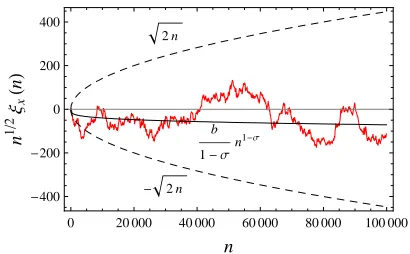
FIG. 2: (Color online) Typical realizations of √n ξx(n) (drawn with δ2
=1) leave the area enclosed by the dashed parabola only finitely many times, but cross the full line
−1−bσn
1−σ forσ >1/2 infinitely often (hereσ= 0.75,b= 1).
which is strictly increasing and convex in µ [11]. The local density can be calculated as usual as a derivative of the free energy
ρx(µ) =hη xi=
∂logzx(µ)
∂µ (6)
and is a strictly increasing function of µ. By h..i we denote the (quenched) expected value with respect toνL µ for fixed disorder, i.e. fixed realization of theex(k). To study the condensation transition we have to identify the maximal or critical chemical potentialµc∈R, such that zx(µ)<∞for allµ < µc.
The single-site marginal (4) is a function of the disorder and forb= 0 it has the distribution of a geometric ran-dom walk with deterministic driftµ. The critical chemi-cal potential in this case is simplyµc= 0 and asn→ ∞ the distributionνx,µ(n) converges to a log-normal. With non-zero b the drift term becomes n-dependent and a more detailed analysis is required. With (3) we have to leading order asn→ ∞
n X
k=1
Ex(k)≃δ√n ξx(n) + b
1−σn
1−σ , σ6= 1 blnn , σ= 1 ,(7) where by the central limit theorem
ξx(n) := 1 δ√n
n X
k=1
ex(k)n−→→∞N(0,1) (8)
converges to a standard Gaussian. Moreover, the process√ n ξx(n) :n∈Nis a random walk with increments of mean zero and variance 1. Since the fluctuations of such a process are of order√nwe have for all C∈R
P ξx(n)≶C for infinitely manyn
= 1 , (9)
and for allγ >0, C >0
P |ξx(n)|> Cnγ for infinitely manyn
in Figure2. Together with (5) and (7) this implies that zx(µ) < ∞ for all µ < 0 with probability one. So for almost all (in a probabilistic sense) realizations of the ex(k) the critical chemical potential isµc= 0 and
zx(µc) = ∞ X
n=0
exp
− n X
k=1
ex(k) + b kσ
. (11)
For certain values ofσandb,zx(µc)<∞is possible and νx,µc can be normalized, which is a necessary condition for a condensation transition [10]. We find
b ≤ 0: In this case (7) and (9) imply that there are infinitely many terms in (11) which are bounded below by 1. Since all terms of the sum are non-negative it diverges andzx(µc) =∞with probability one.
b > 0: In this case the asymptotic behaviour of the terms in the sum (11) depends on the value of σ > 0, since the sign of the exponent can change.
• For σ > 1/2, n1−σ ≪ √n and (7) is dominated by δ√n ξx(n). Applying (9) with C = 0 we get zx(µc) =∞with probability one.
• Forσ= 1/2 both terms in (7) are of the same order sincen1−σ ∼√nand
− n X
k=1
ex(k)+ b kσ
≃ −δ√n ξx(n)+2δb
. (12)
Again, (9) this time with C = 2b/δ implies zx(µc) =∞with probability one.
• For 0 < σ < 1/2 we have n1−σ ≫ √n and (7) is dominated by b
1−σn
1−σ. We apply (10) for γ = 1−σ−1/2 > 0 to see that the random quantity ξx(n) can change the sign of the exponent in (11) only for finitely many terms in the sum. Therefore zx(µc) < ∞ with probability one since 1−bσn
1−σ
has a fixed negative sign in (11).
Wheneverzx(µc) =∞the local critical density
ρxc :=ρx(µc) =∞ (13)
also diverges and there is no condensation transition (see e.g. [21], Lemma I.3.3). But forb >0 and 0< σ <1/2 we havezx(µc)<∞and by the same argument as above it follows that
ρxc = 1 zx(µc)
∞ X
n=0
n e−Pnk=1(ex(k)+ b
kσ)<∞ (14) with probability one, since the factorn in the sum only gives a logarithmic correction in the exponent. Therefore there is condensation since the grand-canonical product measures only exist up to a total density of
ρc(L) := 1 L
X
x∈ΛL
ρxc , (15)
which depends on theex(n) and the size of the latticeL.
D D D D D D D D D D D D D D D D
í í
í í
í í í
í í í í
í í í í í
òò
òòòòòòòòòòòòòòòòòòòòòòòòòòòòòò ìì
ìì ìì
ìì ììì
ìì ììì
ìì ììì
ìì ììì
ìì ìì
ìì
Σ=0.2Hò,DL
Σ=0.8Hì,íL
0 2 4 6 8
0 2 4 6 8
2.77
0.52
NL
Ρbg
FIG. 3: (Color online) Background density ρbg (17) as a function of N/L for b = 1.2. Data for fixed disorder with δ2
= 1/12 andL= 1024 show condensation forσ= 0.2 and no condensation forσ= 0.8. Data forδ2
= 0 are shown by unfilled symbols, dotted lines indicate the critical densities. Data points are averages over 100 MC samples with errors of the size of the symbols.
If the actual number of particles N is larger than L ρc(L), all sites except the ‘slowest’ one contain on aver-agehηxiN =ρxc particles. They form the so-called critical background, since their distribution has non-exponential tails. By h..iN we denote the (canonical) expectation conditioned on the total particel numberN. The slowest site, sayy, is defined byρy
c > ρxc for allx6=y. By the conservation law it is required that
hηyiN =N− X
x6=y ρx
c =O(N), (16)
i.e. it contains of orderNparticles and forms the conden-sate. This interpretation is in accordance with previous results and has been proved rigorously in [20] in the limit N → ∞ for the unperturbed model. For the perturbed model we support this conclusion by MC simulations, some of which are shown in Figure3. For fixedLwe plot the stationary background density
ρbg:= 1
L N − hηyiN
(17)
as a function of the total densityρ=N/L. Forσ= 0.2, ρbg converges to a critical densityρc(L) which is slightly higher than for the unperturbed model. The overshoot ofρbgfor densities close toρc(L) is due to sampling from the canonical rather than the grand canonical ensemble, which has been observed already in [22]. Forσ= 0.8,ρbg increases approximately linearly withρ, which is clearly different from the unperturbed model condensing with critical density 2.77.
For the perturbed system the critical densityρc(L) is a random variable, which according to (15) converges in the thermodynamic limit to the expected value E(ρx
c) with respect to the disorder. This is in general hard to calculate [23], even for simple choices of theex(n). De-tailed numerical estimates of the distribution ofρx
[image:4.612.342.542.50.179.2]4 ì ì ì ì ì ì ì ì ì ì ì ì ì ì ì ì ì ì ì ì ì ì ì ì ì ì ì ì ì ì ì ì ì ì ì ì ì ì ì ì ì ì ì ì ì ì ì ì ì ì ì ì ì ì ì ì ì ì ì ì ì ì ì D D D D D D D D D D D D D D D D D D D D D D D D D D D D D D D D D D D D D D D D D D D D D D D D D D D D D D D D D D D D D D D D
Σ=0.45,∆2=1
ì Σ=0.45,∆2=13
D Σ=0.4,
∆2=1
0.1 10 1000 105
10-5 10-4 0.001 0.01 0.1 1 r P H Ρ
x HΜ
L
>
r
L
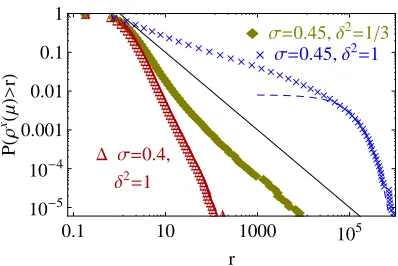
FIG. 4: (Color online) Cumulative tail of the distribution of ρx
cfrom 5·105independent numerical calculations of (14) with b= 1, where infinite sums have been cut off atn= 106
. The full line corresponds to a cumulative exponent−1. The data
exhibit power law decays and for some parameters also large exponential cut-offs, e.g. ∼e−r/10
5
forσ= 0.45,δ2
= 1 fitted by a dashed line. The expectations are finite but may be very large,E(ρxc) = 1.60 (∆), 2.55 (), 1106 (×).
on the system parameters the cumulative tail is either algebraic or consists of an algebraic part with an expo-nential cut-off at large values. This can be explained heuristically by the interplay of the two terms in (7) that determine the main contributions to the partition func-tion [24]. The exponents of the purely algebraic tails is smaller than but often close to −1 and the length scale
of the exponential tails can be extremely large (cf. Fig. 4). Thereforeρx
c has a finite mean which determines the thermodynamic limit of (15)
ρc:= lim
L→∞ρc(L) =
E(ρxc)<∞, (18)
but for finiteLtheρx
c can exhibit large fluctuations, re-sulting in high values forρcand slow convergence of (18). The interaction encoded in the jump rates of a zero-range model represents an effective interaction for which space-dependence and randomness due to microscopic impurities or heterogeneities in the case of complex sys-tems has to be taken into account. We have shown that generic interaction disorder reduces the critical interac-tion exponent from σ = 1 to σ = 1/2. In particular, this implies that for the most-studied caseσ= 1 there is no condensation transition in the presence of interaction disorder. This case is relevant for the mapping of the zero-range process to exclusion models where it becomes an effective model for domain wall dynamics and there-fore a powerful criterion for phase separation in more general particle systems [7]. In this mapping the spatial interaction disorder maps into hopping rates which de-pend in a random fashion on the interparticle distance. Then our results imply that in such heterogeneous finite systems the change of the critical interaction exponent has to be taken into account and finite size effects may play a major role due to large fluctuations of local critical densities.
[1] F. Spitzer, Adv. Math.5, 246–290 (1970).
[2] M.R. Evans, T. Hanney, J. Phys. A: Math. Gen. 38, R195–R239 (2005).
[3] J. Eggers, Phys. Rev. Lett. 83(25), 5322-5325 (1999). D. van der Meer, J.P. van der Weele, D. Lohse, Phys. Rev. Lett. 88, 174302 (2002). F. Coppex, M. Droz, A. Lipowski, Phys. Rev. E66, 011305 (2002).
[4] J. T¨or¨ok, Physica A 355, 374–382 (2005). D. van der Meer, K. van der Weele, P. Reimann, D. Lohse, J. Stat. Mech.: Theor. Exp. P07021 (2007).
[5] M.R. Evans, Europhys. Lett.36, 13-18 (1996). J. Krug, P.A. Ferrari, J. Phys. A: Math. Gen. 29, L465– L471 (1996). I. Benjamini, P.A. Ferrari, C. Landim, Stoch. Proc. Appl.61, 181–204 (1996).
[6] M.R. Evans, T. Hanney, S.N. Majumdar, Phys. Rev. Lett.97, 010602 (2006).
[7] Y. Kafri, E. Levine, D. Mukamel, G.M. Sch¨utz, and J. T¨or¨ok. Phys. Rev. Lett.89(3), 035702 (2002).
[8] A.G. Angel, M.R. Evans, E. Levine, D. Mukamel, Phys. Rev. E72, 046132 (2005). A.G. Angel, T. Hanney, M.R. Evans, Phys. Rev. E73, 016105 (2006).
[9] J. Kaupuzs, R. Mahnke, R.J. Harris, Phys. Rev. E72(5), 056125 (2005).
[10] M.R. Evans, Braz. J. Phys.30(1), 42–57 (2000).
[11] S. Grosskinsky, G.M. Sch¨utz, H. Spohn, J. Stat. Phys. 113(3/4), 389–410 (2003).
[12] M.R. Evans, S.N. Majumdar, R.K.P. Zia, J. Stat. Phys.
123, 357–390 (2006).
[13] J.M. Luck, C. Godreche, J. Stat. Mech.: Theor. Exp. P08005 (2007).
[14] A.G. Angel, M.R. Evans, E. Levine, D. Mukamel, J. Stat. Mech.: Theor. Exp. P08017 (2007).
[15] S. Grosskinsky, G.M. Sch¨utz, J. Stat. Phys.132(1), 77– 108 (2008).
[16] Y. Schwarzkopf, M.R. Evans, D. Mukamel, J. Phys. A: Math. Theor.41, 205001 (2008).
[17] Inhomogeneousp(x, y) leads to multiplication of the fu-gacityφ=eµin the steady state by site-dependent terms which are the unique solutions ofφy=Pxφxp(x, y).
[18] E. Andjel, Ann. Probability10(3), 525–547 (1982).
[19] O. Kallenberg, Foundations of Modern Probability, 2nd edition(Springer, New York, 2002).
[20] P.A. Ferrari, C. Landim, V.V. Sisko, J. Stat. Phys.128, 1153-1158 (2007).
[21] C. Kipnis, C. Landim,Scaling Limits of Interacting Par-ticle Systems(Springer, Berlin, 1999).
[22] A.G. Angel, M.R. Evans, D. Mukamel, J. Stat. Mech.: Theor. Exp. P04001 (2004).
[23] The authors are only aware of results on integrals of exponential Brownian motions with constant drift, e.g. M. Yor, J. Appl. Prob.29, 202-208 (1992).
[image:5.612.76.275.58.191.2]