Proceedings of The Third Workshop on Computational Approaches to Code-Switching, pages 103–109 103
Simple Features for Strong Performance on
Named Entity Recognition in Code-Switched Twitter Data
Devanshu Jain Maria Kustikova Mayank Darbari Rishabh Gupta Stephen Mayhew
University of Pennsylvania
{devjain, mkust, mdarbari, rgupt, mayhew}@seas.upenn.edu
Abstract
In this work, we address the problem of Named Entity Recognition (NER) in code-switched tweets as a part of the Workshop on Computational Approaches to Linguis-tic Code-switching (CALCS) at ACL’18 (Aguilar et al., 2018). Code-switching is the phenomenon where a speaker switches between two languages or variants of the same language within or across utter-ances, known as intra-sentential or inter-sentential code-switching, respectively. Processing such data is challenging using state of the art methods since such technol-ogy is generally geared towards process-ing monolprocess-ingual text. In this paper we ex-plored ways to use language identification and translation to recognize named enti-ties in such data, however, utilizing simple features (sans multi-lingual features) with Conditional Random Field (CRF) classi-fier achieved the best results. Our exper-iments were mainly aimed at the (ENG-SPA) English-Spanish dataset but we sub-mitted a language-independent version of our system to the (MSA-EGY) Arabic-Egyptian dataset as well and achieved good results.
1 Introduction
Recently, social media texts such as tweets and Facebook posts have attracted attention from the Natural Language Processing (NLP) research community. This content has many applications as it provides clues to analyze sentiments of the masses towards areas ranging from basic elec-tronic products to mental health issues to even national political candidates. These applications have motivated the NLP community to rethink
strategies for common tools, such as tokenizers, named entity taggers, POS taggers, dependency parsers, in the context of informal and noisy text.
As access to the internet becomes more and more universal, a linguistically diverse population has come online. Hong et al.(2011) showed that in a collection of 62 million tweets, only a little over 50% of them were in English. This multilin-gualism has given rise to such interesting patterns as transliteration and code-switching. The multi-lingual behavior combined with the informal na-ture of the content makes the task of building NLP tools even harder.
In this paper, we solve the problem of Named Entity Recognition (NER) for code-switched twit-ter data as a part of the ACL’18 Computa-tional Approaches to Linguistic Code-switching (CALCS) Shared Task (Aguilar et al., 2018). Code-switching is a phenomenon that occurs when multilingual speakers alternate between two or more languages or dialects. This phenomenon can be observed across different sentences, within the same sentence or even in the same word. This shared task is similar to other social media tasks, except that the data is explicitly chosen to con-tain code-switching. The entities for the task are: Event, Group, Location, Organization, Other, Per-son, Product, Time, and Title. Below is an ex-ample of some code-switched data, switching be-tween English and Spanish:
My [Facebook]P rod, [Ig]P rod &
[Twitter]P rod is hellaa dead yall Jk soy
yo que has no life!
Value / Data Train Development Test
Total number of tweets 50,757 832 15,634
Total number of tokens 616,069 9,583 183,011
Average number of tokens per tweet 12.14 11.52 15.9 Standard deviation of the number of tokens per tweet 7.6 7.12 7.11
Table 1: (ENG-SPA) English-Spanish number of tweets and tokens for train, development, and test data
Value / Data Train Development Test
Total number of tweets 10,103 1,122 1,110
Total number of tokens 204,323 22,742 21,414
Average number of tokens per tweet 20.22 20.27 21.91 Standard deviation of the number of tokens per tweet 6.63 6.76 6.18
Table 2: (MSA-EGY) Modern Standard Arabic-Egyptian number of tweets and tokens for train, devel-opment, and test data
2 Related Work
NER is a fundamental part of the Information Ex-traction pipeline. Most of the available off-the-shelf systems are trained on formal content, and consequently do not generalize well when eval-uated on twitter data (Ritter et al., 2011). This can be explained by the fact that such systems rely on hand-crafted standard local features and some background knowledge, which is not reliable in data as noisy as tweets. With only a limited num-ber of characters, people use a variety of creative ways to express their thoughts, including emoti-cons and novel abbreviations.
There have been few recent workshops and shared-tasks on analysis of such noisy social media data, such as Workshop on Noisy User-Generated Text (WNUT) at EMNLP (2014, 2016, 2017), Workshop on Approaches to Subjectivity, Sentiment and Social Media (WASSA) at NAACL (2016), and Forum for Information Retrieval Eval-uation (FIRE: 2015, 2016, 2017).
3 Experimental Setup
Here we describe the data, evaluation, and the model we used.
3.1 Data
In our experiments, we focus primarily on the English-Spanish (ENG-SPA) dataset. However, we submitted our basic system results for Arabic-Egyptian (MSA-EGY) dataset as well.
The organizers provided annotated train and de-velopment sets for each language. They also pro-vided an unannotated set of test data, which we annotated with our system, and submitted for eval-uation. We never had access to the gold annotated test set, before or after the evaluation.
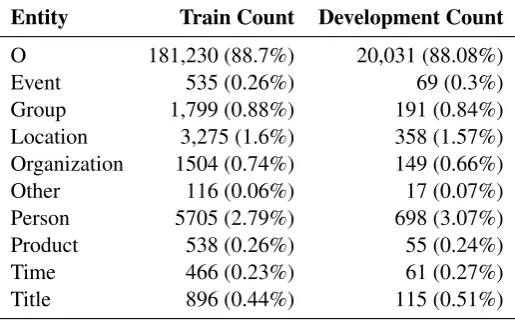
Tables 1 and 2 provide information about the data in terms of number of tweets and tokens for the (EN-SPA) English-Spanish and (MSA-EGY) Modern Standard Arabic-Egyptian language pairs. Tables 3 and 4 provide statistics of the named entities for both (EN-SPA) English-Spanish and (MSA-EGY) Modern Standard Arabic-Egyptian language pairs, where each cell can be interpreted asNumber (Percentage)and entity ‘O’ represents all non-NE tokens. Please note that the data has been tagged using the IOB scheme and data in Ta-bles3and 4is the result of grouping named enti-ties according to the IOB scheme.
3.2 Evaluation
We used the standard harmonic mean F1 score to evaluate the system performance. Additionally, we used surface form F1 score as described in Der-czynski et al.(2017). Both of these metrics were a part of the evaluation in the CALCS shared task.
3.3 Method
We used the sklearn implementation of Condi-tional Random Field (CRF)1 (McCallum and Li,
2003) as the base model in our NER system.
[image:2.595.92.508.64.142.2]Entity Train Count Development Count
O 597,526 (97%) 9,361 (97.68%)
Event 232 (0.04%) 4 (0.04%)
Group 718 (0.12%) 4 (0.04%)
Location 2,810 (0.46%) 10 (0.1%) Organization 811 (0.13%) 9 (0.09%)
Other 324 (0.05%) 6 (0.06%)
Person 4,701 (0.76%) 75 (0.78%) Product 1,369 (0.22%) 16 (0.17%)
Time 577 (0.09%) 6 (0.06%)
Title 824 (0.13%) 22 (0.23%)
Table 3: (ENG-SPA) English-Spanish named entities counts for train and development data
Entity Train Count Development Count
O 181,230 (88.7%) 20,031 (88.08%)
Event 535 (0.26%) 69 (0.3%)
Group 1,799 (0.88%) 191 (0.84%) Location 3,275 (1.6%) 358 (1.57%) Organization 1504 (0.74%) 149 (0.66%)
Other 116 (0.06%) 17 (0.07%)
Person 5705 (2.79%) 698 (3.07%) Product 538 (0.26%) 55 (0.24%)
Time 466 (0.23%) 61 (0.27%)
Title 896 (0.44%) 115 (0.51%)
Table 4: (MSA-EGY) Modern Standard Arabic-Egyptian entities counts for train and development data
System ENG-SPA MSA-EGY
Org. Baseline 53.28 62.70 Experiment 1 62.13 67.44
Top System 63.76 71.61
Table 5: (ENG-SPA) and (MSA-EGY) Our best F1 scores on the test datasets compared with the organizer’s baseline and the top performing sys-tem in the Shared Task.
4 Experiments
This section gives an overview of our experiments. First, we identify various local and global fea-tures using a variety of monolingual tweets and Gazetteers and train a CRF-based classifier on the data. Second, we try to improve system recall us-ing a 2-step NER process. Third, we convert the convert the code-mixed data to monolingual data using language identification (using a character-based language model) and translation.
Of the three experiments that we tried, the first method gave the best results. We compare against the best performing system in the shared task as well as the organizer’s baseline in Table 5. The baseline was provided by the organizers and used Bi-directional LSTMs followed by softmax layer (trained for 5 epochs) to infer the output labels.
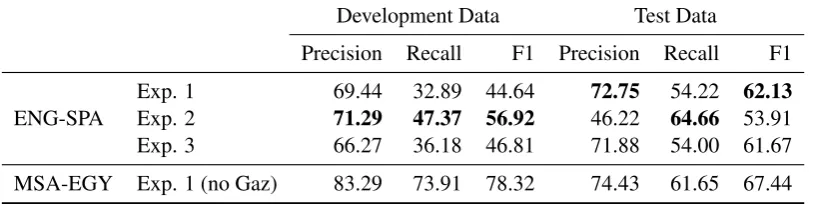
The shared task used Surface Form F1 scores as well, but we omit them from our results as they were the same as harmonic mean F1 in all cases. All scores are reported in Table6. Detailed scores are available in the appendix.
4.1 Experiment 1
Our first experiment used a standard set of fea-tures, augmented with some task-specific ideas, and defined as follows. Given a sequence of words in a sentence: ...,wi−2,wi−1 ,wi ,wi+1 ,wi+2, ... and the current word in consideration iswi, we
used the following features:
[image:3.595.174.425.64.222.2] [image:3.595.170.428.263.423.2]Development Data Test Data
Precision Recall F1 Precision Recall F1
ENG-SPA
Exp. 1 69.44 32.89 44.64 72.75 54.22 62.13 Exp. 2 71.29 47.37 56.92 46.22 64.66 53.91 Exp. 3 66.27 36.18 46.81 71.88 54.00 61.67
[image:4.595.97.504.65.167.2]MSA-EGY Exp. 1 (no Gaz) 83.29 73.91 78.32 74.43 61.65 67.44
Table 6: Results on all submissions. Bold indicates best performance for that language.
• Ifwi is in the end of sentence
• Lower-case version ofwi
• Ifwi is title-cased
• Prefixes and Suffixes of length 4 ofwi
• Brown Clusters2(Cluster Size - 40) ofwi
• Word2Vec Clusters: We trained a Word2Vec (Reh˚uˇrek and Sojka,ˇ 2010) model on the combined tweets dataset (dimension: 100 ; window: 7). Then, we clustered these em-beddings into 40 clusters and used cluster IDs as features.
• Gazetteer: We used the Gazetteer (ex-tracted from Wikidata byMishra and Diesner (2016)) labels as features.
• For each wordwkin a context window of±2:
– The wordwkitself
– Ifwkis upper case
– Shape and Short shape (where same consecutive characters in the shape are compressed to a single character) ofwk
– If wk contains any special symbol like:
,#,$,-,,,etc. or an emoji.
– Ifwkis alphabetic or alphanumeric
– Emoji Description: We identified the 40 most common emojis present in our dataset and manually labelled them with representative words, such as smile, kiss, sad, etc. These emoji description (sense) of every context word were used as another feature.
We also ran the experiment on the MSA-EGY dataset (without the Gazetteer features).
4.2 Experiment 2
Following the first experiment, our main observa-tion was that the recall was quite low. One reason for this could be the presence of a large amount of tokens tagged as ‘O’ (∼97%). In contrast, the
2https://github.com/percyliang/ brown-cluster
standard CONLL 2002 Spanish training NER cor-pus (Tjong Kim Sang,2002) had∼87% of the to-kens tagged as ‘O’.
To solve this issue, we experimented with a 2-step NER process (similar to (Eiselt and Figueroa, 2013)):
1. Train a CRF model to identify whether a to-ken is ‘O’ or not
2. Train a CRF model to identify the type of named-entity (if identified as non-‘O’)
As expected, we saw major improvements in re-call, but these were offset by a substantial drop in precision. Overall, this led to a lower F1 score than before. In light of these results, we did not use the 2-step approach for any other experiments.
4.3 Experiment 3
In this experiment, we tried to eliminate the code-switching by converting the data to a monolingual form. Our method is to identify the language of each token in the dataset and translate into a com-mon language.
We collected training data for language iden-tification using the Twitter API. We downloaded tweets for English and Spanish and assumed that each word in those tweets belonged to that partic-ular language. The statistics for the downloaded data is shown below:
1. 3000 Spanish tweets (7700 tokens∼56%) 2. 1900 English tweets (6100 tokens∼44%)
Finally, we used the language identification and the translation as features in our CRF model, in addition to all the features used in experiment 1.
As compared to the results from experiment 1, this improved the recall on both development and test sets, but again, the loss in precision caused a slight overall drop in performance.
5 Conclusion
Our submissions earned 4th place out of 8 submis-sions in the ENG-SPA task, and 3rd place out of 6 submissions in the MSA-EGY task.
Surprisingly, our simplest NER model, trained without using any language identification or trans-lations, worked best. The other more sophisticated experiments showed promise in improving the re-call, but damaged the precision too much to im-prove the F1 score.
One of the challenges we faced was dissimi-larity between development and test dataset. Al-though some of the techniques that we tried on the development dataset improved the system perfor-mance, the same effect was not seen in the test dataset. For example, see the change in perfor-mance between Table7and Table8. The F1 score on the development set jumped 12 points, but the score on the test set dropped 9 points. This could be explained by the very small size of the devel-opment dataset, where a few errors or successes could change the score dramatically. Without ac-cess to the test data, we could not do any qualita-tive error analysis.
Finally, since the 2-Step NER achieved such a high recall, we believe that creating an ensemble of 1-Step and 2-Step systems could achieve a bet-ter overall F1 score.
References
Gustavo Aguilar, Fahad AlGhamdi, Victor Soto, Mona Diab, Julia Hirschberg, and Thamar Solorio. 2018. Overview of the CALCS 2018 Shared Task: Named Entity Recognition on Code-switched Data. In
Proceedings of the Third Workshop on Compu-tational Approaches to Linguistic Code-Switching, Melbourne, Australia. Association for Computa-tional Linguistics.
Leon Derczynski, Eric Nichols, Marieke van Erp, and Nut Limsopatham. 2017. Results of the wnut2017 shared task on novel and emerging entity recogni-tion. InProceedings of the 3rd Workshop on Noisy User-generated Text, pages 140–147. Association for Computational Linguistics.
Andreas Eiselt and Alejandro Figueroa. 2013. A two-step named entity recognizer for open-domain search queries. In Sixth International Joint Con-ference on Natural Language Processing, IJCNLP 2013, Nagoya, Japan, October 14-18, 2013, pages 829–833. Asian Federation of Natural Language Processing / ACL.
Lichan Hong, Gregorio Convertino, and Ed H. Chi. 2011. Language matters in twitter: A large scale study. In Proceedings of the Fifth International AAAI Conference on Weblogs and Social Media, pages 519–521.
Andrew McCallum and Wei Li. 2003. Early results for named entity recognition with conditional ran-dom fields, feature induction and web-enhanced lex-icons. InProceedings of the Seventh Conference on Natural Language Learning at HLT-NAACL 2003, pages 188–191. Association for Computational Lin-guistics.
Shubhanshu Mishra and Jana Diesner. 2016. Semi-supervised named entity recognition in noisy-text. InProceedings of the 2nd Workshop on Noisy User-generated Text, pages 203–212. The COLING 2016 Organizing Committee.
Radim ˇReh˚uˇrek and Petr Sojka. 2010.Software Frame-work for Topic Modelling with Large Corpora. In
Proceedings of the LREC 2010 Workshop on New Challenges for NLP Frameworks, pages 45–50, Val-letta, Malta. ELRA.
Alan Ritter, Sam Clark, Mausam, and Oren Etzioni. 2011. Named entity recognition in tweets: An experimental study. In Proceedings of the 2011 Conference on Empirical Methods in Natural Lan-guage Processing, EMNLP 2011, 27-31 July 2011, John McIntyre Conference Centre, Edinburgh, UK, A meeting of SIGDAT, a Special Interest Group of the ACL, pages 1524–1534. ACL.
Appendices
A ENG-SPA detailed results
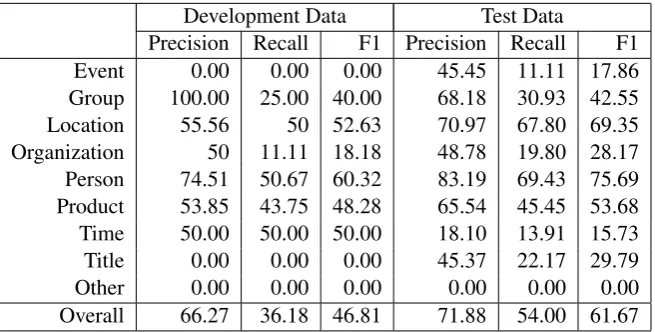
We show detailed results for ENG-SPA experiments in the following tables.
Development Data Test Data
Precision Recall F1 Precision Recall F1 Event 0.00 0.00 0.00 41.67 11.11 17.54 Group 100.00 25.00 40.00 68.89 31.96 43.66 Location 66.67 40.00 50.00 72.16 68.16 70.1 Organization 100.00 11.11 20.00 51.11 22.77 31.51 Person 73.33 44.00 55.00 83.33 69.5 75.79 Product 58.33 43.75 50.00 66.41 45.19 53.79 Time 50.00 50.00 50.00 18.10 12.58 14.84 Title 100.00 4.55 8.70 47.57 22.17 30.25
Other 0.00 0.00 0.00 0.00 0.00 0.00
Overall 69.44 32.89 44.64 72.75 54.22 62.13
Table 7: (ENG-SPA) Results for Experiment 1: simple features and gazetteers
Development Data Test Data
Precision Recall F1 Precision Recall F1 Event 50.00 25.00 33.00 18.60 17.78 18.18 Group 100.00 25.00 40.00 25.34 38.14 30.45 Location 50.00 50.00 50.00 57.16 71.38 63.48 Organization 50.00 11.11 18.18 36.31 30.20 32.97 Person 74.58 58.67 65.67 60.19 80.70 68.95 Product 62.50 62.50 62.50 50.64 51.17 50.90 Time 100.00 100.00 100.00 13.19 64.90 21.92 Title 66.67 9.09 16.00 28.23 31.67 29.85 Other 100.00 33.33 50.00 5.56 5.17 5.36 Overall 71.29 47.37 56.92 46.22 64.66 53.91
Table 8: (ENG-SPA) Results for Experiment 2: 2-step NER
Development Data Test Data
Precision Recall F1 Precision Recall F1 Event 0.00 0.00 0.00 45.45 11.11 17.86 Group 100.00 25.00 40.00 68.18 30.93 42.55 Location 55.56 50 52.63 70.97 67.80 69.35 Organization 50 11.11 18.18 48.78 19.80 28.17 Person 74.51 50.67 60.32 83.19 69.43 75.69 Product 53.85 43.75 48.28 65.54 45.45 53.68 Time 50.00 50.00 50.00 18.10 13.91 15.73 Title 0.00 0.00 0.00 45.37 22.17 29.79 Other 0.00 0.00 0.00 0.00 0.00 0.00 Overall 66.27 36.18 46.81 71.88 54.00 61.67
[image:6.595.133.466.353.519.2] [image:6.595.136.464.564.730.2]B MSA-EGY detailed results
We show detailed results for the one MSA-EGY experiment in the following table.
Development Data Test Data
Precision Recall F1 Precision Recall F1 Event 66.67 43.48 52.63 67.57 35.71 46.73 Group 86.63 78.01 82.09 69.92 73.50 71.67 Location 87.14 75.70 81.02 76.64 57.95 66.00 Organization 74.24 65.77 69.75 68.75 61.60 64.98 Person 85.28 79.66 82.37 79.34 64.70 71.27 Product 79.17 69.09 73.79 66.67 54.55 60.00 Time 74.60 77.05 75.81 68.00 68.00 68.00 Title 77.11 55.65 64.65 26.32 50.00 34.48 Other 92.86 76.47 83.87 100.00 50.00 66.67 Overall 83.29 73.91 78.32 74.43 61.65 67.44