Proceedings of the 55th Annual Meeting of the Association for Computational Linguistics (Short Papers), pages 341–346 Proceedings of the 55th Annual Meeting of the Association for Computational Linguistics (Short Papers), pages 341–346
Multi-Task Learning of Keyphrase Boundary Classification
Isabelle Augenstein⇤ Department of Computer Science
University College London [email protected]
Anders Søgaard⇤ Department of Computer Science
University of Copenhagen [email protected]
Abstract
Keyphrase boundary classification (KBC) is the task of detecting keyphrases in sci-entific articles and labelling them with re-spect to predefined types. Although im-portant in practice, this task is so far un-derexplored, partly due to the lack of la-belled data. To overcome this, we explore several auxiliary tasks, including semantic super-sense tagging and identification of multi-word expressions, and cast the task as a multi-task learning problem with deep recurrent neural networks. Our multi-task models perform significantly better than previous state of the art approaches on two scientific KBC datasets, particularly for long keyphrases.
1 Introduction
The scientific keyphrase boundary classification (KBC) task consists of a) determining keyphrase boundaries, and b) labelling keyphrases with their types according to a predefined schema. KBC is motivated by the need to efficiently search scien-tific literature, which can be summarised by their keyphrases. Several companies are working on keyphrase-based recommender systems for tific literature or search interfaces where scien-tific articles decorate graphs, in which nodes are keyphrases. Such keyphrases must be dynamically retrieved from the articles, because important sci-entific concepts emerge on a daily basis, and the most recent concepts are typically the ones of in-terest to scientists.
KBC is not a common task in NLP, and there are only few small annotated datasets for inducing supervised KBC models, made available recently
?Both authors contributed equally
(QasemiZadeh and Schumann, 2016;Augenstein et al., 2017). Typical KBC approaches therefore rely on hand-crafted gazetteers (Hasan and Ng,
2014) or reduce the task to extracting a list of keyphrases for each document (Kim et al.,2010) instead of identifying mentions of keyphrases in sentences. For related more common NLP tasks such as named entity recognition and identifica-tion of multi-word expressions, neural sequence labelling methods have been shown to be useful (Lample et al., 2016). In order to overcome the small data problem, we study using more widely available data for tasks related to KBC and exploit their synergies in a deep multi-task learning setup. Multi-task learning has become popular within natural language processing and machine learn-ing over the last few years; in particular, hard parameter sharing of hidden layers in deep learn-ing models. This approach to multi-task learnlearn-ing has three advantages: a) It significantly reduces Rademacher complexity (Baxter, 2000; Maurer,
2007), i.e., the risk of over-fitting, b) it is space-efficient, reducing the number of parameters, and c) it is easy to implement.
This paper shows how hard parameter sharing can be used to improve gazetteer-free keyphrase boundary classification models, by exploiting dif-ferent syntactically and semantically annotated corpora, as well as more readily available data such as hyperlinks.
Contributions We study the so far widely un-derexplored, though in practice important task of scientific keyphrase boundary classification, for which only a small amount of training data is available. We overcome this by identifying good auxiliary tasks and cast it as a multi-task learn-ing problem. We evaluate our models across two new, manually annotated corpora of scientific arti-cles and outperform single-task approaches by up
to 9.64% F1, mostly due to better performance for long keyphrases.
2 Keyphrase Boundary Classification Consider the following sentence from a scientific paper:
(1) We find that simple interpolation methods, like log-linear and linear interpolation, im-prove the performance but fall short of the performance of an oracle.
This sentence occurs in the ACL RD-TEC 2.0 corpus. Here, interpolation methods and log-linear and log-linear interpolation are annotated as technical keyphrases,performanceas a keyphrase related to measurements, andoracleis a keyphrase labelled as miscellaneous. Below, we are inter-ested in predicting the boundariesandthe types of all keyphrases.
3 Multi-Task Learning
Multi-task learning is an approach to learning, in which generalisation is improved by taking advan-tage of the inductive bias in training signals of re-lated tasks. When abundant labelled data is avail-able for an auxiliary task, but little data for the target task, multi-task learning can act as a form of semi-supervised learning combined with a dis-tant supervision signal. Inducing a model from only the sparse target task data may lead to over-fitting to random noise in the data, but relying on auxiliary data helps the model generalise, making it easier to abstract away from noise, as well as leveraging the marginal distribution of auxiliary input data. From a representation learning per-spective, auxiliary tasks can be used to induce rep-resentations that may be beneficial for the target task. Caruana(1993) also suggests that the auxil-iary task can help focus attention in the induction of the target task model. Finally, multi-task learn-ing can be cast as a regulariser as studies show re-ductions in Rademacher complexity in multi-task architectures over single-task architectures ( Bax-ter,2000;Maurer,2007).
Here, we follow the probably most common ap-proach to multi-task learning, known ashard pa-rameter sharing. This was introduced inCaruana
(1993) in the context of deep neural networks, in which hidden layers can be shared among tasks. We assumeT different training set,D1,· · · , DT,
where each Dt contains pairs of input-output se-quences(w1:n, yt1:n),wi 2V,yti 2Lt. The input vocabularyV is shared across tasks, but the out-put vocabularies (tagset) Lt are task dependent. At each step in the training process we choose a random taskt, followed by a random training in-stance (w1:n, yt1:n) 2 Dt. We use the tagger to predict the labelsyˆit, suffer a loss with respect to
the true labels yti and update the model parame-ters. The parameters are trained jointly for a sen-tence, i.e. cross-entropy loss over each sentence is employed. Each task is associated with an inde-pendent classification function, but all tasks share the hidden layers. Note that for our experiments, we only consider one auxiliary task at a time.
4 Experiments
Experimental Setup We perform experiments for both keyphrase boundary identification ( un-labelled), and keyphrase boundary identification and classification (labelled). Metrics measured are token-level precision, recall and F1, which are micro-average results across keyphrase types. Types are defined by the two datasets studied.
Auxiliary tasks We experiment with five aux-iliary tasks: (1) syntactic chunking using anno-tations extracted from the English Penn Tree-bank, followingSøgaard and Goldberg(2016); (2) frame target annotations from FrameNet 1.5 (cor-responding to the target identification and clas-sification tasks in Das et al. (2014)); (3) hyper-link prediction using the dataset fromSpitkovsky et al. (2010), (4) identification of multi-word ex-pressions using the Streusle corpus (Schneider and Smith, 2015); and (5) semantic super-sense tagging using the Semcor dataset, following Jo-hannsen et al.(2014). We train our models on the main task with one auxiliary task at a time. Note that the datasets for the auxiliary tasks are not an-notated with keyphrase boundary identification or classification labels.
reserv-SemEval 2017 Task 10 ACL RD-TEC
Labels Material, Process, Task Technology and Method,
Tool and Library, Language Resource, Language Resource Product, Measures and Measurements, Models, Other
Topics Computer Science, Physics, Natural Language Processing
Material Science
Number all keyphrases 5730 2939
Proportion singleton keyphrases 31% 83%
Proportion single-word mentions 18% 23%
Proportion mentions with word length>=2 82% 77%
Proportion mentions with word length>=3 51% 33%
Proportion mentions with word length>=5 22% 8%
Table 1: Characteristics of SemEval 2017 Task 10 and ACL-RD-TEC corpora, statistics of training sets
ing 1/3 for testing. Key dataset characteristics are summarised in Table 1. One important observa-tion is that the SemEval 2017 dataset contains a significantly higher proportion of long keyphrases than the ACL dataset.
Models Our single- and multi-task networks are three-layer, bi-directional LSTMs (Graves and Schmidhuber,2005) with pre-trained SENNA em-beddings.1 For the multi-task networks, we follow
the training procedure outlined in Section3. The dimensionality of the embeddings is 50, and we followSøgaard and Goldberg (2016) in using the same dimensionality for the hidden layers. We add a dropout of 0.1 to the input and train these archi-tectures with momentum SGD with initial learning rate of 0.001 and momentum of 0.9 for 10 epochs.
Baselines Our baselines areFinkel et al.(2005)2
andLample et al.(2016)3, in order to compare to
a lexicalised and a state-of-the-art neural method. We use the implementations released by the au-thors and re-train models on our data.
5 Results and Analysis
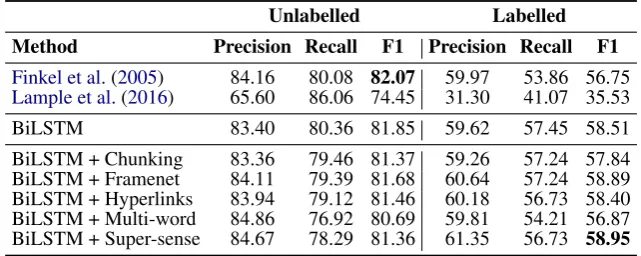
Results for SemEval 2017 Task 10 corpus are pre-sented in Table2, and for the ACL RD-TEC cor-pus in Table3. For the SemEval corpus, all five la-belled multi-task learning models outperform both examples of previous work, as well as our single-task BiLSTM baseline, by some margin. For ACL RD-TEC, three of out five multi-task learning
la-1http://ronan.collobert.com/senna/ 2http://nlp.stanford.edu/software/
CRF-NER.shtml
3https://github.com/clab/
stack-lstm-ner
belled labelled perform better than the single-task BiLSTM baseline.
On the SemEval corpus, the F1 error reduc-tion of of the best labelled model over the Stan-ford tagger is 9.64%. The lexicalisedFinkel et al.
(2005) model shows a surprisingly competitive performance on the ACL RD-TEC corpus, where it is only 2 points in F1 behind our best per-forming labelled model and on par with our best-performing unlabelled model. Results with Lam-ple et al.(2016), on the other hand, are lower than the Finkel et al. (2005) baseline. This might be due to the model having a large set of parameters to model state transitions which poses a difficulty for small training datasets.
Overall, multi-task models show bigger im-provements over baselines for the SemEval cor-pus, and all models achieve better results on ACL RD-TEC. Statistics shown in Table 1 help to explain this. Most noticeably, the SemEval dataset contains a significantly higher proportion of long keyphrases than the ACL dataset. Interest-ingly, ACL RD-TEC contains a large proportion of keyphrases which only appear once in the train-ing set (strain-ingletons), significantly fewer keyphrases and more keyphrase type, but that does not seem to impact results as much as a high proportion of long keyphrases.
Unlabelled Labelled Method Precision Recall F1 Precision Recall F1
Finkel et al.(2005) 77.89 50.27 61.10 49.90 27.97 35.85
Lample et al.(2016) 71.92 49.37 58.55 41.36 28.47 33.72
BiLSTM 81.58 57.86 67.71 45.80 32.48 38.01
[image:4.595.139.460.62.190.2]BiLSTM + Chunking 82.88 52.08 63.96 55.54 34.90 42.86 BiLSTM + Framenet 77.86 56.05 65.18 54.04 38.91 45.24 BiLSTM + Hyperlinks 76.59 60.53 67.62 46.99 44.09 41.13 BiLSTM + Multi-word 74.80 70.18 72.42 46.99 44.09 45.49 BiLSTM + Super-sense 83.70 51.76 63.93 56.94 35.25 43.54
Table 2: Results for keyphrase boundary classification on the SemEval 2017 Task 10 corpus
Unlabelled Labelled
Method Precision Recall F1 Precision Recall F1
Finkel et al.(2005) 84.16 80.08 82.07 59.97 53.86 56.75
Lample et al.(2016) 65.60 86.06 74.45 31.30 41.07 35.53
BiLSTM 83.40 80.36 81.85 59.62 57.45 58.51
BiLSTM + Chunking 83.36 79.46 81.37 59.26 57.24 57.84 BiLSTM + Framenet 84.11 79.39 81.68 60.64 57.24 58.89 BiLSTM + Hyperlinks 83.94 79.12 81.46 60.18 56.73 58.40 BiLSTM + Multi-word 84.86 76.92 80.69 59.81 54.21 56.87 BiLSTM + Super-sense 84.67 78.29 81.36 61.35 56.73 58.95
Table 3: Results for keyphrase boundary classification on the ACL RD-TEC corpus
automatic discovery of text in parallel translation’, ‘honeycomb network of graphite bricks’). Being able to recognise long keyphrases correctly is part of the reason our multi-task models outperform the baselines, especially on the SemEval dataset, which contains many such long keyphrases.
6 Related Work
Multi-Task Learning Hard sharing of all hid-den layers was introduced inCaruana(1993), and popularised in NLP by Collobert et al. (2011a). Several variants have been introduced, including hard sharing of selected layers (Søgaard and Gold-berg, 2016) and sharing of parts (subspaces) of layers (Liu et al., 2015). Søgaard and Goldberg
(2016) show that hard parameter sharing is an ef-fective regulariser, also on heterogeneous tasks such as the ones considered here. Hard parameter sharing has been studied for several tasks, includ-ing CCG super tagginclud-ing (Søgaard and Goldberg,
2016), text normalisation (Bollman and Søgaard,
2016), neural machine translation (Dong et al.,
2015; Luong et al., 2016), and super-sense tag-ging (Mart´ınez Alonso and Plank, 2017). Shar-ing of information can further be achieved by ex-tending LSTMs with an external memory shared
across tasks (Liu et al., 2016). A further in-stance of multi-task learning is to optimise a su-pervised training objective jointly with an unsu-pervised training objective, as shown in Yu et al.
(2016) for natural language generation and auto-encoding, and inRei(2017) for different sequence labelling tasks and language modelling.
Boundary Classification KBC is very similar to named entity recognition (NER), though arguably harder. Deep neural networks have been applied to NER inCollobert et al.(2011b);Lample et al.
(2016). Other successful methods rely on condi-tional random fields, thereby modelling the proba-bility of each output label conditioned on the label at the previous time step. Lample et al. (2016), currently state-of-the-art for NER, stack CRFs on top of recurrent neural networks. We leave explor-ing such models in combination with multi-task learning for future work.
Keyphrase detection methods specific to the sci-entific domain often use keyphrase gazetteers as features or exploit citation graphs (Hasan and Ng,
2014). However, previous methods relied on cor-pora annotated for type-level identification, not for mention-level identification (Kim et al.,2010;
[image:4.595.138.459.228.356.2]rely on extracting keyphrases (as types), this has the unfortunate consequence that previous work ignores acronyms and other short-hand forms re-ferring to methods, metrics, etc. Further, relying on gazetteers makes overfitting likely, obtaining lower scores on out-of-gazetteer keyphrases.
7 Conclusions and Future Work
We present a new state of the art for keyphrase boundary classification, using data from related, auxiliary tasks; in particular, super-sense tag-ging and identification of multi-word expressions. Deep multi-task learning improves significantly on previous approaches to KBC, with error reduc-tions of up to 9.64%, mostly due to better identifi-cation and labelling of long keyphrases.
In future work, we want to explore alterna-tive multi-task learning regimes to hard parameter sharing and experiment with additional auxiliary tasks. The auxiliary tasks considered here are stan-dard NLP tasks, hyperlink prediction aside. Other tasks may be more directly relevant such as pre-dicting the layout of calls for papers for scientific conferences, or predicting hashtags in tweets by scientists, since both data sources contain scien-tific keyphrases.
Acknowledgments
We would like to thank Elsevier for supporting this work.
References
Isabelle Augenstein, Mrinal Das, Sebastian Riedel, Lakshmi Vikraman, and Andrew McCallum. 2017. SemEval-2017 Task 10 : Extracting Keyphrases and Relations from Scientific Publications. In Proceed-ings of SemEval, to appear.
Jonathan Baxter. 2000. A model of inductive bias learning.Journal of Artificial Intelligence Research
12:149–198.
Marcel Bollman and Anders Søgaard. 2016. Improving historical spelling normalization with bi-directional LSTMs and multi-task learning. InProceedings of COLING.
Rich Caruana. 1993. Multitask Learning: A Knowledge-Based Source of Inductive Bias. In Pro-ceedings of ICML.
Ronan Collobert, Jason Weston, L´eon Bottou, Michael Karlen, Koray Kavukcuoglu, and Pavel Kuksa. 2011a. Natural language processing (almost) from scratch.The Journal of Machine Learning Research
12:2493–2537.
Ronan Collobert, Jason Weston, L´eon Bottou, Michael Karlen, Koray Kavukcuoglu, and Pavel Kuksa. 2011b. Natural language processing (almost) from scratch. The Journal of Machine Learning Research
12:2493–2537.
Dipanjan Das, Desai Chen, Andre Martins, Nathan Schneider, and Noah Smith. 2014. Frame-semantic parsing.Computational linguistics40(1):9–56.
Daxiang Dong, Hua Wu, Wei He, Dianhai Yu, and Haifeng Wang. 2015. Multi-Task Learning for Mul-tiple Language Translation. InProceedings of ACL.
Jenny Finkel, Trond Grenager, and Christopher Man-ning. 2005. Incorporating non-local information into information extraction systems by Gibbs sam-pling. InProceedings of ACL.
Alex Graves and J¨urgen Schmidhuber. 2005. Frame-wise Phoneme Classification with Bidirectional LSTM and other Neural Network Architectures.
Neural Networks18(5):602–610.
Kazi Saidul Hasan and Vincent Ng. 2014. Automatic Keyphrase Extraction: A Survey of the State of the Art. InProceedings of ACL.
Anders Johannsen, Dirk Hovy, H´ector Mart´ınez, Bar-bara Plank, and Anders Søgaard. 2014. More or less supervised supersense tagging of Twitter. In Pro-ceedings of *SEM.
Su Nam Kim, Olena Medelyan, Min-Yen Kan, and Timothy Baldwin. 2010. SemEval-2010 Task 5 : Automatic Keyphrase Extraction from Scientific Ar-ticles. InProceedings of SemEval.
Guillaume Lample, Miguel Ballesteros, Sandeep Sub-ramanian, Kazuya Kawakami, and Chris Dyer. 2016. Neural Architectures for Named Entity Recognition. InProceedings of NAACL-HLT. pages 260–270.
Pengfei Liu, Shafiq Joty, and Helen Meng. 2015. Fine-grained Opinion Mining with Recurrent Neural Net-works and Word Embeddings. In Proceedings of EMNLP.
Pengfei Liu, Xipeng Qiu, and Xuanjing Huang. 2016. Deep Multi-Task Learning with Shared Memory for Text Classification. InProceedings of EMNLP.
Minh-Thang Luong, Quoc V. Le, Ilya Sutskever, Oriol Vinyals, and Lukasz Kaiser. 2016. Multi-task Se-quence to SeSe-quence Learning. In Proceedings of ICLR.
H´ector Mart´ınez Alonso and Barbara Plank. 2017. When is multitask learning effective? Semantic se-quence prediction under varying data conditions. In
Proceedings of EACL.
Andreas Maurer. 2007. Bounds for Linear Multi Task Learning. Journal of Machine Learning Research
Behrang QasemiZadeh and Anne-Kathrin Schumann. 2016. The ACL RD-TEC 2.0: A Language Re-source for Evaluating Term Extraction and Entity Recognition Methods. InProceedings of LREC.
Marek Rei. 2017. Semi-supervised Multitask Learning for Sequence Labeling. InProceedings of ACL, to appear.
Nathan Schneider and Noah Smith. 2015. A Corpus and Model Integrating Multiword Expressions and Supersenses.Proceedings of NAACL-HLT.
Anders Søgaard and Yoav Goldberg. 2016. Deep multi-task learning with low level tasks supervised at lower layers. InProceedings of ACL.
Valentin Spitkovsky, Daniel Jurafsky, and Hiyan Al-shawi. 2010. Profiting from Mark-Up: Hyper-Text Annotations for Guided Parsing. InProceedings of ACL.
Lucas Sterckx, Cornelia Caragea, Thomas Demeester, and Chris Develder. 2016. Supervised Keyphrase Extraction as Positive Unlabeled Learning. In Pro-ceedings of EMNLP.